About the Author - Lowri is one of the Freelance Young people Programme makers, working with Amgueddfa Cymru on the Winter of Wellbeing project.
The Situation
I’m standing at the Supermarket checkout bagging up copious amounts of nibbles, cakes and booze. The checkout lady says ‘ Ooh are you having a party! You lucky thing!’
Here’s what I should have said:
‘Actually my Dad just died and all of this is for my family and me (mainly me) to drown our sorrows after the funeral. I don’t need to be doing this but I need something to keep me busy or else I would have to deal with my feelings.’ And then I would make a scene by ugly crying while swigging from one of the wine bottles.
And what I actually said:
‘Yes, I’m having a party.’ And then I went back to my car and cried.
This exchange would never have happened if Mourning dress was still a social convention. Of course, I could wear all black but that wouldn't necessarily convey that I had recently suffered a loss, it would just convey that I am chic… or a vampire… or a chic vampire. There aren’t too many old school social conventions that I would want to revive; however, certain parts of formal mourning are, in my opinion, due a revamp.
So, what is traditional Mourning?
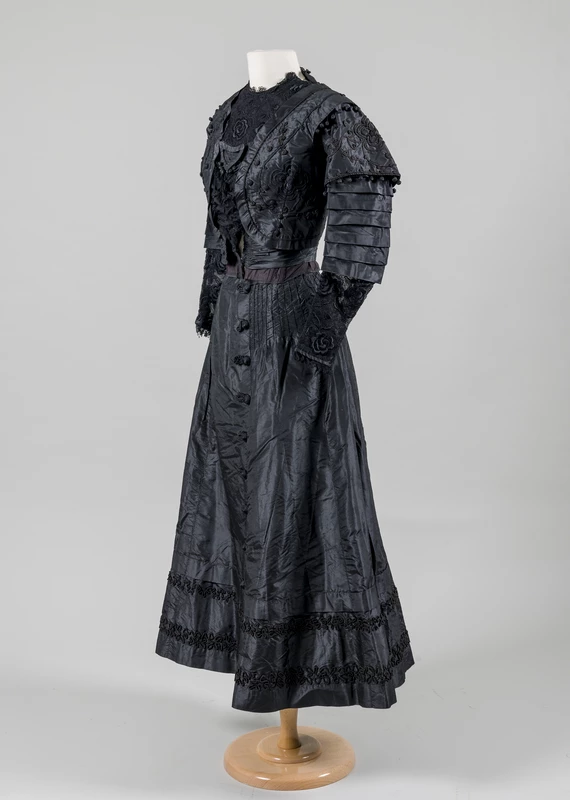
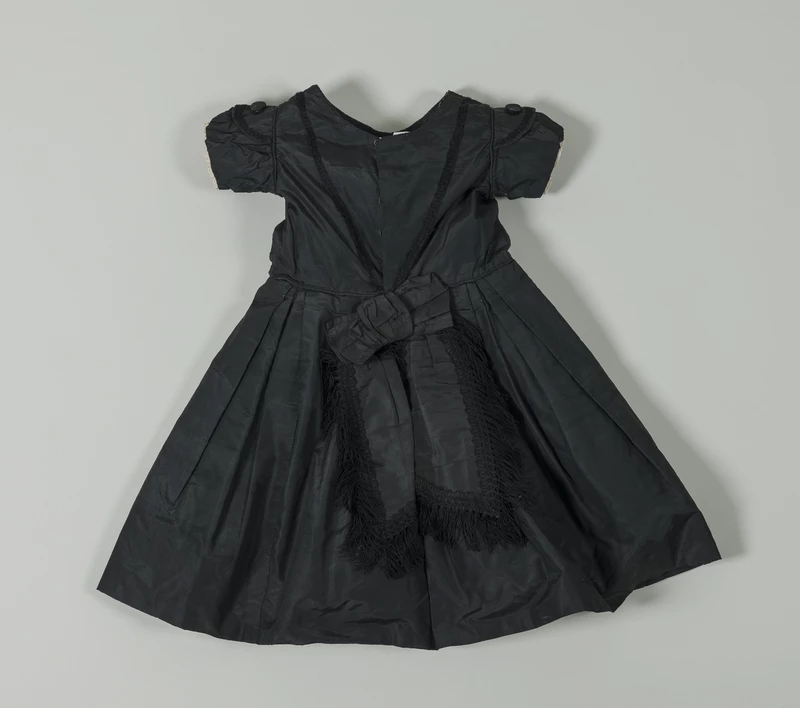
After the death of a close family member or friend it has been a tradition for centuries in many parts of the western world to wear black for varying periods of time, to communicate that they have suffered a loss. However, during the Victorian period, Mourning and all the social conventions that went with it, were at their peak. This was for several reasons but the high death rate, rise of the middle classes and the wider availability of reliable Black clothing dyes contributed heavily to its popularity. Queen Victoria herself, was the poster girl for Mourning, famously remaining in mourning and seclusion for many years after her husband, Prince Albert's death.
Mourning conventions varied and were dependent on class, location, religion and relationship to the deceased. For example, an upper class widow could stay in Mourning clothing for several years whereas a working class widow who had not the means for Mourning wear may show no outward grieving at all. The Mourning period also limited which social occasions the Mourner could attend. Dancing and other frivolities were a no go. Those who disregarded the expected conventions could become social outcasts.
In October 2021 following a talk on cross-dressing in history by Norena Shopland, a Welsh language ballad, Can Newydd, came to light in the Welsh Music Archive (WMA), National Library Wales. More can be read on that story in A Queer Bawdy Ballad. What is striking is the explicitly sexual nature of the ballad, depicting cross-dressing women having sexual relations with women.
Archifdy Ceredigion Archives (ACA) and Archives and Special Collections, Bangor University (BU) have exact copies in their collections but in February 2022 a third copy was located at Amgueddfa Cymru — National Museum Wales (ACNMW) however this version is simply entitled Can and has a few differences. Mair Jones who did the first translation of Can Newydd, also did the translation for Can.
The lyrics of both versions were written by a rather eccentric part-time criminal, one-eyed balladeer Abel Jones, ‘the last of the “great” balladists’ but who was often known by his bardic name Bardd Crwst after his birthplace, Llanrwst. Jones was a balladeer who travelled and performed at fairs across Wales, selling his ballads as ‘new songs’ (can newydd) on specific topics, such as the death of the Emperor of Russia, industrial accidents and disaster, tithe war and murders - though not always historically accurate, because his main aim was to sell his ballads. Sometimes he sold them with his son, and usually it was to people like the agricultural working-class community. He was the most well-known and popular balladeer of his time, though he died in Llanrwst Workhouse.
Dating the ballad is difficult although dates of between 1865-1872 have been suggested (see A Queer Bawdy Ballad for more details) and there is nothing in Can to suggest whether it comes before or after Can Newydd. However, all three versions of Can Newydd are signed Bardd Crwst while the ACNMW version is signed Abel Jones, (Bardd Crwst) and there may be a reason for this.
Jones wrote a number of humorous ballads, often using the tune Robin yn Swil (Robin is Shy), the same as for Can Newydd, a tune ‘more suitable for the tavern than for singing at respectable concerts and eisteddfodau.’ One of his ballads is listed as a poem about ‘courtship’, another was about Dic Sion Dafydd, and another about a drunken woman, while his other ‘courtship’ poems were advice not to marry or a man’s complaints about his wife.
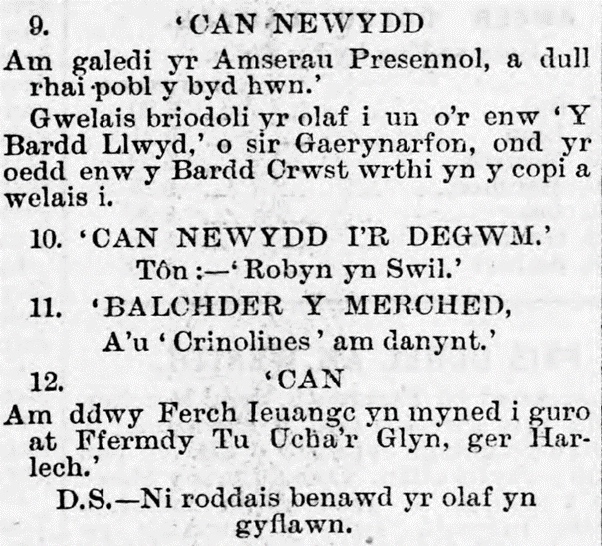
One mention of Can Newydd in a newspaper of 1915, when discussing Bardd Crwst’s works, as ‘Song about two Young Women who went to knock at Ffermdy (Farmhouse) Tu Ucha’r Glyn, near Harlech’, has an added note by the compiler, ‘I didn’t give the title of the last one in full’ which seems to show that this would have been too disrespectful even for the newspaper, including leaving out the cross-dressing aspect.
The risqué nature, not only of the lyrics, but of the tune it was associated with may have caused Jones to remove his full name from the Can Newydd version. No tune is associated with the ACNMW version so there may be the possibility that Can came first and Jones made it saucier in the second version but decided to omit his full name. Can also uses some English words, such as ‘beauty,’ ‘Kate Pugh,’ ‘Visles’ and ‘Cirnoleens [sp],’ while Can Newydd uses Welsh spellings such as ‘biwty,’ ‘Cit Pugh’ and ‘busle,’ and has removed the spelling error of ‘crinoline’.
Another difference is the location where the event takes place. The introduction to Can is "A song about two young women who dressed themselves in men’s clothes and went to knock at Ffarmdy (Farmhouse) at two other young girls, and entered their House, to bed like two men and two dear lovers" whereas in Can Newydd it is "The tale of two young women from this region who dressed themselves in men’s clothes, and went courting to a country house to seduce two young women, who were strangers to them".
The farmhouse has disappeared and is replaced by ‘Plas uchaf and Glyn’. Plas Uchaf (Upper Hall) is 1.5 miles (2.4 km) from Corwen, Denbighshire, and Plas Glyn, possibly short for Plas Glynllifon 56 miles (90km) from Corwen. It seems Jones has moved the location from an obscure working-class farmhouse to named gentrified houses, although no cross-dressing reference has been found in connection with these two properties. It is however, a trope used even today, to place sensational stories among the wealthy who are fewer in number and have more time on their hands, than working-class people and Jones may not have wanted to offend his main audience.
Whatever the purpose of the ballad, it was decided to revive it for a presentation at an LGBTQ+ History Month 2022 by Aberration recorded by Cerys Hafana with backing vocals by the community.
By sharing this queer-related ballad today as a part of our Welsh history, it is reclaimed by the LGBTQ+ community, creatively reimagined and helps to build our Welsh queer community today.
Arthur is a model of the biggest invertebrate that has ever lived on land, a millipede-like creature called Arthropleura.
Where did Arthur the Arthropleura come from?
The model was originally on display in Kew Garden’s Evolution House but when the space was dismantled in preparation for the HLF funded restoration of the Temperate House, it was no longer needed and Kew kindly donated it to Amgueddfa Cymru – National Museum Wales.
The Arthropleura model was in need of some substantial conservation work when it arrived at Amgueddfa Cymru – National Museum Wales.
It had been on open display for many years in a glass house alongside living plants and was damaged and rusty.
The humid display environment had caused the surface paint to flake away and several spiders and snails had taken up residence on the underside of the model!
Arthur the Arthropleura before conservation
The first job was to give the model a good wash with hot soapy water and remove the dirt and cobwebs!
Arthur the Arthropleura has a bath
Then all the flaking paint was scrubbed off, the damaged areas on the legs and head were rebuilt with an epoxy putty and the surface textures recreated.
The nuts and bolts of the removable antennae had rusted together, so the metal parts were replaced with new stainless steel threaded rods.
Once the repairs were complete the model was carefully painted with acrylics and then coated in a durable varnish, making it once again suitable for public display.
Arthur the Arthropleura after conservation
Who named the Arthropleura - Arthur?
Some of the Natural Sciences staff had become rather attached to the impressive 1.5m long millipede model whilst it underwent conservation work in the lab and named it Arthur the Arthropleura.
We have also had fun with Arthur; he has “escaped” and been on the run around the museum galleries!
Arthur the Arthropleura is now a social media star and is a really wonderful addition to our collections!
What did Arthropleura look like?
Arthropleura looked a lot like millipedes do today. It had a long, narrow body made up of lots of segments, and its back was covered in hard plates.
On the underside of the body, there were lots of pairs of jointed legs, around 8 pairs for every six body segments, which is similar to the number of legs modern millipedes have.
Recently, palaeontologists realised that what they had previously thought was the head of Arthropleura, is actually just the front segment of its body. The head was tucked underneath this segment, just like it is in millipedes today. So our model Arthur is a bit out-of-date, and he shouldn’t be looking straight ahead quite as much as he does.
How big was Arthropleura?
There are two types of evidence that tell us how big Arthropleura was. Fossils of the animal’s body, or parts of it, have been found in Germany, Belgium, France, the Czech Republic, and the U.K., but these are relatively rare. More common are fossils of the long trackways made by the many feet of the Arthropleura as it scuttled over damp ground. Its fossilised footprints are known from the USA, Canada, Germany, France and Scotland. Measuring the trackways tells us how wide the animals that made them must have been, and we can calculate from that how long the animals likely were.
Arthur the Arthropleura next to a fox for size
Some places have several trackways in different sizes, showing that different sized (and probably aged) Arthropleuras were moving around in that area. The widest trackway known is 50cm wide, and the biggest Arthropleura is estimated to have been over 2m long.
Where did Arthropleura like tolive?
Arthropleura fossils and trackways have been found in various locations that would have been fairly close to the equator 300 million years ago, including modern-day North America and the U.K.
Many of the first fossils were found in roof shales overlying coal seams, so it was thought for a long time that the giant creepy-crawlies just lived in humid coal swamps. Since then, evidence of Arthropleura has been found from a wider range of environments, including footprints walking along drier river banks.
It appears that they felt at home in a variety of landscapes with some vegetation cover.
Would Arthopleura have eaten me?
We can’t be certain what Arthropleura liked to eat, because its mouthparts have never been found in any fossils. However, if it did have tough, strong jaws for biting prey with, they would probably have survived and become fossilised. That may be circular reasoning, but there are other reasons why we think it probably ate plants rather than meat.
An Arthropleura fossil was found in Scotland in 1967, which had the remains of plants called giant clubmosses in the area where its gut would have been. It’s possible that the fossils were just preserved together by accident, so we can’t be certain the plants were actually Arthropleura’s last meal.
However, if its diet was similar to that of modern-day millipedes, it is likely to have lived on plant remains, seeds and spores.
Which other animals did Arthropleura share its home with?
If you looked around at the animals that shared Arthropleura’s world, you would see a very different view of life from today. There were no birds or mammals, because they hadn’t evolved yet. Scout around for our nearest relative, and you would eventually spy, lurking in the water, a large, squat amphibian called Eryops.
Animals with backbones were yet to gain a dominant foothold on dry land. Instead, creepy-crawlies accounted for most of the life you would have seen around you. There were large cockroaches (up to 9cm long) scuttling around, and spider-like creatures that would fill the palm of your hand. These weren't exactly like modern spiders - their fat bodies were divided up into segments rather than consisting of a single rounded piece, and they hadn't yet evolved the ability to spin webs - but they were well on their way to becoming the arachnids we see today.
fossil of a primitive spider-like creature (Maiocercus celticus)
The air would have been filled with a distinct hum from the most awesome animals around – huge dragonfly-like insects called griffinflies, whose wingspans could exceed 70cm. Griffinflies were among the top predators of their day, and were some of the first creatures on Earth ever to fly, around 150 million years before the first birds took to the wing. Even our amphibian kin Eryops had to share its home with arthropods; horseshoe crabs that also liked to divide their time between dry land and water.
Why don’t we get such huge invertebrates on land today?
The Carboniferous Period, around 300 million years ago, was undoubtedly the era of huge invertebrates.
At that time, giant Arthopleura, the biggest creepy-crawly that has ever lived on land, was joined by large cockroaches, arachnids and dragonfly-like insects. How was that possible, and why don't we see invertebrates as big as Arthur today?
Our atmosphere has around 21% oxygen. The evidence suggests that 300 million years ago, oxygen levels approached 35%. That would have made a huge difference to the amount of energy that insects and other arthropods could generate.
Insects and millipedes don't have lungs to actively breathe in air like we do. Instead, their exoskeletons have lots of tiny tubes passing through them called spiracles. Oxygen diffuses in through the tubes from the outside into a blood-filled cavity, from where it gets distributed around the animal's body, fuelling everything it does. More oxygen available meant more fuel, which enabled creepy-crawlies to grow bigger, and which would have been especially important in generating enough energy to get large flying insects off the ground. Such giants could not get airborne under today's atmospheric conditions.
Arthur in one of his natural habitats, the coal swamp in our Evolution of Wales gallery
Oxygen levels aside, there are mechanical limitations to having an exoskeleton, which make it unlikely that such large invertebrates could exist today.
In order to grow bigger, all arthropods need to moult off their old exoskeleton and grow a new larger one. There is a period of time after moulting when the new exoskeleton is soft, and the arthropod must wait for it to harden before it can carry on with its normal life. Not only is this a dangerous time when the animal is vulnerable to predators, but it places a limit on size – if the exoskeleton becomes too big and heavy, it risks collapsing under its own weight.
That is one reason why the largest arthropods today live in the ocean, where the water helps to support their weight. There is also a limit on how big creepy-crawly legs can get, as the bigger they get, the thicker the cuticle they're made of becomes. They can only get to a certain size before the thick cuticle doesn't leave enough room inside for the muscles needed to operate the legs.
Another factor allowing Arthur and others to grow so huge may have been the lack of large vertebrate predators. For a variety of reasons, it just isn't possible for such giant creepy-crawlies to exist today.
Lucy McCobb, Caroline Buttler & Annette Townsend
Glossary:
Arthropod – an invertebrate animal with a hard exoskeleton and jointed limbs.
Invertebrate – an animal without a backbone.
Exoskeleton – a tough outer skin, which provides support and protection to animals without an internal skeleton.
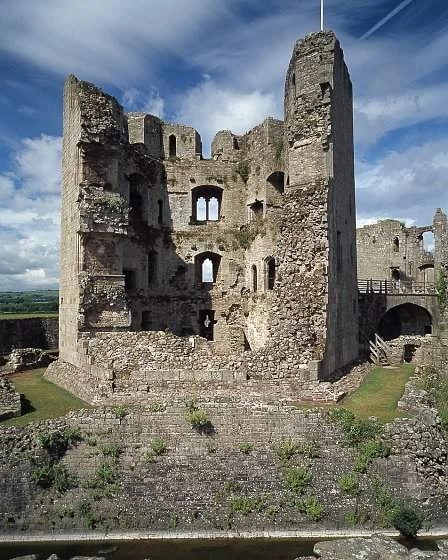
Raglan Castle is one of the finest late medieval buildings in the British Isles and, although now ruined, it remains a striking presence in the landscape of south-east Wales.
Where is Raglan Castle?
Raglan Castle is located just north of the village of Raglan in the county of Monmouthshire, off the A40 between Monmouth and Abergavenny. For details on how to visit, see Cadw’s webpage.
The hexagonal Great Tower is the most impressive of the buildings from this period, dominating the two courtyards of the castle.
The Great Tower. An impressive self-contained fortress-cum-residence which lies outside the circuit of the castle's curtain walls. Image: Cadw (Crown copyright).
The castle as it stands today was built in three main phases.
The first phase of building in the fifteenth century included the hexagonal, five-storey Great Tower, which was surrounded by a moat and, when it was originally built, could only be accessed from inside the castle via a drawbridge.
The second phase, built by Sir William Herbert, the first Earl of Pembroke, added sumptuous apartments. Finally, the castle was transformed into a mansion by the Earls of Worcester in the 16th century.
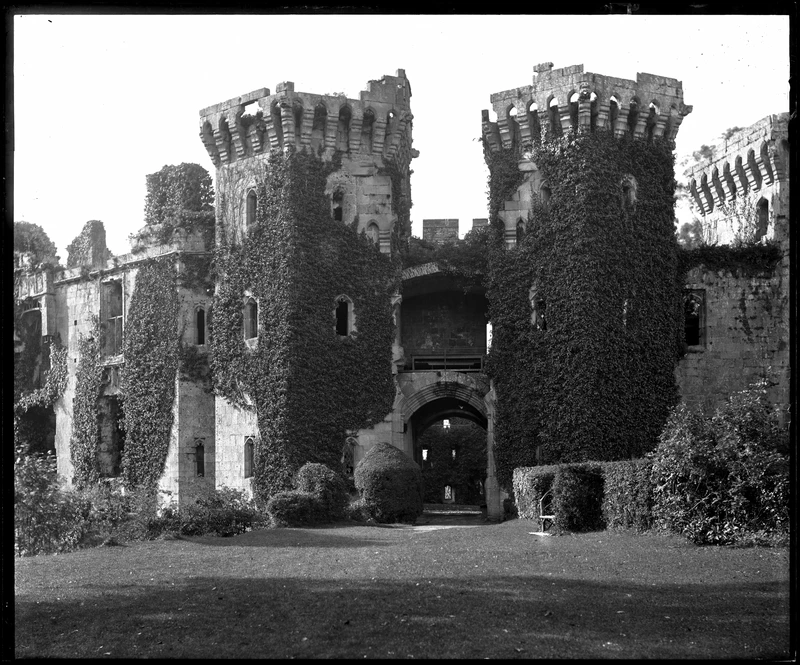
The Great Gatehouse, Raglan. Built between 1460 and 1469 the gatehouse was designed to impress and intimidate visitors with its arrays of gun loops, machicolations, portcullises and doors. Image: Cadw (Crown copyright).
Who built Raglan Castle?
There is some controversy over who built the first phase of the castle; it was built either by William Herbert, the first Earl of Pembroke, or his father, William ap Thomas, who had purchased Raglan in 1432.
William Herbert was a key figure in the politics of the late 15th century. During the Wars of the Roses he supported Edward IV.
The reward for his loyalty was considerable, providing him with the title Earl of Pembroke, and sufficient resources to convert Raglan into a palace-fortress.
Earl William's success was, however, to be short-lived. In 1469 he was captured by Lancastrian supporters at the Battle of Edgecote and put to death.
The Herberts retained control of Raglan until 1492 when it passed to the Somerset family. William Somerset, the third Earl of Worcester (1526–1589), was the first of his family to significantly alter the castle's buildings.
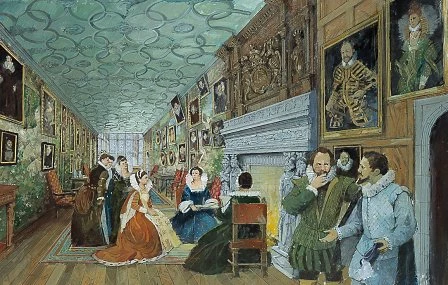
Reconstruction of Raglan Castle, about 1620, showing the formal gardens that existed in the castle's heyday. Image: Cadw (Crown copyright).
He focused his efforts on upgrading the quality of the hall and service ranges to meet the social expectations of his time. He also established the gardens, including a series of walled terraces, an artificial lake, a fountain, flower beds and herb gardens.
The Herberts retained control of Raglan until 1492, when it passed to the Somerset family. William Somerset, the third Earl of Worcester (1526–1589), was the first of his family to significantly alter the castle's buildings.
The third Earl focused his efforts on upgrading the quality of the hall and service ranges to meet the social expectations of his time. He also established the gardens, including a series of walled terraces, an artificial lake, a fountain, flower beds and herb gardens.
Reconstruction of life at Raglan Castle in the 16th century, at the time of the Third Earl of Worcester. Image: Cadw (Crown copyright).
What happened to Raglan Castle?
By the middle of the 17th century, Raglan's fortunes were at their peak. It had achieved a level of sophistication and opulence that only the greatest country houses could match. However, the English Civil War was to change all this.
In 1642, the fifth Earl of Worcester declared his support for the Royalist cause, offering considerable financial support to King Charles I. This was to make Raglan a target for Parliamentarian forces, which subsequently besieged the castle in June 1646. Its defenders held out during the summer, but by mid-August the Parliamentarians had moved their siege works to within sixty yards of the castle. Its defenders surrendered on 19 August.
After it was captured, the castle was deliberately made useless for defensive purposes, a process known as ‘slighting’. This is when the gigantic hole was torn through the Great Tower.
In the years that followed Raglan was abandoned and left to decay, becoming a convenient source of building material and a picturesque tourist attraction. Today this decay has been halted and the building conserved through the work of Cadw and its predecessors.
Raglan Castle is still owned by the Somerset family, who became Dukes of Beaufort in 1682. In 1938 it was put in the care of the Ministry of Works, and it is now looked after by Cadw.
Which films have used Raglan Castle as a backdrop?
Raglan Castle appeared in Terry Gilliam’s film Time Bandits (1981), where it stood in for an Italian castle under siege in the Napoleonic Wars.
Background reading
Raglan Castle by J. R. Kenyon. Published by Cadw (2003).
Meredith Hood - PhD student Zooarchaeology, 22 March 2022
What is my project about?
Hello! I’m Meredith, a PhD student working at Cardiff University and Amgueddfa Cymru. I am a zooarchaeologist, which means I study animal remains from archaeological sites to find out more about the relationship between humans and animals in the past. So, Lambcam seemed like a great opportunity to share a little bit about my project, and how we can learn about sheep farming in the past!
For my project, I am studying the animal bones from the site of Llanbedrgoch on Anglesey. This was an early medieval settlement, occupied from the 5th to 11th centuries AD. Archaeologists recovered over 50,000 pieces of animal bone from Llanbedrgoch, which will provide a really valuable insight into farming practices and diet at this time. You can read about my research in a little more detail here.
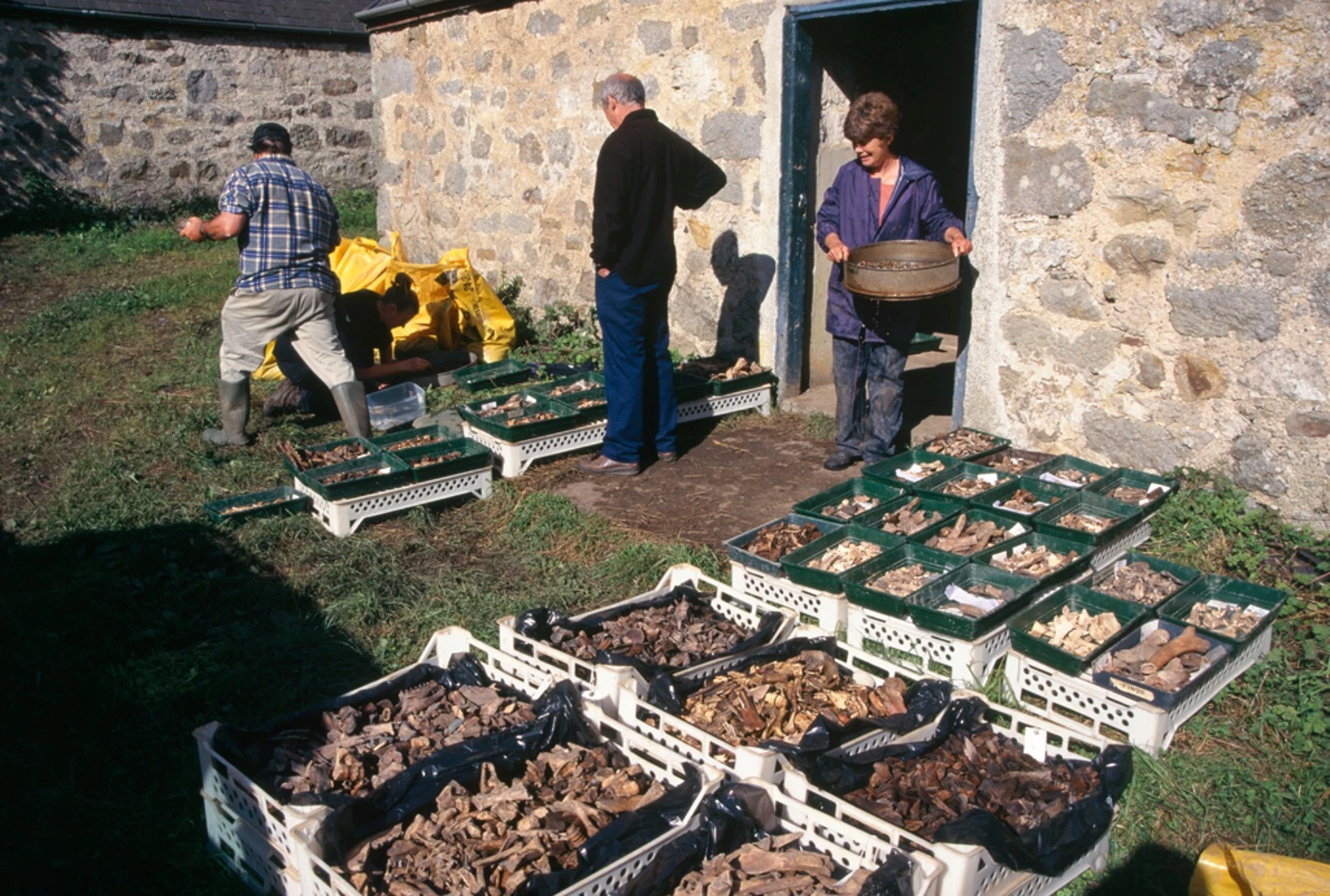
I am currently recording all the bones into a database and trying to identify what animals they came from. This can be tricky, particularly when the bones are very broken. Sheep bones can also be an extra challenge to identify as they look extremely similar to goat bones!
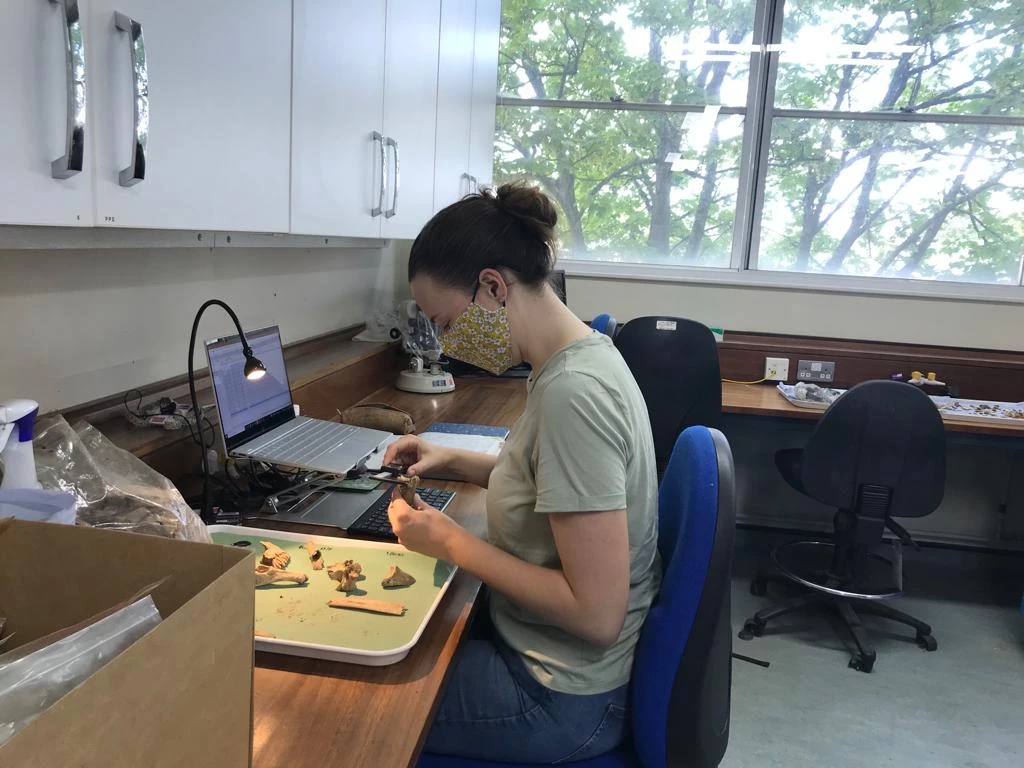
Recording animal bones in the bioarchaeology laboratory at Cardiff University. (Photo: Meredith Hood)
How can we find about sheep farming in the past?
Sheep remains can tell us lots of information about how sheep were farmed and used in the past. For example, we can estimate the age at which a sheep died by looking at how worn their teeth are, or whether their bones have fused. Sheep that were kept for a long time as adults may have been used for their wool or milk.
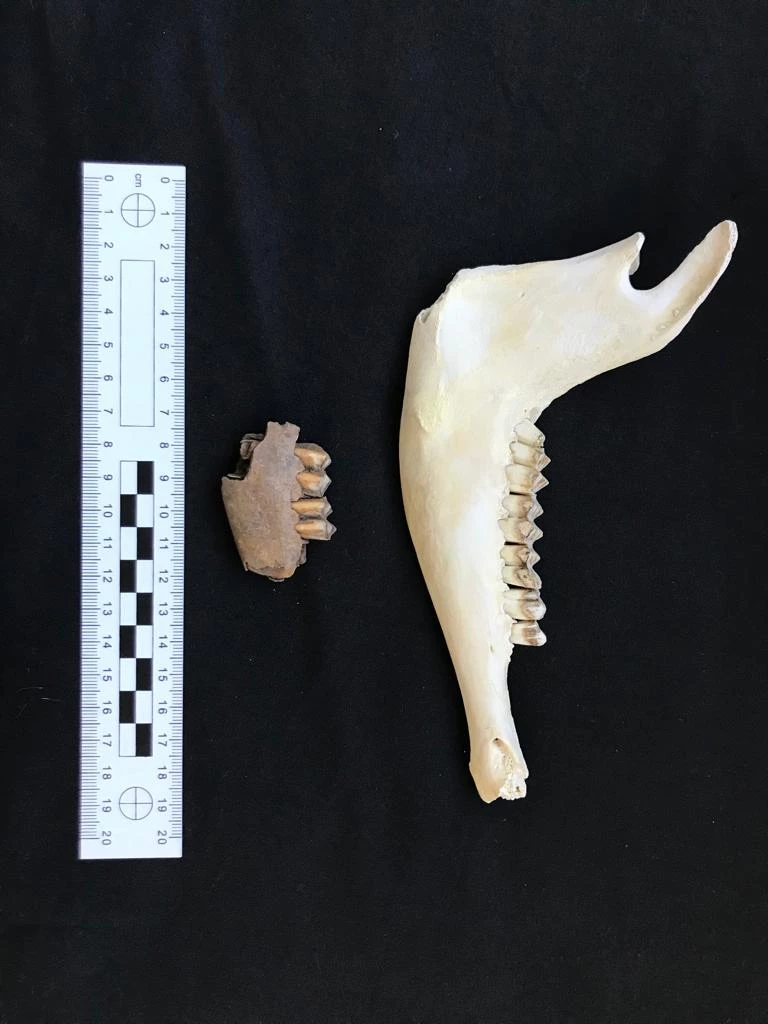
A modern sheep mandible/jawbone (top) compared to an early medieval fragment of a sheep jawbone from Llanbedrgoch, Anglesey (bottom) (Photo: Meredith Hood)
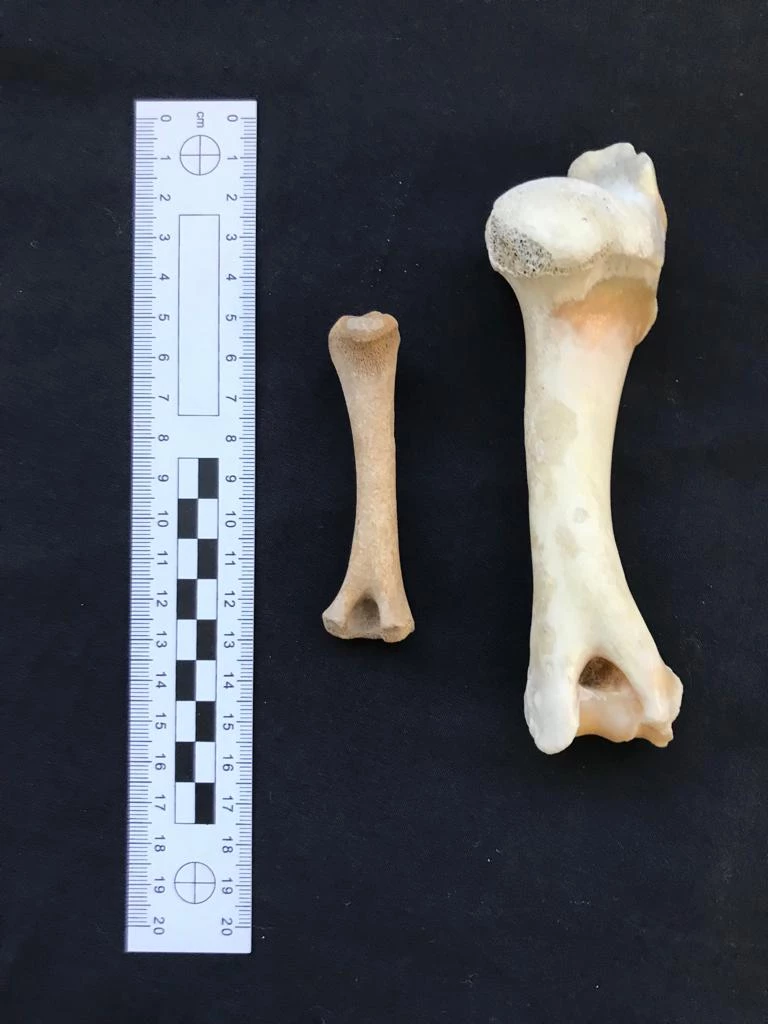
Two sheep humeri (upper arm) bones. The bone on the left is from a juvenile, and the bone on the right is from an adult. (Photo: Meredith Hood)
We can also look for things such as butchery or burning marks on bones which might tell us that lamb or mutton was eaten. Certain body parts, like the pelvis, can tell us the sex of the sheep, which can suggest whether breeding might have taken place on a site.
Part of a sheep metatarsal showing black burning marks. (Photo: Meredith Hood)
What do we know about sheep farming in early medieval Wales?
Unfortunately, animal bones from early medieval Wales haven’t survived very well in the soil. But from archaeological sites where they have survived, it appears that sheep were predominantly being kept for their secondary products like wool and milk.
Historical texts can also give us some clues. Law texts surviving from the 13th century which have been attributed to Hywel Dda (a 10th century king) describe, for example, how much sheep were worth (‘One Penny is the worth of a lamb whilst it shall be sucking’1) and that ‘fat’ sheep should be given to the king as render payments.
The large number of bones from Llanbedrgoch is really exciting and should provide us with more information about early medieval Welsh sheep farming, so watch this space!
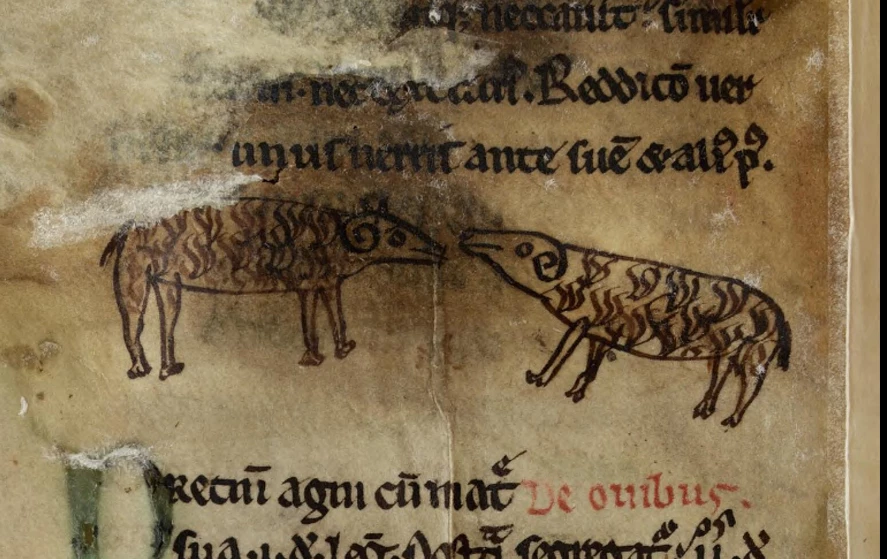
Illustration of sheep from the Laws of Hywel Dda, mid-thirteenth century. From: Peniarth MS 28 f. 25 v. (Image: Llyfrgell Genedlaethol Cymru – The National Library of Wales, Public Domain)
[1] Owen, A. (1841). Ancient Laws and Institutes of Wales. London, p.715
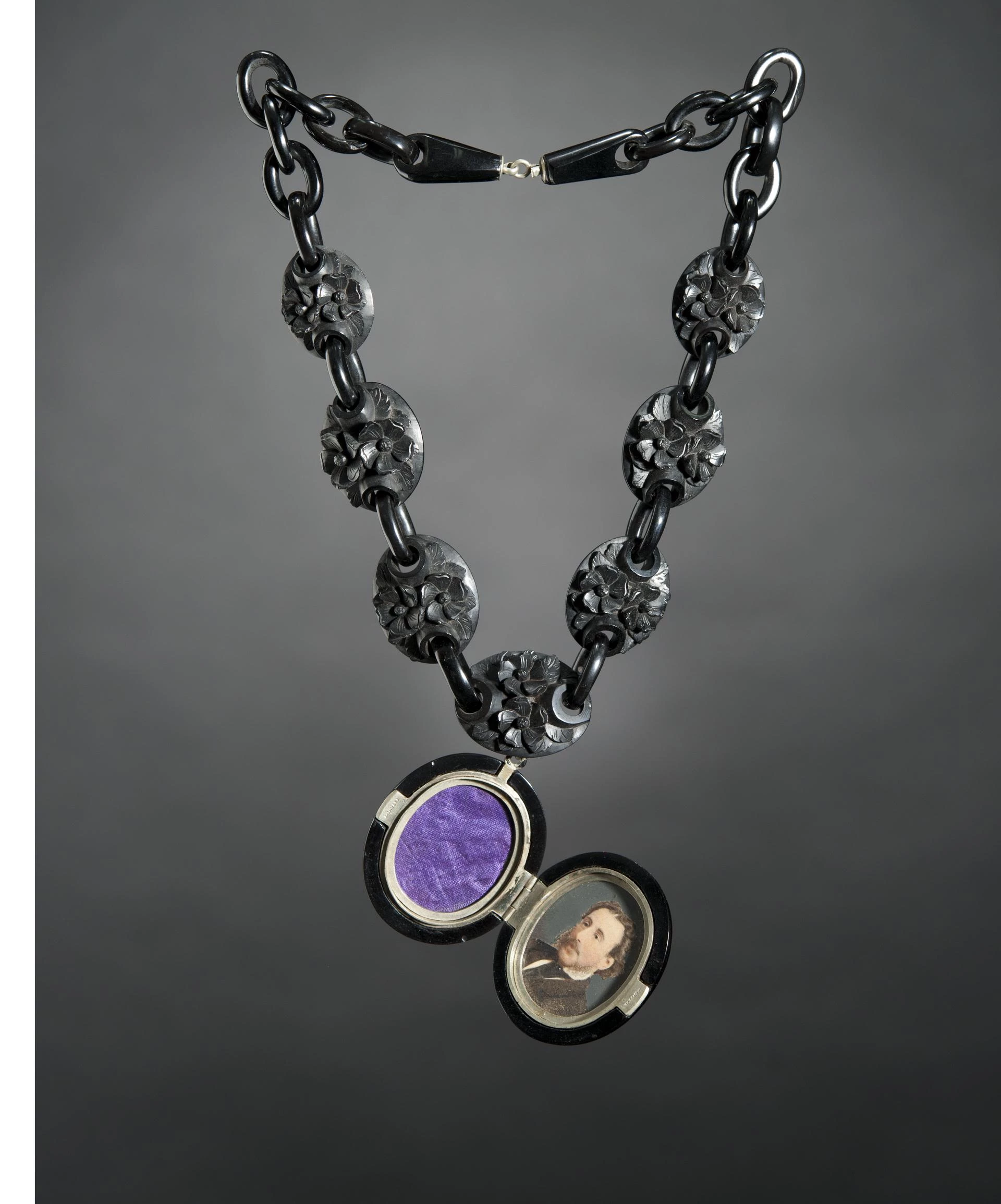
‘Hair is a symbol of life because it does not decompose after death. Mourners often wore jewelry made from their loved ones' hair as a continual reminder of their lives together.’
Ballad MS 1736/5
Ballad MS 1736/5
The Great Tower. An impressive self-contained fortress-cum-residence which lies outside the circuit of the castle's curtain walls. Image: Cadw (Crown copyright).
The Great Gatehouse, Raglan. Built between 1460 and 1469 the gatehouse was designed to impress and intimidate visitors with its arrays of gun loops, machicolations, portcullises and doors. Image: Cadw (Crown copyright).
Reconstruction of Raglan Castle, about 1620, showing the formal gardens that existed in the castle's heyday. Image: Cadw (Crown copyright).
Reconstruction of life at Raglan Castle in the 16th century, at the time of the Third Earl of Worcester. Image: Cadw (Crown copyright).
Recording animal bones in the bioarchaeology laboratory at Cardiff University. (Photo: Meredith Hood)
A modern sheep mandible/jawbone (top) compared to an early medieval fragment of a sheep jawbone from Llanbedrgoch, Anglesey (bottom) (Photo: Meredith Hood)
Two sheep humeri (upper arm) bones. The bone on the left is from a juvenile, and the bone on the right is from an adult. (Photo: Meredith Hood)
Part of a sheep metatarsal showing black burning marks. (Photo: Meredith Hood)
Illustration of sheep from the Laws of Hywel Dda, mid-thirteenth century. From: Peniarth MS 28 f. 25 v. (Image: Llyfrgell Genedlaethol Cymru – The National Library of Wales, Public Domain)