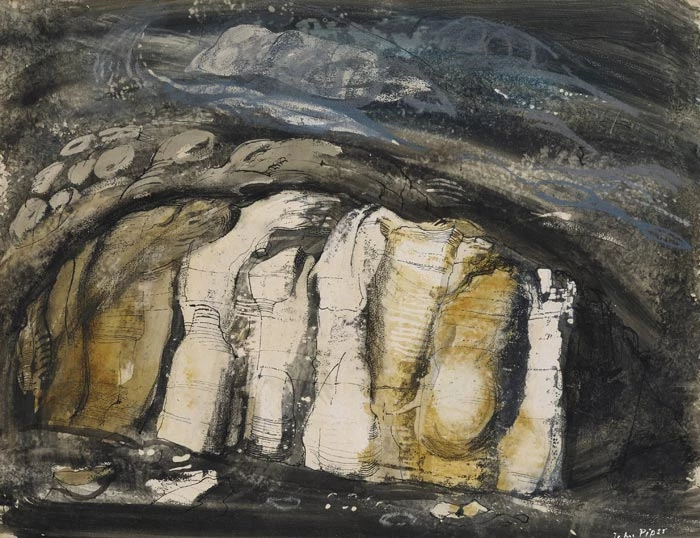
From around 1943 to 1950 John Piper undertook an intense artistic journey through the mountains of north Wales, conveying a passion and vision like none other seen before. There is an exuberance and brilliancy to the tones and hues, as well as sheer drama in each of the pictures.
One of the most versatile British artists of the twentieth century, John Piper's work encompasses portraiture, landscape, architectural studies, still life, ceramics and designs for theatre, stained glass and tapestry. Piper's interest in landscape and architecture extended to all areas of Britain, however his first significant encounter with North Wales came when he was working as an official war artist during the Second World War.
Manod Mawr Quarry: storehouse for priceless objects during the Blitz
In 1943 the War Artists Advisory Committee commissioned Piper to record the interior of Manod Mawr quarry. At the time it housed artworks from the National Gallery and the Royal Collection to protect them from bombing during the Blitz.
The dark conditions of the quarry were not suitable for painting or drawing and so the commission was abandoned. It did, however, provide the opportunity for Piper to explore North Wales. This sparked an intense period of recording the mountains of Wales.
Inspiration from Turner and Wilson
During the period Piper spent in North Wales, he often referred to the guidebooks and early geological texts of the eighteenth and nineteenth centuries as he travelled around the area recording the mountains. Not only did he admire their engraved illustrations, but they also provided a link to the artists of the period most admired by Piper, Richard Wilson (1714-1782) and J.M.W. Turner (1775-1851).
Church architecture from West Wales
Piper's painting trips to Wales did not start with Snowdonia or North Wales, but Pembrokeshire and Cardiganshire in 1936. The following year, he produced Five Chapels, 1937. The chapels depicted are: Emmaus, Llanon, Red Roses, Rhydygwyn and Tyrhos. These five collages were produced with torn and cut papers drawn and assembled. It shows his early interest in church architecture. He took a particular interest in the simple though neo-classical architecture of non-conformist chapels in Wales.
Piper in North Wales
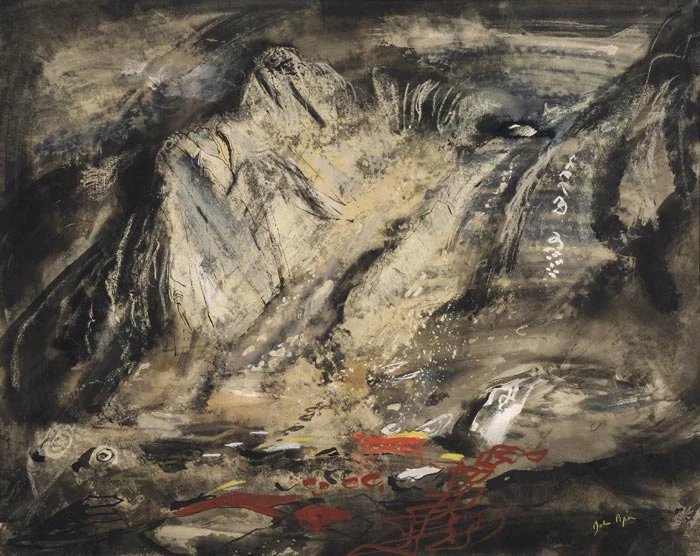
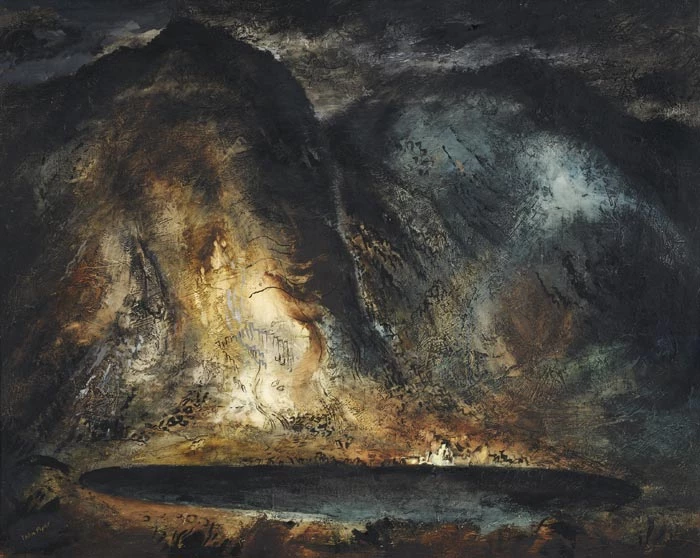
During the unsuccessful Manod Mawr commission, Piper began to explore north Wales and the locations painted by Wilson and Turner such as Cader Idris. This trip also brought him in close proximity to Aran Fawddwy, the subject of an impressive oil, The Rise of the Dovey, 1943-44. The title of this painting refers to Creiglyn Dovey, the lake in the foreground, which is the source of the River Dovey.
Turner painted a slightly different view of Aran Fawddwy in 1798 in a watercolour titled, A bridge over the Dyfi near Dinas Mawddwy, with Aran Fawddwy beyond (collection of the British Museum). The almost abstract nature, foreboding dark atmosphere and brilliant hues of light gold, yellow, blue and red in this work are very similar to Turner's style of painting. Upon the canvas is a layer of gesso, which has been painted on top of in oils. This gives the work this very rough texture, evoking a sense of the roughness of the rocks and the elements.
In 1945 John and his family rented a cottage named Pentre. There is a painting titled Nant Ffrancon Farm, 1950, which shows the house from the roadside. It is situated in the Nant Ffrancon valley, with a steep hill leading up behind the house. The property was sub-let to the Pipers for £35 a year. At the time there was a basic muddy track, rather than a concrete road, making the house almost inaccessible in bad winter weather conditions. Along with this, the house was at the foot of a steep hill, which caused the house to be flooded by heavy rain.