Wales for Africa sep-10

Came in this morning to a very interesting email from John, who's already in Zambia working with one of the Forum's member charities. The email said that someone in Lusaka had asked after me. Now, initially I had the usual moment of 'oh, wonder who that is' that most people from Wales - even more so from Bethesda - get all the time. Then of course remembered that the message is from Lusaka and to my knowledge there isn't anyone even from Bethesda there at the moment (though I could be wrong). Reading on, it was just that the Forum already have my name, and so John was very kindly passing on the message that I'm expected and they're looking forward to meeting me. How amazing, to make someone feel welcome and we're not even on the same continent yet!

I'm still waiting for the specific date when I start work there. Frustrating. Although, it is becoming more and more tangible, partly perhaps because I went for my first jabs this week. Typhoid in my left arm, as that's the one that will hurt most they breezily informed me while wielding the needle, and combined Hep A&B in the other. Not too painful at all at the time, it seemed to me. To be honest I was more concerned with how I looked as I left the surgery with the fluffy ball of cotton wool taped to each arm (ridiculous, is how I looked). However, woke next morning with shoulders and upper arms stiff as a board. Followed by very mild sniffles, probably because of the typhoid jab.

I've also been filling in a questionnaire in preparation for a coaching session next week. The support for the personal development aspect of the ILO scheme is really thorough. The questions included some highly sensible ones about objectives and commitments, as well as a couple I didn't entirely understand if I'm honest. But I know I'll get help and support, which is what matters really I suppose.

Algal Blooms

Green Seaweed <em>Ulva</em> species growing on the rocky shore at West Dale Bay, Pembrokeshire.

Green Seaweed Ulva species growing on the rocky shore at West Dale Bay, Pembrokeshire.

An algal bloom formed by phytoplankton off the west coast of Ireland.

An algal bloom formed by phytoplankton off the west coast of Ireland. It can be seen as a light blue band all along the left side of the image. © Nasa.

Preserved specimen of a Torgoch or Arctic Charr

Preserved specimen of a Torgoch or Arctic Charr (Salvelinus alpinus). Collected from Llyn Peris in 1978.

This is a Sea-Lettuce (<em>Ulva lactuca</em>) from Amgueddfa Cymru's scientific collection.

This is a Sea-Lettuce (Ulva lactuca) from Amgueddfa Cymru's scientific collection. We have around 5,000 algae specimens comprising macroalgae (seaweeds) and charophytes (stoneworts).

<em>Porphyra</em>, the seaweed used to make Laverbread
Porphyra

, the seaweed used to make Laverbread, is shown here growing on a rocky shore...

laverbread as a herbarium specimen in Amgueddfa Cymru

... and here as a herbarium specimen in Amgueddfa Cymru.

Algal blooms develop when algae or bacteria living in the sea or freshwater occur in vast numbers. Algal blooms can become big enough to be visible from space.

What are Algal Blooms?

This is when algae or bacteria living in the sea or freshwater occur in vast numbers. Algal blooms can become big enough to be visible from space. Many different kinds of algae and bacteria can form blooms. Two important groups are green seaweeds and blue-green bacteria (cyanobacteria).

Why do they occur?

Algal blooms occur when conditions are just right, usually where there are high nutrient levels, warm temperatures and slow water currents. Pollution from our homes, sewage plants, fertilisers and manure from farms can result in high nutrient levels in lakes and the sea.

If the global climate warms up, then so will water temperatures. This means algal blooms are likely to occur more frequently. They have already become more common around the UK in the last 30 years.

What are the effects?

As the algal bloom grows it blocks out light to plants in the water, which begin to die and decompose. Bacterial decomposition reduces oxygen levels in the water, which in turn causes marine animals to die.

As the bloom decomposes, the algae also release poisonous hydrogen sulphide gas.

Some algae and cyanobacteria also create toxins that can kill other wildlife in the water. In some cases these toxins can build up in shellfish such as cockles, making them poisonous for us to eat.

Can we prevent it from happening again?

Although algal blooms are natural phenomena, our activities can cause them to occur more frequently. Tighter controls on the use of fertilisers in farming and better treatment of waste water can help to reduce them. The only way to protect people from harm once an algal bloom has formed is to keep them away from the water. Wildlife cannot be protected that easily.

Seaweed Blooms

Sea-Lettuces (Ulva species) are green seaweeds that can form algal blooms. In summer 2009, vast blooms of green seaweed were reported in southern UK and northern France.

In this case it is not the seaweed itself but the hydrogen sulphide gas that is poisonous to humans on the beach. However, the only casualty reported in 2009 was an unfortunate horse, which broke through the crust on a deep pile of weed and was poisoned by the release of hydrogen sulphide.

Fortunately, Sea-Lettuces do not usually grow to such huge proportions. They are common on rocky shores around the UK and, as their name suggests, resemble thin, bright green lettuces.

Toxic Cyanobacteria

In the summer of 2009 a cyanobacteria (Anabaena spiroides) formed a potentially toxic algal bloom in Llyn Padarn, north Wales. This is one of only three lakes where the Torgoch, or Arctic Charr (Salvelinus alpinus), is found in Wales. The population of this rare fish was threatened by the lack of oxygen. There was also an impact on the local economy as people were prevented from visiting the lakeside.

What you can do

We can all help to reduce the chance of algal blooms this summer by using less washing liquids and powders in our homes. The phosphates in these products are washed down our drains and into lakes and the sea where they become nutrients for algae. They can form as much as 25% of the nutrients released in sewage. Look out for environmentally friendly products that contain less phosphate.

Did you know?

The Welsh dish known as Laverbread is made from a type of red seaweed. These seaweeds are called Porphyra, commonly known as laver. Porphyra seaweeds are also known as nori in Asia and are processed in a different way to make the seaweed into sheets used in sushi.

Seaweeds and the Museum

There are three main groups of seaweeds: green seaweeds, red seaweeds and brown seaweeds. The Sea-Lettuces that can cause problems in the UK and France are green seaweeds, and are placed in the genus Ulva by taxonomists.

Taxonomists are scientists that study the classification and evolution of organisms. At Amgueddfa Cymru our taxonomists study many different groups. To do this they use the Museum's extensive scientific collections of animals and plants. These collections provide an invaluable resource for accurate identification and a sound taxonomic foundation. At Amgueddfa Cymru we hold approximately 5,000 algae specimens, which are constantly being added to.

Seaweeds are included in a broad group known as the algae. Our oldest and perhaps the most important algae collection is that of Lewis Weston Dillwyn, who was an important figure in Welsh history. Many of the specimens he collected were from or near Swansea where he lived. The collection contains algae specimens that are 200 years old. They are part of the original material used by Dillwyn in the preparation of his pioneering 1809 work British Confervae.

This work, a rare copy of which is housed at Amgueddfa Cymru, contains beautiful colour drawings of algae and was a significant advance for algology. Before its publication, only 34 species of algae had been described; this rose to 177 described species after its publication.

UK Environment Agency: If you spot an algal bloom, report it on freephone 0800 80 70 60.

Under the layers of a seventeenth century painting

Seventeenth century oil painting on canvas

Seventeenth century oil painting on canvas

Cardiff landscape, 1678

This is one of the earliest images of Wales drawn 'on the spot' that the Museum has in its collections. Sketched by Francis Place in 1678 as two separate views, Amgueddfa Cymru has digitally scanned and stitched the two sketches together to reveal for the first time this unique view of Cardiff as seen in 1678.

Landmark descriptions:

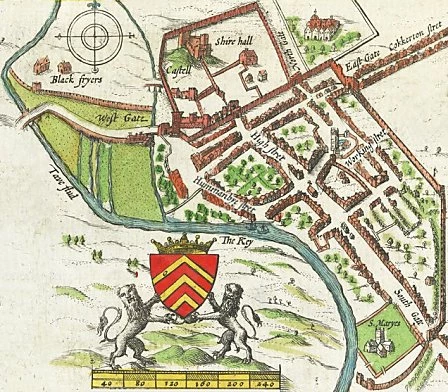
John Speed's map of 1610. Speed's plan of Cardiff reveals many aspects of the city's development, including the majority of features described in this article.

John Speed's map of 1610. Speed's plan of Cardiff reveals many aspects of the city's development, including the majority of features described in this article.

  1. Cardiff Castle

    In the 15th century the town was destroyed by Owain Glyndŵr's Welsh army. The Castle lay in ruin until Richard Beauchamp, Earl of Warwick, restored the defences and castle buildings in 1423. Beauchamp also constructed the octagonal tower, now known as Beauchamp's tower.
  2. St John's Church

    In the centre of Cardiff stands St John's church. Its earliest surviving stonework is mid 13th century and its tower was added around the 1470s, however, much of the church we see today was rebuilt during the 18th century.
  3. Walls of Cardiff castle

    During the medieval period, building plots were packed so tight against the old Roman wall, that some of the inhabitants were forced to extend their homes backwards through it.
  4. Beauchamp's Tower

    Built in the 15th century, to protect the castle's west gate. Openings at the top of the tower allowed stones or burning objects to be dropped on attackers (The unusual decorative spire we see today was not added until the 19th century).
  5. The quay

    The river Taff was a major influence on the shape of medieval Cardiff. Up until the 1840s, the river meandered slowly southward. By 1610, the river has reached Hummanbye [Womanby] Street
  6. Medieval Cardiff

    The medieval town spread out from the Castle's South Gate. Interestingly the High Street lines up with the Roman rather than the medieval South Gate, suggesting it dates from this earlier period.

    The Medieval town probably developed in two stages. The first stage was within a relatively small enclosure marked out by Working Street and Womanby (Hummanbye) Streets' both names are linked to old Norse. In the second stage of its development, Cardiff expanded south. The town was then enclosed and defended to the east by a bank and ditch and eventually a stone gate. To the west, the town was protected by the meandering river Taff.
  7. St Mary's Church

    At the southern end of the medieval town was St Mary's church. By 1610, the meandering river Taff had reached Hummanbye [Womanby] Street, and was beginning to disrupt the church of St Mary. By the early 19th century, the church has been completely destroyed, and today only the name of the church is left as a street name.

Wales for Africa (Aug-10)

I'm taking a huge step both personally and professionally and I'm off to Africa - Zambia, to be precise. This October and November I'll be in Lusaka, working with a forum of housing and land rights charities.

I'm one of about 15 (lucky) people from all over Wales going to Africa as part of the Assembly's International Learning Opportunities (ILO) scheme. The scheme provides development opportunites for managers from the Welsh public sector and helps Wales fulfill the UN's Millennium Development Goals as part of the Wales for Africa initiative.

At a presentation last week for people who went to Africa last year Carwyn Jones, the First Minister, talked about Wales's contribution to development in Africa. For instance Wales makes up about a quarter of all the UK's links with hospitals in Africa - we really punch above our weight when it comes to international development. I've felt many things since I found out I had a place on the scheme (excited, mostly anxious...) but listening to that speech I felt really proud.

More details will follow very soon.