Working Abroad - Welsh Emigration: Radicalism 19 September 2008 Breaker boys in Pennsylvania. Many Welsh boys in the USA began work in this way at an early age. Welsh industrial workers came from areas that had well organised unions. They had a reputation for standing up for their rights, safe working conditions and decent pay. When they left Wales to work abroad they took that reputation – and the fight – with them. John Owens emigrated from Clydach Vale to Ohio, USA, as a child in the 1890s. He lost a leg in an accident and occupied himself with union work. By the 1930s he was president of the United Mine Workers of America for Ohio. After World War Two he was International Secretary Treasurer of UMWA until 1970. Owens created the USA's first workers health and welfare system. Welsh radicalism has been blamed for the troubles of the British car manufacturing industry in the late 1970s, although most of the factories were located outside Wales. Many employees in the car factories of Oxford and Birmingham were Welsh. They had emigrated, looking for work as the traditional Welsh industries struggled in economic depression before and after World War Two. In America this reputation for militancy prejudiced some employers against Welsh workers. Mary Thomas (O'Neil) Born in the Ogmore valley in 1887, Thomas went to the USA in 1913 with her two children, searching for her miner husband who had abandoned her. Involved in the 'Ludlow Massacre' of striking miners in Colorado in 1914, she was the only woman arrested. She travelled across the country raising support for striking miners, even addressing the President.
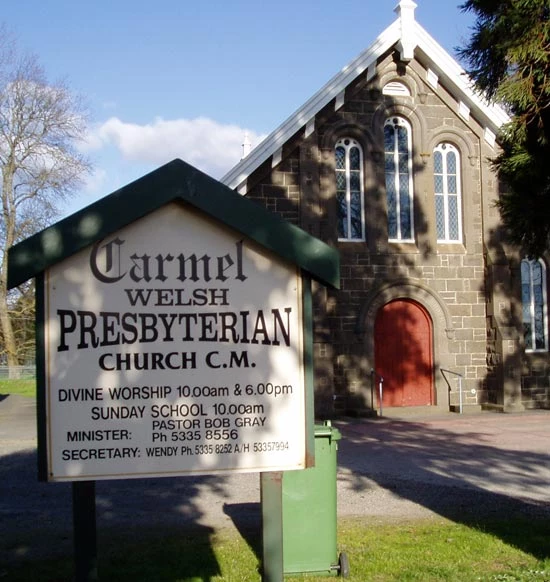
Working Abroad - Welsh Emigration: Welsh Culture 19 September 2008 Old Saron Church, the first Welsh church in Minnesota, 1856
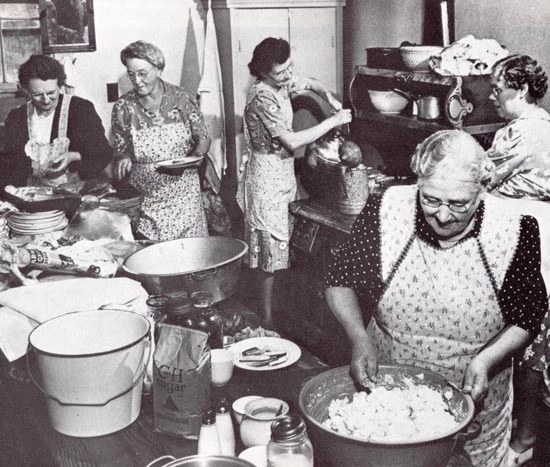
Working Abroad - Welsh Emigration: Women 19 September 2008 Preparing food for a Gymanfa Ganu (singing festival), Peniel Church, Pickett, Wisconsin,1946. The majority of industrial workers were men but women of course formed an important part of migrant communities. Often the men would travel ahead to a new country, to secure work and housing. They would then send for their wives and families to join them. The women had to support themselves and their children in the meantime and then make the long journey themselves. Women were very prominent in organizing community activities such as eisteddfodau, schooling and social reforms. Some women did work in industry. In Wales women were widely employed in tinplate works. In 1895 the Monongahela Tin Plate works in Pittsburgh, Pennsylvania employed a Welsh immigrant called Hattie Williams to train women for what was seen in America as men's work. This led to protests on both sides of the Atlantic. Women also played a part in other aspects of commercial life. In New Zealand, Mary Jane Innes (neé Lewis) of Llanvaches, Monmouthshire successfully ran her late husband's brewery business for many years.
Foreign workers in the Welsh coalfields 6 March 2008 Post War miner shortage Group of Slovenians at Oakdale Training Centre 1948. Following the Second World War, the demand for coal was high and generally rising. Post-war recovery and growth demanded cheap and abundant energy that could only come from coal. There was an urgent need to recruit more miners. One source for these was among the thousands of Europeans who had to flee their home countries during the War. Although Britain desperately needed these men they were not always welcomed with open arms and there was much resistance from local National Union of Mineworkers' lodges. There was more disquiet when the recruitment of Italians began in 1951, and things were no better when the National Coal Board tried to recruit among Hungarian refugees after the 1956 revolution. By this time another group had already entered the coal field. In 1954 the German mining engineering group, Thyssen UK, came to work in south Wales, bringing some of their own countrymen with them. As with today's immigrants, these 'foreign workers' faced much initial suspicion, which arose partly from ignorance and partly from the fear of unemployment among the local population. These young men came to Britain after years of hardship, danger and tragedy. "All Poles" Nyk Woszczycki (2nd from left) in a group celebrating his friend Joe Hughes's retirement from Britannia Colliery Many left the coal industry as soon as they could, many even left Britain, but the ones who stayed earned a lasting reputation for toughness and hard work. Even though they came from many countries they tend to be regarded as 'all Poles' by the Welsh miner. They married local girls and settled down; on their living room walls can often be found photographs of their children and grandchildren, who have been brought up as Welsh. Many of these have gained university degrees; some have won sporting honours for Wales. In spite of their pride in their original homelands, most now regard themselves as Welsh. In turn, Wales should be proud of them and the part they have played in her history. This article forms part of a magazine in the series 'Glo' produced by Big Pit National Coal Museum. Download the complete magazine here: