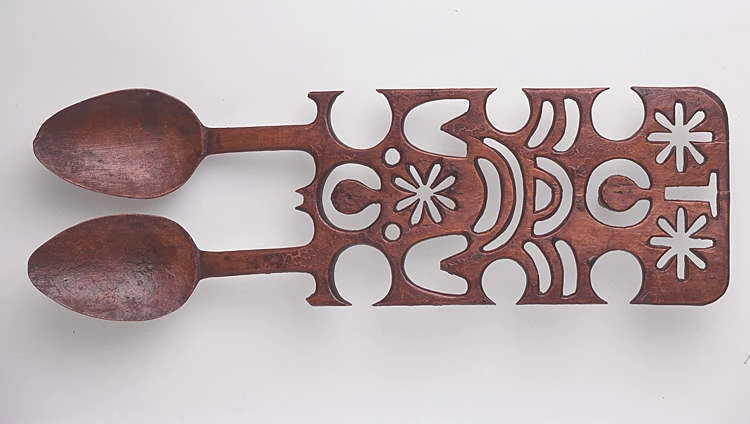
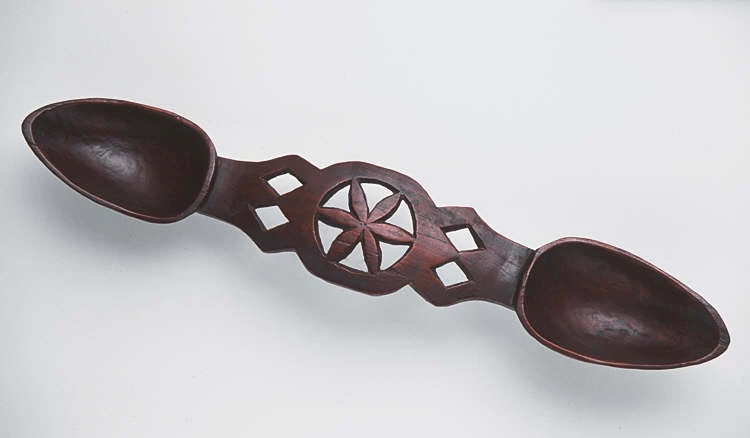
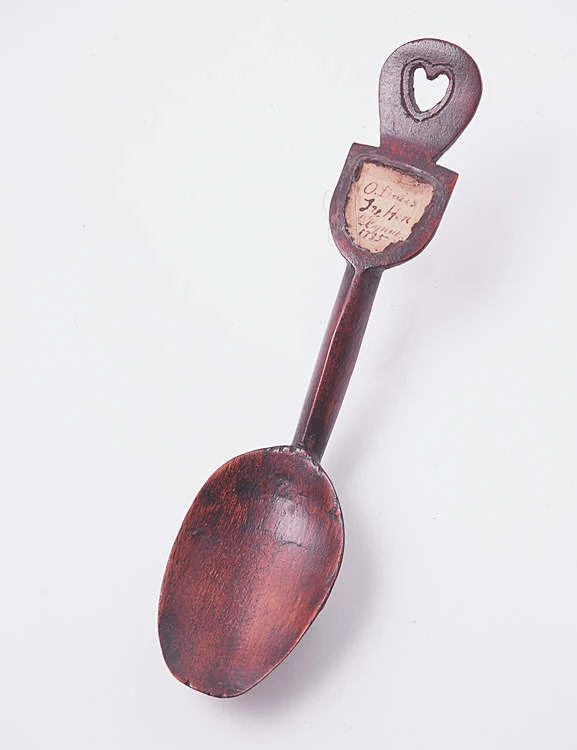
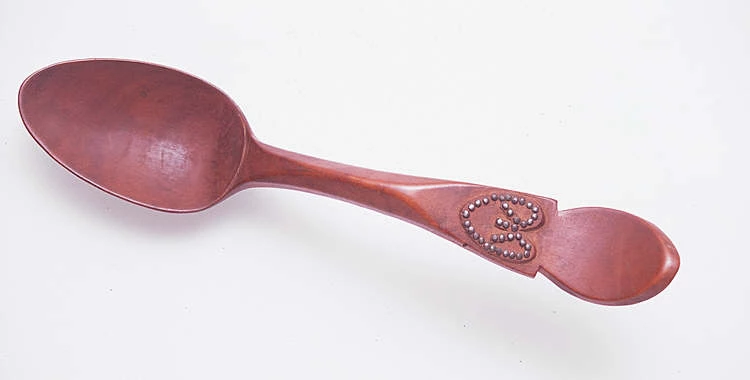
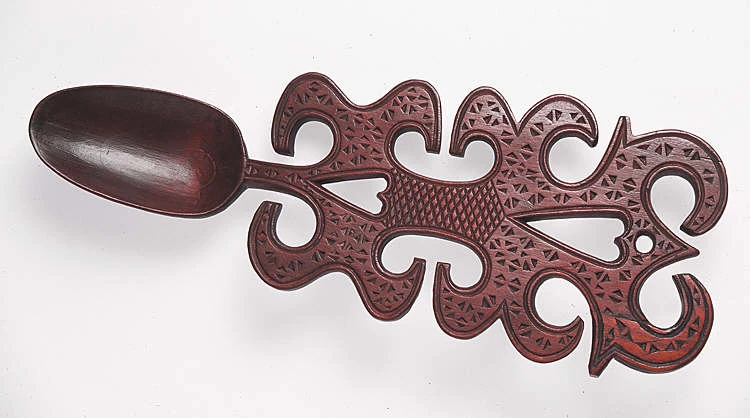
Although the exact origins of love spoon-making in Wales are unclear, we know that such spoons would have been shaped with great care and devotion by their carvers. Often carved during the long, dark winter months, when outdoor agricultural work slowed down, love spoons were given as a token of love and affection and each spoon was unique.
The lovespoon collection at Amgueddfa Cymru contains beautifully ornamented examples both historical and modern. It conveys the changing nature of the art through time and encompasses a wide variety of styles and designs all carefully handcrafted to the highest quality.
Presenting a decoratively carved spoon to a loved one as a token of affection has long been popular in Wales. From the Museum's oldest dated spoon of 1667 to contemporary examples by renowned present-day carvers, the calibre of the spoons is testimony to the makers' skill and devotion in creating objects intended to be treasured by their recipients.
Young men traditionally made a lovespoon from a single piece of wood, as a love token for their sweethearts.
Young men traditionally made a lovespoon from a single piece of wood, as a love token for their sweethearts.
Romantic gifts to maidens
Despite the lack of historical sources, it is generally believed that lovespoons were formerly crafted by male suitors and then presented as romantic gifts to the maidens they admired. The eighteenth- and nineteenth- century examples which form the basis of the Museums collection were driven by the emotion and passion of carvers who sought to produce works of art worthy of their beloveds.
The simplest of tools, such as small pocket knives, were traditionally used to to create the spoons, if possible, from a single piece of wood. Close-grain woods, such as sycamore, box and fruit woods were particularly popular.
Although the popularity of lovespoons has fluctuated over time, lovespoon carving has survived intact and continues thanks to a new breed of craftsmen determined to preserve the art.
Traditionally, lovespoons were given as romantic gifts, but today they are frequently given as gifts to commemorate events such as weddings, birthdays, anniversaries and christenings. Their function has significantly altered over time - particularly from the mid-twentieth century onwards when the fashion for mass-produced examples became increasingly prominent.
What do love spoons mean?
The symbolism on the spoons has also changed in recent years, with the introduction of Celtic and national emblems, such as daffodils and dragons, a means of expressing Welsh identity. This contrasts with the previously romantic sentiment, such as hearts, diamonds and wheel motifs.
Lovespoons continue to represent an expression of one's thoughts and emotions and carvers remain who honour the folk origins, either by creating spoons on commission or as presents for their family and friends.
Lovespoon carving is an ever-evolving craft and one which is sure to continue to delight and inspire for many generations to come.
Judging by the exquisite array of designs in the Museums collections, carvers have always felt free to decorate their lovespoons as they saw fit. Although each spoon is unique and often features initials or dates personal to the recipient, over time a series of symbols were employed to depict romantic thoughts and feelings. Such symbolism can, of course, be interpreted in many ways, and we can only imagine the true emotions of the carver as he prepared the spoon.
Hearts
The heart is the universal symbol of love and is frequently seen on Welsh lovespoons. It is a sign of passion and strong emotion - surely signifying the carver's depth of feeling for his beloved. A lovespoon showing twin hearts might well indicate a mutual love between sender and recipient.
Double bowls
Occasionally, lovespoons are carved with two or more bowls, possibly to indicate the union of the souls when joined together, or perhaps the number of children desired.
Comma or paisley shape
Often visible on historic Welsh lovespoons, this shape is said to represent the soul and deep affection.
Balls in cage
Balls carved within cages are commonly thought to represent the number of children desired by the carver, but could equally be a sign of a man held captive by his love.
Chain links
Generally considered to indicate loyalty and faithfulness, chain links might also symbolise a couple bound together in their love and loyalty.
Diamonds
Diamonds are believed to represent a wish for prosperity and good fortune and a promise to provide well for a loved one.
Keys and keyholes
In addition to the house images that sometimes appear on Welsh lovespoons appearing to represent domestic contentment, key and keyhole carvings are also used frequently, perhaps symbolizing security or, more romantically, the key to one's heart.
Wheel
Wheel symbols often feature in Welsh lovespoons and are said to represent a vow by the carver to work hard and to guide a loved one through life.
Try your hand at designing your very own virtual lovespoon to send to a loved one.
Image Gallery: Welsh Lovespoons
Lovespoon, with heart-shaped opening on handle
Lovespoon, with panel handle and geometrical designs
Lovespoon, inscribed 'MI 1721'
Lovespoon, with hearts and other geometrical designs
Lovespoon, with panel handle and covered with chip-carving
Two heavy lovespoons hanging from two-looped panel
Lovespoon, with panel handle and two bowls
Lovespoon, with bowl at each end
Lovespoon, dated 1735
Lovespoon with narrow panel handle with the name 'John' in fretwork
Lovespoon, with handle carved to depict serpent and bird
Lovespoon with ridged stem and curved terminal
Inscribed wooden fork, 19th century
Lovespoon, with chip-carved handle fretted with various designs
Lovespoon, with fretted heart devices and chip-carving
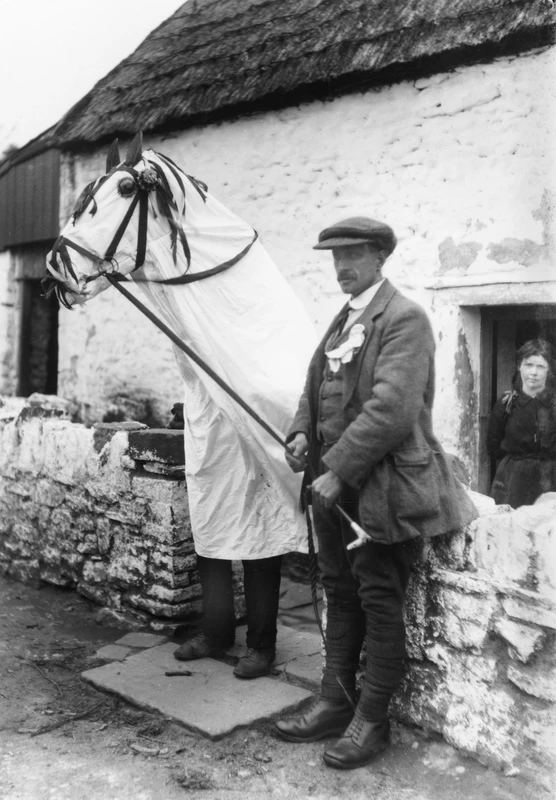
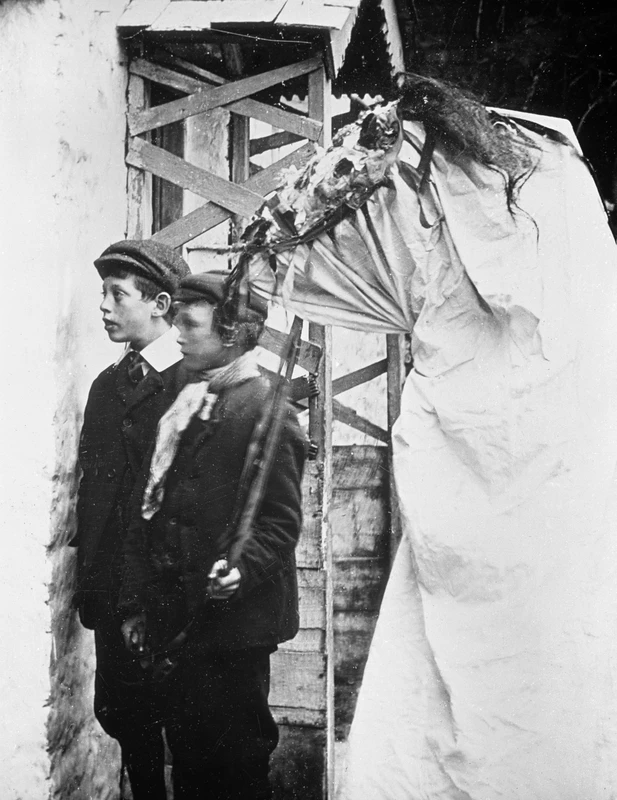
One of the most well-known Welsh customs is the Mari Lwyd, meaning 'Grey Mare', a horse-figure carried from door to door by wassail-singing groups. The tradition begins on Christmas Day and continues through to Twelfth Night and Hen Galan (Old New Year, celebrated on January 13).
Popular in South Wales during the 19th century, the tradition features a real horse's skull, usually decorated with coloured ribbons and rosettes and with glass bottle eyes. The lower jaw is fixed on a spring which shuts the mouth with a loud snap and brings the creation to life. A long white cloth is draped down the carrier which hides him from view.
Occasionally the head was of wood, one account says paper, and in around 1935 a group of boys in Swansea used a pillow, but a horse's head was characteristic. The same horse's head tended to be used annually, for it was buried in lime to preserve it for most the year, and dug up each December.
How is Mari Lwyd celebrated?
In terms of the celebration itself, the custom used to begin at dusk and often lasted late into the night. During the ceremony, a party of usually all men, would carry the Mari through the streets of the village singing and dancing. The Mari does not hunt alone, for depending on the area and the amount of people in the wassailing party, she can be joined by an array of other characters named Punch and Judy, the Sergeant and the Merryman.
Even very small groups usually have a leader, who holds the reigns to control the horse and take charge of the singing.
They would visit every house or pub in the village and stand in front of the door to sing traditional songs.
Next followed the pwnco, an improvised rhyme and verse contest between the Mari party and the inhabitants of the house.
There was a lot of leg pulling, and the verses were usually quite mischievous.
Traditionally these exchanges would be done with the door closed, and the contest could last for some time, sometimes even an hour or so, until one side gave up.
If the Mari side lost the contest, they would have to leave without being admitted to the house. However this would have been quite a rare occurrence, as the Mari entering the building was thought to bring good luck, so they would usually win (or be allowed to win).
Alternatively, the Mari party might sing one last verse begging for entrance.
Once inside, the entertainment continued with the Mari running around neighing and snapping its jaws, creating havoc, and frightening the children, while the Leader pretended to try to restrain it.
The Merryman played music and entertained the householders. Punch and Judy would also be part of the festivities. The participants would be rewarded with food and drink, and sometimes received a gift of money as well. The visit concluded with a traditional farewell song.
Popularity of the Mari Lwyd
With the earliest account of the Mari dating from 1798, the boom years, as regards to the amount of horse's heads in existence, were between 1850 and 1920.
Apart from one or two sightings in the north, the ritual remained exclusive to south Wales, being especially popular in Glamorgan, Monmouthshire and Carmarthenshire.
A general decline occurred in the number of Mari Lwyd groups during the twentieth century. One of the reasons normally given for its demise is the decrease of Welsh speakers, preventing inhabitants from replying to the Mari group, as the Mari Lwyd contest was almost always sung and performed in Welsh.
Another reason for the custom's decline was the increasing rowdiness and drunkenness which became associated with it. This was seen as unacceptable behavior especially with the rise of the Chapel and Methodism in Wales.
However there has been a growing interest in the Mari Lwyd in recent years, and this has resulted in a resurgence in groups performing this tradition across all of Wales.
Where can you see the Mari Lwyd?
Join us at St Fagans this winter to witness the Mari Lwyd tradition brought to life. Explore our full winter programme here.
The Mari Lwyd figure will also be on display as part of our new Wales: Told by Us exhibition. Learn more about the exhibition and plan your visit here.
At one time in Wales – New Year’s festivities were even more important than Christmas. In fact, one resident of Cynwyl Elfed, Carmarthenshire, in the 1860s, said that the chief importance of Christmas was , ‘that it was within a week of New Year’s Day, the biggest day of the year’.
New Year has always been important in that it symbolized hope and starting afresh, every January 1st we make resolutions and try to turn over a new leaf. It’s not surprising therefore, that this period was associated with future fortunes.
It was said that one’s behavior at the beginning of the year was held to influence his fate for the proceeding twelve months. The custom of ‘letting in’ in the New Year is familiar throughout most of Britain and in Wales, the first visitor to enter somebody’s house was of great significance, depending on who they were and their personal characteristics.
For instance, on New Year’s Day in Carmarthenshire and Pembrokeshire it was unlucky for a woman to see a woman first, and for a man to see a man first. People from Pencoed, near Bridgend, believed it bad luck to see a red-haired man first; in Pembrokeshire it was lucky to bring a fresh loaf into the house on January the first.
What is calennig?
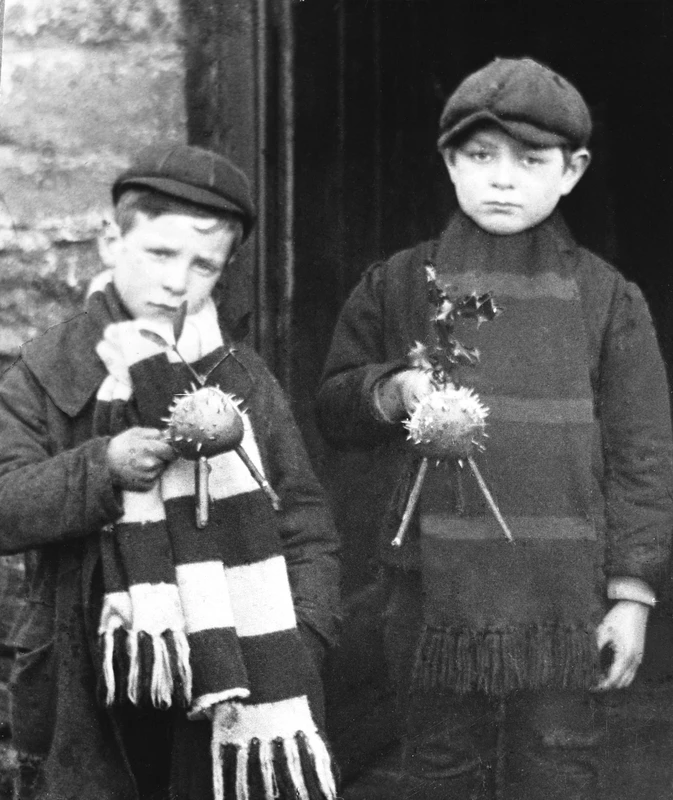
A well-known Welsh tradition, still seen in some areas, is the collection of calennig (New Year’s gift) where children rise early and carry from door to door, as bearers of good luck, a decorated apple, pierced with three sticks and adorned with a sprig of box and hazelnuts.
The children usually sing a simple verse and in return usually received a gift or food or money for their troubles. Rhymes and songs were concisely worded and their message was to announce the New Year's arrival, to wish the family a prosperous twelvemonth, and to ask from it ‘calennig’ or (New Year's Gift).
Two boys collecting Calennig in Llangynwyd c. 1904-1910
Here is a verse sung in Cardiganshire and Pembrokeshire:
(I left my house today With my bag and my stick, And here is my message to you, Fill my bag with bread and cheese.)
The words and verses varied from place to place. Listen to Selina Griffiths of Dinas Cross, near Fishguard, singing a version she learnt as a young girl in the 1880s, or hear Phillip Owen of St Davids, Pembrokeshire, recall the verse as he knew it from childhood.
What is the New Year’s water ritual?
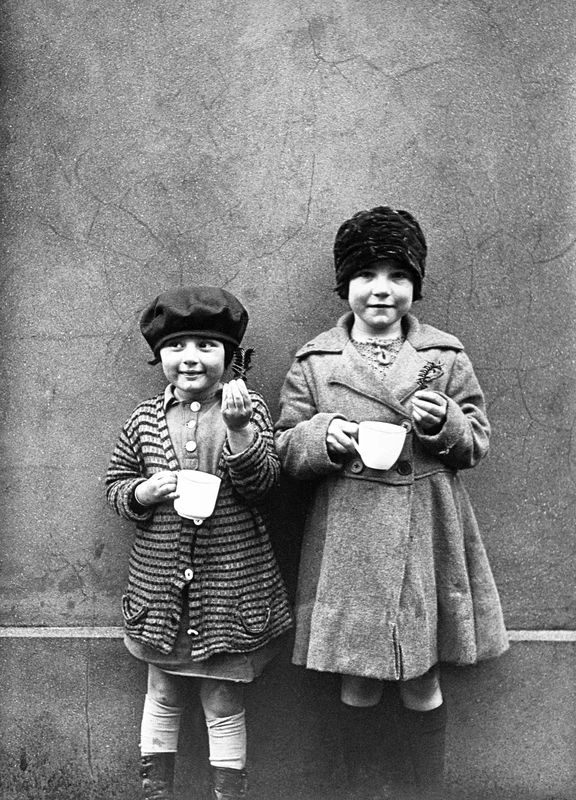
The New Year’s water ritual also took place in some parts of Wales, where children, after filling cups or small bowls with spring water, which they’d drawn from the well that morning, dipped into it a sprig of box, myrtle or mistletoe. This was then sprinkled either on grown ups hands and faces or around the house, in order to do away with the old year and usher in the new. The adults gave them a small gift in return of the sprinkling, which was commonly regarded as a sign of cleansing or or purifying.
Two girls at Tenby partaking in New Year's water ritual, 1928.
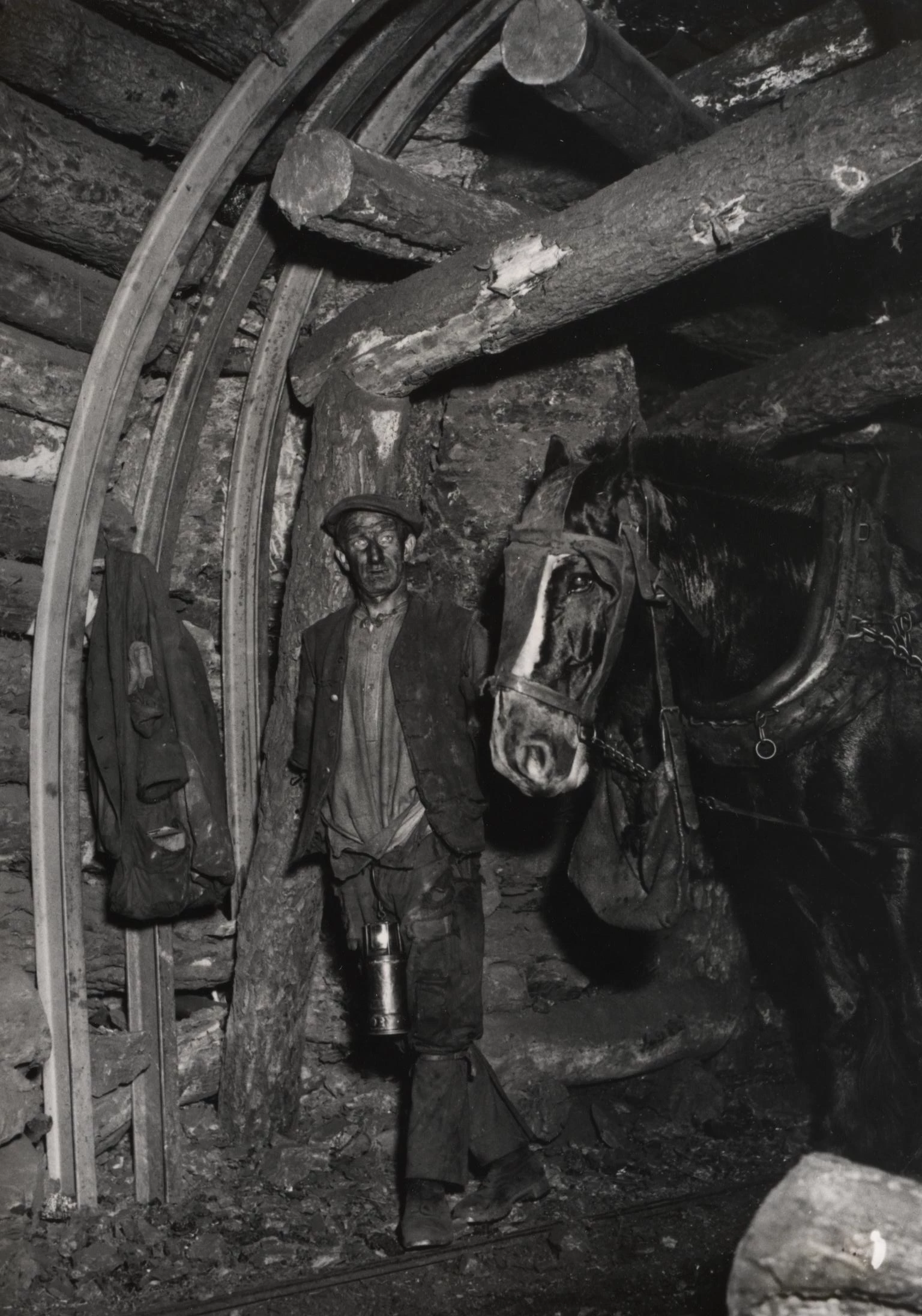
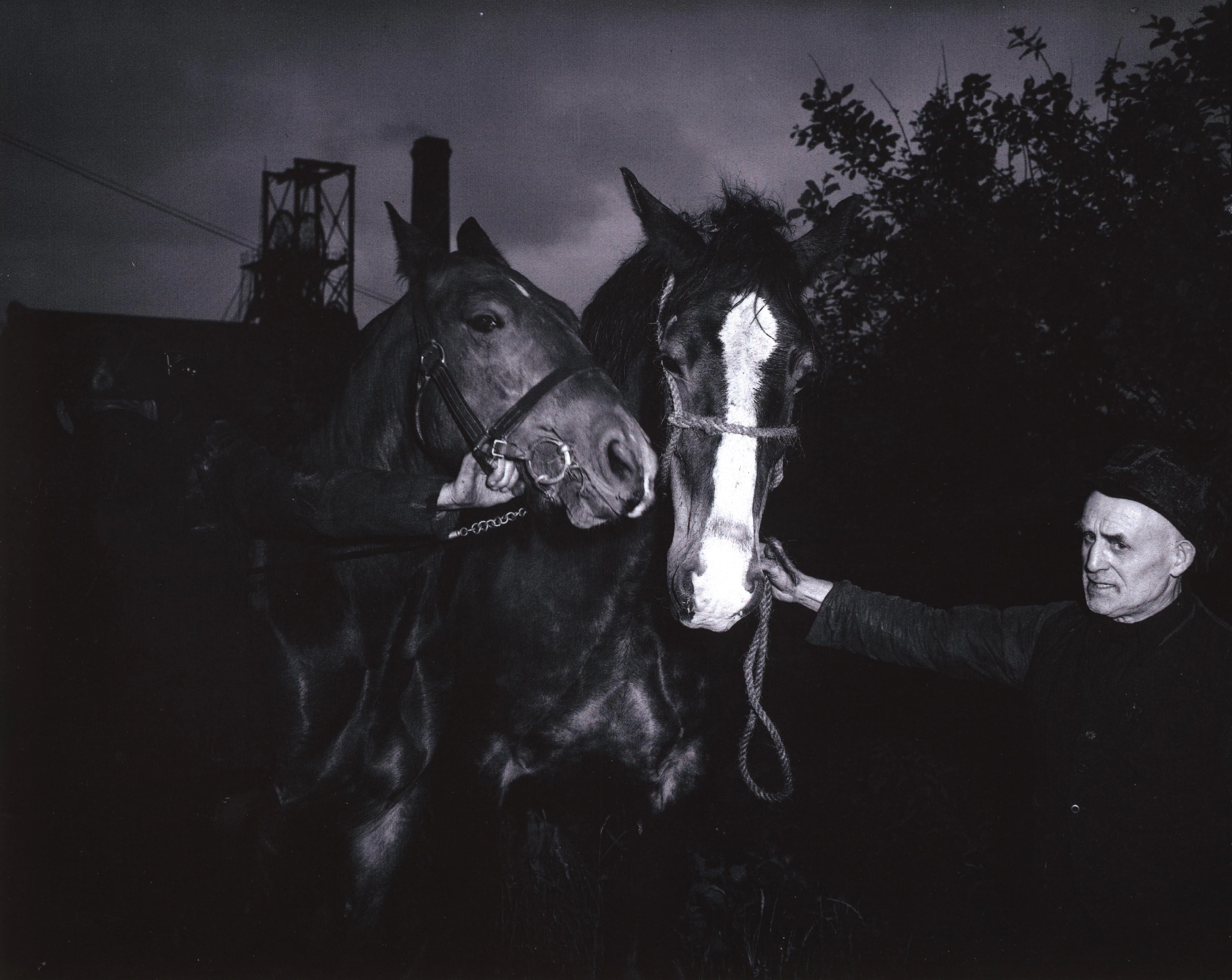
Horses have been closely connected with coal mining since the early days of the industry. They have been used to transport coal from the collieries to the customer, have been used to power winding and pumping engines and, most importantly to move coal from the coalface to the shaft.
In 1878 the RSPCA calculated that there were over 200,000 horses at work in British mines. The numbers decreased as mechanisation became more common, but they continued to be used throughout the twentieth century. The last Welsh colliery horse was probably Robbie who retired from Pant y Gasseg Mine in 1999.
Most commonly known as ‘pit ponies’ by the general public but Welsh colliery horses were usually around 15 hands high – the same size as Henry VIII’s warhorses. It is often claimed that they went blind, but a blind horse would not have been very useful underground and any animal which did lose its sight was usually brought to the surface as soon as possible.
Although they were essential for the production of coal before introduction mechanised haulage, use horses in industry has often been highly controversial. The owners argued that vital economic process winning while animal lovers regarded their as inhuman.
In between these opposing sides were the mineworkers, who may have felt sympathy for these animals. However, they could turn a blind eye to any callousness, or even be cruel themselves, if their pay packets were under threat.
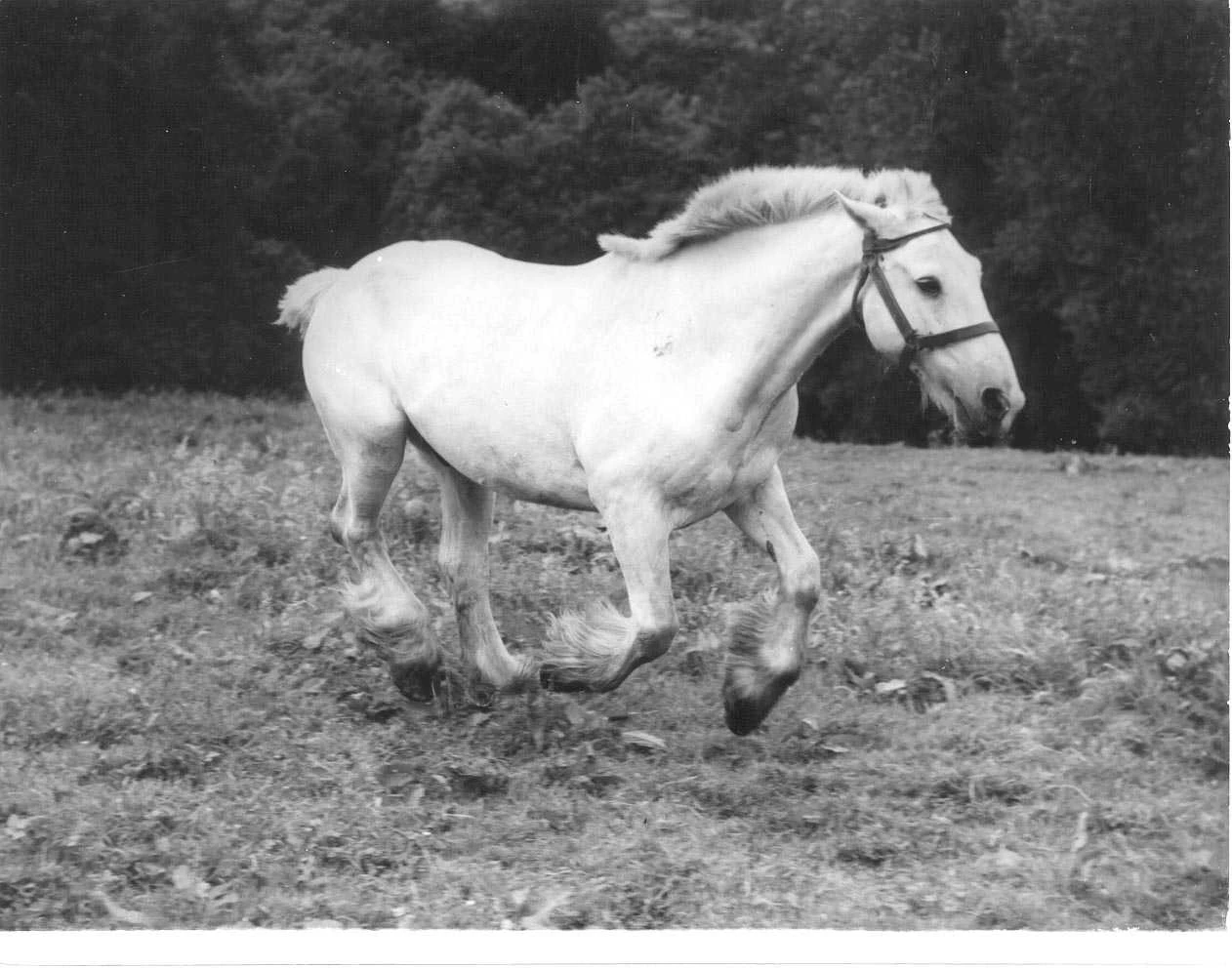
Welsh colliery horses were usually around 15 hands high and males, mostly geldings but some stallions were kept. The majority were of the Welsh Cob type but larger horses such as Shires and imported Belgian horses were also kept, especially on the surface or in main haulage roads. When stocks of horses were low, they could be obtained from as far away as America and Russia. Smaller ponies, around 13 hands, were sometimes used for light haulage duties.
They had to be at least 4 years old before being accepted into colliery work. In 1893, the average life expectancy of a horse was between eight and nine years, with around 6% killed in accidents. By 1950s this risen ten fifteen although there were some on ‘light jobs’ still employment over twenty age.
By the 1930s, most horses worked between forty-five and sixty hours a week. After 1949 the maximum working hours were to be not more than forty-eight hours, and no more than seven shifts, per week. They were also entitled to the same twenty-minute break as the men.
In 1938, colliers were entitled to an annual week’s paid holiday and the horses were usually allowed above ground as well. By 1948 both the colliers and horses got a two-week annual holiday.
By 1878, the RSPCA estimated that there were around 200,000 horses working in British mines. By 1913 this had decreased to 70,000, because of improved mechanical haulage methods. In 1930 it was reported that 25 Welsh collieries had no horses at all. In 1947 there were some 8,000 Welsh colliery horses, by 1967 there were only 417. By the 1980s National Coal Board horses were being retired but, in smaller, ‘private mines’ horses were in use for a few years to come.
The last Welsh colliery horses, ‘Gremlin’ and ‘Robbie’ retired from Pant y Gasseg (‘Horses’ Hollow’) Mine, Pontypool, in 1999. They were sent to a RSPCA rest home in Milton Keynes, but Robbie found that boring and was loaned to the National Coal Mining Museum for England in Wakefield where he pulled light tubs of visitors around the site. Robbie died on the 27th April 2009, probably the last working Welsh colliery horse.
For many visitors to Big Pit, the most memorable parts are the underground and surface stables, still bearing the names of the horses that worked there. By the start of the 20th century, there were around 300 horses working in Blaenafon coal mines with 72 working in Big Pit alone.
The last underground horse at Big Pit was brought up in 1972, but two horses continued to work on the surface until 1974.
Whether he was a ‘willing pet’ or ‘wretched pit pony’ the colliery horse shared the same conditions and dangers as the coalminer. They died in their hundreds from mistreatment, accident and explosion. We owe them a great deal, including the success of the industrial revolution.
Miniature hats from 1860’s by Welsh hatter, John Evans. The Welsh Hat is in middle row, centre.
Hats are often political. Though it would be understandable for someone to assume that they are made to protect someone from inclement weather, it does not take a lot of thought to see that they are often much more. From a red ‘Make America Great Again’baseball cap, to the bonnet rouge of the French Revolution, to any number of military hats, hats are regularly used to indicate which side you are on. Hats, along with all fashion, are used in a huge variety of ways to communicate with others and can tell us a variety of information: nationality, gender, interests, and identity. The hat specifically is often associated with group identity; in a crowd of people the hat can be a key identifier and if worn collectively can create a striking vision. The Welsh Hat does just this, its tall black crown and stiff brim, traditionally worn by Welsh woman creates a distinct and eye-catching look that has long been used as a symbol of Welshness.
Before The Welsh Hat
There is a prevailing myth that the Welsh hat and national costume was a Victorian invention, as part of imagined Welsh heritage and yet there are plenty of accounts going back a century earlier that tell us otherwise. The Victorians may have curated a specific version of Welsh dress and cemented the idea of it as ‘Welsh National Costume’ but the clothes themselves, including the hat, had indeed been around for much longer.
Before the Welsh Hat was Welsh, it was just a hat. High crowned styled hats made of felt or beaver fur were once popular across many countries. Men and woman across Britain in the latter half of the Elizabethan period, wore such hats for travelling and riding, and a wider brimmed version of the hat, ‘cavalier style’, was then adopted by the middle class in the mid-part of the 17th century. At this time hats were an important status symbol. Beaver fur was the quality material used to felt hats, but felting the fur was difficult and costly and from 1670, the product was often imported from America. Samuel Pepys notes in his diary, in 1661, that a beaver hat had cost him 45 shillings. From around 1640 to 1660 a version of the beaver hat with a tall, tapered crown known as a ‘sugarloaf’ became popular and looked very similar to what we would think of as the Welsh hat today. Today hats of this style are heavily associated with the Puritans and pilgrims to America, for its simple, unadorned design. Thus, even 400 years ago, the hat was steeped in meaning, from wealth and class, to political and religious leanings.
Us and Them
While the black Sugarloaf hat, along with other features that we today associate with Welsh National costume, were common across Europe and America in the 17th century, it is in the 18th century that we see a divergence in style. While elsewhere fashion trends moved on, these older looks appear to be retained by the Welsh peasantry. As fashion changed rapidly in the later half of the 18th century, this rejection of the new styles (be it intentional or through financial necessity) resulted in a notable difference in dress by the Welsh lower classes, from their English counterparts. This is documented through numerous accounts of English travellers that commented on the difference in clothing between the English and Welsh, among which are descriptions of a tall black hat worn by women.
Painting by Julius Caesar Ibbetson, Newcastle Emlyn Costumes, 1792
Julius Caesar Ibbetson was an English painter who created a number of works depicting scenes of Welsh life at the end of the 18th century. Through these works, a distinct image of Welsh working-class women can be seen. The paintings depict an attire which is different from what was fashionable dress throughout Europe during the 1790s, and almost all the works include women wearing what we can think of as an early variation of the Welsh hat.
In the work Newcastle Emlyn Costumes from 1792, all 14 women from the scene, as well as 2 children, are depicted wearing almost identical, black brimmed hats. While the hats may be shorter and less rigid from what we think of today as the Welsh hat, there is still a clear resemblance in style. In the inscription beneath the watercolour, Ibbetson writes “peculiar drefs and costume of the peasantry, in the district around Newcastle Emlyn in Pembrokeshire.” Here the English painter highlights that to him, the dress of women in Wales is distinctly different “peculiar” from English standards of dress. These outfits also have clear similarities to what one would think of as the Welsh national costume today, with their striped and checked patterns, and their shawls and aprons. In addition to its distinctive look, what is remarkable is the hats uniformity across all the wearers. At this time there was a large variety of styles in hats, bonnets, caps, turbans, hair accessories, wigs and hair styles and a huge choice in frippery to be added including flowers, ribbons and feathers. However in the works of Ibbetson, we see a singular black and unadorned style.
The striking uniformity of the Welsh dress was not lost on the Welsh, rather it became a strategic symbol of collective power. Famously it is even said to have helped defeat invading military powers. In 1797, French warships descended on Pembrokeshire in what is known as the Battle of Fishguard. Numerous reports document how hundreds of Welsh women in red shawls and black beaver hats, flanked the coastline behind the British military; creating the illusion from afar that they too were soldiers, and so leading to the unconditional surrender of the invading force. Thus the Welsh national dress as a symbol of strength and unity, and part of proud Welsh heritage, was embedded into the nation’s history.
National Costume
1931 Postcard reproductions of "Dull-wisgoedd Cymru/Cambrian Costumes" by Lady Llanover in 1834 (cropped)
Over the course of the 19th century, the Welsh hat along with the rest of the Welsh dress, would shift into an even more defined style. Previously, the Welsh hat was by no means the only hat being worn, partially as they were more expensive than other felt or straw hats.There were also many local variations on the Welsh hat; the tall hat was popular in larger towns such as Cardiff, Bangor and Carmarthen, while lower, flat-topped straw hats were popular in the Gower, as they allowed woman to carry cockle-baskets on their head and were better suited to the windy climate. But over the century, the hat would be consolidated into the more singular, standardised and uniform look that we think of today as the Welsh hat.
Lady Llanover (1802 to 1896) was the influential philanthropist who greatly influenced the uptake of traditional Welsh dress and worked tirelessly to promote Welsh language and culture. She wrote extensively on the matters of Welsh costume, as well as producing a series of illustrations on the subject and it is from her that we get the tradition of wearing the national costume on St David’s Day. While Lady Llanover certainly did not invent the Welsh national dress, she worked hard to bring it from the confines of the working class, into upper class society, even so far as to insist that guests to her parties were to wear the national costume.
In 1832 the then Princess Victoria (not yet queen) and her mother visited North Wales and on their carriage ride wore Welsh hats, when passing through Bangor ‘in compliment to the fair maids of Cambria'. Thus by this point we can see the complete transition from the traditional working wear of the peasantry, to the fashionable National costume for all classes. It is in that century then, that the hat and national dress becomes smart formal wear. Women chose to wear their best costume when selling their goods at market, as well as on Sunday to Church and Chapel. Throughout the 19th century, manyEisteddfod competitions would even have a prize for best Welsh hat. In this century, the Welsh hat has become a point of national pride. The 19th century writer, Marie Trevelyan, writes in an account of West Wales in 1893,“There the tall beaver hat is still worn by some of the prettiest and most handsome woman of the principality. Very spick and span these woman look”.
It is hard to pinpoint when the Welsh hat fell out of authentic regular use, due to the tremendous popularity of the image of the ‘Welsh Lady’. By the mid 19th and 20th century there was a transition from genuine regular attire, to a costume of Welshness for public events and in the tourism trade. The Image of Welsh National Dress became a prolific theme in postcards, souvenirs, and tourism in the Welsh seaside towns. Thus people continued to wear the Welsh Hat but its meaning had once again shifted.
A Hat For Everyone
Throughout the centuries, the use of the Welsh hat, like a swinging pendulum, shifted backwards and forwards in style from peasantry to royalty. Class was not the only cultural boundary that the hat crossed. The hat has also defied the boundaries of gendered clothing. During the 17th and 18th century, this style of hat was largely considered to be a man’s hat, socially acceptable for women only in the context of riding and traveling (acts which themselves were often seen as male activities) and yet in Wales, this binary was seemingly being ignored. In the 18th century, there were many English accounts of Welsh women described dressing in a ‘peculiar’manner, and stating that they wore ‘men’s hats’. Mary Yorke, a traveler to Wales in 1774, attended a service at St David’s Cathedral and noted seeing an old woman with a “kerchief over her head and a hat like a man’s”. Despite this, during the following 19th and 20th century, the Welsh hat had become an item strongly associated with Welsh womanhood.
Despite the Welsh hats’ tradition as a piece of Welsh women’s clothing, more and more it is a piece which defies the binary, with contemporary queer artists in particular using the hat in their work as a national symbol, that can be worn by anyone. Thus, the hat that likely originated as a man’s hat in the 17th century, and was subsequently adopted by women, once again alludes a gender binary in its wearers today. And so as the pendulum of fashion swings from one end of the spectrum to the other, so today we see it starting to swing back.
This dynamic relationship between the Welsh, clothing, and gender is nothing new. In the 1800’s, girls who worked in the mines dressed in boys clothing, including trousers, to be able to crawl through the mines. While the infamous Rebecca Riots saw men dressed in women’s clothing in violent protest, and as mentioned previously, Welsh women were mistaken as British military at the Battle of Fishguard. The Hat itself is in many ways is an androgynous item, its smooth black and angular features are much closer to many typical male items of dress such as a suit and top-hat, then much traditional female attire. Its angular features often sit juxtaposed with the frilly and lacy white cap underneath. This is perhaps partly why it makes for such an interesting subject for many queer artists today.
Photograph of performers from the Contemporary Dance group Qwerin. Photograph credited to Sioned Birchall.
In the contemporary dance performance group Qwerin,directed and choreographed by Osian Meilir, performers fuse traditional Welsh folk dance with the energy of the queer nightlife. The performers wear an adapted form of the national dress, complete with exaggeratedly large Welsh hats, which hang over and obscure much of the performers face, leaving them to peer out through cut out holes in the crown of the hat. These costumes, designed by Becky Davies, tell a striking visual story. In a quote from Meilir on the performance they say:
“The hat creates a looming presence, making our appearance sinister and mysterious. The hats, a symbol of Welsh culture, become the very things that restricts us from physically moving forward into more vigorous and joyful dancing. By removing these hats we shed away the years of shame, burden and oppression, cutting ties with social expectations and constrictions. However, reuniting and greeting the hats towards end of the work is an act of acceptance, an acceptance of our own identity. We welcome these hats back into our arms as a symbol of progression, unity, harmony and change; moving together into a new future, a queer Wales.”
In other words, the hat has become a symbol of an old Welsh Culture, but a symbol that rather than being allowed to slip away, can be reinvigorated with the zeitgeist of a new era of Welsh identity.
The Psychology of Hats
The Hat sits in a prominent position on the wearer, it frames the face and is often seen in the peripheries of the wearer’s view. This means they can become powerful tools in the way we view ourselves. The Fashion editor and prolific hat wearer Isabella Blow said on the subject of hats"Fashion is a vampiric thing, it's the hoover on your brain. That's why I wear the hats, to keep everyone away from me.” Blow touches on the sometimes oppressive societal demands of fashion and conformity and how it can play on the mind; as an antidote to this, the hat performs the role of a mental and physical shield. The brimmed hat creates and demands a physical distance between people, while psychologically doing the same, creating a distinct difference between wearer and non-wearer. In essence, a hat has the potential to create a sense of separation and independent identity between the wearer and the other. This may provide some insight into the success of the Welsh hat, like a protective shield, it symbolises the protection of one’s Welsh culture and heritage.
Finally In another quote from Blow, the intrinsic sense of identity associated with the hat is reinforced. “I don't use a hat as a prop, I use it as a part of me. If I am feeling really low, I go and see Philip (Treacy), cover my face, and feel fantastic”. Thus how one dresses effects not just how others view you, but how we view and feel about ourselves. If clothing is an extension of ourselves, then loving the clothing we wear has the potential to help us view ourselves differently. For the Welsh hat it can be a symbol of strength, nationality, and pride. For wearers of the Welsh Hat today, whether it be a St David’s Day celebration, as part of dance costume, at Eisteddfod, or just for fun, allow wearing the Hat to help you feel fantastic and to connect you with 400 years of history and Welsh heritage.
Reference / Further Reading
British Vogue, Isabella Blow, Bibby Sowray.4 November (2011)
Folk life, Welsh Peasant Costume, F. G. Payne. volume II (1964)
Textile history, Welsh peasant dress-workwear or national costume?, Christine Stevens. 33 (I) (2002)
The costume accessories series, Hats, Fiona Clark. (1982)
Welsh Costume, Ken Ethridge. (1958)
Women in Welsh History, Derek Draisey.(2004)
Women's Headdress and Hairstyles in England from A.D.600 to the Present Day, Georgine de Courtais.(1986)