Early herbals - The German fathers of botany

Amgueddfa Cymru has a number of pre-1701 books in the Museum's Library, including two incunables (books printed before 1501) of Pliny's writings on natural history from 1481 and 1487.

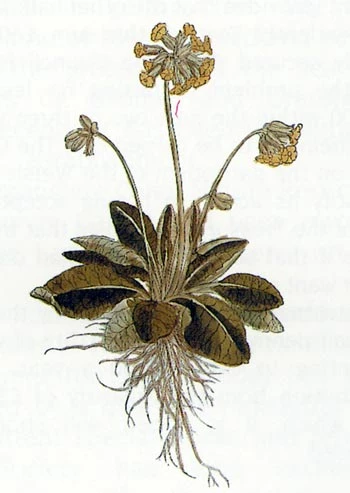
The cowsip as depicted in Fuchs's De Historia Stirpium

The cowsip as depicted in Fuchs's De Historia Stirpium

Part of an early German herbal annotated in Welsh and English, once in the possession of Morris Owen

Part of an early German herbal annotated in Welsh and English, once in the possession of Morris Owen.

There are also a number of 16th- and 17th-century 'herbals' in the collection. Among these are examples of the works of three men who have been described as the 'German fathers of botany', namely Hieronymous Bock (1498-1554), Otto Brunfels (1489-1534) and Leonhard Fuchs (1501-1566).

Herbals

Printed herbals give details of plants along with what illness each one could cure. What made the work of these three men stand out in particular is that many of the descriptions and illustrations of the flowers in their books were, on the whole, based on first-hand evidence in the field, and not copied from other writers.

Hieronymous Bock (1498-1554)

As Bock's herbal of 1539 was unillustrated, it forced him to provide detailed and accurate descriptions. The Museum holds a later, illustrated edition, from 1552. Although the opening pages are missing, the main body of the text is complete, along with fine hand-coloured illustrations.

Most of the woodcuts simply show the plants themselves, but occasionally birds and man are shown, such as the rather crude depiction of the effects on eating a fig!

Otto Brunfels (1489-1534)

The work of Otto Brunfels in the Library is the second volume of Herbarum Vivae Eicones (1531). The title translates as 'living picture of plants' and the author was one of the first to turn to nature itself as the source of his illustrations for a book.

Leonhard Fuchs (1501-1566)

The Library holds two books compiled by Fuchs, namely De Historia Stirpium (1542) and Plantarum Effigies (1549). Although only some of the descriptions of the plants are by Fuchs, the majority being taken from other books, it is the quality of the illustrations that makes this herbal one of the great books of the 16th century.

The Plantarum Effigies is a pocket-sized version of the 1542 volume to be used in the field; it has very little text, apart from an index to the plants depicted, and with each woodcut the name of the plant is given in three or more languages, usually five (Greek, Latin, French, Italian and German).

Other great herbals of the same period are housed in the Library of Amgueddfa Cymru, notably the works of Rembert Dodoens (1516-1585) and John Gerard (1545-1612).

Rembert Dodoens (1516-1585)

Dodoens' herbal was published in Flemish in 1554. The Museum holds the first English edition of 1578 translated by Henry Lyte, including new material which Dodoens himself had sent to Lyte for incorporation in the new edition.

John Gerard (1545-1612)

One of the most famous herbals written in English is Gerard's The Herball (1597). Head gardener to many properties in and around the London area, Gerard was also responsible for the gardens of William Cecil, Lord Burghley, Elizabeth l's Secretary of State and Lord Treasurer, and it was to Cecil that Gerard dedicated his great work.

The Library has a copy of the 1633 edition, along with the original work itself.

Other herbals in the collection include an incomplete German example dating to the first half of the 16th century. It was once in the possession of a Morris Owen of Caernarfonshire who added in ink, around 1767, the names of the various plants in Welsh; the English equivalents are also given in most cases.

This book, and the other herbals, remain of great interest to this day, and are examined in particular by those who study the history of botany and pharmacy, as well as by students of the history of the printed book.
A new lease of life for Cambrian Railways Coach No.238

The coach before work began

The coach before work began

The interior of the main part of the coach

The interior of the main part of the coach

The completed coach

The completed coach

A 19th-century railway coach has been at the centre of one the largest conservation and reconstruction programmes undertaken by Amgueddfa Cymru.

19th-century passenger railways

At the end of the 19th century, Cambrian Railways covered much of mid-Wales. Unlike the lines in south Wales, whose main purpose was to carry iron and coal from the valleys the short distance to the coast, Cambrian Railways provided long-distance passenger services. They connected coastal resorts such as Aberystwyth to the large cities of Liverpool, Manchester, Birmingham and London.

Quality and luxury

In comparison to today's trains, passenger coaches in the 19th century were quite complicated. Coach No.238 had a small luggage compartment at one end, then two first-class compartments and four third-class compartments. There were three toilets, one allocated to first-class use only. To make sure there was no mixing of classes, the corridors for first and third-class compartments were on opposite sides of the coach.

Coach No.238 was built in Birmingham in 1895 to very high standards, its original plans stating: “Interior panelling of polished sycamore framed with walnut wood and gold lined”.

From luxury coach to hollow shell

The coach entered service in 1895 and was used mainly between Aberystwyth and Manchester before finally being withdrawn in 1939. During the Second World War it was converted into a wireless van. Later it was put into storage before being transferred to Amgueddfa Cymru in 1991 by which time the coach was essentially a hollow shell.

The Museum decided to restore one first-class and one third-class compartment at either end of the coach, with the rest of the space to be used for groups of visitors. A special canopy was constructed to house the coach, allowing the restoration to go ahead even in bad weather.

Restoration of the coach

Work began with re-roofing the coach, then replacing the floor with 'tongue and groove' planks. The first-class compartment was found to have one set of planks laid at 45 degrees to the body of the coach, with a top layer laid at 90 degrees to the lower layer. Apparently this gave a quieter ride for the first-class passengers. Next to be renewed were the external panelling and mouldings, then the internal partitions and seat frameworks, all following the original plans. Such was the attention to detail that the metal brackets supporting the luggage rack were copied from an original with replicas being made in the brass foundry at the National Slate Museum in Llanberis.

The coach originally had 14 coats of paint; fortunately, modern paints do not require such methods. The lower half of the coach is finished in Cambrian Green, with an original sample of paint used to produce the appropriate shade.

Finishing touches

The coat-of-arms of the Cambrian Railway Company and the Prince of Wales feathers provided the finishing touches. These were taken from originals that were photographed, scanned and laser printed to provide identical copies.

The glory of this coach will serve as a reminder of the halcyon days at the beginning of the 20th century when people travelled from all over England to visit Cardigan Bay.

Monday 2nd July

Contributed by IWAN BALA

It was remarkable to come here, having heard stories about this place, and imagined other stories too. To stand on the floor that was stood on so long ago. Like Sean Harris, I am inspired to do some work based on this. Not sure what yet. Wedi mwynhau yn ddirfawr. 01/07/07

Monday 2nd July

Contributed by SEAN HARRIS

Visiting Llanmaes this time last year was fascinating as always – took a few photos, soaked it all up, went home… With no idea what it would lead to. I’m sitting here, talking to Nick Comerford, teacher from Aberdare School with whom I made the film Dadeni, a cauldron extravaganza based on finds from Llanmaes – sharks tooth, coin and so on. This time last year none of these had been unearthed. What will come from this years dig I wonder?

Monday 2nd July

Contributed by NICK COMERFORD

I came down to the site in October, so it was nice to come back to see the site opened up. With a little help I’m starting to make sense of the colour of the earth, the position of the post holes, etc. I’m looking forward to seeing what turns up?