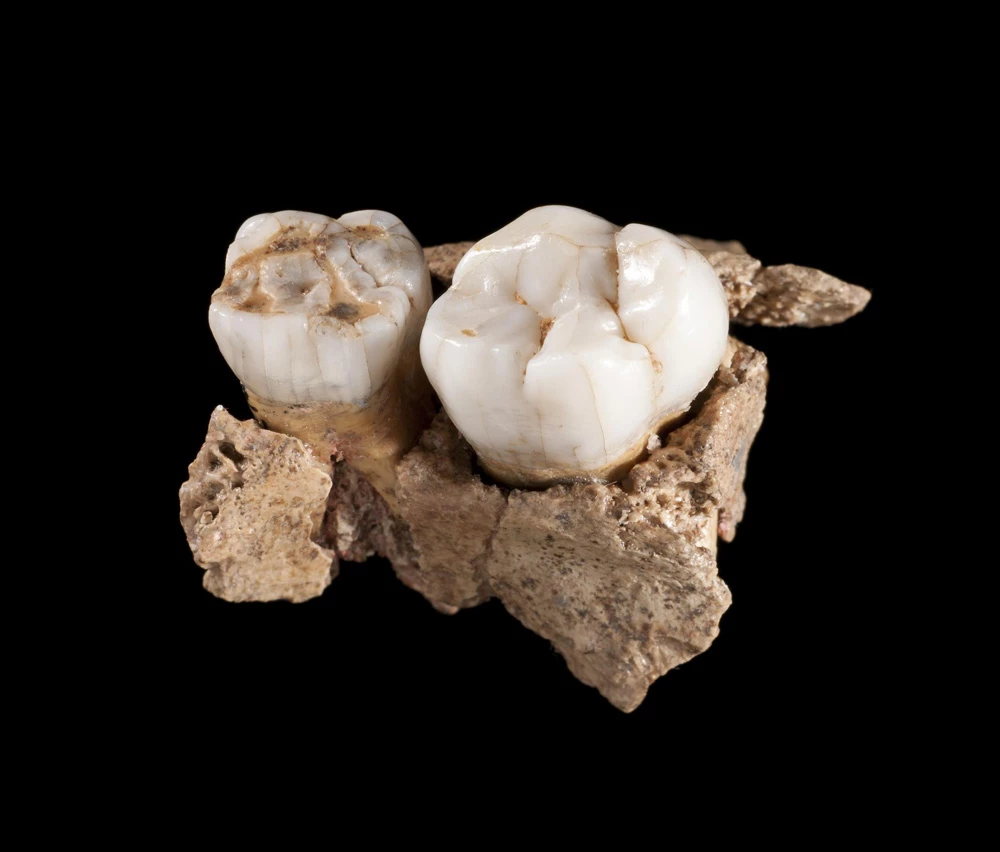
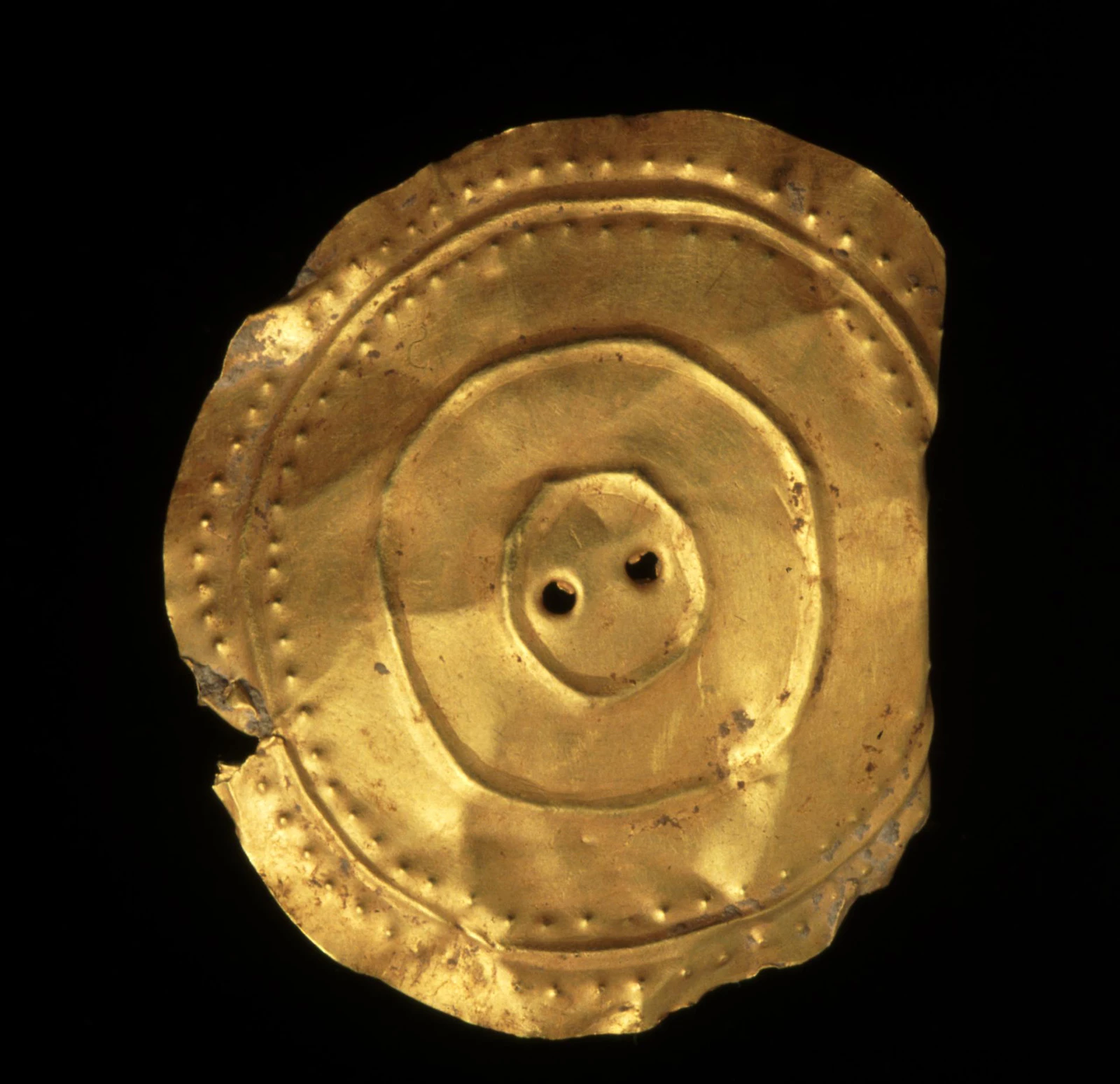
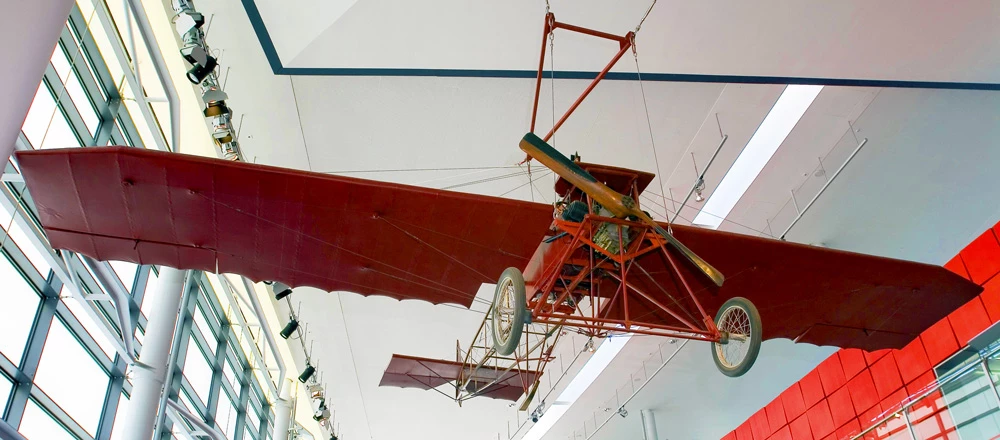
Uncovering our Collections: Half a Million Records now Online 26 March 2018 As we reveal half a million collection records for the first time, we look at some of the strangest and most fascinating objects from National Museum Wales Collections Online. This article contains photos of human skeletal fragments. The Biggest We have some real whoppers in our collections - including a full-size Cardiff Tram and a sea rescue helicopter - but the biggest item in our collection is actually Oakdale Workmen's Institute. Built in 1917, the Institute features a billiard room, dance hall and library - and is nowadays found in St Fagans National Museum of History. Horace Watkins testing his monoplane in 1908 Many of the buildings in St Fagans are part of the national collection - meaning they have the same legal status as one of our masterpiece Monets or this coin hoard. The buildings are dismantled, moved, rebuilt - and cared for using traditional techniques, by the museum's legendary Historic Buildings Unit. The Oldest The oldest human remains ever discovered in Wales These teeth belonged to an eight year-old Neanderthal boy - and at 230,000 years old, they are the oldest human remains in Wales. They were discovered in a cave near Cefn Meiriadog in Denbighshire, along with a trove of other prehistoric finds, including stone tools and the remains of a bear, a lion, a leopard and a rhinocerous tooth. These teeth are among some of the incredible objects on display at St Fagans National Museum of History The Shiniest People in Wales have been making, trading and wearing beautiful treasures from gold for thousands of years - like this Bronze Age hair ornament and this extremely blingy Medieval signet. At around 4000 years old, this sun disc is one of the earliest and rarest examples of Welsh bling One of the earliest examples of Welsh bling is this so-called 'sun disc', found near Cwmystwyth in Ceredigion. Current research suggests that these 'sun discs' were part of ancient funeral practice, most likely sewn onto the clothes of the dead before their funerals. Only six have ever been found in the UK. Most Controversial At first glance, an ordinary Chapel tea service - used by congregations as they enjoyed a 'paned o de' after a service. A closer look reveals the words - 'Capel Celyn'. The chapel, its graveyard and surrounding village are now under water. Capel Celyn, in the Tryweryn Valley, is now underwater Flooded in 1965 by the Liverpool Corporation, the Tryweryn valley became a flashpoint for Welsh political activism - creating a new generation of campaigners who pushed for change in how Welsh communities were treated by government and corporations. Curators from St Fagans collected these as an example of life in Capel Celyn - to serve as a poignant reminder of a displaced community, and to commemorate one of the most politically charged moments of the 20th century in Wales. Honourable Mention: an Airplane made from a Dining Room Chair Made from a dining room chair, piano wire and a 40 horsepower engine, the Robin Goch (Red Robin) was built in 1909 - and also features a fuel gauge made from an egg timer. The Robin Goch (Red Robin) on display at the National Waterfront Museum Its builder, Horace Watkins, was the son of a Cardiff printer - here he is pictured with an earlier, even more rickety version of his famous monoplane. Horace Watkins testing his monoplane in 1908 Our collections are full of stories which reflect Wales' unique character and history. The Robin Goch is one of the treasures of the collection, and is an example of Welsh ingenuity at its best. Half a Million Searchable Items The launch of Collections Online uncovers half a million records, which are now searchable online for the first time. “Collections Online represents a huge milestone in our work, to bring more of our collections online and to reach the widest possible audience. It’s also just the beginning. It’s exciting to think how people in Wales and beyond will explore these objects, form connections, build stories around them, and add to our store of knowledge." – Chris Owen, Web Manager Search Collections Online Plans for the future Our next project will be to work through these 500,000 records, adding information and images as we go. We'll be measuring how people use the collections, to see which objects provoke debate or are popular with our visitors. That way, we can work out what items to photograph next, or which items to consider for display in our seven national museums. Preparing and photographing the collections can take time, as some items are very fragile and sensitive to light. If you would like to support us as we bring the nation's collections online, please donate today - every donation counts. Donate Today We are incredibly grateful to the People's Postcode Lottery for their support in making this collection available online.
"Here comes the Devil": Welsh Suffrage and the Suffragettes Elen Phillips, 1 February 2018 At precisely 8:00pm, February 6th, 1918, The Representation of the People Act was passed by Royal Assent in Westminster. After decades of campaigning, some women were now allowed to vote. The Equal Franchise Act, passed in 1928, gave all women over 21 the right to vote. We're used to seeing photos of 'Suffragettes' protesting in London, but what about the campaign in Wales? Non-Violent Protest Even though the press at the time concentrated on the trials and tribulations of the Suffragettes, there were far more Suffragists in Wales. Suffragists believed in peaceful action, and changing things through constitutional means. Among them were members of the Cardiff District Women's Suffrage Society - the largest branch of the National Union of Women's Suffrage Societies outside London. At their helm was Rose Mabel Lewis (Greenmeadow, Tongwynlais) – or 'Mrs Henry Lewis' as she is described in our museum documentation. The most prominent members of the branch tended to be the city's well-connected, middle-class women. Their annual report for 1911 shows they held a whole host of activities to raise awareness of their campaign, including a fancy dress dance, whist drive and jumble sale. That year, their membership doubled to 920. Banners: The Craft of Activism Banner of the Cardiff Cardiff & District Women's Suffrage Society. Made by Rose Mabel Lewis, President of the Society Rose Mabel Lewis made the silk banner now held in the Museum's collection - a powerful example of how the Suffragists and Suffragettes used craft to communicate and express themselves. The exact date of the banner is unknown, but evidence shows it was used in a protest in 1911. During that year, on the 17th of June, Rose Mabel led the women of south Wales in the Women's Coronation Procession in London. The banner's accession documents contain a note of explanation from one of the branch's former members: The banner was worked by Mrs Henry Lewis… [she] was also President of the South Wales Federation of Women’s Suffrage Societies + she led the S. Wales section of the great Suffrage Procession in London on June 17th 1911, walking in front of her own beautiful banner… It was a great occasion, some 40,000 to 50,000 men + women taking part in the walk from Whitehall through Pall Mall, St James’s Street + Piccadilly to the Albert Hall. The dragon attracted much attention – “Here comes the Devil” was the greeting of one group of on lookers. Banners like this were an incredibly important part of the visual culture of activists campaigning for women's right to vote. A number of these banners can be found today in museums and archives, including the Cardiff University Special Collections and Archives. Organisers of the 1911 march expected over 900 banners on the day! Two years later, in July 1913, the banner appears again on the streets of Cardiff, as part of a march in the city to raise awareness of the Great Suffrage Pilgrimage. In the museum's collection, we find amazing pictures of Rose Mabel Lewis, and the branch's other members, gathering with the banner in front of City Hall in Cathays Park: According to the annual report for 1913-14, some of the members were worried about the march, but were emboldened after receiving a positive response on the day: It was with misgivings that some members agreed to take part in the procession, but afterwards their enthusiasm aroused and the desire to do something more in the future. The march was useful in drawing the attention of many people to the existance of our society. Making History: St Fagans and the centenary In 2018, the banner will be on display in Cardiff once more - not in a protest, but in a display of iconic objects from Wales at St Fagans National Museum of History. The display, which is part of the Making History project to redevelop St Fagans, will mark the first time the banner is displayed since it was donated in 1950 by the Cardiff Women Citizen's Association. At that time, their treasurer wrote a letter to Dr Iorwerth Peate, Keeper of St Fagans, to express their great pride in seeing the banner preserved for the future at St Fagans: A cordial vote of thanks was accorded to you for realising how much the Suffrage Cause meant to women and for granting a memorial of it in the shape of the banner to remain in the Museum. In addition to the banner, the museum also holds a number of objects relating to campaigns for women's right to vote, including letters and reports from the NUWSS, as well as an unusual hand-made anti-suffragette doll from west Wales. Anti-suffrage voodoo doll sent anonymously to a woman in west Wales, early 1900s Primary Sources: National Union of Women's Suffrage Societies: Cardiff & District Annual Report, 1911-12 (St Fagans National Musuem of History). National Union of Women's Suffrage Societies: Cardiff & District Annual Report, 1913-14 (St Fagans National Musuem of History). Accession Documents 50.118 (St Fagans National Museum of History). Secondary Sources: Kay Cook a Neil Evans, 'The Petty Antics of the Bell-Ringing Boisterous Band'? The Women's Suffrage Movement in Wales, 1890 - 1918' yn Angela V. John (gol.), Our Mothers' Land Chapters in Welsh Women's History 1830 - 1939 (Cardiff: University of Wales Press, 1991). Ryland Wallace, The Women's Suffrage Movement in Wales 1866 - 1928 (Cardiff: University of Wales Press, 2009).
Swaps: David Hurn on Photography - Part 2 15 January 2018 Swaps: Photographs from the David Hurn Collection runs from 30 September 2017 to 15 April 2018. This exhibition celebrates the major gift of photographs from David Hurn’s private collection and marks the opening of Amgueddfa Cymru’s first gallery dedicated to photography. Here are some short films from the exhibition: Josef Koudelka "I had this very large flat in London, in Bayswater, so what actually happened was when people used to come to England from abroad they would all end up on my floor, so much so that I had a big front room that actually had four mattresses on the floor. But anyway, basically what happened was Josef Koudelka, who’s Czech, after the Czech uprising was having potential problems in Czechoslovakia, and Elliott Erwitt primarily, who was then the president of Magnum, discovered a way of getting Josef out of Czechoslovakia by giving him some award from Magnum to come and take pictures." "There was this ring at the front doorbell, it was Elliott who I knew was coming with this photographer who I didn’t know very much about who was Josef Koudelka. So Elliott said ‘Look, Josef here, can he use your darkroom and stay with you while he develops his film. So I said, ‘Yes of course, how many rolls do you have?’ My memory is he said 800!" "So he stayed in the flat… who knows, we said 8 years or so, it was an awful long time and in the end we were so close that I used to introduce him as my brother and he did the same. I love him dearly and he’s just the most perfect example, because I’ve never known anybody that works so hard, I’ve never known anyone that’s so involved with photography, that’s so meticulous about what he does." Tish Murtha "Tish was a puzzle; she was a student who came in, she had the shortest interview, so short I remember it, of any person that we ever interviewed coming into Newport. I never used to look at portfolios; I wasn’t that interested in whether people thought they could shoot pictures. I was interested in finding people that had passions about things, they could be a botanist or an architect." "Anyway, Tish came in and I remember asking her what did she want to do and she said something like ‘I want to photograph policemen kicking kids’ or something. That’s all she said, and I said “fine, we’ll teach you how to photograph that”." "I knew I was onto a winner because she talked about her background just in that little sentence with so much passion and so much obvious knowledge etc. etc. She was a wonderful photographer. I mean this picture is extraordinary. Such a loving picture of two people who are living on the streets. It has such intimacy and you can’t take that sort of picture unless you really, really are involved with the people involved." Sergio Larraín "This particular picture by Sergio Larrain is kind of important for me, because it, in a way gave me permission to do certain things. I was in Trafalgar Square photographing the pigeons and there in Trafalgar Square was another photographer photographing the pigeons who turned out to be Sergio Larrain." "We became friends, and Sergio looked at my pictures and he said to me that competing in this world of current affairs was really not me at my best, and that I was at my best doing much more personal kinds of things. That was extraordinary for me because I suddenly realised that here was a photographer who took pictures that I really loved saying to me “it’s ok to go and do what you really love doing”. Now, it happened that by luck, the colour supplements started in the 1960s, and that was great for me because there was always a little slot in those colour supplements for that mundane type of story, which meant that the only person that was left to fill in this slot of the mundane was me! So I had, in many ways, a free hand, and he is a very, very important person in my life." Banner photograph by Tish Murtha. More info David Hurn at Magnum Josef Koudelka at Magnum Sergio Larrain at Magnum Tish Murtha
Swaps: David Hurn on Photography 29 September 2017 Swaps: Photographs from the David Hurn Collection runs from 30 September 2017 to 15 April 2018. This exhibition celebrates the major gift of photographs from David Hurn’s private collection and marks the opening of Amgueddfa Cymru’s first gallery dedicated to photography. Here are some short films from the exhibition: The Collection "The collection really didn’t start until 1958 I suppose. I started taking pictures in 1955, and in 1958 I was shooting pictures in Trafalgar Square, and there was another photographer who came up to me and said a very bizarre thing. He said “I think you might be a pretty good photographer”. Anyway, it turned out to be Sergio Larrain. I was looking at Sergio’s pictures and he gave me a couple of his pictures. And I realised how much I treasured not only the beautiful pictures, but there is something (which is in my opinion indescribable) about the connection between having the print that a photographer himself had okayed. So I started to collect and then I started the idea of actually swapping a print. And so that’s what I started to do, and I had the confidence that I could go to photographers like Dorothea Lang and people like that. I then had the arrogance to meet her and say how much I liked her pictures, and I would love to swap a print. And I suddenly discovered that people like doing it. I think the collection is a very personal collection. I think of the photographers that are in there; it would not be possible to have a better collection." Dorothea Lange White Angel Breadline, San Francisco, 1933. "Dorothea Lange was one of the great photographers in the history of photography, who was very important particularly because of the pre-war pictures in the dustbowl. I knew of Dorothea Lange and I happened to be in Chicago, and I knew that at that time she was living in Chicago, and so I literally went… I was now known a little bit as a photographer, and I just went to see her basically. I hadn’t thought about getting a print, it was before I swapped prints even. I saw her and she was showing me some prints, and I basically said “I love this picture” and she gave me the picture. She did a wonderful book, it was done with her husband and it’s one of the most complete books which is the pointing out of a social problem. It’s a very beautiful book. It really shows you how a book can be laid out, and how the correct captioning and the correct text and the correct pictures can put together a very powerful argument for something, you know. It’s a very important book I think." Henri Cartier-Bresson French painter Henri Matisse at his home, villa 'Le Rêve'. Vence, France, 1944. "Bresson was married to a wonderful photographer called Martine Franck. Martine had photographed on Toraigh Island which is a little island off the Irish coast, and photographed somebody called James Dixon who was a naïve painter there, and I had about three paintings by James Dixon because I’d also been to Toraigh island and photographed. I said ‘Ok, why don’t we swap the painting for a picture by Bresson and a picture by you?’ So I got two pictures for the painting. So, the pictures arrived and I’ve got the two pictures – a wonderful, wonderful picture by Martine Franck. And then this appealed because it’s perhaps one of my favourite painters photographed by one of my favourite photographers. Later, after Henri had died I got an envelope through the post, and it’s from Martine, and it’s another one of the same picture, but it’s got a bend in the corner. I do actually have the note which is even more charming, and the note says ‘discovered this picture. It had obviously been damaged and Henri had realised that it was damaged, therefore had another print made’ because he didn’t make his own prints ever, they were always made by the same people, ‘and so I thought you might like this as well.’ It’s a beautiful portrait. It’s everything to me a portrait should do, you know." Banner photograph by John Davies. More info David Hurn at Magnum Henri Cartier-Bresson at Magnum Sergio Larrain at Magnum Martine Franck at Magnum Dorothea Lange at the History Place
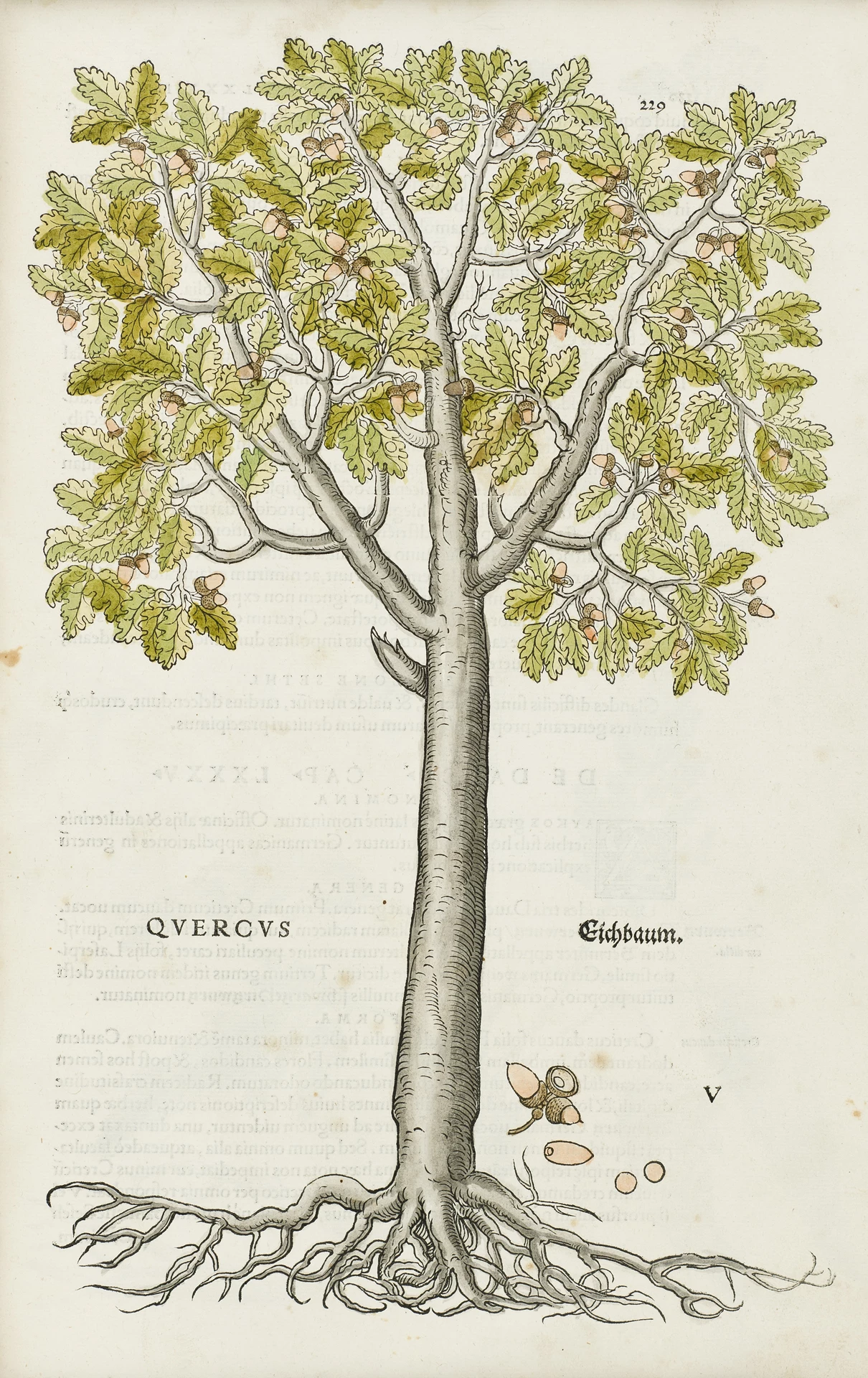
16th century books in the Willoughby Gardner Library Kristine Chapman, 14 August 2017 Pierre Belon - L’histoire de la nature des oyseaux (1555) In 1953 Amgueddfa Cymru - National Museum Wales received the donation of a significant collection of over 300 natural history books, early and modern, from Dr Willoughby Gardner of Deganwy, north Wales. Dr Gardner was born in Cheshire in 1860, but ill health forced him to take early retirement. He went to live in Deganwy in the early 1900s, where he was able to dedicate his time to pursuing his interests, which spanned archaeology, entomology and numismatics. Because of these interests, he had a close relationship with the Museum, for example, he did a great deal of work on surveying hill forts in Wales, and a number of finds from those digs were donated to the Archaeology department. And a few years before his death he donated his collection of British Aculeate Hymenoptera to the Zoology department. However his donation of a substantial library of early natural history books, ranging from the 15th to the 18th centuries was by far his most generous bequest, and contains a number of rare treasures, especially those from the 16th century. Books from this period illustrate the widespread and confident use of printing since the invention of the movable type printing press in 1450 by Gutenberg revolutionised the industry. The innovation spread from Germany throughout the rest of Europe, and by 1500 the number of printer’s workshops had dramatically increased, and they had refined their processes enough to produce books in ever greater quantities. This allowed for an increased exchange of information and ideas that resulted in significant advances in the fields of natural history during the 16th century. Herbals While early subjects for printing tended toward reprints of works from classical antiquity, by the mid-16th century a much wider range of subjects were covered. Very popular at this time were herbals, guides to plants that primarily focused on their properties as medicinal aids. The plants were listed, along with full descriptions and details as to what illnesses they could cure. They were often written by leading physicians and were aimed at the layman rather than the scholar. The descriptions would often include illustrations of the plants, known as woodcuts. A woodcut is a form of relief printing that takes its name from the method of creation, a block of wood is carved away to reveal a raised design. This is inserted into the printing form alongside the text, inked up and printed as one. Afterwards the illustrations can be coloured by hand if required, although a book with coloured illustrations would have been much more expensive. The collection of herbals from the 16th century in the Willoughby Gardner collection covers many of the leading publications of the time, including works by Otto Brunfels, Leonhard Fuchs, and Hieronymous Bock, often known as the ‘Fathers of German Botany’. The Herbarum vivae eicones of Otto Brunfels was influential in that its drawings were primarily taken from life rather than copied from existing works, as was the standard practice of the time. They were also rendered as lifelike as possible instead of the more stylised designs which had been more common in German herbals. First published in 1530, the copy held in the Willoughby Gardner collection is a later volume from 1532. In 1539 Hieronymus Bock published a herbal in his native language, German, which was later translated into Latin and made more widely available. Willoughby Gardner had a copy of the Latin translation, called De stirpium maxime, published in 1552, with hand coloured illustrations. What makes his copy special, is that at some point someone has gone through and written the English names for some of the plants next to the illustrations. De historia stirpium by Leonhard Fuchs was published in 1542, the copy held in the Willoughby Gardner collection also has coloured illustrations, although sadly is incomplete as a section of pages from the middle of the book are missing. Also included in the collection is A niewe herball, or historie of plantes by Rembert Dodoens, an English translation of 1578 taken from an earlier French edition. Originally published in Flemish in 1554, with the French version soon after, many of the illustrations were based on those of Fuchs, although the text was original. Leonhard Fuchs - De historia stirpium (1542) Conrad Gesner - Historiae animalium (1551-58) Zoology As well as the herbals, there are a number of other significant books in the collection dating from the mid-16th century, although these focus more on the field of zoology. Works in this area include; Edward Wotton’s De differentiis animalium libri decem from 1552, a bibliography of the work of classical authors, he was considered to be the first naturalist to make a systematic study of natural history. Guillaume Rondelet’s Libri de piscibus marinis, from 1554. Rondelet was a physician and professor based at the University of Montpelier in the south of France. Libri de piscibus marinis is his most famous work, and covers the full range of aquatic animals as scholars of this period made no distinction between fish and sea mammals. The book was a standard reference for students for nearly a century afterwards. Pierre Belon’s L’histoire de la nature des oyseaux from 1555. Belon was a French explorer, naturalist, writer and diplomat who had been in a position to travel extensively throughout Europe and often recorded the wildlife he encountered in situ. Like many others of the Renaissance period, he studied and wrote on a range of topics including ornithology, botany, comparative anatomy, architecture and Egyptology. And, multiple copies of Conrad Gesner’s Historiae animalium a five volume work, the first four volumes covering quadrupeds, birds and fish was produced in 1551–1558, while the fifth volume on snakes was issued posthumously in 1587. It was Gesner’s intention that his great encyclopaedia should record all of known life both real and mythological, which is why sea monsters, manticores and unicorns are also covered! Gesner was a doctor and professor in Zurich, and unlike Belon he was not in a position to travel as much, relying instead on submissions from friends and colleagues across Europe. First hand observation was not always possible, and because Gesner had decided to include everything written on the animals he featured, he wasn’t always able to guarantee the accuracy of the information. But as he explained himself he: “[thought] it best to record everything that he has been able to meet with, in order that future specialists in the various branches of natural history should have everything placed before them and draw their own conclusions in each case”. Further reading Arber, Agnes. Herbals: their origin and evolution, 3rd edition. Cambridge University Press, 1986 Kenyon, John R. The Willoughby Gardner Library: a collection of early printed books on natural history. National museum of Wales, 1982 A version of this article was first featured in the Friends newsletter.