Museums, Exhibitions and Events

Breeding failure

Katie Mortimer-Jones, 30 April 2014

It now looks that the breeding attempt by Peregrine Falcons in the clock tower has failed. All indications were that eggs were laid during late March and early April and if all had gone according to plan, they should have been hatching about now (eggs are usually incubated for 31-33 days). Unfortunately, no birds have been seen at the nest or perched nearby on the clock tower for several days now so it seems certain that the nest has been abandoned. We do not know why this breeding attempt has failed but the most likely cause is that the eggs have been eaten by predators, perhaps crows, ravens or gulls. Although peregrines only raise one brood each year it remains possible that the birds will make a second attempt to breed and we remain vigilant in case that happens.

Adrian Plant

The Peregrines are back

Katie Mortimer-Jones, 26 March 2014

The Peregrines are back on the City Hall Clock Tower. One bird seems to be spending most of the day hidden in the recesses of the nest (on the right hand side of the ledge underneath the clock face), suggesting that she may have started incubating eggs. This would imply a laying date a little earlier than we have seen in previous years. However, we are aware of another local pair of peregrines that are incubating eggs, so perhaps it is an early season this year. Museum Curator Adrian Plant has taken over the duties of the Peregrine Web-cam, and will be keeping an eye on them for us.

 We will keep you posted on what happens.

The unknown soldier

Jennifer Barsby, 27 February 2014

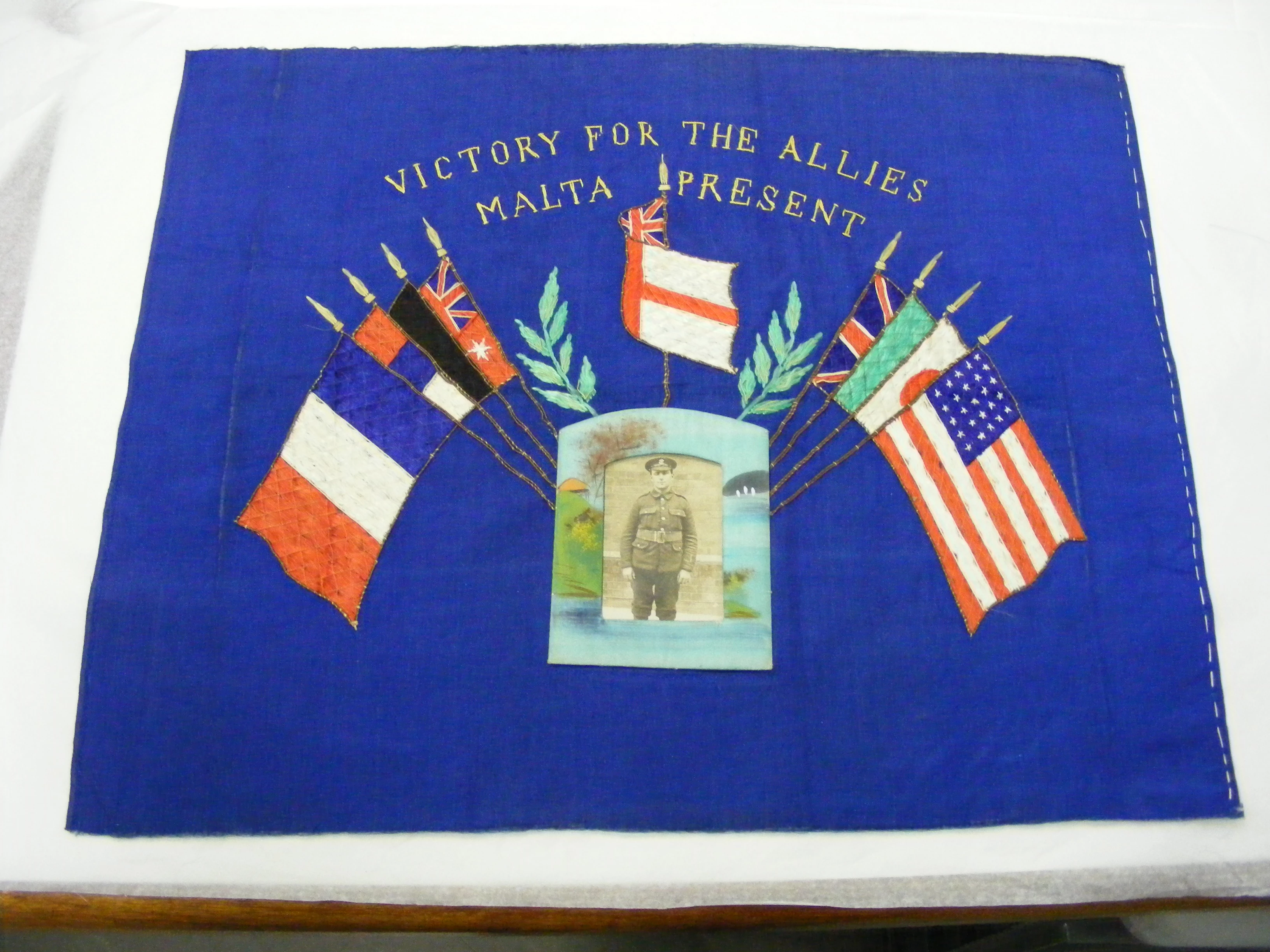
As part of Amgueddfa Cymru’s First World War centenary programme the collections relating to this period will be conserved, digitised and made available online. My role at the museum is Textile Conservator so I am responsible for the practical care of the textile collections across all seven sites. There are many WW1 objects in the textile collection; most take the form of commemorative or souvenir pieces, while others are costumes and accessories.

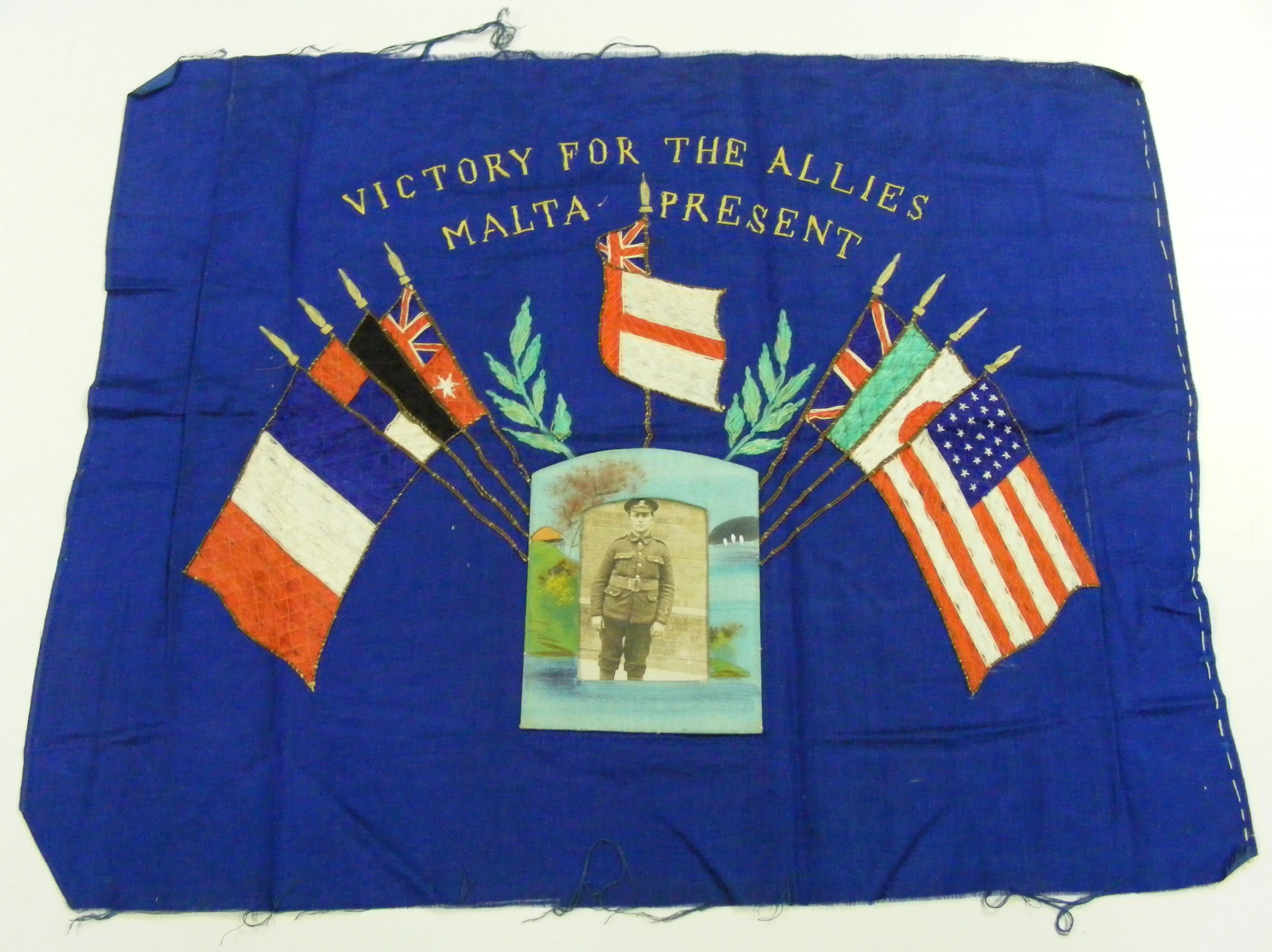
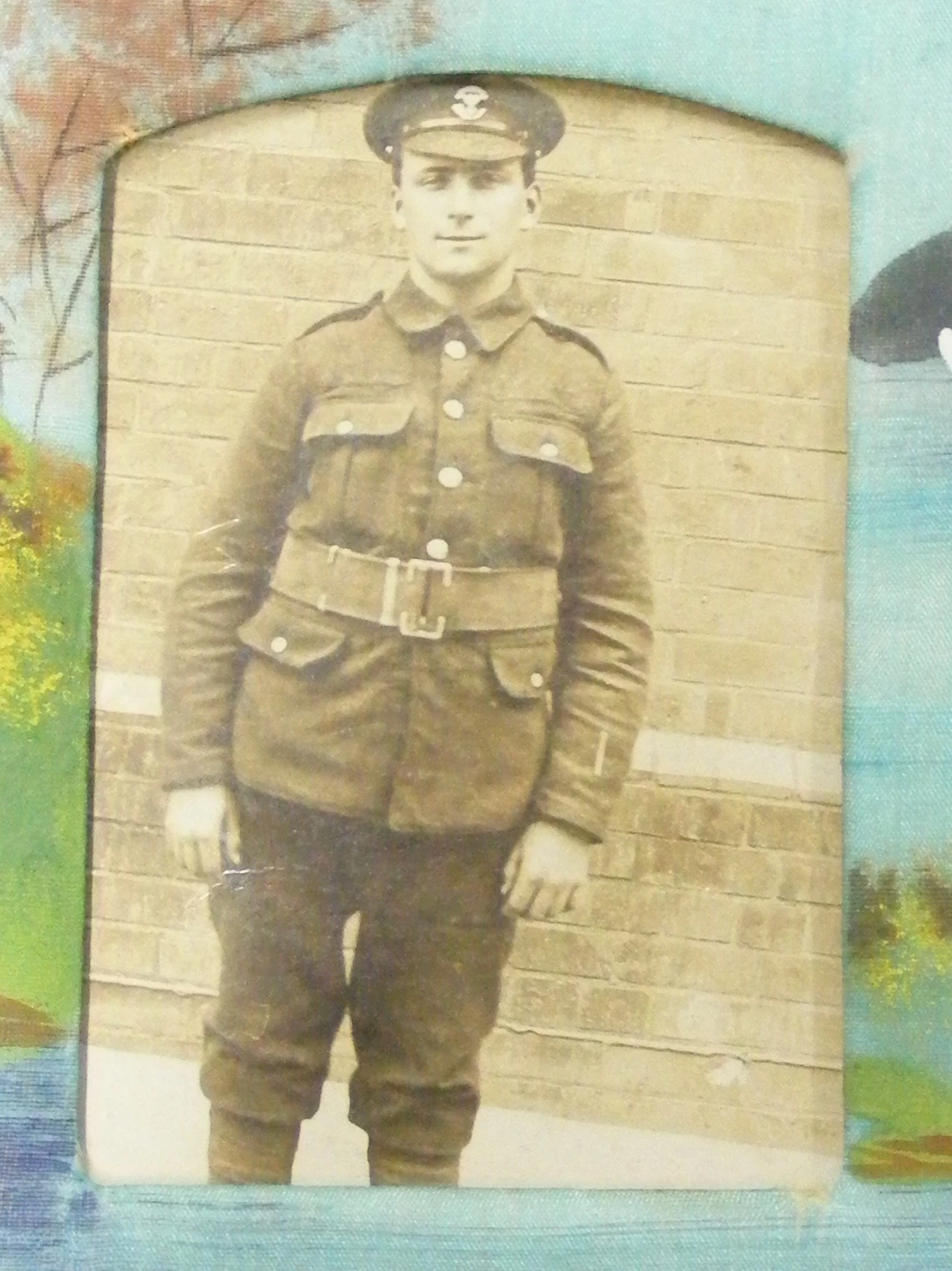
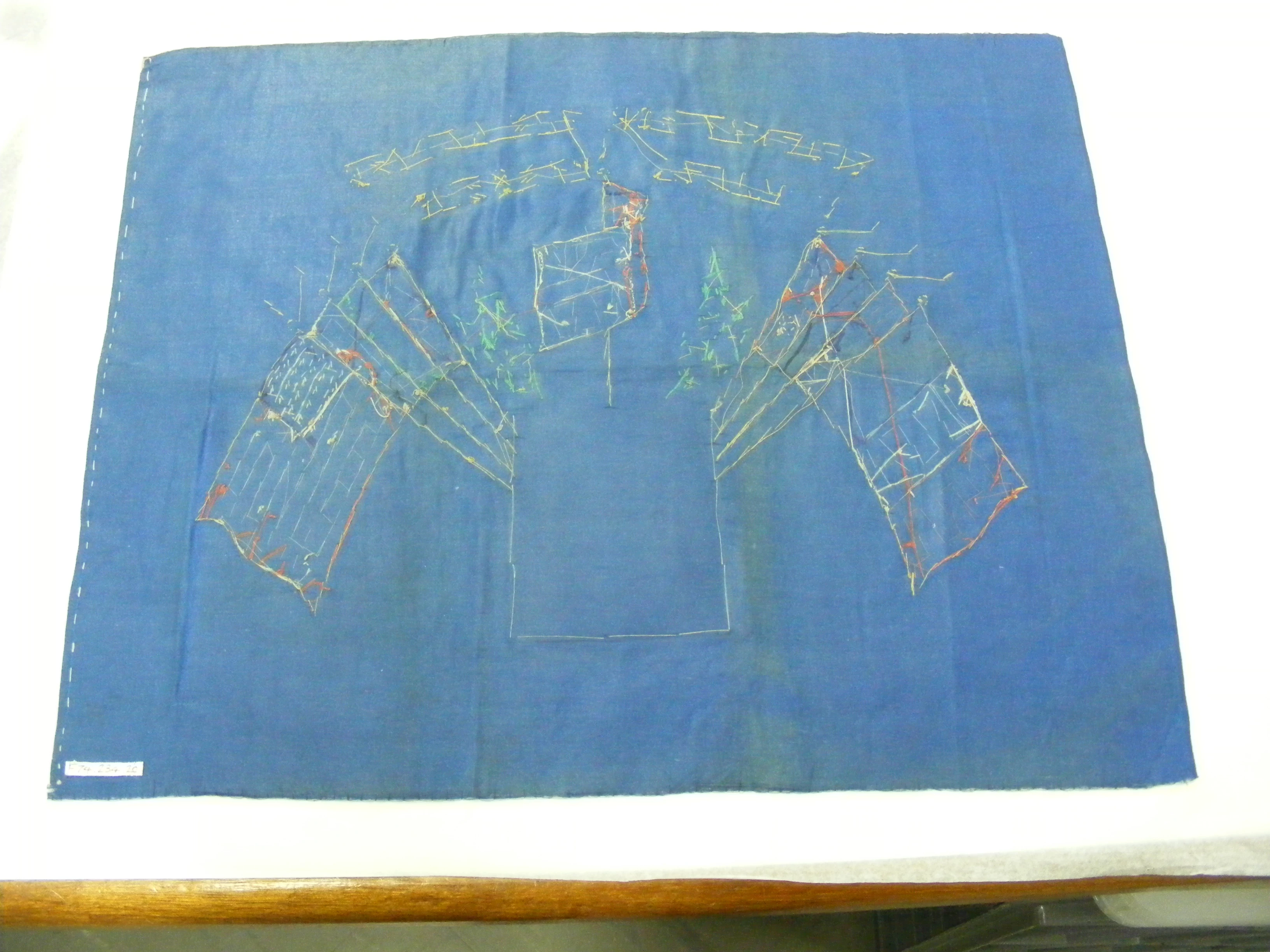
One of the objects recently conserved for the project is an embroidered panel measuring 43.5cm × 53.5cm (maker unknown). It is made from a single piece of royal blue silk satin embroidered with flags and text which reads ‘VICTORY FOR THE ALLIES MALTA PRESENT’ in yellow silk thread using stem stitch. It also features a photograph of a Welsh soldier printed onto a postcard which is slipped inside a frame made from card and covered in painted silk. The frame is tacked to the satin along the bottom and sides with the top edge left open. The flags are made with lines of silk floss which have been laid down to form the coloured sections and secured in a criss-cross, net-like fashion and couched using a very fine thread. Thicker, cotton threads are used to define the sections of colour. The flags and poles are made from a coiled paper thread with a cotton core.

When it came to the conservation studio the panel was in a fair condition with some light surface soiling all over and creasing across the silk from being folded around the frame at some point, probably before it came to the museum. It is possible that the panel once had an adhesive backing as the embroidery threads on the reverse appear stiff and flattened. There is also some abrasion to the surface of the embroidery threads and satin floating yarns. The top and bottom edges are frayed and there are several splits in the ground fabric where it has been stitched through.

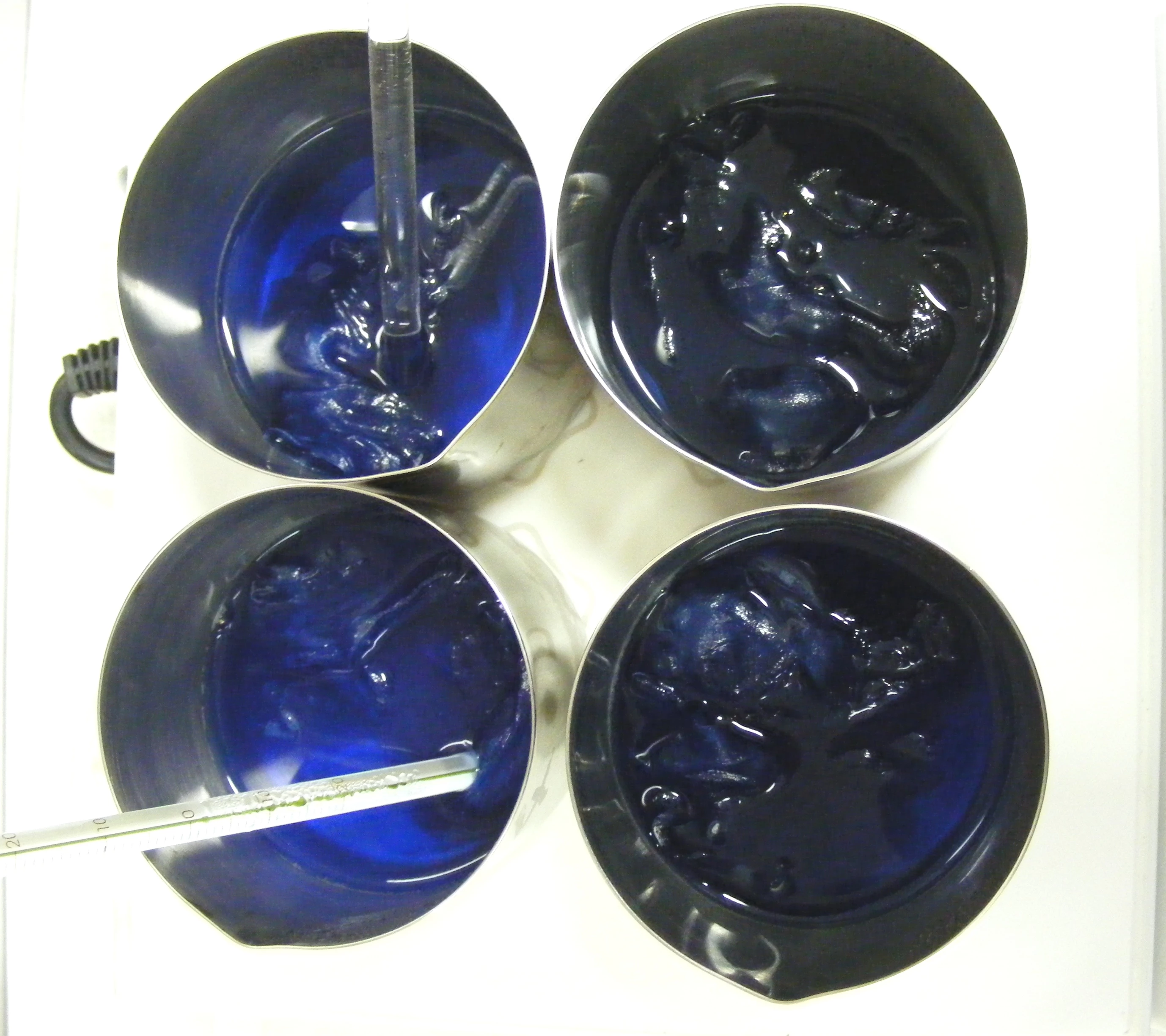
The conservation treatment began with a surface clean using a micro vacuum to pick up dust and fluff. It was then humidified to remove the creases; we cannot iron historic textiles because the heat and pressure of conventional irons can cause further damage. Instead we use gentle techniques with cold water vapour or, in this case, a combination of materials layered up to introduce moisture gradually to the textile, giving it time to penetrate the fibres. Once the fibres were relaxed, glass weights were used to hold them in position whilst drying. The photograph was removed during the humidification process to avoid any damage. The next stage was to support the splits in the satin which affect the stability of the textile. Fine silk crepeline was chosen to do this because it gives a light support but is almost transparent, so even though it covers the reverse you can still see the threads; it was dyed blue to match the colour of the satin. The crepeline was fixed to the textile using a very fine layer of thermoplastic adhesive, which was applied to the dyed crepeline and allowed to dry. The adhesive was then re-activated to bond it to the reverse of the panel using a heated spatula; the bond created is enough to support the textile but not so strong that it cannot be removed in the future if required. The frayed edges were then laid out and secured though to the backing by working a blanket stitch along the edge using a fine polyester thread.

The textile is now back in store but will soon be available to view online and may one day go on display at St Fagans. Keep checking the blog for more updates as the project progresses!

The soldier in the photograph is yet to be identified; if you recognise him please contact the museum via Elen Philips, Principal Curator: Contemporary & Community History. Tel: 029 2057 3432 – or on Twitter: @StFagansTextile

The Participatory Forums

Penny Dacey, 25 February 2014

The Informal Learning Forum

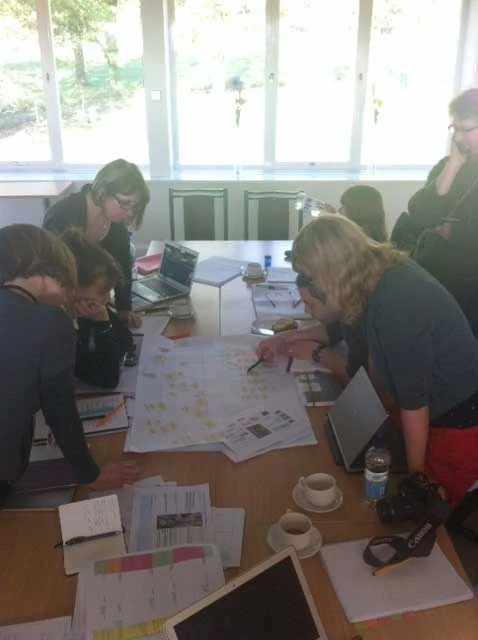
Informal Learning in this context refers to learning outside of the school curriculum. The group consists of representatives from organizations across Wales that facilitate adult and family learning. Most members had previous knowledge of the project having participated in workshops during the planning stage. This group have agreed a remit of work which includes; helping to develop a programme of activities that appeals to people of varied background and ability and reviewing gallery content to ensure we provide appropriate interpretive methods for these audiences.

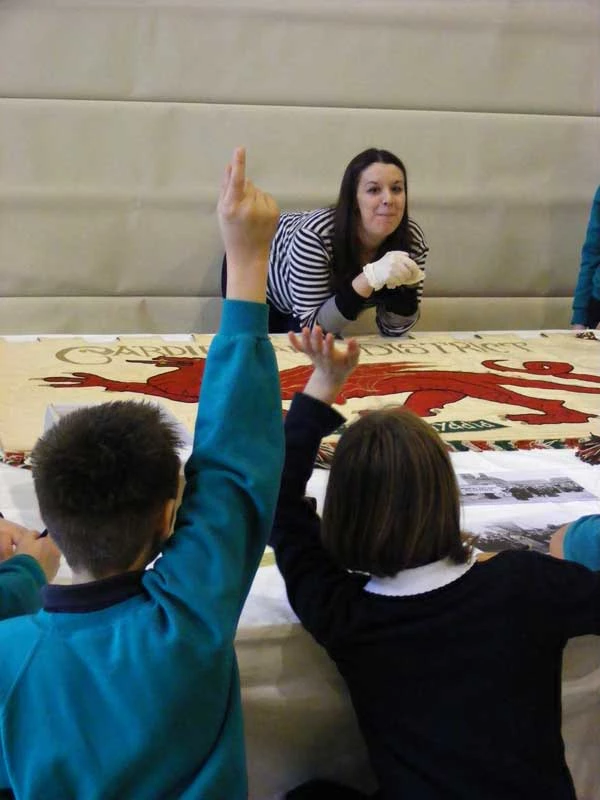
As a result of this Forum a group of adult learners from the Workers Educational Association (WEA) participated in interpretation workshops in July. The workshops provided an opportunity for the group to give their views on items intended for the ‘Wales is’ gallery. Objects studied at close hand included a tailors quilt and artefacts dating from the First World War. The sessions were facilitated by curators working directly with the objects – ensuring that the feedback gleaned has a direct impact on their work.

Bryn Eryr Farm - How to become an Iron Age Carpenter

Penny Hill, 9 January 2014

As Steve said in his last blog posted in December, we’ve started work on growing the thatch for our new Iron Age farm. Alongside this work we’ve also been giving a lot of thought to the objects that will go inside the houses.  Far from being primitive, these replica objects will reflect the high level of knowledge and skill possessed by people who lived in Bryn Eryr over 2000 years ago. One of the first tasks is to furnish the round houses with all those essential objects that no self-respecting Iron Age household could do without, such as plates, bowls, utensils, buckets , storage containers, shelves, barrels, weaving looms, beds, just to name a few.

In this period all these items were made from wood, but we have a problem, wood deteriorates quickly in the ground so objects made from this material rarely survive.  However, we think we can find out more about the wooden objects they would have had by studying the carpentry tools available at this time. These were made from iron and because of this have survived in greater abundance. Ancient iron-work is often much underrated as it doesn’t look very attractive, but when trying to recreate everyday life the information domestic ironwork objects can provide is invaluable.

The first stage of making the replicas was to search the archaeological collections for any original Iron Age carpentry tools.  Much to my delight we had quite a lot of material and could virtually recreate a whole tool kit from examples found throughout Wales. Our Bryn Eryr tool kit will therefore consist of an axe, adze-hammer, gouge, chisels, files, drill bits and numerous wedges from small to large.  Timber in the Iron Age was divided up by splitting with wedges rather than cutting with a saw.  Saws did exist, but were small, similar to modern pruning saws today.

An Iron Age household would be equipped with a wide range of tools for a variety of purposes. Some of these objects appear strange to us today, but others are quite familiar. A 2,000 year old chisel found in the Roman fort of Brecon Gaer and a gouge from the Hill Fort at Castell Henllys wouldn’t look out of place in a carpenter’s tool kit today.

Once our tool kit had been compiled from the examples in the collection, the next step was to make working replicas that could be used by our craftspeople to recreate the objects for Bryn Eryr.

Careful conservation of the original tools had preserved some of the original surfaces. Marks on these surfaces enabled our blacksmith 2000 years later to work out how they were made and reproduce the replicas as accurately as possible.  The replicas are recreated in wrought iron like the originals, which is much softer than the steel used today, so it will be interesting to see how these tools perform? Will we be able to produce a decent cutting edge, how quickly will this edge dull and how often will it need to be sharpened?

Making the tool heads is only half the story, these tools can’t be used without handles!  None of the originals survive and from the shape of some tools we just can’t pop modern handles on them.  We know our tools once had wooden handles, because in some cases the deteriorating iron around the socket  had made a cast of the wood surface before the handle disappeared.  Using a combination of this information and some surviving material from elsewhere, plus the expertise of our own carpenters and estate workers, we managed to reproduce handles to complete the tools.

Now all we have to do is see if they work! More importantly have we still got the expertise to use these tools properly? Hopefully by using them we’ll gain an insight into the skill of our Iron Age carpenters.  I’m sure they would be laughing themselves silly if they could see our efforts today, but we have to start somewhere!

So, how did our tools perform? Its early days, but everyone including our craftspeople are impressed. They appear to be performing well, we even managed to split a large piece of timber with our wedges.  It probably explains why so many of these wedges end up in our collection, they tend to get lost inside the timber during splitting and fall to the ground where they are difficult to spot!

We hope to undertake more experimental work to assess the performance of these tools, so keep watching this space, but in the mean time we have to crack on, there’s the contents of a roundhouse to make!