Adrian in the Amazon - part 9 Adrian Plant, 30 April 2015 Back to civilization again - the regional capital of Loja, a small town nestled under forested Andean slopes and home to the regional Ministry of Environment where we must go once again, to obtain permission to move the samples we have collected back to Quito.Unlike our previous brush with officialdom in Tena (our samples from there still have not been released!... but we have some local support to ensure that they eventually will be), the officials in Loja were helpful, polite and efficient! We had allowed 2 days to process the permissions in Loja, but in the event, we received our permits within 30 minutes, leaving us the best part of 2 days to explore the town and sample the local culture and cuisine.Meanwhile, here are some more photos from our time in the field.To read more about Adrian's travels, go to our Natural History blog page
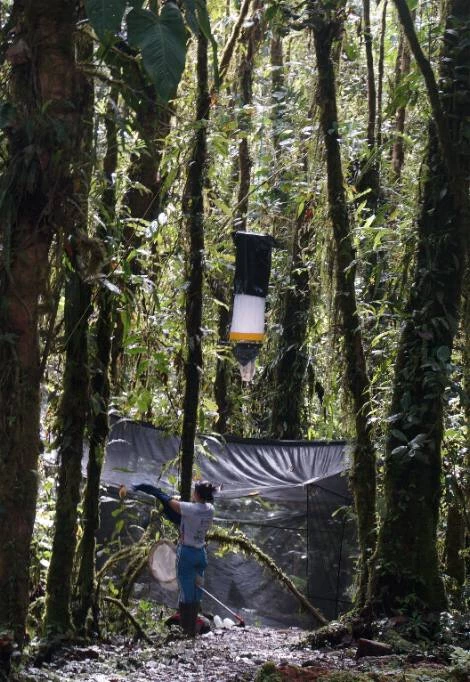
Adrian in the Amazon - part 8 Adrian Plant, 28 April 2015 A week has passed during which the rains slowly abated (at least for part of each day). Dryer vegetation means that our nets (and ourselves) don’t rapidly become water-sodden and we can catch insects more easily and effectively. Whenever the weather has allowed, we have been climbing through the forest searching for flies and enjoying a good measure of success in our quest.Many of the species we have been catching belong in genera with which we have little familiarity; being rare and little-known, even to specialists such as ourselves. Finds such as these make all the hard slogging up precipitous slopes, cutting through dense vegetation, deep sucking mud and scratches and bites from a myriad of thorny plants and man-eating insects worthwhile! I guess you have to be a shade unhinged to enjoy this sort of thing. . . or a field entomologist perhaps?Our time at Estación Científica San Francisco is now drawing to a close and tonight we have been sorting and labelling our samples carefully to ensure they are ready for shipment back to our bases in Cardiff and Manaus. Proper field curation of collected specimens is a vital part of expeditions such as ours, ensuring that all data (where/when an insect was captured, what it’s habitat was and how it was behaving etc. etc.) is properly cross-referenced with the actual samples. Were the samples to become detached from their data they would be rendered useless, of mere cosmetic interest.To read more about Adrian's travels, go to our Natural History blog page
Adrian in the Amazon - part 7 Adrian Plant, 27 April 2015 We have made it to the Estación Científica San Francisco in Podocarpus National Park, Loja Province. Well, we made it but one of our bags didn’t, apparently having been left behind in Quito. We are hopeful that it will arrive tomorrow in Loja and we can arrange for a taxi to bring it the hour or so’s drive to the Estación. Meanwhile we are getting to know our new home for the next week.The Estación is perched on the side of a narrow ravine in dense forest through which flows the Rio San Fransisco. All our routes into the forest start with a spectacular crossing of the river using a wire cradle suspended from a rope running through pulleys at either end high over the water. Progress is made by pulling hand over hand on the opposing rope until the other side is reached. Once over, the ground is very steep and densely forested. Our intial forrays into the near reaches of this wilderness indicate a spectacularly diverse fly fauna. . . and that is what we are here for. We have set our Malaise traps but the incessant rain is making other fieldwork difficult so we will have to wait for better weather to get further afield and explore more.You can read more about Adrian's travels on our blog page
Adrian in the Amazon - part 5 Adrian Plant, 22 April 2015 Our time at Yanayacu has drawn to a close. The final days fieldwork saw us collecting in the Malaise traps we had previously set and making several forays to a particularly good stream site where we had hoped to find more species of Hemerodromia. Hemerodromia is the focus of Josenir’s PhD work at INPA and we have been searching hard for specimens to help her studies.Alas, many hours of wading up streambeds, sloshing through mud and slithering over mossy spring sources has yielded but a handful. These will be valuable for her studies but we can’t help but feel a bit disappointed by the results on this aspect of our expedition. We have speculated long and hard as to why Hemerodromia has been so hard to find. Perhaps these aquatic insects have been washed out of their streams by the unusually strong rains we are experiencing? It seems that a particularly strong El Nino event has commenced bringing late rains throughout Ecuador.During the evenings we have been running an ultraviolet light to attract nocturnal insects to the Biological Station. A couple of nights ago we were absolutely inundated by insects with vast numbers of hawk moths, tiger moths, giant Hercules beetles and enormous stoneflies (Plecoptera) known as Dobson Flies in the US, coming to the light. It’s odd but the best nights for attracting insects are not warm balmy ones but those with torrential rain and enveloping cloud. And such were the conditions on this particular occasion.To read more about Adrian's expedition - read his past blog posts.
Adrian in the Amazon - part 2 Adrian Plant, 31 March 2015 Ecuador at last! Josemir Camara and I have now arrived in Quito, after a long dog-legging flight from Manaus up to Panama City and back down to Ecuador. While we arrange the logistics of our onward travels, we have a little time to explore some of the sights of the world’s highest capital city and to visit the insect collections at the museum of Quito’s Catholic University. The collections of museums around the World house a vast treasure-trove of knowledge and visits between curators of different museums can be significant in unlocking this knowledge for wider appreciation and usefulness.Specialists such as myself and my Brazilian colleagues José Albertino Rafael and Josenir Câmara are able to provide insight into the significance of these collections, promote wider recognition of their value and significance as well as provide pointers to how their importance may be communicated to their own nationals. Of course we have a vested interest too - we get to see specimens of animals we have only ever dreamed of!Sometimes we can arrange loans between our institutions to support our own research or to facilitate contact with others who have something to contribute to the understanding or interpretation of the collections. While it is certainly true that most of insect biodiversity has never been seen (or knowingly seen) by a human being, it is also true that a proportion of that unknown diversity is represented in museum collections and people like me and my Brazilian colleagues are in the very special situation of being able to recognize its importance.