
: Department of Art

Using the national art collection to support NHS staff wellbeing

Stephanie Roberts, 22 April 2021

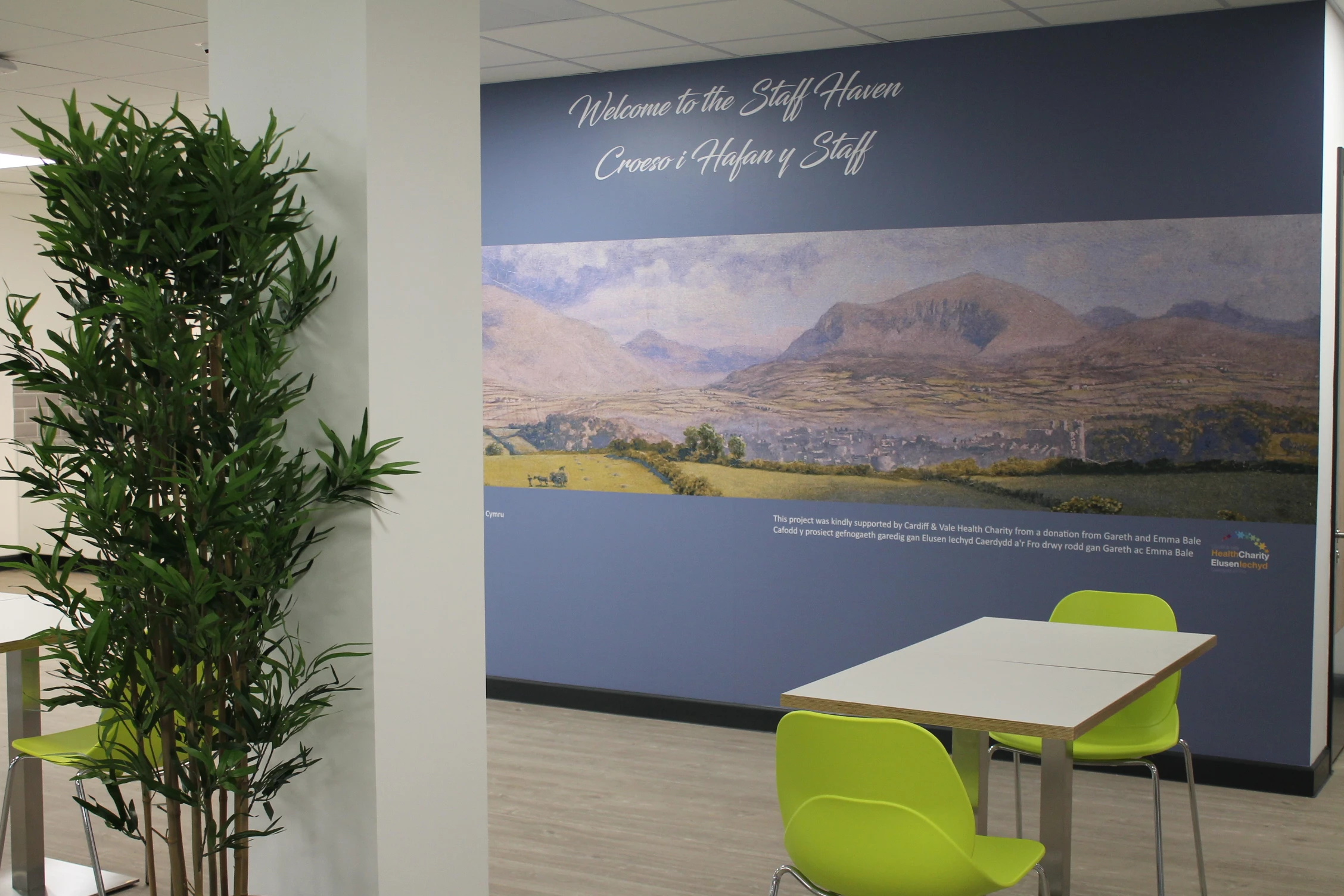
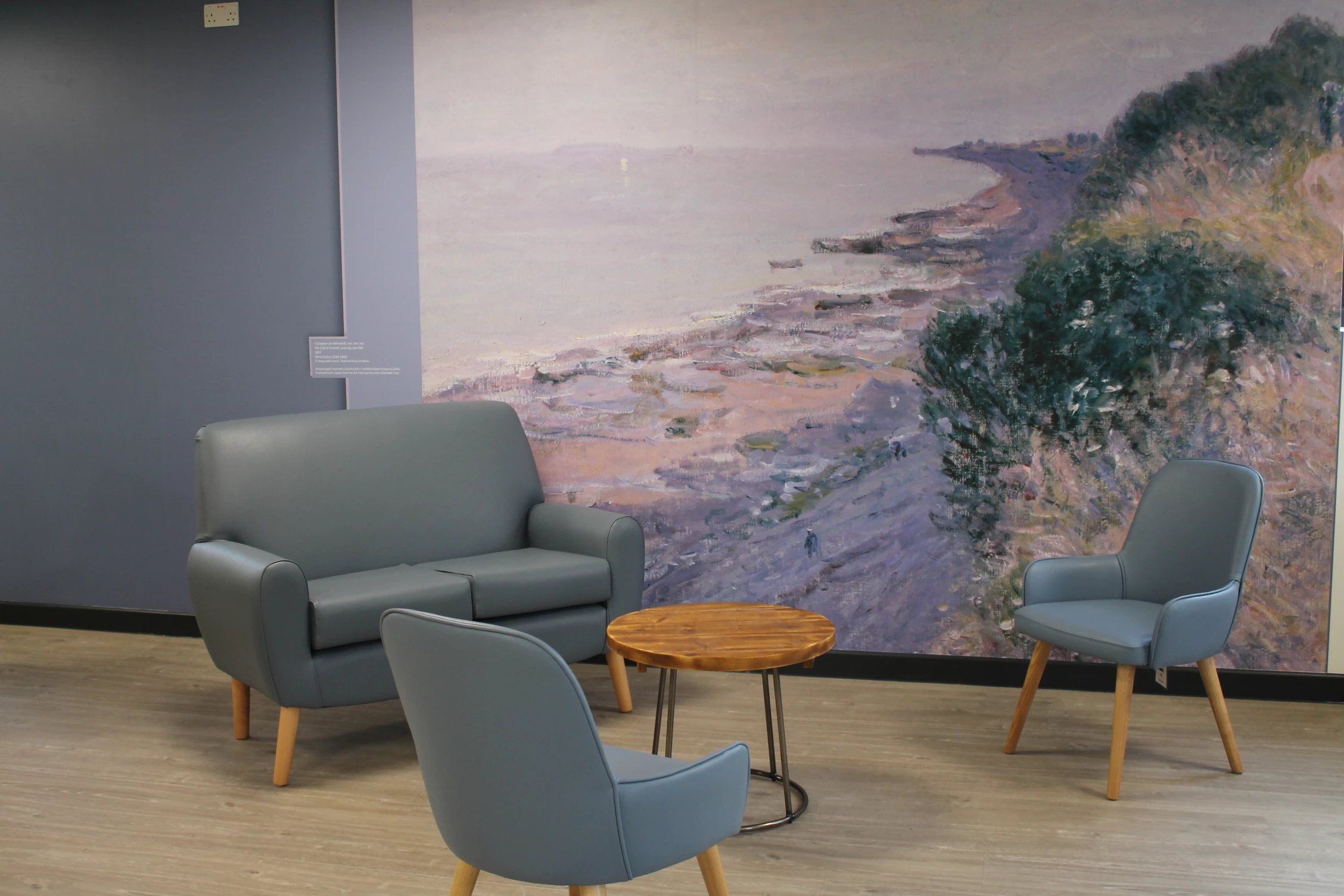
Images from the National Museum of Wales in University Hospital Wales Lakeside wing staff haven

Images from the National Museum of Wales installed at the University Hospital Wales Lakeside wing staff haven

Detail of a large reproduction print of Alfred Sisley’s <em>Cliff at Penarth, evening, low tide</em> from the National Museum of Wales in University Hospital Wales Lakeside wing staff haven

Alfred Sisley’s Cliff at Penarth, evening, low tide, reproduced at Lakeside Staff Haven

A large reproduction print ofJohn Brett's <em>Forest Cove, Cardigan Bay</em> from the National Museum of Wales in University Hospital Wales Lakeside wing staff haven

John Brett's Forest Cove, Cardigan Bay, reproduced at Lakeside Staff Haven

Large reproduction print of Andrew MacCallum's <em>Autumn Sunlight after Rain</em> from the National Museum of Wales in University Hospital Wales Lakeside wing staff haven

Andrew MacCallum's Autumn Sunlight after Rain, reproduced at Lakeside Staff Haven

As the COVID-19 pandemic worsened over the winter of 2020, and the pressure on NHS staff has increased, Amgueddfa Cymru took the national art collection into hospitals to provide solace for staff and patients.

Like many others, we have watched in awe – and horror - as NHS staff continue to make personal sacrifices day after day under unthinkable circumstances. We realise that we have seen only a fraction of what goes on behind-the-scenes, and have asked ourselves what can we, as a museum, do to help?

As part of Celf ar y Cyd - a suite of projects designed to find new ways for people to experience the art collection during the pandemic - we set out to work with

health boards across Wales . We wanted to give NHS staff the chance to make art part of their working day, and to decide for themselves how art can be incorporated into their work environment

Lakeside Staff Haven

At the start of February 2021, a Staff Haven facility opened at the new University Hospital Wales Lakeside wing in Cardiff. The Staff Haven is a space for hospital staff to step away from the intense working environment for a moment of respite and calm. People choose to do this in different ways and so the area is multifunctional. It includes a kitchen, shower facilities, and a quiet area where staff can decompress, read, reflect, sit alone, or be among colleagues. The entire space is a mobile-free zone.

Hospital staff were consulted about the overall design, look and feel of the Staff Haven through a poll on their internal intranet, NHS Connect. There was a strong feeling that it should have a nature theme.

Research has shown that nature and the natural world are popular themes in hospital environments, and an article published in the Journal of the Royal Society of Medicine suggests that this might be due to evolutionary psychology: healthy natural environments stimulate a positive emotional response in humans. It also suggests that the cooler blues and greens often found in nature produce more calming sensory effects than hotter tones, like reds and yellows.

When we heard about plans for the Staff Haven, we knew that we wanted to be involved – and that we had the perfect resource. The national art collection is rich in artworks that celebrate the beauty of the natural world - the difficulty was narrowing down the choice!

Selecting the works

We felt that the visual and therapeutic qualities of the images was more important than art historical significance in a hospital setting, and for our long-list we chose works that had a tranquil feel, and ones that could help ‘open out’ the space with expansive skies, and distant vistas. Many of the works are Welsh views, and included popular highlights, like Alfred Sisley’s Cliff at Penarth, evening, low tide alongside some lesser-known works, including Robert Fowler’s A Bend in the Conway . Sisley was facing ill health when he painted this scene in Penarth, and Robert Fowler too came to Wales for a period of convalescence.

We shared the long list of images with hospital staff and Grosvenor Interiors , a company specialising in healthcare interiors who had been commissioned to design the space. They narrowed the list down, choosing works which complemented one another, and avoiding anything that would be visually jarring. The colour and tonality of the artworks were important to create a sense of unity and calm, and this helped inform the final choice.

A few key colours were chosen from the artworks - a soft blue, taken from clear skies; a deeper, denim blue from moodier skyscapes; and an olive green – and these were used as the colour palette for furniture and walls. Some of the images were reproduced as floor-to-ceiling murals, others as smaller, cropped versions of the original artwork. This allowed for experimentation with scale: it was quite exciting to see a small-scale watercolour like Thomas Hornor’s The Rainbow blown up to a size that you feel you can almost step in to! Reproducing the images at such a large scale creates an immersive experience in the Haven.

We invited poets Hanan Issa and Grug Muse to write new poems in response to the project, picking up on some of the themes and motifs in the images, and these will be reproduced on the hospital walls.

The Staff Haven opened on 1 February 2021, and is now being used daily by staff working at the hospital. We hope that the images from Wales’ national collection will help make it a more pleasurable place to be, and that it brings some beauty and relief to their working days.

Funding and support

The Staff Haven at Lakeside was developed by Cardiff & Vale Health Charity, and the Employee Health and Wellbeing Service thanks to funding from a large donation made by Gareth and Emma Bale during the pandemic.

Amgueddfa Cymru support was made possible through Celf ar y Cyd. This is a series of visual arts project in collaboration with Arts Council Wales with the support of the Welsh Government, which challenges us to share the national art collection in new and innovative ways during the pandemic. The other strands of the project includes our online visual arts magazine, Cynfas, and the Celf 100 Art exhibition. Follow us on Instagram @celfarycyd for more.
Gwen John: ‘It’s tone that matters’ Part 2

Neil Lebeter, 9 June 2020

This is the second part of a look at some of Gwen John’s work in the Amgueddfa Cymru collection. Part one looked at how the largest collection of Gwen John works in the world came together as well as an important example of her early painting technique.

From the mid-1910s onwards, we see this technique change quite dramatically. John moves almost exclusively to female portraits and to applying paint much more sparingly, and with no upper layers or varnishes. Brush strokes become visible and compositions are flatter and less smooth. Again, we see John shift with the artistic movements around her as other artists in Europe were working with similar techniques.

John’s portraits are perhaps what she is best known for. There is something intangible about the mood that these works impart; they are highly emotive, yet elusive. What really highlights John’s genius is how complex these compositions are; how technique is the foundation for the feeling that these portraits exude.

A good way of highlighting this is to look at an unfinished work…

Study of a Seated Nude Girl (c. 1920s)

Study of a Seated Nude Girl (c.1920s)
Oil on canvas
32.4 x 24.1 cm

The flatness and tonal harmony of John’s portraits has been discussed often – how the sitter and background often blend together so that they appear as the same surface. What is extraordinary about the way that John worked was that she painted from the edges - often with no preparatory sketching. She would start at a corner of the canvas and work inwards, as we can see here with this work. The facial features become almost secondary in the construction of the painting, as they are painted last, or not at all in this case. Any painters out there will appreciate how hard this is to do – the spatial awareness to be able to form a cohesive work by starting at its extremity is extraordinarily difficult. Also, what this does is heighten the sense that background and sitter are the same thing – the figure, and particularly the facial features, are not given any particular importance over the rest of the structure of the painting.

On the reverse of this painting is another work of the same sitter, clothed this time, and nearer completion. You can see that the features are almost the last part of the painting to be worked on.

Girl in Blue Dress (c. 1914-15)

Girl in Blue Dress (c. 1914-15)
Oil on canvas
41.8 x W 34.5 cm

We’re now going to come back to Girl in a Blue Dress. From 1915 onwards John’s work changed and this is one of the earliest examples of this dry technique. This is an extraordinary painting and is one of the most popular works in the Museum.

Here John applies a chalk and animal glue ground which contains small bubbles made as the warm glue and chalk are stirred together; creating a textured surface to the canvas. This ground layer and the subsequent oil paint layers are both applied very dryly and thinly, with brush marks left visible.

In these details the brown paint layers can be seen to have skipped over the white ground, leaving much of the ground showing through. This gives the work the appearance of a fading fresco and adds to the sense of fragility of the sitter. The paint is applied so dryly and so evenly to both background and sitter, that they appear the same – they blend into one surface.

Looking at the painting in differing lights shows us some more interesting things.

Light shone from the side shows how uneven the canvas is and very different from a smooth, commercially prepared canvas. This is almost certainly deliberate, adding to that sense of texture.

Infra-red light shows a small amount of preparatory sketch work, outlining the basic elements of the composition prior to painting.

We also know that John came back to rework this painting, as shown here under UV light. This shows that she made changes with a white paint containing more zinc, which shows up under UV. Even as reworking, these are still the slightest of touches.

Most extraordinary though is this…

Shining light through the back of the canvas shows just how little paint has been applied. This highlights John’s skill to produce a work so affecting without really using any paint at all, there’s barely anything there.

little interior

The Little Interior (1926)
Oil on canvas
Bequeathed by Gaynor Cemlyn-Jones, 2003
22.2 x 27.3 cm

This work from 1926 shows the interior of John’s home in the Paris suburbs and was one of the paintings shown at John’s only solo exhibition held during her lifetime. It shows the sparsest use of colour, predominantly subtle tonal differences of the background with a small focal point of the teapot at the centre of the canvas.

After the horrors of the First World War, many artists rejected avant-garde ideas – returning to more traditional approaches to art. Futurism and Vorticism, for example, which celebrated technology and automation prior to the War, were abandoned as those very things were key contributors to the slaughter. Known as the ‘Return to Order’ this saw artists such as Picasso and Braque largely abandon Cubism for more traditional methods. There was a resurgence of classicism, of order and realism in painting. Alicia Foster writes in her biography of Gwen John that her work seen through the prism of the ‘Call to Order’ is complex, but where John’s work chimes with the movement is through the precise measurement and organisation of colour – as we can see here with The Little Interior.

John described using an extremely complicated numbered disc which denoted colour and tone relationships to any other colour and tone. She also developed her own notation system to sketch out and record planned compositions. This ‘code’ has proved incredibly difficult to crack and her notes have a poetic quality that, while beautiful, makes decoding even harder. For example, what colour do you think this is? ‘April faded pansies on the sands at night’

As well as colour notes, Gwen used a numbering system. She made rapid sketches of everything around her – objects in her room, places she went to, people on trains and in church. This numbering along with colour notations were a way for her to remember the tones or colours of the subjects she’d captured in pencil and charcoal.

She then later reworked the images in watercolour, gouache and sometimes oil, experimenting with the composition and colours.

Figure in Church

Figure in Church
Gouache on paper
16.7 x 12.3cm

From around 1913, John converted to Catholicism. Her faith would become hugely important to her and described herself as ‘God’s little artist’. From this point, many of her drawings are of people in church – largely shown from the side or the back.

In Figure in Church, the colour of the dress is a thinner wash of the same colour as the hat and the hair colour is a mixture of the background and the hat. This is key to her harmonious use of colour – that everything is blended together. Simplicity does not necessarily mean that something is simple.

With thanks to Amgueddfa Cymru colleagues past and present from whose research this blog post has been based; particularly David Fraser Jenkins, Beth McIntyre, Kate Lowry and Oliver Fairclough. Moreover, Alicia Foster’s short biography, published by Tate, is an excellent overview and reappraisal of important aspects of John’s career.

Gwen John: ‘It’s tone that matters’ Part 1

Neil Lebeter, 27 May 2020

Gwen John is one of the most important artists of the 20th century. Her work is held in collections worldwide, including Tate, Musée Rodin and the Metropolitan Museum of Art in New York. Fortunately for us, the largest and most important collection of her work is here in Wales at Amgueddfa Cymru. We’re going to take an overview of that collection and pick out a number of key works that can tell us about Gwen John, her technique and why her work resonates so much today.

Gwen John was born in Haverfordwest in 1876, the second of four children and the older sister by 18 months of Augustus John. Both Gwen and Augustus moved to London to study at the Slade School of Art, where she studied from 1895 to 1898. The Slade was one of the first Art Schools to admit female students, so Gwen was part of the first generation of women artists to receive a formal art education.

From the Slade, John moved to France where she was to spend the majority of her life, primarily in and around Paris. There, she studied under James McNeill Whistler; both her education and experiences in Paris had a profound impact on her work as she found herself at the centre of the art world. She supported herself by being an artist’s model, famously for Rodin, with whom she had a passionate affair.

While being visited by her brother Augustus in Paris, he made comment to the great Whistler that Gwen’s work showed good character. Whistler is said to have replied;

“Character? What’s that!? It’s tone that matters. Your sister has a fine sense of tone.”

This quote is our starting point, from which we will look at some of John’s pieces in the collections of Amgueddfa Cymru – the sense of tone, how it developed and how simplicity does not necessarily mean something is simple.

The Amgueddfa Cymru Collection

Gwen John exhibited rarely in her lifetime; holding only one solo show of her work at the New Chenil Galleries in London in 1926. She sold few works, often giving them away as gifts, and most pieces were collected after her death. The American patron John Quinn was a great supporter and did acquire many pieces (39 in total) – which is partly the reason there is good representation of John’s work in the U.S.A. This crucially gave her some financial security to pursue her practice.

National Museum Wales acquired its first Gwen John work in 1935, Girl in a Blue Dress, for £20 after its appearance in an exhibition of Contemporary Welsh Artists at the Deffett Francis Art Gallery in Swansea. On its acquisition, John wrote this short note to the Museum:

Letter from Gwen John to David Kighley Baxandall, Assistant Keeper of Art, 21/11/1935

Letter from Gwen John to David Kighley Baxandall, Assistant Keeper of Art, 21/11/1935

Letter from Gwen John to David Kighley Baxandall, Assistant Keeper of Art, 21/11/1935

“I am very happy and honoured that you have bought one of my little paintings for the Museum, and I thank you for your praise and criticism of it. In an article on the exhibition your competent and intuitive appreciation of my brother’s work has given me pleasure. Believe me, yours very sincerely Gwen John”

While Girl in a Blue Dress remains one of the most important paintings in the Museum’s collection, representation of John’s work did not greatly increase during her lifetime nor in the decades after her death. In fact, even in 1959, she is only listed in the Penguin Dictionary of Art & Artists as an appendix to her brother – she does not have an entry of her own.

It was not until 1976 that this picture changed for the collection at Amgueddfa Cymru collection – and it changed dramatically. In that year, the centenary of her birth, the Museum acquired a collection of more than 900 drawings along with sketchbooks and paintings; acquired from Gwen’s nephew Edwin John. The collection comprised the bulk of the material in her studio after her death 40 years earlier and represented almost the entirety of her later-career output.

Suddenly, Wales had the largest collection of Gwen John work in the world.

Technique

Let’s take a look at some of that collection – particularly John’s later work – and see what it can tell us about her technique, its development and to perhaps understand how John employed a deceptively complex method to produce the beguiling work that we know so well today.

A Corner of the Artist’s Room in Paris (1907–9)

A Corner of the Artist’s Room in Paris (1907–9) 
Oil on canvas 
31.2 × 24.8 cm 
Purchased with the assistance of the Derek Williams Trust and the Estate of Mrs J. Green

John’s oil technique can be divided quite neatly into an early traditional technique and later dry technique. The Museum’s collection has predominately later work, but this is a good example of that earlier style. This painting dates from 1907-09 and depicts John’s small attic apartment in Paris, modestly furnished with a single wicker chair. An open book sits on a small table, itself sitting beneath a half-opened window. The work was acquired by the Museum in 1995 – so a relatively recent acquisition.

Many have read John’s depiction of interiors as a representation of her reclusive lifestyle; and this work, with its sparse furnishings, certainly plays to the thought that the empty interior represents her own solitude. Some have drawn conclusions that this work, painted around the time of the breakdown of her relationship with Rodin, is a portrait of absence. However, Alicia Foster and others have argued that this also places John’s work within the context of her contemporaries in Paris; far from showing a recluse, cut off from the movements of the art world around her, you can see this work as highlighting that John was plugged into what was happening artistically at the time.

In the early 20th century, many artists had turned to The Interior as a subject of study, and Gwen John was no different in this regard. The wicker chair seen here appears in a number of her works from the period; wicker chairs were light, inexpensive and appeared in many artists’ studios and apartments. So much so, that the wicker chair itself became something of a fashionable symbol of an artist’s identity in early 20th century Paris.

Let’s take a closer look at the technique and materials used in this painting; colleagues in Conservation at the Museum have done a great deal of work looking into the structure of some of John’s paintings – and this gives us some very interesting insights into how she worked, and how that changed over time.

A Corner of the Artist’s Room in Paris is one of two versions of this subject, both paintings dating from the same time, with the other work in the collection of Sheffield Museums. At this time Gwen is painting with fluid oil paint built up in layers over a white ground. Brush marks are disguised and the work appears smooth and glossy due to the varnish layer on the top. This is typical of the traditional Old Master technique of painting, and shows John’s formal training. The image on the left is a cross-section through the paint layers and is taken from the left side of the picture, near the top of the chair.

Pictured on the right, the pink layer gives a warm glow to the work, and thinner top layers of paint appear in a number of areas, allowing the pink to show through. This is what gives the work a tangible sense of the late afternoon/early evening – with the lace curtain billowing in the breeze.

In part two we’ll look at John’s later technique and see how much it changed. We’ll also see one of the Museum’s most important paintings in a new light. Lots of new lights actually…

With thanks to Amgueddfa Cymru colleagues past and present from whose research this article has been based; particularly David Fraser Jenkins, Beth McIntyre, Kate Lowry and Oliver Fairclough. Moreover, Alicia Foster’s short biography, published by Tate, is an excellent overview and reappraisal of important aspects of John’s career.