‘Love the Beautiful' - Discovering the Meaning of Finger Rings Rhianydd Biebrach, 9 May 2017 Finger rings, made from precious or base metals, plain and decorated, or inset with gems or enamels, were commonly worn by rich and poor alike in the past. Medieval and Renaissance paintings show that several could be worn on the same hand, sometimes above the middle knuckle, and by both sexes. From time to time examples once worn by long dead Welsh men and women are discovered by metal detectorists and reported via the Portable Antiquities Scheme Cymru. If made of precious metal these are declared treasure and are usually acquired by museums across Wales, allowing local communities and visitors to benefit from having these precious remnants of our past on public display. Even now we can appreciate their beauty and craftsmanship, and make connections with the people who lost them long ago. But beauty is not their only quality, nor does their value lie merely in the gold and silver they are made from. Today we talk about items of jewellery as having ‘sentimental value’, carrying an emotional significance personal to the owner which goes beyond their material or aesthetic qualities. This is also true of the past. For centuries finger rings have been imbued with a range of specific meanings which would have been highly significant for both the wearer and the giver of the ring. Some of these meanings - and the rings themselves - are explored here: Posy Rings Mourning Rings Iconographic Rings Signet Rings Decorative Rings All of these rings, as well as many others which have been unearthed by metal detectorists or found by chance, can be thought of as fragments of intense human emotion. In the posy , mourning and iconographic rings this is clearly communicated in their designs, which still give us a sense of the love, grief and spirituality which moved their wearers. The signet rings can also be thought of as embodying something of the personal identity of their original owners. Even the purely decorative rings may well have held what we would now describe as ‘sentimental value’ as well as the financial value of the material. In the case of the sapphire, we are reminded that Wales, although on the very edge of Europe, was connected to the Far East through trade. Perhaps the most important thing to remember is that each ring found represents an individual loss. People do not generally throw away gold and silver objects or precious stones, even if they no longer hold any emotional significance for them. So it is assumed that these rings were accidentally lost, perhaps slipping off a finger or falling out of a purse, and not missed until it was too late. Despite the distance of the centuries it is easy for us to imagine the anguish felt at the loss of a wedding ring, or of a reminder of a dead loved one, or a ring which brought spiritual comfort. These shared emotions bring us into direct contact with the long-dead owners of these lost treasures. + ieme la belle, or love the beautiful, which gives name to this article is inscribed on the outside of the 15th century Ewenni Ring, discovered near Ewenni Priory by Mr. G. Gregory in 1988 and now held in the collections of Amgueddfa Cymru).
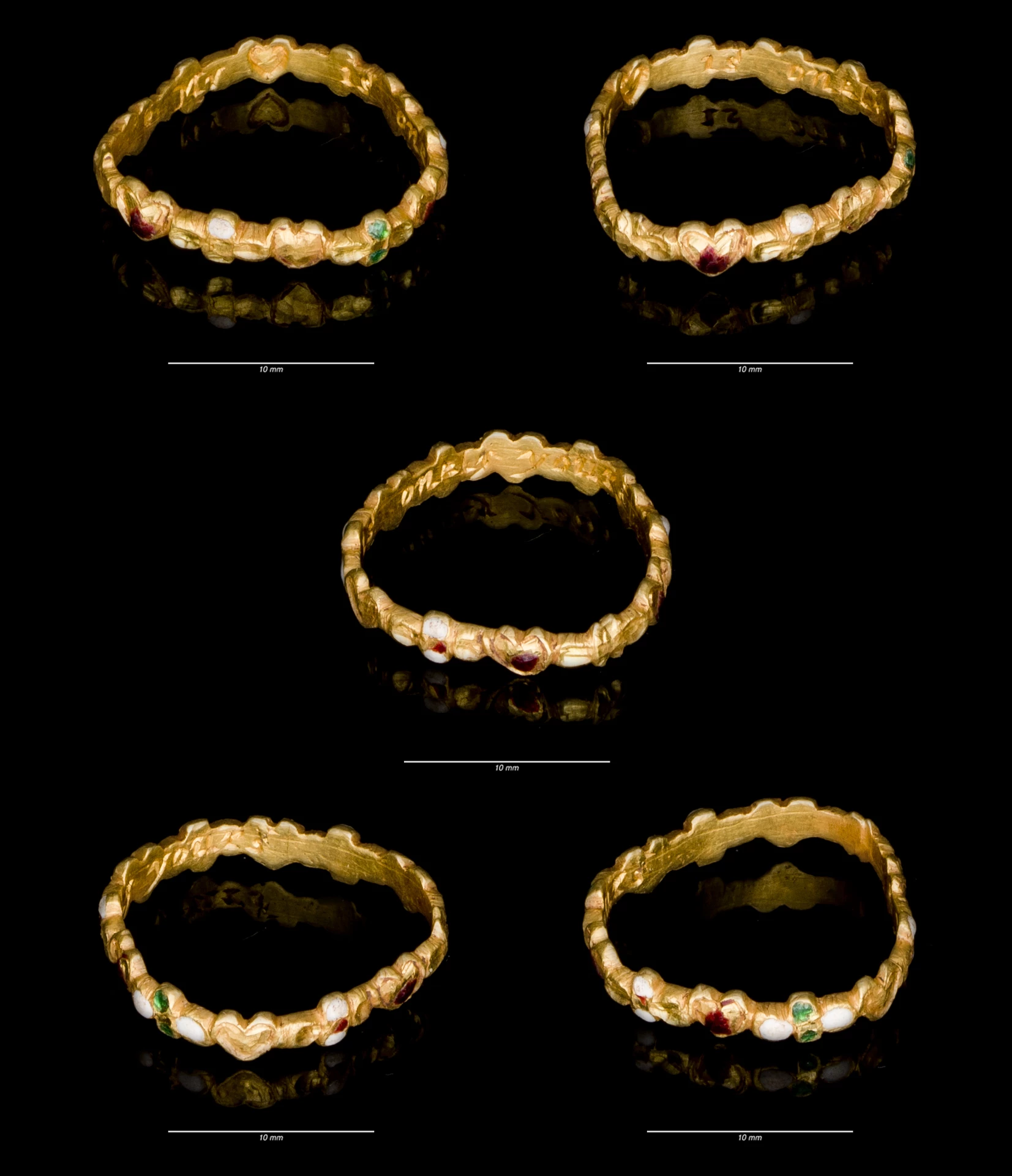
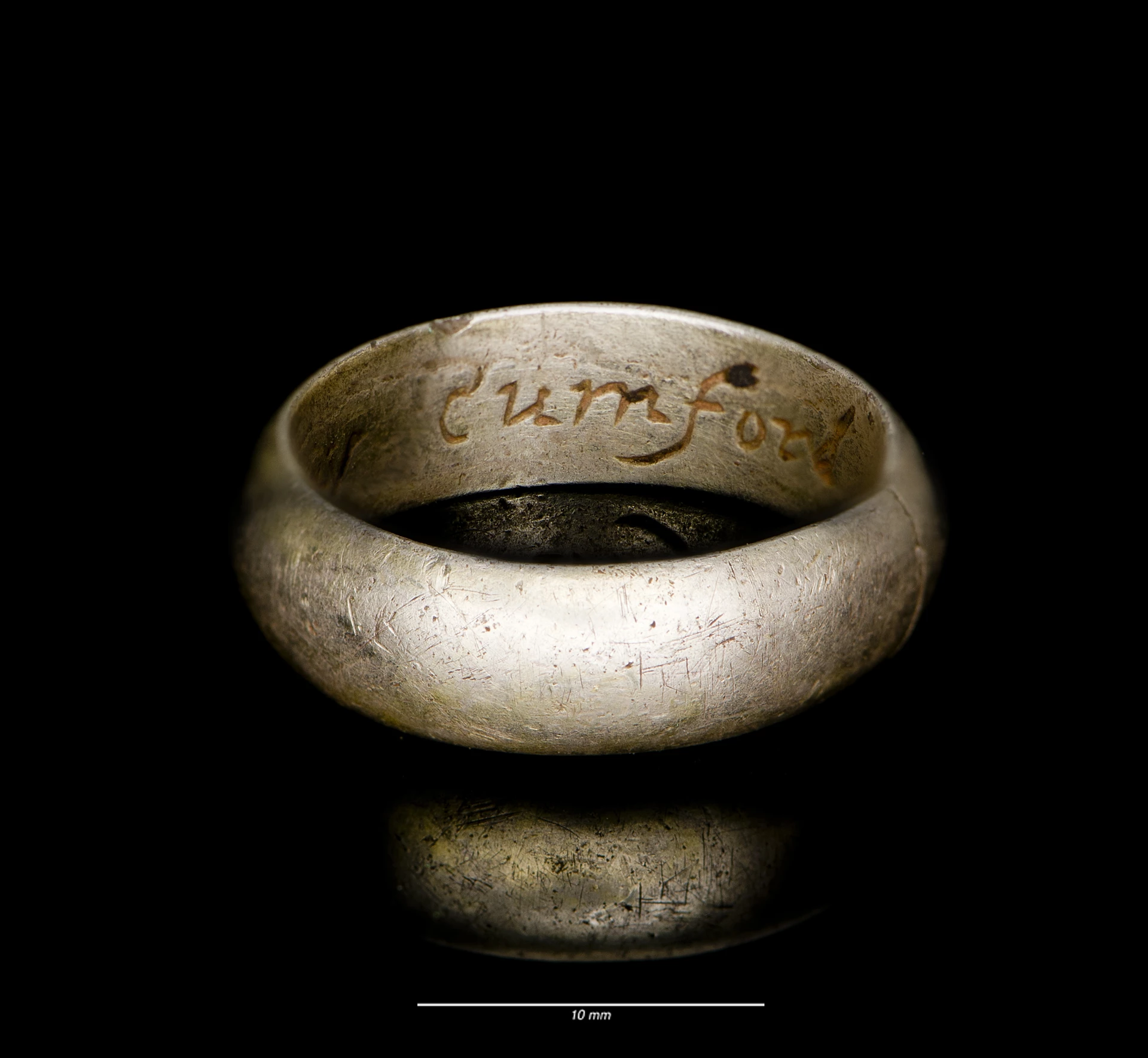
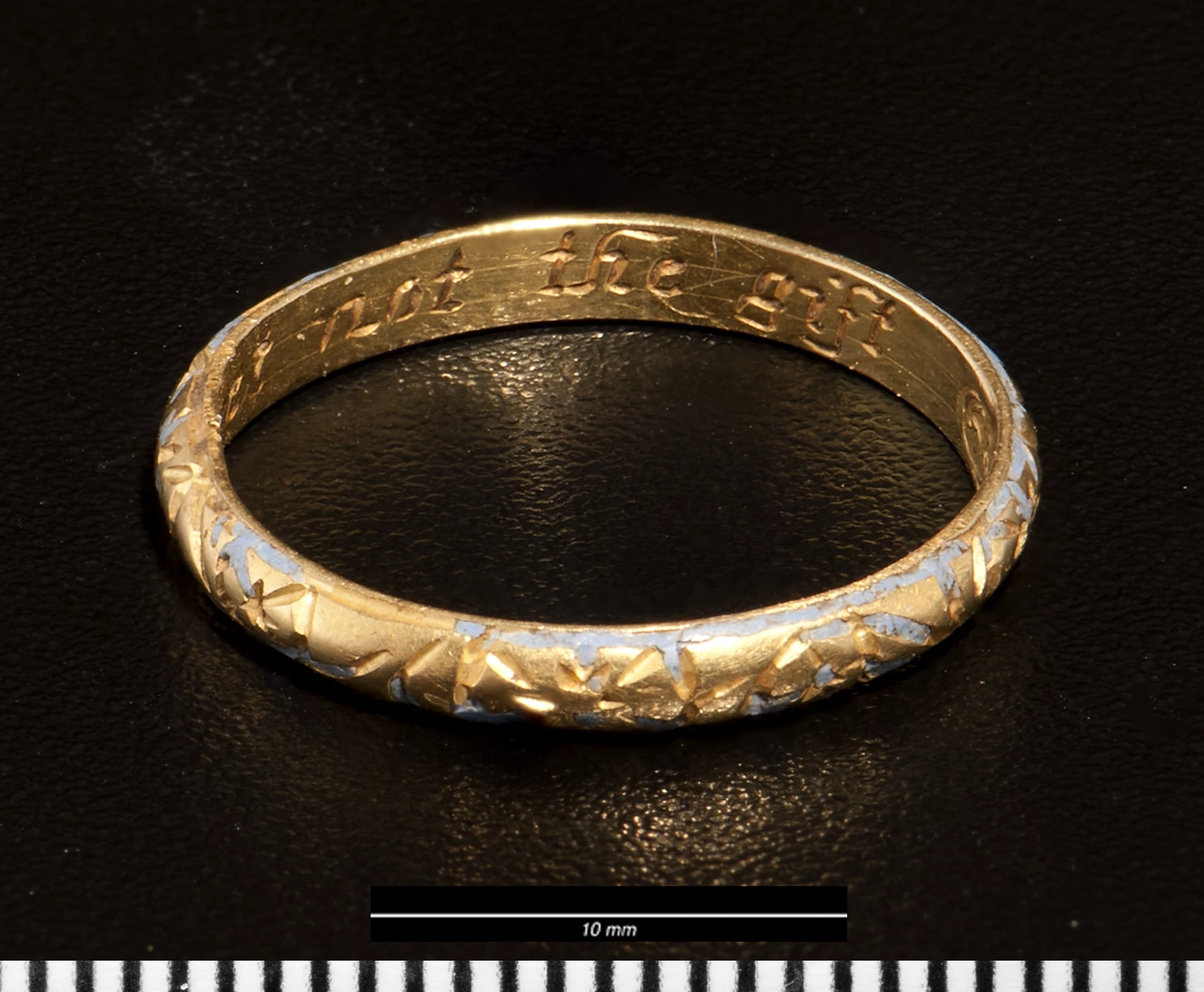
Posy Rings Rhianydd Biebrach, 9 May 2017 Posy ring from Henllys Posy ring 'God is my Cumford' Posy Ring form St Dogmaels The exchanging of rings as tokens of love is not just a modern practice. Posy rings, inscribed with mottoes or short phrases indicating love or fidelity have been popular from the Middle Ages. Though we now associate the giving of rings with the formal occasion of an engagement or wedding, historically posy rings may have been given at any stage of the relationship, and by either partner. They may be plain bands, or decorated in a variety of ways, but their most important aspect was not so much their outer appearance as the carefully chosen message they contained, which was intended as a personal and constant reminder of the giver’s feelings towards the recipient. Some mottoes are in Latin or French, the latter being associated with chivalry and courtly love, but many of those discovered recently by metal detectorists in Wales have English phrases, most of which play on the theme of fidelity and constancy. A particularly delicate and decorative example, from the late 16th or early 17th century was discovered in August 2013 by Mr Simon Harrison at Henllys, Monmouthshire. Made of linked gold roundels and hearts filled with red, white and green enamel, the inner surface is inscribed with the words ‘My ♥ is onely yours’. Several other rings, four of which have been recently acquired by the Saving Treasures; Telling Stories project for national and local collections, have inscriptions communicating a variety of sentiments, but not all of them are as straightforwardly romantic as the Henllys example. ‘Forget not the gift’ urges the decorated gold ring found near St Dogmael’s, Pembrokeshire, by Mr Tom Baxter-Campbell in June 2011. This suggests that the ‘gift’ of the ring should act as a reminder of the giver: was he or she about to go away? Was there perhaps some doubt that their feelings might not be returned? A similar ring, also of gold and dated to the late 16th or early 17th century, found at Llantwit Major by Mr David Hughes in April 2013, bears the enigmatic legend ‘Such is my love.’ The precise meaning of this phrase is unclear, but the intention could be that the giver’s love is enduring and precious, like gold, and eternal, a quality associated with the ring’s shape, which has no beginning and no end. Presumably the receiver of the ring understood exactly how to interpret the message. Although posy rings are associated with messages of love, some examples recently discovered in Wales strike a decidedly sober tone. A late 17th or early 18th century silver-gilt ring found near Caerphilly in June 2013 by Mr T.M. Davies, and now in the collection of the Winding House Museum in Tredegar, looks very much like a modern plain wedding band. On the inner surface is the inscription ‘Keep faith tell [till] death’, a rather sombre sentiment somewhat out of step with lighter modern endearments but utterly in keeping with past understandings of the indissolubility of marriage. In an age when divorce was virtually impossible, marital relationships were for life. Not all posy rings carried statements of love, however: a plain silver-gilt band discovered at Llangibby, Monmouthshire, by Mr Glen Flynn in 2012 declares ‘God is my cumford [comfort]’. Does this suggest that the ring was given at a time of personal distress, sorrow or illness for the wearer, or does it merely reflect their personal piety? A notable feature of all of these rings, as with some of those featured below, is that these mottoes are inscribed on the inside, rather than the outside, of the band. But why would these ardent suitors want to hide their declarations of love instead of setting them where all could see? The likely reason is that the messages were private, intended to have significance only for the giver and for the wearer, who bore the message next to the skin, emphasising the intimacy of the relationship.
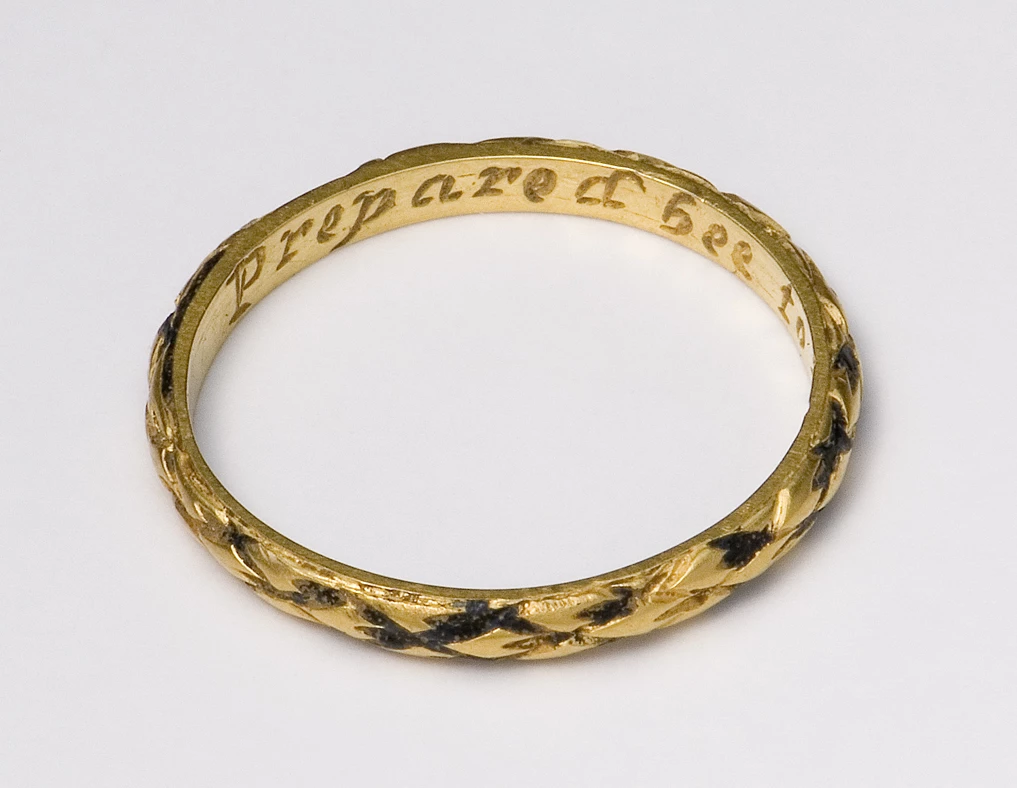
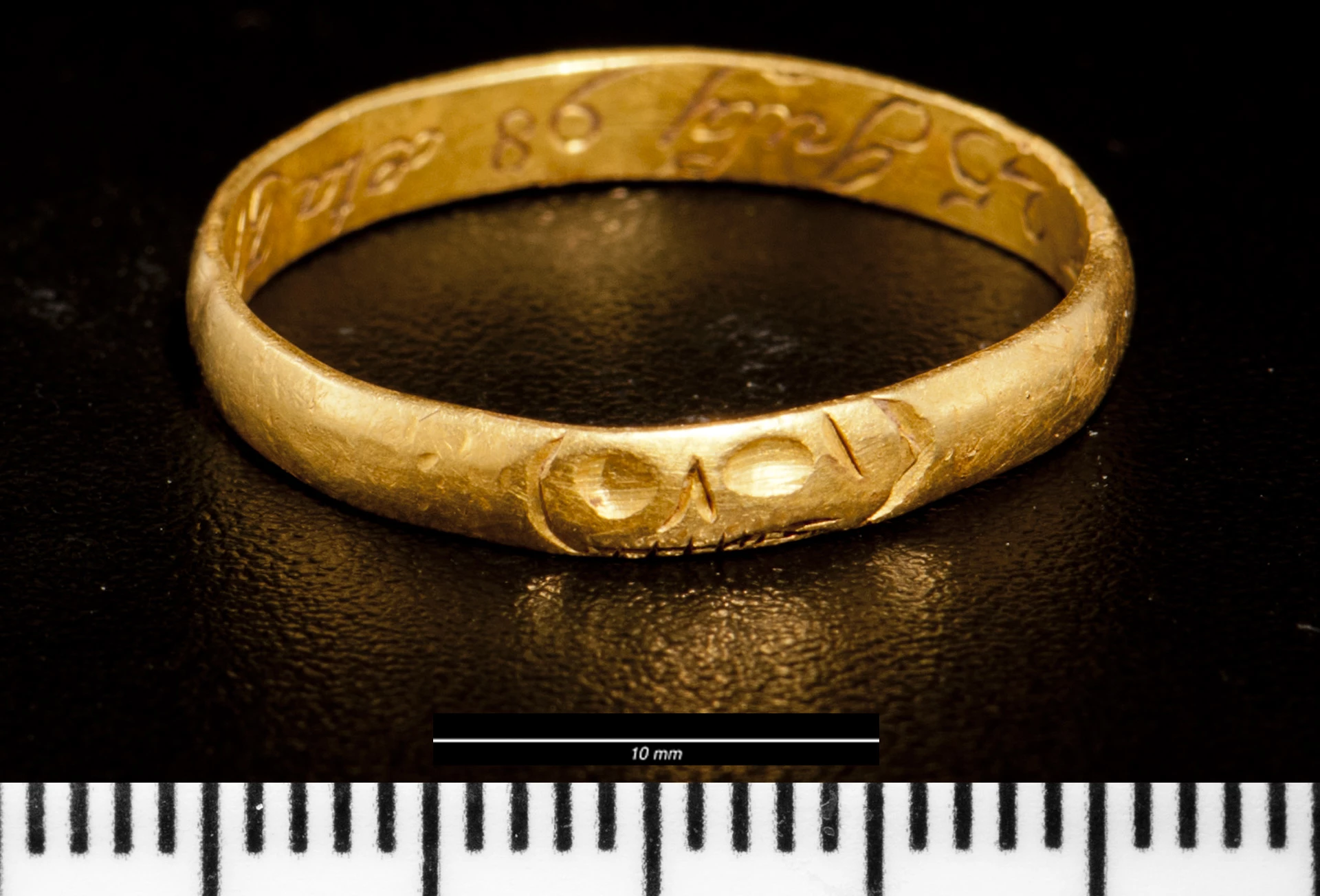
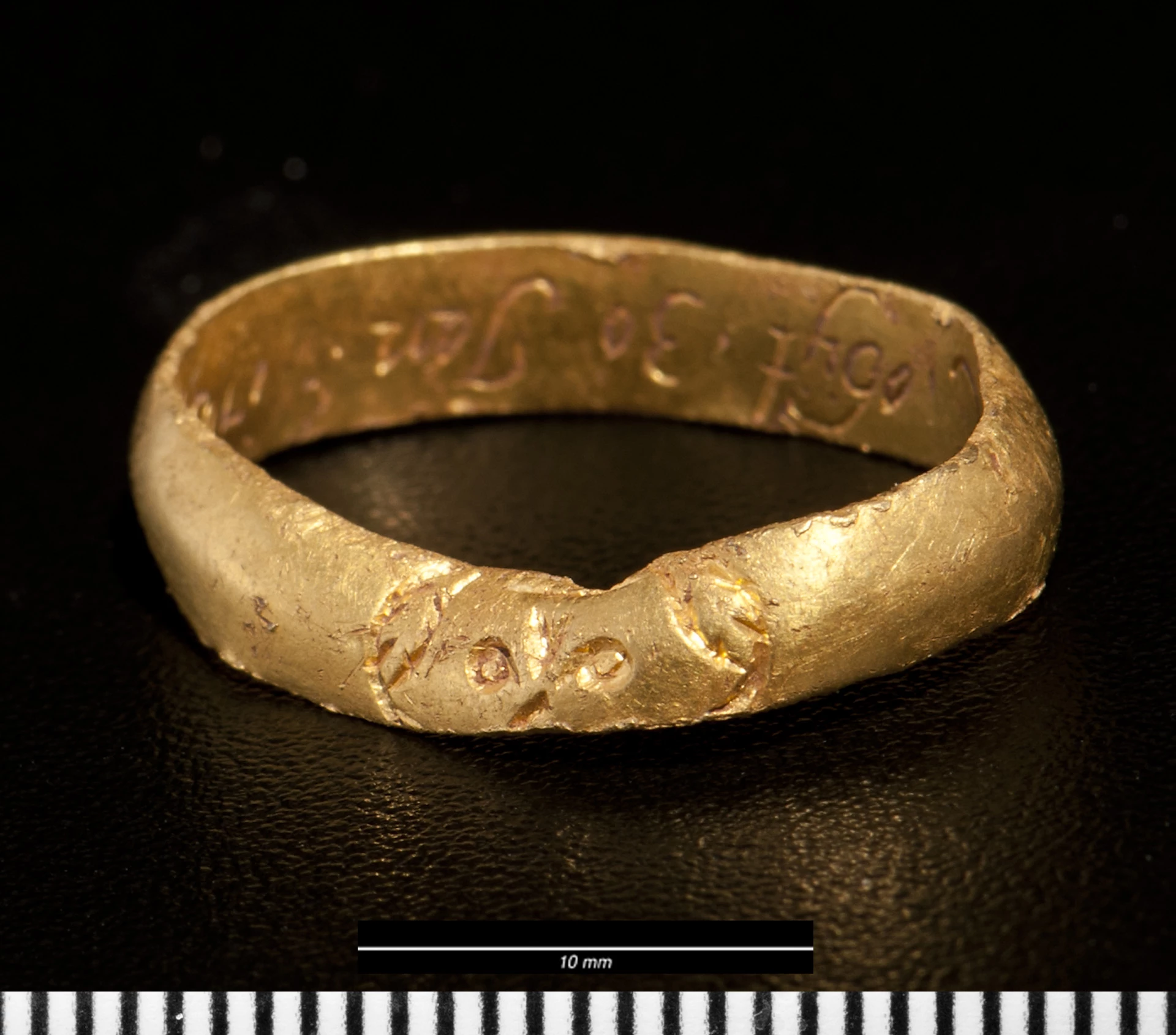
Mourning Rings Rhianydd Biebrach, 9 May 2017 Mourning ring from Pennard Mourning ring from Kidwelly Mourning ring from Hundleton, Pembrokeshire Intense personal feelings were also encapsulated in mourning rings, but here it was the fractured relationship between the living and the dead that was at the heart of the ring’s purpose. In the Middle Ages the living retained some form of contact with the dead through the offering of prayers for the soul, but this practice was stopped at the Reformation and from the mid-16th century the dead could only be remembered, not helped. Mourning rings were sometimes distributed at funerals as a way of aiding this remembrance among the deceased’s family and friends. Often bearing their initials and date of death, they fuse the natural human need to keep in mind the presence of a dead loved one with the old tradition of the memento mori motif. This was a decorative reminder of the nearness of death, highly relevant to societies where epidemic disease, childbirth and simple infections were everyday dangers. Often in the form of a skull or death’s head, memento mori motifs were common throughout many forms of late medieval and Early Modern material culture, and can be found in paintings and books, on tombstones and jewellery. In the 16th century portraits of Edward and Gawen Goodman of Ruthin, which can be seen in the National Museum of Wales, Cardiff, the men are wearing large gold mourning rings on their index fingers, both featuring a grinning skull. Intended as reminders of the brevity of life, they may also have had inscriptions with a more personal meaning, bringing to mind a specific dead loved one. None of the mourning rings recently discovered by Welsh detectorists are quite as elaborate as those shown in the Goodman portraits, but the principles behind them are exactly the same. In October 2010 Mr R. Pitman unearthed a gold mourning ring at Pennard, Swansea. Dated to the late 17th century and decorated with a trellis-style pattern inlaid in dark blue enamel, the ring is one of several acquired by the Saving Treasures; Telling Stories project and is now in Swansea Museum. On its inner surface is inscribed ‘Prepared bee to follow me’ – a reminder that death could come at any time and that it was proper for a good Christian to be spiritually and mentally prepared for the inevitable. We can never know who the ‘me’ was: perhaps a dead loved one; perhaps Death himself. Three other examples are clearer in this respect. They contain the initials and death dates of the people commemorated by the rings in Latin inscriptions on their inner surfaces. The oldest, found by Mr D. Raven in May 2013 at Kidwelly and now in Carmarthen Museum, records the death of ‘J. A. ob 25 July 98 aeta 37’ [J. A. died 25 July 1698, aged 37]. The outer surface is plain apart from an engraved death’s head and is very similar to another gold ring found in Hundleton, Pembrokeshire, by Mr K. Lunn in November 2013, now in Milford Haven Maritime and Heritage Museum. Here the death’s head is rather more crudely cut and the inscription records ‘A. E. obijt 30 Jan’ 17034’ [A. E. died 30 January 1703/4]1. Another example, found further to the east in Caerwent, Monmouthshire, by Mr Colin Price in July 2011, is slightly different in form, having a floral pattern rather than a death’s head on the outside. The inscription marks the ring as commemorating ‘G. K. obt 26 March 1702’ [G. K. died 26 March 1702]. Scant though these details are, it is still possible to get a sense of the personal loss and grief the rings embody, and the need bereaved family members felt to sustain the remembrance of their loved ones long into the future. 1 The apparent confusion over the year of death is due to the old style of dating prior to the adoption of the Gregorian Calendar by England and Wales in 1752. Before this the new year officially began on 25 March, not 1 January. Therefore 31 December 1703 would have been followed by 1 January 1703, not 1 January 1704.
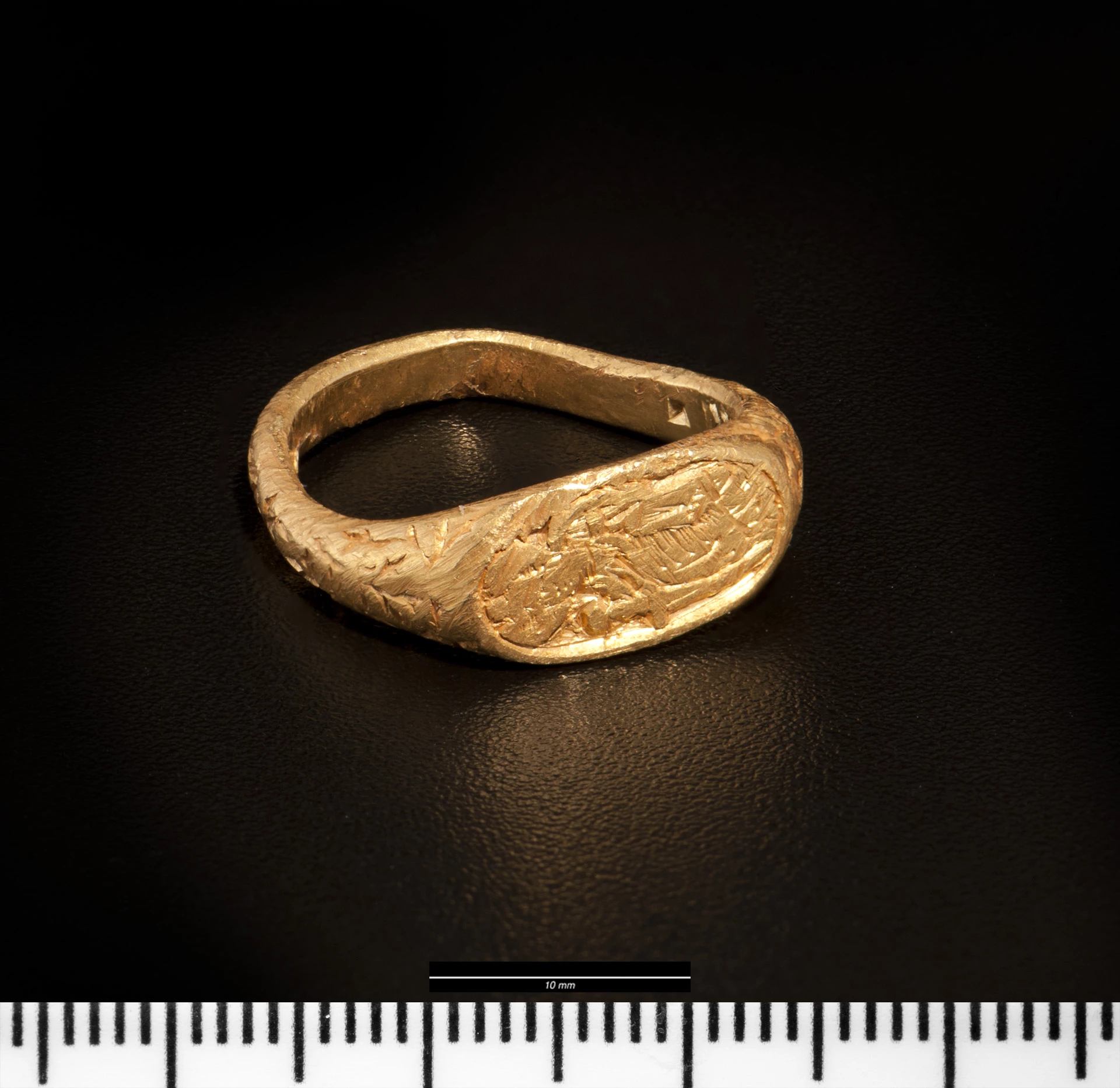
Iconographic Rings Rhianydd Biebrach, 8 May 2017 Iconographic ring with image of St Catherine Iconographic ring from Maes y Groes The starkness of the inscriptions on these mourning rings is largely a consequence of the Reformation, which did away with prayers for the dead and to the saints. In contrast, earlier medieval rings sometimes depicted saints or contained religious formulas such as extracts from prayers, and a small number of these have been recently found in Wales. A fine example is the late 15th century silver gilt ring discovered by Mr Phil Jenkins at Carew in October 2013. Decorated all around with a twisted design, the bezel is divided into three facets, each engraved with a separate word, together making the formula ‘ihs ave maria’ [Jesus. Hail Mary]. Such rings were more than just decorative statements of faith, they could also be used as devotional aids. In the later Middle Ages there was a new emphasis on a more mystic, personal relationship with God, to be achieved through prayer and contemplation, and which could be aided by objects such as books and images. The Carew ring could also have been used in this way as the name of Jesus (‘ihs’) prompted the contemplation of Christ’s life and death. ‘Ave Maria’ is the opening statement of the Latin prayer derived from the words used by the Angel Gabriel at the Annunciation, when he appeared to Mary to tell her that she was carrying Jesus. In this way the ring encapsulated in three short words the central beliefs of the Christian religion – that Christ was sent to earth to save mankind. Does the presence of the Latin words on the Carew ring mean that the owner of this ring was an educated person, or maybe even a cleric? Not necessarily. Although literacy rates were low at this time common Latin phrases such as those used in religious ceremonies and prayers would have been easily recognised, much as ‘post mortem’ and ‘et cetera’ are today. Even if their literal translation was not understood, their general meaning and significance as religious terms was important and would have given them a certain spiritual power. They may also have been thought to have a protective effect in the manner of a charm, although the church would have officially frowned on this as straying too closely into the realm of magic! Other iconographic rings found in Wales contain images of saints, which may have been specifically chosen for particular reasons. In October 2014 Mr Philip Jenkins discovered a late medieval gold ring bearing an engraved image of St Catherine at Llandissilio West, Pembrokeshire. As one of the virgin martyrs she held a special significance for young, unmarried girls, and she was also the patron of scholars, wheelwrights and various other groups. Medieval saints can often be recognised by their ‘attributes’, such as objects they hold or items of dress. Catherine is often shown with a wheel and sword, the instruments of her torture and death (and the rather gruesome inspiration for the Catherine Wheel firework). Like many of the other rings described here the St Catherine ring also carries an inscription on the inside of the hoop. This reads ‘en bon eure’ [In good year], which suggests it might have been a New Year’s gift for someone with a particular devotion to this very popular saint. Although images of medieval saints are often easy to recognise, this is not the case with the late 15th century gold iconographic ring found by Mr Paul Anthony Byrne at Maes-y-Groes, near Wrexham. The ring has two images engraved on its double-faceted bezel, but both are worn and very little can now be made out other than a wing. This could therefore be an image of the Archangel Gabriel, St Michael (generally shown as winged), or even of St George. It may seem strange for St George to appear on a ring found in Wales, but he was not exclusively associated with England at this time and, in any case, the owner may well not have been Welsh. Another interesting feature of this ring is the clasped hands which appear at the base of the hoop. These can signify love, trust or marriage and were a common symbol on medieval rings, known as ‘fede’ (faith) rings. Do the clasped hands suggest that this was also a lover’s gift like the posy rings described earlier?
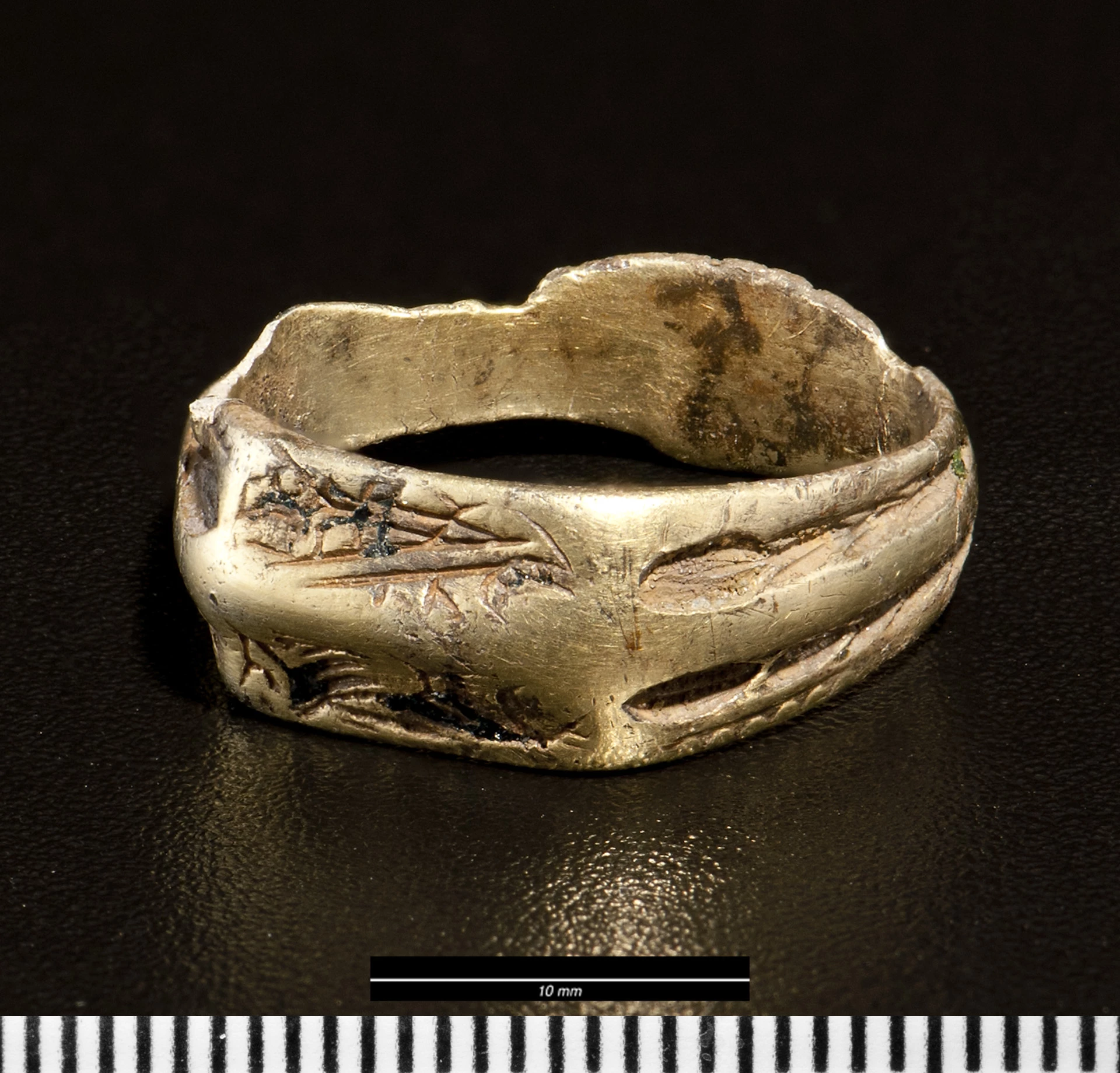
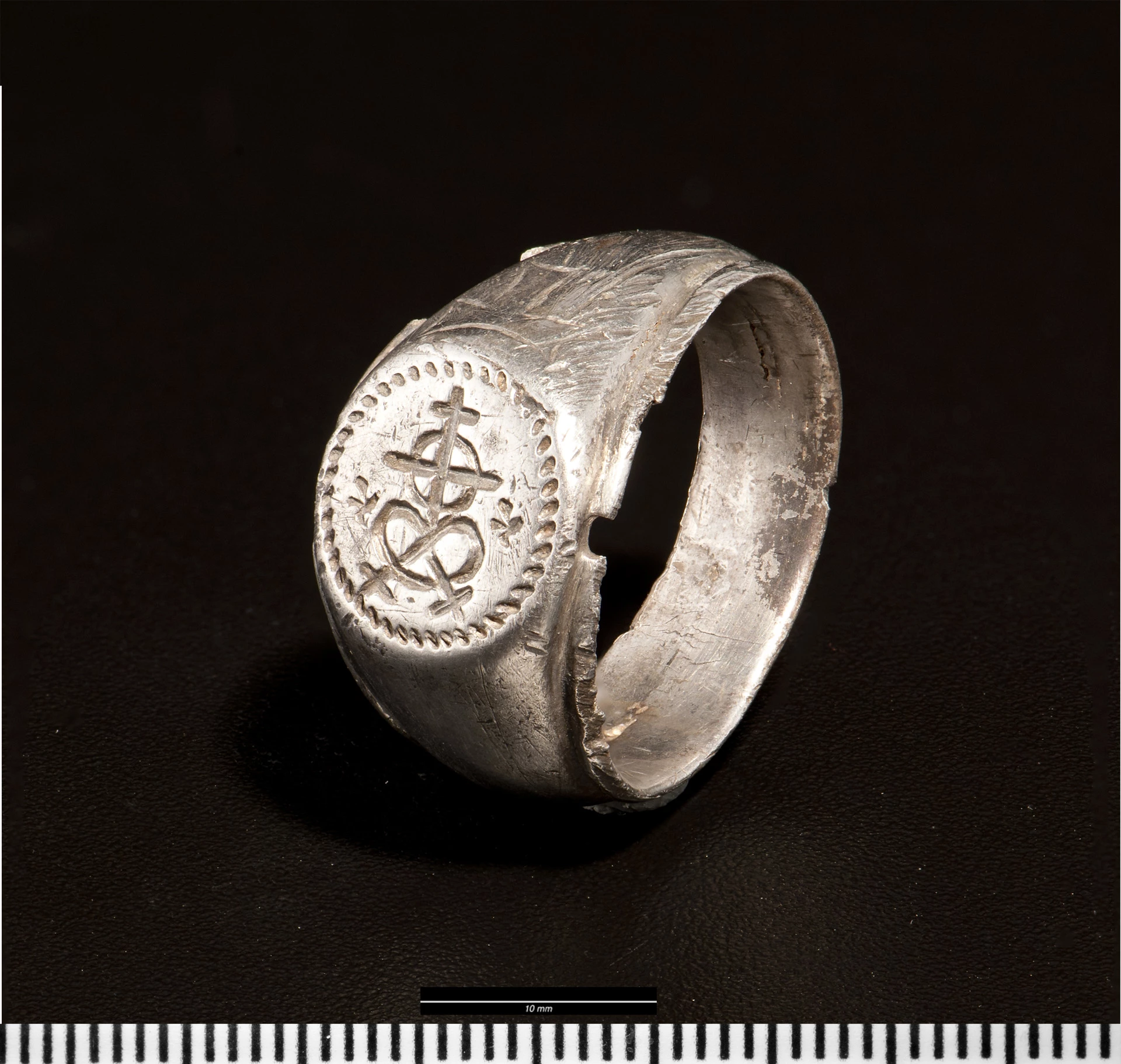
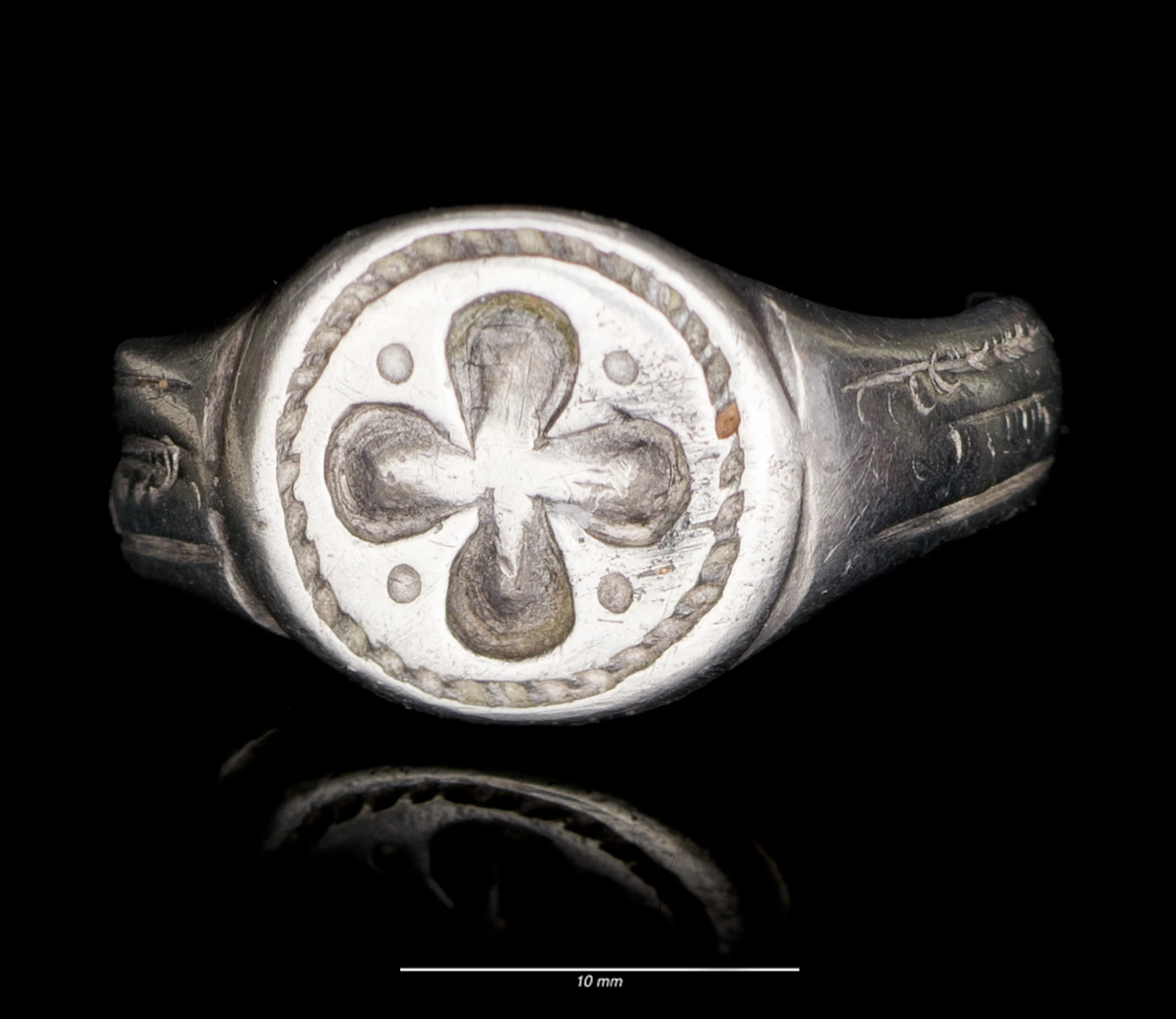
Signet Rings Rhianydd Biebrach, 8 May 2017 Merchant's signet ring from Haverfordwest Signet ring from Sully Meaning was also conveyed in the imagery portrayed on signet rings, which were often worn on the thumb. It is a type of ring still worn today, though now rarely used for its original purpose. In an age when even the wealthy and powerful could not be assumed to be literate, the signet ring featured a personal seal. This was used in place of a signature as a way of authenticating documents and was also an indicator of higher social status. Heraldic devices were used for those who had coats of arms, but for people lower down the social scale a variety of symbols, imagery and lettering could be used. For merchants, heraldry was replaced by merchants’ marks. A fifteenth or early sixteenth-century silver signet ring displaying such a mark was found in 2014 by Mr John Rees at Haverfordwest, and has since been acquired by Saving Treasures; Telling Stories for Haverfordwest Town Museum. The mark, made up of interlaced, curving crosses, is accompanied by a tau cross, associated with St Anthony and the treatment of St Anthony’s Fire, or ergotism, a disease caused by eating contaminated grain. The merchant’s mark itself was a personal device identifying the wearer, but the inclusion of the tau cross gives the ring a separate, religious overtone, and would have been specially chosen. St Anthony was not a saint who was especially popular in late medieval Wales, but as merchants were mobile this devotion could have been picked up elsewhere; west Walian merchants traded all along the Bristol Channel, as well as to Ireland, Spain and Portugal, or it could have belonged to a merchant from overseas. A much simpler signet ring was discovered at Sully in the Vale of Glamorgan in 2013 by Mr Michael Gerry. Made of silver, decorated with a plain, four-petalled flower and dated to the late 15th or 16th century, it is a much more enigmatic example, giving virtually nothing away about the identity, occupation or social status of its owner. Some rings seem to have been hybrids, with more than one purpose or significance. A particularly intriguing example is a 1st or 2nd century silver Roman ring found by Mr Leighton Jones in the Darran Valley, Caerphilly, in March 2010. It once held an oval intaglio, possibly a precious or semi-precious stone, which would have had an incised decoration used for sealing documents. So in one sense this is a signet ring like the ones described above, and would have identified its owner, but the inclusion of a precious or semi-precious stone gave the item at least one additional layer of meaning. The stone was attractive and decorative in its own right, suggesting something about the status and wealth of the individual who could have afforded it. But it would also have been thought to have intrinsic powers of healing or protection, and each gemstone was associated with a variety of medicinal, apotropaic or occult uses.