Share your Family Recipes – St Fagans Food Festival

Mared McAleavey, 5 August 2015

How many of you, like me, find yourselves turning to tried and tested recipes? They’re often dishes that have been handed down through my family, they’re comforting and remind me of my childhood.
The archive at St Fagans has a large collection of recipes, the vast majority of them passed down from generation to generation. The information has been gathered through questionnaires, letters and handwritten recipes. But the bulk of the collection was the work undertaken by Minwel Tibbott. When she started at the Museum in 1969, the study of traditional foods was a very new research field. Minwel realised very early on that the information would not be found in books. She travelled all over Wales in order to interview, record and film the older generation of women, many of them in their eighties. They recalled the dishes prepared by their mothers, and their memories harked back to the end of the 1800s.
As part of St Fagans Food Festival this year, which will be held on the weekend of the 5th and 6th of September, we’re asking for your help to add to this collection. As you settle down this evening to watch the new series of the Great British Bake Off, take a moment to think of your signature bake. What time-honoured family recipe would you share? How do you adapt traditional dishes? Do you have a dog-eared, but well-loved family recipe book, covered with additional notes and food stains? We’d love to find out what the dishes remind you of? Which ones are reserved for special occasions?

Tweet images and memories to @archifSFarchive, or bring them along to Oakdale Workmen’s Institute during the Food Festival and we’ll scan them. If they’re not written, as is the case with so many family favourites, you can tell us on the day.

For the latest on this project, follow tweets by @archifSFarchive and @SF_Ystafelloedd and the hashtags #FoodFestival #Recipes.

A Window into the Industry Collections - July 2015

Mark Etheridge, 30 July 2015

In July we were very fortunate to acquire this silver salver/tray. It was presented to H.W. Lewis for his heroism during the Tynewydd Colliery inundation. Henry Lewis was the Manager of Energlyn Colliery (near Caerphilly), and he was also awarded the Albert Medal, 2nd Class for his bravery during the same disaster. The disaster occurred on the 11th April 1877 and further information can be found in this article. A collection of objects relating to the Tynewydd inundation, can be seen in a display on coal mining disasters at Big Pit: National Mining Museum.

Amgueddfa Cymru has another very similar tray in the collection presented to Thomas William Parry. Both trays were manufactured by Henry Holland (of Holland, Aldwinckle & Slater) of London.

Recently donated, this memorial card was produced "In sad Remembrance of 264 men and boys who were killed in the Prince of Wales Pit, Abercarne, by an explosion, on Wednesday, September 11th, 1878."

The underground fires caused by this massive explosion resulted in the deaths of at least 264 people although the exact death toll is not known. To put out the fire the difficult decision was made to flood the mine with water from the Monmouthshire Canal. It took two months and 35 million gallons of water to put out the fire. This water had to then be pumped out before the victims could be recovered. The photograph below was taken by Thomas Forrest of Pontypridd around the time of the disaster in 1878.

This Clanny flame safety lamp was destroyed during the explosion of 11th September 1878. A very emotional reminder of the disaster, it would have belonged to one of the victims. The glass shield has cracked and melted in the heat. This objects has been part of the collections since 1936.

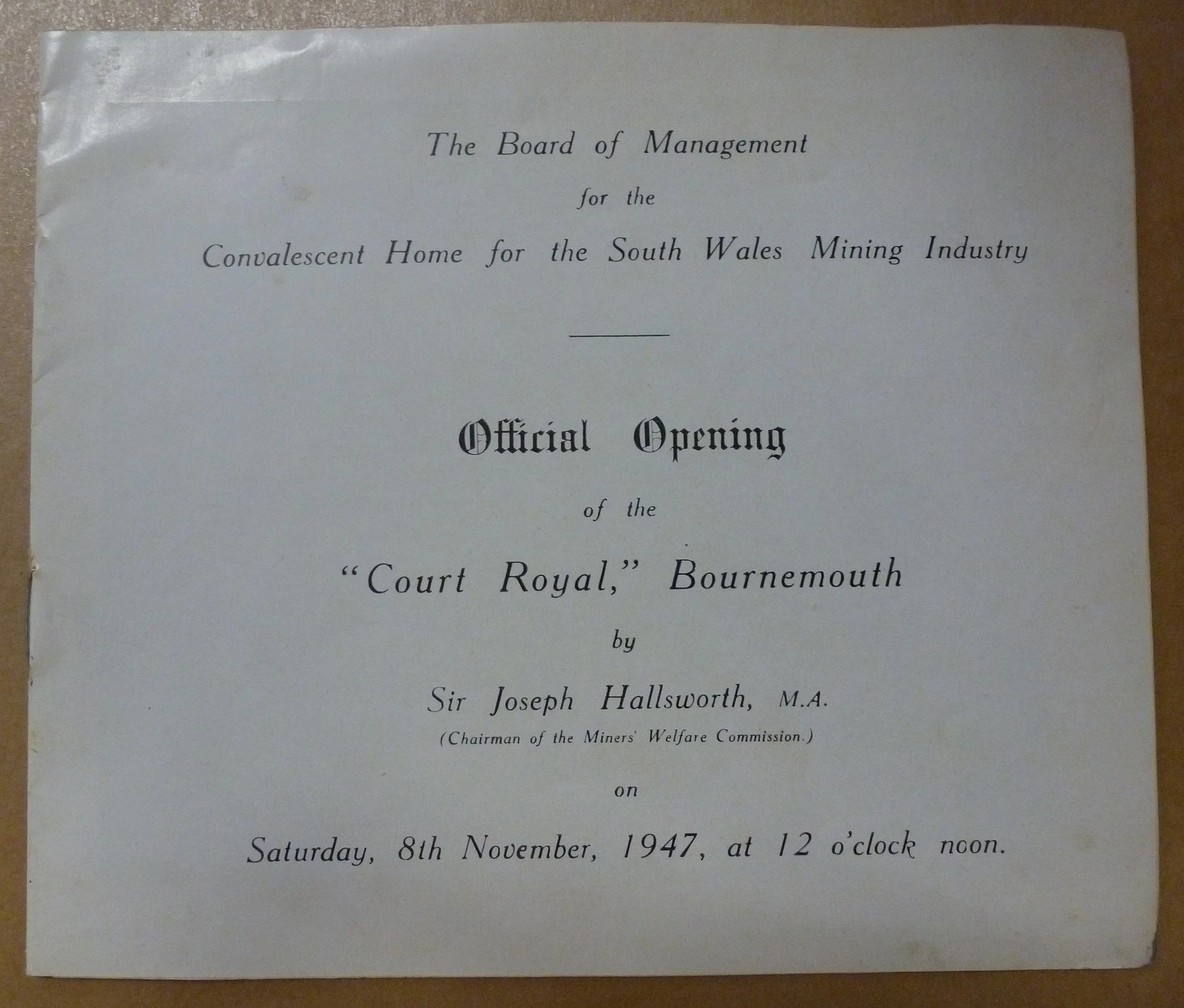
Talygarn House, Pontyclun, South Wales, was a large stone mansion that became a hospital in 1880. In October 1923, it was opened as a miners' convalescent home and in the first 15 years of its opening had more than 41,000 patients. The house was eventually put up for sale in 2000, and has recently been converted into luxury homes. You can read more about Talygarn in this article. The two photographs below were donated this month and show miners at Talygarn.

Morris Castle was built between 1768 and 1774 to house the families of workers employed by Sir John Morris (mainly at his Landore copper works). It is on an elevated position overlooking the surrounding area. It originally comprised of four towers, each four stories tall, connected by blocks three stories tall, around a central courtyard. Both the towers and linking walls were crowned with mock battlements made from copper slag. The building was occupied until about 1850. It is now just a ruin, owned by Swansea City Council and is a listed monument. These photographs were taken in March 1969, and have been added to the collection this month.

Mark Etheridge
Curator: Industry & Transport
Follow us on Twitter - @IndustryACNMW

Cyfri Kate

Sara Huws, 30 July 2015

Dwi'n edrych ymlaen at ein digwyddiad sgyrsiau fflach yfory - cyfle i staff o wahanol adrannau gyflwyo eu hymchwil mewn pum munud.

O ystyried amrywiaeth y disgyblaethau a'r arbenigedd sy'n bodoli 'ma (o ddaeareg gynnar i gelf modern, gofalu am esgyrn i dynnu llo...), dwi'n disgwyl dysgu rhywbeth, a'n gobeithio rhannu arfer da.

Pum Munud i Drafod Dyddiadur

Fe fydda i'n cyflwyno pum munud am @DyddiadurKate - er fod calon ymchwilydd gen i, y tîm yn Sain Ffagan sydd wedi bod yn dod â hanes Kate a'i chynefin at gynulleidfa newydd. Yn aml fe fydda i'n ymladd fy ngreddf i ymgolli mewn casgliadau a'n atgoffa fy hun mai pen hwylusydd sydd gen i - a mai fy rôl innau yw i greu gofod ar gyfer y tîm, eu hannog, a rhannu eu gwaith da ymhellach. 

Model Rhannu Casgliadau

Dwi wedi fy argyhoeddi fod model @DyddiadurKate yn un y gellir ei ddyblygu i rannu casgliadau eraill - yn enwedig y gwrthrychau cynnil hynny na fydd byth yn ennill teitl fel 'trysor' neu 'eicon'. Ond ofer fyddai mentro'r un peth eto heb ymroddiad tîm, a'r holl gynnwys cefnogol sydd gennym ar flaenau'n bysedd. 

O gronfa ddata casgliadau'r Rhyfel Mawr, i adnoddau allanol fel Papurau Newydd Cymru - a mewnbwn ein cynulleidfa - mae'r dyddiadur wedi bod yn sbringfwrdd i straeon amrywiol iawn am Gymru, a thu hwnt, gan mlynedd yn ôl.

Technoleg Gefnogol

O ran stwff nyrdlyd, technolegol, mae arferion rhannu asedau da wedi helpu, yn ogystal â phlatfform rhag-bostio, er mwyn rhyddhau'r curaduron o'r dasg ddyddiol o bostio, i greu amser iddyn nhw afael mewn pynciau perthnasol a'u hymchwilio ar gyfer y blog, neu greu cysylltiadau efo casgliadau eraill.

Y Rhife

Hyd yn hyn, mae dros 207,000 o argraffiadau wedi'u cofnodi ar y cyfri - llawer iawn mwy nag y gallen ni ei hwyluso yn gofforol, a mwy nag y gallai'r ddogfen ei ddioddef, yn gorffol, hefyd. Mae'r prosiect wedi codi traffig i flog Cymraeg yr Amgueddfa dros 800% o'i gymharu â llynedd - sy'n fy argyhoeddi mhellach o bwysigrwydd creu cynnwys gwreiddiol ar gyfer siaradwyr Cymraeg y we, i ateb galw go iawn, ac i greu cysylltiadau rhithiol ar hyd a lled y wlad, o'n swyddfa fach y tu ôl' i'r orielau celf.

Please do not ... !

Christian Baars, 27 July 2015

Everyone knows that museums don't allow visitors to do anything, right? You mustn't touch, eat, smoke, take photos; rucksacks are banned, as are balloons (!) and mobile phones. What's going on here? Are you even allowed to breath?! Well, actually, if you must breath then please don't do it near the objects...

Joking aside, all those rules are part of our efforts to ensure that the objects on display will remain in top condition for many years to come. Things decay - that is the way of the world. Museum conservators try to halt that decay for as long as possible.

For example, colours fade in bright light. I have a pair of my daughter's first shoes on my car dashboard which were once a vivid red. Now, after many years exposure to sunlight, they are a faded pink. To avoid the same fate for the museum objects in our care we limit light levels and have UV filters in our galleries, and we ask you not to use a flash when taking photographs.

Smoking is banned in museums because the smoke from cigarettes contains sticky tarry substances that can settle on objects and are very difficult (and expensive) to clean off. We don't really like balloons and rucksacks because they sometimes get entangled with objects and then pull or push them off their plinth, or cause parts to break off and again, this causes expensive conservation jobs, if the object can be fixed at all.

Touching is usually not desired for similar reasons, but also because your hands leave oils on surfaces; these are contained naturally in the skin. If many people touch the same surface over many years it will show as dirt.

There are exceptions to the "no-touch-rule": if you go up to our gallery number one at National Museum Cardiff you will see the Jenkins Vase on display. This marble object was originally a Roman well-head and it depicts the story of Paris, son of Priam of Troy, and Helen. During the 1770s the well-head was converted into a decorative vase. While we ask you not to touch the vase itself, there is a marble touchpad next to it in the shape of two hands. One hand is behind glass and pristinely white; the other hand has been touched by generations of visitors, and the effect of this touching can be seen clearly.

We also have other opportunities for hands-on activities, for example in our Clore Discovery Gallery, and during events. We keep parts of our collections specifically for people to touch and interact with, but we do ask you to respect our efforts to maintain the collections and preserve them for the enjoyment of future generations.

View of Swansea in 1858

Mark Etheridge, 20 July 2015

Recently working through the John Dillwyn Llewelyn collection, I was reminded of this amazing photograph of Swansea taken in 1858. The image was taken on the 15 March 1858 at 1 o'clock with an exposure of 15 minutes. It was taken by Welsh photographer John Dillwyn Llewelyn using a ground breaking process invented by him in 1856 called the Oxymel process. This was a development of the wet collodion process and used a solution of acetic acid, water & honey to preserve images. This meant that glass negatives could be prepared in advance and exposed in the camera as required, and produced a dry plate that could be kept for days. This new process meant landscape photographers no longer needed to carry with them portable laboratories and darkroom tents.

The photograph shows Swansea taken from St. Thomas on the 15 March 1858. To the far left, above the roofline, Mumbles Head can just about be made out. In the background (slightly to the right) can be seen the North Dock with buildings around it, and sailing ships in the dock. In front of that is the railway embankment alongside the New Cut of the river Tawe. In the foreground can be seen a number of houses, including the 'White Lion Inn', and to the far right it is just about possible to make out the remains of Swansea Castle.

I thought that it would be interesting to try and identify the viewpoint from where this photograph was taken and to see how the view might have changed since 1858. I therefore contacted my colleague Andrew Deathe at the National Waterfront Museum, Swansea to see if his knowledge of the area would allow him to identify the viewpoint.

Living locally Andrew was able to take this modern view in May 2015. He took the photograph by standing on the road which is in the foreground of the 1858 image, which is called Bay View, in St. Thomas. The house in the original image is just behind his viewpoint. John Dillwyn Llewelyn seemed to be standing half way between Bay View and Windmill Terrace (which wasn't built for another 20 years).

The skyline of Swansea has seen many changes over the years and it is difficult to tell that the two images are taken from the same viewpoint. However it is still possible to make out Mumbles Head to the left and part of Swansea Castle to the right. The railway embankment has been completely removed, and there is no trace or it or the tunnel today. In place of the old North Dock buildings, you can see the glass pyramid of Plantasia. The tower of St. Mary's church can't be seen unfortunately, as it is behind the BT Tower.


Mark Etheridge
Curator: Industry & Transport
Follow us on Twitter - @IndustryACNMW