O'r Archif: an Experimental Album

Sara Huws, 27 August 2015

A Radical Collection

I'm content when I'm rummaging through old records, photographs or documents. Gleaning through 'stuff' is an unusual pleasure now that I work in the Digital dept, my day-to-day work mostly bereft of bits of paper.

I love the feel of ruffling through collections; whether it's a pile of vinyl, a card catalogue, or a box of old letters and tickets from the last century (it's scary to say that: "I went to a Levellers gig in the last century".)

Nearest and dearest to me are the Screen and Sound Archive at the National Library (where my Father worked until his retirement), and the Archives at St Fagans National History Museum. At St Fagans, the history of those early, radical curators, the background noises they capture, the dialects and the voices have had me in awe for almost a decade now.

It's also a relatively egalitarian collection, that notes the value of women's histories and makes space for us to tell our stories in our own words, to share our songs, recipes, beliefs and superstitions. Paper history doesn't match up somehow, where our voices oftentimes get squished to the margins and footnotes. It must be said that it isn't a completely intersectional collection, though efforts have been made in recent years to address this, for example, in recording stories from LGBT people.

My Grandmother's Voice

I will never forget finding my Grandmother's voice in the archive. She died when I was very young and so I don't remember very much about her, apart from what I've picked up from photos and from her poetry.

Nancy Hughes Ffordd Deg Bach © R I Hughes

My Grandmother in 1926 © R I Hughes

She was an excellent storyteller, and it was a privilege to receive a CD of her telling a few tales. Her voice had been there, kept safe all along - and I was bowled over, not just by her turn of phrase and sense of humour, but by the noises my Grandfather was making in the background as he tinkered around. His voice was not as deep as the one I'd committed to memory, and unlocked a drawerfull of memories besides.

This encounter further convinced me that archives deserve to be recognised as inherently meaningful collections, to be treated not as a supporting cast, but as whole collections which deserve pride of place alongside archaeological objects and artwork in our museums.

The Archive Today

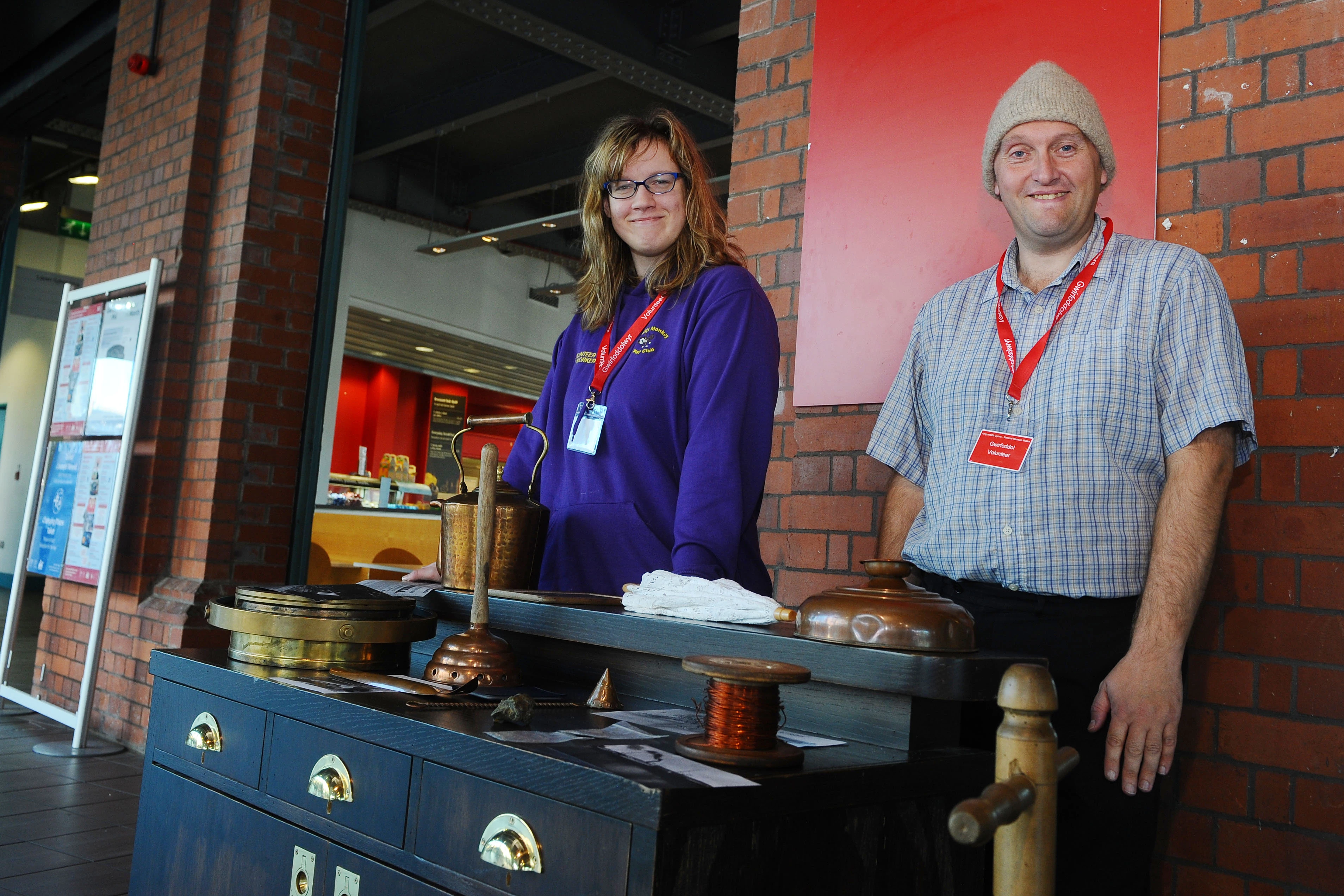
I've been working with the team for a while - Richard (@archifSFarchive) who is part of the @DyddiadurKate team, and now with Lowri and Meinwen, who look after the manuscripts and sound archive. I've been showing them how to use our blogging platform, so hopefully we'll see a bit more of the life of those collections online soon. 

Within the digital department, we're busy revamping our pages on Welsh traditions and folksongs. While that work is going on, I've been looking in more detail at how we could potentially reach a wider audience by sharing sound clips on social platforms.

Sharing Sound Socially

The platforms we currently run - twitter, facebook and tumblr - seemed too ephemeral somehow.

Tweets don't live long enough, especially since we have so many accounts running in St Fagans; and the data shows us that our facebook fans are more interested in our events programme than our collections. Something as focussed as oral history or folk music could easily get lost or miss its mark.

So, I asked Gareth and Rhodri about their experiences of sharing music on soundcloud, bandcamp etc. I decided to create a package our of existing digitised material using bandcamp, and to release them all in one go, father than drip-feed them on the blog or on twitter.

One of the lovely things about bandcamp is the ability to add more information, like sheet music, lyrics and the history of the recording, and that I'm able to package things in an 'album' style. I was also really keen to use the 'pay if you like' function to see if we could open up a small donations stream that could be evaluated in the future.

Download 'O'r Archif'

Here it is then, a selection of folk songs, recorded from 1960 onwards by our archive at St Fagans: O'r Archif: Caneuon Gwerin

Most of the recordings were made by Roy Saer. The sheet music and sound was arranged by Meinwen Ruddock-Jones in the archive, and additional research carried out by Emma Lile. The cover for the collection is held in our art department, and is attributed to the travelling artist W J Champan.

I used Canva to tie together the older scans of the sheet music, and to add a word or two about the archive's history. If there are any errors, therefore, they are mine! Enjoy, share, sing, donate and experiment - and if you have any feedback, please pop it in the comments!

Bryn Eryr: from house to home

Dafydd Wiliam, 18 August 2015

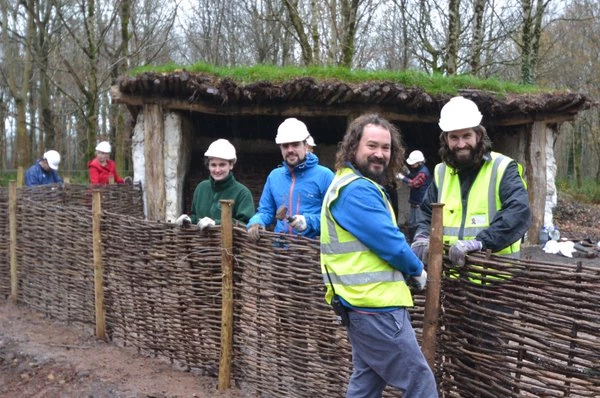
A lot of progress has been made since my last blog post. The thatching has been completed and the final stages of landscaping are underway. An earthen bank has been built around the two roundhouses, replicating the formidable defences of the original site on Anglesey. A turf-roofed shelter has been built behind the houses, which is to be used as an outdoor workshop as well as an additional educational facility. Its walls are of clom (a mixture of clay, subsoil and aggregate) just like the roundhouses, but its turf roof represents another roofing material arguably as old as thatching itself. A cobbled surface has been created outside the front of the roundhouses, again, reminiscent of the original site.

Recently, my work has focused on furnishing the interior of the houses. The larger of the two houses will remain fairly empty (other than a hearth and a wooden bench that circumnavigates its inner perimeter) so that it can be used as a classroom and demonstration area. The smaller house has been dressed to display Iron Age life. Within are some of the furnishings expected of any Iron Age house: a hearth for warmth, a bed for sleeping, a loom for weaving clothing and blankets – along with wooden chests to store them in, and a cauldron for cooking food. Nearly all of the items on display are based on period examples that have managed to survive 2,000 years of time. For instance, the cauldron is a replica of a well-preserved copper and iron cooking pot from Llyn Cerrig Bach – only 25km away from the Bryn Eryr site. The iron fire-dogs are simplified replicas of the Capel Garmon fire-dog which was discovered not far away in Denbighshire. The wooden bowls are replicas of those found at the Breiddin hillfort in Montgomeryshire, and the quern stones (for grinding corn into flour) are replicas of ones found within the Bryn Eryr roundhouses themselves. We have a full wood-working tool-kit based on examples from hillforts such as Tre’r Ceiri and Castell Henllys. Even the blankets on the bed have been faithfully copied from surviving scraps of textile.

Now that the house has been faithfully dressed with period furnishings, we can use the space to demonstrate what life was like within a roundhouse. Furthermore, with the aid of craftspeople, re-enactors and volunteers, we can contribute to a deeper understanding of life in the Iron Age, and help turn this house into a home.

Flint in Egyptian Pharaonic Warfare

Christian Baars, 11 August 2015

This is the summary of a talk Carolyn Graves-Brown from Swansea's Egypt Centre gave at the recent "Heritage in Turbulent Times" event at National Museum Cardiff.

Studies of Bronze Age Egyptian weapons and warfare tend concentrate on metal weapons and ignore the part played by flint. Flint is not considered as attractive as copper or gold and in a milieu which is impressed by technological progress, metal is still considered superior. However, at least until the Early New Kingdom (c. the time of Tutankhamun or 1300 BC) there is strong evidence that flint weapons were standard military issue and far from being a primitive technology they were a natural choice for both utilitarian and ideological reasons.

Despite the fact that many hundreds of artefacts were found in a possible armoury in an Egyptian fort sited in Nubia (modern Sudan) and the fact that contemporary artefacts are known from sites in Egypt, flint found on Egyptian sites is often explained away as either foreign or intrusive to New Kingdom contexts. However, in many instances flint is a good choice for weapon manufacture, particularly where a quick and ‘dirty’ fight is envisaged. Flint is sharper, arguably cheaper and often more deadly than metal. Warfare and flint also had an ideological importance, it is the ideal weapon of the sun-god Re and perfect for destroying the enemies of Egypt. I concur that metal was a component of warfare, but make a plea for the role of lithics.

National Museum Wales and Cardiff University contribute to heritage preservation. If you would like to know more about "Heritage in Turbulent Times" please follow our blog.

Bringing the Seashore to Cardiff

Katherine Slade, 7 August 2015

Cardiff Bay Beach/Traeth Bae Caerdydd wasn’t the only taste of the sea for people visiting Cardiff yesterday. Museum Scientists brought the seashore to museum visitors in one of our Natural Science family workshops. These drop-in sessions aim to give visitors a taste of the wildlife that you can find on your doorstep, in woodland, on meadows…or in this case on the seashore.

More than 140 visitors looked down microscopes at seaweed, found out where on the shore different animals like to live, and sorted through many kinds of molluscs (such as top shells, periwinkles, slipper limpets, whelks, limpets, mussels), sea worms, starfish and sea urchins from the museum’s collections. Few people could resist popping the ‘bubble-wrap seaweed’ (Bladder Wrack) or counting the air bladders on the Egg Wrack to see how old it was. They found out which seaweed is used to make laverbread and which is used in their ice-cream!

With over 870 miles of stunning coastline, Wales is a great place to explore the seashore. We hope that some of our visitors can get outside and discover some of the animals and plants for themselves.

Share your Family Recipes – St Fagans Food Festival

Mared McAleavey, 5 August 2015

How many of you, like me, find yourselves turning to tried and tested recipes? They’re often dishes that have been handed down through my family, they’re comforting and remind me of my childhood.

The archive at St Fagans has a large collection of recipes, the vast majority of them passed down from generation to generation. The information has been gathered through questionnaires, letters and handwritten recipes. But the bulk of the collection was the work undertaken by Minwel Tibbott. When she started at the Museum in 1969, the study of traditional foods was a very new research field. Minwel realised very early on that the information would not be found in books. She travelled all over Wales in order to interview, record and film the older generation of women, many of them in their eighties. They recalled the dishes prepared by their mothers, and their memories harked back to the end of the 1800s.

As part of St Fagans Food Festival this year, which will be held on the weekend of the 5th and 6th of September, we’re asking for your help to add to this collection. As you settle down this evening to watch the new series of the Great British Bake Off, take a moment to think of your signature bake. What time-honoured family recipe would you share? How do you adapt traditional dishes? Do you have a dog-eared, but well-loved family recipe book, covered with additional notes and food stains? We’d love to find out what the dishes remind you of? Which ones are reserved for special occasions?

Tweet images and memories to @archifSFarchive, or bring them along to Oakdale Workmen’s Institute during the Food Festival and we’ll scan them. If they’re not written, as is the case with so many family favourites, you can tell us on the day.

For the latest on this project, follow tweets by @archifSFarchive and @SF_Ystafelloedd and the hashtags #FoodFestival #Recipes.