Museum Beekeeper’s Diary
, 8 June 2015
Well last week we posted about the Beehives up on the roof at National Museum Cardiff and how they fared over the winter. Today we have another exert from our Beekeeper’s diary. Has the weaker colony survived? Let’s find out: The weather in late March and early April was fantastic and the strong colony went from strength to strength.
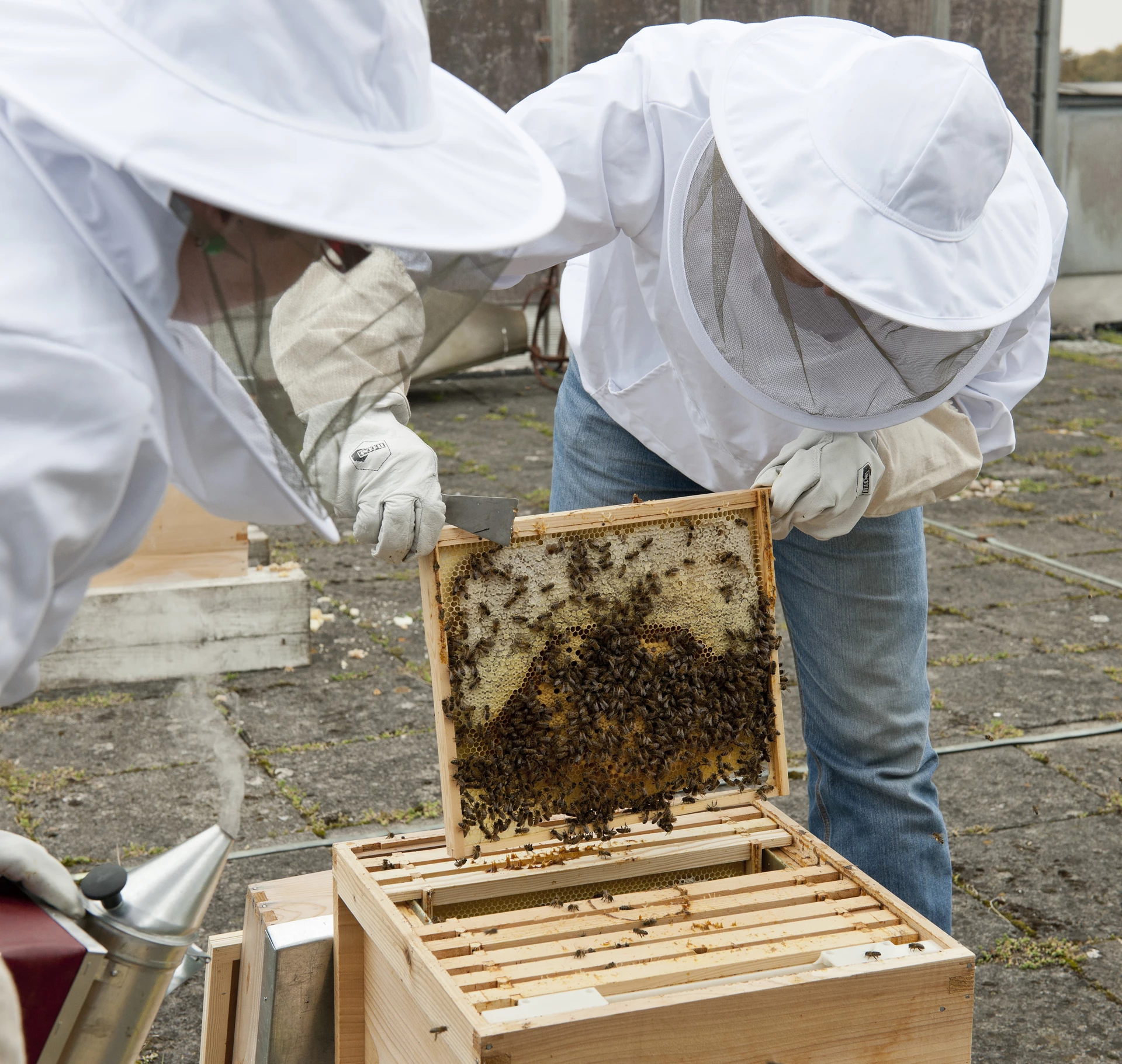
During the next weekly (9th April) inspection we decided to place our first super (a set of shallow frames from which the queen is excluded, used to collect honey) on the strong colony and moved another frame of brood across to the weaker colony. This moving of frames serves two purposes, it helps reinforce the struggling colony whilst limiting the size and growth of the strong colony and thus lessens the risk of having to deal with the colony growing to such an extent that the bees swarm. Every time a frame of brood is removed the frame is replaced with a fresh frame of new foundation (a sheet of patterned wax on which bees build their comb). The rate of productivity is currently so high in the strong colony that a new frame of foundation is being drawn out and prepared for laying within a week!
At the next inspection (16th April) another frame of brood was moved across and the contact feeder in the weaker colony was refilled with more honey. Whilst honey might not be the most cost effective feed the bees certainly like it!
We noticed that the weaker colony certainly had more activity with more bees flying in and out than has been seen recently, hopefully the translocation of brood is working and the colony is growing in strength and numbers.
Whist inspecting the strong colony, a large elongated brood cell called a queen cup was noted- it wasn’t sealed and contained a grub. We removed the cup and grub in order to minimise the chances of a new queen bee hatching and the colony swarming. We inspected the rest of the frames looking particularly closely at the abundance of dome shaped, capped drone (male) cells! There were quite a number of hatched drone bees too, which may be indicative of the colony getting ready to swarm? Hopefully our regular removal of brood should limit the expansion and development of the colony and reduce the risk of having to deal with swarming this year.
Beekeepers use the term drawn-out to describe the process where bees build their honeycomb structures on a base of fresh foundation wax. The bees build up hexagonal honeycomb until the honeycomb cells are 12-15mm deep. This process of building comb outwards from the flat foundation is called drawing-out. The super that we placed on the strong colony is gradually getting filled with honey too.
The bees are gradually filling the fully drawn-out comb in the centre of the super although all the frames have been drawn out to some extent. The super frames that have been partial filled have been moved one or two positions out towards the edge of the super and the more empty frames have been moved inwards to a more central position in order to encourage the bees to work evenly across all the frames within the super.
During this inspection we also installed a third hive on the roof. In this third hive we placed pheromone swarm lures. The idea being that a passing swarm of bees might find and settle in this hive if we’re lucky. The lure hive is essentially a normal hive loaded with foundation filled frames. We have used some of the old, drawn-out frames from our other hives in order to give it a lived in feel and scent (apparently swarms don’t typically settle in new unused hives). If we aren’t successful in catching a wild swarm the hive can be used to home a third colony of bees that we currently have on order with Natures Little Helpers.
29th April inspection – it was a lovely sunny warm day although perhaps in hindsight a little windy for bee keeping inspections. I took the opportunity to take Annette Townsend up onto the roof to see the bees. Not only was it tough to hold the frames of bees still in the breeze, but Annette’s hair and bee keeping suit was being buffeted around so much that she could hardly see a thing! The bees weren’t keen either, there were lots flying around and they were generally grumpy. Annette has blogged her experience, so you can see how she found beekeeping here. Anyway another lesson learned – too much wind makes life tricky – heavy frames of bees and a strong breeze aren’t compatible!
Bee inspection 6th May, another sunny but slightly breezy day again but not as bad as the previous windy hive inspection. Again the weaker colony wasn’t inspected particularly intensively, we just quickly refilled the feeder with honey and once again transferred a frame of brood and juvenile bees into the hive from the stronger colony. Our efforts certainly seem to be paying off, once again there seemed to be significantly more bees flying in and out of the hive plus at least four of the frames now seemed to be covered in bees! The feeder obviously is still being used by the bees but they also seem to be flying out to find natural sources of food too.
The strong colony seems to have stepped up a gear too! Another two queen cups were removed and several suspect other dome shaped cells were removed just in case! A section of brace comb was cut at the edge of the hive in order to allow all the frames to be removed freely. Brace comb is extra honeycomb that is built between frames, it is perfectly normal for wild bee colonies but for managed hives, brace comb prevents frames being removed. The brood now extends almost to the outside frames and there is a considerable amount of capped honey surrounding the brood. The small honey collecting frames inside the super were moved around once again to ensure an even honey fill. None of the honey filled comb in the super is actually capped (the honey sealed in with a wax cover) yet but you get the impression that within a few weeks another super might need to be added!