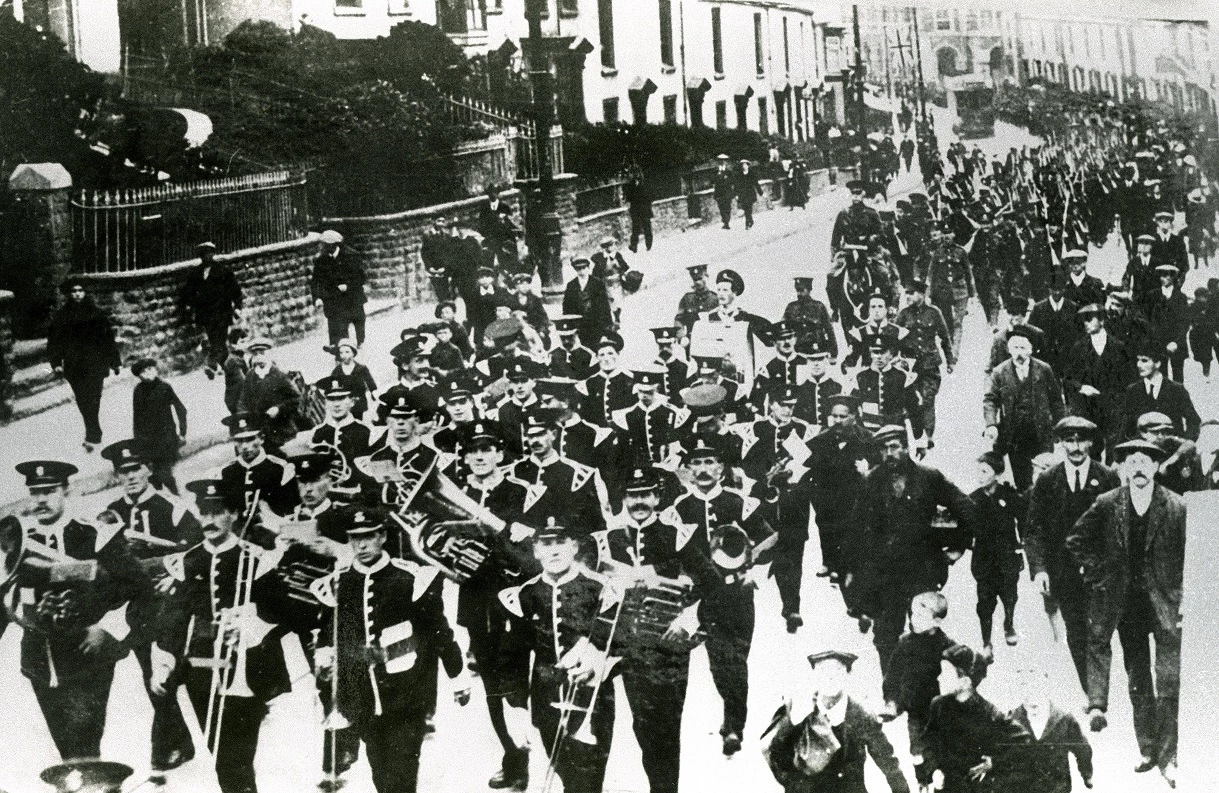
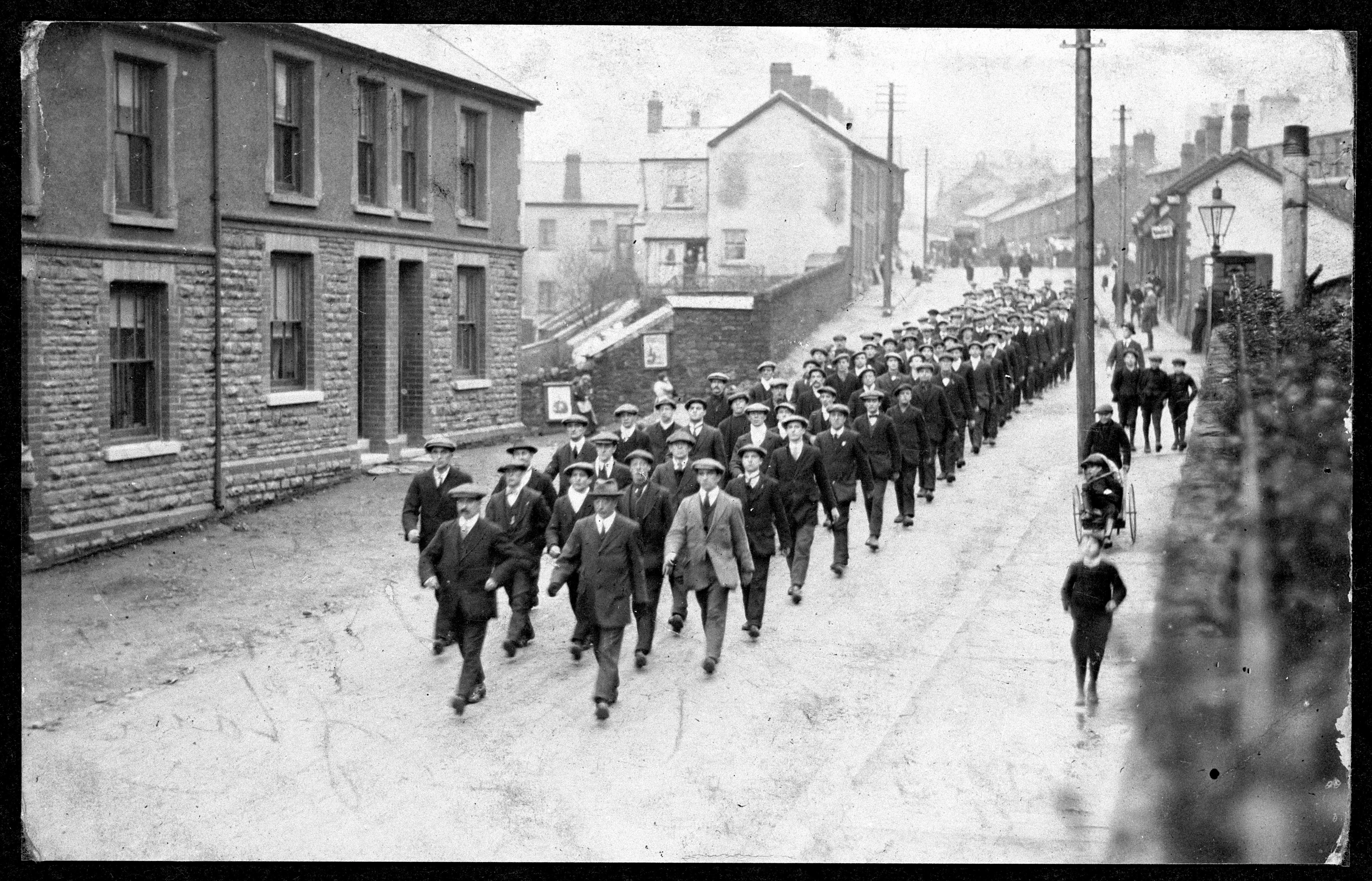
Ar y 19eg o Ionawr 1915 mae @dyddiadurKate yn sôn am ddynion yn ymuno â'r lluoedd arfog: ‘Ymdaith y milwyr trwy Station. Eu noson yn y Bala ymunodd 25 yng Nghorwen a 5 ym Mhenllyn’.
Mae’r cofnod hwn yn cael ei wirio gan erthygl bapur newydd. Ar yr 22ain o Ionawr mae’r ‘Cambrian News and Welsh Farmers Gazette’ yn sôn am ymdaith gan deithlen recriwtio o’r Corfflu Byddin Cymru, trwy’r Sir Feirionnydd a Sir Gaernarfon. Roedd band pib a drwm a band y ‘Royal Oakley’ yn arwain yr ymdaith ym Mlaenau Ffestiniog ar Ddydd Llun 18 Ionawr, a'r llwybr ar Ddydd Mawrth yn cynnwys Corwen a Bala. Mae’r erthygl yn sôn am y gobaith y byddai’r y milwyr yn dod yn gyfeillion gyda’r dynion o’r oedran milwrol, i’w hannog i ymuno â’r ‘lliwiau’ (enw arall ar y Corfflu). Gallwch ddarllen yr erthygl ar wefan Llyfrgell Genedlaethol Cymru (yn Saesneg).
Ar ôl y dechrau'r Rhyfel yn Awst 1914 roedd ymgyrch fawr i recriwtio mwy o ddynion i’r lluoedd arfog i gynyddu'r rhengoedd. Yn ogystal ag ymdaith recriwtio, agorwyd swyddfa recriwtio ac aeth posteri recriwtio i fyny dros Brydain. Yng Ngymru, cynhyrchodd y llywodraeth bosteri Cymraeg hefyd, i apelio at ddynion oedd yn siarad Cymraeg.
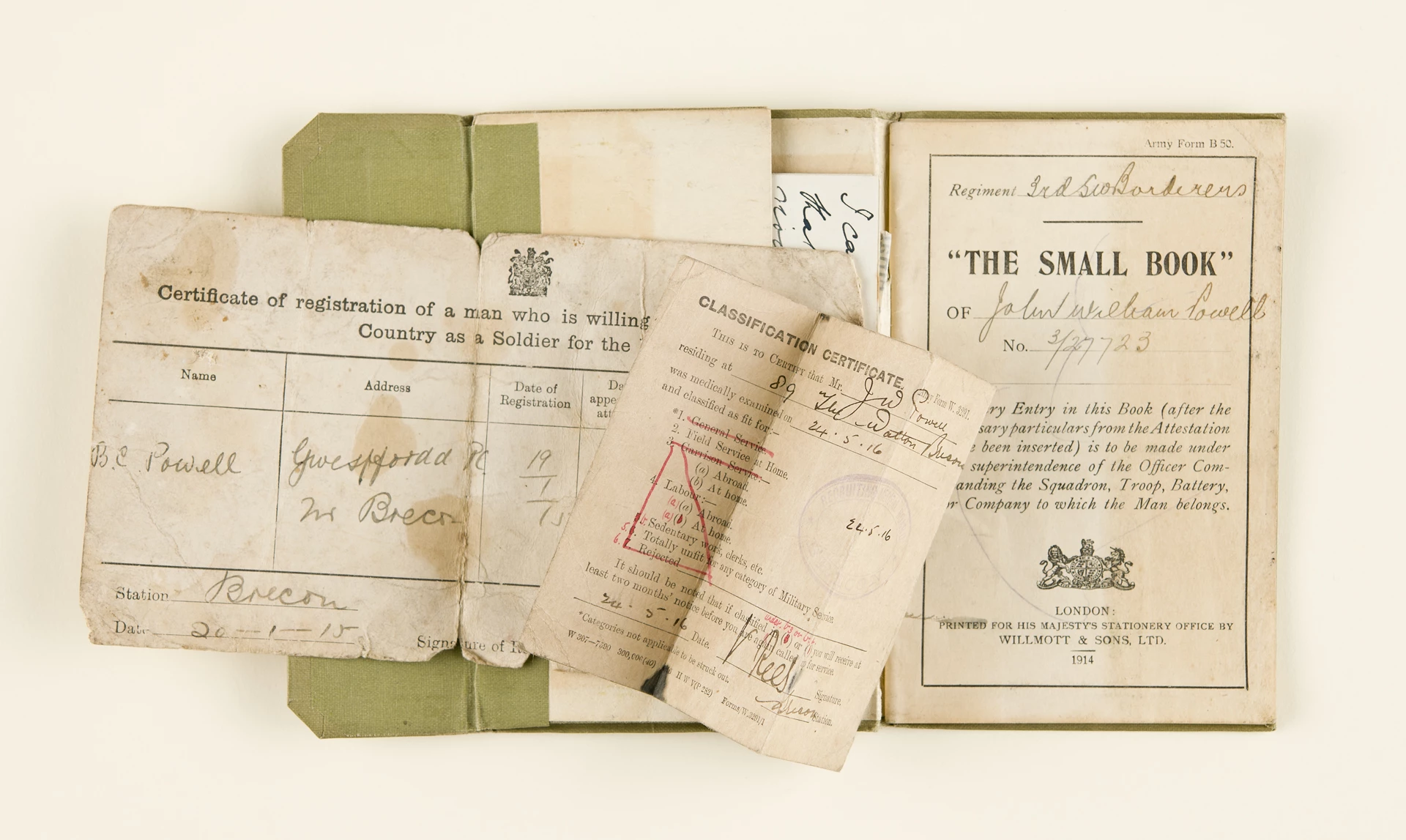
I ymuno gyda’r lluoedd arfog roedd rhaid pasio prawf meddygol. Os oedd y dynion yn iach, roedden nhw’n cael ‘Llyfr Bach’ gyda gwybodaeth fel cerdyn meddygol. Erbyn Rhagfyr 1914 roedd 62,0000 o Gymry wedi ymuno â’r lluoedd arfog ac erbyn Ionawr 1915 roedd 1,000,000 ddynion o Brydain wedi ymuno â’r lluoedd arfog. Y flwyddyn wedyn, yn 1916, dechreuodd y broses o gonsgripsiwn ym mis Mawrth.
The Polychaetes of the Falkland Islands project has been running since 2011 with two highly successful field trips run so far. The project has been well supported with two Shackleton Scholarship Fund grants and support form the local environmental groups and institutes. So far, over 30 families of polychaetes have been identified from the samples and 2 new species have been described, with more on the way. The third field trip hopes to build on the success of the previous two, expanding the range of sampling sites and seeking new opportunities for collaborative project funding in the islands.
16.01.2015
After the usual gruelling 18 hour flight, I’m back out in the Falkland Islands again to continue expanding my range of sampling sites, maintain my contact with those out here and also investigate further project funding opportunities. This time my husband has travelled out with me to see what all the fuss is about and also to try and understand what it is I actually do (you can see his eyes glaze over when I try and explain things so maybe seeing first-hand will actually help!). He’s going to come out with me in the field, help me collect and generally be an extra person in those remote areas I end up in. I’m not sure he knows what he’s let himself in for but at least he may stop referring to my fieldwork as ‘rock pooling for adults’!
The weather hasn’t been kind to us initially, being very wet and windy, even beyond normal Falkland Islands standards! It is supposed to be summer here but it was only 5°C when we landed, cooler than the UK when we left, and the horizontal hail driven into us at hyper speed by the winds was no fun at all!
This was my first full day here and after finalizing all of the arrangements for the next two weeks, our first sampling was a short but harsh introduction to the kind of work I sometimes find myself doing. This was night sampling, attempting to collect the reproductive forms of certain polychaetes that come out at night, swimming free in the water to spawn and are attracted to bright lights. For this reason we found ourselves in a Stanley marina, on a pontoon at 11pm, in the rain, dangling an underwater torch into the water and sweeping a fine mesh net around it, collecting the many different small creatures that were attracted to it (see photo). It was too late to have a detailed look at our catch, so they went into the fridge to keep cool overnight until I could get to the lab for a look and I went to bed.
17.01.2015
The order of the day today was to have a look at what I had managed to catch in the marina last night. Most of what I had were small Crustacea and the smallest jellyfish I’ve ever seen (about 2mm wide) but there were 4 worms of the right kind of appearance, albeit a bit smaller than I would have expected (about 10 mm long). I’ve been allowed access to the Fisheries lab while I’m here and their camera microscope so I was able to take some photos of the little critters. Interesting as they were, unfortunately they were not what I was after, which was a bit disappointing. They were certainly reproductive stages of polychaetes but of a different group to the one I am after, although I haven’t determined which group yet. Still, better than nothing!
The weather has been better, being mostly dry, a bit warmer and marginally less windy. Fingers crossed for tomorrow’s weather, which is the first shore visit. It is an early start though, with a 6.30 am wake-up call, to get to Mare Harbour, about an hour and a half drive away. Hopefully something interesting will turn up!
I'm happy to report the first signs of spring at National Museum Cardiff! Daffodils have started growing at the Museum!
Daffodils growing at National Museum Cardiff
I’d like to share a joke from St. Paul's Primary School. This did make me laugh! If anyone has any other science, nature or (particularly) plant related jokes then please send them in!
Q. Why was the computer cold?
A. Because it left its windows open!
Coppull Parish Primary School: Friday's rain measurement may be misleading as it was not water but hailstones! Professor P: Hi Coppull Parish Primary, I always like to watch hail but hate to get caught in it! The Blessed Sacrament Catholic Primary School also reported that their rain gauge filled with hail stones! The readings shouldn’t be miss-leading if you do the same as we do to measure snow. If it hails again, take the rain gauge inside and wait for the hail to melt, then record the water level as rainfall.
Thorn Primary School: Hi Professor Plant, We have had snow this week! It snowed on Tuesday night and a little bit on Wednesday morning then for most of the day on Friday. Is there anything we need to do to care for our bulbs during snowy weather? Most of our bulbs now have shoots. Prof P: Hi Thorn Primary School, I hope you enjoyed the snow and it wasn’t too cold! Your plants are quite sturdy and will be Okay outside in this weather. The soil provides a warm layer for the bulb and protects it from the cold. You might notice that daffodils planted in the ground are growing quicker than those in your plant pots. That is because the soil is thicker around bulbs planted in the ground and so is providing more warmth. This shows how important warmth is to growing plants and why changes in the climate have an effect on when plants grow and flower!
St. Ignatius Primary School: Dear, Professor Plant. We brought our plants in over the Christmas holidays and when we came back we noticed some of the shoots had come up. We are so excited about this but hope it's not too soon for them to be growing. Also we have had some really windy and wet weather so some of or plants had fallen over. We think they are ok and we will keep an eye on them. Thanks P4 St. Ignatius. Prof P: Hi P4 at St. Ignatius Primary! I’m sorry to hear the wind blew over your plants, but am very glad that they are all Okay! It’s great that your plants have started growing and don’t worry, it’s not too early! Other schools have reported their first shoots too, including St. Brigid's School, Bickerstaffe CE Primary School, Stanford in the Vale Primary School and Freuchie Primary School. Silverdale St. John's CE School have informed me that their shoots are now 3cm high! I'm happy to report that my plants have started to grow too!
The Blessed Sacrament Catholic Primary School: Over the holidays it had rained so much that the rain gauge had filled up and tipped to one side so some of the water had tipped out. We are really enjoying collecting the weather data and watching the shoots growing from the bulbs. Thank you for sending them to us. K and J. Prof P: Hi K & J, Thank you for letting me know that your rain gauge had tipped over and for monitoring the weather so well! You must have had a lot of rain! I’m glad you are taking good care of the bulbs and watching the shoots closely. Other schools have had similar problems with their rain gauges on coming back from the holidays. Rivington Foundation Primary School and Llanishen Fach C.P School reported that their rain gauges were overflowing on their first day back!
Ysgol Nant Y Coed: There should be rainfall on Wed and Thurs but the rain gauge had been tipped over. We're very sorry. We've now put a second, back up rain gauge out so it shouldn't happen again. C and E. Prof P: Hi Ysgol Nant Y Coed, don’t worry about your rain gauge falling over but thank you for letting me know! And well done for thinking of a solution and putting out a second rain gauge! St Laurence CE Primary School have been having the same problem, maybe they could try using a back-up rain gauge too! Or, they could secure their rain gauge (maybe by tying it to a fence or post) or move it to an area where it might be more sheltered from the wind but will still be able to collect rainfall!
Darran Park Primary: Sorry for not doing it for a couple of weeks but we couldn’t find this page. I really enjoyed the Christmas card and we will use the coupon to improve our school garden which we also use as a learning area. Prof P: Hello Darran Park Primary! The gift vouchers were from our sponsors at the Edina Trust, and I’m glad to hear you are putting them to good use. As for being late recording your readings, that’s fine, you can still upload readings for previous weeks!
Darran Park Primary: Professor Plant we have checked our crocuses and our daffodils and some are starting to get bigger and healthier. I enjoyed the Christmas card you gave me. I had to photocopy it so my friend Brandon and I could have one each, we are going to use the £10 voucher on our school garden. We really enjoy checking the temperature and the plants and we really enjoy talking to you and please could you send a letter telling us more information about your museum and more information on plants and more about history. Prof P: Hello Darran Park Primary, what a lovely comment, thank you very much! I would like to see a photo of your school garden when the flowers start to bloom! I’m glad to hear that you are enjoying the project and are looking after your plants so well. I will of course send a letter with some more information about National Museum Wales. You can also explore the seven Museum sites online: http://www.museumwales.ac.uk/. The closest to you are St Fagans National History Museum, which run regular out door nature activities and National Museum Cardiff, which has wonderful galleries exploring Natural History. There is an exciting exhibition on at the moment which I think you would like: http://www.museumwales.ac.uk/whatson/?id=7233.
Keir Hardie Memorial Primary School: We did not get the chance to check the weather records for the rainfall because the weather was rainy and snowy all week so our interval and lunchtimes were indoor. We were able to record the temperature because Miss Nicholls did the reading at the playground door. From Primary 4/5. Prof P: Not to worry Keir Hardie Memorial Primary, thank you for letting me know why there are no rainfall records and well done for recording the temperature! Other schools have reported colder weather, strong winds and storms! These include Arkholme CE Primary School, St. Brigid's School, Ysgol Rhys Prichard, St. Paul's PrimarySchool, Maes-y-Coed Primary and Morningside Primary School. Stanford Gardening Club at Stanford in the Vale Primary have also noticed changing patterns through the week, reporting ‘very cold weather, snow Tuesday, rain Thursday and high winds during the week. Then today Friday the sun is out!’
Thank you for sending in last weeks readings. The weather has definitely been getting colder – and some of you have even reported snow! For this reason I want to talk to you about how Meteorologists (weather scientists) measure snow.
It is a lot trickier to measure the amount of snow that falls than it is to measure the amount of rain. This is because snow misbehaves! Snow is often blown by the wind into drifts, which causes some areas of deep snow and less snow in the areas around it. Because the snow fall is uneven the measurements from these places will be wrong! This is why we have to measure snow on flat surfaces, in the open and away from areas where drifts happen! Snow also likes to play games with Meteorologists who want to measure it, it melts into water and re-freezes into ice! This means that the snow measured on the ground isn’t always the same as the amount of snow that has fallen. Another problem is that new snow settles on old snow, so it is difficult to tell how much snow has fallen in one day from the snow that fell the day before!
Meteorologists have to take all these tricks the snow plays, and work around them to discover how much snow has fallen. They look at snow fall (the amount of snow that falls in one day) and snow depth (how deep the total snow level is, old snow and new snow). One way that Meteorologists measure snow fall is to use a piece of ply wood. They place the wood in an open location away from areas where snow drifts occur, and measure the snow on the board at 6hr intervals, clearing the snow from the board each time they measure it. This means they are only measuring the snow from that day, which will tell them how much snow has fallen on that day in that area!
Snow fall can also be measured in its melted state, as water. This means that you can use your rain gauge to measure the water equivalent of snow fall! If you only get a bit of snow then it should melt in your rain gauge anyway. But if you get a lot of snow, take your rain gauge inside to the warm and wait for the snow to melt into water. Then measure the water in the same way as you have done each week and report this as rain fall in your weather logs.
If you have snow and enough time for an extra experiment – why not have a go at measuring snow depth? To do this all you need is a ruler (also known as a snow stick!). Place the snow stick into the snow until it touches the surface underneath, and read the depth of the snow.You need to take these measurements from flat surfaces (benches work well) in open areas and away from snow drifts! You need to take at least three separate measurements to work out the average snow depth in your area. You work out the average measurement by adding the different readings together and dividing them by the number of measurements. So, if I measured the snow depth of three surfaces at 7cm, 9cm and 6cm, I would add these together (7+9+6 =22) and divide that by three, because there are three readings (22÷3=7.33). So 7.33 would be my average reading for snow depth on that date.
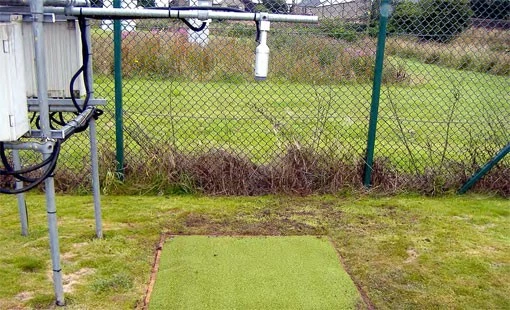
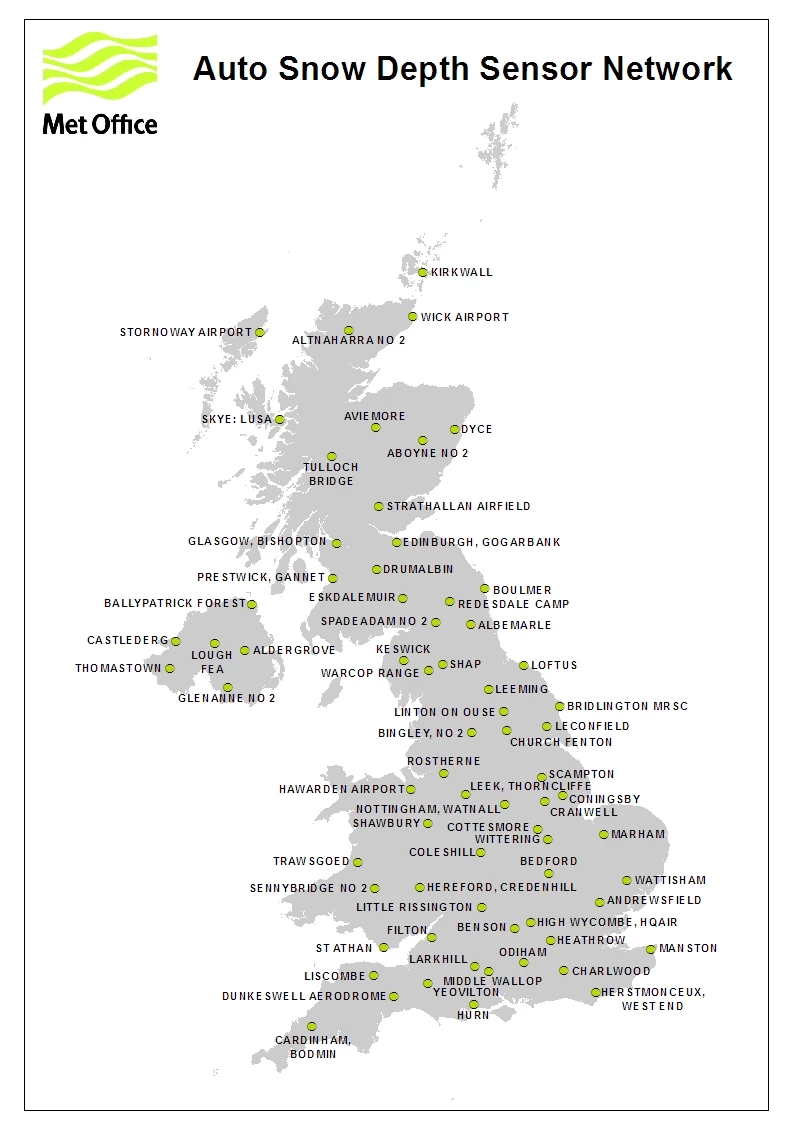
Weather stations such as the MET Office have come up with new ways of measuring snow depth, using new technologies. The picture below shows one of the MET Offices snow stations. These use laser sensors to measure how deep the snow is on the flat surface placed below it. This means that Meteorologists can collect readings from all over the country at the push of a button – which is far more reliable and a lot easier than sending people out into the cold with snow sticks! The map below shows how many snow stations the MET office has and where these are, is there one close to you?
This is what the METOffice’s Snow Depth sensors look like!
(MET Office website)
Map showing the MET Office’s Snow Depth sensors – is there one near you?
(Image courtesy of MET Office website)
If you have snow and measure the snow fall with your rain gauge or the snow depth with a snow stick, then please tell me in the ‘comments’ section when you are logging your weekly records! I would be very interested to know what the snow depth is compared to the snow fall collected in your rain gauge!