Exploring the Magic of Spring: A Season of New Beginnings

Penny Dacey, 23 February 2024

Hi Bulb Buddies! There’s something in the air at the moment, as winter begins to turn into Spring. You may have noticed blooming flowers, chirping birds, and longer days? These are some of the earliest signs that springtime is coming! Let's dive in and explore some of the exciting changes that you might notice as this season draws closer.

What is Spring?

Spring is one of the four seasons that we experience each year. It comes after winter and before summer. During spring, the days become warmer, and nature starts to wake up from its winter snooze. In the UK Spring begins in March, so it’s still a few weeks away. But there are lots of signs that it’s coming. 

The Early Signs of Spring:

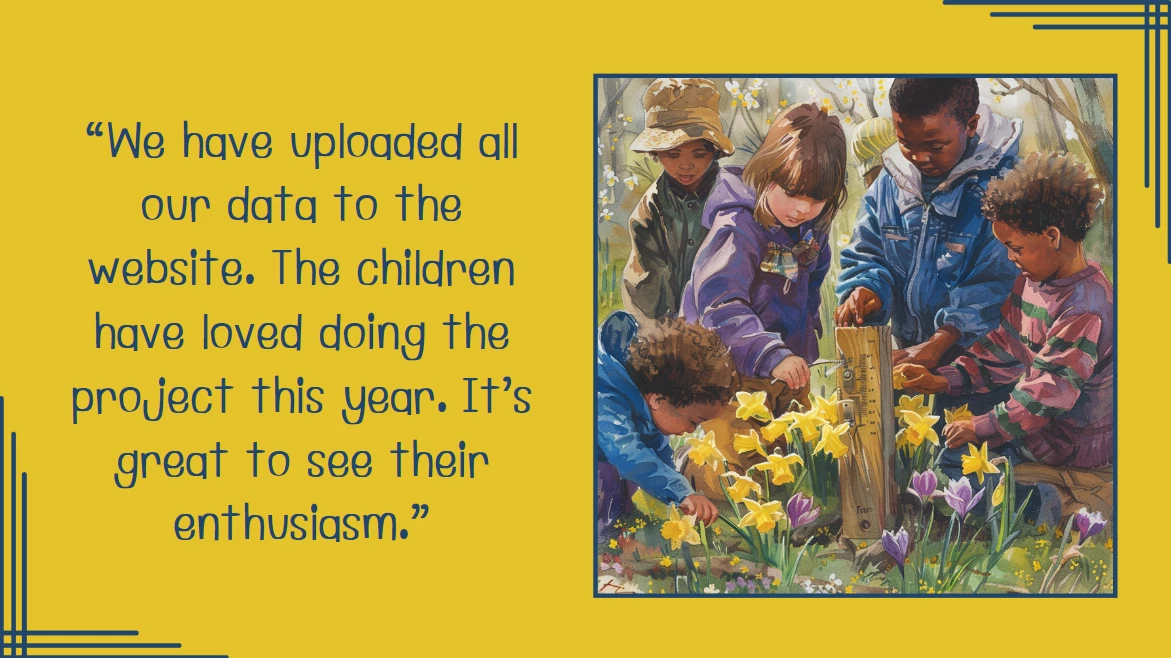
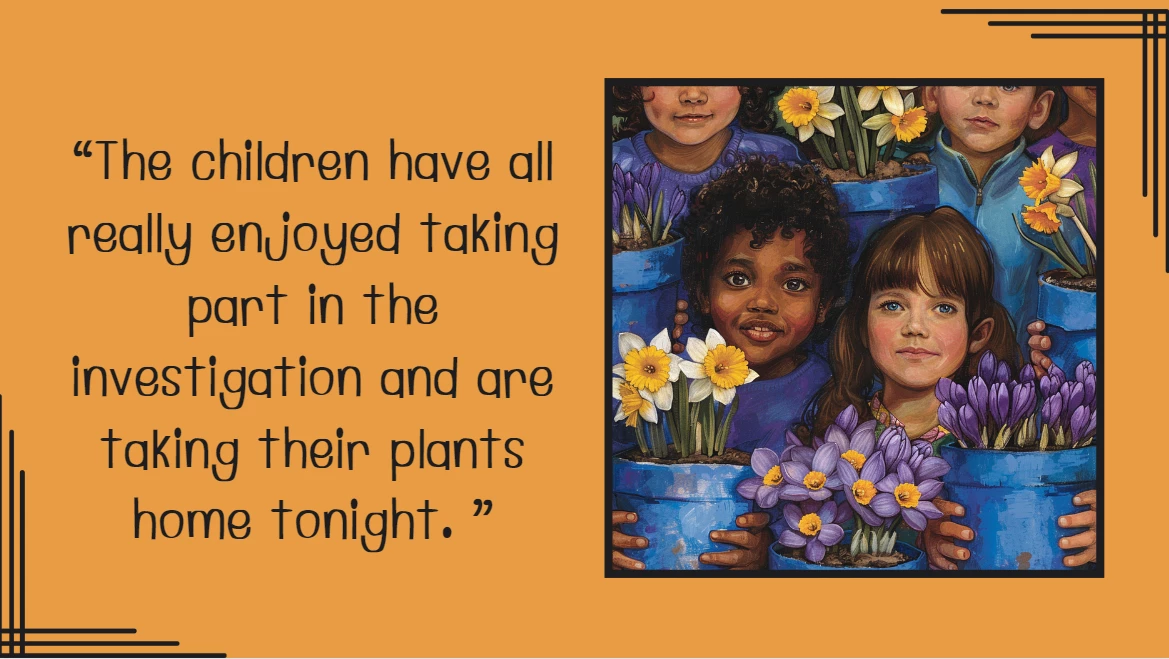
  • Blossoming Flowers: One of the first signs of spring is the appearance of colorful flowers. Keep an eye out for daffodils, crocus, tulips, cherry blossoms, and many more as they start to bloom and paint the world with their vibrant hues.
  • Singing Birds: Have you noticed the cheerful melodies filling the air? That's the sound of birds returning from their winter migrations and singing to attract mates or establish territories. Listen closely, and you might even hear the distinctive songs of robins, sparrows, and finches.
  • Buzzing Bees and Butterflies: As the flowers bloom, they attract busy bees and fluttering butterflies. These important pollinators play a crucial role in helping plants reproduce. Watch them flit from flower to flower, collecting nectar and pollen.
  • Greening of Trees: Look around, and you'll notice the leaves on trees starting to unfurl. Spring brings new growth, transforming bare branches into lush green canopies. It's a sign that life is returning to the land.
  • Warmer Weather: Bid farewell to chilly days as spring brings warmer temperatures. It's time to shed those bulky winter jackets and enjoy the gentle sunshine.
  • Baby Animals: Spring is a time of birth and renewal. Keep an eye out for baby animals like ducklings, lambs, and bunnies as they make their debut in the world. You can watch for new lambs on the LAMBCAM from 1 March: Lambcam 2024 (museum.wales)
  • Rain Showers: Don't forget your umbrella! Spring often brings showers that help nourish the earth and support new plant growth. So, embrace the rain and splash in the puddles.
  • Longer Days: Have you noticed that the days are getting longer? That's because spring marks the time when the Earth's axis tilts closer to the sun, giving us more daylight to enjoy outdoor adventures.

Spring is truly a magical time of year, full of wonder and new beginnings. So, grab your magnifying glass, put on your explorer hat, and venture outdoors to see how many signs of spring you can spot! One might be your bulbs, have they started to grow? Can you see what colours your flowers will be yet?

You can share your photos via email or on Twitter by tagging @Professor_Plant

If this is your favourite part of the investigation so far, maybe it will inspire your entry to the BULBCAST video competition! More details on this can be found here: Bulbcast 2024 

Keep up the good work Bulb Buddies,

Professor Plant

Secret Messages of Love: Archaeological Finds of an Amorous Kind

Elena Johnston, 14 February 2024

Last year, 77 finds from across Wales, all over 300 years old, were reported as treasure. My favourite treasure cases are the ones that include jewellery, especially rings. Yes, they are beautiful little objects, but they are also very personal items each with a story to tell.

I often wonder how these prized possessions end up in buried in the ground. Perhaps lost on a countryside stroll, the owner only realising with a jolt of panic once they have returned home. An argument between lovers perhaps, resulting in a ring being thrown across fields in a fit of rage. Or the remembering of a loved one with the private placing of the ring at a shared special place.

Love, in one form or another, is the common theme here, so to celebrate Valentine’s Day let’s take a closer look at some of the rings recently declared treasure in Wales.


A gold posy-ring dating from the late 1600s to early 1700s (treasure case 21.26 from Esclusham Community, Wrexham). The inscription inside reads ‘Gods providence is our inheritance’.

Gold Posy-ring.

Posy rings were used to communicate secret messages of love, faith and friendship between the giver and the recipient. The wearing of hidden words against the skin offering a poignant, intimate connection.


A medieval gold fede or betrothal ring, decorated with engraved leaves and flower heads (treasure case 21.14 from Bronington Community, Wrexham).

Gold Fede or Betrothal Ring. 

The inscription on the outer surface reads ‘de bon cuer’ which means ‘of good heart’. The ring forms part of a hoard of coins and finger-rings dating to the Wars of the Roses during the later 15th century.


A gold finger ring, dated 1712, (treasure case 19.41 from Llanbradach and Pwll y Pant Community, Caerphilly).

gold finger ring.

The initials A. D. and E. P. are inscribed either side of two joined hearts, representing the names of the couple betrothed or married.


Remember to keep an eye on our social channels for new treasure declarations and please do check out our website to find out more.

https://museum.wales/treasure/ 


I’ll finish with a few FAQs about Treasure - everyone has heard of it, but what does it mean?


How is Amgueddfa Cymru – Museum Wales involved in Treasure declarations? 
Curators based at Amgueddfa Cymru provide expert advice and make recommendations to Coroners on cases of reported treasure from Wales. They compare finds with the legal definition of treasure, as set out in the Treasure Act 1996 and the Treasure Act 1996: Code of Practice (3rd Revision) of 2023. We also have Portable Antiquities Scheme Finds Officers based at our museums, who work with finders, often metal-detectorists, who show their treasure and non-treasure archaeological finds, enabling them to be recorded and reported.


Why does a Coroner make the decision on Treasure cases? 
The role of Coroners in treasure cases arose from the Medieval duty of the Coroner as a protector of the property of the Crown belonging to the king or queen of the day. In Middle English, the word ‘coroner’ referred to an officer of the Crown, derived from the Latin corona, meaning ‘crown’.


What happens to ‘Treasure’? 
When treasure finds are declared treasure by Coroners, they legally become the property of the Crown. Finders and landowners are entitled to rewards, usually each receiving 50% of the independent commercial value placed on the treasure find. The Treasure Valuation Committee, an appointed group of experts representing the antiquities trade, museums and finder groups, commissions and agrees the values placed on treasure. Interested accredited museums may acquire treasure for their collections and for wider public benefit, by paying the agreed valuation sum placed on a find.  
 

Early Years Learning at National Museum Cardif in partnership with Flying Start

Megan Naish, Learning Facilitator, 7 February 2024

Amgueddfa Cymru has worked alongside Flying Start to invite families with young children to explore our collection through themed play, craft, and sensory activities as part of our Family and Early Years Learning Program.

For many families, there can be anxiety and hesitance around bringing their young children to museum spaces, and so our Saturday sessions are designed to relieve that concern by providing our younger visitors with safe, supervised spaces and interactive resources that encourage their curiosity, inquisitiveness, and learning. 

Occurring monthly, each weekend invites a different theme that relates back to an area in our museum collection, such as ‘Dino Discovery Day’, ‘Under the Sea’, ‘Minibeasts in the Garden’, and ‘Ice Age’. We use our Clore Discovery Centre as the base for our Family Saturday sessions, and families can freely drop in throughout the day and have the opportunity to explore our vast handling objects collection.

We aim to give our families a safe and welcoming environment to spend time together, make memories and to experience the museum in a unique way that supports the needs of our young visitors and their families.

It's here: Bulbcast 2024

Penny Dacey, 2 February 2024

Hi Bulb Buddies,

I'm excited to announce the launch of a new competition for those participating in the Spring Bulbs for Schools Investigation. 

I've attached a helpful guide that can be your handbook for completing this challenge. 

There's also a video introduction here:  

Video entries should be about 30 seconds long and shared over Twitter or by email by 22 March.

We can't wait to see what you create!

Get casting Bulb Buddies!

Professor Plant & Baby Bulb

Conserving Anti-Apartheid Banners

Madalyne Epperson and Sarah Bayliss, 31 January 2024

In July 2022, three anti-apartheid banners from the 1980s were acquired by the museum, two by Anthony Evans and one by Gerda Roper.

The banners were made for and used by the Wales Anti-Apartheid Movement (WAAM). This group vigorously campaigned for an end to racism and the apartheid system in South Africa. They began as a regional branch of the British Anti-Apartheid Movement (AAM), but they split in 1981 when it became clear that they would garner more support with a distinctly Welsh identity. Under the leadership of Hanef Bhamjee, WAAM was active until the first democratic election in South Africa in 1994 (The National Library of Wales 2021).

The two banners by Anthony Evans, who was an active member of WAAM, were treated in the National Museum of Wales’ painting conservation studio. They presented very different challenges, as both were created with materials at hand with the purpose of being taken out onto the streets rather than hung in a museum.

Sanctions Now! banner on a protest in the 1980s

Sanctions Now! banner on a protest in the 1980s


Nelson Mandela

This banner was made in the mid-1980s with household paints applied onto an unprimed canvas. The banner is covered in signatures of protesters and supporters of WAAM. According to Evans, it was made with the intention to be signed as, “an autographed book”. The signatures date from both the protests in the 80s and the memorial service of Hanef Bhamjee held in June 2022. Quite a few of these later signatures go onto the bare canvas, which is exposed from paint loss.

F2022.80_AT_01_Whole front after treatment

F2022.80_AT_01_Whole front after treatment  

© Anthony Evans. Photograph ©Amgueddfa Cymru – Museum Wales 

The banner was in a very vulnerable state when it came into the studio. Years of protests, of being unrolled and rolled again, had taken a toll on the banner. Lines of paint loss follow where the banner had been folded. The entire painted surface was cracked and the paint was actively flaking off. The canvas was stapled to a wooden batten along the top edge, but there was nothing to hold it in place and provide a support for the paint layers. Movement of the canvas could cause more paint loss in the future.

As a paintings conservator, I’m used to working on artworks that were made to be hung on a wall with a purpose to invite admiration and interpretation. For this banner, I was very aware that I wanted to treat it differently, even if the materials and artist’s technique was similar to a modern painting. The banner’s condition was a direct result of how and why it had been made, and how it had been used by protesters. While we needed to find a way of stabilising the banner so it could safely be displayed and stored, many of the go-to conservation methods for stabilising such a damaged painting would change the appearance and structure of the banner, which we wanted to avoid.

Unrolling the banner at the beginning of the treatment

Unrolling the banner at the beginning of the treatment  

© Anthony Evans. Photograph ©Amgueddfa Cymru – Museum Wales 

Detail showing extent of paint loss and flaking

Detail showing extent of paint loss and flaking  

© Anthony Evans. Photograph ©Amgueddfa Cymru –Museum Wales 

Future risk vs intervention

In conservation, you often have to make decisions about balancing risk to the object with being able to see and appreciate the artwork as it was intended. Risk can come in different ways; it can come from a method of treatment changing something fundamental about the object or from not intervening at all and it deteriorating over time, or perhaps from the environmental conditions needed to display it (for example, fading might occur from being displayed in the light). As conservators, we are constantly trying to balance these risks. For this banner, not doing anything would result in the continued deterioration of the banner. However, to make sure no paint fell off in the future, we would have to do something drastic, like flattening and lining the canvas and stretching it onto a stretcher so the paint was properly supported. This would mean the paint was safe, but it would also change the appearance of the banner and remove some of the features that show the history and character of the banner.

To strike a balance, I decided to pursue a course of action that would stabilise the banner enough to be displayed but would leave it in a condition that would need to be monitored over time and would reduce the ability for it to travel.

Treatment

The flaking paint was consolidated with isinglass adhesive. Every part of the banner was consolidated several times to make it secure enough to move off the table we had unrolled it onto. The banner was then attached onto a wooden frame, which allowed me to brush a different adhesive onto the back of the canvas. An insert was made for the back using a fluted polycarbonate board and polyester wadding to support the canvas. The front of the banner was held onto the wooden support with Perspex clips. This allowed us to display the banner upright with enough support, but without changing the appearance of the banner.

Putting back loose flakes of paint while unrolling the banner

Putting back loose flakes of paint while unrolling the banner  

© Anthony Evans. Photograph ©Amgueddfa Cymru – Museum Wales 

Applying adhesive to the back of the banner

Applying adhesive to the back of the banner 

The paint losses were left unfilled so that the new signatures that went onto the canvas could remain visible and we also wanted to place a greater value on the history of the banner rather than the painted image.

Sanctions Now

Anthony Evan’s Sanctions Now is made from alkyd paints and an old plastic movie projector screen. A wooden beam adds support to the upper edge of the banner, as well. The image on the front of the banner is a copy of a now-famous photograph taken during the Soweto Uprising in South Africa by Sam Nzima on June 16, 1976. Black school children led a series of demonstrations against white-minority rule after Afrikaans was introduced as the instructional language in black schools. An estimated 20,000 students gathered in the streets of Soweto to protest and were quickly met with police brutality. The image captured by Sam Nzima is of 12-year-old Hector Pieterson, who was fatally shot by South African police. He was carried to a clinic by Mbuyisa Makhubo while Hector’s sister, Antoinette Sithole, followed. Nzima’s picture became an icon of the Soweto Uprising and helped galvanize the anti-apartheid movement (Baker 2016). An amended logo from the Anti-Apartheid Movement adorns the back of the banner. Anthony Evans added the Welsh dragon to the group’s taijitu, or yin yang, symbol due to the importance of Welsh identity within WAAM.

F2022.80.2 (Sanctions Now) Front After Conservation Treatment

F2022.80.2 (Sanctions Now) Front After Conservation Treatment  

© Anthony Evans. Photograph ©Amgueddfa Cymru – Museum Wales


F2022.80.2 (Sanctions Now) Back After Conservation Treatment

F2022.80.2 (Sanctions Now) Back After Conservation Treatment  

© Anthony Evans. Photograph ©Amgueddfa Cymru – Museum Wales 

Flaking paint on both sides of the banner was consolidated to prevent further loss of material. Lascaux Medium fur Konsolidierung was applied to the plastic surface with a soft bristle brush, before a silicone tipped tool and siliconized Melinex were used to press down the paint flakes.

Sanctions Now Before Paint Consolidation

Sanctions Now Before Paint Consolidation

© Anthony Evans. Photograph ©Amgueddfa Cymru – Museum Wales 

Sanctions Now After Paint Consolidation

Sanctions Now After Paint Consolidation

© Anthony Evans. Photograph ©Amgueddfa Cymru – Museum Wales 

Once the paint was secured, the banner needed to be cleaned. Smoke sponges were rolled across the surface of the banner to remove loose contaminants, such as dirt and dust, without causing stress to the plastic. The mould stains and residues were removed with a cotton swab dampened with Adjusted Water (pH 6.5).

Sanctions Now Surface Cleaning Tests: Smoke Sponge (Left) vs Cosmetic Sponge (Right)

Sanctions Now Surface Cleaning Tests: Smoke Sponge (Left) vs Cosmetic Sponge (Right)

© Anthony Evans. Photograph ©Amgueddfa Cymru – Museum Wales 

After conservation treatment was complete, Sanctions Now was wrapped around a large cardboard tube (40 cm x 2 m) covered in ALUVP. To prevent the banner from being in contact with itself when rolled, the banner was sandwiched between silicon coated paper before it was rolled. The silicon coated paper will prevent the transfer of paint. Polyester sail cloth was used to cover the rolled banner and protect it from dust. Cotton tape keeps the banner from unrolling.

References:

Baker, A. 2016. This Photo Galvanized the World Against Apartheid. Her’s the Story Behind It.                
Available at: https://time.com/4365138/soweto-anniversary-photograph/ (Accessed 9 June 2023)

The National Library of Wales. 2021. 40th Anniversary of Wales Anti-Apartheid Movement.                
Available at: https://blog.library.wales/40th-anniversary-of-wales-anti-apartheid-movement/ (Accessed 7 June 2023)

The Welsh Group. 2023. Anthony Evans.                
Available at: https://www.thewelshgroup-art.com/anthony-evans (Accessed 7 June 2023)