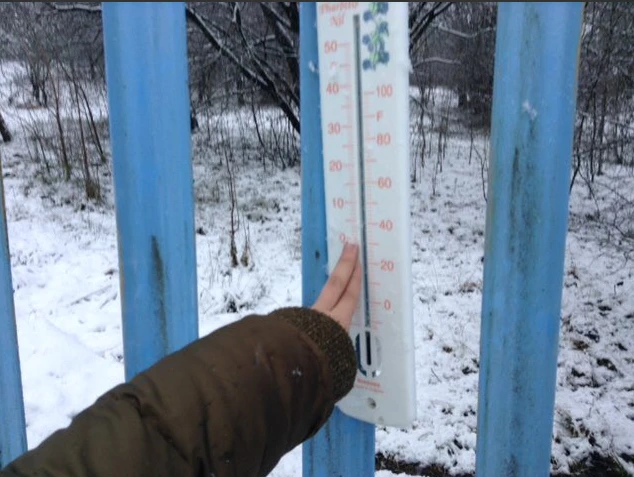
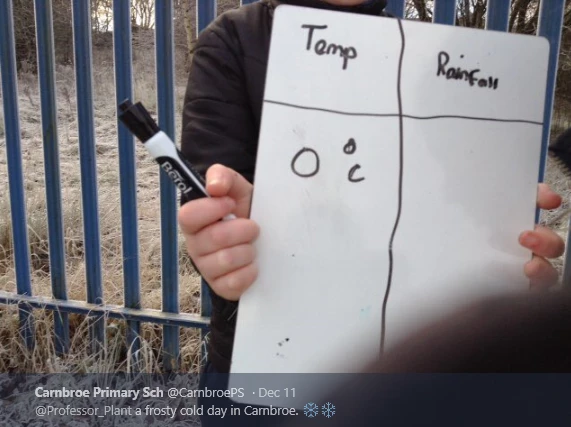
What an interesting time to be studying and observing the weather! Most of you will have had frost and cold winds this last week. I've heard that many schools have had to close in January because of the effects of extreme weather conditions, such as ice and floods. Even on days where schools were open, conditions in the school grounds may have meant you weren’t able to collect weather data.
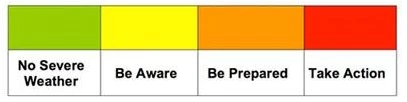
It’s likely that you’ve heard people talking about weather warnings a lot recently. Weather warnings are released by the MET Office (the UK’s official weather service) and are colour coded (green, yellow, amber and red) to indicate how extreme the weather will be in different areas.
Green: weather is not expected to be extreme.
Yellow: possibility of extreme weather so you should be aware of it.
Amber (orange): strong chance of the weather effecting you in some way, so be prepared.
Red: extreme weather expected, plan ahead and follow the advice of the emergency services and local authorities.
The Met Office also use symbols to indicate what type of weather to expect. For example, the symbols to the right show (in order) a red warning for rain, green for wind, green for snow, amber for ice and green for fog. This means there will be heavy rain and that you should prepare for ice. Why not have a look at the Met Office website and see what the weather forecast is for where you live?
The Met Office warn us about bad weather so that we can prepare for it. This is because extreme weather (such as strong winds and ice) can cause difficulties and make it hard to travel. Roads and train lines can close, flights can be cancelled, and walking conditions can be dangerous.
What was the weather like where you live? If you weren’t able to collect weather records you can enter ‘no record’ on the online form, but please let me know in the comment section what the weather was like! You can also let me know how your plants are doing and whether they have begun to sprout!
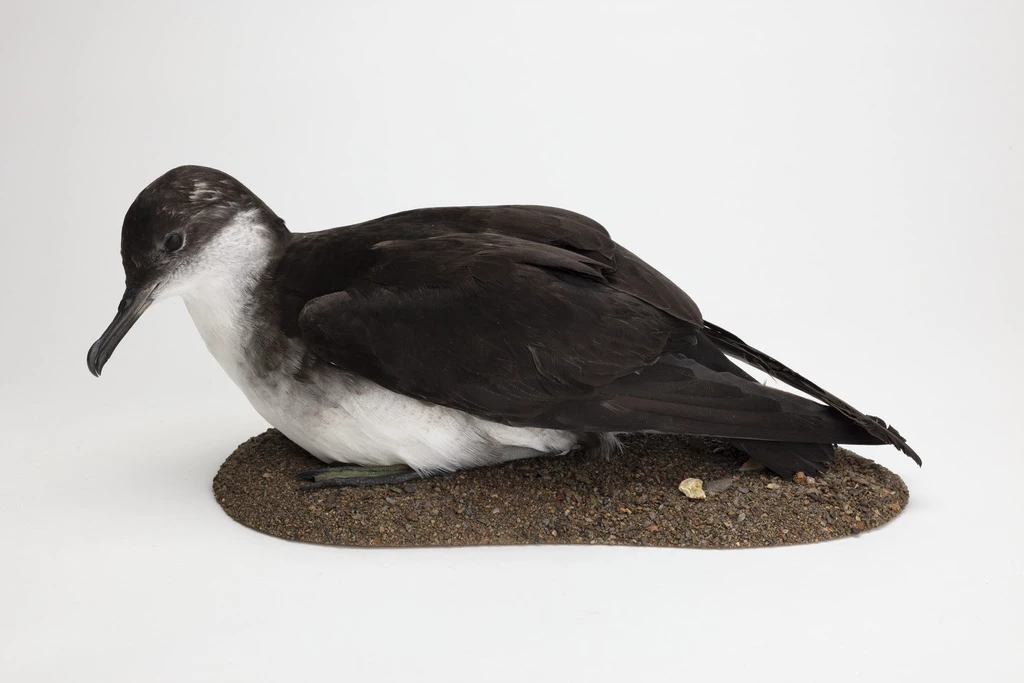
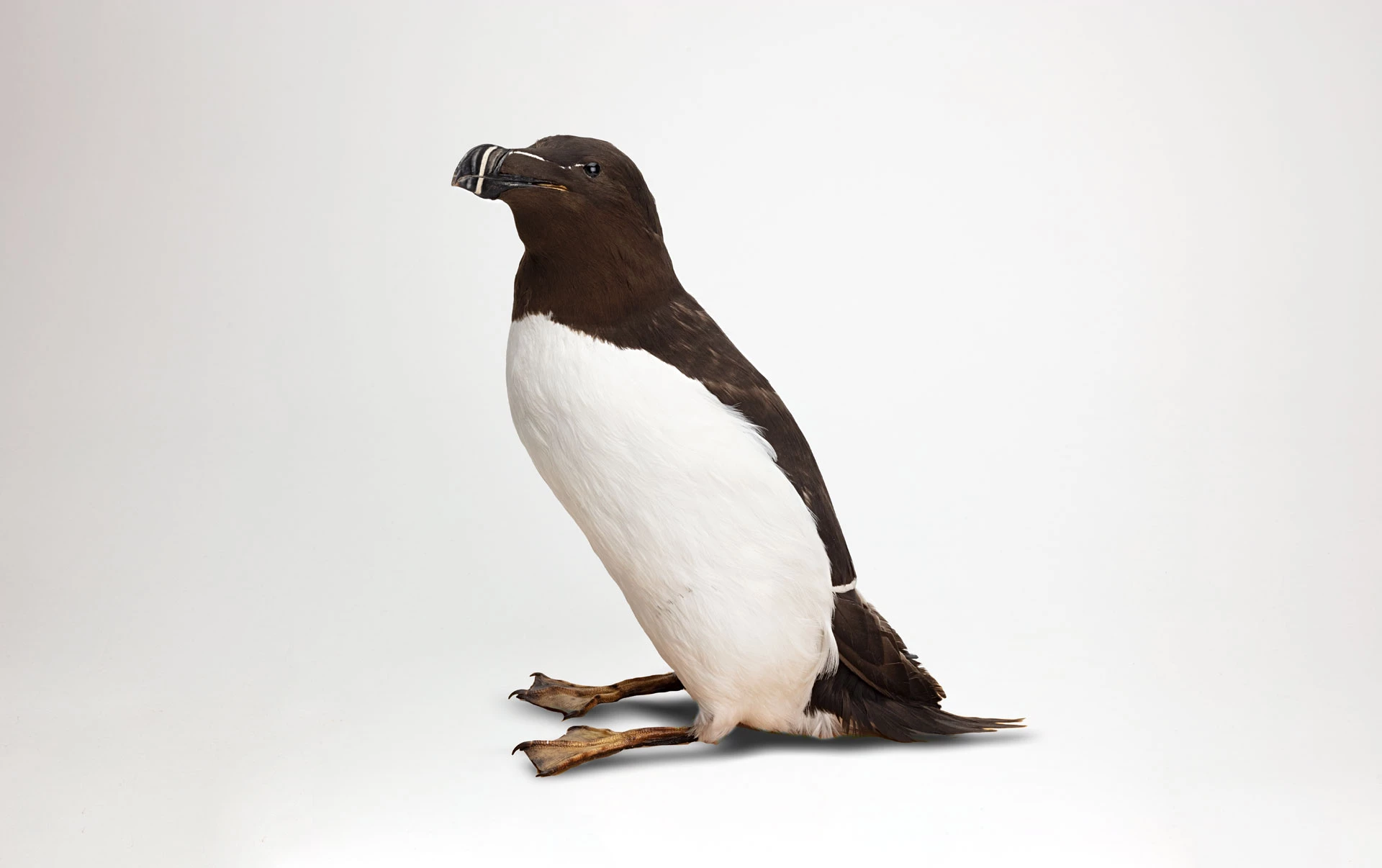
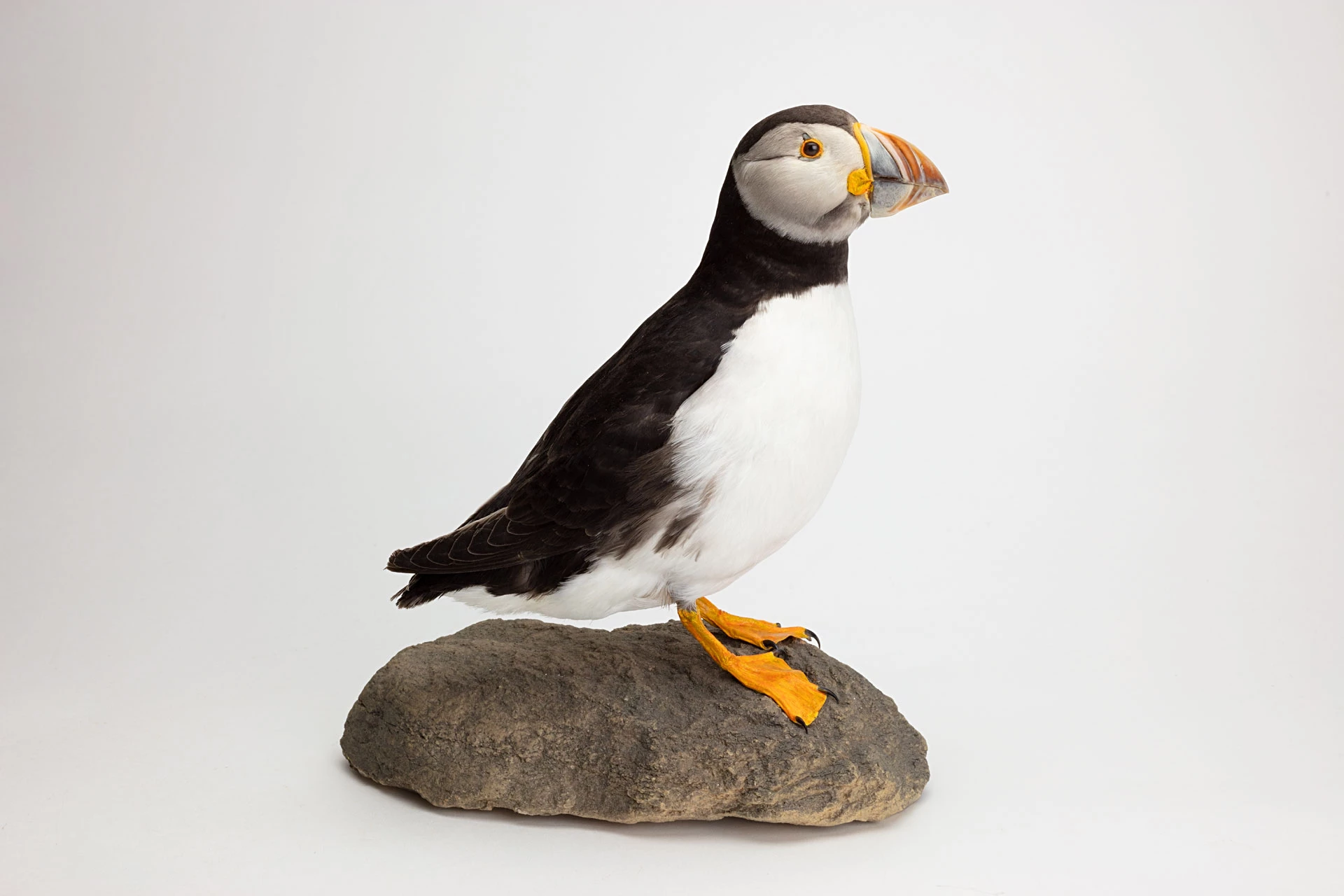
Regular visitors to the Natural History galleries at National Museum Cardiff will be familiar with our fantastic dioramas, particularly the one recreating a Pembrokeshire sea cliff complete with nesting sea birds, rock pools and life-size basking shark. Recent visitors will have noticed however a distinct lack of sea birds as we have had an outbreak of clothes moths which has threatened to eat all the taxidermy specimens! All the specimens have had to be removed for treatment and some will unfortunately not be returning as the damage is too severe.
A sad fact is that this disappearance is mirroring what is happening in the outside world. Birds are suffering a pandemic of their own, the worst outbreak of avian flu ever known in the northern hemisphere. A new strain of bird flu has been attacking bird populations since the autumn of 2021, spreading from intensively farmed poultry in China. By late spring of 2022 there were increasing reports of the disease in seabird colonies in the north of the UK, and this has now spread across the whole of the country.
Avian flu is a virus that affects a range of birds but as with other viruses there are many different strains, most of which cause few or moderate symptoms. The difference is that this current strain, HPAI H5N1, is transmitted easily and causes symptoms that can be fatal to birds.
The effect on wild bird populations has been devastating, particularly on sea birds who live in large dense colonies along cliffs and islands where the virus is easily transmitted. It is estimated that tens of thousands of birds have died - you may well have seen some of the footage of dead or dying birds or even seen dead birds along our coasts.
In the UK we are privileged to host internationally important breeding populations of seabirds, a whopping 25% of Europe’s breeding seabirds. Worst affected species are the Great Skua and Northern Gannet populations. Up to 11% (over 2,200 birds) of the UK population of Great Skuas have been lost and scientists have recorded such high numbers of Gannet deaths that they think some populations are near collapse.
The situation is continuing to be monitored, particularly with waterfowl, like geese, who overwinter in the UK. The hope is that populations will eventually develop an immunity to the disease, and there have been some encouraging signs in some birds, like Puffins, who seem to have had a good breeding year in 2022.
We hope to see the return of our seabirds both in the galleries and along our coasts soon!
Adam Webster, Chief Conservator Art, Natural Sciences & Preventive Conservation and Rhodri Viney, Digital Producer, 17 January 2023
After decades in a private collection, and under layers of dirt and yellow varnish, this tender portrait entered the Amgueddfa Cymru collection in lieu of tax in 2020. We were fortunate to receive funding from TEFAF, The Finnis Scott Foundation and the Friends of Amgueddfa Cymru to conserve the painting and frame.
The painting was cleaned and conserved in our own paintings conservation studio and the frame in a private studio. The process was transformative, the true colours, subtlety of brushwork and tonal values being gradually revealed as the surface coatings were removed. We also repaired and strengthened the weak edges and removed the unsightly bulges from the canvas.
We carried out all the professional documentation necessary for such treatment, but also made a time lapse video of the treatment and recorded interviews with the conservator and curator at key stages in the process. These will be displayed at Amgueddfa Cymru alongside the painting from the beginning of 2023 and will feature in our online content. We hope this will demystify the process for our visitors and even provide a bit of mindfulness along the way!
Adam
Adam Webster and Rhodri Viney making a film about the restoration of Manet's portrait of Jules Dejouy.
The restoration process took several months, and we wanted to document as much of it as possible. The first piece of filming relating to the portrait took place in June 2021, so this was a long production by our standards.
The process started in earnest in June 2022. We set up a timelapse camera to capture the transformation that recorded over several months, and I visited the conservation studio regularly to interview Adam on the latest progress. It was a pleasure and privilege to see the portrait change with every visit. I also made a significant dent in their teabag supply - the conservation team are very hospitable!
We filmed nearly 3 and a half hours of footage in the studio, and you can see the edited results in the film above. I hope it does justice to the amazing conservation work done by Adam.
There are many different kinds of portals. They can be physical spaces, periods of time, dreamworlds and rituals. Anyone can make them. My favourite kinds of portals are stories: our doorways to freedom and lessons on shapeshifting.
Stories can be the most dangerous portals. When a story becomes the only one that can be told, when it is wielded by those in power and used to suppress other narratives, the portal becomes calcified. Like a thing that wants to change and grow but no longer can, we get trapped halfway through the portal, tense and afraid, unable to see ourselves
For me the pandemic was a portal of sorts. A sudden opening, disconnecting me from regular life, a space created where there was none before. And time: to process, to rest, to anxiously worry about survival and whether or not I’d really washed my hands before I ate those chips yesterday. It wasn’t easy: like many others I lost my home, I lost my income, I lost relationships. This pandemic portal was full of a grief I couldn’t run away from. Everyone had their own hurts and the air was thick with it. Slowly, stubbornly, I realised it was best to sit with the discomfort. I used the space to shout and dance, to get lost in the forest, to grow plants. I used the time to write, to reach out for help, to dream and to create. The land was my guide, and in that space-time I met myself again.
Portals beget portals. Some doors can only be accessed by going through others. I was sitting under a tree with my sibling when the idea for The Wound is a Portal first whispered itself to me. From the beginning, the work knew itself: I would create a portal, a space for healing and for community. This portal would take the form of a series of tattoos: each one unique but similar to the next so that they could create an animation. The intention was simple: connection.
My experiences tattooing and being tattooed had shown me that tattoos can be a powerful tool for addressing and healing trauma. Pain is a portal. This ritual is a meditation: bringing our bodies and minds to the present, reminding us of our agency and serving as a permanent marker of belonging.
It’s easy to forget yourself when you are trapped in a calcified portal. We have been hurting in so many ways. The air is thick with it. This work isn’t really about Picton. It’s about Portals. It’s an offering. I wanted to create a space for a group of Black Trinidadians to meet and talk about the stories of our families. A safe space where we could sit with our pain, one where we could talk about race and share our experiences candidly. I wanted us to connect with each other and to connect with the land. I wanted to create a space for us to see ourselves.
Tattoos are some of the most fluid portals. Like us, once created, they are always changing. In The Wound is a Portal, eight participants between the ages of 20 and 78 volunteered to receive a tattoo inspired by the island and by breeze blocks, a common architectural feature throughout the country—our way of letting the outside in. The work developed over eight months to incorporate the mythology of our island and to include interviews with participants, dance and writing.
My creative process is spiritual, it’s joyful, it’s honest. These days, it feels like my role as an artist is to stay open, to witness and experience life in all its beauty and horror and still be able to stay soft, flowing from my centre, grounded in possibility. I’ve poured myself into this work, lovingly tending to all of its parts, creating space for healing and dreaming, and witnessing change in myself and my community. Now it’s here, out in the world, a journey taken together. All this time I thought that I was making a portal, now I realise that it was making me.
See The Wound is a Portal for yourself as part of the Reframing Picton exhibition at National Museum Cardiff until 3 September 2023.
Film Stills. The Wound is a Portal, Gesiye, 2022, Trinidad.
Thank you to everyone who supported and participated in this work. Commissioned by Amguedddfa Cymru in partnership with the Sub-Saharan Advisory Panel Participants: Robbie Price, Safiya Hoyte, Adam ‘Mar” Andrews, Alicia Viarruel, Dawn-Marie Alexander, Kevon Samuel, Nadine Marshall-Joseph, Joan Ballantyne Production Manager: Lisa-Marie Brown Production Assistant: Neisha Rahamut Researcher: Timiebi Souza-Okpofabri Interviewer: Tracy Assing Stylist: Suelyn Choo Composer: Omar Jarra Location Sound Recordist: Jelani Serette Director of Photography: Mikhail Gibbings 2nd Camera Operator: Aviel Scanterbury Drone Camera Operator: Renaldo Celestine Matamoro 2nd Drone Camera Operator: Avery Smart Designers: Meiling & Kaleen Salois Colour Grader: Shane Hosein & Maia Nunes, Rheanna Chen, Melanie Archer, Bunty & Rory O’Connor, Justin Koo, Stephanie Roberts, Nicholas Thornton, Pomegranate Studios, Nigel & Debbie Souza-Okpofabri, Eileen & Vernon Phipps, Urban Hudlin, Ancestors Known & Unknown, The Land.
The Reframing Picton exhibition has now opened at National Museum Cardiff.
The exhibition is a culmination point for over two and a half years of work for Amgueddfa Cymru and its community partners, the Sub-Sahara Advisory Panel (SSAP) and both organisations’ outreach programmes – the Sub-Sahara Advisory Panel Youth Network and the Amgueddfa Cymru Producers.
In this blog, one of the young people involved in the project since the very beginning gives us an insight into the project, guiding us through the key stages of the Reframing of Sir Thomas Picton.
Date: Dec 2021
We’re well over a year into this project so this entry is well overdue: let’s get to it.
What is the project about?
Amgueddfa Cymru’s collection includes a portrait of Lieutenant-General Sir Thomas Picton, the highest-ranking soldier to lose his life at the battle of Waterloo in 1815. In addition to the oil portrait, plaques and statues were erected around Wales decades after Picton’s passing; these memorials have remained into the 21st century.
Why make a change now?
On 25 May 2020, a father accused of using a counterfeit $20 dollar bill became a murder victim; the perpetrators were four Minneapolis Police Department officers. The victim, George Floyd, whose brutal end was captured via cameraphone and disseminated globally on social media. George Floyd’s murder served as a catalyst for protests and demonstrations starting in Minnesota, Minneapolis, spreading across North America, South America, Australia, Eurasia, and of course Africa. By 6 June 2020, global solidarity with George Floyd and against racism manifested in massive public pressure placed on the governments of countries across the world to address the racism within their societies; Wales of course held demonstrations from Cardiff, Swansea and Carmarthenshire to Wrexham and Bangor in the north.
This is where I enter the frame. I was part of the team that planned the demonstrations in Bangor, Caernarfon, and Llandudno. The Sub-Sahara Advisory Panel (SSAP) and the SSAP Youth Leadership Network took note of the work being done in the area and eventually, working alongside SSAP and SSAP Youth Leadership Network, brought the opportunity to get involved in the Reframing Picton project.
So I was recruited as one of the black, African-British, young(ish) activists for at least 3 reasons:
My filmmaking and photography capabilities I’m a filmmaker and photographer. On 6 June I was part of the team capturing the demonstration in Bangor.
To make a decision regarding what to do about the portrait A huge proportion of this project has been reaching a decision regarding what to actually do with the 2.14m x 1.37m, gilt-framed, portrait of Picton. We decided it should be removed. Primarily, humans unintentionally associate scale with importance hence an oil painting of this size has always been a “flex”; or to be more proper, a display of status hence the intent of making such a large painting is to convey the importance of the subject. The team being aware of this underlying message of veneration towards Picton, in the absence of the violence he was responsible for, led us to the decision to remove the portrait.
Reach a decision on an artist to commission As a result of removing the portrait, the project team decided to commission artists to create art that would better tell the story of Picton; we were particularly interested in artists from Trinidad where Picton was the Governor from 1797 to 1801. Most importantly, the team was interested in commissioning a piece to better educate the audience about Picton, a mass murderer, rather than blindly memorialise the man. We expect the new additions to be ready to view in one of the historic paintings galleries at National Museum Cardiff by 1 August 2022.
As we speak, our team is allowing the artists some time to create, while we take time to build capacity. Lieutenant-General Sir Thomas Picton will be remembered differently for future generations. As well as National Museum Wales removing Picton’s portrait, the Hall of Heroes of Cardiff’s City Council has decided to cover up the statue of Picton placed there in light of public pressure.
The original aim of the project, Reframing Picton, does what it says on the tin. Our objective was for the audience to see Thomas Picton in a truer light, to reframe his character, and to include the seldom told stories; I hope at the conclusion of the project that we will reach that goal.
Date: Feb 2022
What’s the project about?
The image used as part of the callout for the Reframing Picton project
The portrait that started this whole project.
The protests led by Black Lives Matter around the globe in 2020, prompted by the murder of George Floyd, also triggered Amgueddfa Cymru to think about some of the characters within their collection.
Thomas Picton, who died a Lieutenant-General and a knight, has his military exploits recorded in the prevailing history of the man. What is seldom discussed about the former Governor of Trinidad is the perspective of the inhabitants of Trinidad who had to live under his rule and the bits which the British Empire, and its advocates, wish to conceal.
Even today, Picton’s brutal legacy affects the people on the island.
From Wales to Trinidad, roads are named, plaques and paintings hang, and statues and monuments are erected; all to memorialise a man with a reputation for cruelty and sadism.
We hope that this project allows the audience to view Picton through the eyes of some of the humans that lived around him, rather than the fabricated reverence we know was bestowed posthumously.
Most importantly, we hope the audience can decide which side of history Picton sits on.
Date: March 2022
Reframing Picton started as an idea that the SSAP's Youth Leadership Network engaged with.
The SSAP used its network to partner with a dynamic team of Youth with Amgueddfa Cymru’s experienced staff. The project team that was assembled spent years deciding how to approach the subject of Thomas Picton through the Museum collection of items and a re-designed (or novel)exhibition.
The entire process of creating a commission was new to me; some of the team had varied experience working with Amgueddfa Cymru, all of which came in handy as we progressed. I really had no appreciation for the amount of work it takes to review items from the museum's collection, curate them according to some criteria and create a captivating exhibition.
The museum supplied really capable and supportive people who truly allowed the Youth team to lead decisions: an entirely worthwhile experience.
Throughout the entire project I think there were two major decisions that felt the most important:
1) Deciding whether the portrait should go back into public circulation, if so, how?
2) Reach a decision on the commissioned artists
The outcome of these decisions can only be answered by seeing the exhibition.
Date: 19th May 2022
'The Wound is a Portal' by Gesiye
The Reframing Picton exhibition
Reframing Picton is a project whose mandate is inclusivity, particularly to the descendants of Picton’s victims.
Reaching a decision on the commissioned artists was one of the most difficult processes of this project, not least because of the volume of applicants. I truly believe the process of wading through applications has the effect of further focusing the team's understanding of the project. As we saw the Artist’s interpretation of the call-out, it allowed us to cement the theoretical ideas we had about the project, and decide whether the artist’s ideas matched our collective vision of the project.
One of the museum staff captured the sentiment behind the idea of commissioning an artist perfectly:
The Museum acknowledges they are an institution that has been founded and staffed by white people. They know that a project that contends with so much squalid history with White Europeans perpetrating unquantifiable violence against Black Africans, as such the project should be led by African diaspora.
Between the project team and the artist commissions, I have my expectations set pretty high as the people are so capable in their artistic craft and in sync with the zeitgeist.
Date: 25th June 2022
What’s happening with the portrait
The Reframing Picton project will be unveiled soon. I have the typical combination of emotions you’d expect; mostly apprehension.
At the heart of theissues with Thomas Picton’s portrait was always the scale, the ostentatious frame, and the elevated placement. The sentiment behind each of these factors is that of respect and reverence. Devoid of the context of how Picton rose to infamy, the issues listed need a solution.
The way in which you see the portrait presented in the museum's Historic Art gallery represents the sum of the Reframing Picton project team’s thinking. After spending so long working on this project avoiding the accusation of “erasing history” I believe we’ve struck an impressive balance.
The Picton portrait will remain on show in an altered manner, amongst exhibits and Trinidadian artist installations that I hope will convey context on Picton.
Date: 14th October 2022
Picton Reframed – what now?
Reframing Picton the project has been finished for approximately 3 months now, with the unveiling taking place around 2 months ago.
I intimately remember my first time seeing the entire space, the ecstasy I felt over completing the project was very welcome after all the time and energy put into the project. Beyond the endorphins of finishing a task, I have a vague sense of pride in participating in the project because I believe the self-esteem of some unknown, future visitors will be lifted once they take in some of the facts covered within this exhibition. At least that’s what I hope.
Some of my most serious trepidation was around the artists and their outputs. Intrepidation quickly followed after my first viewing of the commissioned artist’s installations. I felt like the artists were exactly right, beyond that they accomplished what the AC-SSAP team never could; creating their exhibits as an interpretation of the artistic expression.
I participated in this project with the hope that future generations will have information and exhibits like Reframing Picton readily available to them and that they should not be daunted by museums and historical sites. I have personally found a new appreciation for arts, heritage, culture, and the work involved in preserving these aspects of society, and most of all, I hope more museums adopt working models that promote this degree of community collaboration.