: Museums, Exhibitions and Events

rare breeds at St Fagans

Bernice Parker, 17 February 2015

We have three types of sheep at St Fagans, and they are all on the Rare Breed List:


rare breed:
noun: rare breed
A breed of livestock or poultry that is not associated with large-scale commercial farming, typically one that has traditionally been reared in a particular region.


Source: Oxford Dictionaries

Traditional breeds won’t give you the best, or fastest return on your money, unlike modern commercial animals, but they may have characteristics which make them better suited to specific local circumstances, like hardiness, disease resistance or a willingness to work harder to find food! Each breed might not offer the complete package to a modern farmer, but they are part of the library of genetic material that we need to protect to ensure a sustainable future for Welsh farming.


So if you’re in the mood for some sheep facts – you’ve come to the right place!
Eyes down for a game of Rare Breed Bingo…


Hill Radnor (listed as ‘at risk’)

A rare breed Hill Radnor sheep at St Fagans 


Developed over the years to suit the Radnor Hills and is probably typical of the old Welsh tan-faced sheep that used to roam the hills. Reference was being made to the breed as far back as 1911 and a Breed Society was formed in 1949. The breed remains very much confined to the Radnor/Brecon area of Wales and there are very few flocks in the rest of the U.K.
Key Characteristics:
Size: Medium ewes- 50-55kg, rams- 70-80kg
Looks: A hill breed but larger and bulkier than a Welsh Mountain.Thick white fleece and a distinctive tan face with an aquiline nose. Ewes are polled, rams are horned.
Hardiness: The breed is hardy and is well suited to life on the hills. Can do well on limited forage.

Llanwenog (listed as a ‘minority breed’)

A rare breed Llanwenog sheep at St Fagans


Derived from the cross of the Shropshire with various local black faced hill breeds in the Teifi valley in West Wales in the late 19th century. The Llanwenog Breed Society was formed in 1957. The breed is still centred in West Wales but has spread throughout the UK. Particular value is placed on its ability to survive in harsh upland areas as well as to make the best use of richer lowland pastures.
Key Characteristics:
Size: Medium - ewes- 55-60kg, rams- 80-90kg
Looks: A well balanced sheep with a thick white fleece and characteristic tuft or topknot above the head. The head and ears are black.
Hardiness: The Llanwenog retains some of the hardiness from its hill breed ancestors but is more suited to lowland grazing.


Black Welsh Mountain (listed as a ‘success story’ hooray!!!)

A rare breed Welsh Black sheep at St Fagans


A distinct colour variation of the Welsh Mountain which occurred from time to time in white Welsh Mountain flocks for centuries. In 1920 a Black Welsh Mountain Society was founded to register the breed as separate from the white Welsh Mountain. The Black Welsh Mountain is the only completely black breed of sheep found in the UK.
Key Characteristics:
Size: Small- ewes- 45kg, rams- 60-65kg
Looks: To conform to the breed standard a sheep must be black all over. A small, slender sheep although not as thin looking as a primitive breed. Ewes are polled, rams are horned.
Hardiness:  Can survive on upland grazing where other breeds would struggle and similarly to other Welsh Mountain varieties, the breed will thrive when brought onto richer lowland grazing.


(information supplied by kind permission of the Rare Breeds Survival Trust)

ladies in waiting

Bernice Parker, 23 January 2015

Our pregnant ewes came in from the field just after Christmas for extra care, shelter and food - this is important for strong lamb development. The ewes were all scanned in the New Year so that we can separate them into two groups: those expecting a single lamb in one group, twins or triplets in the other. The blue and green marks on their backs are the farmer’s code for whose got what inside them.


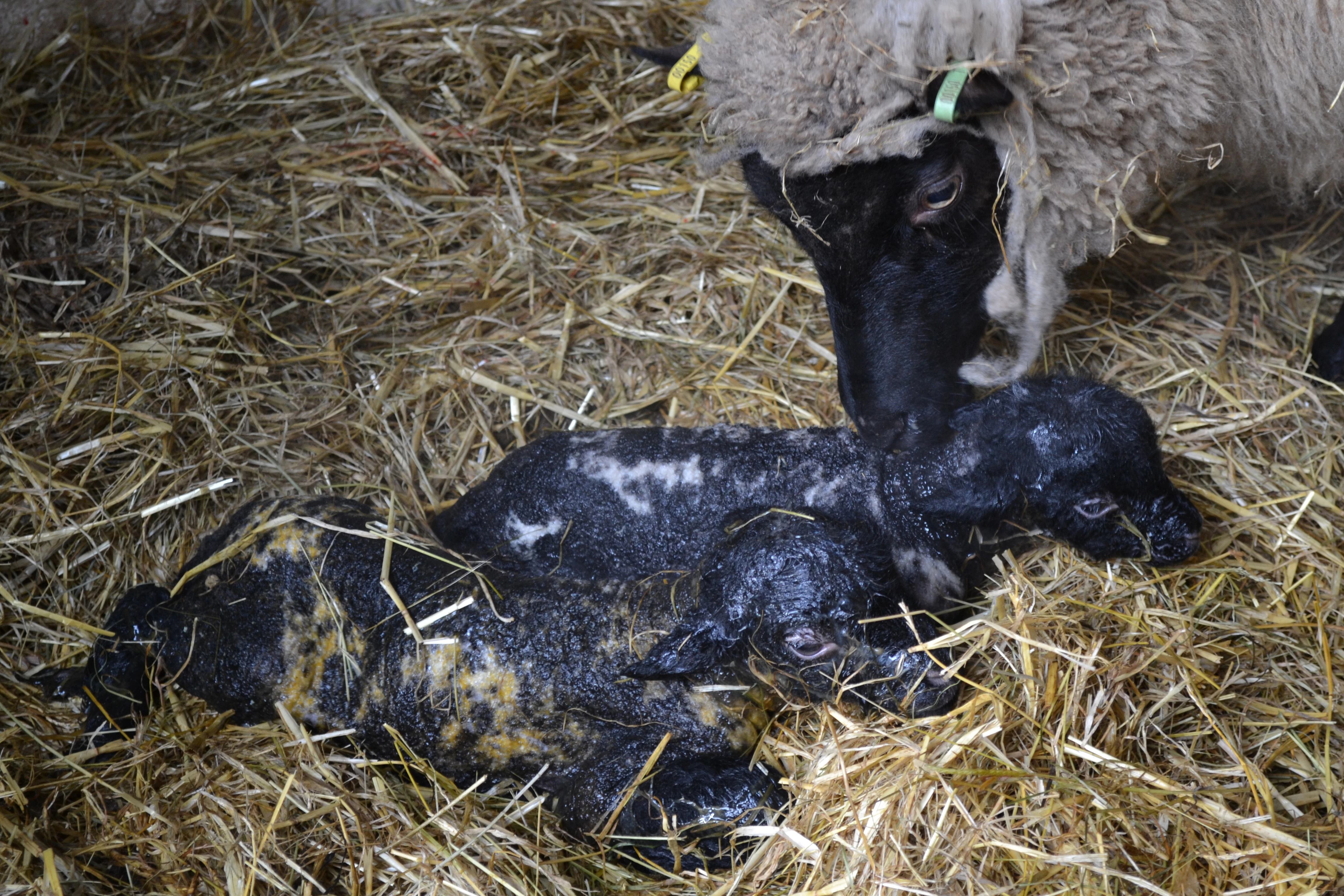
There are currently about 100 breeding ewes in the flock and we expect 150+ lambs. Our ewes are 2 years old the first time they lamb. The gestation period for a sheep is 5 months - the ewes come into season in September and we put our rams in the field in with the girls on 1st October. This means lambing will commence in the first week of March. We choose this schedule in order to have lambs on show in the Museum's fields for Easter.


So for the next few weeks they’ll be loafing around in the shed eating and sleeping….

Sunbathing, and generally being pampered.

Somewhere in amongst them is Poopsie, one of our bottle fed lambs from two years ago. She got the name after pooping all over my leg the first time I fed her.

Sometimes hand reared lambs will stay very tame, but Poopsie has merged back into the flock. Just occasionally though, there’s a look in the eye that makes me think ‘maybe it’s you……’

counting sheep

Bernice Parker, 15 January 2015


In between Christmas and New Year our girls came in from the fields for pregnancy scans.

The St Fagans flock


And the scores on the doors are……

scan results for St fagans ewes


We have three breeds of sheep at St Fagans and they’re all on the Rare Breeds List:

A Hill Radnor ewe

Hill Radnor

Llanwenog ram


Llanwenog

a group of mixed ewes on a frosty morning

sheep at St Fagans


and Black Welsh Mountain.


We’re expecting our babies to start arriving in March,
so keep an eye on the website for more details nearer the time.

Make an Aria

Sioned Williams, 27 October 2014

What is an aria? That was the question posed by Music Theatre Wales Director, Michael McCarthy to kick-off this very exciting collaborative project. The Make an Aria scheme is a partnership between Music Theatre Wales (MTW) and the Royal Welsh College of Music & Drama (RWCMD) giving young composers an opportunity to have-a-go at opera. This time, they are using St Fagans Castle and the Museum’s collections as their inspiration. A group of composers from RWCMD teamed with creative writers will ‘make an aria’ from scratch.

So where do you start? A speed-dating session was a good way to establish the best creative match for composer and writer. When everyone was paired-up, curator Elen Phillips gave an introduction to the material for the arias – the story of St Fagans Castle during the Great War.

The Windsor-Clive family of St Fagans Castle were at the centre of events during these turbulent years; Lord Windsor as chairman of the Welsh Army Corps and Lady Windsor as President of the Red Cross Society in Glamorgan. Grief-stricken by the loss of their youngest son, Archer, who was killed in action, they opened the Castle grounds to set-up a hospital run by volunteer nurses or VADs.

The stories were brought alive by looking at objects from the Museum’s collections; a nurses’ uniform from the hospital, a delicate necklace made by one of the wounded soldiers and a field-communion set used on the battlefield. At this point we were joined by members of the Armed Forces community, the 203 Welsh Field Hospital Medics who gave us a completely new take on some of these objects and stories. It just proves that working collaboratively can bring some unexpected and rewarding results. We will continue to work with the Armed Forces in co-curating some of the exhibits in the new galleries at St Fagans but that’s another blog for another day.

We then led the composers and writers on a tour of the Castle and grounds; the old site of the WW1 hospital, the Italian garden where the soldiers recuperated and the greenhouses where the land girls may have worked. Any of these locations could be the setting to perform the arias in the summer of 2015. I think that everyone left with their heads bubbling with ideas. All we can do now is wait.

More I Spy Competition Winners

Katie Mortimer-Jones, 14 October 2014

We were joined this Saturday by two more of our I Spy…Nature drawing competition winners and their families. The winners were shown around the mollusc (shell), marine invertebrate and vertebrate collections as part of their special behind the scenes tour by museum curators Katie Mortimer-Jones and Jennifer Gallichan. The visitors were able to select draws from the mollusc collections to look in and saw a Giant Clam and a cone shell known as Glory of the Seas (Conus gloriamaris), a once sort after shell found in the Pacific and Indian Oceans, to name but a few. Next onto the fluid store, where we keep our fluid preserved specimens such as marine bristleworms, starfish, crabs, lobsters and fish specimens. Lastly the tour finished up in the Vertebrate store where we keep some of the Museum’s taxidermy and skeleton specimens. After the tour, the winners were given their prizes of natural history goodies from the Museum Shop.