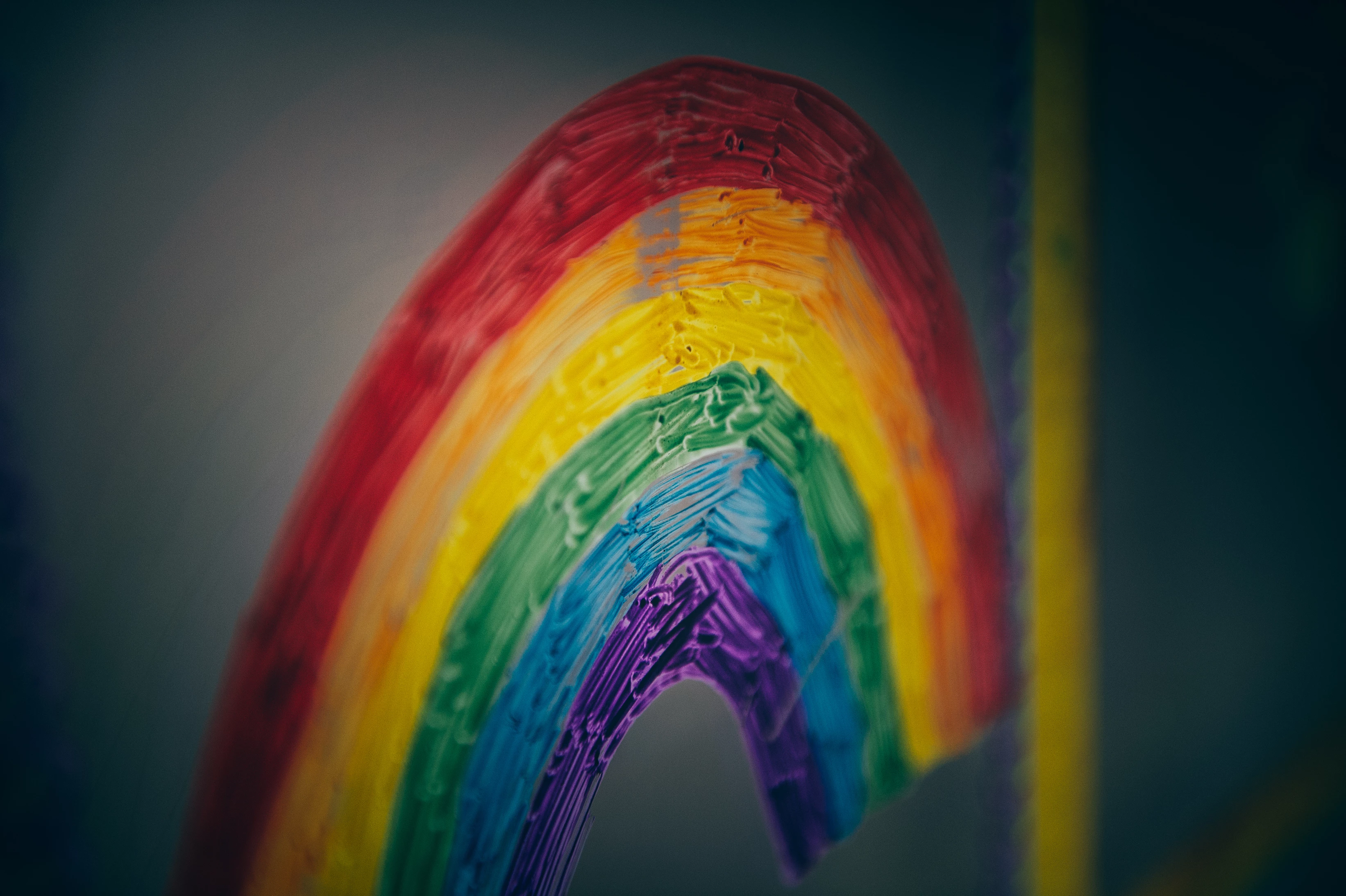
Thank you for your square contributions. Contributions for Exhibition of Hope have now closed.
The Exhibition of Hope involved the creation of 8 inch or 20cm rainbow coloured squares. These will now be joined together by National Wool Museum Volunteers and exhibited later in the year at the National Wool Museum and following this, the National Waterfront Museum, Swansea.
Please keep an eye out on this page and @amgueddfawlan Facebook and Twitter pages for more information about the Exhibition of Hope.
Rainbows are often used as a symbol of peace and hope and as we know, they often appear when the sun shines following heavy rainfall. They serve to remind us that following dark times, there is always light at the end of the tunnel.
The woollen mill factories produced shirts, underwear and blankets. These proved particularly popular with the workers of the south Wales coalfields. By the 1890s there were over 250 woollen factories in west Wales with 23 in Dre-fach Felindre and the surrounding area. The growth of woollen mills and factories gave birth to a new way of life.
The woollen mills remained the largest employer in the area until the 1980s.
“Since the inhabitants of the village of Dre-fach Felindre relied entirely on industry rather than agriculture, their outlook became much more akin to inhabitants of the industrial valleys of South Wales, with whom they had constant trading contracts, than of their agricultural neighbours”
J. Geraint Jenkins, Welsh Craft: Dre-fach Felindre and the Woollen Industry (2005)
Looking down to Ty-Cornel Felindre, c.1920
The village of Felindre
Land of song
Bands and choirs became an important part of life in Dre-fach Felindre.
As the mills flourished the local population grew. Workers formed choirs and bands. Some, like the celebrated Silver Band led by Albert Evans, won many titles. Many competed in annual local and national competitions, known as Eisteddfodau. The Bargoed Teifi Mixed Choral Society was particularly successful, taking first prize at the Carmarthen National Eisteddfod in 1911. The choir received a hero’s welcome when they returned to Dre-fach Felindre.
Local eisteddfodau were held in many villages throughout Wales. Dre-fach Felindre’s Eisteddfod was no small event. In 1897 the choir competition, for example, was `for choirs numbering no less than 100 voices`!
Dyffryn Bargod Temperance band, 1909
Bargod Teifi Choir, 1922
Built on faith
Churches and chapels were an important focus for the community. Many new chapels were built in the industrial areas of Wales to accommodate the growing population. Bethel Chapel in Dre-fach was expanded in 1840 to meet the needs of the burgeoning population.
The Lewis family, owners of Cambrian Mills, were deacons in Bethel Chapel. The gas engine at Cambrian Mills provided the electricity for the Chapel! Wealthy mill owners often invested money in their places of worship. Religion was viewed by some as a means of maintaining a disciplined workforce. Social prestige was never too far away; the choice and size of some gravestones reflected a person’s standing and income. This can clearly be seen in St Barnabas graveyard.
Penboyr Church
Entertainment
Shift patterns provided opportunities for shared leisure time. The mill workers often formed sports teams. At Dre-fach Felindre these included the Bargoed Rangers football team and a women’s football team.
In 1922 the Red Dragon Hall was built in Dre-fach Felindre. Similar to the Workingmen’s Institutes of the South Wales valleys, it provided a focus for the village’s social life. The hall was used for dances, plays, concerts, billiards and card games. Johnny Lewis of Cambrian Mills donated £8,000 to building a new Red Dragon hall in 1964.
The land on which the local park, Parc Puw , is now situated was also donated to the people of Dre-fach Felindre by Johnny Lewis.
Bargod Rangers First League Champions after the Second World War
Drefach Felindre hockey team, 1930-31
Carnival queen, c.1950s
Shops and local business
Dre-fach Felindre became a bustling village with a variety of outlets to meet the needs of the growing population. At one time the village had three pubs, a shoe shop, butter making business, blacksmith, a tailor’s shop and a general stores.
These businesses were in many ways dependent upon the success of the woollen industry. The decline of the woollen mills after the First World War left many unemployed and forced some families to leave the area in search of work.
John Jones Cabinet Maker, Gwalia House, Felindre, 1916
William Hindes, Felindre, 1920
Strikes and social unrest
The 1880s saw the growth of unions with calls to improve working conditions.
Factory workers in Dre-fach Felindre organised a strike in 1889 over poor pay. The strike lasted for seventeen weeks. After the strike the Carmarthen Journal, a local newspaper, suggested ways of developing better working relationships between owner and worker. The Journal encouraged the mill owners to invest in their workers’ education and support the building of a reading room. In 1890 a Reading Room was completed.
520 men and women weavers, from the parishes of Llangeler and Penboyr, formed a Labour Union in 1900.
Dyffryn Woollen Mill staff, c.1890
Handloom and spinning, c.1870
Conflict
The uniforms of the soldiers were made of flannel during the First World War. The factory mills at Dre-fach Felindre worked twenty four hours a day to keep up with the orders for flannel from the War Office. This new demand brought back prosperity to the area.
During the Second World War American soldiers were stationed at Dre-fach Felindre. Some disused factories were used as barracks. The American GIs are remembered fondly by the community for giving gifts of chocolate to local children.
A prisoner of war camp was established in nearby Henllan for Italian prisoners. They were sent to work in the local community. They turned one of the camp huts into a chapel and used dyes from the woollen mills to paint frescos on the walls.
First World War soldiers from the parish
Home Guard, Felindre, 1940-45
Mrs Nesta Morgan, 1912- 2003
Nesta Morgan worked at Cambrian Mills between 1927 and 1965. Nesta’s father was Mr John Davies, the first manager of Cambrian Mills. They lived next door to the mill at Clungwyn. He worked at Cambrian Mills for 58 years. Following his retirement he still helped out in the mill until he died just before his 100th birthday.
When Cambrian Mills burnt down in 1919, Nesta was on holiday with her parents in Llanwrtyd Wells. It happened to be her 7th birthday. She remembers her parents receiving a telegram and their upset on hearing the news. When they returned to Dre-fach Felindre the apples on the apple tree in their garden had cooked in the heat of the fire.
When Nesta worked at the mill there were around 80 people working there. She worked in the sewing room and carried out mostly piecework. By the age of 18 she was sewing aprons and belts and then spent 10 years in the cutting room and was put in charge of the sewing room.
Nesta remembers annual day trips from Cambrian Mills for the employees. They travelled by bus to places such as Builth Wells, Llandrindod Wells and Neath. They had lunch out and these were happy occasions.
Caernarfon blankets have been described as an oddity in Welsh textiles; the National Wool Museum at Dre-fach Felindre has a couple of examples of this blanket in its collection.
What Makes Caernarfon Blankets Unique?
These Caernarfon blankets are made up of three pieces; the most obvious is the middle piece. On this piece are the words ‘Cymru Fydd’ (Wales to be) underneath a picture of Aberystwyth College, and under a picture of Caernarfon Castle the words ‘Cymru Fu’ (Wales that was). Above and beneath these pictures are two dragons and three leeks; the rest of the quilt is then covered with leeks and daffodils in full bloom.
Origins and Historical Background
The origins of the original design are disputed by scholars. Ann Sutton, a leading authority on Welsh textiles, credits the original blanket to weaver John Roberts of Caernarfon; he is said to have presented the blanket to the Prince of Wales (the future Edward VII) on a visit to Caernarfon to open the water works in 1876. Welsh historian D. G. Lloyd Hughes disputes this as he states the water works in Caernarfon were opened in 1868 not 1876, and as the blankets show Aberystwyth College with the extension that was not completed until 1872. The Prince of Wales did not visit Caernarfon again until 1894; he accredits the design to Pwllheli Woollen Mill who patented the design in February 1895. There is a picture of the staff from Pwllheli Woollen Mill holding a Caernarfon blanket from the 1890s. There are other claimants to the original design, most notably Edward Davies-Bryan, whose great-granddaughter says he commissioned Pwllheli Woollen Mill to produce a blanket commemorating Aberystwyth college in the early 1890s as he was a former student and a great benefactor to the college.
Debates Around the Design and Attribution
The last Caernarfon blanket was produced in 1969 at Trefriw Woollen Mill to commemorate the investiture of the Prince of Wales at Caernarfon Castle. A recent donation to the National Wool Museum may have finally answered this debate: it is an early hand-woven blanket that is similar to the other blankets and is made up of two pictures of Caernarfon Castle and no picture of Aberystwyth College. The donor said the blanket belonged to her great-grandparents from Denbigh, North Wales, and they passed away in the 1890s. Could this be the type of blanket that was presented to the Prince of Wales in 1868?
'I should like to see a Welsh army in the field. I should like to see the race that faced the Norman for hundreds of years in struggle for freedom, the race that helped to win Crecy, the race that fought for a generation under Glyndwr against the greatest captain in Europe. I should like to see that race give a good taste of their quality in this struggle in Europe and they are going to do it'
On 29 September 1914 the Welsh National Executive Committee was formed to recruit a Welsh Army Corps of 40,000 to 50,000 men. The recruitment was based on the Corps's unique Welshness, with the encouragement of Welsh-speaking officers and Welsh-language recruitment posters.
Equipment Shortage
Due to the rapid expansion, the British Army faced a severe shortage of uniforms and equipment. To overcome the shortage the Committee decided in October 1914 to reinforce the national identity of the Welsh Army Corps by tendering for Welsh Grey homespun cloth “Brethyn Llwyd” for uniforms from the woollen manufacturers of Wales.
David Morgan of Cardiff was the main contractor, with all finished material sent to their offices in Cardiff before being made into uniforms by Messrs Masters. The woollen manufacturers of Wales were in desperate need of these new contracts as the industry was in decline due to worker unrest and competition from the larger mills of Northern England.
Production problems
There were early supply problems from the woollen manufacturers; Brethyn Llwyd is made by blending fleece from black and white sheep. Each mill had its own unique colour for Brethyn Llwyd; they therefore sent samples to the Committee to agree the colour.
The cloth produced by the mills was sent to Bristol for finishing and returned to Cardiff adding to the cost and time to make a complete uniform. A Brethyn Llwyd jacket was more expensive than traditional khaki, a Brethyn Llwyd jacket cost almost £1 and a khaki Jacket cost 14s 6d.
Factories re-equipped
By 1915 the mills were being re-equipped in anticipation of large orders for Brethyn Llwyd. Cambrian Mills Dre-fach Felindre (Now the National Wool Museum) built a new weaving shed, other mills invested in new equipment and staff. David Lewis of Cambrian Mills claimed he was able to produce 3,500 yards of cloth a week in February 1915 enough for 1,200 uniforms.
Demise of Brethyn Llwyd
Unfortunately this increased capacity came too late and production of Brethyn Llwyd was short-lived due to extra cost and the now ready availability of Khaki forcing the Committee to only order 8,440 uniforms in Brethyn Llwyd. The mill owners sent many letters to the Committee pleading for orders. Brethyn Llwyd uniforms never saw active service but due to their hard wearing qualities the uniforms were re-used repeatedly by the Reserves at Kinmel Park Camp until at least November 1916. In August 1915 the War Office took over the Welsh National Executive Committee, the raised units were formed into the 38th Welsh Division and the dream of a Welsh Corps vanished.
Supplying the Allies
Brethyn Llwyd was not the only war contract for woollen manufactures of Wales, woollen manufactures across Wales produced blankets for the army. One of the largest orders was secured by Ben Evans of Swansea for 15,000 blankets.
Welsh woollen manufactures also secured orders from foreign governments, for example in 1917 the Romanian Army ordered large quantities of Welsh flannel. The North Wales stocking industries supplied 300,000 pairs of socks to the allies during the war although these contracts only benefitted the larger manufactures.
Labour Shortage
With conscription of men into the army mill owners struggled for labour, before the war unlike English mills Welsh mills employed predominately men and the weavers worked one man one loom. The weavers threatened to strike over pay finally resolved with the intervention from the War Office in favour of higher wages but for more output.
Mill owners attended tribunals arguing for their workers not to be conscripted into the army because they could not be replaced, women preferred to work in the munitions factories and other heavy industries for higher wages than work in the woollen mills.
Weavers at war
Many workers from the mills volunteered for the army or were conscripted. Willie Evans worked at Cambrian Mills Drefach Felindre, he joined the royal artillery serving on the western front and in Russia, Willie returned to Cambrian mills after the war.
David Emlyn Jones was a weaver at Ogof Mill Cwmpengraig he was conscripted into the army in 1917 to the Welsh regiment. David was killed on sentry duty on the Western front 12th December 1917 he left behind 4 children including a baby that he never met. David's last letter home, written in Welsh arrived after the letter in English informing his wife of his death.
Post war decline and fires
'[Mill owners who made vast profits from war contracts] made no attempt to set their mills on a sound financial basis, content to bank the money or buy seaside cottages'
Geraint Jenkins 1967, the Welsh Woollen Industry, p. 278
After the war 12 million yards of surplus flannel was sold on the open market by the government at ridiculously low prices forcing woollen manufactures to also cut their prices. Flannel shirts for example sold at 52s 6d a dozen in 1916 by 1923 the price had dropped to 38 shillings. In Dre-fach Felindre 21 factories closed and 7 more burnt to the ground including Cambrian Mills, arson was suspected but never proven.
Unfortunately no Brethyn Llwyd uniform has been found, all that exists are the samples sent by woollen manufactures to the committee to decide the final colour, the choice they made remains a mystery. The samples are now part of the Welsh Army Corp collection held at the National Library of Wales.
In the early twentieth century the high streets of Welsh industrial towns looked very different to the ones that we see today. Stores were individual and specialized in their trade, rather than large stores selling a variety of goods. Drapers’ shops were an essential part of the high street, selling cloth and fabrics by the yard. Clothes were made at home or by local dressmakers or tailors, so rolls of cloth were cut to meet individual customers’ specifications. Local demand for fabric and haberdashery was constant and the days of mass-produced clothing were yet to come.
With the development of coal mining and the iron industry in south Wales during the nineteenth century, many people left rural Wales to seek employment. Emlyn Davies was one such young man; born in Newcastle Emlyn, he moved to Dowlais and worked as a shop assistant for J. S. Davies, Drapers. In 1898 he opened his own draper’s shop. Emlyn Davies was primarily a flannel merchant and purchased most of his stock from Cambrian Mills in Dre-fach. David Lewis, the owner of Cambrian Mills, would travel through the south Wales valleys collecting orders for flannel; the woollen cloth would then be sent to Dowlais by train from Henllan Station. The flannel would be made into shirts and underwear for the local colliers and workers at the iron works.
Emlyn Davies annual staff outing to Abergavenny, 1912
Colliers and iron workers wore Welsh flannel because it was extremely hard-wearing and excellent at absorbing the sweat of heavy labour. Working conditions were hard and the workers were in constant danger from fires. Wool is a natural fire retardant and Welsh flannel was the clothing of choice until the 1920s.
Emlyn Davies staff and family, 1914
Emlyn Davies was a credit draper, meaning that his customers would buy their goods on credit terms, paying small amounts off their bill each week. He would travel to the nearby towns collecting orders and delivering the goods the following week. He also had a market stall at the weekly market in Brecon.
Emlyn Davies silver jubilee 6th May, 1935
The flannel drapers enjoyed prosperity until the 1920s. The introduction of knitted underwear produced by the hosiery manufactures of the East Midlands, combined with the influx of cheaper printed cotton and mass-produced ready-made clothing, marked the beginning of the decline. This, combined with strikes, political unrest and the Great Depression in the industrial valleys, saw many drapers close down. Emlyn Davies’s business peaked in 1920, but from there it was in a steady decline until his death in 1937. Thereafter his daughter Miriam ran the business, selling cottons and mass-produced clothing, and the business finally closed when Miriam retired in 1962.
Miriam Davies in front of her father’s draper’s shop in East Street Dowlais c. 1917
Emlyn Davies outside his shop with friends and family Coronation Day 12th May, 1937