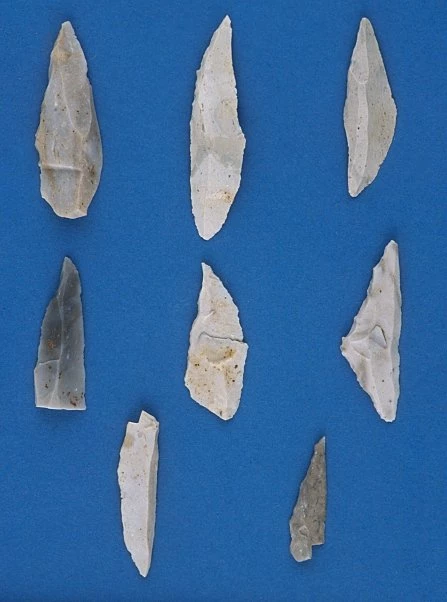
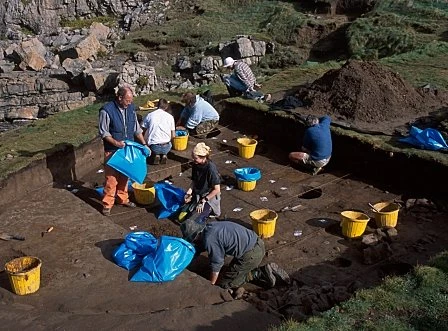
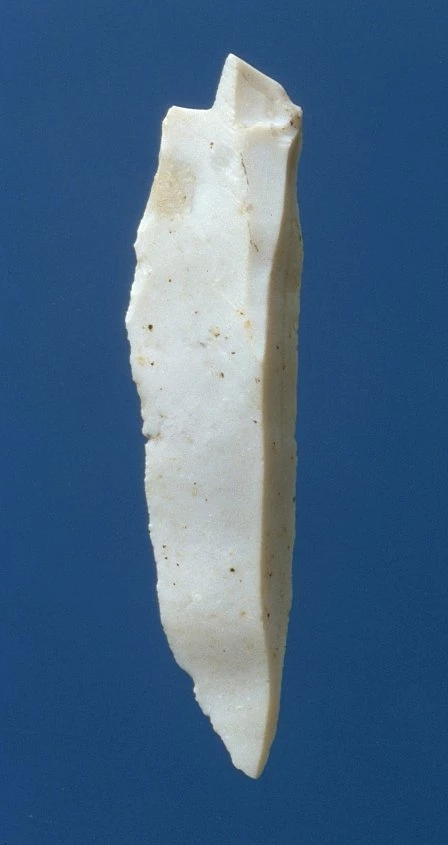
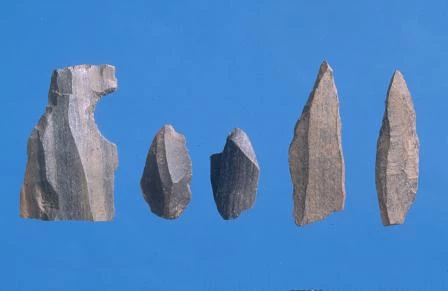
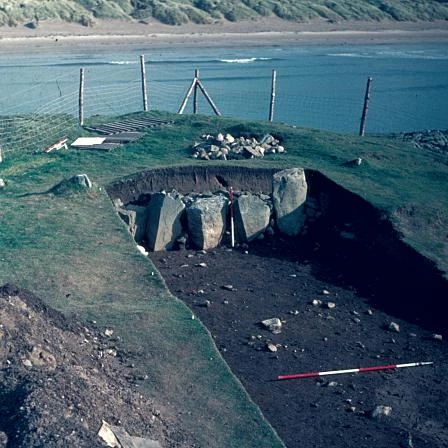
Hunting for food in the Stone Age 11 May 2007 Microliths Microliths from Burry Holms, Gower. Each microlith illustrated here is less than 50mm (2 inches) long. Microliths were widely used across Europe during the Middle Stone Age, or Mesolithic. This period dates from the end of the Ice Age (about 9200BC) until the introduction of agriculture to Wales (4000BC). 9,000 years ago one of the most important tools in the search for food were microliths - barbs made of stone that made a big impact on life in the Middle Stone Age. From 9200-4000BC (during the Mesolithic or Middle Stone Age) people in Wales lived by hunting, fishing and gathering edible plants. Harpoons and spears were common tools and these carried stone barbs (microliths) that could inflict a deep cutting wound on prey. Microliths, were made from flint blades each carefully crafted to make a sharp point. Individually a microlith is too small to do any real damage, but when two rows of these are glued into a spear's shaft they make an effective tool. Between 1923 and 2001 over eighty microliths have been discovered on Burry Holms, today a tidal island on the north-western tip of Gower (a peninsula in south Wales). Here a band of hunter-gatherers spent part of the year hunting red deer, gathering nuts and fishing in the nearby rivers. Burry Holms Excavations at Burry Holms The soils at Burry Holms do not preserve the wooden or bone hafts of these hunters' tools, but even so, the microliths that survived have some interesting stories to tell. Several of the microliths unearthed at Burry Holmes have snapped at their tip, possible evidence of where they struck an animal during a hunt, breaking from the impact. In constrast, the missing tips of these microthiths have been discovered seperately, showing markings of once being in a fire. It is possible that a flint microlith had done its work in killing a red deer and that its tip survived in the meat when it was cooked and eaten - perhaps this was the ancient equivalent of finding lead shot in a rabbit pie! Background Reading Microlith showing an impact fracture across its tip (top of image). This damage may have been caused during hunting. 'Burry Holms (SS40019247)' by E. A. Walker. In Archaeology in Wales, vol. 40, p88-89 (2000). 'Burry Holms (SS40019247)' by E. A. Walker. In Archaeology in Wales, vol. 41, p126 (2001). Late Stone Age Hunters of the British Isles by C. Smith. Published by Routledge (1992).
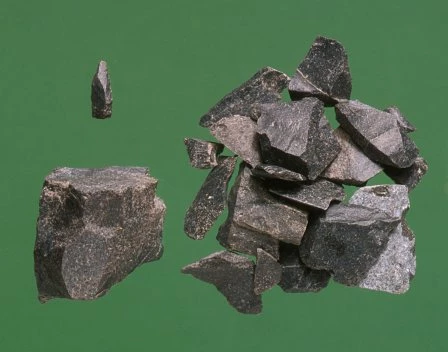
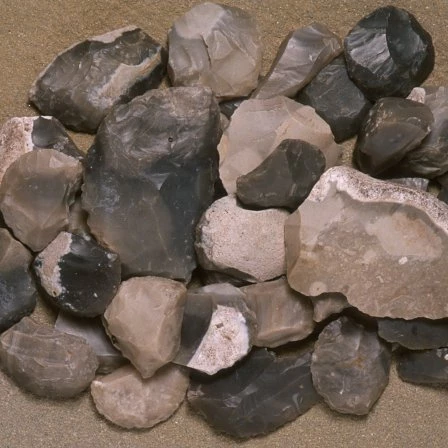
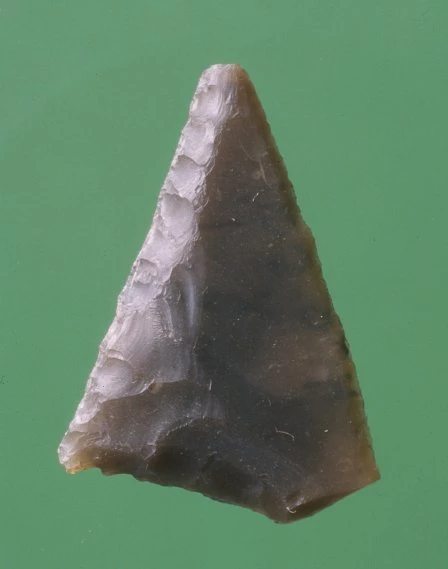
The Flint Finder of Wales 11 May 2007 Phil Shepherd at National Museum Cardiff with some of the finds he has collected over the past 25 years. A small group of later Mesolithic flints from Cefn Rhos-Gwair (Rhondda Cynon Taff), dating from 7500-4000BC. Group of flint scrapers from Carn-y-Bwlch (Rhondda Cynon Taff). Arrowhead from Lluest Wen (Rhondda Cynon Taff), dating to the later Neolithic (3400-2500BC). The donation of over one and a half thousand small stone relics, collected over 25 years, to the collections of Amgueddfa Cymru, has helped improve our understanding prehistoric life in South Wales. For over 25 years, forestry worker Phil Shepherd has searched for prehistoric flint tools as part of his work preparing areas of land for tree-planting or felling for Natural Resources Wales. In this time, Phil discovered 1,636 individual pieces of flint, all of which he has brought to Amgueddfa Cymru and donated on behalf of Natural Resources Wales. Flint tools Flint is a stone that can be shaped into sharp blades. These razor-sharp blades were used commonly by early man in Wales for hunting deer and spearing fish, as well as for cutting tools. Many of the flints Phil has found in the forest range in date from the early Mesolithic (beginning 9200BC) through into the Bronze Age (about 2000BC). The number of known Mesolithic sites in the uplands of south Wales has increased considerably through his many discoveries. Cefn Rhos-Gwair flints A small group of later Mesolithic flints from Cefn Rhos-Gwair (Rhondda Cynon Taff), dating from 7500-4000BC. The largest piece shown measures about 2.5cm (1 inch) in length. These flints were left behind by a hunter who had been making a spear. They include small blades (right), a block of stone known as a core (bottom left) from which the blades would have been removed, and a single microlith (or barb) from a spear (top left). Carn-y-Bwlch flints Each piece is about 2.5cm (1 inch) long. This important collection of Early Bronze Age flint scrapers (dating to sometime after 2500BC) were all found by Phil Shepherd. Unexpectedly, the group also contained a comparatively recent gun flint which must have been inadvertently dropped near the Early Bronze Age collection. Lluest Wen arrowhead The arrowhead is 3cm (1.2 inches) long. The majority of the flints that Phil has found are made on small pebbles deposited by the melting of Ice Age glaciers. However some, like this example, are made on a much finer quality black chalk flint that was clearly carried into the area from Wiltshire, the closest natural outcrop of flint to Wales. Mesolithic Wales In Mesolithic times the climate was warmer and damper and much of the landscape was heavily wooded with oak, elm, birch and hazel trees. There would have been few of the conifers that we now associate with today's Welsh forests. It was only towards the end of the Stone Age period (about 4000BC) that people cleared the forests to make way for early agriculture. Many upland areas have been bare ever since, and hence evidence of ancient life has been left relatively undisturbed - until the more recent deliberate creation of forestry plantations. Discoveries like those made by Phil and his colleagues from the Forestry Commission can provide important information about the lives once lived in a particular area of the country, with each piece telling a story, like the ones provided as captions to this article's images. Background Reading Prehistoric Wales by F. Lynch, S. Aldhouse-Green and J. L. Davies. Published by Sutton (2000). Treasure by R. Hobbs. Published by The British Museum Press (2003).
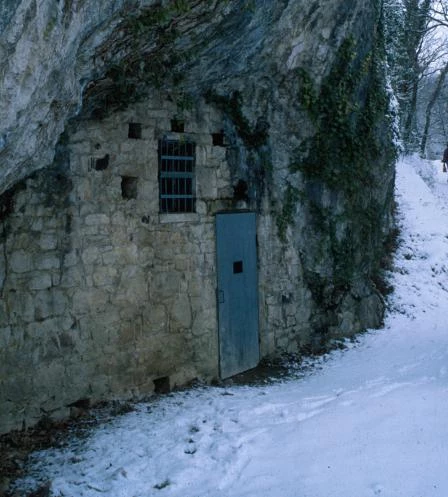
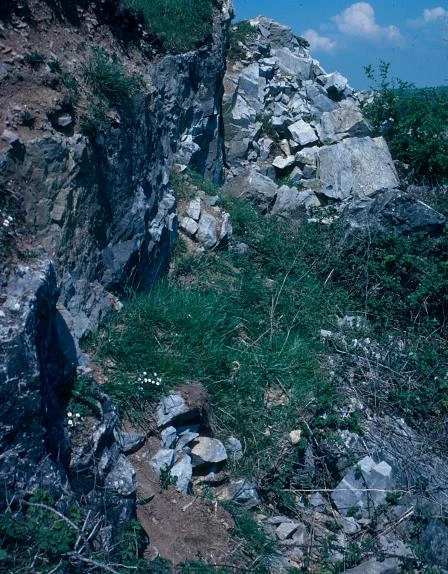
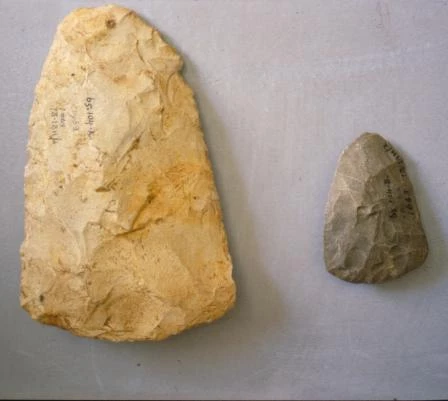
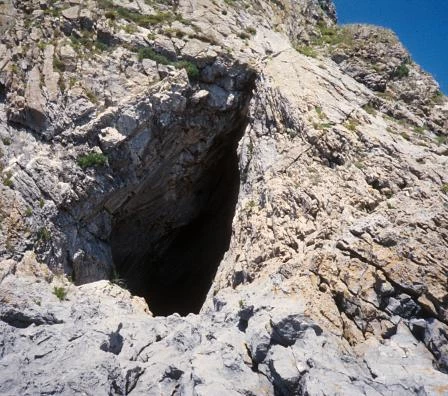
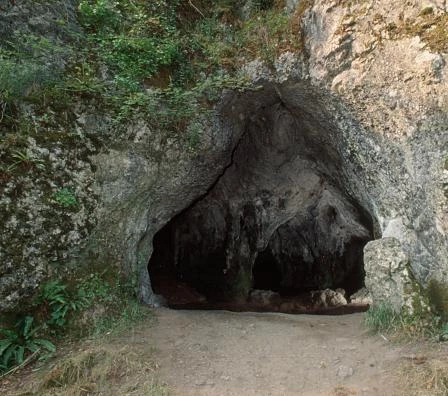
The Cave Men of Ice Age Wales 11 May 2007 The Ice Age in Wales Pontnewydd Cave (Denbighshire). This cave produced the oldest human remains from Wales, dated to around 230,000 years ago. Humans have lived in Wales for over a quarter of a million years, first by the Neanderthals and then by modern humans. Evidence for the first human occupation of Wales can be found in caves around the country. The 'Palaeolithic' or 'Early Stone Age' period is the time popularly known as the 'Ice Age'. It saw very cold periods (known as glacials) when ice covered all of Wales, and warm periods (interglacials), like the one in which we live today. It is against this backdrop of changing climate that our earliest ancestors evolved from their African origins, migrated across Europe and Asia, and developed into modern humans. In Wales most of the evidence we have for the earliest Palaeolithic settlements come from caves. These caves are found in limestone areas, for example in parts of Denbighshire, Gower and south Pembrokeshire. The Neanderthals Coygan Cave (Carmarthenshire). No human remains have been found here, just a handful of tools that show that Neanderthals used the cave briefly. The first evidence we have for humans in Wales comes from the site of Pontnewydd Cave (Denbighshire). Here, excavations have identified the remains of an early form of Neanderthal, that lived around 230,000 years ago. Neanderthals were hunters and their tools show that they needed to get close to their prey in order to kill. Neanderthal skeletons excavated around Europe have a very high number of broken bones, suggesting that they may often have come off worst from these encounters. The Neanderthals at Pontnewydd Cave made tools using the local stones picked up near the cave; including cutting tools, scrapers and hand axes. Handaxes have been discovered at Coygan Cave in Carmarthenshire - a site now destroyed by quarrying. Climate change Bout coupè handaxes (Coygan Cave). These tools are characteristic of Neanderthal technology. Coygan Cave was used briefly as a lookout point by Neanderthals some time between 60,000 and 40,000 years ago. The cave was then used as a den by hyeanas as the last glacial began. It is possible that this deterioration in the climate is the reason for the extinction of the Neanderthals, who died out around 35,000 years ago. Modern Humans In 1823, William Buckland of Oxford University discovered a skeleton in this cave. The bones were stained red and were accompanied by bracelets and shell beads. Buckland believed that the body was that of a woman, who had lived during the Roman period. Modern science has now proved this appealing theory to be wrong. The skeleton actually belongs to a 25 year old man buried around 26,000 years ago. Modern humans, like us, first appear in Europe about 60,000 years ago. Our appearance is marked by the use of new types of stone tools made from long thin blades struck from a block of flint. These blades were much more versatile than those of the Neanderthals. Paviland Cave — The earliest human burial in Britain Excavation by Amgueddfa Cymru has shown that the cave was occupied around 30,000 years ago and again around 12,500 years ago. Early modern humans also developed the first art. Cave paintings from this period have survived in France and northern Spain - areas unaffected by the return of the glaciers. In Wales no cave art has yet been discovered, but engraved and carved bones have been found. Perhaps the most significant site to have produced this material is Paviland Cave (Gower). This is home to the earliest human burial found in Britain, dating to around 26,000 years ago. Other caves occupied during this early part of the last glacial include Cae Gwyn and Ffynnon Beuno (both in Denbighshire), and Hoyles Mouth (Pembrokeshire). This latter cave was used around 30,000 years ago. After this time, ice sheets spread across Wales reaching their greatest extent between 20,000 and 18,000 years ago, at this time, animals retreated south, forcing the people who hunted them to follow. Around 18,000 years ago the ice sheets began a slow retreat and the animals and people returned. We believe they had returned by around 14,500 years ago, but the earliest evidence from Wales dates to around 12,500 years ago at caves such as Paviland and Hoyles Mouth. With the end of the last glacial, about 11,500 years ago, the evidence for people living in Wales increases greatly and changes in character. This date is used to mark the end of the Early Stone Age (Palaeolithic) and the start of the Middle Stone Age (Mesolithic). Background Reading Ice Age hunters: neanderthals and early modern hunters in Wales by Stephen Green and Elizabeth A. Walker. Published by the National Museum of Wales (1991).
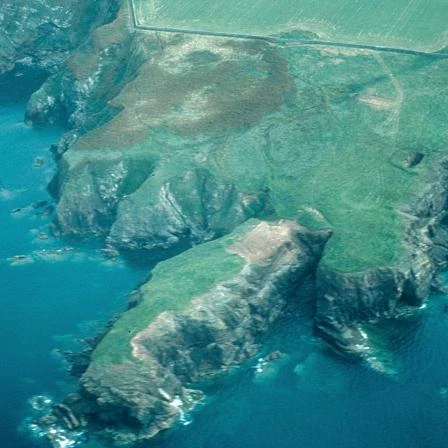
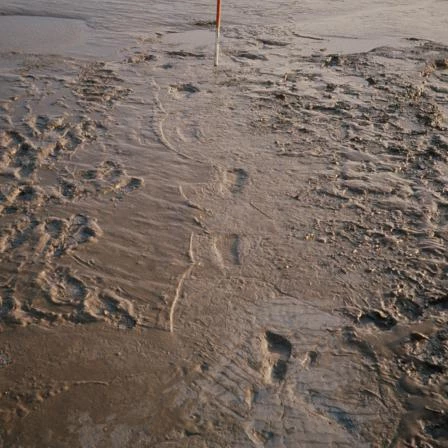
After the Ice Age... 11 May 2007 The Mesolithic (Middle Stone Age) The Nab Head (Pembrokeshire). The Nab Head was a seasonal campsite at which stone beads were made. Image © Andrew David. At the height of the last Ice Age, around 18,000 years ago, Wales was uninhabitable; ice sheets covered almost the entire. As the ice sheets retreated north, people recolonized the land, with the first evidence for occupation in Wales coming from caves, dating to around 15,000 years ago. About 2,500 years later the climate improved significantly and the population of Britain rose as a result. This period, known as the Mesolithic (or Middle Stone Age), lasted until the introduction of farming around 6,000 years ago. Woodland landscape Stone tools from Rhuddlan (Denbighshire). Each tool is about 2.5cm (1 inch) long. A large quantity of stone tools was discovered at Rhuddlan during excavations in the medieval town. During the Mesolithic, the climate in Britain became warmer and wetter than it is today. This led to changes in the vegetation of Wales with the development of a wooded landscape. Juniper was the first tree to return, quickly followed by birch, hazel, pine, willow and alder. In the lowlands, oak, elm and pine dominated the landscape, while in the uplands pine and birch were more common. This heavily wooded landscape was home to red deer, roe deer, wild cattle and pigs, all of which were potential prey for Mesolithic hunters. Indeed, it is likely that parts of the woodland in upland Wales was deliberately cleared in order to promote fresh plant growth which would attract grazing animals that could then be hunted for food. One of the defining features of the Mesolithic was a change in the types of tools that people used for hunting, fishing, and gathering plants. Stone tools in particular became smaller, with tools made on small stone blades becoming common. A range of stone tools has been found on The Nab Head (Pembrokeshire), which was first inhabited around 8600BC. Burry Holms Trwyn Du (Anglesey). The Mesolithic site at Trwyn Du lies beneath a Bronze Age Cairn constructed around 2000BC. It was excavated in 1977 when it became clear that the site was threatened by coastal erosion. Another campsite of similar age has been found on Burry Holms (Gower). Today Burry Holms is a tidal island but, during the Mesolithic, sea levels were much lower and the island would have been an inland hill overlooking the plain of the River Severn. The rise in sea levels that has occurred since, is a consequence of the melting of ice sheets far to the north. Excavation at the site has produced a range of finds, including small stone barbs (microliths) used for hunting, and tiny saws. These may have been used for cutting plant stems to make thatch, twine, or fibre for basketry. Communication between groups may have been fairly easy since it is likely that people spent part of their year travelling in pursuit of herds of animals and other important food sources. During the warm summer months it is likely that they were to be found in inland areas, while in winter they returned to the lower lying coast or river valleys. Possibly the most important Mesolithic site so far discovered in Wales is at Goldcliff (Newport). This site lies in the modern intertidal zone but, around 7,500 years ago, it sat on a small wooded island surrounded by saltmarsh. In addition to stone tools, pollen, animal and fish bones were also preserved at the site. Fish is believed to have been important in the diet of Mesolithic people. Their stone microliths (barbs) would have been attached into wooden spears, ideal for fishing. Given the abundance of animals to hunt, fish to catch, and plants to gather, it is difficult to understand why Mesolithic people began to turn their back on their traditional lifestyle around 6,000 years ago as farming became the dominant means of supporting the population of Wales. Uskmouth Footprints Uskmouth footprints (Newport). This trail of human footprints is one of three found at Uskmouth that head out towards the sea. Scientific study has revealed that the man who left these prints had a shoe size equivalent to modern UK size 8 (European 42, USA 8.5). He stood about 1.70m tall (5.5 feet), and the way his big toe splays outwards indicates that he was accustomed to walking without shoes. The footprints have been preserved because very soon after he took his walk a period of hot dry weather baked the mud on which he trod. This mud was then gradually covered over by a layer of peat. Recent erosion in the Severn Estuary has resulted in the exposure of these footprints again, some 6,250 years after this Mesolithic man walked towards the sea. Background Reading Late Stone Age hunters of the British Isles by Christopher Smith. Published by Routledge (1992).
Hunting for food in the Stone Age 11 May 2007 Microliths from Burry Holms, Gower. Each microlith illustrated here is less than 50mm (2 inches) long. Microliths were widely used across Europe during the Middle Stone Age, or Mesolithic. This period dates from the end of the Ice Age (about 9200BC) until the introduction of agriculture to Wales (4000BC). Microlith showing an impact fracture across its tip (top of image). This damage may have been caused during hunting. Excavations at Burry Holms Microliths 9,000 years ago one of the most important tools in the search for food were microliths - barbs made of stone that made a big impact on life in the Middle Stone Age. From 9200-4000BC (during the Mesolithic or Middle Stone Age) people in Wales lived by hunting, fishing and gathering edible plants. Harpoons and spears were common tools and these carried stone barbs (microliths) that could inflict a deep cutting wound on prey. Microliths, were made from flint blades each carefully crafted to make a sharp point. Individually a microlith is too small to do any real damage, but when two rows of these are glued into a spear's shaft they make an effective tool. Between 1923 and 2001 over eighty microliths have been discovered on Burry Holms, today a tidal island on the north-western tip of Gower (a peninsula in south Wales). Here a band of hunter-gatherers spent part of the year hunting red deer, gathering nuts and fishing in the nearby rivers. Burry Holms The soils at Burry Holms do not preserve the wooden or bone hafts of these hunters' tools, but even so, the microliths that survived have some interesting stories to tell. Several of the microliths unearthed at Burry Holmes have snapped at their tip, possible evidence of where they struck an animal during a hunt, breaking from the impact. In constrast, the missing tips of these microthiths have been discovered seperately, showing markings of once being in a fire. It is possible that a flint microlith had done its work in killing a red deer and that its tip survived in the meat when it was cooked and eaten - perhaps this was the ancient equivalent of finding lead shot in a rabbit pie! Background Reading 'Burry Holms (SS40019247)' by E. A. Walker. In Archaeology in Wales, vol. 40, p88-89 (2000). 'Burry Holms (SS40019247)' by E. A. Walker. In Archaeology in Wales, vol. 41, p126 (2001). Late Stone Age Hunters of the British Isles by C. Smith. Published by Routledge (1992).