: The Stone Age & Early Humans

The Stone Age tombs of south-east Wales

14 May 2007

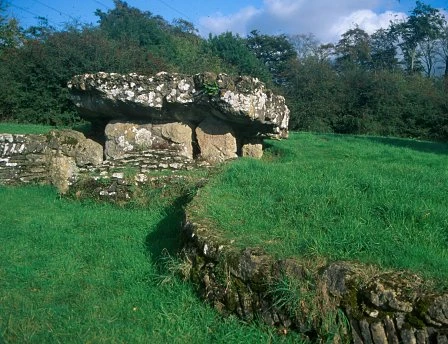
The forecourt and chamber of Tinkinswood (Vale of Glamorgan).

The forecourt and chamber of Tinkinswood (Vale of Glamorgan). Built in the Cotswold-Severn style, the chamber of this impressive monument can still be visited today. Image: Cadw (Crown Copyright).

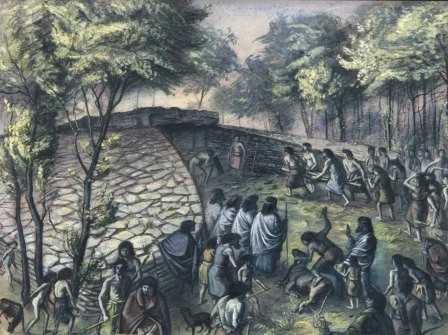
Imaginative reconstruction of a burial ceremony at Tinkinswood, by Alan Sorrell.

Imaginative reconstruction of a burial ceremony at Tinkinswood, by Alan Sorrell.

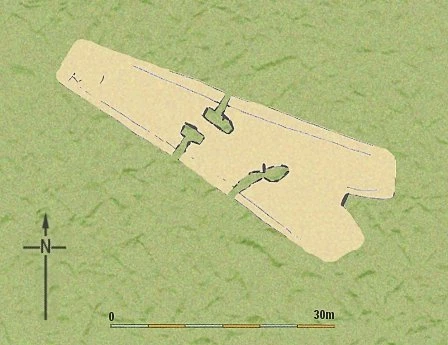
Ground plan of tomb at Gwernvale (Powys).

Ground plan of tomb at Gwernvale (Powys). This plan of the tomb is typical of the Cotswold-Severn type, although in this case the chambers are not accessed from the forecourt, but from the sides of the tomb.

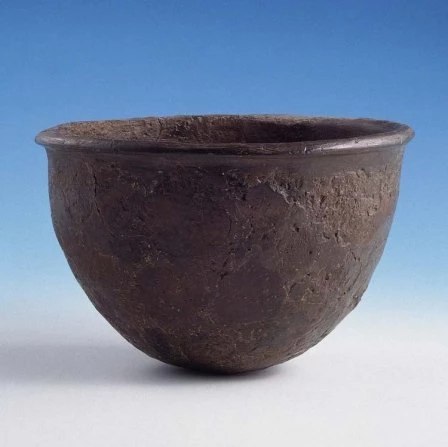
Bowl from Ty-Isaf (Powys). 24.6cm (9.8 inches) in diameter. Found in fragments, this simple bowl is more typical of the grave goods offered at this time.

Bowl from Ty-Isaf (Powys). 24.6cm (9.8 inches) in diameter. Found in fragments, this simple bowl is more typical of the grave goods offered at this time.

6,000 years ago small farming communities began to build tombs that continued to be used for hundreds of years - many survive to this day.

Stone Age tombs are relatively common in Wales. These 6,000 year old monuments consist of one or more chambers constructed from massive stones (megaliths). These were originally covered by a mound of earth or stones, although this rarely survives.

Many of these tombs were made to a common design, and in south-east Wales this often takes the form of mounds where the wider end points eastwards and opening to a forecourt. The internal chambers are accessed by short passages leading from the forecourt or the sides of the mound.

This design also appears throughout the Cotswolds (England), and beside the River Severn giving rise to the archaeological name Cotswold-Severn tombs.

Excavation at Cotswold-Severn tombs such as Gwernvale (Powys) have shown that they were sometimes built over earlier settlements, suggesting it was important that the dead be buried on land once occupied by the living.

At Pipton and Ty-Isaf (both in Powys) archaeologists have also discovered that some tombs were built in stages, often with a smaller monument being incorporated into a larger design.

The end product can be massive, for example Penywyrlod, Talgarth (Powys). It is likely that these grand houses for the dead were intended to stake a claim to a territory, emphasising to passers-by that the land was taken.

Once built Cotswold-Severn tombs were used for generations. For example, bodies were interred at Parc le Breos Cwm (Gower) for over five hundred years. This site gives us a glimpse of the burial rituals at these tombs, with some bodies apparently having been kept outside the tomb until they had partially decomposed - a practice which sounds gruesome today, but appears to have been a common part of the burial rite at this time.

When abandoned Cotswold-Severn tombs often held the remains of a large number of people. At Parc le Breos Cwm archaeologists found more than 40 bodies, while at Ty-Isaf and Tinkinswood (Vale of Glamorgan) over 30 and 50 were found respectively.

The fragmentary nature of these bodies suggests that it was not the individual burial that was important to the tomb builders, but the creation of an ancestral bone pile.

Few grave goods are found in these tombs, at most a few broken pots and a handful of flint tools. It is likely that what ceremony occurred to honour the dead took place outside of the chambers.

Together, the bones, grave goods and the tombs themselves provide one of the main sources of information about life and death in south-east Wales during this remote period.

Background Reading

The Tomb Builders: In Wales 4000-3000BC by Steve Burrow. National Museum Wales Books (2006)

The megalithic chambered tombs of the Cotswold-Severn region by T. C. Darvill. Vorda Publications (1982).
Ancient relic gives up its sticky secrets

14 May 2007

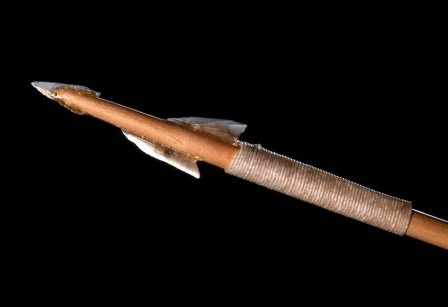
Arrowhead

Arrowhead showing hafted rows of stone barbs, known as microliths. Microlith-tipped arrowheads were used in Wales between 9000-4000BC.

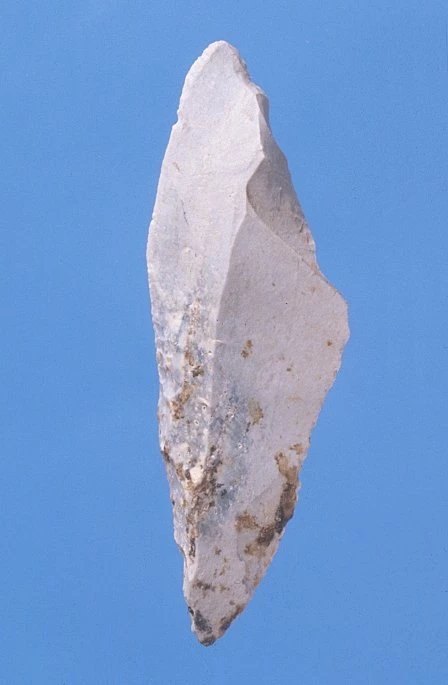
Microlith

Microlith (less than 40mm, 1.6 inches, long) found at Burry Holms. The patches of tar can be seen at the base of the image.

Birch bark tar

One of the spots of birch bark tar, seen under a scanning electron microscope. The tar appears to have been heated at some point, giving it a glassy appearance.

When tiny spots on the surface of an 11,000-year-old piece of stone from South Wales were examined under powerful microscopes, they turned out to be evidence of the first use of glue ever discovered in Wales.

The hunter-gathers of Wales

During the Middle Stone Age or Mesolithic (9200-4000BC), harpoons and spears were commonly used by the early peoples of Wales. These hunter-gatherers used these tools to hunt deer and to spear fish, the two being the main food sources at this time.

The harpoons and spears were made of wood, bone or antler, with stone barbs, known as 'microliths', set in rows down their sides. Over thousands of years, the wood and bone decayed leaving only the stone microliths to be found and studied by archaeologists.

Hundreds of these microliths have been found in Wales, but how they were attached to the wood, bone or antler sticks remained a mystery.

That is, until excavations at Burry Holms on the Gower (a peninsula in south Wales) uncovered a microlith that had curious spots on its surface.

Powerful microscopes

This microlith was studied under the powerful magnification of a scanning electron microscope, allowing extremely fine detail of the surface spots to be examined.

What was discovered was the remains of a tar like substance. This was more than likely to be birch bark tar, a sticky resin that was once used as a glue. This discovery suggests that the stone microliths would have been originally attached to the spears or harpoons using the sticky tar as a glue.

Although the use of birch bark tar has been found across Europe, this is the first time it has ever been discovered in Wales.

This modern day scientific analysis of an object 11,000 years old shows how the ancient technology of our ancestors can by uncovered through the use of modern science.

Background Reading

'Identification of hafting traces and residues by scanning electron microscopy and energy-dispersive analysis of x-rays' by A. F. Pawlik. In Lithics in action by E. A. Walker, F. Wenban-Smith and F. Healy. Published by Oxbow books (2004).

'Burry Holms (SS40019247)' by E. A. Walker. In Archaeology in Wales, vol. 40, p88-89 (2000).

'Burry Holms (SS40019247)' by E. A. Walker. In Archaeology in Wales, vol. 41, p126 (2001).

The burial tombs of Stone Age Wales

14 May 2007

Common Culture

Bryn Celli Ddu

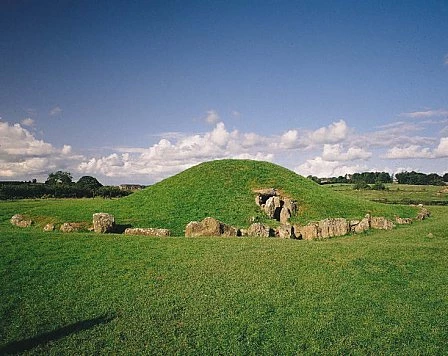
Bryn Celli Ddu (Anglesey) is one of the best preserved passage tombs in Wales. Image: Cadw (Crown copyright).

5,500 years ago a common culture spread around the Atlantic coast of Europe linking Brittany, Cornwall, Wales, southern Scotland and Ireland.

Today, evidence of this culture survives in the form of passage tombs - circular burial mounds pierced by stone-lined passages that open into central chambers.

Stone Age Crematoriums

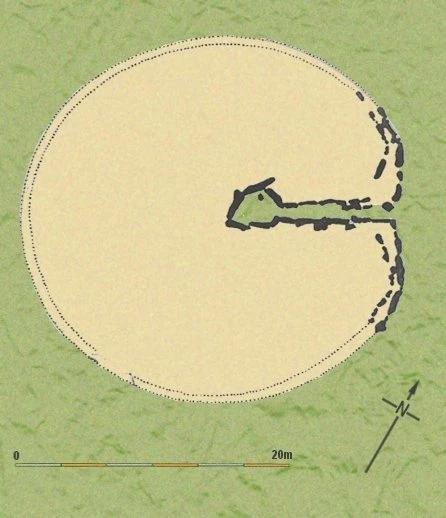
Plan of Bryn Celli Ddu showing the passage way leading into the centre of the circular mound.

Plan of Bryn Celli Ddu showing the passage way leading into the centre of the circular mound.

These tombs were built by early farming communities to house the cremated remains of their dead and were used for generations. They must have been important landmarks that linked the living with their ancestors.

Within Wales, passage tombs are best seen on Anglesey where two important examples are sufficiently well-preserved to allow public access - Barclodiad y Gawres and Bryn Celli Ddu.

Barclodiad y Gawres ('the apronful of the giantess') was built with a main chamber flanked by three side-chambers in which the dead would have been placed. In the centre of the main chamber was a hearth from which a fire would have illuminated the tomb during rituals.

Witches brew and spiral artwork

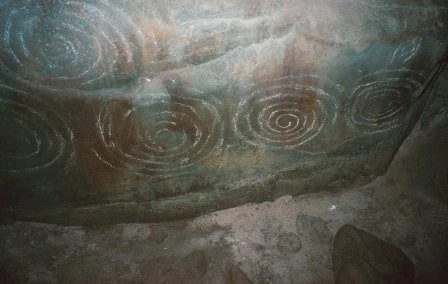
Carved stone inside the chamber of Barclodiad y Gawres (Anglesey). The style of carving in this passage tomb is common to many tombs in Ireland.

Carved stone inside the chamber of Barclodiad y Gawres (Anglesey). The style of carving in this passage tomb is common to many tombs in Ireland.

To the surprise of the archaeologists excavating the site, the hearth contained a strange mix of reptile, fish and amphibian bones. While the reason for this 'witches brew' will never be known, one important insight into the culture of these tomb builders is the strange artwork that is pecked into the rocks that line the passage and chamber. These designs include spirals and strange meandering zig-zag patterns.

On their own they might be dismissed as a whim of the builders, but this type of design is also found within other passage tombs as far afield as Ireland and Brittany.

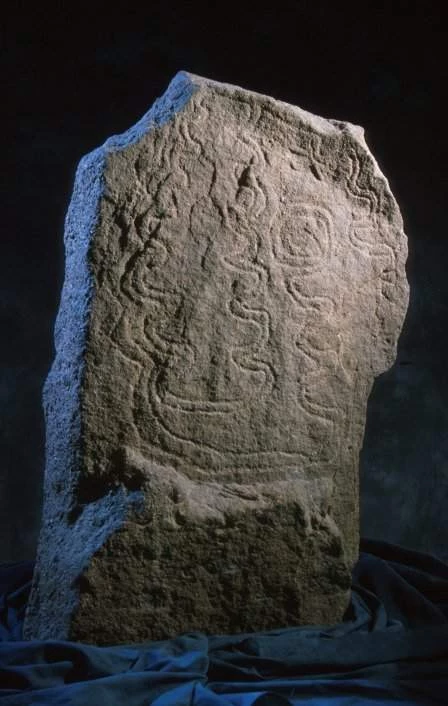
A similarly patterned stone was found at Bryn Celli Ddu (Anglesey). However, here the stone was discovered lying face down in a pit beneath the tomb's chamber where it must have been buried before tomb building began. Was it buried in order to sanctify the site, or was it buried to hide it away? - another unanswered mystery.

The passage tombs on Anglesey are not the only ones in Wales. Other examples are known from Gwynedd and Pembrokeshire, although these are less well-preserved.

Grand ambitions

Decorated stone

Decorated stone found beneath Bryn Celli Ddu (Anglesey). 1.5m (4.9 feet) high. The swirling patterns on this stone are typical of passage tomb art.

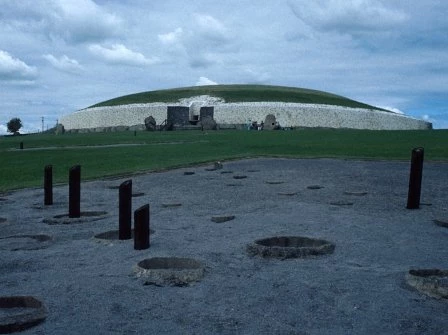
The largest and most complex passage tombs occur in Ireland. The tombs at Newgrange and Knowth show how grand the ambitions of the tomb builders could be.

At Knowth the central tomb is accompanied by a cemetery of at least 18 smaller examples, while at Newgrange skilled engineers precisely aligned the passage way with the mid-winter sunrise.

In all of the areas where passage tombs appear they are built to slightly different designs, but there is sufficient similarity between them all to indicate that the Irish Sea was a thriving highway at the end of the Stone Age, with communities from Brittany to Scotland sharing both ideas and ways of respecting the dead.

Background Reading

Newgrange, Co. Meath (Ireland), with pit circle in foreground.

Newgrange, Co. Meath (Ireland), with pit circle in foreground. The reconstructed passage tomb at Newgrange is one of several massive tombs in the Boyne Valley. Image © Steve Burrow.

The Tomb Builders: In Wales 4000-3000BC by Steve Burrow. National Museum Wales Books (2006)

Barclodiad y Gawres: the excavation of a megalithic chamber tomb in Anglesey, 1952-1953 by T. G. E. Powell and G. E. Daniel. Liverpool University Press (1956).

Irish Passage Graves: Neolithic tomb builders in Ireland and Britain 2500BC by M. Herity. Dublin University Press (1974).

'The chambered cairn of Bryn Celli Ddu' by W. J. Hemp. In Archaeologia Cambrensis vol. 86, p216-58 (1931).

The megalithic tombs of Stone Age Wales

14 May 2007

Megalithic Tombs

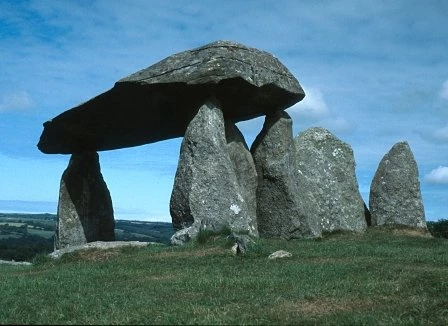
Pentre Ifan

Pentre Ifan (Pembrokeshire), one of the most dramatic megalithic tombs in Wales. It would originally have been covered by a stone mound.

Wales is home to one of the best collections of megalithic tombs in the UK. As well as being visually dramatic, they provide an important source of information about life, and death, from over five thousand years ago.

The landscape of Wales is filled with ancient monuments. A thousand years ago castles were the most impressive features, a thousand years before that it was Roman forts and before that Iron Age hillforts. But the earliest monuments to survive to the present day are megalithic tombs - stone burial chambers, built almost six thousand years ago.

Megalithic tombs were built at a time when the population of Wales lived in small communities, using stone tools, and experimenting with the newly introduced ways of farming and herding. Today such a life sounds simple and unsophisticated compared to our own. However, the evidence of the megalithic tombs tells us that life was not completely uncomplicated at this time.

Wales's megalithic tombs consist, for the most part, of stone chambers composed of a large capstone perched on top of a number of uprights. These would once have been covered with a mound of earth or stone. Often they have a forecourt area in which ceremonies would have been performed.

The scale of the megaliths is their most striking feature. At Arthur's Stone on the Gower peninsula a rock over 4m (14ft) long and 2m (7ft) thick was lifted to create the chamber. At Tinkinswood (Vale of Glamorgan) a slab weighing over 36 tonnes (39 tons) was used.

Community crypts

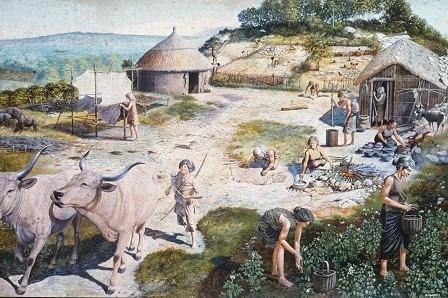
Reconstruction of daily life in Wales 6,000 years ago

Reconstruction of daily life in Wales 6,000 years ago, based on excavations at Clegyr Boia (Pembrokeshire). For most people the daily routine focused on farming crops, gathering wild plants, and herding sheep and cattle.

That Stone Age people went to such lengths to build their tombs indicates their importance for communities at this time.

When completed the tomb functioned like a modern crypt, being slowly filled over the generations with the dead. The result was, in effect, a home for the ancestors.

South East Wales

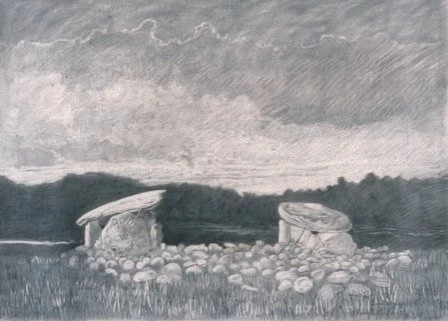
Dyffryn Ardudwy

Drawing of Dyffryn Ardudwy (Gwynedd), by David Gunning. This monument was constructed in stages with the chamber on the right being the first to be built.

Tombs like these can be found in many parts of Wales. In south-east Wales there is an important group of tombs centred on the Black Mountains as well as in the Vale of Glamorgan. In south-west Wales, there are clusters in Pembrokeshire and Carmarthenshire. Most impressive of all are the tombs of Anglesey, which are notable for their number and variety.

These tombs are the few that have survived agricultural clearance and robbing for building works - doubtless there were once many more in Wales, and perhaps there are a few more still waiting to be discovered.

Background Reading

Arthur's Stone, on the Gower peninsula.

Arthur's Stone, on the Gower peninsula. The massive stone that caps this chamber was set atop several smaller uprights in an impressive feat of Stone Age engineering.

The Tomb Builders: In Wales 4000-3000BC by Steve Burrow. National Museum Wales Books (2006)

Megalithic tombs and long barrows in Britain by F. Lynch. Shire Publications (1997).

A Stone Age masterpiece - A Mace-head from North Wales

14 May 2007

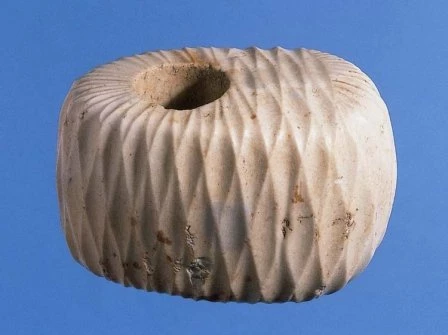
The Maesmor mace-head.

The Maesmor mace-head. Discovered in 1840, this artefact was initially thought to be either an Arch Druid's sacrificial hammer, or a war mace belonging to a Celtic chief.

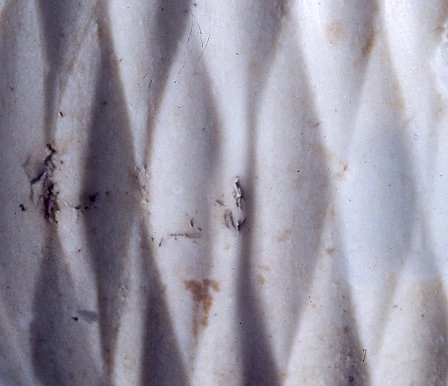
Detail of the carving on the Maesmor mace-head, showing a rare flaw in the design where two chevrons are broken (see centre of image).

Detail of the carving on the Maesmor mace-head, showing a rare flaw in the design where two chevrons are broken (see centre of image).

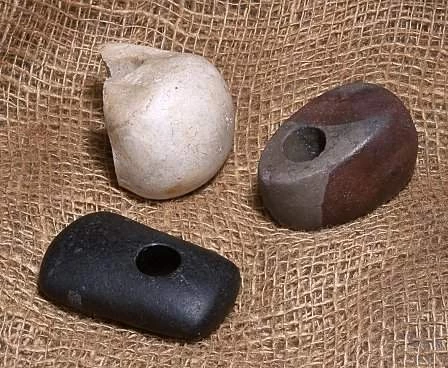
Mace-heads

Mace-heads from Ogmore (Vale of Glamorgan), Y Fron (Flintshire), and Sker House (Bridgend). The majority of mace-heads made around 2500BC are comparatively simple and undecorated. Examples like these ones have been found throughout Wales.

It is easy to think of the Stone Age as a period in which life was nasty, brutish and short. The Maesmor mace-head from North Wales is proof that it was not always so.

Mace-heads like this one were made around 2500BC, and were typically used for combat. Elaborate mace heads were also created as ceremonial objects and symbols of power within Stone Age tribes.

Many mace-heads have been found in Wales. For the most part they have been discovered by chance, having been disturbed from the spot at which they were lost or discarded. However, occasionally they are found with burials, including one example from Wiltshire, which was found with a body that had been adorned with gold and bone ornaments.

A symbol of power and wealth

This has led to the suggestion that mace-heads were symbols of power and were held by people with status. It is easy to imagine that this would have been true of the Maesmor mace-head since if its owner had only wanted something to use as a club he could have saved himself a lot of trouble by drilling a hole in a pebble and mounting that on the wooden handle.

Instead, a large piece of white flint – a rare stone in Denbighshire where the mace-head was found – was cut roughly into shape. Then a hole was drilled through the tough stone, probably using a bow drill with lots of sand and water. This hole was where the handle would originally have fitted.

Skilled workmanship

But the real skill was the cutting and shaping of the elaborate design on the sides of the mace-head. This was probably also done using the side of a bow drill to score the overlapping grooves.

This process must have taken the maker many tens of hours of work, slowly but gradually shaping first the rough outline, then grinding a hole through the stone before carving out the elaborate decoration on the sides.

The finished mace-head must have been much admired by its owner – possibly the elder of a community, a chieftain, or possibly just a craftsman revelling in his own skill.

Whoever owned the Maesmor mace-head, it demonstrates that even in the Stone Age there was time to make art and time to appreciate it. Luckily, it is still possible to appreciate the decoration that took so much effort and time to create thousands of years later.