Wales' other languages
1 February 2010
The many voices of Wales

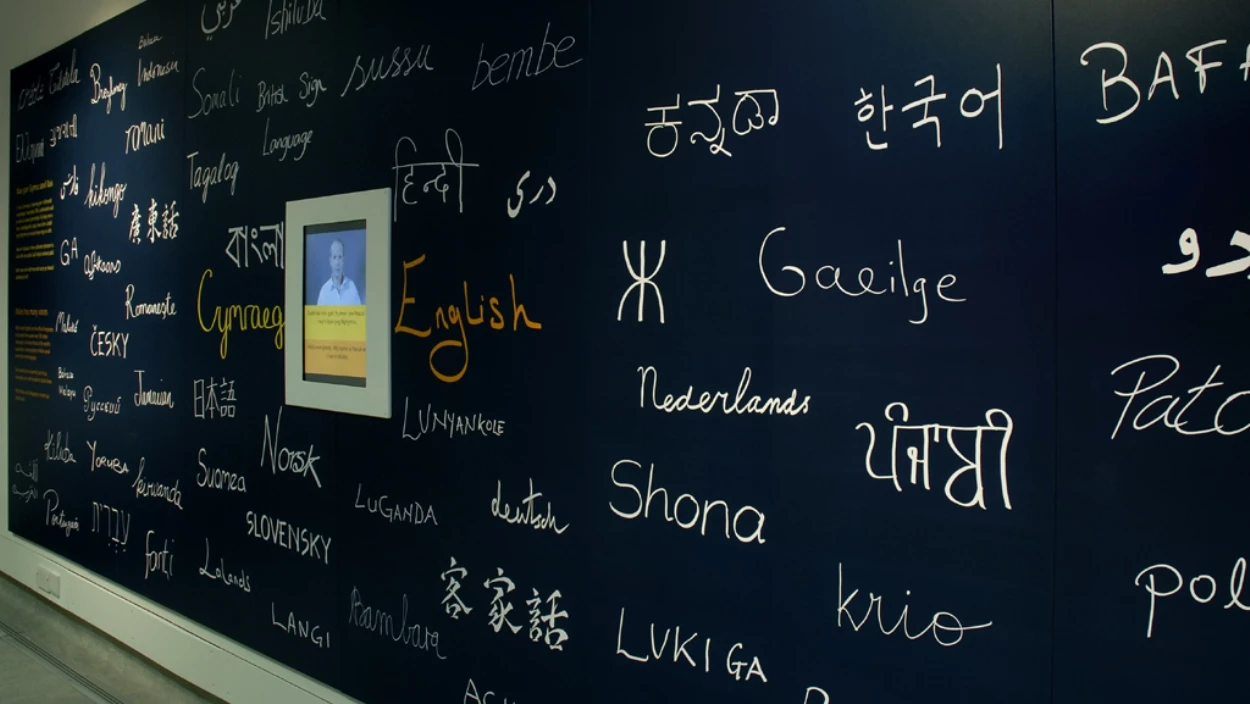
The Wall of Languages in Oriel 1, St Fagans National Museum of History
Wales has always had many voices. Welsh and English are Wales' official languages, but people here speak many other languages. Like two-thirds of the world's population, many people in Wales are bilingual or multilingual.
It is not easy to find reliable statistics about languages other than Welsh or English, because there isn't a question about them in the census. A survey by CILT Cymru revealed that at least 98 languages are spoken by school pupils in this country. In 2006, Amgueddfa Cymru collected the names of 78 languages from people who spoke those languages and lived in Wales, and displayed them in an exhibition.
Hear some of these languages
Here on the People's Collection, you can listen to some of these languages and the experiences and opinions of the people who speak or spoke them. You can help us also to find out more about Wales' languages. If you live in Wales and your language community isn't included here, why not tell your own story on the People's Collection?
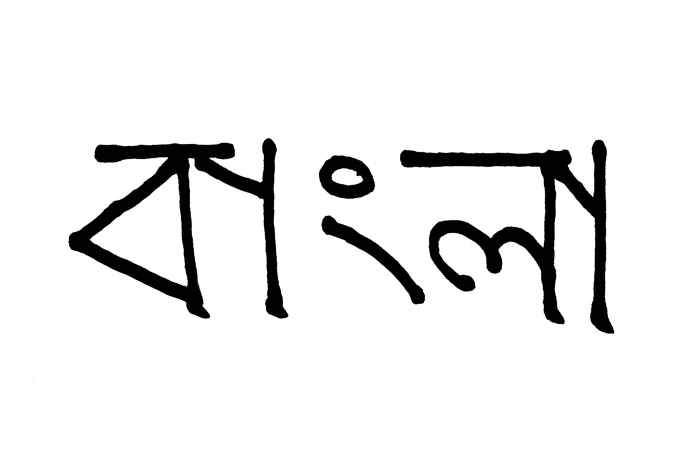
Bengali
There are about 400,000 Bengali speakers in the United Kingdom, from a total of 230 million worldwide. It is spoken by 100 million people in Bangladesh and over 70 million people in India. In Wales, Bengali-speaking pupils have been reported in schools in Cardiff, Carmarthenshire, Conwy/Denbighshire, Merthyr Tydfil, Newport, Swansea/Neath Port Talbot, Torfaen, Vale of Glamorgan, and Wrexham local authority areas. In recent years, Cardiff has seen a rapid growth in the Bangladeshi population, which now makes up more than a quarter of all Asians in the city.
When Pakistan was formed in 1947, Urdu was decreed the only official language, despite the fact that Bengali was more widely spoken in the east. East Pakistan achieved independence in 1971, changing its name to Bangladesh and adopting Bengali as the official language.
Most British Bangladeshis have their roots in Sylhet, a region in north-western Bangladesh, and speak the Sylheti dialect of Bengali which is very different from the standard language. The Sylhet region has very old links with the UK because of the sea trade in jute and tea. The Bengali community in Britain dates back to the 1870s, but the peak period of immigration was the 1960s and 1970s.
Sirajul Islam: Sylheti Bengali
Sirajul Islam introducing himself in Welsh.
Sirajul Islam introducing himself in Welsh.
Sirajul Islam talks about his linguistic background and why he has learnt Welsh.
Sirajul Islam talks about his linguistic background and why he has learnt Welsh.
(In Welsh) "I come originally from Bangladesh. I came here in 1963 as an economic migrant to search for a new life, and to keep my family in the old country from poverty, hardship and suffering. At home, we speak Sylheti Bengali, not pure Bengali. Because our area belonged to Assam — where the tea comes from — so it was totally different to pure Bengali. So I spoke Sylheti at home, and pure Bengali at school. But after independence in 1947, Pakistanis came into our area like Vikings, with their culture and their Urdu language too. We had to learn Urdu straight away. It was rather like an official language — Urdu and English. So when I was working in an office as a civil servant, I couldn't use my Bengali mother tongue at all. Urdu or English. So that's why I can speak it — I had no choice but to learn Urdu, to please the Pakistani government. The same thing happened a century ago in rural Wales, didn't it — the Welsh Not.
I'm very grateful to Wales and her people, and I've achieved a lot here. I had the opportunity to do things, to realise my dreams, things I couldn't do anywhere else.
I decided to learn Welsh to say 'Thank you very much, Wales, for everything.' In her own language. And that was important. That was important to me."
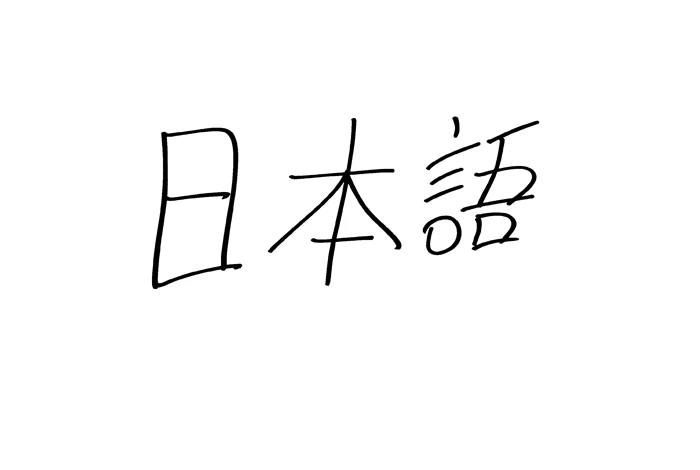
Japanese
Japanese is spoken by about 125 million people, 99% of them still in Japan. However the number of Japanese speakers living abroad has increased with the expansion of Japan's economy, working for Japanese companies or the government.
There are about 50,000 Japanese speakers in the UK, with about 2000 of them living in Wales. Wales is the largest centre in Europe for Japanese electronics firms. The first Japanese manufacturing company came to Wales in 1973. Over the last 30 years, that number has expanded to about 60 firms, employing thousands of Welsh people. Japanese-speaking pupils have been reported in schools in Cardiff, Carmarthenshire, Flintshire, Merthyr Tydfil, Swansea/Neath/Port Talbot, the Vale of Glamorgan and Wrexham.
Midori Matsui: Japanese
Midori Matsui introduces herself in Japanese.
Midori Matsui introduces herself in Japanese.
Midori Matsui - from Japan to south Wales
Midori Matsui - from Japan to south Wales
"I came from Japan, and in Japan I was a schoolteacher of English. And I wanted to see England, Great Britain first, before Wales. So I came to England in 1972. Having spent one year there, I was asked to come down to Wales to work for a Japanese company. So the next year, '73, I came to Wales and ever since I've lived here.
A lot of people have already made a comment, I have got a Welsh accent. I can't tell though. About Welsh accent, I've got a funny story. One day I was at Heathrow airport, looking for a whisky, a particular brand of whisky. And the manager came up to me, started to explain about the whisky. He was thinking I was a tourist, and Japanese people are well known as a lover of whisky. And then all I said was, 'Thank you very much but no, I know what I'm looking for. So I'm all right.' But when I said that, he said, 'Where on earth did you get that Welsh accent?' And then he realised that I was living in this country, not a tourist, not just a tourist."
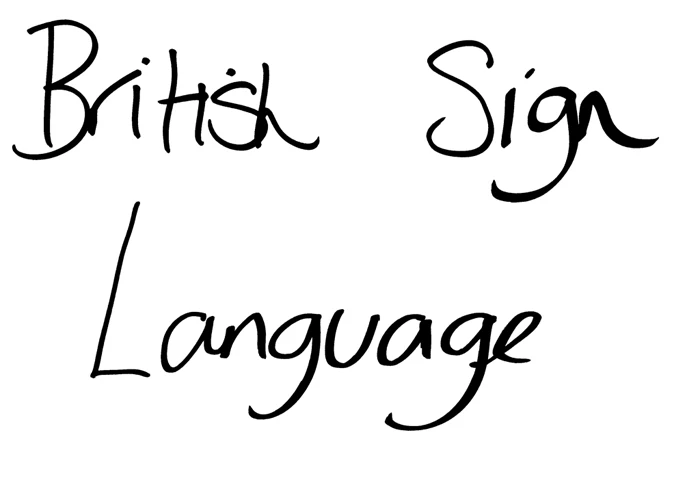
British Sign Language
British Sign Language (or BSL) is the language used by Britain's Deaf community. It is a language in its own right, not a way of speaking English through signs. It is estimated that around 70,000 people use BSL as their first language, and that up to 250,000 people use some BSL.
Sign languages differ from country to country: British Sign Language is different from French or American Sign Language, for example. Just as in other languages, there are regional varieties or dialects too. BSL has a long history and culture, but for most of the 20th century, it was banned in schools for Deaf children. Pupils were made to speak and lip-read instead. Despite this, BSL survived and since 2003 it has been officially recognised by the Government as an independent language.
Jeff Brattan-Wilson: British Sign Language
Jeff Brattan-Wilson introduces himself in British Sign Language.
Jeff Brattan-Wilson introduces himself in British Sign Language.
Jeff Brattan-Wilson talks about British Sign Language
Jeff Brattan-Wilson talks about British Sign Language
"I learnt BSL because my parents are deaf, my family's deaf. I was born into a deaf world and I grew up signing. The community around me were using English, and everybody around me was hearing, but my family's deaf.
BSL is a real language. It has its own grammar structure, its own language structure, its own linguistic context. Now England and Wales, different countries, have their own language, their own spoken language. And BSL is the same. It has its own structure.
Well, accents. Let's talk about that. Now sign language actually has different regional variations. North Wales and south Wales has different regional variations, and it's the same with west and east Wales. It's quite similar as to spoken language, as there are regional differences in the spoken language of west and east, north and south Wales. BSL is the same. And also Welsh sign language is quite a lot different from the sign language used in England, although it is all British Sign Language.
Now there are very different signs, yes. One sign is very different. It's the sign for letter. Now the Welsh sign for letter is this, and the English sign for letter is this one. They are very different as you can see." (209)
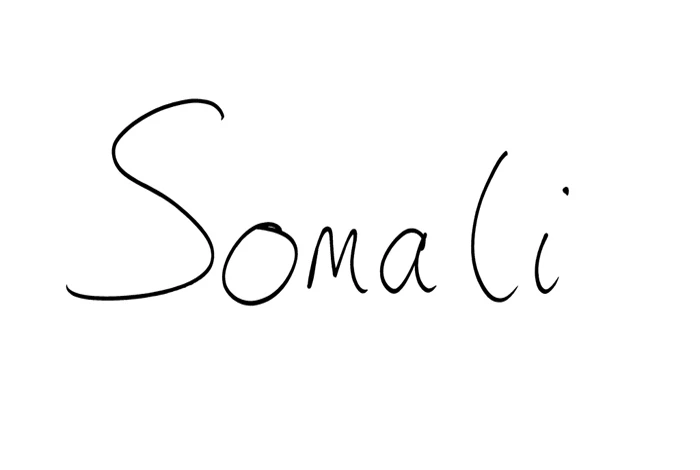
Somali
There have been Somalis in Cardiff since the 1870s. The city has one of the oldest Somali communities in the UK. The first settlers were sailors who came here shortly after opening the Suez Canal in 1869, when Cardiff was developing as a major international seaport. During the 1980s, another wave of Somali immigrants arrived, fleeing from the civil war in the Horn of Africa. It is estimated that currently over 8000 Somalis live in the Cardiff, Newport and Swansea areas, making them the largest ethnic minority community in Wales.
There are about 10-15 million Somali speakers worldwide. It is a language which has a long, rich tradition of poetry and literature. However it was only in 1972 that the Somali language became the official language of Somalia, replacing the colonial languages of English and Italian in government and education.
Faisal Mohamed Hashi: Somali
Faisal Mohamed Hashi introduces himself in Somali.
Faisal Mohamed Hashi introduces himself in Somali.
Faisal Mohamed Hashi talks about his Somali-speaking background in Newport.
Faisal Mohamed Hashi talks about his Somali-speaking background in Newport.
"I was born in Newport, in the Pill part, the new Pilgwenlly part of Newport, which is the docks area. The reason I was there was that my father was a merchant seaman who came to the UK with the Merchant Navy, British Merchant Navy. He settled here with his family and I was his first product that he had here in this country. But it was quite strange being born in Wales — though I was Welsh in that respect, being born here, but the first language I learnt was Somali because within the home it was like being in Somalia but obviously transported to Wales. So in that respect, I was Somali first. But then obviously when I came onto the street, I realised my Welshness and my Welsh roots have grown since then.
Language is very very important within my culture. And obviously the first language that you learn is the language that your parents speak to you. My mother's first tongue was Somali, so she made sure that when she spoke to us, she spoke to us in Somali. What it meant for me was that I learnt Somali first, then I learnt English. There was obviously a step back from living in this country. So in that respect, there's great pride in the knowledge of the language and there's great pride in being able to speak in one's tongue and to have an understanding of your own culture.
I do have a Welsh accent — an English-Welsh accent — when I speak Somali. If I was to stand behind that wall and have a conversation with a Somali person, they could definitely tell that I wasn't born and brought up in Somalia. But I have a broad vocabulary which would make them think twice about exactly what my origins were. But in terms of accent, definitely, I've got an English-Welsh accent when I speak Somali.
Essentially, yeh, I'm Welsh. Somali Welsh. In that respect, the Welsh accent comes through in both my English and in my Somali."
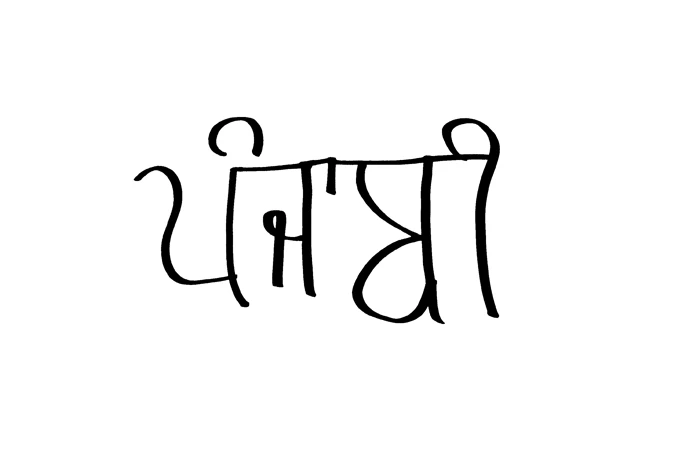
Panjabi
Panjabi is spoken by about 93 million speakers. Punjabi speakers came originally from the Panjab, which was divided between India and Pakistan after partition in 1947. About 70 per cent of Panjabi speakers live in Pakistan, and 30 per cent in India. Those who live in Pakistan are mostly Muslim and use Urdu as the language of religion and high culture. Panjabi-speaking Hindus look to Hindi as the language of religion. For Sikhs, however, Panjabi is the main language of their holy book, the Guru Granth Sahib.
Many Panjabis came to the UK in the period from the late 1950s to the early 1970s. They mainly settled around the London area, the Midlands and the textile towns of northern England. However not all Panjabi speakers came from India and Pakistan. Many were business and professional people who came from East Africa, where people from the Panjab had settled as traders earlier in the 20th century.
In Wales, we know that Panjabi-speaking pupils have been recorded in schools in Carmarthenshire, Denbighshire, Cardiff, Flintshire, Merthyr Tydfil, Swansea/Neath/Port Talbot and Torfaen.
Swinder Chadha: Panjabi
Swinder Chadha introduces herself in Panjabi.
Swinder Chadha introduces herself in Panjabi.
Swinder Chadha talks about her linguistic background.
Swinder Chadha talks about her linguistic background.
I speak Punjabi. That's my mother tongue which I inherited from my family. But when we were living in Delhi, the languages in Delhi were Hindi and Urdu, so as a child I could pick up quite easily. So I could speak three languages in my childhood — Hindi, Urdu and Punjabi. And English I learned when I went to school and college.
I merely speak Punjabi with my children and my husband at home. I also speak Punjabi when I go to our local Gurdhwara for worship every Sunday. Otherwise it's all English.
In the Gurdhwara where I go, people are from different parts of the world. We're all Sikhs, we all speak the same Punjabi, but we have different accents. There are people who have come to Wales via East African countries, or they have come from Burma or Singapore, and there are people from Iran, people from directly Punjab as well. So we all have a different accent, but we do understand the language.
I train staff how to understand cultural diversity. So that takes me to different organisations and again I talk to different professionals how to understand their employees who come from different parts of the world, and what sort of treatment would be acceptable to most of them, and how to go about it. These are the — and then I taught Indian history as well, which makes me understand that all the people in the world are all the same. They look different, the colours are different, the languages are different, they have different names for the god, but by the end of the day we are human beings.
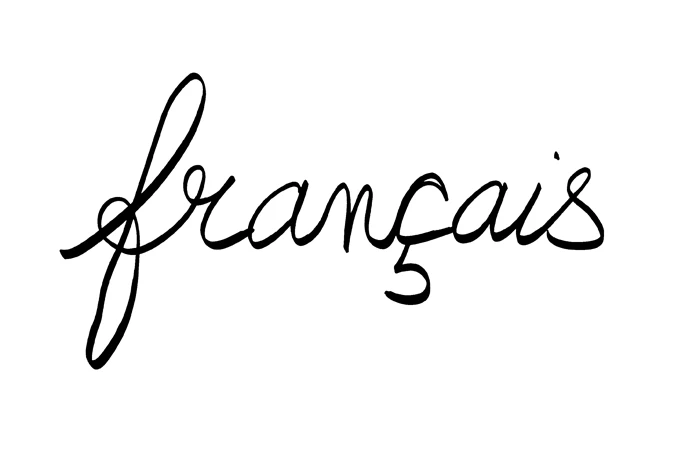
French
There are about 128 million people around the world who speak French. It is not only an official language in France, but also in 24 other countries, for example Switzerland and Canada and some African countries. It is spoken in the Channel Islands, and there are sizeable French communities in London. It is by far the most commonly taught language in UK secondary schools. In Wales, first language French speakers have been reported in schools in Cardiff, Carmarthenshire, Conwy/Denbighshire, Flintshire, Newport, Swansea/Neath Port Talbot, and Wrexham.
Sylvie Hoffman: French
Sylvie Butterbach introduces herself in French.
Sylvie Butterbach introduces herself in French.
Sylvie Butterbach talks about language choices within a family
Sylvie Butterbach talks about language choices within a family.
French I've learnt — it's my mother tongue. I was born in France and French was spoken at home. Although my grandparents spoke Plattdeutsch, because we are on the border between Germany and France, and we were invaded so many times that my parents were forbidden to speak French in school, so were my grandparents. And my great-grandparents were French-speaking, but I didn't know them...
Being in Wales — I have been on the receiving end of arrogance of, when I am in France, people who don't bother to speak the language. Not even greet in the language. From Germans, and I have met some English people. So I thought, no, this is not going to happen. My children will have an awareness, will know that we are in Wales, that Welsh is spoken, and everything. So I sent them to the Welsh school and my daughter then, she just lapped it all up...
Wales against England with the rugby, you shout for Wales of course, you know. But Wales against France? I was shouting for France! And in front of me, that ten-year-old was shouting for Wales. In front of me! I thought that was of the highest, the highest treason. I grabbed her like that and said to her, 'Qu'est-ce-que tu fait? What do you think you are doing?' And she said, 'Mam, I'm Welsh. I've decided to be Welsh.' And I said, 'Mais, pourquoi? Why?' And she said, 'When I speak French with you, I feel disloyal to Dad, because he doesn't understand French, and — well he understands but he doesn't speak French. And when I speak English with my dad — he doesn't speak Welsh — I feel disloyal to you, so, I've decided to be Welsh. So I don't have to owe anybody anything.' So she decided to be Welsh, and from then on she was Welsh. And that's it. And her sister followed suit.
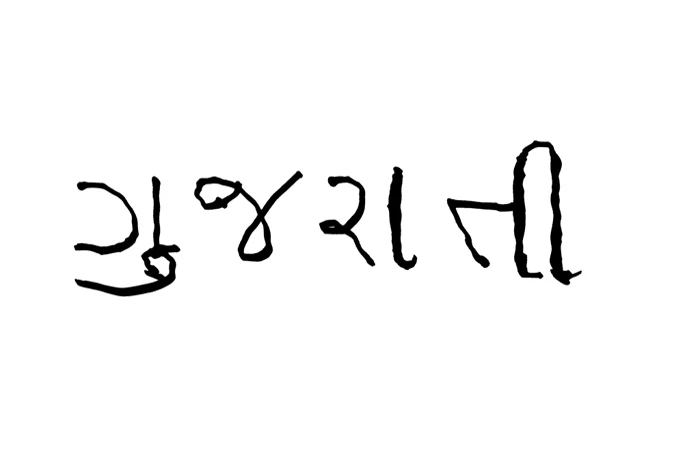
Gujarati
Gujarati is one of India's fifteen official languages and the state language of Gujarat in the north-west of the country. An estimated 47 million people worldwide speak the language. It was the first language of Mahatma Gandhi and has a literary tradition dating back to the tenth century. There are many Gujarati speakers in the UK, the main settlements being in the Midlands, the northern textile towns and Greater London. Some came direct from India in the 1950s and 1960s, but many came to the UK via East Africa, particularly after the expulsion of the South Asian population from Uganda in 1972. Gujarati-speaking pupils have been reported in schools in Cardiff, Carmarthenshire, Merthyr Tydfil, Swansea/Neath Port Talbot, Torfaen, and the Vale of Glamorgan.
Dinesh Patel: Gujarati
Dinesh Patel introduces himself in Gujurati
Dinesh Patel introduces himself in Gujurati.
Dinesh Patel talks about moving from Kenya to Welsh-speaking Caernarfon.
Dinesh Patel talks about moving from Kenya to Welsh-speaking Caernarfon.
I was born in Kenya, from an Indian background. Living in Kenya, I spoke Gujarati at home. And English at school, then other languages like Gujarati, Hindi, Swahili on the street with other children. Then I went to India to learn to write Hindi. And I arrived in England in 1973. After leaving college there I came to Caernarfon, because of work. I work with the council, and everyone in Caernarfon speaks Welsh. I picked up a little bit of Welsh on the street first of all, then I went to college to learn a bit more. And I met a Welsh girl, married her, and had two children, and everyone in our house speaks Welsh, all the time.
People living in Caernarfon, they speak Welsh — Cofi Welsh. And I've picked up a lot of Cofi Welsh in Caernarfon, going to the pub with my friends, playing cricket together, speaking Welsh with everybody. And I've settled in well, with all the community.
Malayan
The Malay (Bahasa Melayu) is a language spoken by people living in the Malay peninsula, southern Thailand, Philippines, Singapore, central eastern Sumatra and parts of the Borneo coast. It is an official language of Malaysia, Brunei and Singapore. About 18 million people speak Standard Malay, while there are also about 170 million people who speak Indonesian, which is a form of Malay. Malayan speakers have been reported in schools in Cardiff and the Vale of Glamorgan.
Juliet Revell: Malayan
Juliet Revell introduces herself in Malayan.
Juliet Revell introduces herself in Malayan.
Juliet Revell talks about learning Welsh.
Juliet Revell talks about learning Welsh.
I'm very fond of learning new languages. Welsh is very interesting, and different to my mother tongue. And also it's a great challenge for me to learn it. I believe it's important for me to be able to speak Welsh so I can socialise with people locally. Because I live in Wales now. Wales is my home.
I speak Welsh with neighbours, friends, or my Welsh tutor. Sometimes I'll go to a CYD (Friends of Welsh Learners) meeting to practice my Welsh. I have one very interesting story. One of my neighbours, the farmer, said it was difficult to talk Welsh to me, because my Welsh is as good as a minister's. Oh, how I loved hearing that!
Breton
Breton is a Celtic language closely related to Cornish and Welsh, though speakers of Welsh would not be able to understand a Breton speaker. It is spoken mainly in Brittany on the north-west coast of France by about 365,000 speakers. It has no official status. From 1880 to 1951 it was banned from schools and children were punished for speaking the language. Since 1951, the law has allowed Breton language and culture to be taught for a few hours a week. There is also limited radio broadcasting in Breton and a weekly one-hour TV programme.
Pascal Lafargue: Breton
Pascal Lafargue introduces himself in Breton.
Pascal Lafargue introduces himself in Breton.
Pascal Lafargue explains why he wanted to learn Breton and Welsh.
Pascal Lafargue explains why he wanted to learn Breton and Welsh.
I was born in Rennes, the capital of Brittany, but unfortunately there's been no Breton in Rennes for some time. So I taught myself with books. Then I applied to the university in Rennes where I could carry on learning Breton.
At the moment I speak French with my partner, but I speak Welsh with my son. Because I have friends from Brittany here in Wales, I get a chance to speak Breton with them.
People often ask me, 'Why have you learnt Welsh?' It's difficult to answer that kind of question, but usually I reply, ''Why drink a glass of wine? Why go for a walk in the country?' I just learn languages because I'm interested in people, and want to share things with them. That's why I've learnt Welsh. And it's so close to Breton, too, so I think it's very interesting.
Swahili
Swahili is a language that has spread beyond its place of origin on the East African coast due to trade networks. It is a Bantu language, but through contact with Arab traders it has adopted many Arabic words. During the 18th and 19th centuries, it was used as a language of administration by the British who colonised that part of Africa. Swahili became the national language of Tanzania and Kenya when those countries achieved independence in the 1960s, but it is also spoken in parts of Somalia, Uganda, the Democratic Republic of Congo, Rwanda, and Burundi. It has about 5 million first-language speakers, but there are 50 million or so second-language speakers who use it as a lingua franca.
A survey of local education authorities in Wales indicated that there were Swahili speakers in schools in Conwy/Denbighshire and Swansea/Neath Port Talbot. It is only one of many African languages spoken by people living in Wales.
Aime Kongolo: Swahili
Aime Kongolo is from Katanga in the Democratic Republic of the Congo, an area that was at one timed ruled by Belgium. He comes from a society where speaking many languages is the norm.
"Swahili's like my mother language, my mother tongue. I can say that, 'cause in my city in Katanga, everyone speaks Swahili. We have other dialects spoken there, but we speak, all of them, we understand Swahili. So Swahili, I grew up with that language. And then the same time, from — because my father was a teacher — in my house I was speaking two languages: my father French, my mother Swahili so I grew up with those two languages. And from — from just primary school, from nursery to primary school, you go to secondary school and then go high school — there it's only French.
Lingala, I came to learn Lingala when I moved to Kinshasa, the capital city. In the capital city there's all those people. They speak different, all those Congolese languages. But Lingala, it's like the main language they speak, all of them. They understand each other. And French as well. But Lingala, it's more when you go out, socialising life, when you speak Lingala. If you go like in professional way, it's only French. Or maybe if you just want to be posh, you speak in French all the time. So it's up to you.
When I came to England, I started learning English, and then I moved to English — to England, to Wales, where I learnt more English. Now maybe I speak a little bit more with Welsh accent for people to understand me. Probably in future I was thinking to start learning Welsh."