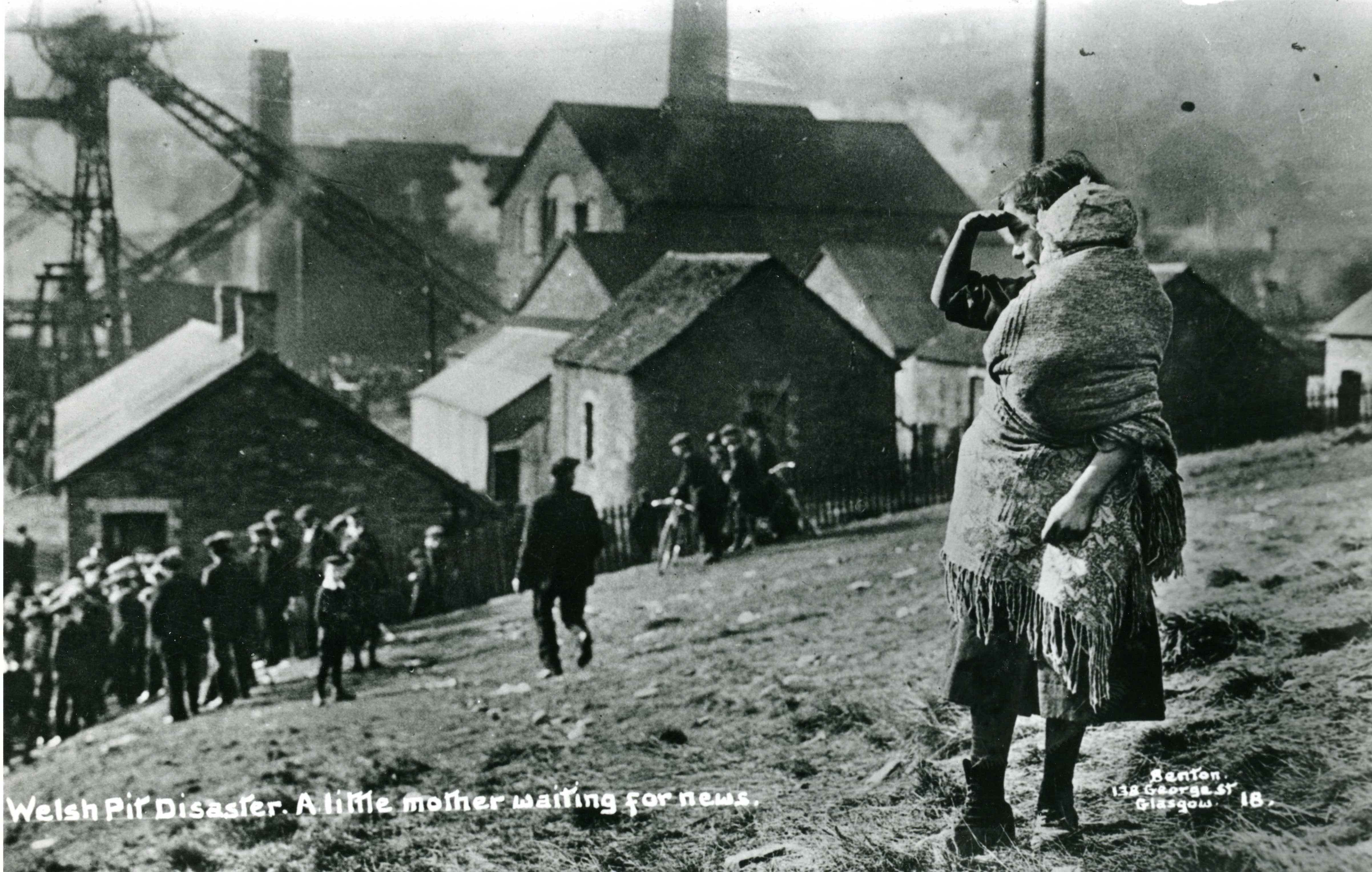
Senghenydd Disaster: Mine inspector's notebook
17 May 2013

A young mother and baby wait for news
The final death toll from the Senghenydd mine disaster on 14 October 1913 was 439 men. Some of the bodies were never recovered. It was the worst mining disaster in the history of the British coalfields.
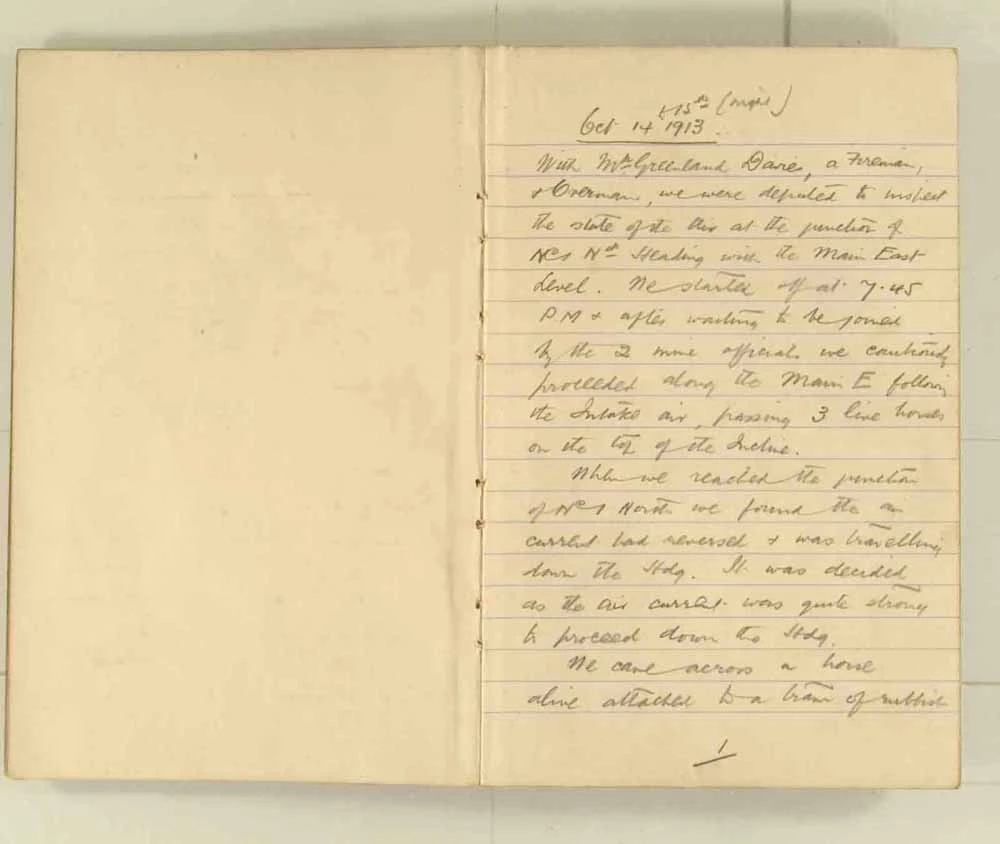
Below you can view pages from the notebooks made by the Inspector of Mines immediately following the explosion as he walked around the devistated workings.
Senghenydd Mine Disaster: Inspector of Mines notebooks
Notes made by the Inspector of Mines as he travelled around the devastated underground workings following the Senghenydd mine explosion on 14th October 1913 that killed 439 men. Courtesy of the National Coal Mining Museum for England [Notebook 3/4]
Notes made by the Inspector of Mines as he travelled around the devastated underground workings following the Senghenydd mine explosion on 14th October 1913 that killed 439 men. Courtesy of the National Coal Mining Museum for England [Notebook 3/4]
Notes made by the Inspector of Mines as he travelled around the devastated underground workings following the Senghenydd mine explosion on 14th October 1913 that killed 439 men. Courtesy of the National Coal Mining Museum for England [Notebook 3/4]
Notes made by the Inspector of Mines as he travelled around the devastated underground workings following the Senghenydd mine explosion on 14th October 1913 that killed 439 men. Courtesy of the National Coal Mining Museum for England [Notebook 3/4]
Notes made by the Inspector of Mines as he travelled around the devastated underground workings following the Senghenydd mine explosion on 14th October 1913 that killed 439 men. Courtesy of the National Coal Mining Museum for England [Notebook 3/4]
Notes made by the Inspector of Mines as he travelled around the devastated underground workings following the Senghenydd mine explosion on 14th October 1913 that killed 439 men. Courtesy of the National Coal Mining Museum for England [Notebook 3/4]
Notes made by the Inspector of Mines as he travelled around the devastated underground workings following the Senghenydd mine explosion on 14th October 1913 that killed 439 men. Courtesy of the National Coal Mining Museum for England [Notebook 3/4]
Notes made by the Inspector of Mines as he travelled around the devastated underground workings following the Senghenydd mine explosion on 14th October 1913 that killed 439 men. Courtesy of the National Coal Mining Museum for England [Notebook 3/4]
Notes made by the Inspector of Mines as he travelled around the devastated underground workings following the Senghenydd mine explosion on 14th October 1913 that killed 439 men. Courtesy of the National Coal Mining Museum for England [Notebook 3/4]
Notes made by the Inspector of Mines as he travelled around the devastated underground workings following the Senghenydd mine explosion on 14th October 1913 that killed 439 men. Courtesy of the National Coal Mining Museum for England [Notebook 3/4]
Notes made by the Inspector of Mines as he travelled around the devastated underground workings following the Senghenydd mine explosion on 14th October 1913 that killed 439 men. Courtesy of the National Coal Mining Museum for England [Notebook 3/4]
Notes made by the Inspector of Mines as he travelled around the devastated underground workings following the Senghenydd mine explosion on 14th October 1913 that killed 439 men. Courtesy of the National Coal Mining Museum for England [Notebook 3/4]
Notes made by the Inspector of Mines as he travelled around the devastated underground workings following the Senghenydd mine explosion on 14th October 1913 that killed 439 men. Courtesy of the National Coal Mining Museum for England [Notebook 3/4]
Notes made by the Inspector of Mines as he travelled around the devastated underground workings following the Senghenydd mine explosion on 14th October 1913 that killed 439 men. Courtesy of the National Coal Mining Museum for England [Notebook 3/4]
Notes made by the Inspector of Mines as he travelled around the devastated underground workings following the Senghenydd mine explosion on 14th October 1913 that killed 439 men. Courtesy of the National Coal Mining Museum for England [Notebook 3/4]
Notes made by the Inspector of Mines as he travelled around the devastated underground workings following the Senghenydd mine explosion on 14th October 1913 that killed 439 men. Courtesy of the National Coal Mining Museum for England [Notebook 3/4]
Notes made by the Inspector of Mines as he travelled around the devastated underground workings following the Senghenydd mine explosion on 14th October 1913 that killed 439 men. Courtesy of the National Coal Mining Museum for England [Notebook 3/4]
Notes made by the Inspector of Mines as he travelled around the devastated underground workings following the Senghenydd mine explosion on 14th October 1913 that killed 439 men. Courtesy of the National Coal Mining Museum for England [Notebook 3/4]
Notes made by the Inspector of Mines as he travelled around the devastated underground workings following the Senghenydd mine explosion on 14th October 1913 that killed 439 men. Courtesy of the National Coal Mining Museum for England [Notebook 3/4]
Notes made by the Inspector of Mines as he travelled around the devastated underground workings following the Senghenydd mine explosion on 14th October 1913 that killed 439 men. Courtesy of the National Coal Mining Museum for England [Notebook 3/4]
Notes made by the Inspector of Mines as he travelled around the devastated underground workings following the Senghenydd mine explosion on 14th October 1913 that killed 439 men. Courtesy of the National Coal Mining Museum for England [Notebook 3/4]
Notes made by the Inspector of Mines as he travelled around the devastated underground workings following the Senghenydd mine explosion on 14th October 1913 that killed 439 men. Courtesy of the National Coal Mining Museum for England [Notebook 3/4]
Notes made by the Inspector of Mines as he travelled around the devastated underground workings following the Senghenydd mine explosion on 14th October 1913 that killed 439 men. Courtesy of the National Coal Mining Museum for England [Notebook 3/4]
Notes made by the Inspector of Mines as he travelled around the devastated underground workings following the Senghenydd mine explosion on 14th October 1913 that killed 439 men. Courtesy of the National Coal Mining Museum for England [Notebook 3/4]
Notes made by the Inspector of Mines as he travelled around the devastated underground workings following the Senghenydd mine explosion on 14th October 1913 that killed 439 men. Courtesy of the National Coal Mining Museum for England [Notebook 3/4]
Notes made by the Inspector of Mines as he travelled around the devastated underground workings following the Senghenydd mine explosion on 14th October 1913 that killed 439 men. Courtesy of the National Coal Mining Museum for England [Notebook 3/4]
Notes made by the Inspector of Mines as he travelled around the devastated underground workings following the Senghenydd mine explosion on 14th October 1913 that killed 439 men. Courtesy of the National Coal Mining Museum for England [Notebook 3/4]
Notes made by the Inspector of Mines as he travelled around the devastated underground workings following the Senghenydd mine explosion on 14th October 1913 that killed 439 men. Courtesy of the National Coal Mining Museum for England [Notebook 3/4]
Notes made by the Inspector of Mines as he travelled around the devastated underground workings following the Senghenydd mine explosion on 14th October 1913 that killed 439 men. Courtesy of the National Coal Mining Museum for England [Notebook 3/4]
Notes made by the Inspector of Mines as he travelled around the devastated underground workings following the Senghenydd mine explosion on 14th October 1913 that killed 439 men. Courtesy of the National Coal Mining Museum for England [Notebook 3/4]
Notes made by the Inspector of Mines as he travelled around the devastated underground workings following the Senghenydd mine explosion on 14th October 1913 that killed 439 men. Courtesy of the National Coal Mining Museum for England [Notebook 3/4]
Notes made by the Inspector of Mines as he travelled around the devastated underground workings following the Senghenydd mine explosion on 14th October 1913 that killed 439 men. Courtesy of the National Coal Mining Museum for England [Notebook 3/4]
Notes made by the Inspector of Mines as he travelled around the devastated underground workings following the Senghenydd mine explosion on 14th October 1913 that killed 439 men. Courtesy of the National Coal Mining Museum for England [Notebook 3/4]
Notes made by the Inspector of Mines as he travelled around the devastated underground workings following the Senghenydd mine explosion on 14th October 1913 that killed 439 men. Courtesy of the National Coal Mining Museum for England [Notebook 3/4]
Notes made by the Inspector of Mines as he travelled around the devastated underground workings following the Senghenydd mine explosion on 14th October 1913 that killed 439 men. Courtesy of the National Coal Mining Museum for England [Notebook 3/4]
Notes made by the Inspector of Mines as he travelled around the devastated underground workings following the Senghenydd mine explosion on 14th October 1913 that killed 439 men. Courtesy of the National Coal Mining Museum for England [Notebook 3/4]
Notes made by the Inspector of Mines as he travelled around the devastated underground workings following the Senghenydd mine explosion on 14th October 1913 that killed 439 men. Courtesy of the National Coal Mining Museum for England [Notebook 3/4]
Notes made by the Inspector of Mines as he travelled around the devastated underground workings following the Senghenydd mine explosion on 14th October 1913 that killed 439 men. Courtesy of the National Coal Mining Museum for England [Notebook 3/4]
Notes made by the Inspector of Mines as he travelled around the devastated underground workings following the Senghenydd mine explosion on 14th October 1913 that killed 439 men. Courtesy of the National Coal Mining Museum for England [Notebook 3/4]
Notes made by the Inspector of Mines as he travelled around the devastated underground workings following the Senghenydd mine explosion on 14th October 1913 that killed 439 men. Courtesy of the National Coal Mining Museum for England [Notebook 3/4]
Notes made by the Inspector of Mines as he travelled around the devastated underground workings following the Senghenydd mine explosion on 14th October 1913 that killed 439 men. Courtesy of the National Coal Mining Museum for England [Notebook 3/4]
Notes made by the Inspector of Mines as he travelled around the devastated underground workings following the Senghenydd mine explosion on 14th October 1913 that killed 439 men. Courtesy of the National Coal Mining Museum for England [Notebook 3/4]
Notes made by the Inspector of Mines as he travelled around the devastated underground workings following the Senghenydd mine explosion on 14th October 1913 that killed 439 men. Courtesy of the National Coal Mining Museum for England [Notebook 3/4]
Notes made by the Inspector of Mines as he travelled around the devastated underground workings following the Senghenydd mine explosion on 14th October 1913 that killed 439 men. Courtesy of the National Coal Mining Museum for England [Notebook 3/4]
Notes made by the Inspector of Mines as he travelled around the devastated underground workings following the Senghenydd mine explosion on 14th October 1913 that killed 439 men. Courtesy of the National Coal Mining Museum for England [Notebook 3/4]
Notes made by the Inspector of Mines as he travelled around the devastated underground workings following the Senghenydd mine explosion on 14th October 1913 that killed 439 men. Courtesy of the National Coal Mining Museum for England [Notebook 3/4]
Notes made by the Inspector of Mines as he travelled around the devastated underground workings following the Senghenydd mine explosion on 14th October 1913 that killed 439 men. Courtesy of the National Coal Mining Museum for England [Notebook 3/4]
Notes made by the Inspector of Mines as he travelled around the devastated underground workings following the Senghenydd mine explosion on 14th October 1913 that killed 439 men. Courtesy of the National Coal Mining Museum for England [Notebook 3/4]
Notes made by the Inspector of Mines as he travelled around the devastated underground workings following the Senghenydd mine explosion on 14th October 1913 that killed 439 men. Courtesy of the National Coal Mining Museum for England [Notebook 3/4]
Notes made by the Inspector of Mines as he travelled around the devastated underground workings following the Senghenydd mine explosion on 14th October 1913 that killed 439 men. Courtesy of the National Coal Mining Museum for England [Notebook 3/4]
Notes made by the Inspector of Mines as he travelled around the devastated underground workings following the Senghenydd mine explosion on 14th October 1913 that killed 439 men. Courtesy of the National Coal Mining Museum for England [Notebook 3/4]
Notes made by the Inspector of Mines as he travelled around the devastated underground workings following the Senghenydd mine explosion on 14th October 1913 that killed 439 men. Courtesy of the National Coal Mining Museum for England [Notebook 3/4]
Notes made by the Inspector of Mines as he travelled around the devastated underground workings following the Senghenydd mine explosion on 14th October 1913 that killed 439 men. Courtesy of the National Coal Mining Museum for England [Notebook 3/4]
Notes made by the Inspector of Mines as he travelled around the devastated underground workings following the Senghenydd mine explosion on 14th October 1913 that killed 439 men. Courtesy of the National Coal Mining Museum for England [Notebook 3/4]
Notes made by the Inspector of Mines as he travelled around the devastated underground workings following the Senghenydd mine explosion on 14th October 1913 that killed 439 men. Courtesy of the National Coal Mining Museum for England [Notebook 3/4]
Notes made by the Inspector of Mines as he travelled around the devastated underground workings following the Senghenydd mine explosion on 14th October 1913 that killed 439 men. Courtesy of the National Coal Mining Museum for England [Notebook 3/4]
Notes made by the Inspector of Mines as he travelled around the devastated underground workings following the Senghenydd mine explosion on 14th October 1913 that killed 439 men. Courtesy of the National Coal Mining Museum for England [Notebook 3/4]
Notes made by the Inspector of Mines as he travelled around the devastated underground workings following the Senghenydd mine explosion on 14th October 1913 that killed 439 men. Courtesy of the National Coal Mining Museum for England [Notebook 3/4]
Notes made by the Inspector of Mines as he travelled around the devastated underground workings following the Senghenydd mine explosion on 14th October 1913 that killed 439 men. Courtesy of the National Coal Mining Museum for England [Notebook 3/4]
Notes made by the Inspector of Mines as he travelled around the devastated underground workings following the Senghenydd mine explosion on 14th October 1913 that killed 439 men. Courtesy of the National Coal Mining Museum for England [Notebook 3/4]
Notes made by the Inspector of Mines as he travelled around the devastated underground workings following the Senghenydd mine explosion on 14th October 1913 that killed 439 men. Courtesy of the National Coal Mining Museum for England [Notebook 3/4]
Notes made by the Inspector of Mines as he travelled around the devastated underground workings following the Senghenydd mine explosion on 14th October 1913 that killed 439 men. Courtesy of the National Coal Mining Museum for England [Notebook 3/4]
Notes made by the Inspector of Mines as he travelled around the devastated underground workings following the Senghenydd mine explosion on 14th October 1913 that killed 439 men. Courtesy of the National Coal Mining Museum for England [Notebook 3/4]
Notes made by the Inspector of Mines as he travelled around the devastated underground workings following the Senghenydd mine explosion on 14th October 1913 that killed 439 men. Courtesy of the National Coal Mining Museum for England [Notebook 3/4]
Notes made by the Inspector of Mines as he travelled around the devastated underground workings following the Senghenydd mine explosion on 14th October 1913 that killed 439 men. Courtesy of the National Coal Mining Museum for England [Notebook 3/4]
Notes made by the Inspector of Mines as he travelled around the devastated underground workings following the Senghenydd mine explosion on 14th October 1913 that killed 439 men. Courtesy of the National Coal Mining Museum for England [Notebook 3/4]
Notes made by the Inspector of Mines as he travelled around the devastated underground workings following the Senghenydd mine explosion on 14th October 1913 that killed 439 men. Courtesy of the National Coal Mining Museum for England [Notebook 3/4]
Notes made by the Inspector of Mines as he travelled around the devastated underground workings following the Senghenydd mine explosion on 14th October 1913 that killed 439 men. Courtesy of the National Coal Mining Museum for England [Notebook 3/4]
Notes made by the Inspector of Mines as he travelled around the devastated underground workings following the Senghenydd mine explosion on 14th October 1913 that killed 439 men. Courtesy of the National Coal Mining Museum for England [Notebook 3/4]
Notes made by the Inspector of Mines as he travelled around the devastated underground workings following the Senghenydd mine explosion on 14th October 1913 that killed 439 men. Courtesy of the National Coal Mining Museum for England [Notebook 3/4]
Notes made by the Inspector of Mines as he travelled around the devastated underground workings following the Senghenydd mine explosion on 14th October 1913 that killed 439 men. Courtesy of the National Coal Mining Museum for England [Notebook 3/4]
Notes made by the Inspector of Mines as he travelled around the devastated underground workings following the Senghenydd mine explosion on 14th October 1913 that killed 439 men. Courtesy of the National Coal Mining Museum for England [Notebook 3/4]
Notes made by the Inspector of Mines as he travelled around the devastated underground workings following the Senghenydd mine explosion on 14th October 1913 that killed 439 men. Courtesy of the National Coal Mining Museum for England [Notebook 3/4]
Notes made by the Inspector of Mines as he travelled around the devastated underground workings following the Senghenydd mine explosion on 14th October 1913 that killed 439 men. Courtesy of the National Coal Mining Museum for England [Notebook 3/4]
Notes made by the Inspector of Mines as he travelled around the devastated underground workings following the Senghenydd mine explosion on 14th October 1913 that killed 439 men. Courtesy of the National Coal Mining Museum for England [Notebook 3/4]
Notes made by the Inspector of Mines as he travelled around the devastated underground workings following the Senghenydd mine explosion on 14th October 1913 that killed 439 men. Courtesy of the National Coal Mining Museum for England [Notebook 3/4]
Notes made by the Inspector of Mines as he travelled around the devastated underground workings following the Senghenydd mine explosion on 14th October 1913 that killed 439 men. Courtesy of the National Coal Mining Museum for England [Notebook 3/4]
Notes made by the Inspector of Mines as he travelled around the devastated underground workings following the Senghenydd mine explosion on 14th October 1913 that killed 439 men. Courtesy of the National Coal Mining Museum for England [Notebook 3/4]
Notes made by the Inspector of Mines as he travelled around the devastated underground workings following the Senghenydd mine explosion on 14th October 1913 that killed 439 men. Courtesy of the National Coal Mining Museum for England [Notebook 3/4]
Notes made by the Inspector of Mines as he travelled around the devastated underground workings following the Senghenydd mine explosion on 14th October 1913 that killed 439 men. Courtesy of the National Coal Mining Museum for England [Notebook 3/4]
Notes made by the Inspector of Mines as he travelled around the devastated underground workings following the Senghenydd mine explosion on 14th October 1913 that killed 439 men. Courtesy of the National Coal Mining Museum for England [Notebook 1/2]
Notes made by the Inspector of Mines as he travelled around the devastated underground workings following the Senghenydd mine explosion on 14th October 1913 that killed 439 men. Courtesy of the National Coal Mining Museum for England [Notebook 1/2]
Notes made by the Inspector of Mines as he travelled around the devastated underground workings following the Senghenydd mine explosion on 14th October 1913 that killed 439 men. Courtesy of the National Coal Mining Museum for England [Notebook 1/2]
Notes made by the Inspector of Mines as he travelled around the devastated underground workings following the Senghenydd mine explosion on 14th October 1913 that killed 439 men. Courtesy of the National Coal Mining Museum for England [Notebook 1/2]
Notes made by the Inspector of Mines as he travelled around the devastated underground workings following the Senghenydd mine explosion on 14th October 1913 that killed 439 men. Courtesy of the National Coal Mining Museum for England [Notebook 1/2]
Notes made by the Inspector of Mines as he travelled around the devastated underground workings following the Senghenydd mine explosion on 14th October 1913 that killed 439 men. Courtesy of the National Coal Mining Museum for England [Notebook 1/2]
Notes made by the Inspector of Mines as he travelled around the devastated underground workings following the Senghenydd mine explosion on 14th October 1913 that killed 439 men. Courtesy of the National Coal Mining Museum for England [Notebook 1/2]
Notes made by the Inspector of Mines as he travelled around the devastated underground workings following the Senghenydd mine explosion on 14th October 1913 that killed 439 men. Courtesy of the National Coal Mining Museum for England [Notebook 1/2]
Notes made by the Inspector of Mines as he travelled around the devastated underground workings following the Senghenydd mine explosion on 14th October 1913 that killed 439 men. Courtesy of the National Coal Mining Museum for England [Notebook 1/2]
Notes made by the Inspector of Mines as he travelled around the devastated underground workings following the Senghenydd mine explosion on 14th October 1913 that killed 439 men. Courtesy of the National Coal Mining Museum for England [Notebook 1/2]
Notes made by the Inspector of Mines as he travelled around the devastated underground workings following the Senghenydd mine explosion on 14th October 1913 that killed 439 men. Courtesy of the National Coal Mining Museum for England [Notebook 1/2]
Notes made by the Inspector of Mines as he travelled around the devastated underground workings following the Senghenydd mine explosion on 14th October 1913 that killed 439 men. Courtesy of the National Coal Mining Museum for England [Notebook 1/2]
Notes made by the Inspector of Mines as he travelled around the devastated underground workings following the Senghenydd mine explosion on 14th October 1913 that killed 439 men. Courtesy of the National Coal Mining Museum for England [Notebook 1/2]
Notes made by the Inspector of Mines as he travelled around the devastated underground workings following the Senghenydd mine explosion on 14th October 1913 that killed 439 men. Courtesy of the National Coal Mining Museum for England [Notebook 1/2]
Notes made by the Inspector of Mines as he travelled around the devastated underground workings following the Senghenydd mine explosion on 14th October 1913 that killed 439 men. Courtesy of the National Coal Mining Museum for England [Notebook 1/2]
Notes made by the Inspector of Mines as he travelled around the devastated underground workings following the Senghenydd mine explosion on 14th October 1913 that killed 439 men. Courtesy of the National Coal Mining Museum for England [Notebook 1/2]
Notes made by the Inspector of Mines as he travelled around the devastated underground workings following the Senghenydd mine explosion on 14th October 1913 that killed 439 men. Courtesy of the National Coal Mining Museum for England [Notebook 1/2]
Notes made by the Inspector of Mines as he travelled around the devastated underground workings following the Senghenydd mine explosion on 14th October 1913 that killed 439 men. Courtesy of the National Coal Mining Museum for England [Notebook 1/2]
Notes made by the Inspector of Mines as he travelled around the devastated underground workings following the Senghenydd mine explosion on 14th October 1913 that killed 439 men. Courtesy of the National Coal Mining Museum for England [Notebook 1/2]
Notes made by the Inspector of Mines as he travelled around the devastated underground workings following the Senghenydd mine explosion on 14th October 1913 that killed 439 men. Courtesy of the National Coal Mining Museum for England [Notebook 1/2]
Notes made by the Inspector of Mines as he travelled around the devastated underground workings following the Senghenydd mine explosion on 14th October 1913 that killed 439 men. Courtesy of the National Coal Mining Museum for England [Notebook 1/2]
Notes made by the Inspector of Mines as he travelled around the devastated underground workings following the Senghenydd mine explosion on 14th October 1913 that killed 439 men. Courtesy of the National Coal Mining Museum for England [Notebook 1/2]
Notes made by the Inspector of Mines as he travelled around the devastated underground workings following the Senghenydd mine explosion on 14th October 1913 that killed 439 men. Courtesy of the National Coal Mining Museum for England [Notebook 1/2]
Notes made by the Inspector of Mines as he travelled around the devastated underground workings following the Senghenydd mine explosion on 14th October 1913 that killed 439 men. Courtesy of the National Coal Mining Museum for England [Notebook 1/2]
Notes made by the Inspector of Mines as he travelled around the devastated underground workings following the Senghenydd mine explosion on 14th October 1913 that killed 439 men. Courtesy of the National Coal Mining Museum for England [Notebook 1/2]
Notes made by the Inspector of Mines as he travelled around the devastated underground workings following the Senghenydd mine explosion on 14th October 1913 that killed 439 men. Courtesy of the National Coal Mining Museum for England [Notebook 1/2]
Notes made by the Inspector of Mines as he travelled around the devastated underground workings following the Senghenydd mine explosion on 14th October 1913 that killed 439 men. Courtesy of the National Coal Mining Museum for England [Notebook 1/2]
Notes made by the Inspector of Mines as he travelled around the devastated underground workings following the Senghenydd mine explosion on 14th October 1913 that killed 439 men. Courtesy of the National Coal Mining Museum for England [Notebook 1/2]
Notes made by the Inspector of Mines as he travelled around the devastated underground workings following the Senghenydd mine explosion on 14th October 1913 that killed 439 men. Courtesy of the National Coal Mining Museum for England [Notebook 1/2]
Notes made by the Inspector of Mines as he travelled around the devastated underground workings following the Senghenydd mine explosion on 14th October 1913 that killed 439 men. Courtesy of the National Coal Mining Museum for England [Notebook 1/2]
Notes made by the Inspector of Mines as he travelled around the devastated underground workings following the Senghenydd mine explosion on 14th October 1913 that killed 439 men. Courtesy of the National Coal Mining Museum for England [Notebook 1/2]
Notes made by the Inspector of Mines as he travelled around the devastated underground workings following the Senghenydd mine explosion on 14th October 1913 that killed 439 men. Courtesy of the National Coal Mining Museum for England [Notebook 1/2]
Notes made by the Inspector of Mines as he travelled around the devastated underground workings following the Senghenydd mine explosion on 14th October 1913 that killed 439 men. Courtesy of the National Coal Mining Museum for England [Notebook 1/2]
Notes made by the Inspector of Mines as he travelled around the devastated underground workings following the Senghenydd mine explosion on 14th October 1913 that killed 439 men. Courtesy of the National Coal Mining Museum for England [Notebook 1/2]
Notes made by the Inspector of Mines as he travelled around the devastated underground workings following the Senghenydd mine explosion on 14th October 1913 that killed 439 men. Courtesy of the National Coal Mining Museum for England [Notebook 1/2]
Notes made by the Inspector of Mines as he travelled around the devastated underground workings following the Senghenydd mine explosion on 14th October 1913 that killed 439 men. Courtesy of the National Coal Mining Museum for England [Notebook 1/2]
Notes made by the Inspector of Mines as he travelled around the devastated underground workings following the Senghenydd mine explosion on 14th October 1913 that killed 439 men. Courtesy of the National Coal Mining Museum for England [Notebook 1/2]
Notes made by the Inspector of Mines as he travelled around the devastated underground workings following the Senghenydd mine explosion on 14th October 1913 that killed 439 men. Courtesy of the National Coal Mining Museum for England [Notebook 1/2]
Notes made by the Inspector of Mines as he travelled around the devastated underground workings following the Senghenydd mine explosion on 14th October 1913 that killed 439 men. Courtesy of the National Coal Mining Museum for England [Notebook 1/2]
Notes made by the Inspector of Mines as he travelled around the devastated underground workings following the Senghenydd mine explosion on 14th October 1913 that killed 439 men. Courtesy of the National Coal Mining Museum for England [Notebook 1/2]
Notes made by the Inspector of Mines as he travelled around the devastated underground workings following the Senghenydd mine explosion on 14th October 1913 that killed 439 men. Courtesy of the National Coal Mining Museum for England [Notebook 1/2]
Notes made by the Inspector of Mines as he travelled around the devastated underground workings following the Senghenydd mine explosion on 14th October 1913 that killed 439 men. Courtesy of the National Coal Mining Museum for England [Notebook 1/2]
Notes made by the Inspector of Mines as he travelled around the devastated underground workings following the Senghenydd mine explosion on 14th October 1913 that killed 439 men. Courtesy of the National Coal Mining Museum for England [Notebook 1/2]
Notes made by the Inspector of Mines as he travelled around the devastated underground workings following the Senghenydd mine explosion on 14th October 1913 that killed 439 men. Courtesy of the National Coal Mining Museum for England [Notebook 1/2]
Notes made by the Inspector of Mines as he travelled around the devastated underground workings following the Senghenydd mine explosion on 14th October 1913 that killed 439 men. Courtesy of the National Coal Mining Museum for England [Notebook 1/2]
Notes made by the Inspector of Mines as he travelled around the devastated underground workings following the Senghenydd mine explosion on 14th October 1913 that killed 439 men. Courtesy of the National Coal Mining Museum for England [Notebook 1/2]
Notes made by the Inspector of Mines as he travelled around the devastated underground workings following the Senghenydd mine explosion on 14th October 1913 that killed 439 men. Courtesy of the National Coal Mining Museum for England [Notebook 1/2]
Notes made by the Inspector of Mines as he travelled around the devastated underground workings following the Senghenydd mine explosion on 14th October 1913 that killed 439 men. Courtesy of the National Coal Mining Museum for England [Notebook 1/2]
Notes made by the Inspector of Mines as he travelled around the devastated underground workings following the Senghenydd mine explosion on 14th October 1913 that killed 439 men. Courtesy of the National Coal Mining Museum for England [Notebook 1/2]
Notes made by the Inspector of Mines as he travelled around the devastated underground workings following the Senghenydd mine explosion on 14th October 1913 that killed 439 men. Courtesy of the National Coal Mining Museum for England [Notebook 1/2]
Notes made by the Inspector of Mines as he travelled around the devastated underground workings following the Senghenydd mine explosion on 14th October 1913 that killed 439 men. Courtesy of the National Coal Mining Museum for England [Notebook 1/2]
Notes made by the Inspector of Mines as he travelled around the devastated underground workings following the Senghenydd mine explosion on 14th October 1913 that killed 439 men. Courtesy of the National Coal Mining Museum for England [Notebook 1/2]
Notes made by the Inspector of Mines as he travelled around the devastated underground workings following the Senghenydd mine explosion on 14th October 1913 that killed 439 men. Courtesy of the National Coal Mining Museum for England [Notebook 1/2]
Notes made by the Inspector of Mines as he travelled around the devastated underground workings following the Senghenydd mine explosion on 14th October 1913 that killed 439 men. Courtesy of the National Coal Mining Museum for England [Notebook 1/2]
![Notes made by the Inspector of Mines as he travelled around the devastated underground workings following the Senghenydd mine explosion on 14th October 1913 that killed 439 men. Courtesy of the National Coal Mining Museum for England [Notebook 3/4]](/media/27264/version-full/note-books081.webp)
![Notes made by the Inspector of Mines as he travelled around the devastated underground workings following the Senghenydd mine explosion on 14th October 1913 that killed 439 men. Courtesy of the National Coal Mining Museum for England [Notebook 3/4]](/media/27263/version-full/note-books080.webp)
![Notes made by the Inspector of Mines as he travelled around the devastated underground workings following the Senghenydd mine explosion on 14th October 1913 that killed 439 men. Courtesy of the National Coal Mining Museum for England [Notebook 3/4]](/media/27262/version-full/note-books079.webp)
![Notes made by the Inspector of Mines as he travelled around the devastated underground workings following the Senghenydd mine explosion on 14th October 1913 that killed 439 men. Courtesy of the National Coal Mining Museum for England [Notebook 3/4]](/media/27261/version-full/note-books078.webp)
![Notes made by the Inspector of Mines as he travelled around the devastated underground workings following the Senghenydd mine explosion on 14th October 1913 that killed 439 men. Courtesy of the National Coal Mining Museum for England [Notebook 3/4]](/media/27260/version-full/note-books077.webp)
![Notes made by the Inspector of Mines as he travelled around the devastated underground workings following the Senghenydd mine explosion on 14th October 1913 that killed 439 men. Courtesy of the National Coal Mining Museum for England [Notebook 3/4]](/media/27259/version-full/note-books076.webp)
![Notes made by the Inspector of Mines as he travelled around the devastated underground workings following the Senghenydd mine explosion on 14th October 1913 that killed 439 men. Courtesy of the National Coal Mining Museum for England [Notebook 3/4]](/media/27258/version-full/note-books075.webp)
![Notes made by the Inspector of Mines as he travelled around the devastated underground workings following the Senghenydd mine explosion on 14th October 1913 that killed 439 men. Courtesy of the National Coal Mining Museum for England [Notebook 3/4]](/media/27256/version-full/note-books074.webp)
![Notes made by the Inspector of Mines as he travelled around the devastated underground workings following the Senghenydd mine explosion on 14th October 1913 that killed 439 men. Courtesy of the National Coal Mining Museum for England [Notebook 3/4]](/media/27255/version-full/note-books073.webp)
![Notes made by the Inspector of Mines as he travelled around the devastated underground workings following the Senghenydd mine explosion on 14th October 1913 that killed 439 men. Courtesy of the National Coal Mining Museum for England [Notebook 3/4]](/media/27253/version-full/note-books072.webp)
![Notes made by the Inspector of Mines as he travelled around the devastated underground workings following the Senghenydd mine explosion on 14th October 1913 that killed 439 men. Courtesy of the National Coal Mining Museum for England [Notebook 3/4]](/media/27251/version-full/note-books071.webp)
![Notes made by the Inspector of Mines as he travelled around the devastated underground workings following the Senghenydd mine explosion on 14th October 1913 that killed 439 men. Courtesy of the National Coal Mining Museum for England [Notebook 3/4]](/media/27249/version-full/note-books070.webp)
![Notes made by the Inspector of Mines as he travelled around the devastated underground workings following the Senghenydd mine explosion on 14th October 1913 that killed 439 men. Courtesy of the National Coal Mining Museum for England [Notebook 3/4]](/media/27248/version-full/note-books069.webp)
![Notes made by the Inspector of Mines as he travelled around the devastated underground workings following the Senghenydd mine explosion on 14th October 1913 that killed 439 men. Courtesy of the National Coal Mining Museum for England [Notebook 3/4]](/media/27247/version-full/note-books068.webp)
![Notes made by the Inspector of Mines as he travelled around the devastated underground workings following the Senghenydd mine explosion on 14th October 1913 that killed 439 men. Courtesy of the National Coal Mining Museum for England [Notebook 3/4]](/media/27246/version-full/note-books067.webp)
![Notes made by the Inspector of Mines as he travelled around the devastated underground workings following the Senghenydd mine explosion on 14th October 1913 that killed 439 men. Courtesy of the National Coal Mining Museum for England [Notebook 3/4]](/media/27245/version-full/note-books066.webp)
![Notes made by the Inspector of Mines as he travelled around the devastated underground workings following the Senghenydd mine explosion on 14th October 1913 that killed 439 men. Courtesy of the National Coal Mining Museum for England [Notebook 3/4]](/media/27244/version-full/note-books065.webp)
![Notes made by the Inspector of Mines as he travelled around the devastated underground workings following the Senghenydd mine explosion on 14th October 1913 that killed 439 men. Courtesy of the National Coal Mining Museum for England [Notebook 3/4]](/media/27243/version-full/note-books064.webp)
![Notes made by the Inspector of Mines as he travelled around the devastated underground workings following the Senghenydd mine explosion on 14th October 1913 that killed 439 men. Courtesy of the National Coal Mining Museum for England [Notebook 3/4]](/media/27241/version-full/note-books063.webp)
![Notes made by the Inspector of Mines as he travelled around the devastated underground workings following the Senghenydd mine explosion on 14th October 1913 that killed 439 men. Courtesy of the National Coal Mining Museum for England [Notebook 3/4]](/media/27240/version-full/note-books062.webp)
![Notes made by the Inspector of Mines as he travelled around the devastated underground workings following the Senghenydd mine explosion on 14th October 1913 that killed 439 men. Courtesy of the National Coal Mining Museum for England [Notebook 3/4]](/media/27239/version-full/note-books061.webp)
![Notes made by the Inspector of Mines as he travelled around the devastated underground workings following the Senghenydd mine explosion on 14th October 1913 that killed 439 men. Courtesy of the National Coal Mining Museum for England [Notebook 3/4]](/media/27238/version-full/note-books060.webp)
![Notes made by the Inspector of Mines as he travelled around the devastated underground workings following the Senghenydd mine explosion on 14th October 1913 that killed 439 men. Courtesy of the National Coal Mining Museum for England [Notebook 3/4]](/media/27237/version-full/note-books059.webp)
![Notes made by the Inspector of Mines as he travelled around the devastated underground workings following the Senghenydd mine explosion on 14th October 1913 that killed 439 men. Courtesy of the National Coal Mining Museum for England [Notebook 3/4]](/media/27236/version-full/note-books058.webp)
![Notes made by the Inspector of Mines as he travelled around the devastated underground workings following the Senghenydd mine explosion on 14th October 1913 that killed 439 men. Courtesy of the National Coal Mining Museum for England [Notebook 3/4]](/media/27235/version-full/note-books057.webp)
![Notes made by the Inspector of Mines as he travelled around the devastated underground workings following the Senghenydd mine explosion on 14th October 1913 that killed 439 men. Courtesy of the National Coal Mining Museum for England [Notebook 3/4]](/media/27234/version-full/note-books056.webp)
![Notes made by the Inspector of Mines as he travelled around the devastated underground workings following the Senghenydd mine explosion on 14th October 1913 that killed 439 men. Courtesy of the National Coal Mining Museum for England [Notebook 3/4]](/media/27233/version-full/note-books055.webp)
![Notes made by the Inspector of Mines as he travelled around the devastated underground workings following the Senghenydd mine explosion on 14th October 1913 that killed 439 men. Courtesy of the National Coal Mining Museum for England [Notebook 3/4]](/media/27232/version-full/note-books054.webp)
![Notes made by the Inspector of Mines as he travelled around the devastated underground workings following the Senghenydd mine explosion on 14th October 1913 that killed 439 men. Courtesy of the National Coal Mining Museum for England [Notebook 3/4]](/media/27231/version-full/note-books053.webp)
![Notes made by the Inspector of Mines as he travelled around the devastated underground workings following the Senghenydd mine explosion on 14th October 1913 that killed 439 men. Courtesy of the National Coal Mining Museum for England [Notebook 3/4]](/media/27229/version-full/note-books052.webp)
![Notes made by the Inspector of Mines as he travelled around the devastated underground workings following the Senghenydd mine explosion on 14th October 1913 that killed 439 men. Courtesy of the National Coal Mining Museum for England [Notebook 3/4]](/media/27228/version-full/note-books051.webp)
![Notes made by the Inspector of Mines as he travelled around the devastated underground workings following the Senghenydd mine explosion on 14th October 1913 that killed 439 men. Courtesy of the National Coal Mining Museum for England [Notebook 3/4]](/media/27219/version-full/note-books050.webp)
![Notes made by the Inspector of Mines as he travelled around the devastated underground workings following the Senghenydd mine explosion on 14th October 1913 that killed 439 men. Courtesy of the National Coal Mining Museum for England [Notebook 3/4]](/media/27218/version-full/note-books049.webp)
![Notes made by the Inspector of Mines as he travelled around the devastated underground workings following the Senghenydd mine explosion on 14th October 1913 that killed 439 men. Courtesy of the National Coal Mining Museum for England [Notebook 3/4]](/media/27217/version-full/note-books048.webp)
![Notes made by the Inspector of Mines as he travelled around the devastated underground workings following the Senghenydd mine explosion on 14th October 1913 that killed 439 men. Courtesy of the National Coal Mining Museum for England [Notebook 3/4]](/media/27216/version-full/note-books047.webp)
![Notes made by the Inspector of Mines as he travelled around the devastated underground workings following the Senghenydd mine explosion on 14th October 1913 that killed 439 men. Courtesy of the National Coal Mining Museum for England [Notebook 3/4]](/media/27215/version-full/note-books046.webp)
![Notes made by the Inspector of Mines as he travelled around the devastated underground workings following the Senghenydd mine explosion on 14th October 1913 that killed 439 men. Courtesy of the National Coal Mining Museum for England [Notebook 3/4]](/media/27214/version-full/note-books045.webp)
![Notes made by the Inspector of Mines as he travelled around the devastated underground workings following the Senghenydd mine explosion on 14th October 1913 that killed 439 men. Courtesy of the National Coal Mining Museum for England [Notebook 3/4]](/media/27213/version-full/note-books044.webp)
![Notes made by the Inspector of Mines as he travelled around the devastated underground workings following the Senghenydd mine explosion on 14th October 1913 that killed 439 men. Courtesy of the National Coal Mining Museum for England [Notebook 3/4]](/media/27212/version-full/note-books043.webp)
![Notes made by the Inspector of Mines as he travelled around the devastated underground workings following the Senghenydd mine explosion on 14th October 1913 that killed 439 men. Courtesy of the National Coal Mining Museum for England [Notebook 3/4]](/media/27211/version-full/note-books042.webp)
![Notes made by the Inspector of Mines as he travelled around the devastated underground workings following the Senghenydd mine explosion on 14th October 1913 that killed 439 men. Courtesy of the National Coal Mining Museum for England [Notebook 3/4]](/media/27210/version-full/note-books041.webp)
![Notes made by the Inspector of Mines as he travelled around the devastated underground workings following the Senghenydd mine explosion on 14th October 1913 that killed 439 men. Courtesy of the National Coal Mining Museum for England [Notebook 3/4]](/media/27209/version-full/note-books040.webp)
![Notes made by the Inspector of Mines as he travelled around the devastated underground workings following the Senghenydd mine explosion on 14th October 1913 that killed 439 men. Courtesy of the National Coal Mining Museum for England [Notebook 3/4]](/media/27208/version-full/note-books039.webp)
![Notes made by the Inspector of Mines as he travelled around the devastated underground workings following the Senghenydd mine explosion on 14th October 1913 that killed 439 men. Courtesy of the National Coal Mining Museum for England [Notebook 3/4]](/media/27207/version-full/note-books038.webp)
![Notes made by the Inspector of Mines as he travelled around the devastated underground workings following the Senghenydd mine explosion on 14th October 1913 that killed 439 men. Courtesy of the National Coal Mining Museum for England [Notebook 3/4]](/media/27206/version-full/note-books037.webp)
![Notes made by the Inspector of Mines as he travelled around the devastated underground workings following the Senghenydd mine explosion on 14th October 1913 that killed 439 men. Courtesy of the National Coal Mining Museum for England [Notebook 3/4]](/media/27205/version-full/note-books036.webp)
![Notes made by the Inspector of Mines as he travelled around the devastated underground workings following the Senghenydd mine explosion on 14th October 1913 that killed 439 men. Courtesy of the National Coal Mining Museum for England [Notebook 3/4]](/media/27204/version-full/note-books035.webp)
![Notes made by the Inspector of Mines as he travelled around the devastated underground workings following the Senghenydd mine explosion on 14th October 1913 that killed 439 men. Courtesy of the National Coal Mining Museum for England [Notebook 3/4]](/media/27203/version-full/note-books034.webp)
![Notes made by the Inspector of Mines as he travelled around the devastated underground workings following the Senghenydd mine explosion on 14th October 1913 that killed 439 men. Courtesy of the National Coal Mining Museum for England [Notebook 3/4]](/media/27202/version-full/note-books033.webp)
![Notes made by the Inspector of Mines as he travelled around the devastated underground workings following the Senghenydd mine explosion on 14th October 1913 that killed 439 men. Courtesy of the National Coal Mining Museum for England [Notebook 3/4]](/media/27201/version-full/note-books032.webp)
![Notes made by the Inspector of Mines as he travelled around the devastated underground workings following the Senghenydd mine explosion on 14th October 1913 that killed 439 men. Courtesy of the National Coal Mining Museum for England [Notebook 3/4]](/media/27200/version-full/note-books031.webp)
![Notes made by the Inspector of Mines as he travelled around the devastated underground workings following the Senghenydd mine explosion on 14th October 1913 that killed 439 men. Courtesy of the National Coal Mining Museum for England [Notebook 3/4]](/media/27199/version-full/note-books030.webp)
![Notes made by the Inspector of Mines as he travelled around the devastated underground workings following the Senghenydd mine explosion on 14th October 1913 that killed 439 men. Courtesy of the National Coal Mining Museum for England [Notebook 3/4]](/media/27198/version-full/note-books029.webp)
![Notes made by the Inspector of Mines as he travelled around the devastated underground workings following the Senghenydd mine explosion on 14th October 1913 that killed 439 men. Courtesy of the National Coal Mining Museum for England [Notebook 3/4]](/media/27197/version-full/note-books028.webp)
![Notes made by the Inspector of Mines as he travelled around the devastated underground workings following the Senghenydd mine explosion on 14th October 1913 that killed 439 men. Courtesy of the National Coal Mining Museum for England [Notebook 3/4]](/media/27196/version-full/note-books027.webp)
![Notes made by the Inspector of Mines as he travelled around the devastated underground workings following the Senghenydd mine explosion on 14th October 1913 that killed 439 men. Courtesy of the National Coal Mining Museum for England [Notebook 3/4]](/media/27195/version-full/note-books026.webp)
![Notes made by the Inspector of Mines as he travelled around the devastated underground workings following the Senghenydd mine explosion on 14th October 1913 that killed 439 men. Courtesy of the National Coal Mining Museum for England [Notebook 3/4]](/media/27194/version-full/note-books025.webp)
![Notes made by the Inspector of Mines as he travelled around the devastated underground workings following the Senghenydd mine explosion on 14th October 1913 that killed 439 men. Courtesy of the National Coal Mining Museum for England [Notebook 3/4]](/media/27193/version-full/note-books024.webp)
![Notes made by the Inspector of Mines as he travelled around the devastated underground workings following the Senghenydd mine explosion on 14th October 1913 that killed 439 men. Courtesy of the National Coal Mining Museum for England [Notebook 3/4]](/media/27192/version-full/note-books023.webp)
![Notes made by the Inspector of Mines as he travelled around the devastated underground workings following the Senghenydd mine explosion on 14th October 1913 that killed 439 men. Courtesy of the National Coal Mining Museum for England [Notebook 3/4]](/media/27191/version-full/note-books022.webp)
![Notes made by the Inspector of Mines as he travelled around the devastated underground workings following the Senghenydd mine explosion on 14th October 1913 that killed 439 men. Courtesy of the National Coal Mining Museum for England [Notebook 3/4]](/media/27190/version-full/note-books021.webp)
![Notes made by the Inspector of Mines as he travelled around the devastated underground workings following the Senghenydd mine explosion on 14th October 1913 that killed 439 men. Courtesy of the National Coal Mining Museum for England [Notebook 3/4]](/media/27189/version-full/note-books020.webp)
![Notes made by the Inspector of Mines as he travelled around the devastated underground workings following the Senghenydd mine explosion on 14th October 1913 that killed 439 men. Courtesy of the National Coal Mining Museum for England [Notebook 3/4]](/media/27188/version-full/note-books019.webp)
![Notes made by the Inspector of Mines as he travelled around the devastated underground workings following the Senghenydd mine explosion on 14th October 1913 that killed 439 men. Courtesy of the National Coal Mining Museum for England [Notebook 3/4]](/media/27187/version-full/note-books018.webp)
![Notes made by the Inspector of Mines as he travelled around the devastated underground workings following the Senghenydd mine explosion on 14th October 1913 that killed 439 men. Courtesy of the National Coal Mining Museum for England [Notebook 3/4]](/media/27186/version-full/note-books017.webp)
![Notes made by the Inspector of Mines as he travelled around the devastated underground workings following the Senghenydd mine explosion on 14th October 1913 that killed 439 men. Courtesy of the National Coal Mining Museum for England [Notebook 3/4]](/media/27185/version-full/note-books016.webp)
![Notes made by the Inspector of Mines as he travelled around the devastated underground workings following the Senghenydd mine explosion on 14th October 1913 that killed 439 men. Courtesy of the National Coal Mining Museum for England [Notebook 3/4]](/media/27184/version-full/note-books015.webp)
![Notes made by the Inspector of Mines as he travelled around the devastated underground workings following the Senghenydd mine explosion on 14th October 1913 that killed 439 men. Courtesy of the National Coal Mining Museum for England [Notebook 3/4]](/media/27183/version-full/note-books014.webp)
![Notes made by the Inspector of Mines as he travelled around the devastated underground workings following the Senghenydd mine explosion on 14th October 1913 that killed 439 men. Courtesy of the National Coal Mining Museum for England [Notebook 3/4]](/media/27182/version-full/note-books013.webp)
![Notes made by the Inspector of Mines as he travelled around the devastated underground workings following the Senghenydd mine explosion on 14th October 1913 that killed 439 men. Courtesy of the National Coal Mining Museum for England [Notebook 3/4]](/media/27181/version-full/note-books012.webp)
![Notes made by the Inspector of Mines as he travelled around the devastated underground workings following the Senghenydd mine explosion on 14th October 1913 that killed 439 men. Courtesy of the National Coal Mining Museum for England [Notebook 3/4]](/media/27180/version-full/note-books011.webp)
![Notes made by the Inspector of Mines as he travelled around the devastated underground workings following the Senghenydd mine explosion on 14th October 1913 that killed 439 men. Courtesy of the National Coal Mining Museum for England [Notebook 3/4]](/media/27179/version-full/note-books010.webp)
![Notes made by the Inspector of Mines as he travelled around the devastated underground workings following the Senghenydd mine explosion on 14th October 1913 that killed 439 men. Courtesy of the National Coal Mining Museum for England [Notebook 3/4]](/media/27178/version-full/note-books009.webp)
![Notes made by the Inspector of Mines as he travelled around the devastated underground workings following the Senghenydd mine explosion on 14th October 1913 that killed 439 men. Courtesy of the National Coal Mining Museum for England [Notebook 3/4]](/media/27177/version-full/note-books008.webp)
![Notes made by the Inspector of Mines as he travelled around the devastated underground workings following the Senghenydd mine explosion on 14th October 1913 that killed 439 men. Courtesy of the National Coal Mining Museum for England [Notebook 3/4]](/media/27176/version-full/note-books007.webp)
![Notes made by the Inspector of Mines as he travelled around the devastated underground workings following the Senghenydd mine explosion on 14th October 1913 that killed 439 men. Courtesy of the National Coal Mining Museum for England [Notebook 3/4]](/media/27175/version-full/note-books006.webp)
![Notes made by the Inspector of Mines as he travelled around the devastated underground workings following the Senghenydd mine explosion on 14th October 1913 that killed 439 men. Courtesy of the National Coal Mining Museum for England [Notebook 3/4]](/media/27174/version-full/note-books005.webp)
![Notes made by the Inspector of Mines as he travelled around the devastated underground workings following the Senghenydd mine explosion on 14th October 1913 that killed 439 men. Courtesy of the National Coal Mining Museum for England [Notebook 3/4]](/media/27173/version-full/note-books004.webp)
![Notes made by the Inspector of Mines as he travelled around the devastated underground workings following the Senghenydd mine explosion on 14th October 1913 that killed 439 men. Courtesy of the National Coal Mining Museum for England [Notebook 3/4]](/media/27172/version-full/note-books003.webp)
![Notes made by the Inspector of Mines as he travelled around the devastated underground workings following the Senghenydd mine explosion on 14th October 1913 that killed 439 men. Courtesy of the National Coal Mining Museum for England [Notebook 3/4]](/media/27171/version-full/note-books002.webp)
![Notes made by the Inspector of Mines as he travelled around the devastated underground workings following the Senghenydd mine explosion on 14th October 1913 that killed 439 men. Courtesy of the National Coal Mining Museum for England [Notebook 1/2]](/media/27170/version-full/DSCF0054.webp)
![Notes made by the Inspector of Mines as he travelled around the devastated underground workings following the Senghenydd mine explosion on 14th October 1913 that killed 439 men. Courtesy of the National Coal Mining Museum for England [Notebook 1/2]](/media/27169/version-full/DSCF0053.webp)
![Notes made by the Inspector of Mines as he travelled around the devastated underground workings following the Senghenydd mine explosion on 14th October 1913 that killed 439 men. Courtesy of the National Coal Mining Museum for England [Notebook 1/2]](/media/27168/version-full/DSCF0052.webp)
![Notes made by the Inspector of Mines as he travelled around the devastated underground workings following the Senghenydd mine explosion on 14th October 1913 that killed 439 men. Courtesy of the National Coal Mining Museum for England [Notebook 1/2]](/media/27167/version-full/DSCF0051.webp)
![Notes made by the Inspector of Mines as he travelled around the devastated underground workings following the Senghenydd mine explosion on 14th October 1913 that killed 439 men. Courtesy of the National Coal Mining Museum for England [Notebook 1/2]](/media/27166/version-full/DSCF0050.webp)
![Notes made by the Inspector of Mines as he travelled around the devastated underground workings following the Senghenydd mine explosion on 14th October 1913 that killed 439 men. Courtesy of the National Coal Mining Museum for England [Notebook 1/2]](/media/27165/version-full/DSCF0049.webp)
![Notes made by the Inspector of Mines as he travelled around the devastated underground workings following the Senghenydd mine explosion on 14th October 1913 that killed 439 men. Courtesy of the National Coal Mining Museum for England [Notebook 1/2]](/media/27164/version-full/DSCF0048.webp)
![Notes made by the Inspector of Mines as he travelled around the devastated underground workings following the Senghenydd mine explosion on 14th October 1913 that killed 439 men. Courtesy of the National Coal Mining Museum for England [Notebook 1/2]](/media/27163/version-full/DSCF0047.webp)
![Notes made by the Inspector of Mines as he travelled around the devastated underground workings following the Senghenydd mine explosion on 14th October 1913 that killed 439 men. Courtesy of the National Coal Mining Museum for England [Notebook 1/2]](/media/27162/version-full/DSCF0046.webp)
![Notes made by the Inspector of Mines as he travelled around the devastated underground workings following the Senghenydd mine explosion on 14th October 1913 that killed 439 men. Courtesy of the National Coal Mining Museum for England [Notebook 1/2]](/media/27161/version-full/DSCF0045.webp)
![Notes made by the Inspector of Mines as he travelled around the devastated underground workings following the Senghenydd mine explosion on 14th October 1913 that killed 439 men. Courtesy of the National Coal Mining Museum for England [Notebook 1/2]](/media/27160/version-full/DSCF0044.webp)
![Notes made by the Inspector of Mines as he travelled around the devastated underground workings following the Senghenydd mine explosion on 14th October 1913 that killed 439 men. Courtesy of the National Coal Mining Museum for England [Notebook 1/2]](/media/27159/version-full/DSCF0043.webp)
![Notes made by the Inspector of Mines as he travelled around the devastated underground workings following the Senghenydd mine explosion on 14th October 1913 that killed 439 men. Courtesy of the National Coal Mining Museum for England [Notebook 1/2]](/media/27158/version-full/DSCF0042.webp)
![Notes made by the Inspector of Mines as he travelled around the devastated underground workings following the Senghenydd mine explosion on 14th October 1913 that killed 439 men. Courtesy of the National Coal Mining Museum for England [Notebook 1/2]](/media/27157/version-full/DSCF0041.webp)
![Notes made by the Inspector of Mines as he travelled around the devastated underground workings following the Senghenydd mine explosion on 14th October 1913 that killed 439 men. Courtesy of the National Coal Mining Museum for England [Notebook 1/2]](/media/27156/version-full/DSCF0040.webp)
![Notes made by the Inspector of Mines as he travelled around the devastated underground workings following the Senghenydd mine explosion on 14th October 1913 that killed 439 men. Courtesy of the National Coal Mining Museum for England [Notebook 1/2]](/media/27155/version-full/DSCF0039.webp)
![Notes made by the Inspector of Mines as he travelled around the devastated underground workings following the Senghenydd mine explosion on 14th October 1913 that killed 439 men. Courtesy of the National Coal Mining Museum for England [Notebook 1/2]](/media/27154/version-full/DSCF0038.webp)
![Notes made by the Inspector of Mines as he travelled around the devastated underground workings following the Senghenydd mine explosion on 14th October 1913 that killed 439 men. Courtesy of the National Coal Mining Museum for England [Notebook 1/2]](/media/27153/version-full/DSCF0037.webp)
![Notes made by the Inspector of Mines as he travelled around the devastated underground workings following the Senghenydd mine explosion on 14th October 1913 that killed 439 men. Courtesy of the National Coal Mining Museum for England [Notebook 1/2]](/media/27152/version-full/DSCF0036.webp)
![Notes made by the Inspector of Mines as he travelled around the devastated underground workings following the Senghenydd mine explosion on 14th October 1913 that killed 439 men. Courtesy of the National Coal Mining Museum for England [Notebook 1/2]](/media/27151/version-full/DSCF0035.webp)
![Notes made by the Inspector of Mines as he travelled around the devastated underground workings following the Senghenydd mine explosion on 14th October 1913 that killed 439 men. Courtesy of the National Coal Mining Museum for England [Notebook 1/2]](/media/27150/version-full/DSCF0034.webp)
![vNotes made by the Inspector of Mines as he travelled around the devastated underground workings following the Senghenydd mine explosion on 14th October 1913 that killed 439 men. Courtesy of the National Coal Mining Museum for England [Notebook 1/2]](/media/27149/version-full/DSCF0034.webp)
![Notes made by the Inspector of Mines as he travelled around the devastated underground workings following the Senghenydd mine explosion on 14th October 1913 that killed 439 men. Courtesy of the National Coal Mining Museum for England [Notebook 1/2]](/media/27148/version-full/DSCF0033.webp)
![Notes made by the Inspector of Mines as he travelled around the devastated underground workings following the Senghenydd mine explosion on 14th October 1913 that killed 439 men. Courtesy of the National Coal Mining Museum for England [Notebook 1/2]](/media/27147/version-full/DSCF0032.webp)
![Notes made by the Inspector of Mines as he travelled around the devastated underground workings following the Senghenydd mine explosion on 14th October 1913 that killed 439 men. Courtesy of the National Coal Mining Museum for England [Notebook 1/2]](/media/27146/version-full/DSCF0031.webp)
![Notes made by the Inspector of Mines as he travelled around the devastated underground workings following the Senghenydd mine explosion on 14th October 1913 that killed 439 men. Courtesy of the National Coal Mining Museum for England [Notebook 1/2]](/media/27145/version-full/DSCF0030.webp)
![Notes made by the Inspector of Mines as he travelled around the devastated underground workings following the Senghenydd mine explosion on 14th October 1913 that killed 439 men. Courtesy of the National Coal Mining Museum for England [Notebook 1/2]](/media/27144/version-full/DSCF0029.webp)
![Notes made by the Inspector of Mines as he travelled around the devastated underground workings following the Senghenydd mine explosion on 14th October 1913 that killed 439 men. Courtesy of the National Coal Mining Museum for England [Notebook 1/2]](/media/27143/version-full/DSCF0028.webp)
![Notes made by the Inspector of Mines as he travelled around the devastated underground workings following the Senghenydd mine explosion on 14th October 1913 that killed 439 men. Courtesy of the National Coal Mining Museum for England [Notebook 1/2]](/media/27142/version-full/DSCF0027.webp)
![Notes made by the Inspector of Mines as he travelled around the devastated underground workings following the Senghenydd mine explosion on 14th October 1913 that killed 439 men. Courtesy of the National Coal Mining Museum for England [Notebook 1/2]](/media/27141/version-full/DSCF0026.webp)
![Notes made by the Inspector of Mines as he travelled around the devastated underground workings following the Senghenydd mine explosion on 14th October 1913 that killed 439 men. Courtesy of the National Coal Mining Museum for England [Notebook 1/2]](/media/27140/version-full/DSCF0025.webp)
![Notes made by the Inspector of Mines as he travelled around the devastated underground workings following the Senghenydd mine explosion on 14th October 1913 that killed 439 men. Courtesy of the National Coal Mining Museum for England [Notebook 1/2]](/media/27139/version-full/DSCF0024.webp)
![Notes made by the Inspector of Mines as he travelled around the devastated underground workings following the Senghenydd mine explosion on 14th October 1913 that killed 439 men. Courtesy of the National Coal Mining Museum for England [Notebook 1/2]](/media/27138/version-full/DSCF0023.webp)
![Notes made by the Inspector of Mines as he travelled around the devastated underground workings following the Senghenydd mine explosion on 14th October 1913 that killed 439 men. Courtesy of the National Coal Mining Museum for England [Notebook 1/2]](/media/27137/version-full/DSCF0022.webp)
![Notes made by the Inspector of Mines as he travelled around the devastated underground workings following the Senghenydd mine explosion on 14th October 1913 that killed 439 men. Courtesy of the National Coal Mining Museum for England [Notebook 1/2]](/media/27136/version-full/DSCF0021.webp)
![Notes made by the Inspector of Mines as he travelled around the devastated underground workings following the Senghenydd mine explosion on 14th October 1913 that killed 439 men. Courtesy of the National Coal Mining Museum for England [Notebook 1/2]](/media/27135/version-full/DSCF0020.webp)
![Notes made by the Inspector of Mines as he travelled around the devastated underground workings following the Senghenydd mine explosion on 14th October 1913 that killed 439 men. Courtesy of the National Coal Mining Museum for England [Notebook 1/2]](/media/27134/version-full/DSCF0019.webp)
![Notes made by the Inspector of Mines as he travelled around the devastated underground workings following the Senghenydd mine explosion on 14th October 1913 that killed 439 men. Courtesy of the National Coal Mining Museum for England [Notebook 1/2]](/media/27133/version-full/DSCF0018.webp)
![Notes made by the Inspector of Mines as he travelled around the devastated underground workings following the Senghenydd mine explosion on 14th October 1913 that killed 439 men. Courtesy of the National Coal Mining Museum for England [Notebook 1/2]](/media/27132/version-full/DSCF0017.webp)
![Notes made by the Inspector of Mines as he travelled around the devastated underground workings following the Senghenydd mine explosion on 14th October 1913 that killed 439 men. Courtesy of the National Coal Mining Museum for England [Notebook 1/2]](/media/27131/version-full/DSCF0016.webp)
![Notes made by the Inspector of Mines as he travelled around the devastated underground workings following the Senghenydd mine explosion on 14th October 1913 that killed 439 men. Courtesy of the National Coal Mining Museum for England [Notebook 1/2]](/media/27130/version-full/DSCF0015.webp)
![Notes made by the Inspector of Mines as he travelled around the devastated underground workings following the Senghenydd mine explosion on 14th October 1913 that killed 439 men. Courtesy of the National Coal Mining Museum for England [Notebook 1/2]](/media/27129/version-full/DSCF0014.webp)
![Notes made by the Inspector of Mines as he travelled around the devastated underground workings following the Senghenydd mine explosion on 14th October 1913 that killed 439 men. Courtesy of the National Coal Mining Museum for England [Notebook 1/2]](/media/27128/version-full/DSCF0013.webp)
![Notes made by the Inspector of Mines as he travelled around the devastated underground workings following the Senghenydd mine explosion on 14th October 1913 that killed 439 men. Courtesy of the National Coal Mining Museum for England [Notebook 1/2]](/media/27127/version-full/DSCF0012.webp)
![Notes made by the Inspector of Mines as he travelled around the devastated underground workings following the Senghenydd mine explosion on 14th October 1913 that killed 439 men. Courtesy of the National Coal Mining Museum for England [Notebook 1/2]](/media/27126/version-full/DSCF0011.webp)
![Notes made by the Inspector of Mines as he travelled around the devastated underground workings following the Senghenydd mine explosion on 14th October 1913 that killed 439 men. Courtesy of the National Coal Mining Museum for England [Notebook 1/2]](/media/27125/version-full/DSCF0010.webp)
![Notes made by the Inspector of Mines as he travelled around the devastated underground workings following the Senghenydd mine explosion on 14th October 1913 that killed 439 men. Courtesy of the National Coal Mining Museum for England [Notebook 1/2]](/media/27124/version-full/DSCF0009.webp)
![Notes made by the Inspector of Mines as he travelled around the devastated underground workings following the Senghenydd mine explosion on 14th October 1913 that killed 439 men. Courtesy of the National Coal Mining Museum for England [Notebook 1/2]](/media/27123/version-full/DSCF0008.webp)
![Notes made by the Inspector of Mines as he travelled around the devastated underground workings following the Senghenydd mine explosion on 14th October 1913 that killed 439 men. Courtesy of the National Coal Mining Museum for England [Notebook 1/2]](/media/27122/version-full/DSCF0007.webp)
![Notes made by the Inspector of Mines as he travelled around the devastated underground workings following the Senghenydd mine explosion on 14th October 1913 that killed 439 men. Courtesy of the National Coal Mining Museum for England [Notebook 1/2]](/media/27121/version-full/DSCF0006.webp)
![Notes made by the Inspector of Mines as he travelled around the devastated underground workings following the Senghenydd mine explosion on 14th October 1913 that killed 439 men. Courtesy of the National Coal Mining Museum for England [Notebook 1/2]](/media/27120/version-full/DSCF0005.webp)
![Notes made by the Inspector of Mines as he travelled around the devastated underground workings following the Senghenydd mine explosion on 14th October 1913 that killed 439 men. Courtesy of the National Coal Mining Museum for England [Notebook 1/2]](/media/27119/version-full/DSCF0004.webp)
![Notes made by the Inspector of Mines as he travelled around the devastated underground workings following the Senghenydd mine explosion on 14th October 1913 that killed 439 men. Courtesy of the National Coal Mining Museum for England [Notebook 1/2]](/media/27118/version-full/DSCF0003.webp)