Launching Welsh Roald Dahl audiobooks with RNIB Cymru

Liam Doyle, 22 November 2016

If you’re a regular visitor to our blog pages, you may have read about our work to improve the visitor experience for those who are blind or visually impaired. We’ve had training with Cardiff Institute for the Blind, worked with our Youth Forum to make our art galleries more accessible and even discovered a specially created exhibition from the 80s.

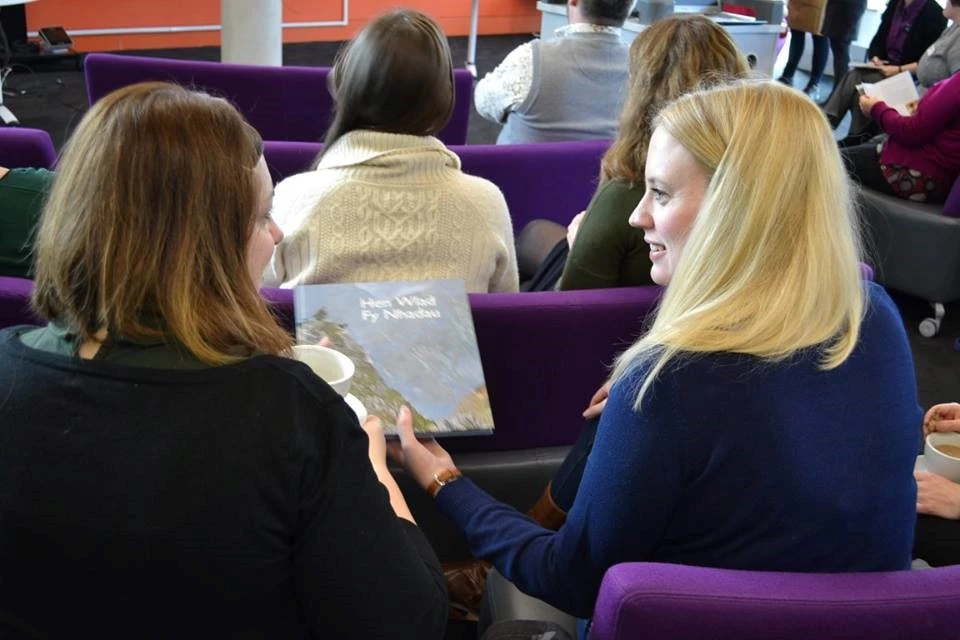
We were proud to host RNIB Cymru’s launch event introducing a series of Welsh-language Roald Dahl Talking Books. The RNIB’s Talking Books (neu Llyfrau Llafar yn Gymraeg) scheme offers a library of over 25,000 free audiobooks that helps create a lifeline to the outside world for people who are blind or partially sighted. The service’s 6,000 customers will now be able to listen to Dahl’s stories in Welsh for the first time.

At the launch, there were inspiring talks from RNIB staff, S4C announcer/Talking Books narrator Huw Charles and a long-time Talking Books subscriber who shared just how big a difference the service can make to people’s lives.

We were then treated to readings from The BFG and Jiraff, a'r Pelican a Fi by Melangell Dolma, a Welsh-language Talking Books narrator, who demonstrated how expressive and engaging Talking Books can be.

Following the event in the Main Hall, we ran brief audio description tours of our illustration exhibition, Quentin Blake: Inside Stories. The tours were designed to offer a taster of our audio description gallery tours, which are now on offer to the public. As the day was a celebration of Roald Dahl, we focused on Blake’s illustrations from two Roald Dahl stories.

First we explored artworks from The Twits, describing how Blake captures the mean and disgusting title characters using scratchy lines and drab watercolours.

To add a tactile element, we passed around several tools that Quentin Blake might use, including watercolour paint brushes, metallic dip pens and feather quills. The brave among the group were also given the opportunity to sample the scent of Mr Twit’s beard, a striking blend of sardines and Stilton cheese.

Finally we moved on to illustrations from Matilda, focusing in particular on Matilda’s tyrannical head teacher, Miss Trunchbull. The story is one of Roald Dahl’s most popular books and was a fitting end to the morning of Dahl-themed fun. The tour was then repeated for our Welsh-speaking visitors.

We were also lucky enough to welcome RNIB Connect Radio, who did a segment on the launch, including interviews with visitors and members of staff. The comments from CIB member and good friend (along with our number one canine visitor) Sian Healy showed how the tour made Quentin Blake’s work more accessible to people with visual impairments.

“Through the description that the guide gave us of what was in the picture,” she said. “I could piece it together and know what I was seeing. I got the feel of the whole energy of the painting. And that’s what Quentin Blake can give, that energy”.

Sian also said some very kind things about her role in helping us develop these tours, proving that, although we still have a lot to learn, we’re certainly on the right track.

“I’ve thoroughly enjoyed being involved, getting to know the staff here, getting to know more about the Museum …It’s been lovely to have this sort of response from the Museum who have really embraced the idea of making the Museum accessible with these tours.”

Our audio description tours run once every other month. For more information and future dates, please call (029) 2057 3240.

Worms, leaves, jellyfish, football and Britain's rarest plant!

Katie Mortimer-Jones, 22 November 2016

The @CardiffCurator Twitter account tweets the latest news, research and events from the Natural Sciences Department at Amgueddfa Cymru - National Museum Wales. This can be anything from shells, insects, plants and fossils to minerals and birds. From specimens in our collections, to an insight of the research that happens every day just beyond the museum gallery walls. So what are our followers most interested in?

Here's a look back at the TOP TWEET and TOP MEDIA TWEET of each month during 2016 from the the account: TOP TWEETS 2016


4,000 Years in the Life of a Bronze Age Dagger

Rhianydd Biebrach, 18 November 2016

Sometime at the beginning of the Bronze Age, about 2,250 to 2,000 BC, some people walked through the wetlands where Swansea Bay now lies. Perhaps they used one of the wooden trackways which had been laid across the wet ground, parts of which can still be seen when the tide is out.

They had with them a special object, a fine flint dagger, a piece of exquisite workmanship made by an expert craftsman. The dagger was part of a Europe-wide culture, and was perhaps an important part of their identity.

For some reason the precious object was dropped; perhaps by accident, but more likely left as a deliberate offering in shallow water in a place of special significance.

Rediscovery

The dagger remained submerged, first in the water, and then, as the environment changed, in peat beneath the sands of Swansea Bay, for four millennia. Then, in 1971, a student, Paul Tambling and his girlfriend, Angela, were walking across the bay and saw it sticking out of the sand.

They picked it up and took it home, and it became a treasured object once more, associated with happy memories and a unique symbol of their relationship.

Reporting

Early in 2016 Paul and Angela heard of a flint knapping demonstration being held at Cyfarthfa House Museum in Merthyr Tydfil and decided to take their dagger along to show an expert.

The flint knapper recognised the dagger’s significance and it was reported to Mark Lodwick, the Portable Antiquities Scheme finds co-ordinator at Amgueddfa Cymru.

The dagger was identified as a ‘Beaker Dagger’, more commonly found in south-eastern England, often accompanying high-status burials, with only four other examples known of in Wales.

The discovery was exciting, and Mark contacted Paul and Angela, who brought the dagger in for recording and told him their story.

Recreation

Ideally, an object of this importance would belong in a public collection in a museum, but it is understandable that Paul and Angela want to keep it, given its personal significance to them.

Happily, a solution has been found in the form of flint-knapper Karl Lee, who attended Swansea Museum’s Welsh Museums Festival event in October and made a replica for display in their galleries.

It will now become a part of Swansea Museum’s Lost Treasures of Swansea Bay project, which invites communities to respond to the deep history of the bay through the many archaeological items found there by members of the public.

Aberthaw’s Humpback Whale

Guest blog: Natalie Christie, SEWBReC Biodiversity Information Assistant, 17 November 2016

Here at the Mary Gillham Archive Project hub we’ve recently begun ‘timehopping’ on social media.

This involves using Mary’s detailed writings to find out what she was doing on today’s date, so many years ago, and then posting it on Twitter and Facebook (i.e. “on this date, in this year, Mary was doing this…”). It’s an interesting way to learn about Mary’s life history and see the many activities that she got up to in her day-to-day life.

A recent and particularly intriguing timehop posted on 16th October described how on that day in 1982, Mary witnessed the enormous humpback whale lying washed up on Gilestone beach at Aberthaw, near the Power Station.

This sparked the interest of many and after a twitter conversation with National Museum Cardiff it turns out that the bones of the whale are now on display at the museum, right here in Cardiff! This means that you can still visit this gigantic sea mammal today and see a part of Welsh history with your own eyes, just like Mary did.

Crowds on Aberthaw Beach

For those fortunate enough to be there in 1982 Aberthaw, the experience was an unforgettable one.

In her archive, Mary explains that it was almost “impossible to photograph the whale” due to the thousands of people congregating to get a glimpse.

The coastguard had tied the tail of the whale to a large iron post in the ground with ropes (to prevent the animal from washing back out to sea).

Mary describes how she got the chance to hold one of the whale’s gigantic flippers while Piers Langhalt, formerly of National Museum Cardiff, cut the large barnacles from the animal. These same barnacles can be found preserved at the museum, alongside the whale!

One volunteer on the Mary Gillham Archive Project, Julia Banks, recalls the “overpowering, rotting smell” of the beached whale that she witnessed as a young child. Julia visited the scene with her parents and remembers joining the masses of locals all gathering for the unusual sight, as well as seeing a group of people measuring the whale in order to figure out its age.

Julia also remembers visiting National Museum Cardiff when the skeleton was put up on display, and “feeling proud that [their] whale was in the museum”.

For more of the story and info on how the whale was managed by National Museum Cardiff, why not take a trip to the museum to see for yourself how it stands today?


The Mary Gillham Archive Project is a Heritage Lottery funded project at South East Wales Biodiversity Records Centre
For more info about the project visit our website: https://marygillhamarchiveproject.com/the-project/


Snow fall and snow depth 2016-11-17

Penny Dacey, 17 November 2016

Hello Bulb Buddies,

Thank you for the comments and observations you sent in with last weeks weather readings. I've included some of these below. Many of you have commented that the temperature has dropped and that you have had higher rain fall. Some of you have even had snow! For this reason I want to talk to you about how Meteorologists (weather scientists) measure snow. 

It is a lot trickier to measure the amount of snow that falls than it is to measure the amount of rain. This is because snow misbehaves! Snow is often blown by the wind into drifts, which causes some areas of deep snow and less snow in the areas around it. Because the snow fall is uneven the measurements from these places will be wrong! This is why we have to measure snow on flat surfaces, in the open and away from areas where drifts happen! Snow also likes to play games with Meteorologists who want to measure it, it melts into water and re-freezes into ice! This means that the snow measured on the ground isn’t always the same as the amount of snow that has fallen. Another problem is that new snow settles on old snow, so it is difficult to tell how much snow has fallen in one day from the snow that fell the day before! 

Meteorologists have to take all these tricks the snow plays, and work around them to discover how much snow has fallen. They look at snow fall (the amount of snow that falls in one day) and snow depth (how deep the total snow level is, old snow and new snow). One way that Meteorologists measure snow fall is to use a piece of ply wood. They place the wood in an open location away from areas where snow drifts occur, and measure the snow on the board at 6hr intervals, clearing the snow from the board each time they measure it. This means they are only measuring the snow from that day, which will tell them how much snow has fallen on that day in that area! 

Snow fall can also be measured in its melted state, as water. This means that you can use your rain gauge to measure the water equivalent of snow fall! If you only get a bit of snow then it should melt in your rain gauge anyway. But if you get a lot of snow, take your rain gauge inside to the warm and wait for the snow to melt into water. Then measure the water in the same way as you have done each week and report this as rain fall in your weather logs. 

If you have snow and enough time for an extra experiment – why not have a go at measuring snow depth? To do this all you need is a ruler (also known as a snow stick!). Place the snow stick into the snow until it touches the surface underneath, and read the depth of the snow.You need to take these measurements from flat surfaces (benches work well) in open areas and away from snow drifts! You need to take at least three separate measurements to work out the average snow depth in your area. You work out the average measurement by adding the different readings together and dividing them by the number of measurements. So, if I measured the snow depth of three surfaces at 7cm, 9cm and 6cm, I would add these together (7+9+6 =22) and divide that by three, because there are three readings (22÷3=7.33). So 7.33 would be my average reading for snow depth on that date. 

Weather stations such as the MET Office have come up with new ways of measuring snow depth, using new technologies. The picture on the right shows one of the MET Offices snow stations. These use laser sensors to measure how deep the snow is on the flat surface placed below it. This means that Meteorologists can collect readings from all over the country at the push of a button – which is far more reliable and a lot easier than sending people out into the cold with snow sticks! The map on the right shows how many snow stations the MET office has and where these are, is there one close to you? 

If you have snow and measure the snow fall with your rain gauge or the snow depth with a snow stick, then please tell me in the ‘comments’ section when you are logging your weekly records! I would be very interested to know what the snow depth is compared to the snow fall collected in your rain gauge! 

Keep up the good work Bulb Buddies, 

Professor Plant


Your comments:

Carnbroe Primary School: The weather in Carnbroe changed throughout the week. It started with beautiful crisp sunny days, snow on Wednesday and finally it rained and rained. Our plants were all well watered. Hooray!!

East Fulton Primary School: We had snow during Tues evening which is why rainfall reading is so high on Wed.

Auchenlodment Primary School: On Tuesday night it snowed so the rain gauge was filled with snow on Wednesday. We had to melt the snow so we could get a reading.

St. Charles Primary School: It was very icy this week and the water in the water gauge was frozen.

Ysgol Y Wern: Mae'r tywydd wedi oeri ond mae hi wedi bod yn heulog.

Arkholme CE Primary School: First really cold weather also got a bit of frost and one of the pots fell over. None of the bulbs have started to sprout yet though.

Stanford in the Vale Primary School: Frosty mornings, bright blue skies we have experienced this week.  Heavy rain on Wednesday.

Henllys CIW Primary: We had a lot of rain on Wednesday and it was cold on Monday

Beulah School: very rainy Tuesday night !!!!!!!!!!

Trellech Primary School: It rained on Wednesday but not any other day of the week. It was fun measuring the rainfall.

St. Nicholas Primary School: We had a lot of rain on Tuesday night.

Barmston Village Primary School: The weather has been rainy this week.

Ysgol Glanyfferi: A wet week in Wales! Getting colder. Looking forward to seeing green shoots.

Broad Haven Primary School: It was very windy to start this week but with some sun. We had more rain and it was cold in the mornings.

Ysgol Rhys Prichard: A lot of rain on Wednesday. Really cold on Tuesday.

Darran Park Primary: The rainfall hasn't been very consistent. On the other hand the temperature has been very consistent has only varied by 1 or 2 degrees.

St. Charles Primary School: It was very icy this week and the water in the water gauge was frozen.

Garstang St. Thomas' CE Primary School: We were on half term this week but Mrs Bosson kept a record of the rainfall and temperature for us.

Professor Plant: Thank you Mrs Bosson!

Breckon Hill Primary School: We have measured the temperature and the rainfall in the location of the pots (front of the school) and in the flower beds (at the back of the school). We have noticed that it is slightly warmer at the front of the school as this area gets a little bit more sun.