Archaeopteryx – the missing link between dinosaurs and birds?

Archaeopteryx is an iconic fossil, often thought of as the ‘missing link’ between dinosaurs and birds. It was first described in 1861 by the German palaeontologist Hermann von Meyer (1801–1869). Since then Archaeopteryx has been the focus of controversy surrounding the origin of birds and their links with dinosaurs.

Only eleven specimens and an isolated feather have so far been found, all coming from a few quarries near the Bavarian town of Solnhofen in southern Germany.

Almost all of the specimens are from the Solnhofen Limestone, fine muddy limestones deposited in tropical lagoons about 150 million years ago near the end of the Jurassic Period. One was found in the overlying Mörnsheim Formation and is younger by perhaps half a million years.

Fossil of an Archaeopteryx skeleton with feather impressions.

Archaeopteryx specimen (Museum für Naturkunde, Berlin, Germany)

Discovery

In 1861 Hermann von Meyer published a description of a single fossil feather found in the Solnhofen Limestone and named it Archaeopteryx lithographica.

Archaeopteryx means ‘ancient wing’. Von Meyer also mentioned that ‘an almost complete skeleton of an animal covered in feathers’ had been found. After competition from other museums this skeleton was eventually bought by the British Museum along with other Solnhofen fossils for £700, then a huge sum of money.

In 1863 Richard Owen, Superintendent of the natural history collections at the British Museum, described and illustrated the specimen, declaring it be a bird with ‘rare peculiarities indicative of a distinct order’. The discovery of this remarkable fossil came just two years after the publication of Charles Darwin's book On the Origin of Species, which changed people’s perception of the natural world.

Archaeopteryx seemed to fit well with Darwin’s theory as it showed features of both birds and reptiles.

What did Archaeopteryx look like?

Archaeopteryx was a primitive bird with feathers, but its fossilised skeleton looks more like that of a small dinosaur. It was about the size of a magpie.

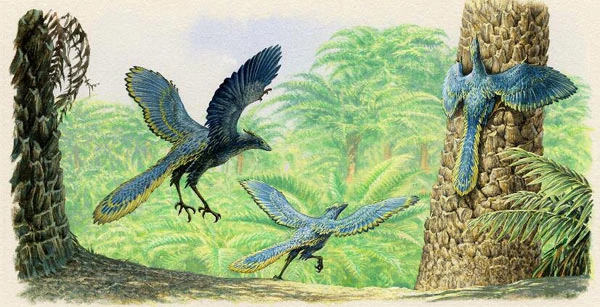
Unlike modern birds it had a full set of teeth, a long bony tail and three claws on its wing which may have been used for grasping branches. It lacked the fully reversed toes which enable many modern birds to perch. However, Archaeopteryx did have a wishbone, wings and asymmetrical ‘flight’ feathers, like a bird. It is likely that Archaeopteryx could fly, although perhaps not strongly.

Reconstruction of Archaeopteryx with blue and yellow feathers, perched on a branch.

Reconstruction of Archaeopteryx (© J. Sibbick)

The world of Archaeopteryx

Archaeopteryx lived on land near a series of stagnant and salty lagoons within a shallow tropical sea. Life in the lagoons was concentrated in the surface waters, as most of the lower levels were extremely toxic. It is possible that the only animals living in the lagoons were small floating crinoids (sea-lilies) and some fish.

Ammonites, shrimps, lobsters and starfish lived in the open sea nearby and were occasionally washed into the lagoons during storms. They did not survive for long in the lagoon waters. Horseshoe crabs have been found preserved at the end of a short trail of their own footprints. Very occasionally marine reptiles, such as ichthyosaurs and crocodiles, were also washed in.

Flying over the sea were pterosaurs and large insects such as dragonflies. These were blown into the lagoonal waters during these storms. A juvenile specimen of a small theropod dinosaur called Compsognathus has also been discovered in the same deposit, which must have been washed in from the land.

Illustration of three Archaeopteryx in a prehistoric forest: one flying close to the ground, another taking off from the ground and a third climbing a tree.

Reconstruction of Archaeopteryx (© J. Sibbick)

How did Archaeopteryx die and become preserved?

Although Archaeopteryx lived on land, occasionally some would have been caught up in storms as they flew or glided over the water. Waterlogged and unable to take off again, they would have drowned and sunk to the floor of the lagoon.

All of the known specimens display various characteristics of immaturity, indicating that none of the specimens was fully adult. This may have been the reason for their inability to survive storm events.

The carcasses were quickly buried by fine lime muds deposited on the lagoon floors. It is thought that one metre of rock today represents 5,000 years of deposition. The fossils of Solnhofen are exceptionally well preserved, due to the lack of disturbance from both predators and water movement. Within the fine-grained limestones, delicate features such as dragonfly wings or the feathers of Archaeopteryx can be found.

Further reading

Wellnhofer, P. 2009. Archaeopteryx the icon of evolution. Pfeil Verlag, Munich, 208 pp

Article by: Cindy Howells, Collections Manager (Palaeontology) and Caroline Buttler, Head of Palaeontology
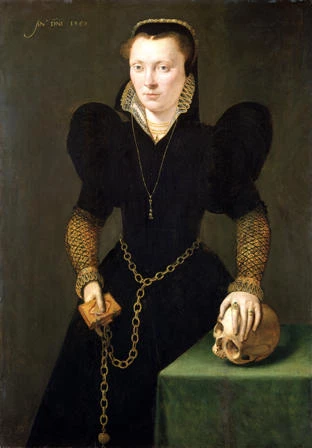
Katheryn of Berain

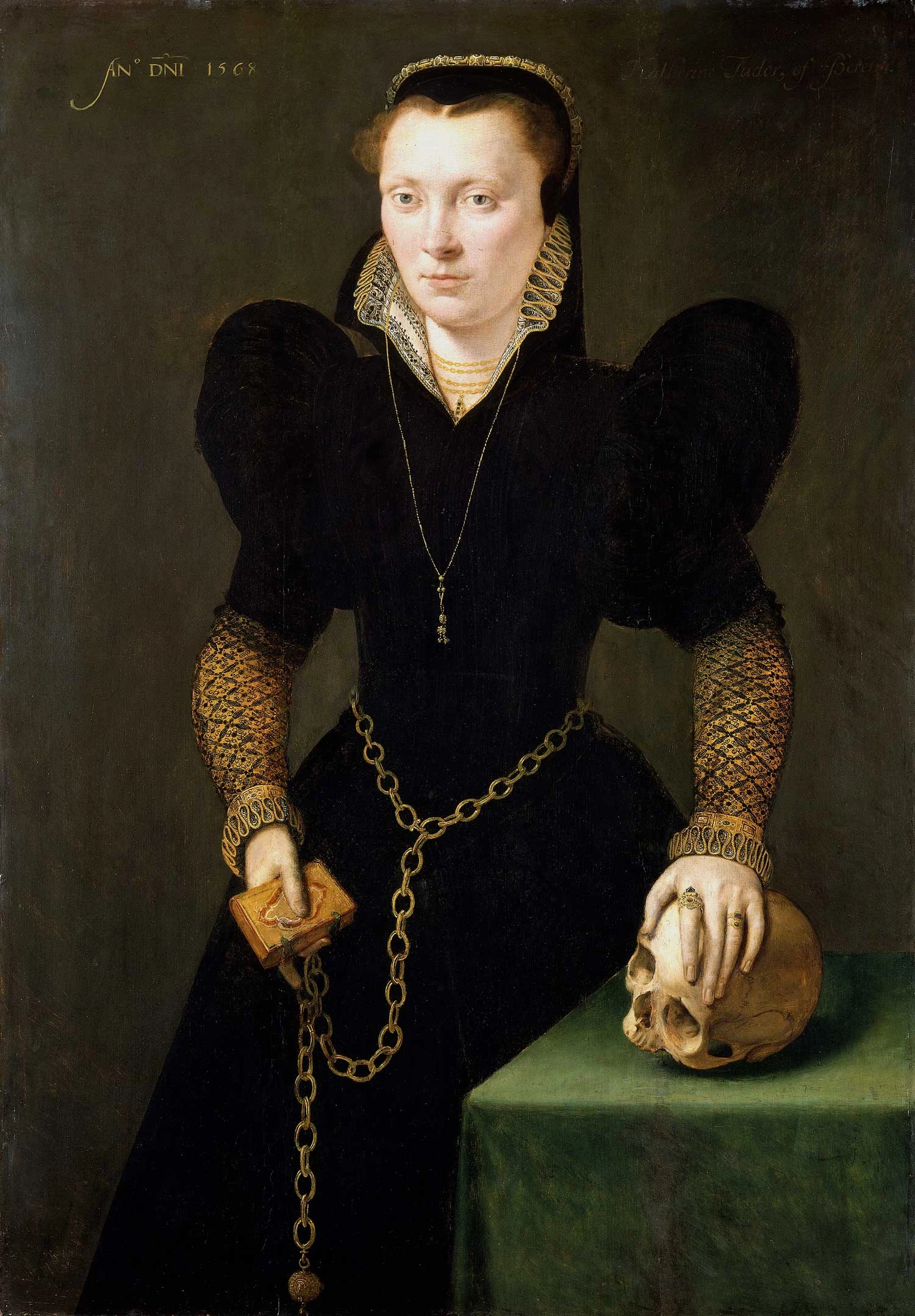
Katheryn of Berain, 'The Mother of Wales' (1534/5-1591)

The life of Katheryn of Berain is laden with intrigue. This wealthy heiress from Denbighshire had Tudor blood in her veins, and was a distant relative to Queen Elizabeth I.

The story of her and her many husbands has become one of the chief romances of north Wales. She had six children and over thirty grandchildren who all went on to form some of the country's richest families, earning her the title 'the Mother of Wales'.

In Katheryn's age people married for money, land and power, not love. As a wealthy heiress of royal descent, Katheryn was considered a bit of a catch! She married four times to high-profile Welshmen, and became related to the richest, most important families of north Wales.

Wealthy sitters would often have their portraits painted to flaunt their richness and social status. But in this religious time it was just as important to appear humble in front of God.

The portrait is attributed to the Dutch artist Adriaen van Cronenburgh, who often painted portraits of the Friesian nobility. His work demonstrates the sophisticated Netherlandish oil painting technique of the time.

When Katheryn's second husband died abroad, she returned to Denbighshire with this portrait, where it remained for almost four hundred years. Just before the Second World War it was sold and taken to the Netherlands. From there it was sold to a collector who brought the work back to Britain. Finally, it was purchased by the Friends of National Museum Wales who presented it to the Museum in 1957.

Kathryn of Berain can be seen in the

Historic Art galleries at National Museum Cardiff

Big Draw

Hello!

Every year we take part in the Big Draw Here are the pictures from this year which took place on the 1st and the 8th October. We made a paper version of St Fagans: National History Museum inspired by Made by Joel, and used some of his images too.

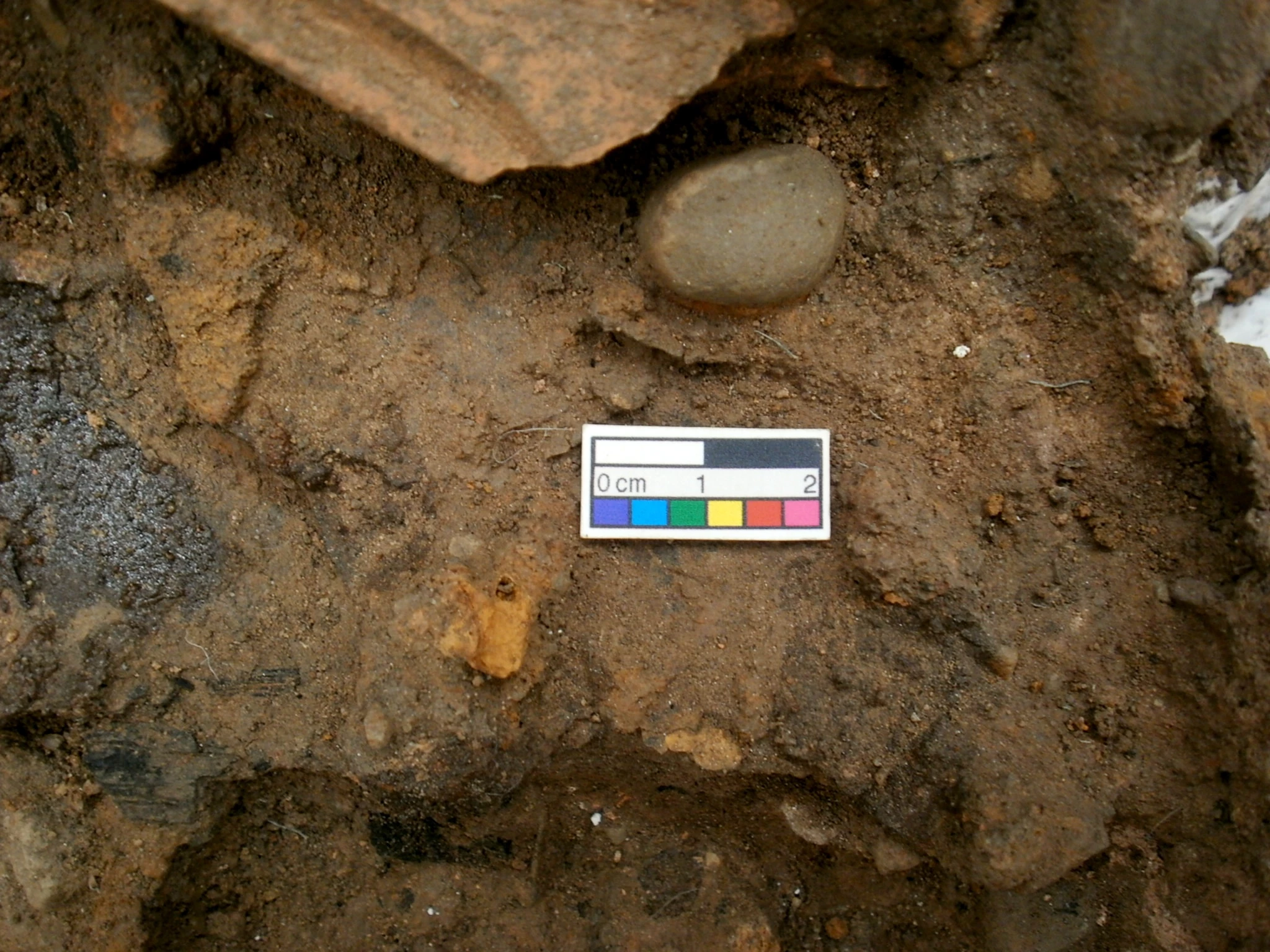
Excavating a Girth Hoop

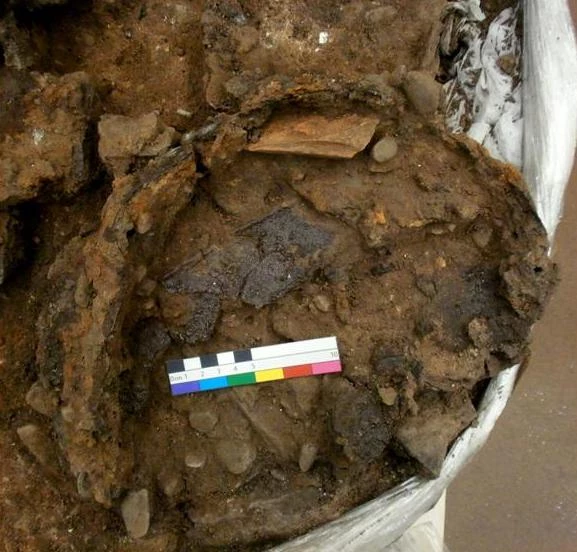
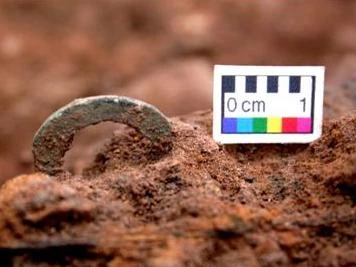
To the right is an image of the lorica segmentata girth hoop, complete with a copper alloy tie ring, after excavation in the conservation laboratory. The general shape of the hoop, which is lying on its side, can be discerned, and it is obvious that the plate is broken in several places. I had hoped to be able to see how the solid tie ring interacted with the girth hoop, but unfortunately too little of the iron plate remains in a stable enough state to remove enough of the obscuring soil currently supporting it. An x-ray of this area of the block will show the complete shape of the tie ring, and hopefully how it is attached to the plate.


To reiterate, I am excavating the artefacts in this soil block in the same way that archaeologists do in the field, and am coming across the same extraneous stones, silty-soil and common artefacts such as ceramic building material and animal bone contained within the burial deposit that are found on the average archaeological site. As the stones, tile, etc, do underlie so much of the fragile iron plate, I will not remove them at this stage, though I am aware they could be covering more artefacts.


Within the hoop further broken plates can be seen, most notably a flat plate with a rolled edge: this is one of the few plates that can at this early stage be attributed to a specific area of the cuirass; the only plates with rolled edges were the lowest girth hoop above the hip, and the breast and back plates. Given the flat nature of this plate, it is most likely the lowest girth hoop.


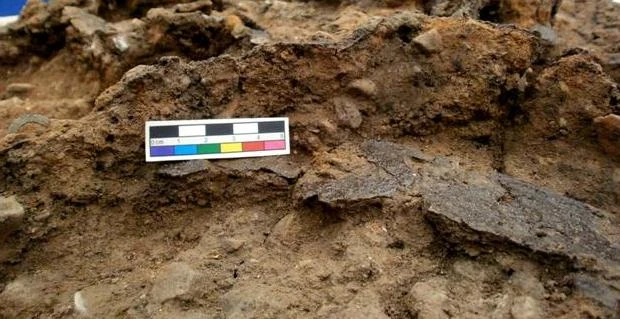
To give readers an idea of the depth of the archaeological remains in the soil block, I have included photographs of the back of the girth hoop, as well as a photograph showing the interior. Of interest in the third photograph is part of a plate held to the back of the girth hoop by corrosion and burial products, and how thin the lorica plate with a rolled edge is in the fourth.


Not all artefacts excavated in this area of the soil block can be as easily identified as the plate with the rolled edge; some of the iron has suffered greatly, and only vague shapes in the soil can be distinguished. Removing soil from the surfaces of these mineralized objects has been challenging, as I have to be careful not to take away any burial deposit that might contain corrosion that may be part or all that is left of the archaeological object.


I have not recovered as many fittings, such as buckles, rivets, washers and studs as those found on cuirasses from other Roman sites, and it will be these attachments, and their position on the body armour, that will be very important when trying to work out which plates were breastplates, backplates, shoulderguards, etc. As expected, I have not found many of the valuable copper alloy fittings which could have been removed for re-use during and after the occupation of the fortress by military forces, although I have found possible iron components, harder to spot given the corroded nature of the metal. For example, in the last photograph, the red arrows are pointing towards vague rectangular shapes slightly proud of what is an extremely fragmentary lorica plate; these might be the remains of fittings. Again, only high quality x-radiography will provide us with an image which might allow curators to make an identification of what these deteriorated artefacts are.


The hoop and other items will remain in place until the rest of the block has been excavated, when deconstruction will take place.

British Seaweeds

Seaweeds (marine algae) show a wide array of forms, colours and textures, and there are many different species of seaweed occupying different niches on the seashore. Some are able to grow high on the shore where it is dry for long periods of the day; others have developed defences against damaging wave action. These features and many more have been used by taxonomists to identify and classify them.

Within its botanical collections, Amgueddfa Cymru houses a herbarium of dried, pressed algal specimens. This herbarium provides an essential resource for studying seaweeds.

Browse through the images below to view a selection of seaweeds that can all be found on Wales' diverse rocky shores.