Crafted memories, Rachel Evans

1 April 2026

As an artist, my work explores the traces of social history held within domestic artefacts and local landscapes. I’m drawn to details that reflect nurture and resourcefulness, especially those shaped by women’s everyday experiences, which are often missing from official histories. This project was a great opportunity to engage with participants, hear their stories, and explore how everyday objects carry memories and histories.

Our sessions in Morfa ward, Ysbyty Alltwen 'day room' began with conversations about domestic life in the past, sparked by handling artefacts from the museum, such as crockery, utensils, and textiles.

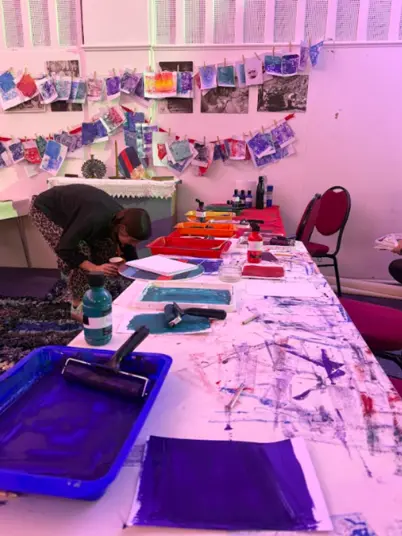
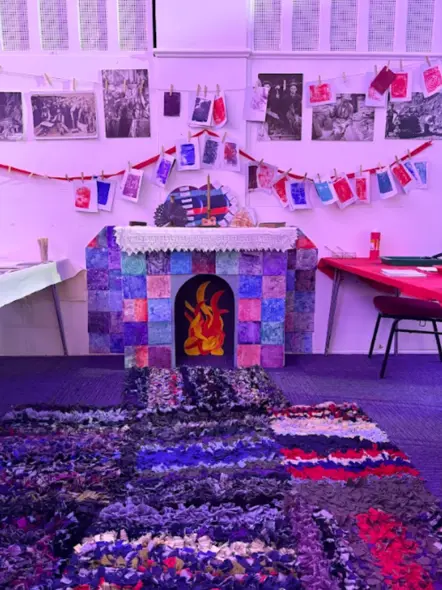
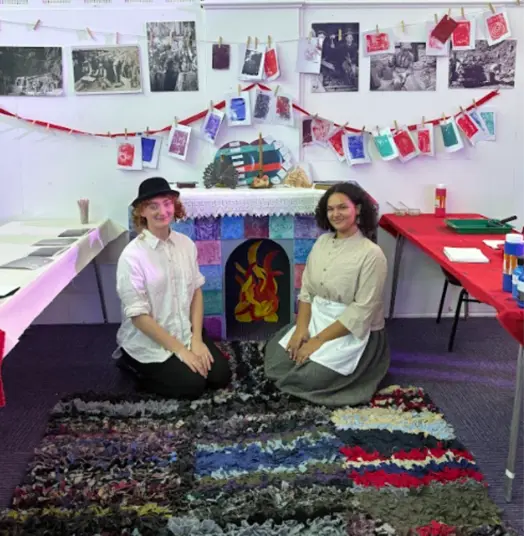
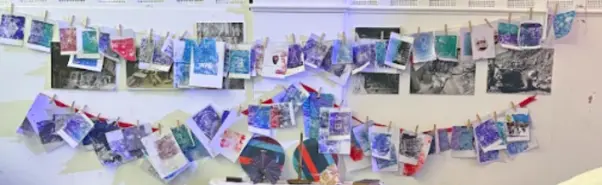
Banner of photographs taken during creative workshops in Alltwen Hospital.

We created our own pieces inspired by domestic life using air-dry clay, incorporating textures that reflect both industrial and household labour. Letter stamps allowed us to imprint memories from our discussions into the clay, adding a personal layer to collective stories. Colour was added with ink and graphite, or tea and coffee, buffed between layers to give an aged effect—a process that echoed domestic chores.

Rag rugs, part of the Slate Museum’s collection and a symbol of domestic resourcefulness, inspired us to create our own collaborative sample. Traditionally made by prodding strips of rag through sacking cloth, we adapted the method for simplicity: looping rags around pipe cleaners, then linking and stitching them into a smaller rug shape.

Creative works made during workshops in Alltwen Hospital.

The embroidery hoop pieces are inspired by a quarryman’s blanket from c.1900, made from patched pieces of grey cloth trimmed with red, to protect its owner from the harsh conditions of the barracks. Our stitched pieces combine the resourcefulness of stitching and mending with symbols from the carved hearths seen in some slate quarrying communities.

The postcard-sized pieces continue the theme, featuring symbols from the hearths, with text drawn from conversations and memories.

This project has been a wonderful way to share personal stories and creativity, bringing people together through collective making —thanks to everyone involved!

"It was nice to come together as a group and learn new skills" - a patient on Morfa ward, Alltwen hospital


Contact details: rachelevanscelf@gmail.com   
Instagram: rachelevans_artist


This activity was a part of the National Slate Museum redevelopment project, which is funded by The National Lottery Heritage Fund, UK Government via Gwynedd Council as part of the Llewyrch o’r Llechi project, Welsh Government including the Community Facilities Programme, the Wolfson Foundation, The Garfield Weston Foundation and other funders. 

Spring at St Fagans

Ellen Davies, 18 March 2026

Spring is a special time at St Fagans. There are daffodils and crocuses in bloom, and the farmyard is a hive of activity.  

From February to April, Llwyn-yr-eos Farm is alive with the sound of bleating as the expectant ewes take shelter in the lambing sheds. This year, we’re expecting over 350 lambs. Around 200 lambs have been born so far and there’s still plenty more to come!  

We keep three rare Welsh breeds of sheep at St Fagans:

  • Hill Radnor  
  • Llanwenog  
  • Welsh Black Mountain  

Keeping native breeds of sheep is important as they are a vital part of Wales’ farming heritage. You can learn more about these rare breeds in this blog

Once the lambs are born, both the lamb and their mother are marked with the same number, so we know who belongs to who! The ewes and lambs are moved from the main lambing shed into smaller nursery pens, before being turned out into the fields a few days later. Can you spot any of the new arrivals as you walk around the museum?  

Please note, to protect the welfare of our sheep, no dogs are allowed in the farmyard during lambing.  

Can’t make it to St Fagans? We’re not streaming live from the shed this year, but you can watch the action from previous years’ on our website.  

Weather Data for February

Megan Naish, 11 March 2026

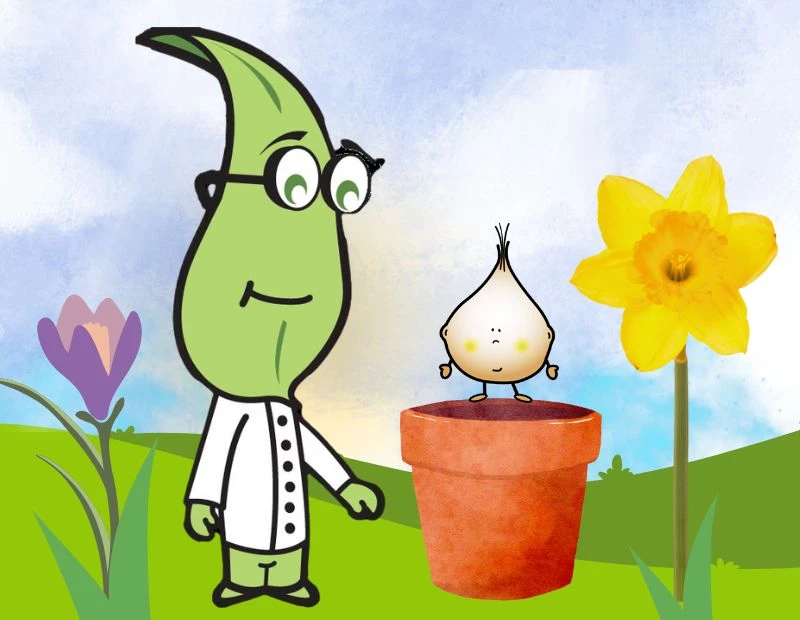
Hi Bulb Buddies!

I hope you have had a lovely February and have enjoyed continuing your hard work collecting your weather data! Some schools have even begun logging their flowering data, which is great to see. 

February was quite a wet month for many areas across the UK with some areas seeing more than the full month's average rainfall within the first 14 days of the month, as reported by the Met Office. There were however regional differences, with Scotland and particularly western Scotland reporting below average rainfall. Temperatures were also variable, with it being colder at the beginning of the month and milder towards the end.

Some areas may have experienced a few days here and there of sunshine, which is reflected in some of your comments, and some images I have taken around St Fagans during the month! I wonder if we will see more sunshine now as we enter into March.

Let’s take a look at your observations for last month, as well as some of your flowering updates!

Weather Observations: 

Henllys Church in Wales School

It has been very rainy this week

Lammack Primary School 

Extremely windy and very cold

Henllys Church in Wales School 

It has not been as cold as it has been

Irvinestown Primary School 

We really loved all the sunny weather we had this week

Professor Plant:

Thank you all for continuing to add these details in your comments. We can definitely see the trend of the weather getting milder as we read through the comment timeline, which means our data matches with other weather reports! 

I agree with Irvinestown Primary School about enjoying the bits of sunshine we have still managed to have!

For all schools who were unable to take weather readings due to half term, don’t worry! – but thank you for commenting this under your ‘No Record’ uploads.

Flowering Updates:

Llanmartin Primary School

Our daffodils in pots are blooming (up against the wall) and those planted in the bed and alongside the pathway in the ground are only just beginning to bloom.

Pinehurst Primary School

Our lovely daffodils opened today. They look so pretty and really brighten up our school.

We have a lovely Crocus. We love the purple colour on it.

Lammack Primary School

One of the mystery bulbs flowered on Wednesday. It is a snowdrop.

Another mystery bulb is almost flowering. It looks to be deep purple.

Leslie Primary School 

We are so Excited. Out first Crocus has flowered

We were all so excited to see the purple.

St Chrysostom's C of E Primary School

Many plants daffodils have flowered in the pots Only two have not flowered yet. Daffodils in the ground planter box have also flowered.

Mountain Lane School

A lovely week in Buckley. It was warm and sunny. We all went to check on the flowers on Friday afternoon. None of the daffodils have flowered yet but several looked ready to pop

 St Francis' Primary - Aghaderg 

The pots in the sunnier location of the school grew taller and have opened first

St Mary's CE Primary - Manchester

One daffodil has bloomed; the rest are slowly growing still.

Professor Plant:

It is great to hear that you have started to see your Daffodils, Crocus and Mystery Bulbs bloom! It is so exciting to see your hard work pay off as you watch your plants grow from small bulbs into vibrant flowers. 

It is lovely to know that you feel that they are brightening up your school area, Pinehurst Primary School.

Keep up the amazing work watching over your flowers, Bulb Buddies.

-

This month (March) is now our last month of collecting data for this year, so make sure you are uploading everything you have collected to our website by the 27th.  Thank you to everyone who has engaged in the project so far.

Professor Plant

Touring with Cranogwen

Norena Shopland, 6 March 2026

When trying to visualise people’s lives, particularly those from the past, it’s often the small things that bring lives to life such as a ticket to a lecture or a brooch - and two items in Amgueddfa Cymru’s collection certainly do that. 

They both relate to Cranogwen, the bardic name for Sarah Jane Rees (1839–1916) a master mariner, poet, writer, editor and temperance worker who, for most of her life lived in the small town of Llangrannog, Cardiganshire. She was born there and throughout her life travelled from there to become one of the most well-known women in Wales in the late nineteenth/early twentieth century. And it was here that her two partners lived, first Fanny Rees “Phania” (1853-1874) who died aged just 21 and later Jane Thomas (1850-?) who, in most of the census returns is described as a ‘domestic worker’, ‘general servant’ or ‘charwoman’. 

Cranogwen was often away, involved in myriad projects and giving lecturers but her first tour started in 1866, a year after controversially winning an Eisteddfod poetry prize when it was revealed a woman had beaten the men. Consequently, when she started touring her name was already known as a Y Gwladgarwr journalist noted: 

The reader will remember that it was the young girl lion who took the prize at the Aberystwyth Eisteddfod for the song for the Wedding Ring. After hearing that, and also understanding that our leading poets, such as Islwyn and Ceiriog were competing, I was a bit surprised that there was some ‘dirt in the cheese’ somewhere. [i]

Cranogwen’s tour centred on her lecture ‘The Youth and the Culture of their Minds’ although this did expand later to include two other lecturers, ‘Anhebgorion Cymeriad da’ (Essentials of a Good Character) and ‘Elements of Happiness’, all concerned with improvements in people’s characters. As she spoke in Welsh, they were predominantly covered by the Welsh language press with the English language media paying very little attention. 

Cranogwen started off in the Aberystwyth area so hopefully Jane did travel with her to provide some support but as the talks grew in popularity Cranogwen travelled further afield and just two months later at Swansea’s Brynhyfryd Chapel nearly one thousand people turned out to see her - a daunting prospect for anyone so hopefully Jane was there as well to give support. 

Word was spreading quickly and, as a journalist at Baner ac Amserau Cymru noted, ‘There is no need in the world to go to the trouble of giving a description of the lecture today, because it is already quite well known throughout Wales.[ii] 

Everywhere she went praise was showered upon her, causing one journalist to wonder if she could live up to the hype: ‘since we had heard such praise for her, we expected her to be good. But we never imagined that she was as talented as she is, and so masterful at her work.’ [iii] Night after night she spoke to rave reviews and her one-hour lecture expanded into two and even longer when local dignitaries sought to appear on stage alongside her, adding their pennyworth. Local poets flocked to her, often writing englyns, many of which were published in the papers, and women were following her example and taking to the stage.

This caused concern. 

Women, particularly ‘young girls’ (she was 27 at the time) should not be lecturing, said the men, who complained of the impropriety of women speaking in public. ‘The inhabitants of South Wales,’ ranted the Cardiff Times, ‘are running wild with the young ladies who are lecturing about the country [and] in the opinion of many eminent men this is going too far.

At the Association of the Calvinistic Methodists held at Carnarvon the Rev. Henry Rees, and eminent minister, whose name is known through the Principality, spoke against female preachers, and stated that it would be far more becoming in those who are fond of preaching to attend to those duties which belong to their sex. We are glad that a gentleman of Mr Rees’s standing has set his face against this new mania.[iv]

‘Are these women not at home?’ Seren Cymru joined in, ‘are we ready to see our parishes being dotted, if not flooded, and women lecturing.[v]

Most journalists ignored them and continued their rave reviews of Cranogwen. 

The talks usually began at 7pm and tickets cost 6d (about £2 today) and audiences were huge with many writers noting how listeners would sit quietly entranced for two hours often nodding in agreement and rewarding Cranogwen with thunderous applause. In almost all her talks it was noted that the profits went to pay off chapel debts. 

Throughout 1867 Cranogwen continued to tour and the Amgueddfa Cymru ticket is dated to 2 January but no newspaper report has been found for Brynmenyn, Bridgend – but then there were so many talks not all were covered and the tour was a year old by this time.

In 1869–1870 Cranogwen toured the United States giving the same sort of lectures – and we would need to examine the immigration records to see if Jane went with her. 

When she returned, Cranogwen continued her good works, and in the early twentieth century she, like many eminent women, become involved in the temperance movement. Drunkenness, particularly among women was endemic as they tried to escape harsh lives and a number of unions were set up to try and tackle this including the Rhondda Women’s Union, set up in April 1901. It was so successful that a decision was made to expand it, and Cranogwen was instrumental in changing it to Undeb Dirwestol Merched y De (U.D.M.D.) (South Wales Women’s Temperance Union) where she was the Organisational Secretary, with her address still listed at Llangrannog. Once again, Cranogwen was touring extensively with the Union.

As they arrived at each town, Union members would process through the streets carrying banners before settling at a chapel where prayers and hymns, and readings from the Bible, were read out followed by speeches by leading members of the Union. In addition, guest speakers featured well-known Welsh women who would draw in audiences, followed by tea and cake and socialising, and the three-hour events were attended by hundreds of people. There would be collections, and sales of pamphlets and badges. The example in the Amgueddfa Cymru collection is technically a brooch and it is not clear if the badges Cranogwen received money for, were these brooches.

By December 1901, new U.D.M.D. branches were growing throughout south Wales and by the time of Cranogwen’s death in 1916 there were 140 branches throughout South Wales. 

Cranogwen was indefatigable, and one can only wonder at her energy. As well as all her good works one of her strengths was the encouragement of so many young women to become writers and orators, even if the men disapproved. 

Cranogwen died in 1916 at Wood Street Cilfynydd, Rhondda Cynon Taf, her niece’s house. ‘No other Welsh woman enjoyed popularity in so many public spheres’[vii] noted the Cambrian Daily Leader. Unfortunately, it is not yet known when Jane died, hopefully the forthcoming biography by Jane Aaron will tell us more, but just five years earlier they were still living together in Llangrannog and the town was to remain Cranogwen’s permanent address for most of her life. No matter how much she travelled, it seems she always went home to Jane.

Memorial to Sarah Jane Rees, Llangrannog (WikiCommons)

[i] Y Gwladgarwr, 5th May 1866

[ii] Baner ac Amserau Cymru, 14 April 1866

[iii] Baner ac Amserau Cymru, 14 April 1866

[iv] Cardiff Times, 5 October 1866

[v] Seren Cymru, 4 January 1867

[vii] Cambrian Daily Leader, 28 June 1916

Celebrating Women Who Lead: Helen Goddard, Project Director, National Slate Museum Redevelopment

6 March 2026

For International Women's Day, we are shining a light on one of the incredible women that’s shaping the future of the National Slate Museum. 

Let us introduce you to Helen Goddard, Project Director for our redevelopment project. 

Leading with Purpose 

As Project Director, Helen oversees every aspect of the ambitious redevelopment of the National Slate Museum. Her role is all about ensuring the project delivers on its full potential creatively, culturally, and for communities across Wales and beyond. 

“I’m responsible for the project as a whole,” Helen explains, “and for making sure it delivers on its ambition.”  

A Journey Through Heritage 

Before joining the museum, Helen worked as an archaeologist and community archaeologist before moving into community development work. She spent many years working in the breathtaking northern and western Isles of Scotland, supporting island communities with heritage and community infrastructure projects. 

Helen moved to Wales in 2011, driven by a personal ambition to learn Welsh. She later qualified as a museum professional while working for Conwy County Borough Council. 

Women Leading the Way 

Helen is passionate about women taking up space in sectors where they’ve historically been underrepresented. While the heritage world has strong female representation, construction remains more male dominated. But at the National Slate Museum, the picture is different. 

“One of the wonderful things about our project is that there are numerous women in leadership roles,” she says. “Our Head of Site, Elen; Exhibition Development Manager, Ulli; our Curator, Cadi; and our Heads of Capital Projects, Julie and Diane. All outstanding women.” 

Her advice for other women entering similar fields? 

“Lead authentically. You don’t need to behave in traditionally male ways to lead. It’s okay to show emotion, to be collaborative, and to trust your team.” 

Life Beyond the Museum 

When she’s not leading a major redevelopment, Helen’s full of surprises, including one unforgettable chapter of her life: 

“I once worked on a fishing boat in the Outer Hebrides!” 

Inspired by a Strong Woman 

Helen credits her mother as one of her greatest inspirations. 
“My mum came from a family of 10 children living in rural poverty and went on to carve out her own destiny, never compromising on her dream to help people. She became a Nurse Practitioner towards the end of her career.” 

Thanks for sharing, Helen, you are a true leader and inspiration!