Swaps: David Hurn on Photography 29 September 2017 Swaps: Photographs from the David Hurn Collection runs from 30 September 2017 to 15 April 2018. This exhibition celebrates the major gift of photographs from David Hurn’s private collection and marks the opening of Amgueddfa Cymru’s first gallery dedicated to photography. Here are some short films from the exhibition: The Collection "The collection really didn’t start until 1958 I suppose. I started taking pictures in 1955, and in 1958 I was shooting pictures in Trafalgar Square, and there was another photographer who came up to me and said a very bizarre thing. He said “I think you might be a pretty good photographer”. Anyway, it turned out to be Sergio Larrain. I was looking at Sergio’s pictures and he gave me a couple of his pictures. And I realised how much I treasured not only the beautiful pictures, but there is something (which is in my opinion indescribable) about the connection between having the print that a photographer himself had okayed. So I started to collect and then I started the idea of actually swapping a print. And so that’s what I started to do, and I had the confidence that I could go to photographers like Dorothea Lang and people like that. I then had the arrogance to meet her and say how much I liked her pictures, and I would love to swap a print. And I suddenly discovered that people like doing it. I think the collection is a very personal collection. I think of the photographers that are in there; it would not be possible to have a better collection." Dorothea Lange White Angel Breadline, San Francisco, 1933. "Dorothea Lange was one of the great photographers in the history of photography, who was very important particularly because of the pre-war pictures in the dustbowl. I knew of Dorothea Lange and I happened to be in Chicago, and I knew that at that time she was living in Chicago, and so I literally went… I was now known a little bit as a photographer, and I just went to see her basically. I hadn’t thought about getting a print, it was before I swapped prints even. I saw her and she was showing me some prints, and I basically said “I love this picture” and she gave me the picture. She did a wonderful book, it was done with her husband and it’s one of the most complete books which is the pointing out of a social problem. It’s a very beautiful book. It really shows you how a book can be laid out, and how the correct captioning and the correct text and the correct pictures can put together a very powerful argument for something, you know. It’s a very important book I think." Henri Cartier-Bresson French painter Henri Matisse at his home, villa 'Le Rêve'. Vence, France, 1944. "Bresson was married to a wonderful photographer called Martine Franck. Martine had photographed on Toraigh Island which is a little island off the Irish coast, and photographed somebody called James Dixon who was a naïve painter there, and I had about three paintings by James Dixon because I’d also been to Toraigh island and photographed. I said ‘Ok, why don’t we swap the painting for a picture by Bresson and a picture by you?’ So I got two pictures for the painting. So, the pictures arrived and I’ve got the two pictures – a wonderful, wonderful picture by Martine Franck. And then this appealed because it’s perhaps one of my favourite painters photographed by one of my favourite photographers. Later, after Henri had died I got an envelope through the post, and it’s from Martine, and it’s another one of the same picture, but it’s got a bend in the corner. I do actually have the note which is even more charming, and the note says ‘discovered this picture. It had obviously been damaged and Henri had realised that it was damaged, therefore had another print made’ because he didn’t make his own prints ever, they were always made by the same people, ‘and so I thought you might like this as well.’ It’s a beautiful portrait. It’s everything to me a portrait should do, you know." Banner photograph by John Davies. More info David Hurn at Magnum Henri Cartier-Bresson at Magnum Sergio Larrain at Magnum Martine Franck at Magnum Dorothea Lange at the History Place
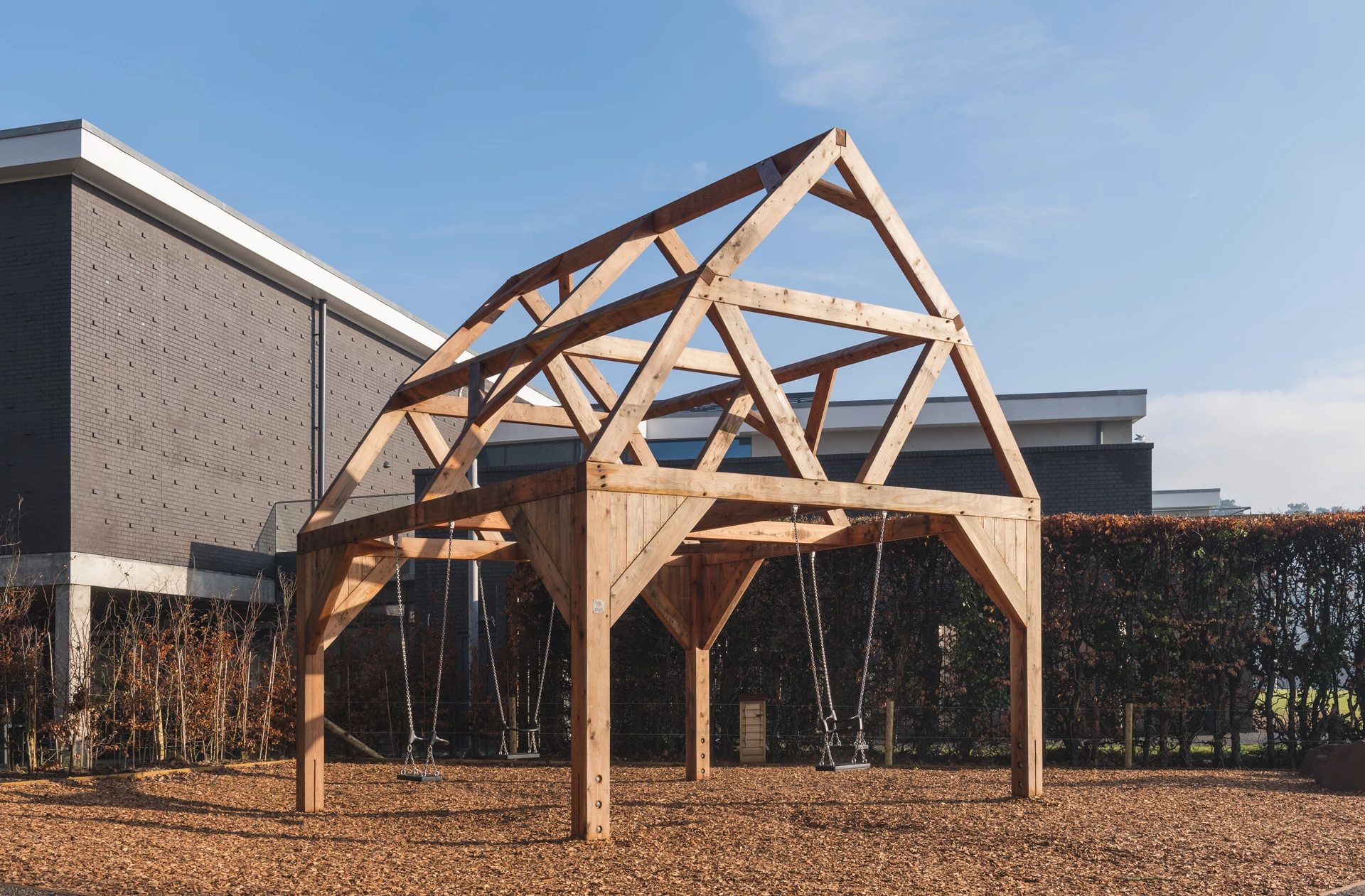
The Artists in Residence programme at St Fagans Sian Lile-Pastore, 20 July 2017 History, Art and Play St Fagans National Museum of History is renowned for its historic installations - from a medieval church to a tailor's shop, bakehouse and terraced houses . The museum has long been an inspiration to artists, who have used and responded to the museum site, its collections and archives over the years. Recently, we have created more opportunities for artists to use the museum in innovative ways, through an Artists in Residence programme. Thanks to the generous support of the Heritage Lottery Fund in Wales and the Arts Council of Wales, the Artist in Residency programme provides opportunities for artists to develop their work, as well as developing new experiences for visitors - such as the children's play area, by the artist Nils Norman. Detail from Yr Iard, an artist-led play area at St Fagans For 2017 and 2018 we are really excited to be working with Owen Griffiths, Sean Edwards with research support from Louise Hobson. Their brief is to investigate how visitors navigate the museum site. Artists in Residence at St Fagans Nils Norman, 2015-16 As part of the redevelopment of St Fagans National Museum of History , there was a need for new play area. We wanted the play area to be unique and bespoke to the site and to encourage creative play. We invited the artist Nils Norman to spend time at the museum as a resident artist and to create a design for the new play area as well as some ideas for creative play around the site. Nils is a London based artist who has worked on numerous projects dealing with play and urban design, he is the author of four publications and is also a Professor at the Royal Danish Academy of Art and Design, Copenhagen, Denmark where he leads the School of Walls and Space. See more of Nils' work. Birdscreens - Nils Norman Imogen Higgins “Being on a residency at St Fagans has enabled me the freedom to explore the potential of community arts independently. This freedom has allowed me to expand on ideas that play to my strengths and interests. Additionally, it has given me the chance to work in a more focused way and to a specific brief. I have also had to experiment with creative ways of gathering information, which I am sure will be a great advantage in my career as a community artist.” Imogen Higgins is a recent ceramics graduate based in Cardiff was is interested in community arts and engagement and her task was to work with local groups to feed into the design of the playground. Imogen began her workshops by looking at patterns in the collections and on site, investigating patchwork quilts, medieval tiles and the paving patterns in the Italian garden and also researched play grounds and creative play around Cardiff. She worked with two local groups as part of the project – students from Woodlands High School and parents and children from Ysgol Gynradd Hywel Dda. You can read more on Imogen's project blog. Workshop - Imogen Higgins Fern Thomas “Over recent years my practice has increasingly explored historical narratives, documents and archives. I am drawn to exploring lost objects, hidden narratives or knowledge, and imagining the layers of history one place can offer. I was therefore very excited about the potential of this residency, with the specific opportunity to explore the archives of St Fagans.” Fern Thomas is a Swansea-based artist whose work is rooted in research and she is also interested in folklore and folk magic. Her remit was to undertake research for the play area and information about her research and work can be foundFern's website. “The residency itself has been key in helping me shape new territory within my practice, helping me clarify my interest in archives and Welsh history, which I intend to take further into future works and research.” Fern Thomas Melissa Appleton “I set out to sample the site and to create a palette of fragments - a space of collisions – between the domestic, the spiritual, the everyday, the otherworldly. Gathering structures, plants, windows, patterns, objects, rocks, tools and doorways, I planned to rework these into a shifted, yet familiar, landscape. In essence, I set out to evolve a parallel St Fagans, with one foot in this world and one in another.” (interview with CCQ, 2015) Melissa Appleton's work usually manifests outside of the gallery walls and combines constructed environments, live events, sound and other materials into an expanded form of sculpture. During her residency in 2015 Melissa worked with the site close-up and at a distance, collaborating with Mighty Sky (Swansea) to film the site using a drone and Cardiff Met to map parts of the site using a 3D scanner. As a result of this and interviews with museum staff, Melissa gathered a palette of elements that included a man on beach conjuring mackerel through song; a triskelion (an ancient symbol depicting three hares with ears intertwined); a triple harp; window frames made from recycled aircrafts; a figure of death scratched into a headpost and the ghost of a naked coracle man furiously paddling across a river. Melissa plotted an apocryphal masterplan for the museum, drawing on St Fagans' evolution which has been shaped by desires and dreams of different curators and staff over the last fifty years. As the residency progressed Melissa became interested in the ‘listening studio and laboratory’ (the recording studio and sound/video archive) which inhabited the edge of the museum redevelopment (underway at the time), seemingly unchanged since the 1960’s – caught between the awaited future expansion and the present day. Melissa is now working with Bedwyr Williams (also artist-in-residence in 2015) on a speculative project to tour the sound and video archive across Wales in a vehicle which reimagines the curator's original caravan. Melissa Appleton James Parkinson “I set out to look into the architectural histories of the Museum and the process of recording, relocating, and rebuilding. I wanted to explore areas across the site where fragments of original and replicated elements had been fused to produce a believable whole. I was interested in how this process is central to the museum’s creation and continual development but also challenges the notion of the historic monument being fixed and immobile.” James Parkinson is a Bristol based artist whose work uses processes of material translation to re-code notions of space, object, and body. During the residency James spent the majority of his time with Museum conservators and staff from the Historic Buildings Unit. Since completing the residency, James has continued to work and develop ideas informed by his time at St Fagans. “During the residency I was able to develop a series of texts by transcribing interviews I conducted with conservators who describe techniques used to excavate a series of wall paintings. I am interested in recirculating the conditions of artefact and monuments in the museum’s collection through writing, and tracking the effect of this process of translation. Allowing these voices into my practice is a substantial moment and going forward I’m really excited at the possibilities of bringing these texts into proximity with other areas of my work.” More about the artist's work: James Parkinson Around Anything, 2015, James Parkinson That's the Original - James Parkinson Claire Prosser Claire Prosser is a visual artist, writer and performer. During her residency at St Fagans she worked with museum attendants, craftspeople, gardeners and cleaners to look at the small, every day, repetitive, subconscious movements that people make as part of their jobs – the way the museum attendants use their hands to turn the key in the locks of the historic buildings, the movements the clog maker uses as he sews or cuts leather. At the end of the residency Claire ‘scored’ a performance entitled ‘If Movement was an Object’ that was then performed for the public by herself and Expressions Dance Company. “When I was spending time with these members of staff, I realised that what I was more interested in was not necessarily the technical movements and skilled work, but the necessary, subconscious, idiosyncratic movements that each person would adopt. [….]These movements, are human, necessary and ordinary. They happen because of the time spent in the space, they happen because over time people naturally become familiar with a space. They are of the person that is there in that location, at that time every single day. These people are just as part of the space as the space is a part of them. What happens if these movements are taken elsewhere? Do they fit? Just like an object that fits in a certain space, can a movement be moved and refit?” Claire Prosser Claire Prosser Bedwyr Williams Bedwyr Williams Bedwyr Williams represented Wales in the Venice Biennale in 2015 and is currently one of the shortlisted artists for Artes Mundi. During his residency at St Fagans, Bedwyr spent a lot of his time in the sound archives as well as walking around the site filming and taking photographs. He is still considering ways to use his research in his work, but did make a short film whilst at St Fagans, which has since been exhibited as part of his show at the Whitworth in Manchester. Since presenting his work at Artes Mundi 2016, Bedwyr was awarded the The Derek Williams Trust Prize, and through the Trust's generosity, his work, 'Tyrrau Mawrion' is now part of the national collections. Read more about the St Fagans 'Making History' Redevelopment or browse the art collection of Amgueddfa Cymru - National Museum Wales.
Radical by Tradition: Cardiff and Contemporary Art 30 January 2017 The UK's largest international art prize, Artes Mundi, draws to a close this February in Cardiff. As we celebrate the announcement that video artist John Akomfrah has won this year's prize, for his work exploring 400 years of human migration: let's take a look back at Cardiff's long tradition of celebrating radical and thought-provoking art. The Davies Sisters - Collecting Light Gwendolene Davies and Mary Davies were two Methodist sisters who collected cutting-edge art at the beginning of the 20th century. The artworks they bought with their coal-boom wealth are now considered quite respectable: lillies by Monet, Venetian seascapes, open-air studies of the French middle class. It wasn't always so: in 1874, popular journalists described the Impressionists' method as: "Smear a panel with grey, plonk some black and yellow lines across it, and the enlightened few, the visionaries, exclaim: Isn't that ... perfect ..?". As some of the earliest UK patrons for the Impressionists, the sisters donated these works to the nation between 1951-63 - creating a huge boost for the national collection, displayed today in National Museum Cardiff. In addition to the Impressionists, you can now visit works by artists who, at the turn of the 20th century, responded to the impending crisis in Europe. Both Gwendoline and Mary opened the doors of their home to artists, such as those fleeing the German invasion of Belgium in 1914. The museum, in turn, collected works by David Jones, Paul Nash and many others who had taken part in campaigns during the two World Wars that were to follow. Charing Cross Bridge, Claude Monet, 1902 Wales Tomorrow - The Future of Art (in 1969) By the time the Impressionists had passed into quiet respectability, artists in the UK emerged from the post-war period eager to experiment with new ways of working - performances, happenings and pop art. Some of the earliest happenings in the UK took place in Swansea, under the care of young performance artist Ivor Davies - who, at 80, held a spectacular show at National Museum Cardiff last year. He also holds the unusual honour of being the first artist to use explosives in an artwork, as he often included film, fire and explosions in his work. The Reardon Smith Theatre at the Museum hosted the first even 'happening' in Wales, as well as intervenions by international artists. The legendary Yoko Ono didn't attend her performance piece in person, preferring instead to send a cardboard cutout of herslf to Cardiff, by taxi. National Museum Cardiff captured this new, rebellious spirit by embracing artists using new materials - such as inflatable vinyl, recycled waste and perspex - in its show 'Cymru Yfory', held in 1969. Artists were invited to imagine the 'Wales of Tomorrow' - a Wales with a bright future, booming industry and plenty of go-go boots. Visit Silent Explosion for rare images of @yokoono performing with #ivordavies in 1966 at DIAS #destructioninartpic.twitter.com/q17P0E3bmM — National Museum Art (@NatMuseumArt) November 25, 2015 A Home for Contemporary Art National Museum Cardiff's commitment to showing art from the 'here and now' continues: The Colwinston Gallery's exhibitions are varied and showcase the work of artists responding to the world around them today. It has recently been home to a golden, 12' high self-destructing loudspeaker; an installation of mosses grown in the museum's research herbarium; Welsh landscapes inspired by Allan Ginsberg's famous acid trip in the Welsh hills; and most recently, arresting contemporary portraits of people from Aberfan, taken by Shimon Attie to mark the anniversary of the disaster. Curators maintain the tradition of radical collecting and display, encouraging visitors to smash a ceramic display in 'Fragile?', and even joining in on the cowbell during Ivor Davies' playful performance art. Artes Mundi has played a part in keeping the museum's link to social activism alive. The competition bring artists from all over the world to Cardiff - and encourages us to view global issues through the eyes of contemporary practitioners. It is art that responds to the world around us, and asks questions about the 'status quo'. The national collection, displayed alongside, reminds us that even Monet's waterlilies was considered unusual, transgressive and rebellious, once. Hear more about free events and exhibitions at the museum by keeping in touch with their monthly newsletter. Through the duration of the show, friendly gallery guides will be available to make the show as accessible as possible - and this year, a brand new programme of events for adults will be held for free at National Museum Cardiff. Visit the show between 21 October and February 15th - and find out more about contemporary art near you through Arts Council Wales. You can see the Artes Mundi entries at National Museum Cardiff and Chapter Arts Centre. For the latest from Artes Mundi, sign up to receive their e-newsletter. Visitors breaking tiles in 'Fragile' at National Museum Cardiff
Llareggub: Peter Blake illustrates Under Milk Wood Rhodri Viney, 10 November 2016 'Llareggub: Peter Blake illustrates Dylan Thomas’s Under Milk Wood' was an exhbition that was held at Amgueddfa Cymru - National Museum Wales between 23 November 2013 - 16th March 2014. The exhibition featured portraits drawn in black and white pencil on tinted paper, watercolors illustrating the dream sequences in the play, ‘narratives and locations’ in a mix of media including collage, and photographs that Blake took himself in Laugharne in the 1970s. Sir Peter Blake discusses his approach, technique and relationship with Under Milk Wood in these films made for the exhibition. Under Milk Wood at Entiharmon Editions Peter Blake on Wikipedia Peter Blake at the Tate Under Milk Wood on Wikipedia Dylan Thomas on Wikipedia 'Dylan' at the National Library of Wales
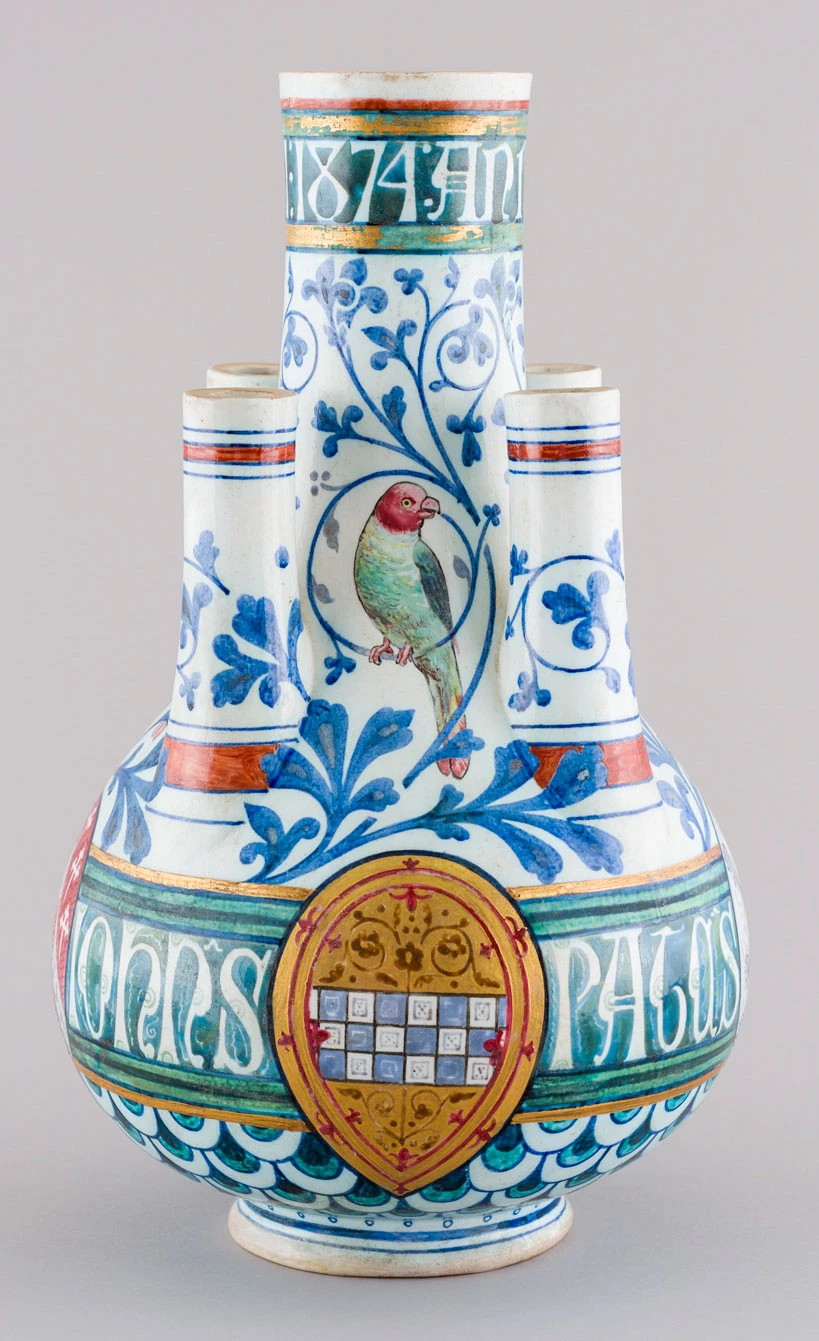
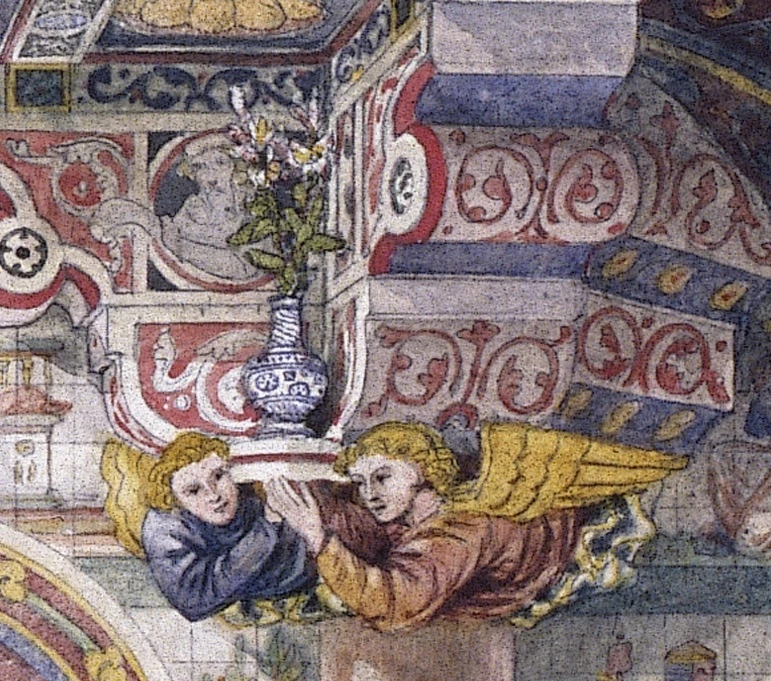
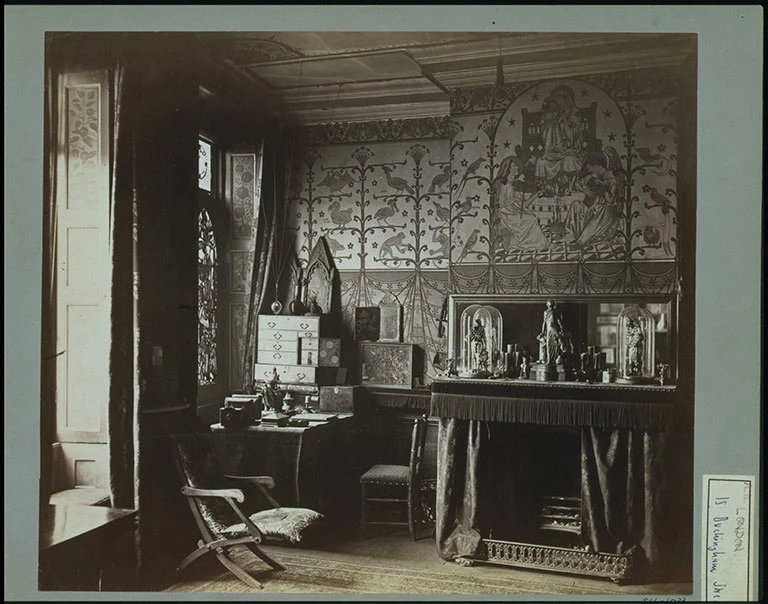
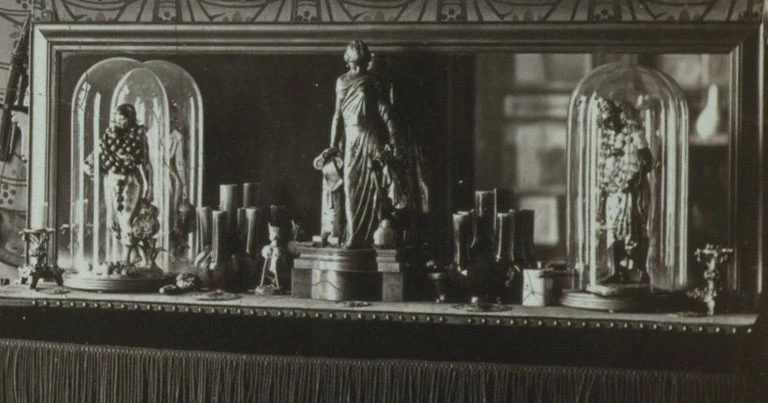
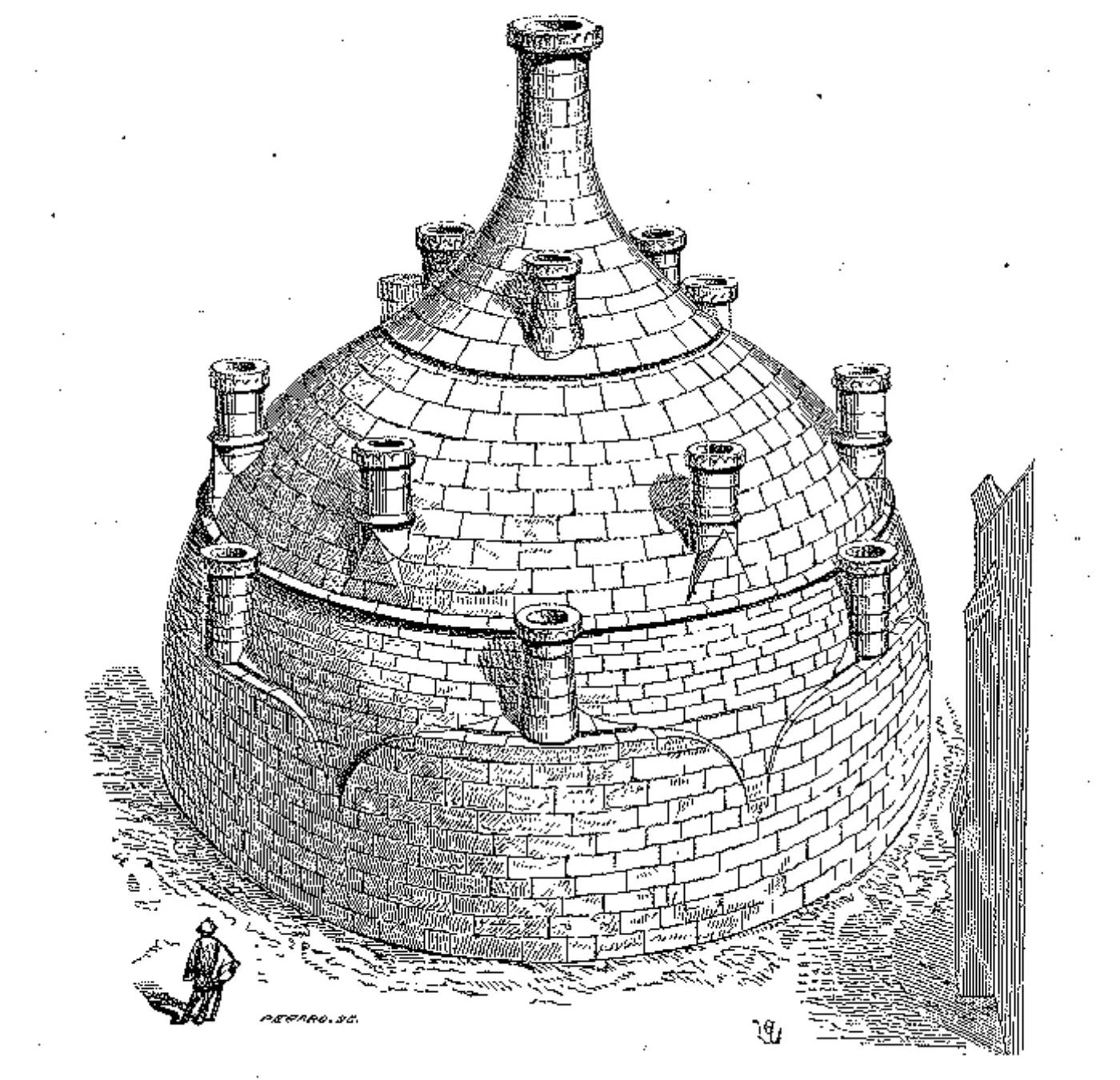
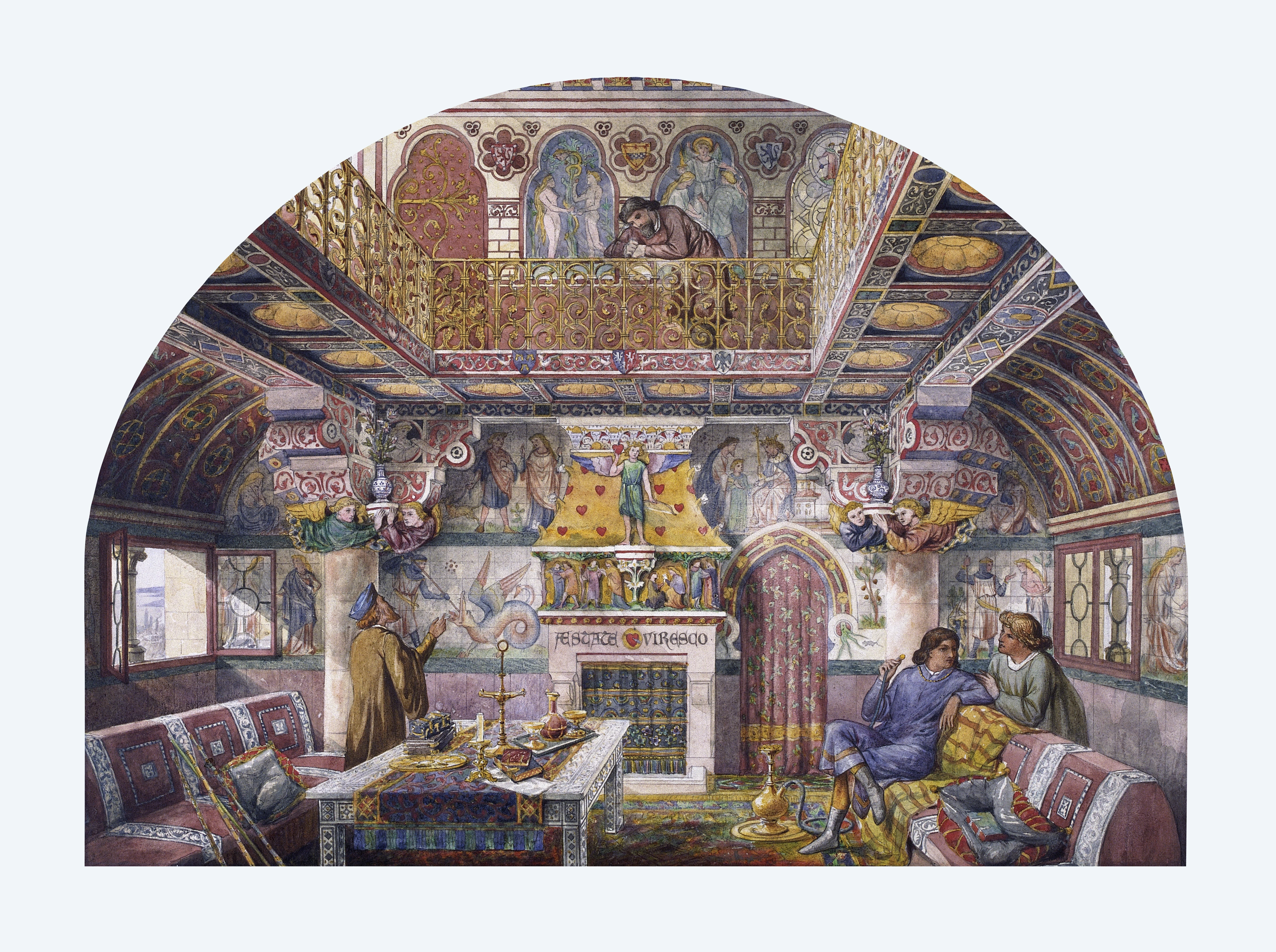
A tulip vase designed by William Burges for Cardiff Castle, 1874 Andrew Renton, 20 October 2016 Tulip vase designed by William Burges, 1874 Amgueddfa Cymru has in its collections a remarkable pottery vase designed by William Burges (1827-1881) for the Summer Smoking Room at Cardiff Castle, the pseudo-mediaeval extravaganza he created for John Patrick Crichton-Stuart, 3rd Marquess of Bute (1847-1900). This vase is among the most important examples of Victorian design with a Welsh connection. It was created as part of one of the pre-eminent architectural and decorative commissions of the nineteenth century, and certainly the most significant in Wales. William Burges (1827-1881) Burges was perhaps the most original and exuberant architect-designer of the 19th century, widely regarded at the time of his early death as the most brilliant of his generation. Burges considered A W N Pugin, famous for the ornamentation of the Palace of Westminster, to be his great hero. However, his strongest early influence was the doctrine of 'progressive eclecticism' of his patron A J B Beresford Hope, who hoped that by drawing on a wide range of historical styles architects would create a new style worthy of the Victorian age. Burges inherited significant wealth, enabling him as a young architect to travel widely in Europe and as far as Turkey, while also studying the arts of Japan, India, Scandinavia and North Africa. As a result, his work is distinguished by its imaginative but informed use of multifarious sources, most obviously the architecture and design of mediaeval Europe but including those of the Islamic world and East Asia, Pompeii and Assyria. The Marquess of Bute’s Castle in Cardiff At Cardiff Castle, given free rein by the hugely wealthy Marquess of Bute, Burges’s imagination created one of the great masterpieces of Victorian architecture. The exteriors of this uninhibited architectural fantasy were inspired by French mediaeval castles, while the interiors are alive with coloured carvings, panelled walls and painted ceilings. The Summer Smoking Room at the top of the Clock Tower was the pièce de résistance, where a set of four tulip vases designed by Burges was integral to the room’s amazingly theatrical effect. Late in his life Burges came to believe that the future of architecture lay in a renaissance of the 'minor arts'. His designs for furniture, metalwork, jewellery, stained glass and ceramics were just as inventive, scholarly and elaborate as those for buildings, and were conceived as integral to the architectural schemes he devised. This made him a key influence on the Arts and Crafts movement. The Summer Smoking Room, Cardiff Castle, c. 1900 The Tulip Vases The vases themselves are made of a white porcelain-like stoneware, hand-painted and gilded. They have a globular body and four smaller necks round the central one. They are painted in the glaze with parakeets sitting in blue scrolling foliage, while around the belly are four oval armorial bearings associated with the Bute family. Inscriptions round the neck (ANNO : DOMINI : 1874) and lower belly (IOHN^S PATC^S MARCQ DE BUTE) identify the patron and date. Unfortunately there is no record of who made or decorated the vases. While it is usually proposed that they were made in Staffordshire, they may in fact have been made by George Maw of Broseley, Shropshire. Best known for their tiles, Maw & Co manufactured Burges’s own tile designs, including those for Cardiff Castle's Summer Smoking Room. They also produced moulded architectural ceramics and were quite capable of making unusual vessel forms, such as the well-known vase in the form of a swan designed by Walter Crane in 1889. They were certainly manufacturing ambitious pottery vessels as early as 1874, as described in The Art Journal that year by a Professor Archer in terms that could apply to the Burges vases: 'Some of the designs, as in that of a jardinière in Louis Quatorze style and in a number of vases formed after Indian, Moorish and classic models, are works which would do credit to the oldest-established potteries, whilst some of the colour-effects displayed upon them have a richness that has never been surpassed. For these articles a white clay is used, and they may be classed as semiporcelain with a very firm, hard texture.' The decoration of the vases may be the work of W B Simpson of 456 West Strand, Maw’s agent in London. Maw sent the ‘majolica tiles for architectural purposes’ which he had developed to Simpson for them to be painted by hand and fired. As the tiles at Cardiff Castle show, these were of outstanding quality, and the Summer Smoking Room vases are very much their equal. The design of the Clock Tower at Cardiff Castle Axel Haig, Design for the Summer Smoking Room at Cardiff Castle, c. 1870 Axel Haig, detail of the design for the Summer Smoking Room at Cardiff Castle, c. 1870 The commission to rebuild Cardiff Castle provided Burges with an unprecedented opportunity to realise his ideas on a grand scale. Bute’s unparalleled wealth, his love of travel and his romantic passion for the Middle Ages made him the ideal patron for Burges. As leading Burges expert J Mordaunt Crook has written, ‘Cardiff was the commission of a lifetime: the chance of creating a dream castle for Maecenas himself.’ The Clock Tower is the most prominent element of Burges's Cardiff Castle and created a sensation when the architect revealed his design at the Royal Academy in 1870. Each apartment was richer than the one below and it culminated in the galleried Summer Smoking Room, probably the finest example of Burges’s fantasy architecture. It was (also in Mordaunt Crook’s words) ‘a veritable skyscraper among palaces. A skyscraper, moreover, clad in the garments of progressive eclecticism.’ The guiding iconographic theme of the Clock Tower is time. The Summer Smoking Room's decorative scheme is inspired by astronomy, illustrating the divisions of Time and the organisation of the Cosmos. Its tiled floor, modelled on tiles before the high altar in Westminster Abbey, depicts the five continents, the Holy City, and the life cycle of the birds and beasts of the earth. The chimneypiece is carved with the amusements of summer, love in particular. A frieze of painted tiles illustrates the legends of the zodiac, with subjects such as Apollo and Cupid, Castor and Pollux, and Europa and the Bull. Paintings around the walls by Frederick Weekes represent seventeen different types of metal and in the spandrels astronomers of the past. In the centre hangs a sun-burst chandelier in the form of Apollo. Between the ribs of the dome are figures of the four elements – earth, fire, air, water – while in the four corners are giant carved anthropomorphic corbels depicting the eight winds of Greek mythology, such as Africus, Auster and Zephyrus. Also designed by Burges, the furniture included luxurious ottomans and inlaid chairs of Jacobean shape and Romanesque decoration. This all typifies Burges’s richly eclectic and allusive approach. Designed to sit as bright highlights in each corner of the room on the carved stone corbels depicting the winds, the set of four tulip vases was an integral part of this amazingly theatrical whole. Axel Haig’s watercolour of about 1870 illustrating Burges’s original vision for the Summer Smoking Room (in Amgueddfa Cymru’s collection) depicts vases in the corners different to the form eventually produced and more generic in character. Comparison with the completed vases shows that Burges subsequently expended special care and imagination on their design to make them play an active role in his concept for the room. Their decorative details contributed to the room’s themes and helped to animate the space. The colours – blue, green, gold and ochre – reflect those elsewhere in the room, such as the orange and blue of the upholstery of the ottomans, while the armorials echo those around the base of the gallery. More particularly, the parakeets – love-birds, an especially favourite motif of Burges – develop the theme of love, echoing the parakeets carved and painted in the hands of the sculpted figure of Amor perched on the chimney hood as well as on the hood itself and painted in roundels on the underside of the room’s gallery. The design and decoration of the vases are an imaginative admixture of sources as varied as mediaeval architecture and illuminated manuscripts, Italian Renaissance maiolica, Dutch Delft pottery and Chinese porcelain. This wide range of allusions was all part of the intellectual games Burges enjoyed playing with the Marquess of Bute. Drawings of vases of similar form appear in Burges’s ‘Vellum Sketchbook’ (Royal Institute of British Architects collection), one in particular annotated ‘this is a pot of glass / in which you put flowers’ and probably based on a glass water sprinkler typical of Catalonia in about 1550-1650. Another source of inspiration for the form was the multi-spouted ceramic flower vases made in Iran both in the 12th century and in the Savafid period (1500-1722). Closest of all are multi-necked Chinese porcelain vases of the late 18th and 19th centuries, a rare form of which two examples can be seen in photographs of Burges's chambers at 15 Buckingham Street, London, in the 1870s. The office in William Burges’s chambers, 15 Buckingham Street, 1876 © Victoria and Albert Museum, London Detail from the office in William Burges’s chambers, 15 Buckingham Street, 1876 © Victoria and Albert Museum, London The kitchen at Marmoutier abbey, from Eugène Viollet-le-Duc, Dictionnaire raisonné de l’architecture française du XIe au XVIe siècle (1856) The form is also an architectural one in miniature, strongly influenced by one of Burges’s favourite mediaeval buildings, the multi-chimneyed kitchen of the Benedictine abbey at Marmoutier near Tours in France. This had been illustrated by the hugely influential French Gothic Revival architect Eugène Viollet-le-Duc in his Dictionnaire raisonné de l’architecture française du XIe au XVIe siècle of 1856. It also reworks one of Burges’s own earlier architectural concepts, his unrealised design for the Bombay School of Art of 1866 the circular smithy of which owed its silhouette to the Marmoutier kitchen. According to critics, the Bombay design ‘caused a major stir in the architectural profession’ and was ‘perhaps the most marvellous design that he ever made.’ The set of four vases was removed from Cardiff Castle by August 1948, after the Castle had been presented to the City of Cardiff in 1947. Two were acquired by poet John Betjeman, who in 1965 gave them to Charles Handley-Read, whose thank-you note read ‘I am near to bursting with gratitude and delight.’ One of these is now at the Victoria and Albert Museum, the other at The Higgins, Bedford. The other two were acquired by the Newport dealer John Kyrle Fletcher, who sold them to a private collector. While one of these has now returned to Cardiff, at the time of writing the fourth vase has had its export licence deferred to give public bodies the opportunity to raise the funding required to keep it in the UK. It is strongly to be hoped that a British institution will be able to raise the funds to acquire it, so that the whole of this important group can be preserved in public ownership in this country in perpetuity, with the chance of exhibiting all four vases together at some point. This acquisition was made possible by the generous support of the National Heritage Memorial Fund, the Art Fund and the Headley Trust. Their grants enabled the Museum to buy the vase, after it too had had its export licence deferred. This article was features in the The Friends newsletter. Find out more about supporting Amgueddfa Cymru by becoming a Friend.