: Ceramics, Sculpture & Craft

Attic sculptures at National Museum Cardiff

Kristine Chapman, 23 September 2022

The exterior of the National Museum building in Cathays Park is home to several figures placed around the top, known as the ‘attic sculptures’. This is a feature that it has in common with the City Hall building right next door.

In fact, when the competition to design the flagship National Museum of Wales building was opened in 1909, the Conditions of Competition included the following guidelines:

‘From the position of the site on the east side of the City Hall and the relation of the Law Courts on its west side, to that building as a centre, it is thought desirable that externally the Museum building should be designed in harmony with these buildings, that, so far as possible, it may be in sympathy with the general scheme adopted.’

The architects who won the building competition, Arnold Dunbar Smith (1866–1933) and Cecil Claude Brewer (1871–1918), worked with the Welsh sculptor Sir William Goscombe John (1860–1952) to come up with a design scheme for the sculptures that would decorate the exterior. Their idea was to have four groups, consisting of two or three figures in each group, for each of the four sides of the Museum. This would have resulted in sixteen sculpture groups in total.

The groups on the South Wing, which is the front entrance of the Museum, were supposed to illustrate the history of Wales and were to be called The Stone Age, The Bronze Age, The Iron Age and The Coal Age.

Sepia photograph of a relief sculpture of Minerva seated on a throne, flanked to the left by a muscular man wearing a helmet and a loincloth and to the right by a female figure

Gilbert Bayes’s plaster model for The Bronze Age, later retitled The Classic Period.

The four sculpture groups for the West Wing were meant to represent the industries of Wales. These were defined as Agriculture, Mining, Shipping and Iron and Steel.

The East Wing groups would focus on the sciences, and were listed as Astronomy, Chemistry, Physics, Biology and Geology and Archaeology.

And, finally, on the North Wing the arts would be represented by Literature, Music, Graphic Arts and Architecture/Sculpture.

As the Museum building was to be completed in stages, wing by wing, starting with the South Wing, it was decided to focus on commissioning the sculptures in that area first.

In 1914 fourteen sculptors were invited to submit models to a limited competition. They advised that ‘the sculpture is to form part of the building, and not be applied to it, and that therefore a monumental and masonic, rather than a plastic treatment is required’ and that they have a ‘monumental and symbolic, rather than pictorial treatment, and that, too much must not be sacrificed to historical accuracy and attempted realism’.

Sepia photograph of a plaster model for a sculpture of three figures: a seated woman wearing a square academic cap (mortar board) raised above two seated men either side of her, one holding a telephone receiver and the other dressed as a pilot

The Modern Period by Richard Garbe

The 1914–1915 Museum Annual Report lists the winning artists as:

Each winning artist was asked to produce a final version of his design and submit a companion sculpture to go with it. Additionally, the competition assessors decided that the four Ages were no longer satisfactory and renamed them as the Prehistoric Period, the Classic Period, the Mediaeval Period and the Modern Period.

Therefore, Gilbert Bayes was tasked with producing The Prehistoric Period and The Classic Period, as the renamed Stone Age and Bronze Age groups were now called. Richard Garbe produced The Mediaeval Period and The Modern Period, which were the renamed Iron Age and Coal Age groups. These four sculpture groups completed the History of Wales scheme for the front of the South Wing.

Sepia photograph of two plaster models for sculptures on the left and right corners of a building; each of the sculptures has three human figures

Mining and Shipping by Thomas J. Clapperton

The other winner, Thomas J. Clapperton, was asked to rename his Coal Age sculpture as Mining and create a second sculpture group called Shipping. These were to be the first two of the four sculpture groups that were to represent the Industries of Wales on the West Wing. A section of the West Wing was built at the same time as the South Wing, and so there was space available to accommodate these two groups.

There were also a couple of other exterior sculptures commissioned at this time, although they were not part of the attic sculpture scheme. Two dragons and two lions were designed by A. Bertram Pegram to be placed around the base of the dome. It’s worth pointing out that no plans were ever made to put a sculpture on the top of the dome to mirror the dragon on the top of the City Hall dome; such a sculpture is not pictured in any of the architects’ drawings of the Museum.

This was as far as the attic sculptures scheme progressed until the extension of the East Wing in the 1930s. The East Wing, up to and including the Reardon Smith Lecture Theatre, was officially opened in 1932. However, by this point the original scheme for the attic sculptures was radically changed. Instead of the three figure groups of the South Wing, these sculptures were all single figures.

The belief was that as the East Wing wouldn’t be viewed as much as the main entrance of the South Wing, the sculptures therefore no longer needed to be three-figure groups. The Building Committee minutes of February 1936 state that ‘While it is important that these carvings should do their duty by helping to complete the architectural design, it is submitted that three-figure groups in high relief are not necessary’.

Black-and-white photograph of a plaster model showing a seated woman in an architectural setting holding a palette and paintbrush, against a black background

Art by Bertram Pegram

Instead of the original plan to depict the sciences on the East Wing, the committee decided to commission sculptures more in keeping with the arts, the theme originally planned for the North Wing. As a result, the sculptures created for the East Wing were Learning by Thomas J. Clapperton (the sculptor responsible for the two existing West Wing sculptures), Music by David Evans (1893–1959) and Art by A. Bertram Pegram, the creator of the lions at the base of the dome.

Black-and-white photograph of a stone sculpture of a seated man playing a small harp, set into the architecture of a building

Music by David Evans

It wasn’t until the 1960s that the remainder of the West Wing was built, and the final two attic sculptures for that section of the building could be added. These sculptures followed the single figure format of the 1930s East Wing designs, rather than the group design of the two existing West Wing sculptures by T.J. Clapperton.

Both sculptures are by Jonah Jones (1919–2004); in the first Natural History is represented by Saint Melangell holding a sheaf of flowers, ferns and grasses, and handling a ram’s skull ‘with a hare about her skirts’. The second is Industry, represented by a slate quarryman splitting slate. Although the sculptures don’t use the names from the original scheme (Agriculture and Iron and Steel), they do allude to the theme of the West Wing, the industries of Wales.

The final attic sculpture was commissioned in the 1980s when work was completed on the East Wing to match it in parallel with the West Wing. The Art Committee decided in 1988 to approach five sculptors with plans to create a figure to pair with the sculpture of Music by David Evans and complete the arts theme for that wing.

Black-and-white photograph of three workmen in hard hats working on a large stone sculpture of a winged mythical creature on the top storey of a building

Reguarding Guardians of Art by Dhruva Mistry

The chosen sculpture, installed in August 1990, was Reguarding Guardians of Art by Dhruva Mistry (1957– ), a figure of a part-human, part-animal winged creature. Although the style of this sculpture is quite different to that of the other attic sculptures, in the words of the then Keeper of Art, it ‘meets the requirement of the situation admirably particularly from the point of view of composition and scale’.

The original architects’ plans for the Museum building also included a North Wing, but as it was never built, no attic sculptures were ever created. This means that of the initial sixteen sculpture groups that were planned for the exterior of the Museum building, only twelve were completed. Of those twelve, half are the original three-figure groups and half are individual figures. Perhaps if a North Wing is ever constructed, a new competition will be launched to design the remaining four attic sculptures.


Fragile - The Biggest Contemporary Ceramics Exhibition ever held in Wales

19 March 2020

The 'Fragile' exhibition was held at Amgueddfa Cymru - National Museum Wales between 18 April - 4 October 2015. It was the biggest contemporary ceramics exhibition ever held in Wales.

The exhibition brought together key works from the collection of Amgueddfa Cymru – National Museum Wales, including ceramic works by Richard Deacon and Felicity Aylieff, as well as pieces from the archaeology, industry and botany collections.

Also on view were works by four Wales-based artists – Claire Curneen, Walter Keeler, Lowri Davies and Adam Buick – shown together with specially-commissioned films that delve into each maker’s creative process. You can see the films here:

Alongside these were three major innovative installations by Phoebe Cummings, Keith Harrison and Clare Twomey, who challenged you to walk across and break a sea of bone china tiles.

Uncovering our Collections: Half a Million Records now Online

26 March 2018

As we reveal half a million collection records for the first time, we look at some of the strangest and most fascinating objects from National Museum Wales Collections Online.

This article contains photos of human skeletal fragments.

The Biggest

We have some real whoppers in our collections - including a full-size Cardiff Tram and a sea rescue helicopter - but the biggest item in our collection is actually Oakdale Workmen's Institute.

Built in 1917, the Institute features a billiard room, dance hall and library - and is nowadays found in St Fagans National Museum of History.

Photograph from 1908 showing Horace Watkins in a very early, precarious-looking monoplane

Horace Watkins testing his monoplane in 1908

Many of the buildings in St Fagans are part of the national collection - meaning they have the same legal status as one of our masterpiece Monets or this coin hoard. The buildings are dismantled, moved, rebuilt - and cared for using traditional techniques, by the museum's legendary Historic Buildings Unit.
 

The Oldest


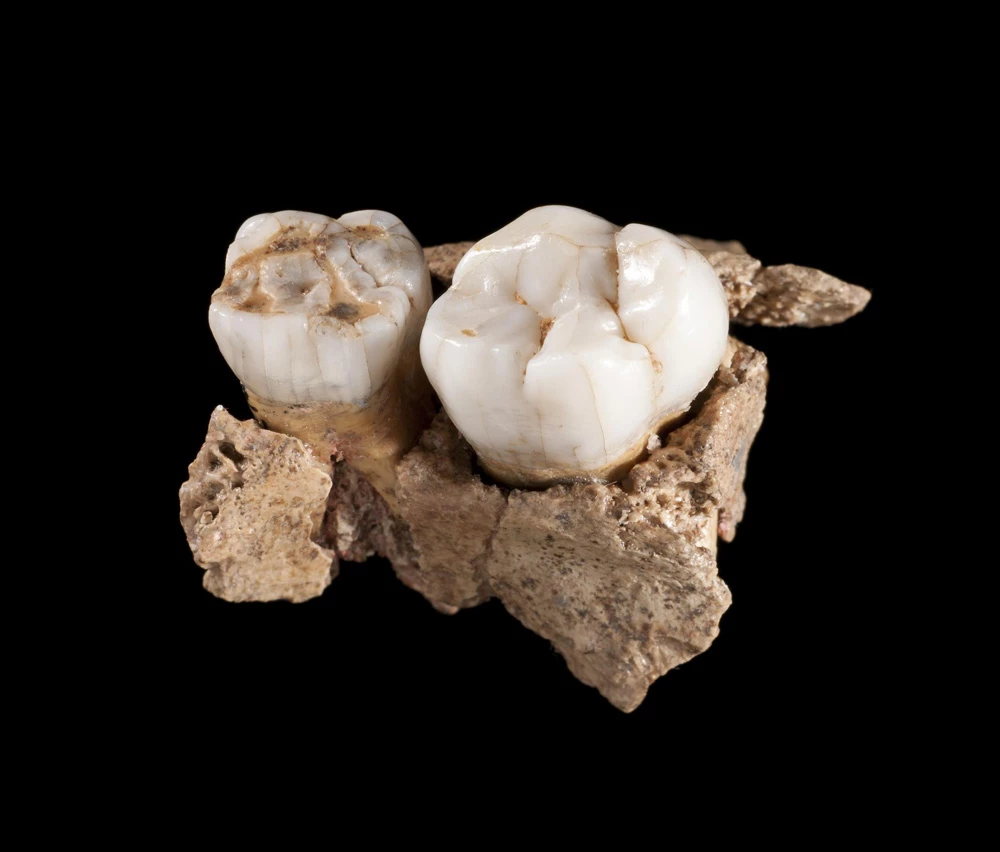
photograph of two teeth, belonging to a Neanderthal boy aged 8

The oldest human remains ever discovered in Wales

These teeth belonged to an eight year-old Neanderthal boy - and at 230,000 years old, they are the oldest human remains in Wales.

They were discovered in a cave near Cefn Meiriadog in Denbighshire, along with a trove of other prehistoric finds, including stone tools and the remains of a bear, a lion, a leopard and a rhinocerous tooth.

These teeth are among some of the incredible objects on display at St Fagans National Museum of History
 

The Shiniest

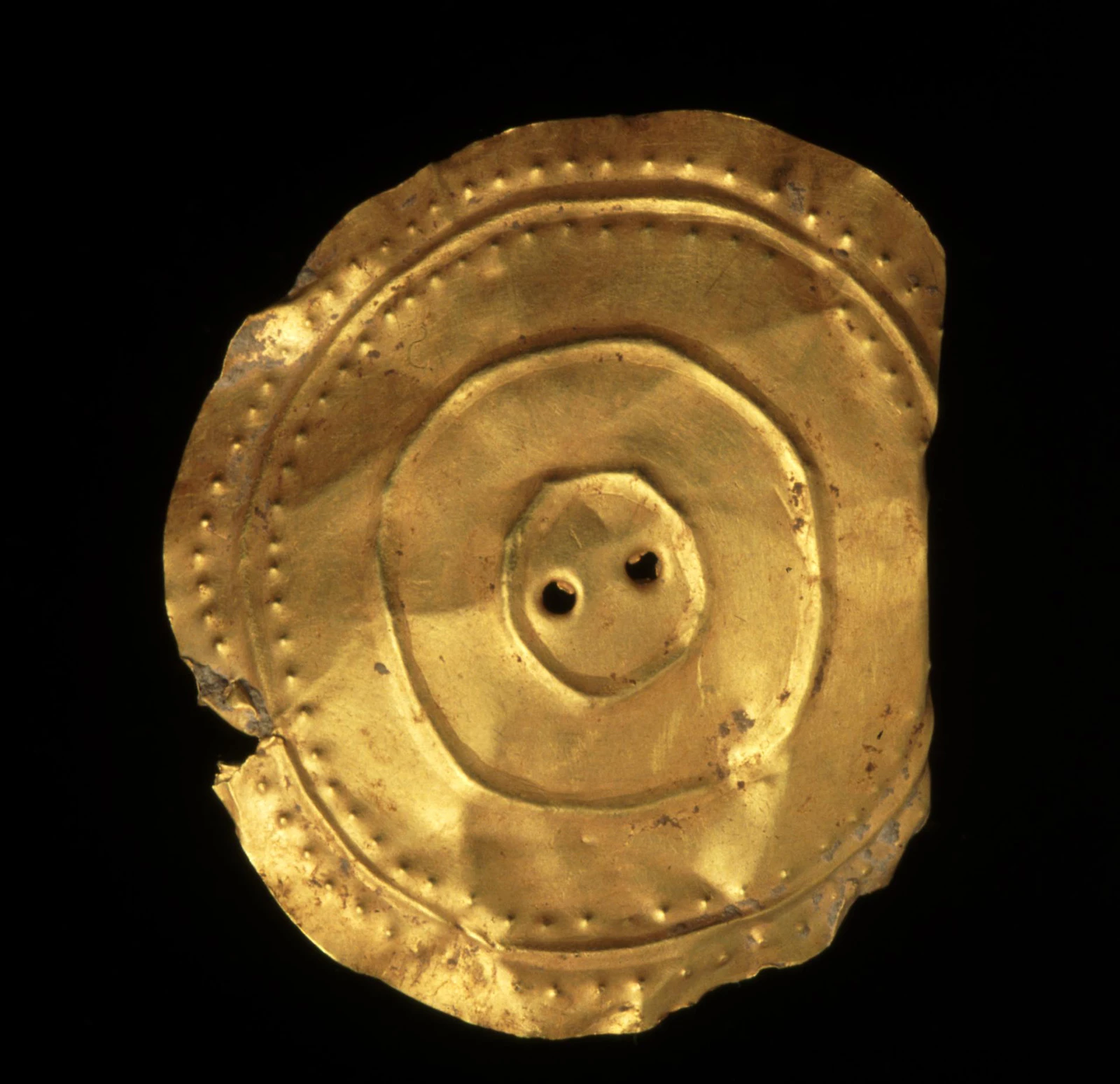
People in Wales have been making, trading and wearing beautiful treasures from gold for thousands of years - like this Bronze Age hair ornament and this extremely blingy Medieval signet.


photograph of gold disc with repousse design

At around 4000 years old, this sun disc is one of the earliest and rarest examples of Welsh bling

One of the earliest examples of Welsh bling is this so-called 'sun disc', found near Cwmystwyth in Ceredigion.

Current research suggests that these 'sun discs' were part of ancient funeral practice, most likely sewn onto the clothes of the dead before their funerals. Only six have ever been found in the UK.
 

Most Controversial

At first glance, an ordinary Chapel tea service - used by congregations as they enjoyed a 'paned o de' after a service. A closer look reveals the words - 'Capel Celyn'. The chapel, its graveyard and surrounding village are now under water.


Photograph showing a cup and saucer with 'Capel Celyn' and a ribbon scroll design

Capel Celyn, in the Tryweryn Valley, is now underwater

Flooded in 1965 by the Liverpool Corporation, the Tryweryn valley became a flashpoint for Welsh political activism - creating a new generation of campaigners who pushed for change in how Welsh communities were treated by government and corporations.

Curators from St Fagans collected these as an example of life in Capel Celyn - to serve as a poignant reminder of a displaced community, and to commemorate one of the most politically charged moments of the 20th century in Wales.
 

Honourable Mention: an Airplane made from a Dining Room Chair

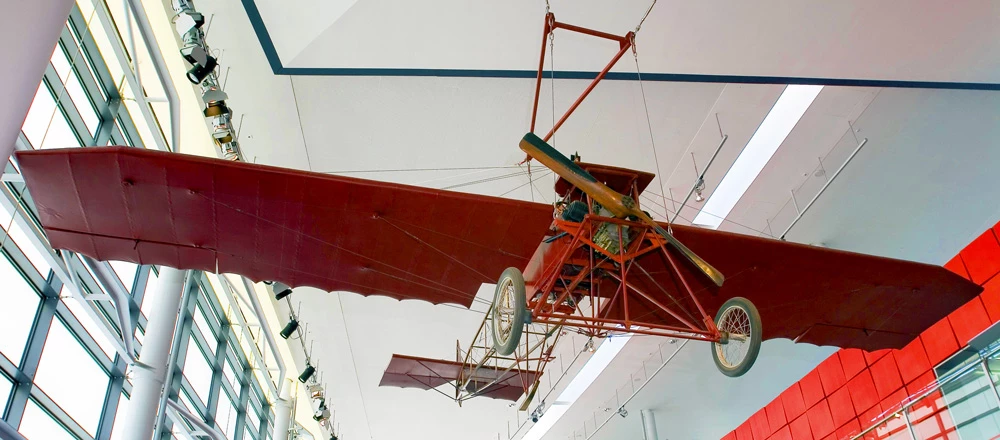
Made from a dining room chair, piano wire and a 40 horsepower engine, the Robin Goch (Red Robin) was built in 1909 - and also features a fuel gauge made from an egg timer.


photograph of a small, early twentieth century airplane with red wings

The Robin Goch (Red Robin) on display at the National Waterfront Museum

Its builder, Horace Watkins, was the son of a Cardiff printer - here he is pictured with an earlier, even more rickety version of his famous monoplane.
 

Photograph from 1908 showing Horace Watkins in a very early, precarious-looking monoplane

Horace Watkins testing his monoplane in 1908

Our collections are full of stories which reflect Wales' unique character and history. The Robin Goch is one of the treasures of the collection, and is an example of Welsh ingenuity at its best.

Half a Million Searchable Items

The launch of Collections Online uncovers half a million records, which are now searchable online for the first time.

“Collections Online represents a huge milestone in our work, to bring more of our collections online and to reach the widest possible audience.

It’s also just the beginning. It’s exciting to think how people in Wales and beyond will explore these objects, form connections, build stories around them, and add to our store of knowledge." – Chris Owen, Web Manager
 

Search Collections Online

Plans for the future

Our next project will be to work through these 500,000 records, adding information and images as we go.

We'll be measuring how people use the collections, to see which objects provoke debate or are popular with our visitors. That way, we can work out what items to photograph next, or which items to consider for display in our seven national museums.

Preparing and photographing the collections can take time, as some items are very fragile and sensitive to light. If you would like to support us as we bring the nation's collections online, please donate today - every donation counts.


Donate Today


We are incredibly grateful to the People's Postcode Lottery for their support in making this collection available online.
 

A tulip vase designed by William Burges for Cardiff Castle, 1874

Andrew Renton, 20 October 2016

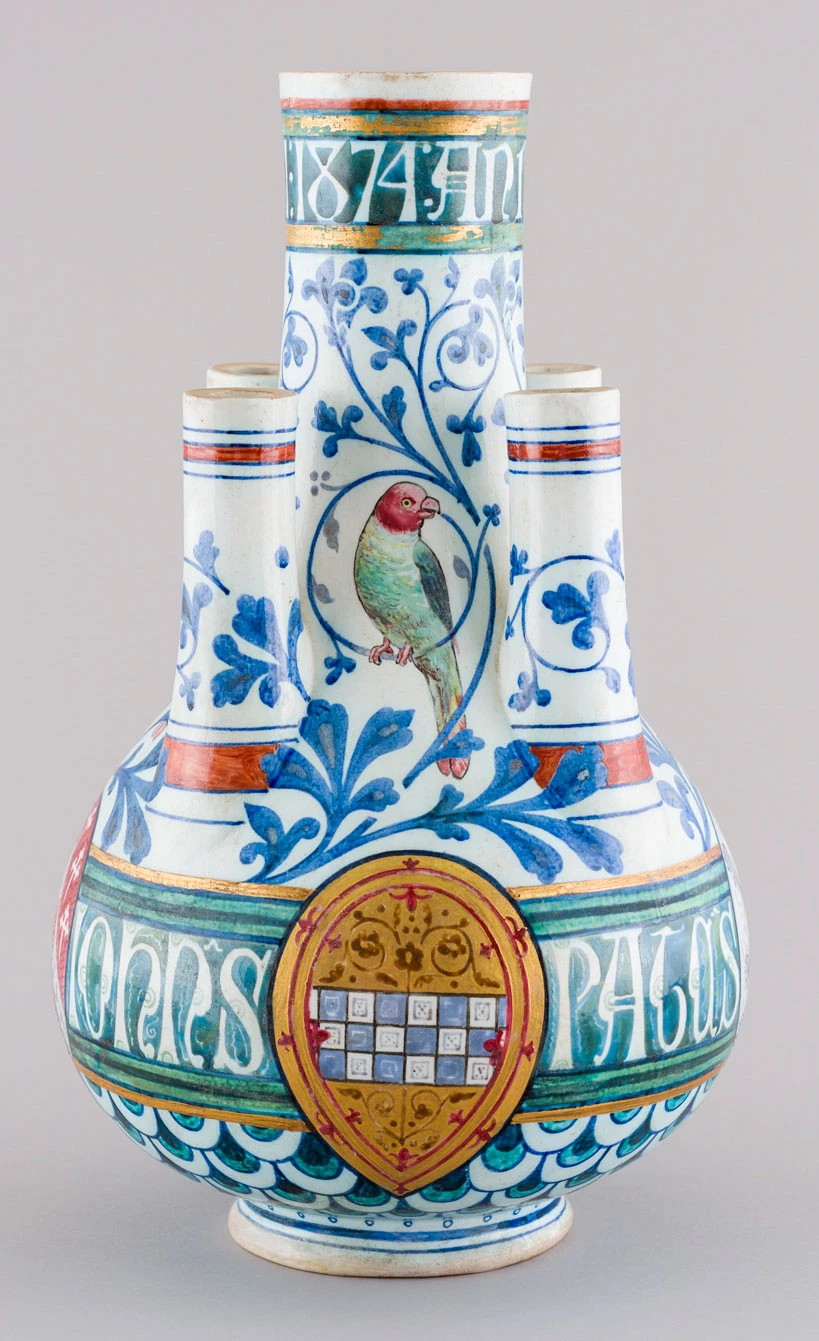
Tulip vase designed by William Burges, 1874

Tulip vase designed by William Burges, 1874

Amgueddfa Cymru has in its collections a remarkable pottery vase designed by William Burges (1827-1881) for the Summer Smoking Room at Cardiff Castle, the pseudo-mediaeval extravaganza he created for John Patrick Crichton-Stuart, 3rd Marquess of Bute (1847-1900). This vase is among the most important examples of Victorian design with a Welsh connection. It was created as part of one of the pre-eminent architectural and decorative commissions of the nineteenth century, and certainly the most significant in Wales.

William Burges (1827-1881)

Burges was perhaps the most original and exuberant architect-designer of the 19th century, widely regarded at the time of his early death as the most brilliant of his generation. Burges considered A W N Pugin, famous for the ornamentation of the Palace of Westminster, to be his great hero.

However, his strongest early influence was the doctrine of 'progressive eclecticism' of his patron A J B Beresford Hope, who hoped that by drawing on a wide range of historical styles architects would create a new style worthy of the Victorian age. Burges inherited significant wealth, enabling him as a young architect to travel widely in Europe and as far as Turkey, while also studying the arts of Japan, India, Scandinavia and North Africa.

As a result, his work is distinguished by its imaginative but informed use of multifarious sources, most obviously the architecture and design of mediaeval Europe but including those of the Islamic world and East Asia, Pompeii and Assyria.

The Marquess of Bute’s Castle in Cardiff

At Cardiff Castle, given free rein by the hugely wealthy Marquess of Bute, Burges’s imagination created one of the great masterpieces of Victorian architecture. The exteriors of this uninhibited architectural fantasy were inspired by French mediaeval castles, while the interiors are alive with coloured carvings, panelled walls and painted ceilings.

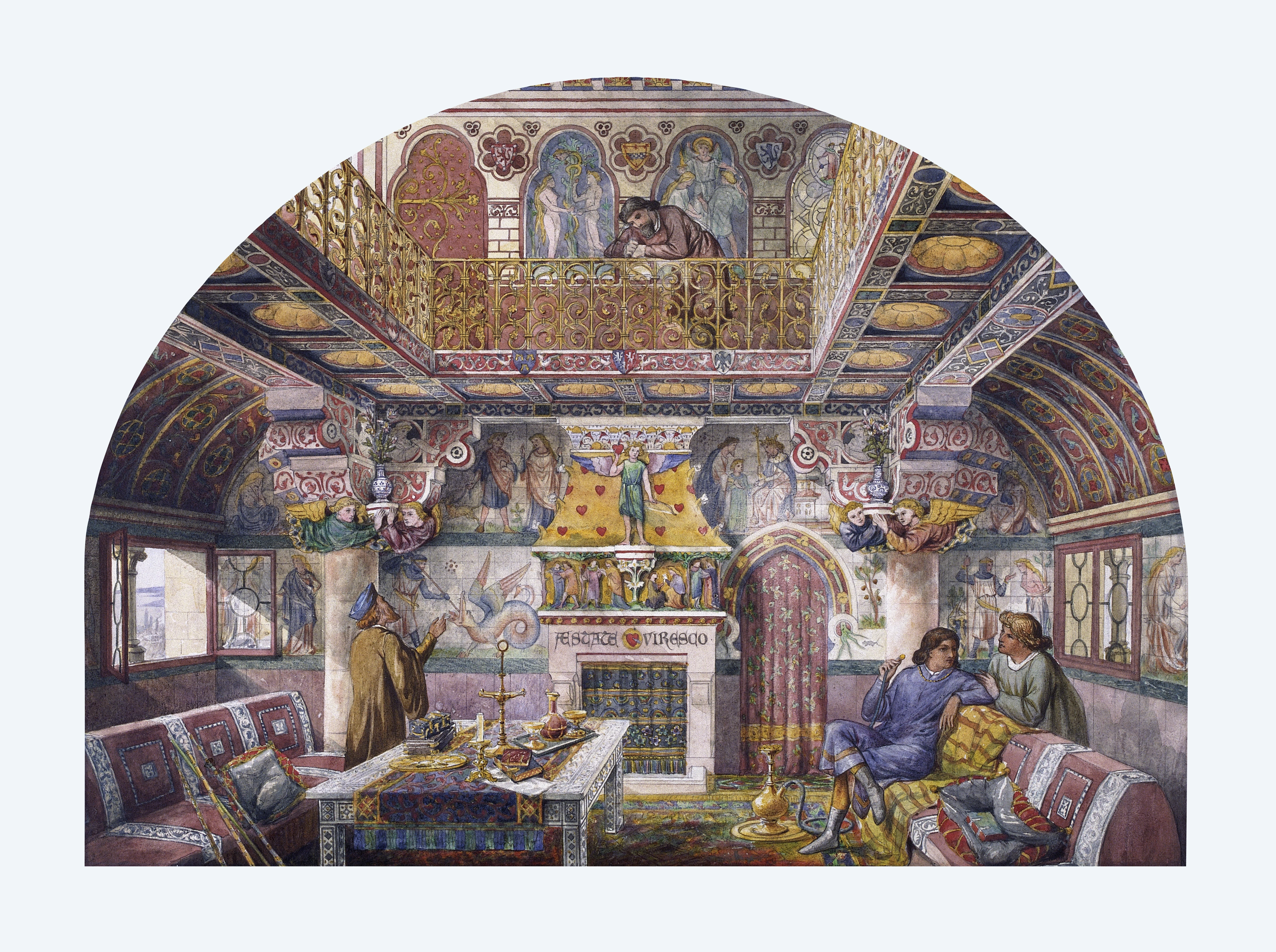
The Summer Smoking Room at the top of the Clock Tower was the pièce de résistance, where a set of four tulip vases designed by Burges was integral to the room’s amazingly theatrical effect.

Late in his life Burges came to believe that the future of architecture lay in a renaissance of the 'minor arts'. His designs for furniture, metalwork, jewellery, stained glass and ceramics were just as inventive, scholarly and elaborate as those for buildings, and were conceived as integral to the architectural schemes he devised. This made him a key influence on the Arts and Crafts movement.

The Summer Smoking Room, Cardiff Castle, c. 1900

The Summer Smoking Room, Cardiff Castle, c. 1900

The Tulip Vases

The vases themselves are made of a white porcelain-like stoneware, hand-painted and gilded. They have a globular body and four smaller necks round the central one. They are painted in the glaze with parakeets sitting in blue scrolling foliage, while around the belly are four oval armorial bearings associated with the Bute family. Inscriptions round the neck (ANNO : DOMINI : 1874) and lower belly (IOHN^S PATC^S MARCQ DE BUTE) identify the patron and date.

Unfortunately there is no record of who made or decorated the vases. While it is usually proposed that they were made in Staffordshire, they may in fact have been made by George Maw of Broseley, Shropshire.

Best known for their tiles, Maw & Co manufactured Burges’s own tile designs, including those for Cardiff Castle's Summer Smoking Room. They also produced moulded architectural ceramics and were quite capable of making unusual vessel forms, such as the well-known vase in the form of a swan designed by Walter Crane in 1889. They were certainly manufacturing ambitious pottery vessels as early as 1874, as described in The Art Journal that year by a Professor Archer in terms that could apply to the Burges vases:

opening quotemark

'Some of the designs, as in that of a jardinière in Louis Quatorze style and in a number of vases formed after Indian, Moorish and classic models, are works which would do credit to the oldest-established potteries, whilst some of the colour-effects displayed upon them have a richness that has never been surpassed. For these articles a white clay is used, and they may be classed as semiporcelain with a very firm, hard texture.'

The decoration of the vases may be the work of W B Simpson of 456 West Strand, Maw’s agent in London. Maw sent the ‘majolica tiles for architectural purposes’ which he had developed to Simpson for them to be painted by hand and fired. As the tiles at Cardiff Castle show, these were of outstanding quality, and the Summer Smoking Room vases are very much their equal.

The design of the Clock Tower at Cardiff Castle

Axel Haig, Design for the Summer Smoking Room at Cardiff Castle, c. 1870

Axel Haig, Design for the Summer Smoking Room at Cardiff Castle, c. 1870

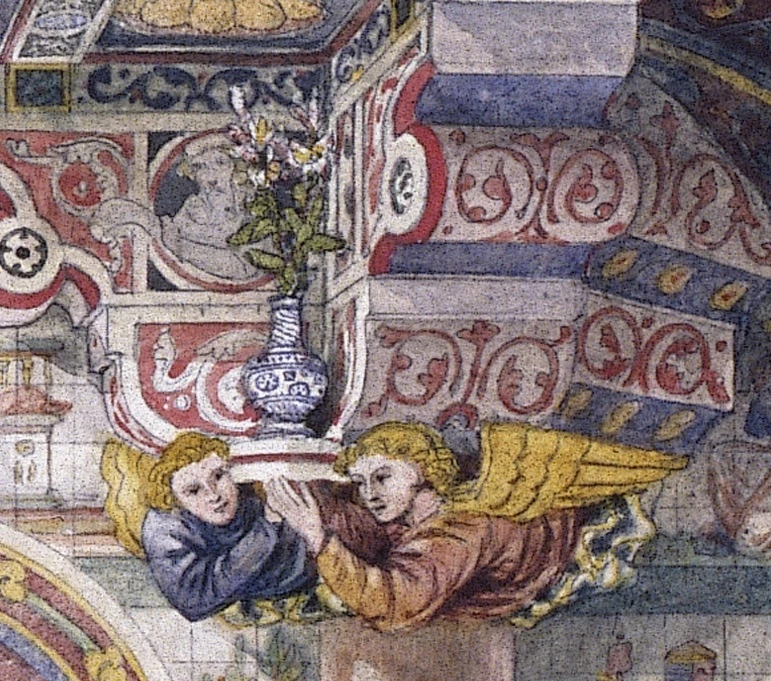
Axel Haig, detail of the design for the Summer Smoking Room at Cardiff Castle, c. 1870

Axel Haig, detail of the design for the Summer Smoking Room at Cardiff Castle, c. 1870

The commission to rebuild Cardiff Castle provided Burges with an unprecedented opportunity to realise his ideas on a grand scale. Bute’s unparalleled wealth, his love of travel and his romantic passion for the Middle Ages made him the ideal patron for Burges. As leading Burges expert J Mordaunt Crook has written, ‘Cardiff was the commission of a lifetime: the chance of creating a dream castle for Maecenas himself.’

The Clock Tower is the most prominent element of Burges's Cardiff Castle and created a sensation when the architect revealed his design at the Royal Academy in 1870. Each apartment was richer than the one below and it culminated in the galleried Summer Smoking Room, probably the finest example of Burges’s fantasy architecture. It was (also in Mordaunt Crook’s words) ‘a veritable skyscraper among palaces. A skyscraper, moreover, clad in the garments of progressive eclecticism.’

The guiding iconographic theme of the Clock Tower is time. The Summer Smoking Room's decorative scheme is inspired by astronomy, illustrating the divisions of Time and the organisation of the Cosmos.

Its tiled floor, modelled on tiles before the high altar in Westminster Abbey, depicts the five continents, the Holy City, and the life cycle of the birds and beasts of the earth. The chimneypiece is carved with the amusements of summer, love in particular. A frieze of painted tiles illustrates the legends of the zodiac, with subjects such as Apollo and Cupid, Castor and Pollux, and Europa and the Bull.

Paintings around the walls by Frederick Weekes represent seventeen different types of metal and in the spandrels astronomers of the past. In the centre hangs a sun-burst chandelier in the form of Apollo. Between the ribs of the dome are figures of the four elements – earth, fire, air, water – while in the four corners are giant carved anthropomorphic corbels depicting the eight winds of Greek mythology, such as Africus, Auster and Zephyrus. Also designed by Burges, the furniture included luxurious ottomans and inlaid chairs of Jacobean shape and Romanesque decoration. This all typifies Burges’s richly eclectic and allusive approach.

Designed to sit as bright highlights in each corner of the room on the carved stone corbels depicting the winds, the set of four tulip vases was an integral part of this amazingly theatrical whole. Axel Haig’s watercolour of about 1870 illustrating Burges’s original vision for the Summer Smoking Room (in Amgueddfa Cymru’s collection) depicts vases in the corners different to the form eventually produced and more generic in character. Comparison with the completed vases shows that Burges subsequently expended special care and imagination on their design to make them play an active role in his concept for the room.

Their decorative details contributed to the room’s themes and helped to animate the space. The colours – blue, green, gold and ochre – reflect those elsewhere in the room, such as the orange and blue of the upholstery of the ottomans, while the armorials echo those around the base of the gallery. More particularly, the parakeets – love-birds, an especially favourite motif of Burges – develop the theme of love, echoing the parakeets carved and painted in the hands of the sculpted figure of Amor perched on the chimney hood as well as on the hood itself and painted in roundels on the underside of the room’s gallery.

The design and decoration of the vases are an imaginative admixture of sources as varied as mediaeval architecture and illuminated manuscripts, Italian Renaissance maiolica, Dutch Delft pottery and Chinese porcelain. This wide range of allusions was all part of the intellectual games Burges enjoyed playing with the Marquess of Bute.

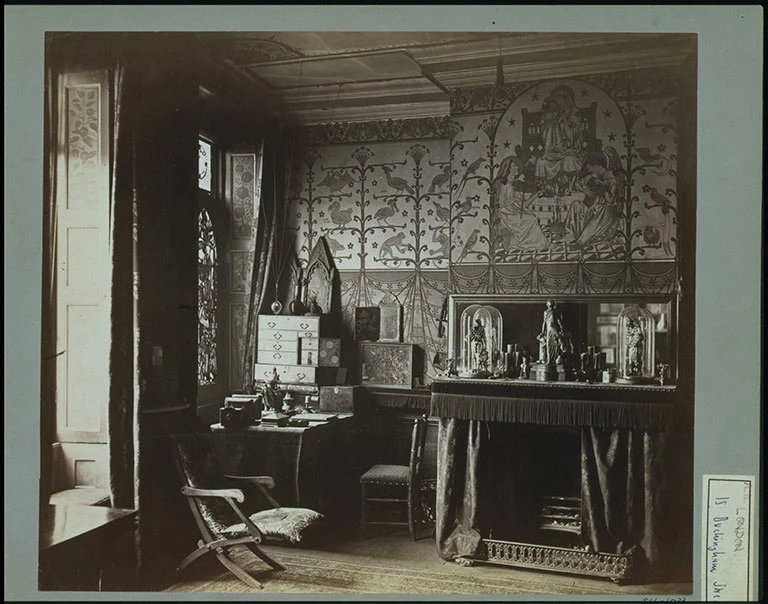
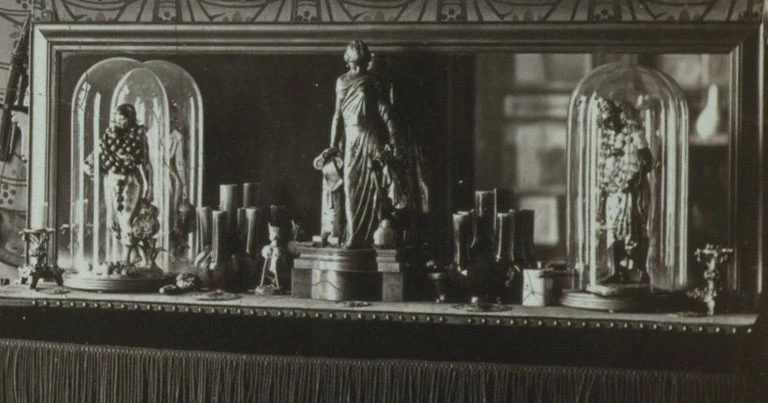
Drawings of vases of similar form appear in Burges’s ‘Vellum Sketchbook’ (Royal Institute of British Architects collection), one in particular annotated ‘this is a pot of glass / in which you put flowers’ and probably based on a glass water sprinkler typical of Catalonia in about 1550-1650. Another source of inspiration for the form was the multi-spouted ceramic flower vases made in Iran both in the 12th century and in the Savafid period (1500-1722). Closest of all are multi-necked Chinese porcelain vases of the late 18th and 19th centuries, a rare form of which two examples can be seen in photographs of Burges's chambers at 15 Buckingham Street, London, in the 1870s.

The office in William Burges’s chambers, 15 Buckingham Street, 1876 © Victoria and Albert Museum, London

The office in William Burges’s chambers, 15 Buckingham Street, 1876 © Victoria and Albert Museum, London

Detail from the office in William Burges’s chambers, 15 Buckingham Street, 1876 © Victoria and Albert Museum, London

Detail from the office in William Burges’s chambers, 15 Buckingham Street, 1876 © Victoria and Albert Museum, London

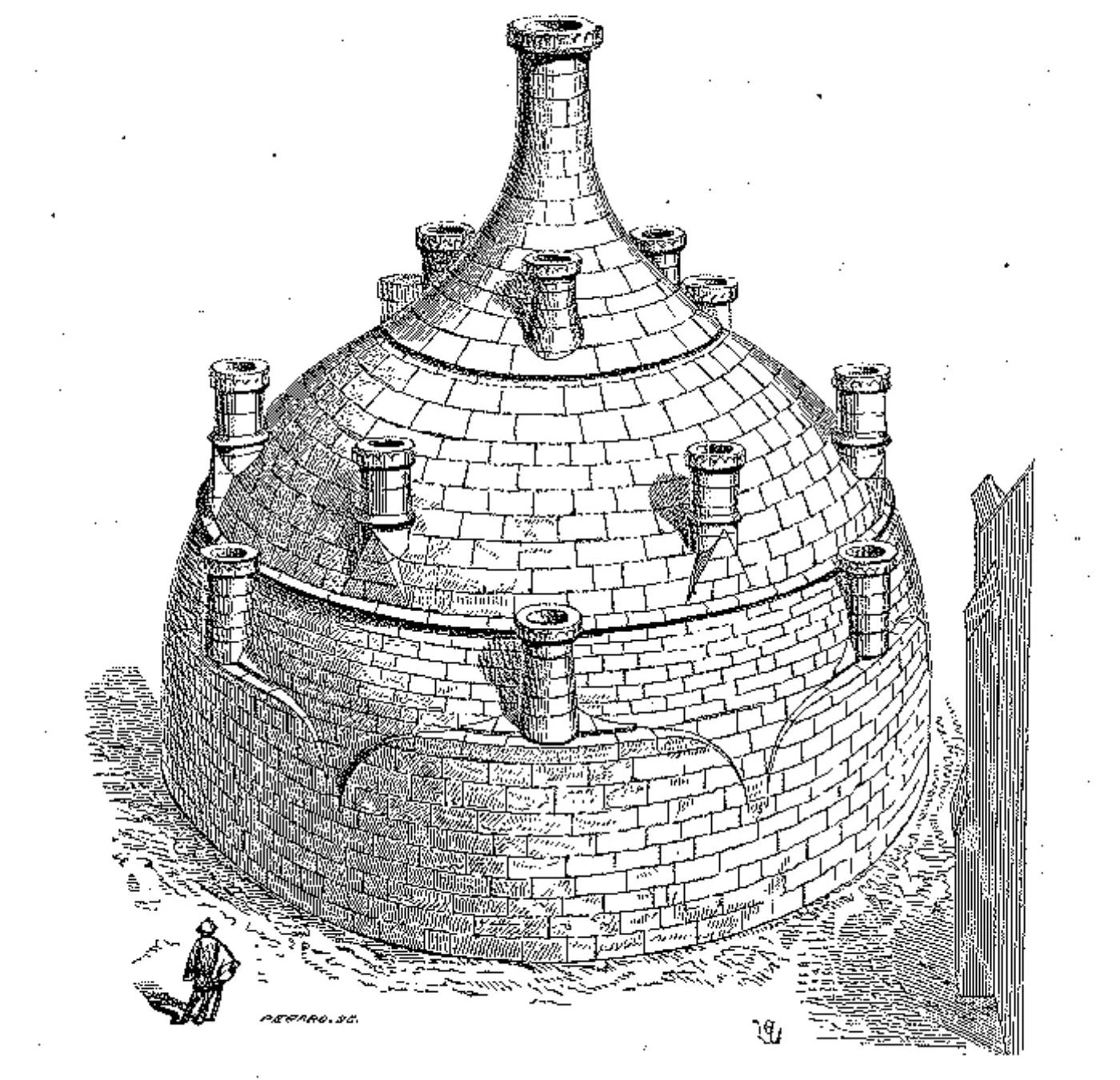
The kitchen at Marmoutier abbey, from Eugène Viollet-le-Duc, <em>Dictionnaire raisonné de l’architecture française du XIe au XVIe siècle</em> (1856)

The kitchen at Marmoutier abbey, from Eugène Viollet-le-Duc, Dictionnaire raisonné de l’architecture française du XIe au XVIe siècle (1856)

The form is also an architectural one in miniature, strongly influenced by one of Burges’s favourite mediaeval buildings, the multi-chimneyed kitchen of the Benedictine abbey at Marmoutier near Tours in France. This had been illustrated by the hugely influential French Gothic Revival architect Eugène Viollet-le-Duc in his Dictionnaire raisonné de l’architecture française du XIe au XVIe siècle of 1856. It also reworks one of Burges’s own earlier architectural concepts, his unrealised design for the Bombay School of Art of 1866 the circular smithy of which owed its silhouette to the Marmoutier kitchen. According to critics, the Bombay design ‘caused a major stir in the architectural profession’ and was ‘perhaps the most marvellous design that he ever made.’

The set of four vases was removed from Cardiff Castle by August 1948, after the Castle had been presented to the City of Cardiff in 1947. Two were acquired by poet John Betjeman, who in 1965 gave them to Charles Handley-Read, whose thank-you note read ‘I am near to bursting with gratitude and delight.’

One of these is now at the Victoria and Albert Museum, the other at The Higgins, Bedford. The other two were acquired by the Newport dealer John Kyrle Fletcher, who sold them to a private collector. While one of these has now returned to Cardiff, at the time of writing the fourth vase has had its export licence deferred to give public bodies the opportunity to raise the funding required to keep it in the UK. It is strongly to be hoped that a British institution will be able to raise the funds to acquire it, so that the whole of this important group can be preserved in public ownership in this country in perpetuity, with the chance of exhibiting all four vases together at some point.

This acquisition was made possible by the generous support of the National Heritage Memorial Fund, the Art Fund and the Headley Trust. Their grants enabled the Museum to buy the vase, after it too had had its export licence deferred.

This article was features in the The Friends newsletter. Find out more about supporting Amgueddfa Cymru by becoming a Friend.

Heat, Smoke and Tears - The work of Maurice Marinot

Rachel Conroy, 19 November 2015

'I have never seen anything so beautiful, so precious and at the same time so simple'

(André Derain)

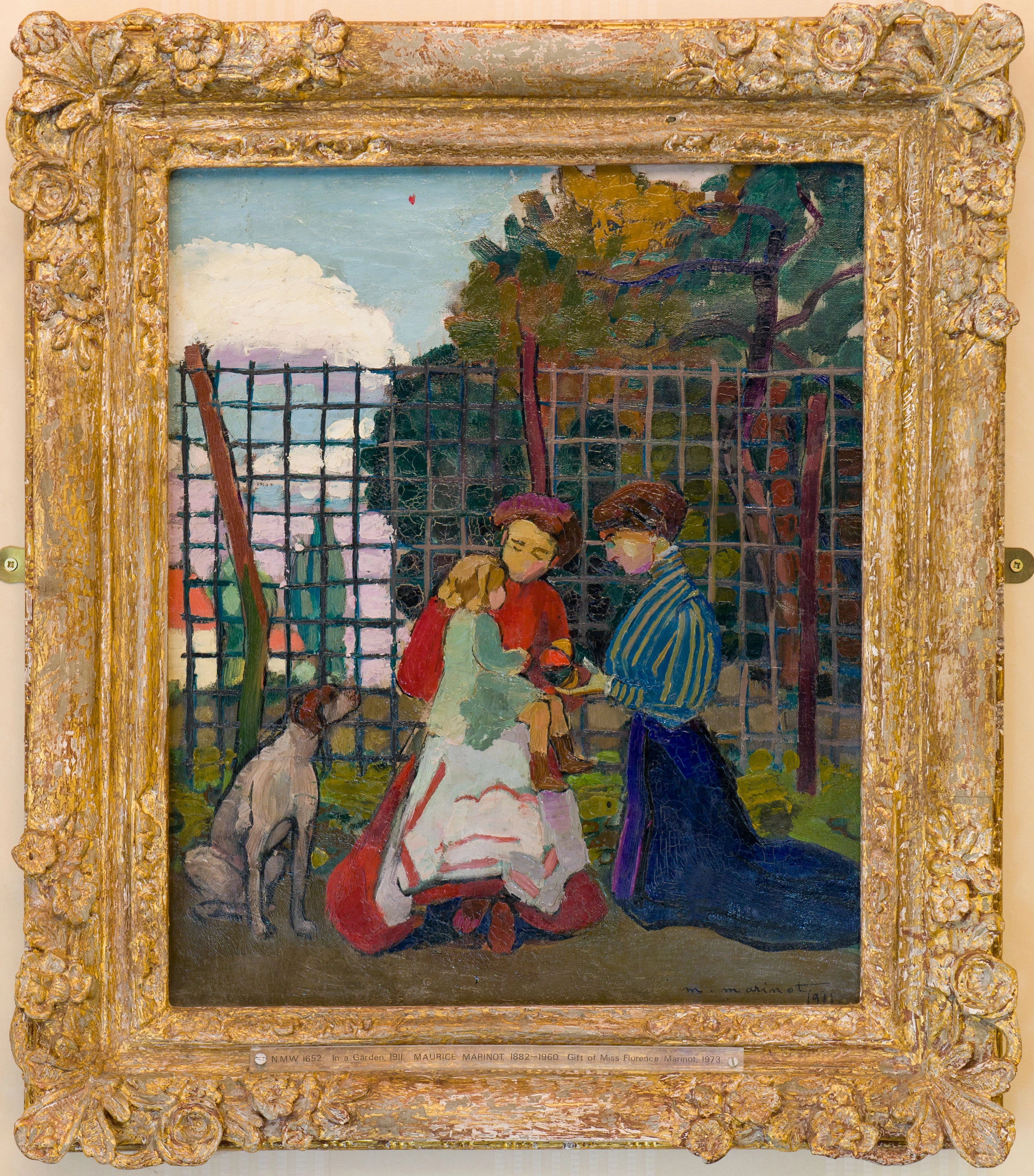
In a Garden, 1908, oil on canvas. (DA007037)

In a Garden, 1908, oil on canvas. (DA007037)

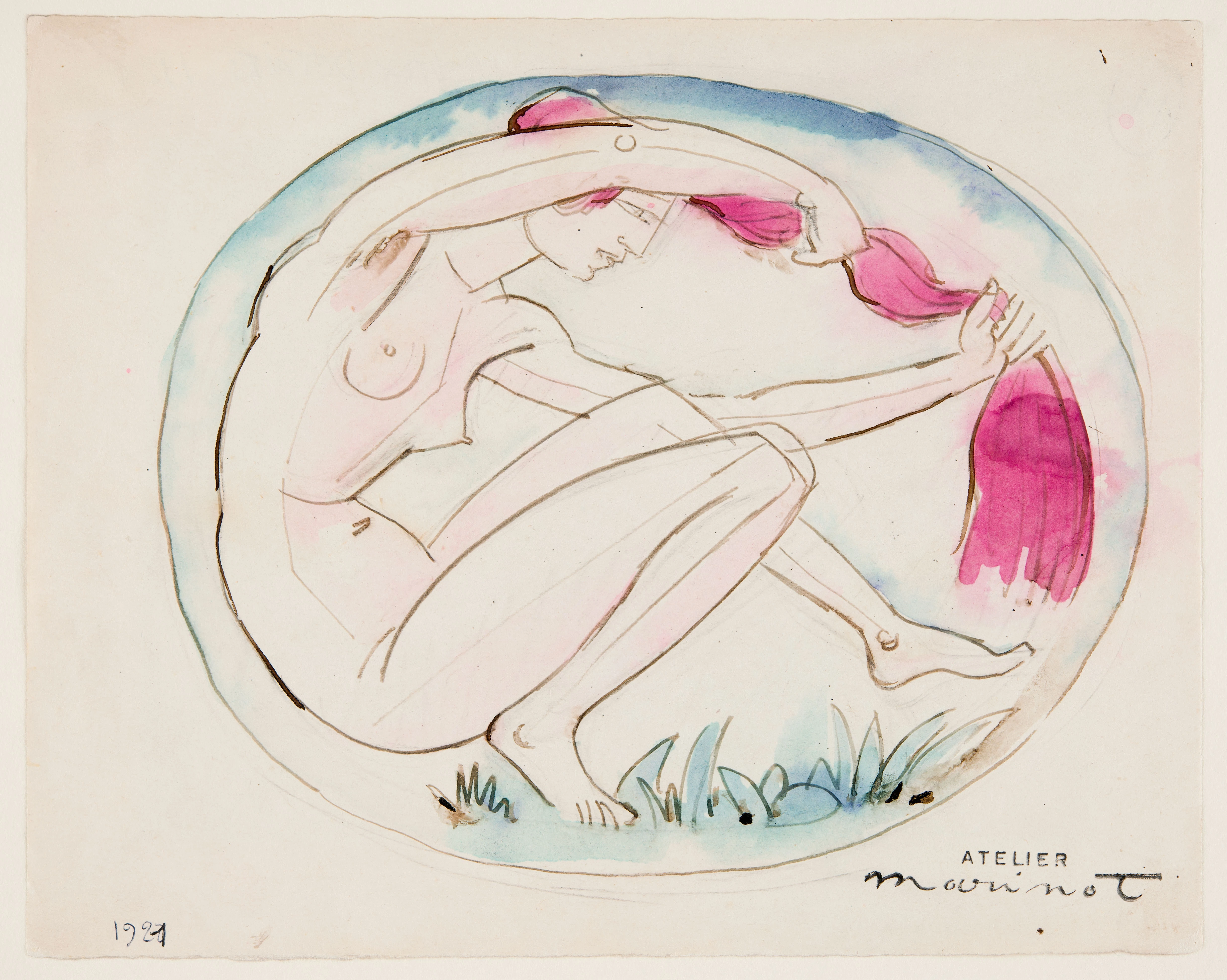
Design for enamelled decoration, 1921, watercolour, ink and pencil on paper. (DA008188)

Design for enamelled decoration, 1921, watercolour, ink and pencil on paper. (DA008188)

Maurice Marinot (1882-1960) is one of the most important glassmakers of the twentieth century. He was a pioneer in the development of glass as an art form. In 1944, a munitions truck exploded outside of his studio, destroying a lifetime of work and making his glass very rare.

Marinot was born in Troyes, south-east of Paris and began his career as a painter. He enrolled at a prestigious Paris art school, but was expelled for being a ‘dangerous non-conformist.’ At the 1905 Salon d’automne in Paris, his paintings were shown alongside those by artists such as Matisse and Derain. Critics attacked the exhibition for its riot of colour, coining the term ‘fauves’ (‘wild beasts’) to describe the artists.

In 1911 Marinot visited the glassworks of his old school friends, Gabriel and Eugène Viard, at Bar-sur-Seine. He was immediately captivated. Desperate to learn the secrets of glassmaking, Marinot persuaded the Viards to give him a work space and tools. He initially drew on his experience as a painter, decorating pieces made by others with vibrant enamels. By the early 1920s, he was sufficiently skilled to begin creating and exhibiting his own glass.

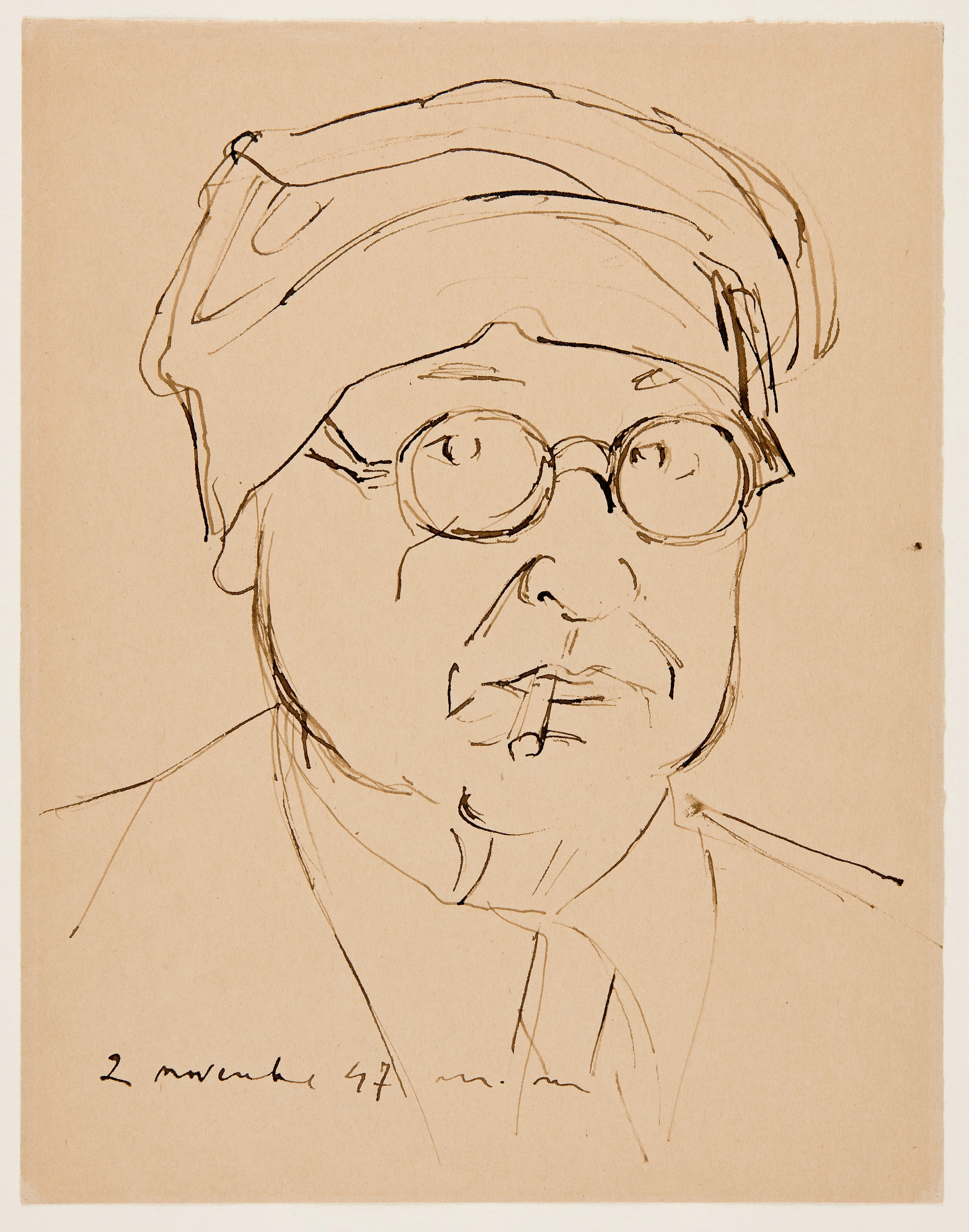
Self portrait, 1947, pen and ink on paper. (DA008196)

Self portrait, 1947, pen and ink on paper. (DA008196)

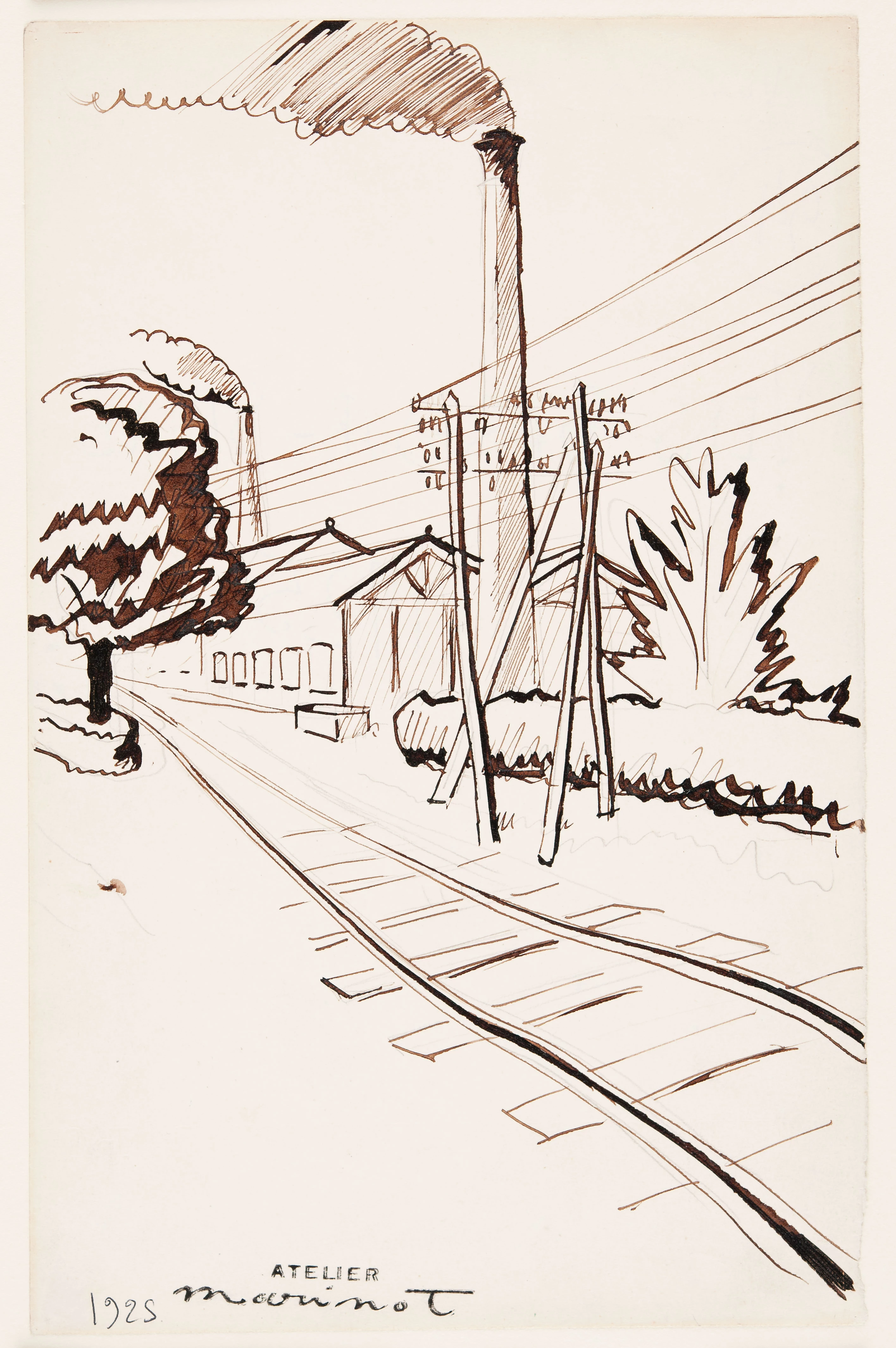
Near Bar-sur-Seine, 1925, pen ink and pencil on paper. (DA006752)

Near Bar-sur-Seine, 1925, pen ink and pencil on paper. (DA006752)

"To be a glassman is to blow the transparent stuff close to the blinding furnace…to work in the roasting heat and the smoke, your eyes full of tears, your hands dirtied with coal-dust and scorched"

(Maurice Marinot, 1920).

Marinot made unique works, entirely by hand, that he considered as creative and meaningful as painting or sculpture. His glass is dense, bold and highly experimental, with an emphasis on form and constant interest in the effects of light. Working in glass provided Marinot with the opportunity to extend his exploration of colour – from delicate, opaque pinks and rich purples, to lucid greens and shimmering metallic. Taking inspiration from nature, his objects can seem as if they are cut from a block of melting ice, carved from granite or filled with murky pond water.

Marinot’s career in glass was intense and very successful, yet relatively brief. In 1937 failing health and a catastrophic fire at the glassworks meant he stopped making after 26 years of experimentation. His extraordinary achievements continue to influence glass artists today.

In 1973 Florence Marinot, the artist’s daughter, gifted works to Amgueddfa Cymru. Florence chose to donate them to this Museum due to the strength of its collection of modern French paintings. Only three other collections in the UK and Ireland hold work by the artist: the Victoria and Albert Museum, New Walk Museum in Leicester and the National Gallery of Ireland.

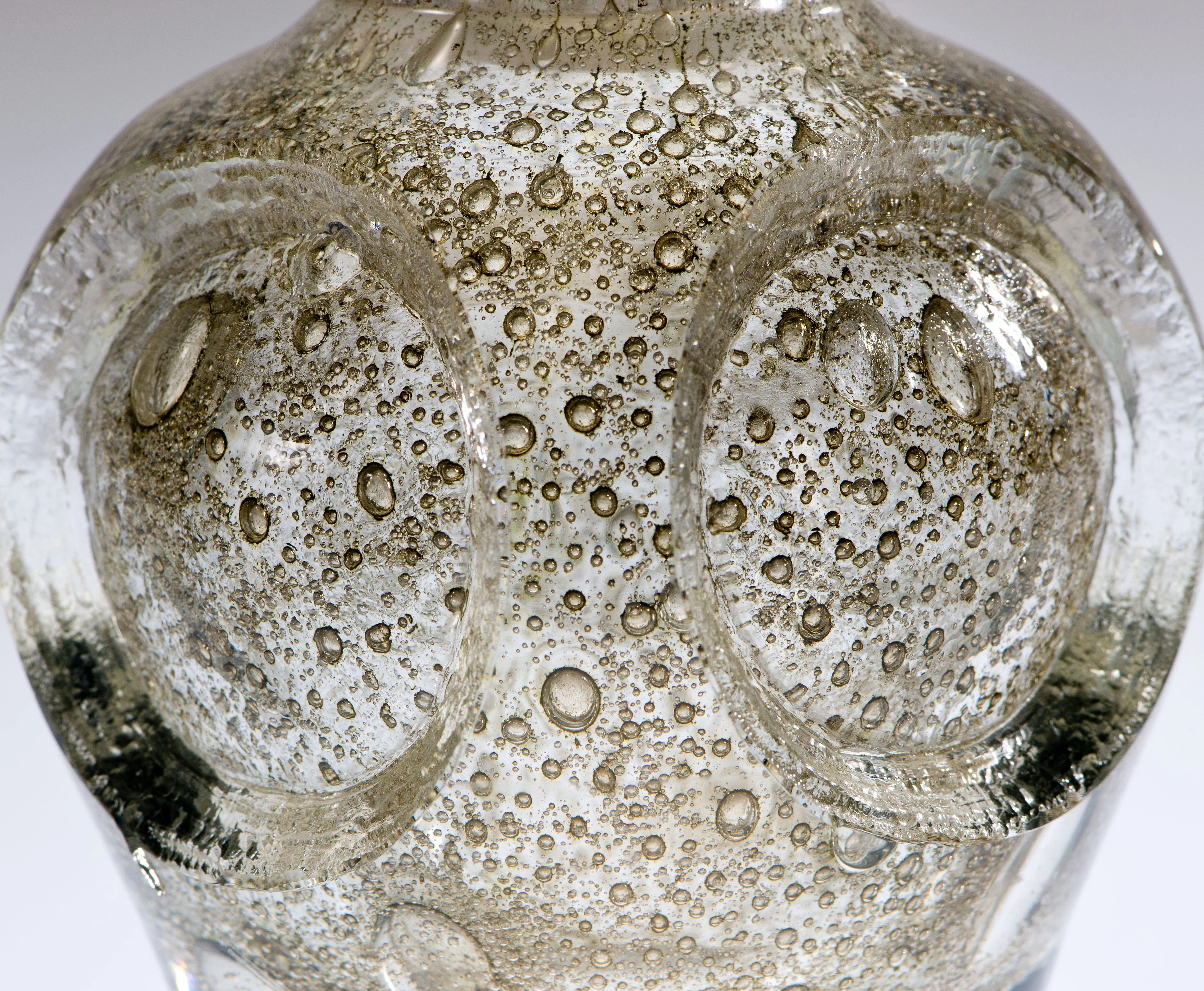
Detail of a bottle, 1929, bubbled and acid-etched glass. (DA008203_05)

Detail of a bottle, 1929, bubbled and acid-etched glass. (DA008203_05)

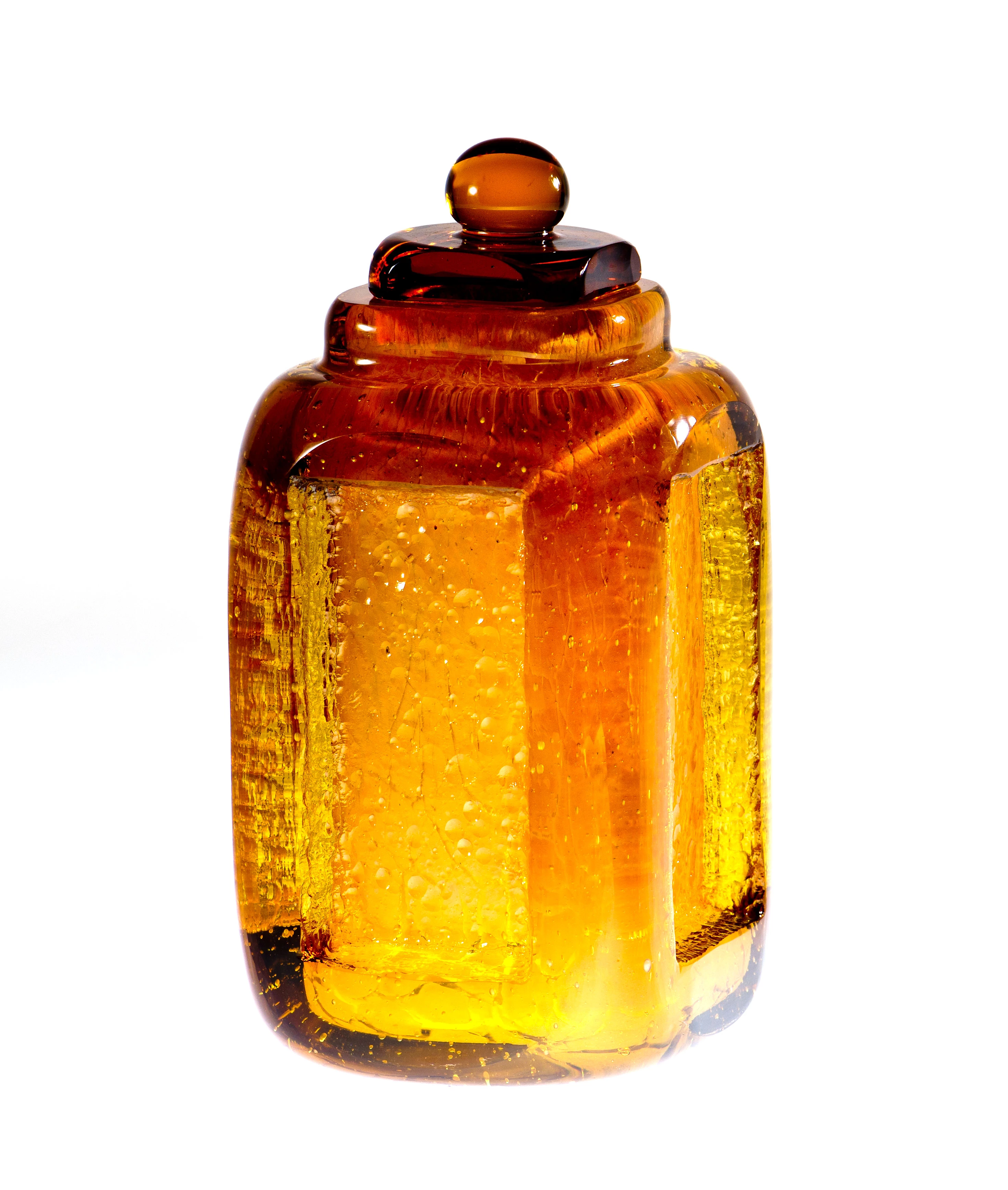
Bottle and stopper, 1929, acid-etche, crackled and cased glass. (DA008205_03)

Bottle and stopper, 1929, acid-etche, crackled and cased glass. (DA008205_03)

With thanks to Dr P. Merat for permission to reproduce images of work. All images © Dr P Merat.