Collections & Research

Voices from the Archive – Christmas at St Fagans in the early 1900s

Elen Phillips, 19 December 2016

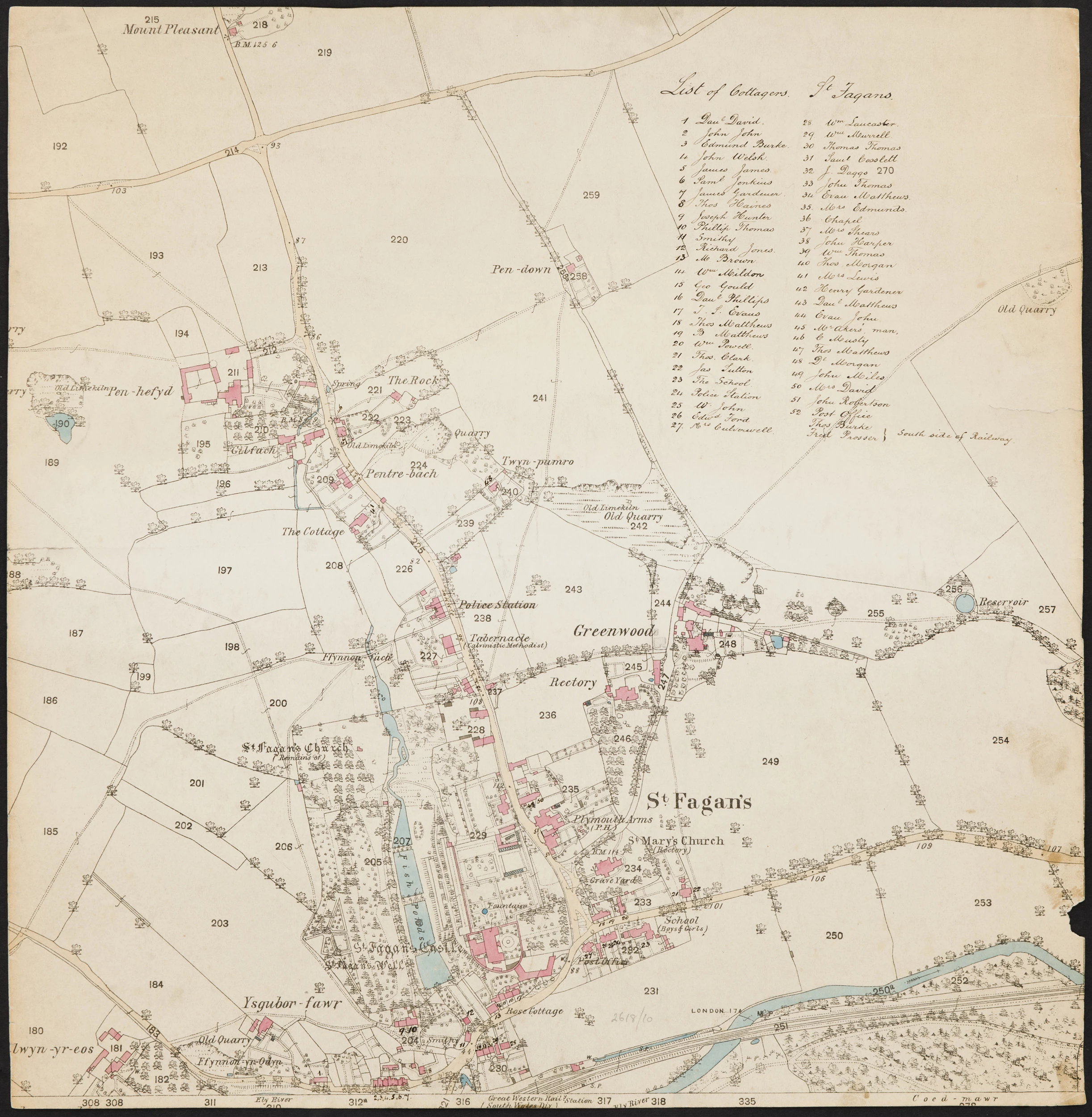
A few years ago, while researching the history of St Fagans Castle during the First World War, I came across a number of oral history interviews in the Sound Archive with former tenants of the Plymouth Estate. The recordings were made in the 1970s and 1980s with people who had, for the most part, lived all their lives in St Fagans village. Although very few of the recordings yielded information relevant to my research, they did provide a vivid insight into the workings of the estate during the first half of the twentieth century, when village life revolved around the Castle and its owners the Earl and Countess of Plymouth. With Christmas almost upon us, I thought I'd use my last blogpost of 2016 to share some of the villagers' recollections of Christmas at St Fagans in the early 1900s. Nadolig llawen!

Christmas beast

Alexander ‘Bert’ Warden, born in Cirencester in 1910, moved with his family to St Fagans as a child. In an interview with the Museum in 1979, he remembered distributing meat to the villagers at Christmas:

Penhefyd Farm was the home farm in those days. Of course, the Plymouth people kept cattle there and all the rest of it. At Christmas time, they’d have a beast and it would be slaughtered, cut up into various chunks and each family in the village was allowed so much – I think it was about 5lb for a man, and 3lb for his wife and so much for each child. Now that was delivered around for the villagers by workmen from the estate. I did it myself when I was a boy. That was one of the Christmas boxes from the Plymouth Estate. Also a couple of rabbits – each person had a couple of rabbits and a load of logs. [6020/1]

Mary Ann Dodd, a housemaid for the Plymouth family at the turn of the century, remembered using the Christmas beast to make soup for the villagers. In the early 1960s, at the age of 96 and living at the Grange Home for the Blind in Hereford, she wrote an essay for the Museum about her 30 years working at St Fagans Castle:    

Every Christmas two animals were killed, and her Ladyship told Mrs Cousins to use the heads, legs and offal for soup. This was supervised by the Lady herself and was made in my biggest copper saucepan. It was so big I could almost stand in it. The Housekeeper put in the salt and seasoning, and my Lady was keen on plenty of parsley, and all five kitchen maids and myself prepared the vegetables. We cleaned celery, carrots and leeks. Once they knew that the soup was ready, the village folk came from breakfast time on with jugs and basins and all manner of things and they were all provided with meat and soup. [MS 1293]

Children’s party

Another festive tradition remembered with fondness was the children’s Christmas party. This was held in the Banqueting Hall – a large pavilion in the Castle grounds – before the end of the school term. Jessie Warden (née Mildon), who was born and brought-up in the village, described it as one of the 'perks' of living on the estate:

We were always a jolly lot. Lord Plymouth, every year, gave every child in the whole of the school – there could be a 100, there could be 50 – a Christmas party in the Banqueting Hall. Everything from the jelly to the Christmas presents at five shillings per child was paid by Lord Plymouth. And that was wonderful. It was a real Christmas party paid for by Lord Plymouth. There was a huge Christmas tree with your presents on the tree. Lady Plymouth was usually there and would give to the boys and Lord Plymouth would give to the girls. And they’d have a man with a ladder to get your particular present off the tree. The tree would then go to the Cardiff Royal Infirmary. [6020/1]

Mari Lwyd

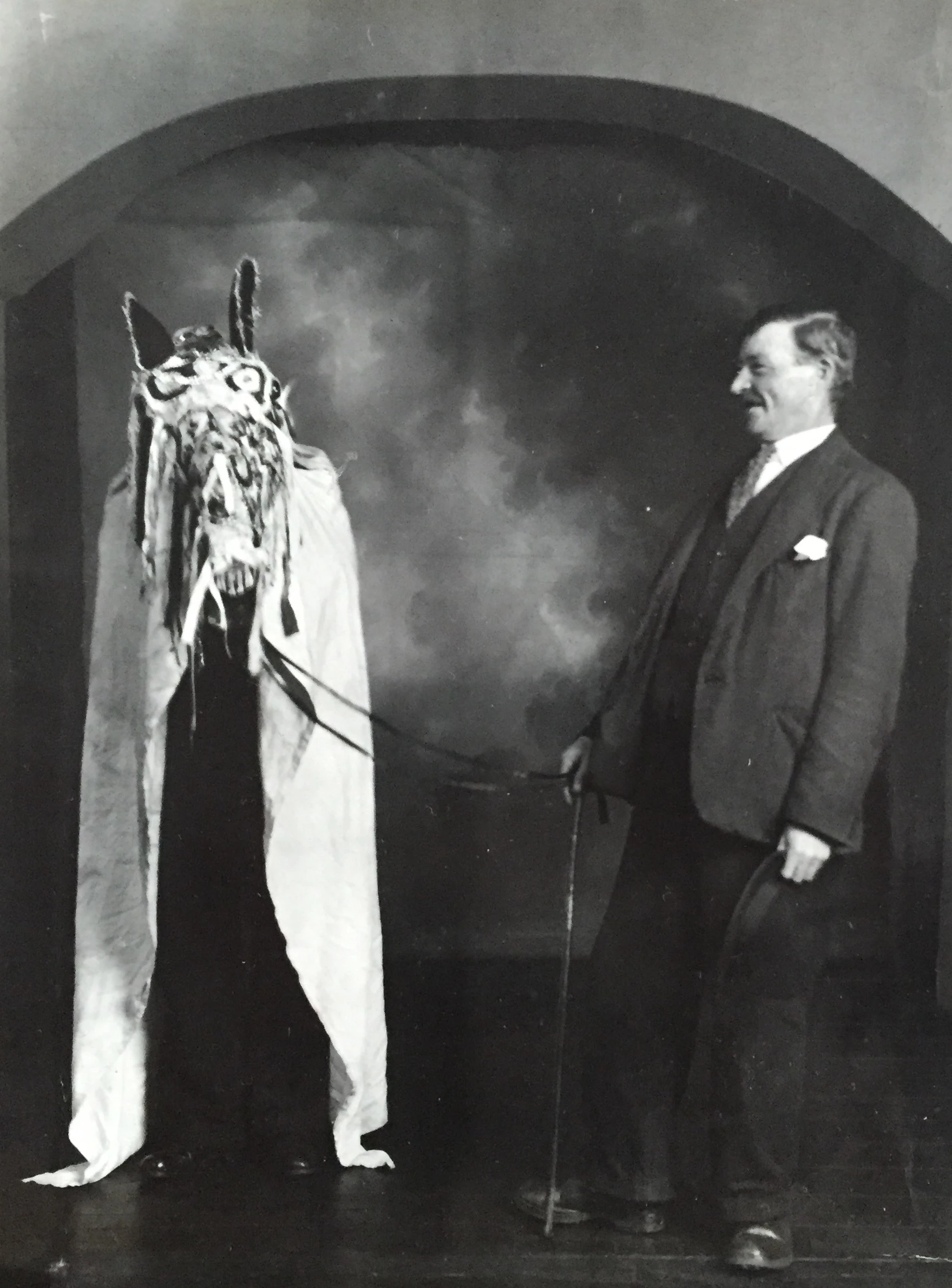
Jessie Warden also recalled her childhood fear of the Mari Lwyd – a seasonal custom practiced without the patronage of the Plymouth Estate:

They had a Mari Lwyd every year. The Mari Lwyd used to come and that was a chap from Pentyrch, and there was one from Ely. There was one from the village, but then when he finished, his relatives in Ely came out in my day. When I was about ten. I can remember the Mari Lwyd. We were always petrified! The responses etc. were always in Welsh. [6020/1]

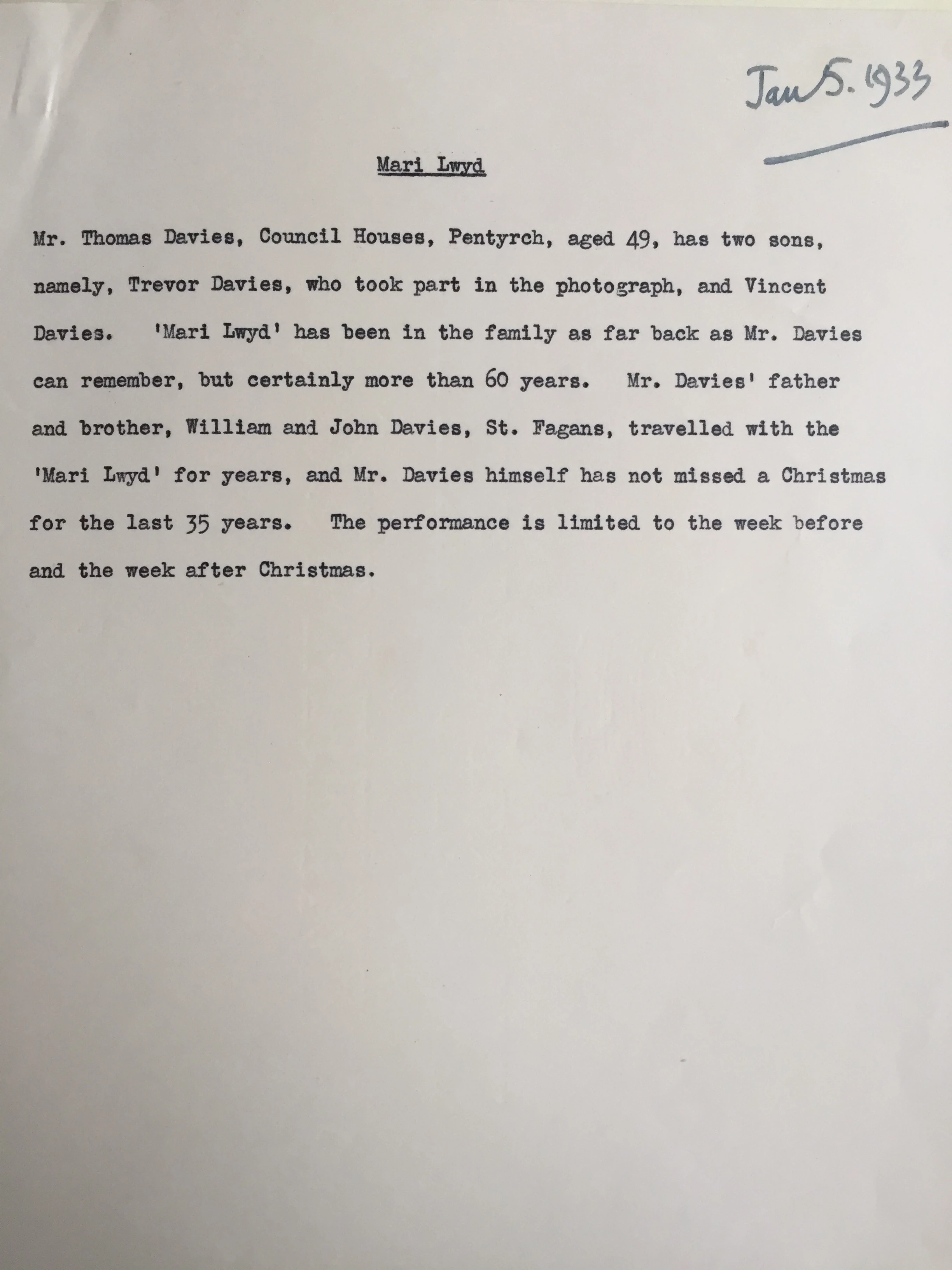
In 1933 the Museum acquired a Mari Lwyd for the collection from Thomas Davies of Pentyrch who would perform for one week either side of Christmas. At the time, the curator noted that he had been travelling with the Mari for 35 years and had connections with St Fagans. He probably visited the young Jessie Mildon and her family.



Off With His Head!
The Story of Commonwealth Coins

Rhianydd Biebrach, 16 December 2016

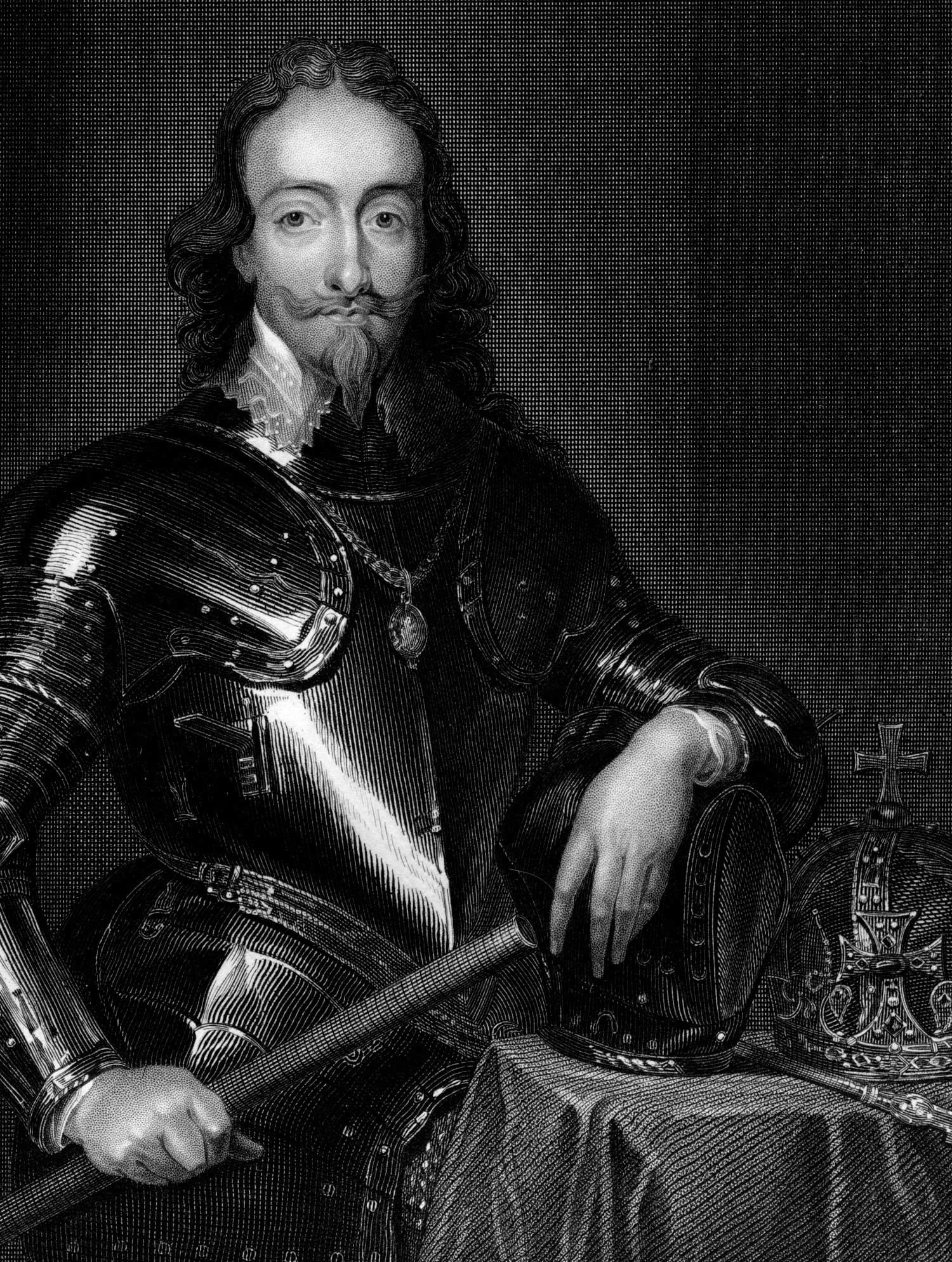
Portrait of King Charles I

Portrait of King Charles I

On the bitterly cold morning of 30 January 1649, following a long and brutal civil war between Crown and Parliament, King Charles I was beheaded in London and the monarchy was abolished.

Three years earlier, in 1646, Parliament had rid the Church of England of its bishops, and when the House of Lords was also abolished in March 1649, virtually the entire, centuries-old, basis of government in Britain had disappeared, seemingly for good. Little wonder people living at the time called it ‘a world turned upside down.’

In the end this uncertain Commonwealth period was to last only eleven years as the monarchy was restored in 1660, but the highly distinctive coins minted during this short stretch of time are sometimes unearthed by metal detectorists in Wales and reported via the

Portable Antiquities Scheme . They have been found in small numbers all over Wales, from Manorbier in Pembrokeshire to Cwm in Flintshire, and in various states of wear including one or two which were later reused for other purposes. So what makes them worth talking about?

Coins for the Commonwealth

It is not surprising that the radically new form of government ushered in so bloodily with the end of the monarchy in 1649 should have caused an upheaval in another enduring aspect of national identity – the coinage. Prior to this all coins had been issued in the monarch’s name and contained his or her image. Even during the Civil Wars (1642-48), Parliament – which was in control of London and therefore also of the Tower Mint - had continued to strike coins in the traditional style as long as the outcome of the war was uncertain. But now that Britain was a republic the centuries-old design of coins with the monarch’s head and Latin legend was clearly inappropriate. A new design, emphasising the legitimacy of the new republican regime, was needed.

Why do they look different?

Commonwealth half groat (twopence) found by R. W. Bevans in Manorbier, Pembrokeshire, 2009. The smaller denomination coins did not have a legend or date.

Commonwealth half groat (twopence) found by R. W. Bevans in Manorbier, Pembrokeshire, 2009. The smaller denomination coins did not have a legend or date.

You don’t need to be a coin expert to notice the obvious difference between the new coins and those we are all more familiar with - there is no king’s head! Of course, when the real king’s head was removed from his shoulders, its likeness also had to be removed from the coinage. With the king gone, the House of Commons claimed that it now exercised sovereign power on behalf of the people, and that God had given his approval to this new state of affairs by allowing Parliament to defeat the king in battle. This bold claim was bolstered by the imagery and lettering used on the new coinage.

On the obverse (heads) side, replacing the traditional monarch’s crowned head, there now appeared a shield containing the cross of St George, representing England. This was surrounded by a wreath of laurel and palm, symbolising Parliament’s victory and the peace it claimed it had brought. On the reverse (tails) side were the conjoined shields of England and Ireland, the latter represented by an Irish harp, along with the date of issue and denomination. Scotland, then a separate nation with its own coinage, was not represented, nor was Wales, which was thought of as part of the kingdom of England and so covered by the cross of St George – as is still the case in the modern Union Jack.

There were also changes to the legends, or lettering, appearing around the edge of the coin’s faces. Traditionally these would have been in Latin, giving the name of the monarch and an abbreviated list of their titles (including a claim to France!) as well as a Latin motto, but this was now replaced with ‘THE COMMONWEALTH OF ENGLAND’ on the obverse and ‘GOD WITH US’ on the reverse. These simple statements not only did away with all references to royal power, they also replaced Catholic-sounding Latin with good Protestant English, and in true Puritan style laid claim to God’s favour and support.

Royalist reaction and the ‘Rump Parliament’

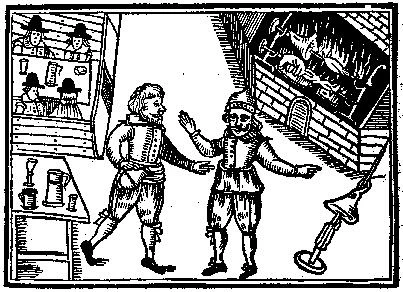
A seventeenth-century woodcut showing two men in a tavern, wearing the breeches said to resemble the conjoined shields of the Commonwealth coins

A seventeenth-century woodcut showing two men in a tavern, wearing the breeches said to resemble the conjoined shields of the Commonwealth coins. (Source: http://www.godecookery.com/mirth/mirth008.html)

Although Charles had been defeated and the monarchy abolished, there were still many people who had been against his execution and were fierce critics of the new republican regime, led by the so-called ‘Rump Parliament’ until 1653. Even the coins came in for ridicule, the royalists finding ways to attack the government by poking fun at the new designs. The wording of the legends on either side of the coins, for example, led royalists to observe that ‘God’ and ‘the Commonwealth’ were on opposite sides. The appearance of the conjoined shields of England and Ireland also caused amusement as they bore an uncanny resemblance to a pair of breeches, and were referred to in royalist circles as ‘breeches for the rump’, ‘rump’, being not only the name of the parliament but also a common term for someone’s backside.

Interestingly, in 1658 the government made an attempt to return to a more familiar design harking back to the royalist period. This featured the profile of the new head of state, Protector Oliver Cromwell, crowned with a laurel wreath on the obverse, and a coat of arms surmounted by – of all things – a crown on the reverse. Cromwell had earlier been offered the crown, but had refused it, so was it included in the new design in an attempt by the shaky government of the day to present an image of stability using the more familiar symbolism of times gone by? Cromwell died soon after this and the coins were never circulated so are not likely to be found by detectorists.

The Restoration and beyond

Worn commonwealth half groat reused as a love token, found by Gwyn Rees near Wenvoe, South Glamorgan, in 2012.

Worn commonwealth half groat reused as a love token, found by Gwyn Rees near Wenvoe, South Glamorgan, in 2012.

Commonwealth half groat found by Gwyn Rees near Wenvoe in 2015. The piercing may have been to take it out of circulation.

Commonwealth half groat found by Gwyn Rees near Wenvoe in 2015. The piercing may have been to take it out of circulation.

The republican experiment ultimately failed and the monarchy was restored under Charles II in 1660. Those who had signed his father’s death warrant, known as the regicides, were rounded up and executed; even the corpse of Oliver Cromwell was exhumed and hung in chains. A similar lack of mercy was shown to the Commonwealth coinage. It was suppressed and called in for recoining between 1661 and 1663, with an estimated two-thirds out of the total minted since 1649 being recovered. But what happened to the rest?

Most will have been taken abroad and some was hoarded, although the coins recovered by detectorists in Wales, which are all of the smaller denominations of penny and half-groat, suggest that some were accidentally lost. The wear and tear suffered by most of these finds may be a result of use or of subsequent damage while in the ground, although one found by Gwyn Rees near Wenvoe, South Glamorgan, in 2012, which has been bent and pierced with a hole at the top, seems to have been reused as a love token, possibly to have been suspended from a chain or ribbon. Was this discarded coin an accidental loss, or is it evidence of a failed relationship? Another Commonwealth half groat, also found near Wenvoe by Mr Rees in 2015, has been pierced in the centre, probably to demonetise it and take it out of circulation in the early 1660s. It is possible that the Restoration government did not bother to recall all the smaller denomination coins, which may therefore have continued in circulation beyond the early 1660s.

Historical significance

Commonwealth of England, half crown (2s 6d), 1649

Commonwealth of England, half crown (2s 6d), 1649

Although collectors see them as relatively uninteresting because of the plainness of the design and its uniformity across the denominations, Commonwealth coins are fascinating from a historical and archaeological point of view. In circulation for such a short period of time they are survivors of a troubled period in British history, when a bloody and divisive war was followed first by the shock of the king’s execution and then by years of political and religious upheaval as the country tried to find an acceptable alternative to monarchical rule. Just as all the political alternatives failed in turn, the new coins’ design was also shortlived – Charles II reverting to the familiar, centuries-old monarch’s head format, which continues in use today. The radical changes in design show how the new republican government tried to heal the ruptures of the Civil Wars and bolster its legitimacy in the absence of the king. Are they best seen as signs of life continuing much as it always had, or relics of a world turned upside down?

Oliver Cromwell, pattern half crown, 1658

Oliver Cromwell, pattern half crown, 1658

Connecting with the past through objects

Rhianydd Biebrach, 9 December 2016

If you have read any of the recent blog posts about the Saving Treasures; Telling Stories Project, or the Lost Treasures of Swansea Bay Project and its various exciting activities, you will know that Saving Treasures works with metal detector groups and local museums in Wales to widen access to, and understanding of, the material heritage of Wales.

What is material heritage?

Material heritage is the physical remains of the past, the objects left behind by past societies. Often, these are brought to light by members of the public, mainly metal detectorists, who report their significant finds to their local Finds Liaison Officer in order that they can be recorded on the Portable Antiquities Scheme database.

Taken together, these objects – especially when they are made available to the public in museum collections – help to build up a picture of how we used to live and who we used to be.

Why is it important?

The Saving Treasures; Telling Stories Project recognises that interaction with the history of your local area through the objects past communities left behind can be a powerful and enriching experience.

For those who are interested in the past, having access to the actual things that long-dead people used, wore and handled can bring us into contact with them much more directly than a history book ever could.

Every object has a story to tell

The discovery of a lost mourning ring or a hoard of Bronze Age axes tells us something about the people who used such objects and raises questions about how they came to be in the ground. Were they lost, discarded, or put there deliberately? And if so, why?

Thinking about these questions allows us to empathise with our forebears, understand something of their hopes, fears and concerns, and walk a little way in their shoes.

O Christmas Tree, O Christmas Tree

Katie Mortimer-Jones, 1 December 2016

Yes, you have guessed it, it's time to roll out our annual #MuseumAdvent Calendar at National Museum Cardiff.

Each year throughout December we like to highlight our fantastic collections and spread some Christmassy cheer.

So why not find out what is behind each door of our advent calendar by following the @CardiffCurator Twitter account and see what wonderful suprises we have in store for you behind each one. We have delved deep into our collections to find some great Christmas objects. This year the theme of our advent calendar is lines from Christmas songs and poems. See if you can work out which song or poem each line comes from.

We have started off the calendar with:

Diwrnod 1 #AdfentAmgueddfa: ‘Aur, thus a myrr a gafodd ef, gan ddoethion ddaeth o bell’. Aur Cymru o gasgliadau @Museum_Cardiff

Day 1 of #MuseumAdvent - ‘Five gold rings!’, 5 nuggets of Welsh Gold from @Museum_Cardiff collections

Enjoy!

Update:

Well, now that the festive period is over and the decorations are coming down. We thought that we would put all of our Christmassy tweets together in this Storify for you to read.

Let the festivities begin - Conservation volunteer update

Penny Hill, 30 November 2016

Our conservation volunteers are helping to get Christmas underway at St Fagans. The first historic building to get the festive treatment was Cilewent Farmhouse originally from Rhaeadr Powys. The display reflects life as it was in the 18th century with most of the furniture dating to 1750. Preparations for Christmas would involve decorating the home with evergreen foliage gathered from the surrounding countryside, such as laurel, ivy, holly and yew. A tradition that has its origins firmly rooted back in our pagan past and continues to this day with the Christmas tree.

The evergreens stand out among the dormant trees in the museum grounds so it didn't take long to gather up enough to prepare the garlands for Cilewent.  We also created a bracket out of 4 sticks of even length (80cm) and to this attached more evergreen foliage and red ribbons. Red berries were very popular, but these dry out and fall off quickly. A recommended technique to help preserve their colour was to store the berries in salt water after picking, we haven't tried this yet, but we'll probably give it a go next year as a flash of red would definitely enhance the overall effect.

The garlands were much bigger than we anticipated and they soon turned into rather unwieldy evergreen snakes, but between us we managed to walk them across the site and secure them to the beams of Cilewent.

If you would like to try this out at home be careful with the holly, it can scratch, not just yourself but furniture and wallpaper as well, so remember to place a barrier of card or fabric between holly and any vulnerable surfaces.

Well, one house done, 11 more to do and only 20 days to Christmas!