: Agricultural, Craft and Transport

Traditional fishing practices on the Severn Estuary

25 September 2007

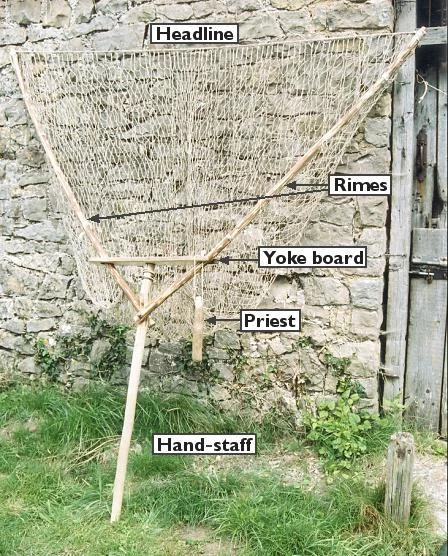
The lave net.

The lave net.

Blackrock Lave Net Fishermen, beside the Second Severn Crossing. From left to right: Bob Leonard, Richard Morgan a Martin Morgan.

Blackrock Lave Net Fishermen, beside the Second Severn Crossing. From left to right: Bob Leonard, Richard Morgan a Martin Morgan.

The centuries-old fishing method of 'Lave Net fishing' continues along the banks of the River Severn.

The waters of the Severn Estuary are among the most dangerous in Wales but this has not deterred generations of fishermen from fishing its rich waters for salmon. Traditional Welsh methods of catching salmon survived particularly strongly in the area. Within living memory a range of methods were used, including putcher ranks, stopping boats, putts, drift nets and lave netting. Lave Net fishing is the only traditional method to have survived into the 21st century.

Unique historic significance

The number of lave netsmen has declined over the years and now can only be seen in the area of the Second Severn Crossing close to the villages of Sudbrook and Portskewett in Monmouthshire. The Blackrock Lave Net Fishermen Association, carry on a tradition that has a unique cultural and historical significance.

Fish are caught at low tides, known as spring tides, using a hand-held net. At one time fishermen were allowed to fish from February to August but this has since been restricted from June to August. At most, they can fish for an hour and a half at a time depending on weather conditions.

Fishing commences as it always has with the fishermen going down to the shore at Black Rock standing where their grandfathers and great-grandfathers once stood.

The basic technique for lave fishing is simple, the hand-staff is held in one hand and the headboard with the other, whilst the fingers are entwined in the bottom of the mesh feeling for the fish. The net is positioned in front of the fisherman, to face the run of the water. The fishermen consider wind direction and the height of the tide, with the optimum conditions being flat and calm.

At one time there was no need to divide the catch as there was sufficient salmon for everyone. Times have changed and commercial fishing using the lave net has not been viable on the estuary since before the Second World War. Prior to 1939 the fish were sent to Billingsgate Market in London.

The lave netsmen are as skilled as their forefathers but due to the diminishing fish stocks they are lucky if they catch more than a dozen fish for the season. They fish to keep their centuries old craft alive as Martin Morgan, Secretary of the Association explains "Lave fishing has a tradition going back a thousand years in Wales. My great-grandfather was a fisherman and passed his skills on through the family".

Background Reading

Severn Tide by Brian Waters. Published by J.M. & Sons Ltd (1947).

Nets and Coracles by J. Geraint Jenkins. Published by David and Charles (1974).
The Brynmawr Experiment, 1929-40

23 April 2007

Brynmawr furniture

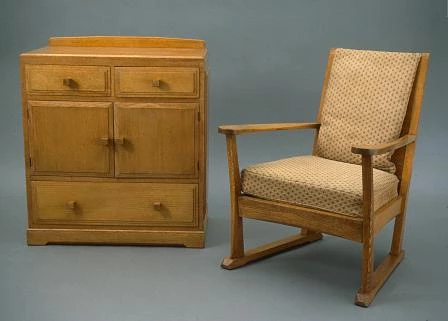
Talybont cupboard-chest and Ynysddu armchair by the Brynmawr Furniture Company.

Talybont cupboard-chest and Ynysddu armchair by the Brynmawr Furniture Company.

The 'Brynmawr Experiment' was an attempt by the Quakers to relieve the mass unemployment in the town of Brynmawr, south Wales in the early 1920s. They set up a small furniture-making enterprise that led to a major chapter in the social and artistic history of Wales.

The venture started in 1929, employing twelve local untrained men and later took on boys trained straight from school. Support came mainly from other successful Quaker companies - the first order was for 400 chairs for a Quaker school in York. Each chair cost £1 each (equivalent to £41 or $71 today). New equipment and machinery was bought with the profits

Paul Matt

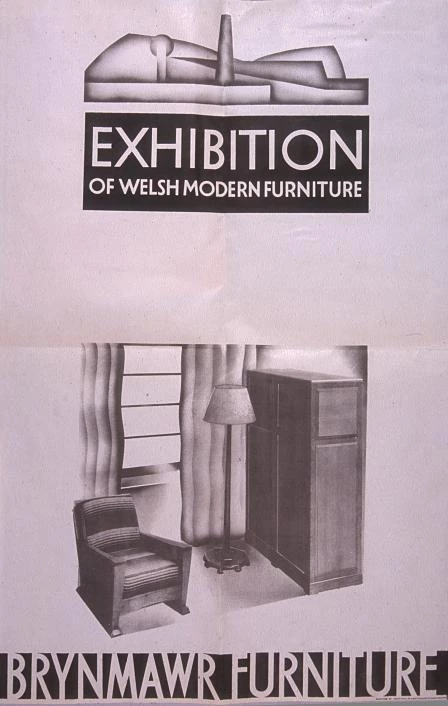
Advertising poster for the Brynmawr Furniture Company.

Advertising poster for the Brynmawr Furniture Company.

The success of Brynmawr furniture was mainly due to the designer, Paul Matt. He had served his apprenticeship under his father, a skilled designer and cabinet-maker in London.

Paul Matt designed furniture that was simple to construct, taking into consideration that the workers were initially all unskilled. The main timber used was imported oak, finished with a coat of clear wax which gave the furniture an overall simple and minimal appearance, in line with the Quaker philosophy.

Glossy catalogues and promotional leaflets emphasised the high quality and design of the products whilst providing sustainable employment for the local community. These ideals appealed to the middle and professional classes of the 1930s and the company made the furniture affordable to such professions.

'Welsh' furniture

David Morgan's department store opened in Cardiff in 1879. The store provided important support for the Brynmawr Furniture Company between 1932 and 1940.

David Morgan's department store opened in Cardiff in 1879. The store provided important support for the Brynmawr Furniture Company between 1932 and 1940.

Brynmawr furniture was available in large department stores such as Browns of Chester and Lewis's of Birmingham and Manchester. In 1938 the company had a permanent showroom in London's fashionable Cavendish Square.

Although successful in England, the company was also keen to promote Brynmawr furniture in Wales. David Morgan Limited, a well-known Cardiff department store provided exhibition space free of charge for the products and exhibitions were held at the National Eisteddfods.

The furniture was marketed as 'Welsh' and branded using Welsh place-names such as the Cwmbran chest, Llanelli table and the Cwm-du chair. This ensured a loyal following within Welsh professional and academic circles throughout the 1930s.

The advent of War

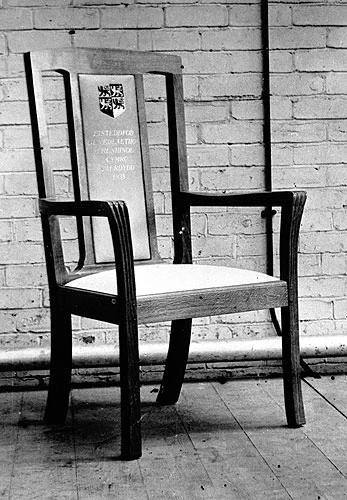
The Cardiff National Eisteddfod Chair, 1938 from the Bryn-mawr Settlement Factory.

The Cardiff National Eisteddfod Chair, 1938 from the Bryn-mawr Settlement Factory.

In 1936 Arthur Reynolds took over as designer from Paul Matt. Although production remained relatively unaffected, sales gradually declined in the late 1930s as the war approached. The advent of war also made it difficult to import materials therefore the Brynmawr Furniture Co. sadly had no other choice than to cease trading in 1940.

Background Reading

'Crafts and the Quakers' by Gwen Lloyd Davies. In Planet, vol. 51, p108-111 (July 1985).

'Utopian designer: Paul Matt and the Brynmawr Experiment', by Roger Smith. In Furniture History vol. 23, p88-94 (1987).

Lindsay Shen, 'Philanthropic Furniture: Gregynog Hall, Powys' by Lindsay Shen. In Furniture History vol. 31, p217-235 (1995).