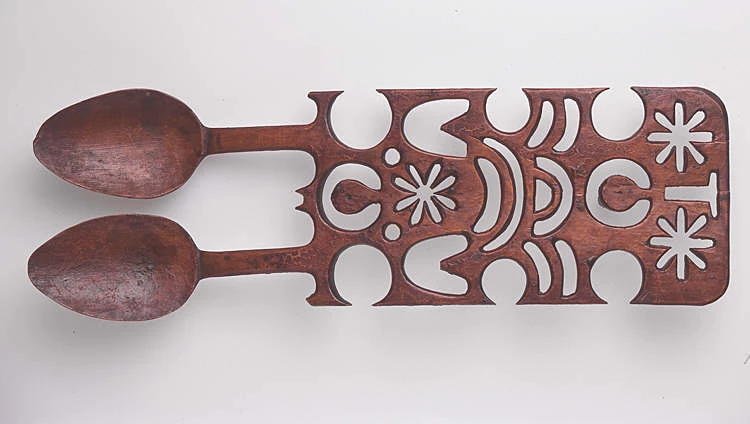
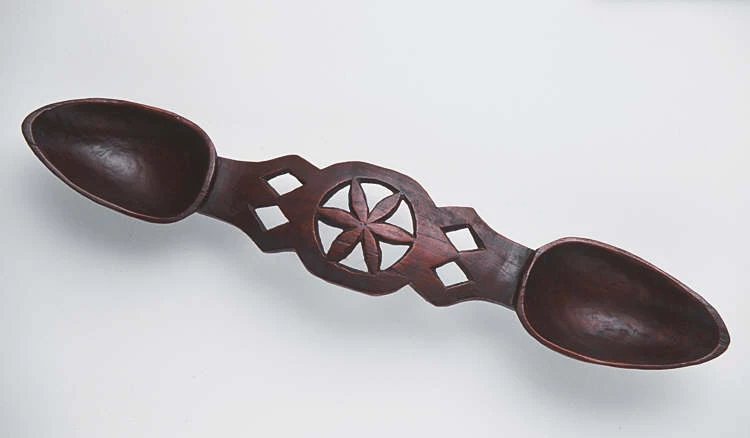
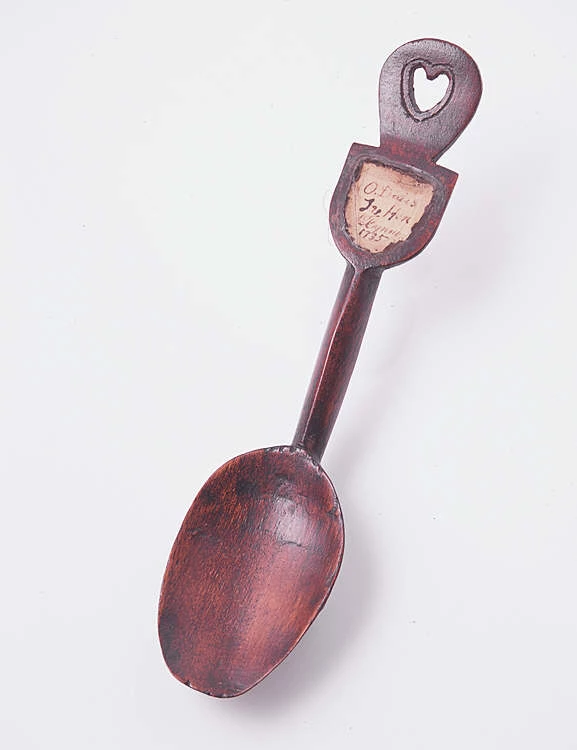
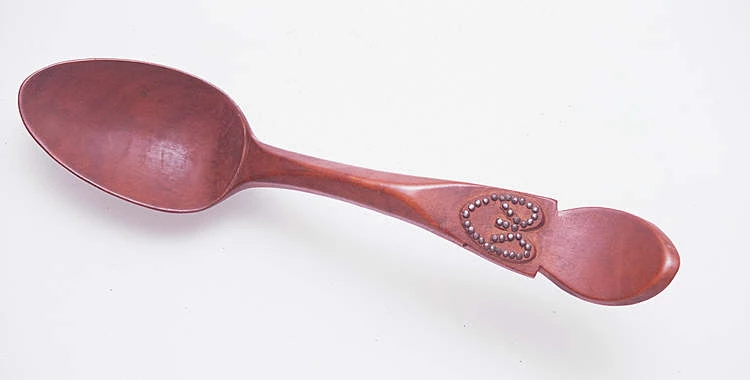
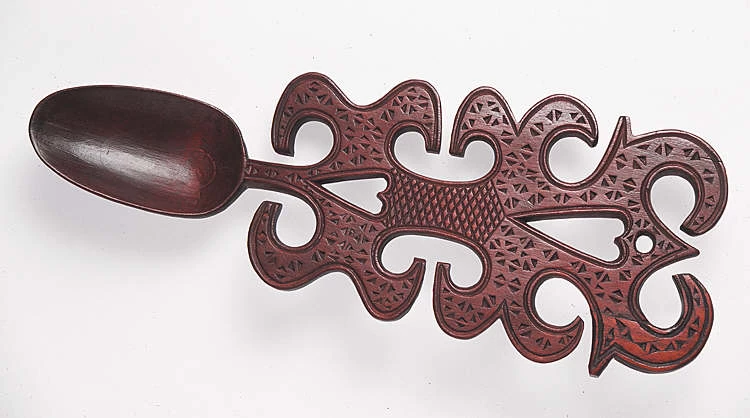
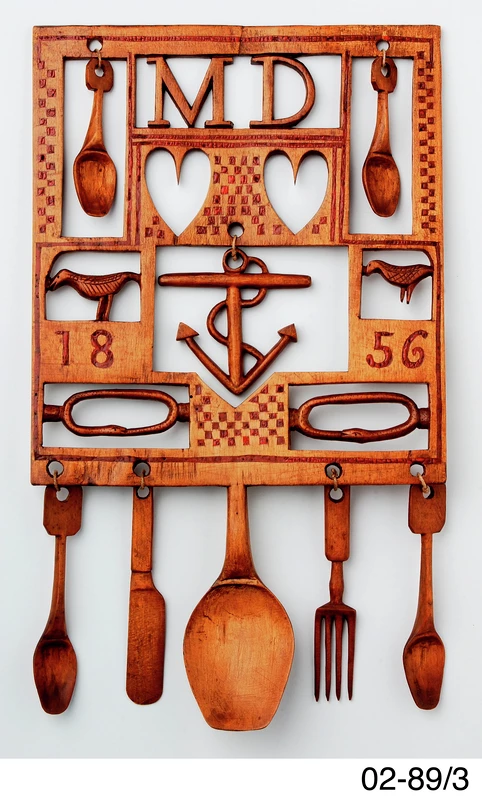
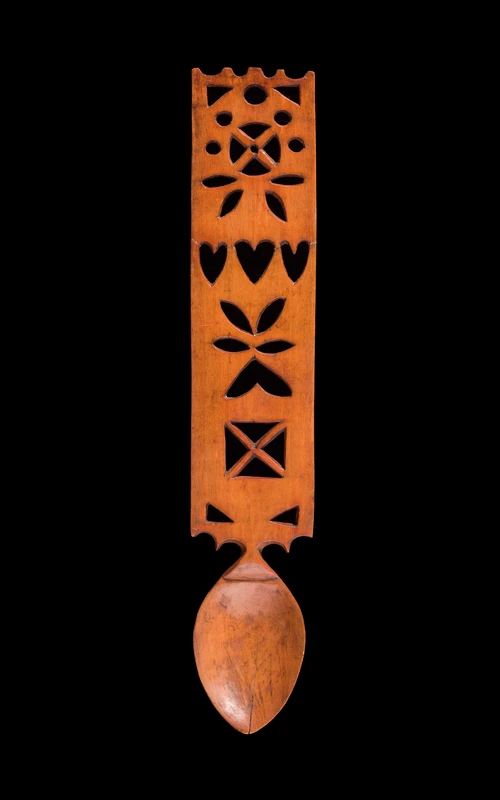
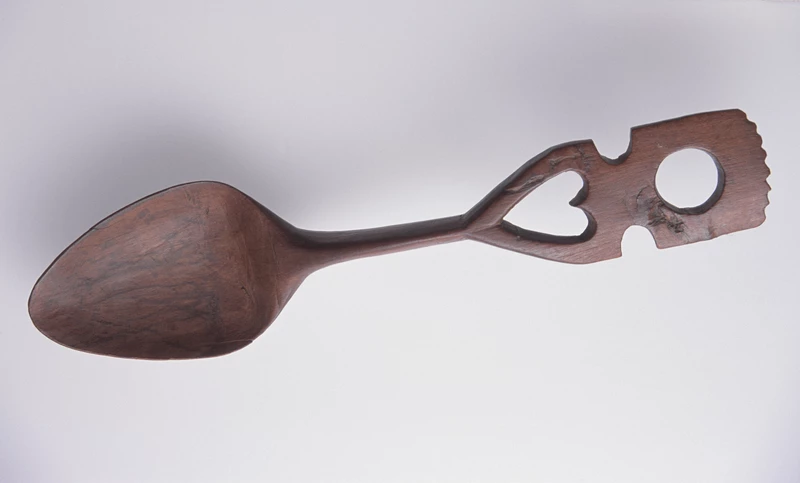
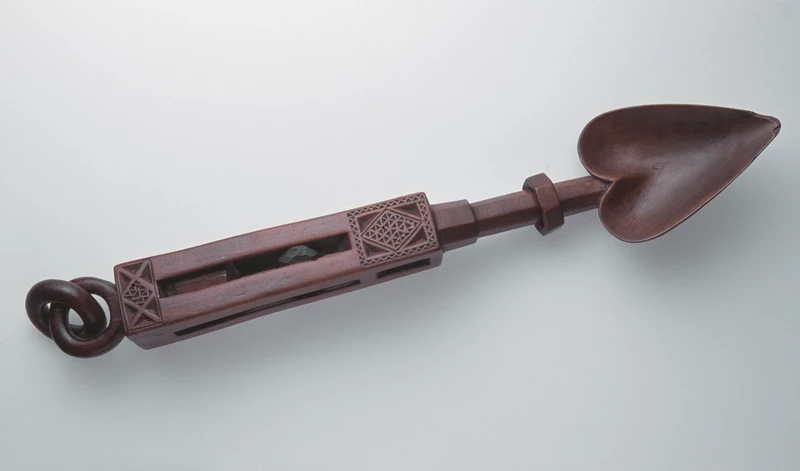
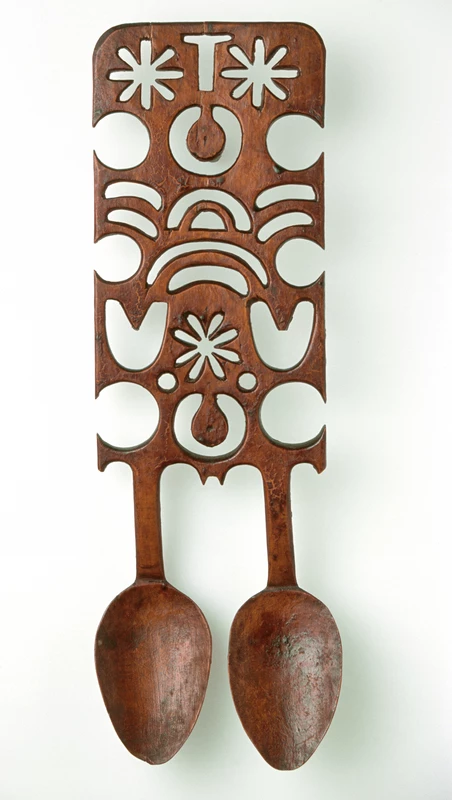
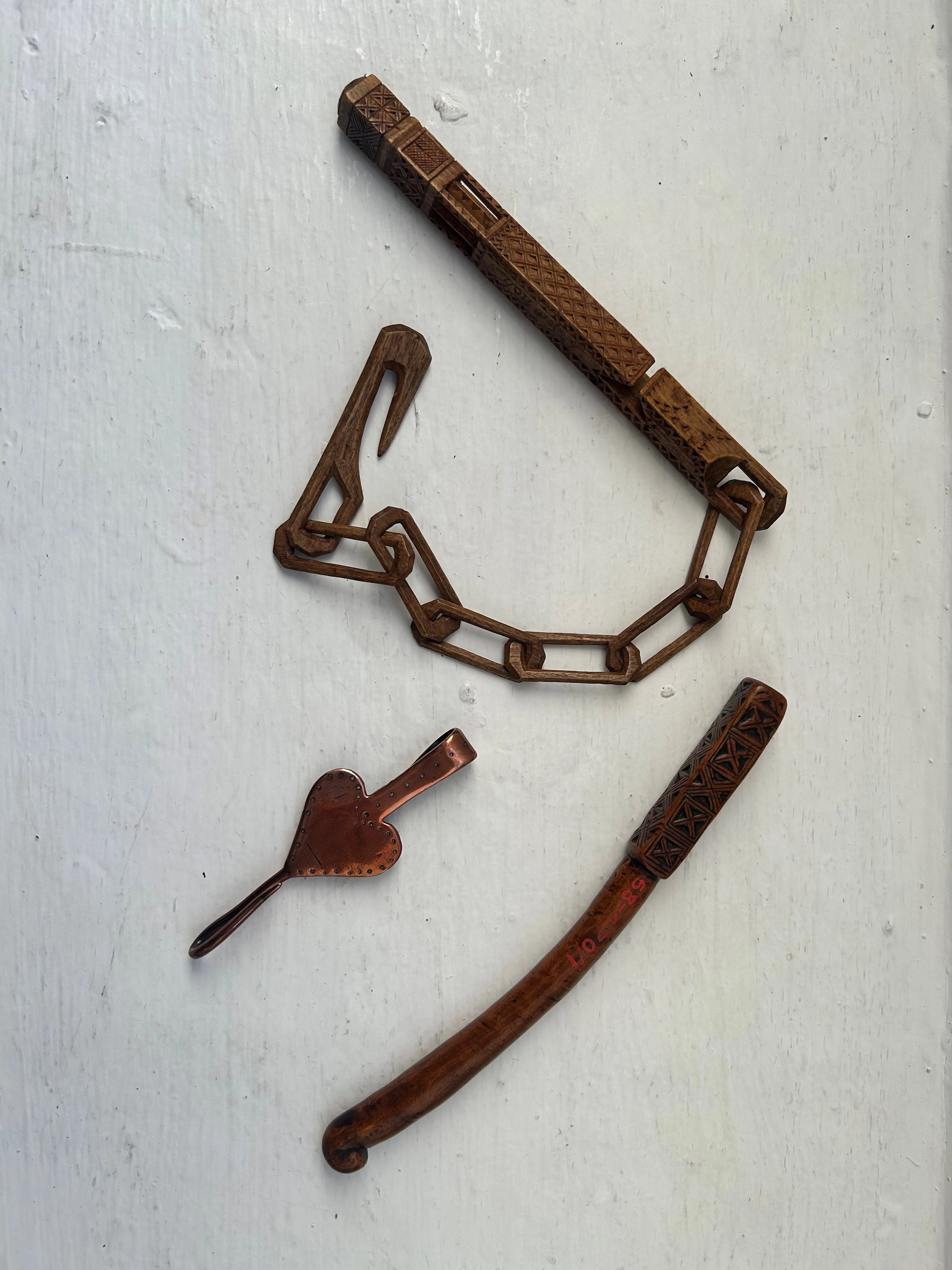
Although the exact origins of lovespoon-making in Wales are unclear, we know that such spoons would have been shaped with great care and devotion by their carvers. Lovespoons were given as a token of love and affection and each spoon was unique.
The lovespoon collection at Amgueddfa Cymru contains beautifully ornamented examples both historical and modern. It conveys the changing nature of the art through time and encompasses a wide variety of styles and designs all carefully handcrafted to the highest quality.
Presenting a decoratively carved spoon to a loved one as a token of affection has long been popular in Wales. From the Museum's oldest dated spoon of 1667 to contemporary examples by renowned present-day carvers, the calibre of the spoons is testimony to the makers' skill and devotion in creating objects intended to be treasured by their recipients.
Young men traditionally made a lovespoon from a single piece of wood, as a love token for their sweethearts.
Romantic gifts to maidens
Despite the lack of historical sources, it is generally believed that lovespoons were formerly crafted by male suitors and then presented as romantic gifts to the maidens they admired. The eighteenth- and nineteenth- century examples which form the basis of the Museums collection were driven by the emotion and passion of carvers who sought to produce works of art worthy of their beloveds.
The simplest of tools, such as small pocket knives, were traditionally used to to create the spoons, if possible, from a single piece of wood. Close-grain woods, such as sycamore, box and fruit woods were particularly popular.
Although the popularity of lovespoons has fluctuated over time, lovespoon carving has survived intact and continues thanks to a new breed of craftsmen determined to preserve the art.
Traditionally, lovespoons were given as romantic gifts, but today they are frequently given as gifts to commemorate events such as weddings, birthdays, anniversaries and christenings. Their function has significantly altered over time - particularly from the mid-twentieth century onwards when the fashion for mass-produced examples became increasingly prominent.
What do love spoons mean?
The symbolism on the spoons has also changed in recent years, with the introduction of Celtic and national emblems, such as daffodils and dragons, a means of expressing Welsh identity. This contrasts with the previously romantic sentiment, such as hearts, diamonds and wheel motifs.
Lovespoons continue to represent an expression of one's thoughts and emotions and carvers remain who honour the folk origins, either by creating spoons on commission or as presents for their family and friends.
Lovespoon carving is an ever-evolving craft and one which is sure to continue to delight and inspire for many generations to come.
Judging by the exquisite array of designs in the Museums collections, carvers have always felt free to decorate their lovespoons as they saw fit. Although each spoon is unique and often features initials or dates personal to the recipient, over time a series of symbols were employed to depict romantic thoughts and feelings. Such symbolism can, of course, be interpreted in many ways, and we can only imagine the true emotions of the carver as he prepared the spoon.
Hearts
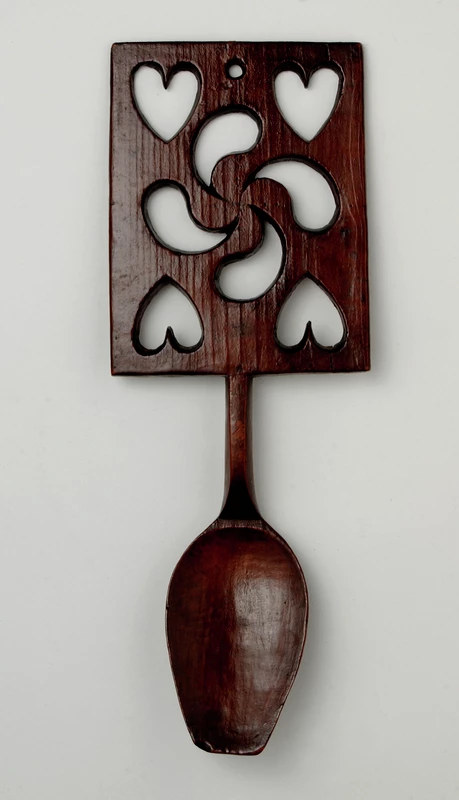
The heart is the universal symbol of love and is frequently seen on Welsh lovespoons. It is a sign of passion and strong emotion - surely signifying the carver's depth of feeling for his beloved. A lovespoon showing twin hearts might well indicate a mutual love between sender and recipient.
Double bowls
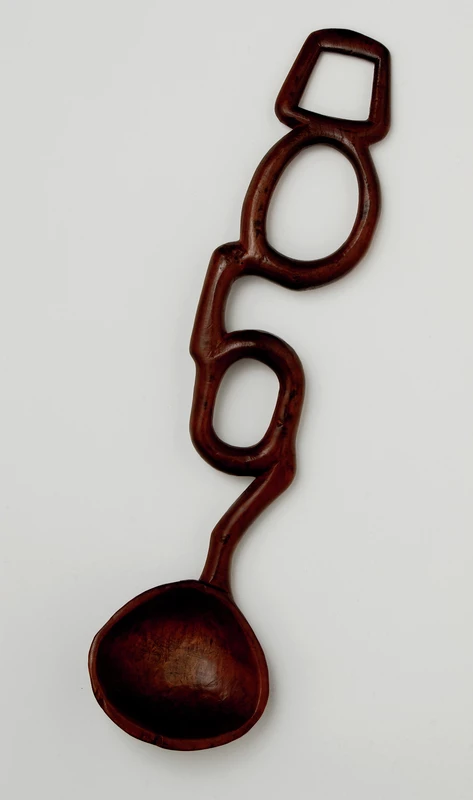
Occasionally, lovespoons are carved with two or more bowls, possibly to indicate the union of the souls when joined together, or perhaps the number of children desired.
Comma or paisley shape
Often visible on historic Welsh lovespoons, this shape is said to represent the soul and deep affection.
Balls in cage
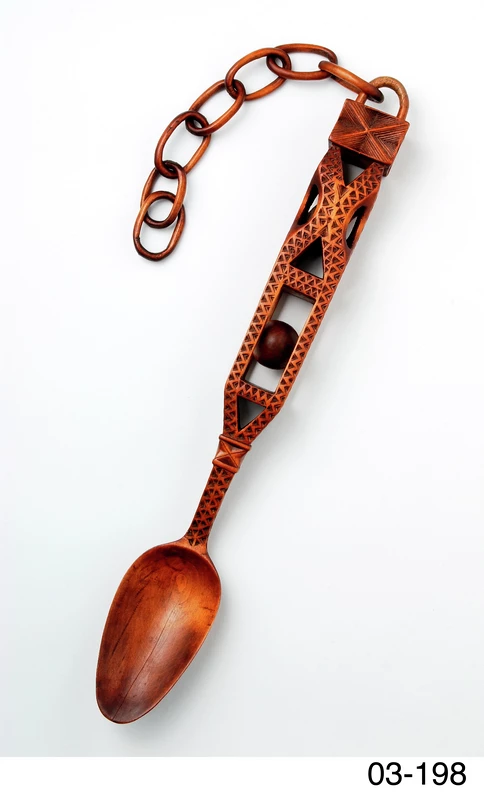
Balls carved within cages are commonly thought to represent the number of children desired by the carver, but could equally be a sign of a man held captive by his love.
Chain links
Generally considered to indicate loyalty and faithfulness, chain links might also symbolise a couple bound together in their love and loyalty.
Diamonds
Diamonds are believed to represent a wish for prosperity and good fortune and a promise to provide well for a loved one.
Keys and keyholes
In addition to the house images that sometimes appear on Welsh lovespoons appearing to represent domestic contentment, key and keyhole carvings are also used frequently, perhaps symbolizing security or, more romantically, the key to one's heart.
Wheel
Wheel symbols often feature in Welsh lovespoons and are said to represent a vow by the carver to work hard and to guide a loved one through life.
Try your hand at designing your very own virtual lovespoon to send to a loved one.
Image Gallery: Welsh Lovespoons
Lovespoon, with heart-shaped opening on handle
Lovespoon, with panel handle and geometrical designs
Lovespoon, inscribed 'MI 1721'
Lovespoon, with hearts and other geometrical designs
Lovespoon, with panel handle and covered with chip-carving
Two heavy lovespoons hanging from two-looped panel
Lovespoon, with panel handle and two bowls
Lovespoon, with bowl at each end
Lovespoon, dated 1735
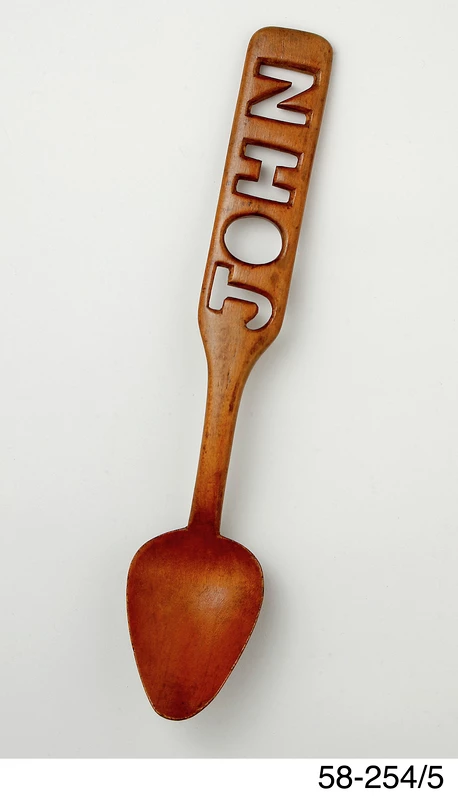
Lovespoon with narrow panel handle with the name 'John' in fretwork
Lovespoon, with handle carved to depict serpent and bird
Lovespoon with ridged stem and curved terminal
Inscribed wooden fork, 19th century
Lovespoon, with chip-carved handle fretted with various designs
Lovespoon, with fretted heart devices and chip-carving
Take a look at our online shop for the perfect St Dwynwen's day gift
Miniature hats from 1860’s by Welsh hatter, John Evans. The Welsh Hat is in middle row, centre.
Hats are often political. Though it would be understandable for someone to assume that they are made to protect someone from inclement weather, it does not take a lot of thought to see that they are often much more. From a red ‘Make America Great Again’baseball cap, to the bonnet rouge of the French Revolution, to any number of military hats, hats are regularly used to indicate which side you are on. Hats, along with all fashion, are used in a huge variety of ways to communicate with others and can tell us a variety of information: nationality, gender, interests, and identity. The hat specifically is often associated with group identity; in a crowd of people the hat can be a key identifier and if worn collectively can create a striking vision. The Welsh Hat does just this, its tall black crown and stiff brim, traditionally worn by Welsh woman creates a distinct and eye-catching look that has long been used as a symbol of Welshness.
Before The Welsh Hat
There is a prevailing myth that the Welsh hat and national costume was a Victorian invention, as part of imagined Welsh heritage and yet there are plenty of accounts going back a century earlier that tell us otherwise. The Victorians may have curated a specific version of Welsh dress and cemented the idea of it as ‘Welsh National Costume’ but the clothes themselves, including the hat, had indeed been around for much longer.
Before the Welsh Hat was Welsh, it was just a hat. High crowned styled hats made of felt or beaver fur were once popular across many countries. Men and woman across Britain in the latter half of the Elizabethan period, wore such hats for travelling and riding, and a wider brimmed version of the hat, ‘cavalier style’, was then adopted by the middle class in the mid-part of the 17th century. At this time hats were an important status symbol. Beaver fur was the quality material used to felt hats, but felting the fur was difficult and costly and from 1670, the product was often imported from America. Samuel Pepys notes in his diary, in 1661, that a beaver hat had cost him 45 shillings. From around 1640 to 1660 a version of the beaver hat with a tall, tapered crown known as a ‘sugarloaf’ became popular and looked very similar to what we would think of as the Welsh hat today. Today hats of this style are heavily associated with the Puritans and pilgrims to America, for its simple, unadorned design. Thus, even 400 years ago, the hat was steeped in meaning, from wealth and class, to political and religious leanings.
Us and Them
While the black Sugarloaf hat, along with other features that we today associate with Welsh National costume, were common across Europe and America in the 17th century, it is in the 18th century that we see a divergence in style. While elsewhere fashion trends moved on, these older looks appear to be retained by the Welsh peasantry. As fashion changed rapidly in the later half of the 18th century, this rejection of the new styles (be it intentional or through financial necessity) resulted in a notable difference in dress by the Welsh lower classes, from their English counterparts. This is documented through numerous accounts of English travellers that commented on the difference in clothing between the English and Welsh, among which are descriptions of a tall black hat worn by women.
Painting by Julius Caesar Ibbetson, Newcastle Emlyn Costumes, 1792
Julius Caesar Ibbetson was an English painter who created a number of works depicting scenes of Welsh life at the end of the 18th century. Through these works, a distinct image of Welsh working-class women can be seen. The paintings depict an attire which is different from what was fashionable dress throughout Europe during the 1790s, and almost all the works include women wearing what we can think of as an early variation of the Welsh hat.
In the work Newcastle Emlyn Costumes from 1792, all 14 women from the scene, as well as 2 children, are depicted wearing almost identical, black brimmed hats. While the hats may be shorter and less rigid from what we think of today as the Welsh hat, there is still a clear resemblance in style. In the inscription beneath the watercolour, Ibbetson writes “peculiar drefs and costume of the peasantry, in the district around Newcastle Emlyn in Pembrokeshire.” Here the English painter highlights that to him, the dress of women in Wales is distinctly different “peculiar” from English standards of dress. These outfits also have clear similarities to what one would think of as the Welsh national costume today, with their striped and checked patterns, and their shawls and aprons. In addition to its distinctive look, what is remarkable is the hats uniformity across all the wearers. At this time there was a large variety of styles in hats, bonnets, caps, turbans, hair accessories, wigs and hair styles and a huge choice in frippery to be added including flowers, ribbons and feathers. However in the works of Ibbetson, we see a singular black and unadorned style.
The striking uniformity of the Welsh dress was not lost on the Welsh, rather it became a strategic symbol of collective power. Famously it is even said to have helped defeat invading military powers. In 1797, French warships descended on Pembrokeshire in what is known as the Battle of Fishguard. Numerous reports document how hundreds of Welsh women in red shawls and black beaver hats, flanked the coastline behind the British military; creating the illusion from afar that they too were soldiers, and so leading to the unconditional surrender of the invading force. Thus the Welsh national dress as a symbol of strength and unity, and part of proud Welsh heritage, was embedded into the nation’s history.
National Costume
1931 Postcard reproductions of "Dull-wisgoedd Cymru/Cambrian Costumes" by Lady Llanover in 1834 (cropped)
Over the course of the 19th century, the Welsh hat along with the rest of the Welsh dress, would shift into an even more defined style. Previously, the Welsh hat was by no means the only hat being worn, partially as they were more expensive than other felt or straw hats.There were also many local variations on the Welsh hat; the tall hat was popular in larger towns such as Cardiff, Bangor and Carmarthen, while lower, flat-topped straw hats were popular in the Gower, as they allowed woman to carry cockle-baskets on their head and were better suited to the windy climate. But over the century, the hat would be consolidated into the more singular, standardised and uniform look that we think of today as the Welsh hat.
Lady Llanover (1802 to 1896) was the influential philanthropist who greatly influenced the uptake of traditional Welsh dress and worked tirelessly to promote Welsh language and culture. She wrote extensively on the matters of Welsh costume, as well as producing a series of illustrations on the subject and it is from her that we get the tradition of wearing the national costume on St David’s Day. While Lady Llanover certainly did not invent the Welsh national dress, she worked hard to bring it from the confines of the working class, into upper class society, even so far as to insist that guests to her parties were to wear the national costume.
In 1832 the then Princess Victoria (not yet queen) and her mother visited North Wales and on their carriage ride wore Welsh hats, when passing through Bangor ‘in compliment to the fair maids of Cambria'. Thus by this point we can see the complete transition from the traditional working wear of the peasantry, to the fashionable National costume for all classes. It is in that century then, that the hat and national dress becomes smart formal wear. Women chose to wear their best costume when selling their goods at market, as well as on Sunday to Church and Chapel. Throughout the 19th century, manyEisteddfod competitions would even have a prize for best Welsh hat. In this century, the Welsh hat has become a point of national pride. The 19th century writer, Marie Trevelyan, writes in an account of West Wales in 1893,“There the tall beaver hat is still worn by some of the prettiest and most handsome woman of the principality. Very spick and span these woman look”.
It is hard to pinpoint when the Welsh hat fell out of authentic regular use, due to the tremendous popularity of the image of the ‘Welsh Lady’. By the mid 19th and 20th century there was a transition from genuine regular attire, to a costume of Welshness for public events and in the tourism trade. The Image of Welsh National Dress became a prolific theme in postcards, souvenirs, and tourism in the Welsh seaside towns. Thus people continued to wear the Welsh Hat but its meaning had once again shifted.
A Hat For Everyone
Throughout the centuries, the use of the Welsh hat, like a swinging pendulum, shifted backwards and forwards in style from peasantry to royalty. Class was not the only cultural boundary that the hat crossed. The hat has also defied the boundaries of gendered clothing. During the 17th and 18th century, this style of hat was largely considered to be a man’s hat, socially acceptable for women only in the context of riding and traveling (acts which themselves were often seen as male activities) and yet in Wales, this binary was seemingly being ignored. In the 18th century, there were many English accounts of Welsh women described dressing in a ‘peculiar’manner, and stating that they wore ‘men’s hats’. Mary Yorke, a traveler to Wales in 1774, attended a service at St David’s Cathedral and noted seeing an old woman with a “kerchief over her head and a hat like a man’s”. Despite this, during the following 19th and 20th century, the Welsh hat had become an item strongly associated with Welsh womanhood.
Despite the Welsh hats’ tradition as a piece of Welsh women’s clothing, more and more it is a piece which defies the binary, with contemporary queer artists in particular using the hat in their work as a national symbol, that can be worn by anyone. Thus, the hat that likely originated as a man’s hat in the 17th century, and was subsequently adopted by women, once again alludes a gender binary in its wearers today. And so as the pendulum of fashion swings from one end of the spectrum to the other, so today we see it starting to swing back.
This dynamic relationship between the Welsh, clothing, and gender is nothing new. In the 1800’s, girls who worked in the mines dressed in boys clothing, including trousers, to be able to crawl through the mines. While the infamous Rebecca Riots saw men dressed in women’s clothing in violent protest, and as mentioned previously, Welsh women were mistaken as British military at the Battle of Fishguard. The Hat itself is in many ways is an androgynous item, its smooth black and angular features are much closer to many typical male items of dress such as a suit and top-hat, then much traditional female attire. Its angular features often sit juxtaposed with the frilly and lacy white cap underneath. This is perhaps partly why it makes for such an interesting subject for many queer artists today.
Photograph of performers from the Contemporary Dance group Qwerin. Photograph credited to Sioned Birchall.
In the contemporary dance performance group Qwerin,directed and choreographed by Osian Meilir, performers fuse traditional Welsh folk dance with the energy of the queer nightlife. The performers wear an adapted form of the national dress, complete with exaggeratedly large Welsh hats, which hang over and obscure much of the performers face, leaving them to peer out through cut out holes in the crown of the hat. These costumes, designed by Becky Davies, tell a striking visual story. In a quote from Meilir on the performance they say:
“The hat creates a looming presence, making our appearance sinister and mysterious. The hats, a symbol of Welsh culture, become the very things that restricts us from physically moving forward into more vigorous and joyful dancing. By removing these hats we shed away the years of shame, burden and oppression, cutting ties with social expectations and constrictions. However, reuniting and greeting the hats towards end of the work is an act of acceptance, an acceptance of our own identity. We welcome these hats back into our arms as a symbol of progression, unity, harmony and change; moving together into a new future, a queer Wales.”
In other words, the hat has become a symbol of an old Welsh Culture, but a symbol that rather than being allowed to slip away, can be reinvigorated with the zeitgeist of a new era of Welsh identity.
The Psychology of Hats
The Hat sits in a prominent position on the wearer, it frames the face and is often seen in the peripheries of the wearer’s view. This means they can become powerful tools in the way we view ourselves. The Fashion editor and prolific hat wearer Isabella Blow said on the subject of hats"Fashion is a vampiric thing, it's the hoover on your brain. That's why I wear the hats, to keep everyone away from me.” Blow touches on the sometimes oppressive societal demands of fashion and conformity and how it can play on the mind; as an antidote to this, the hat performs the role of a mental and physical shield. The brimmed hat creates and demands a physical distance between people, while psychologically doing the same, creating a distinct difference between wearer and non-wearer. In essence, a hat has the potential to create a sense of separation and independent identity between the wearer and the other. This may provide some insight into the success of the Welsh hat, like a protective shield, it symbolises the protection of one’s Welsh culture and heritage.
Finally In another quote from Blow, the intrinsic sense of identity associated with the hat is reinforced. “I don't use a hat as a prop, I use it as a part of me. If I am feeling really low, I go and see Philip (Treacy), cover my face, and feel fantastic”. Thus how one dresses effects not just how others view you, but how we view and feel about ourselves. If clothing is an extension of ourselves, then loving the clothing we wear has the potential to help us view ourselves differently. For the Welsh hat it can be a symbol of strength, nationality, and pride. For wearers of the Welsh Hat today, whether it be a St David’s Day celebration, as part of dance costume, at Eisteddfod, or just for fun, allow wearing the Hat to help you feel fantastic and to connect you with 400 years of history and Welsh heritage.
Reference / Further Reading
British Vogue, Isabella Blow, Bibby Sowray.4 November (2011)
Folk life, Welsh Peasant Costume, F. G. Payne. volume II (1964)
Textile history, Welsh peasant dress-workwear or national costume?, Christine Stevens. 33 (I) (2002)
The costume accessories series, Hats, Fiona Clark. (1982)
Welsh Costume, Ken Ethridge. (1958)
Women in Welsh History, Derek Draisey.(2004)
Women's Headdress and Hairstyles in England from A.D.600 to the Present Day, Georgine de Courtais.(1986)
As we reveal half a million collection records for the first time, we look at some of the strangest and most fascinating objects from National Museum Wales Collections Online.
This article contains photos of human skeletal fragments.
Built in 1917, the Institute features a billiard room, dance hall and library - and is nowadays found in St Fagans National Museum of History.
Horace Watkins testing his monoplane in 1908
Many of the buildings in St Fagans are part of the national collection - meaning they have the same legal status as one of our masterpiece Monets or this coin hoard. The buildings are dismantled, moved, rebuilt - and cared for using traditional techniques, by the museum's legendary Historic Buildings Unit.
The Oldest
The oldest human remains ever discovered in Wales
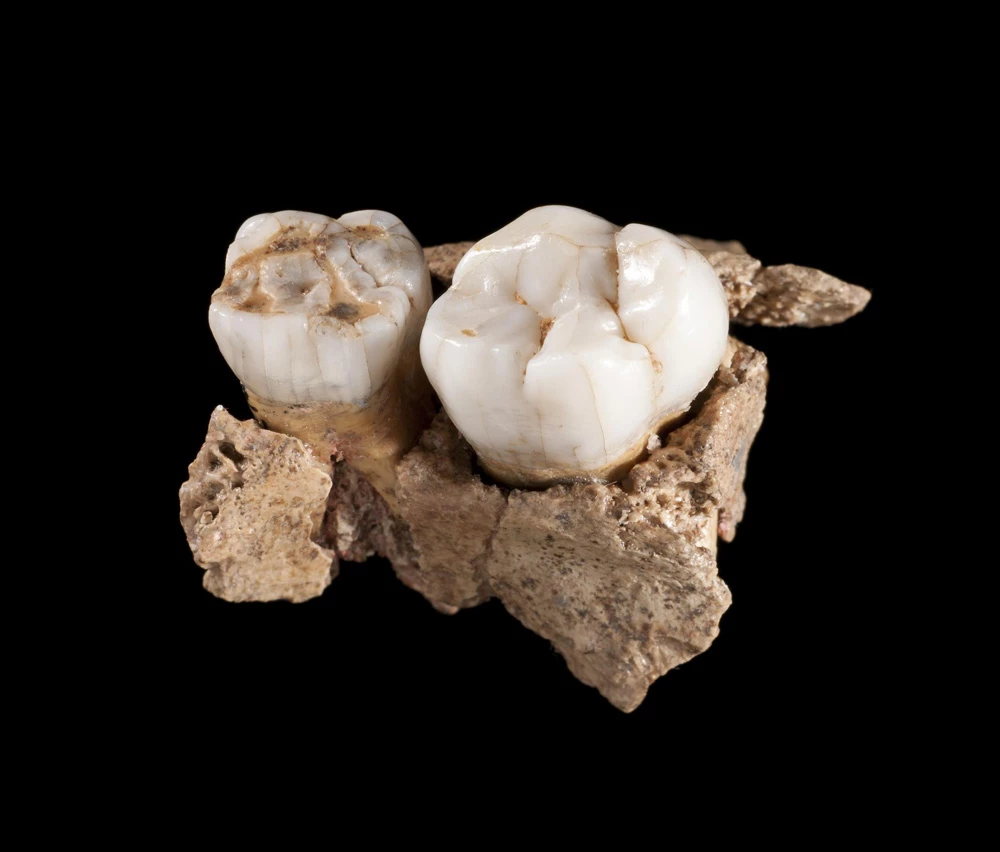
These teeth belonged to an eight year-old Neanderthal boy - and at 230,000 years old, they are the oldest human remains in Wales.
They were discovered in a cave near Cefn Meiriadog in Denbighshire, along with a trove of other prehistoric finds, including stone tools and the remains of a bear, a lion, a leopard and a rhinocerous tooth.
People in Wales have been making, trading and wearing beautiful treasures from gold for thousands of years - like this Bronze Age hair ornament and this extremely blingy Medieval signet.
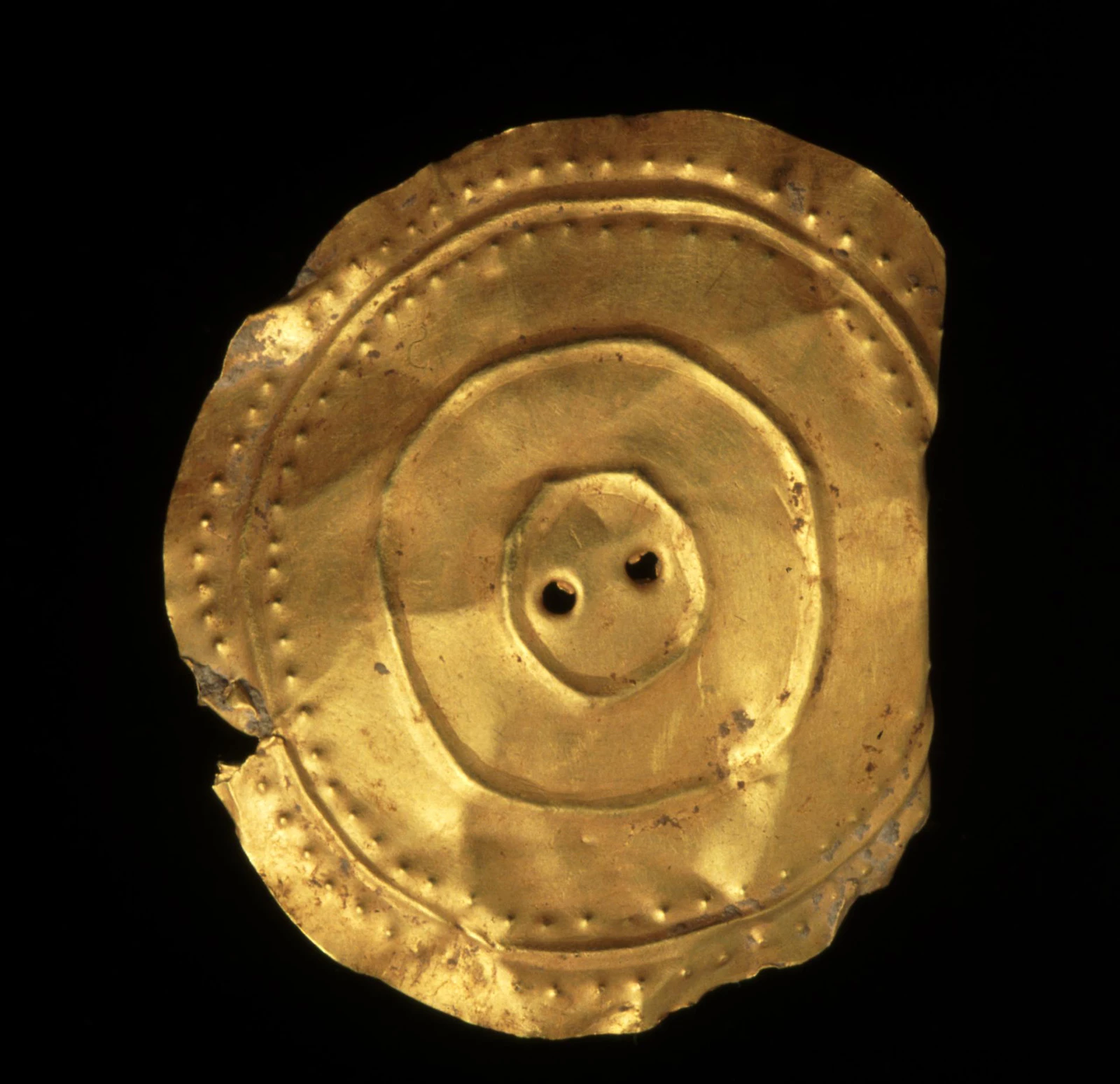
At around 4000 years old, this sun disc is one of the earliest and rarest examples of Welsh bling
One of the earliest examples of Welsh bling is this so-called 'sun disc', found near Cwmystwyth in Ceredigion.
Current research suggests that these 'sun discs' were part of ancient funeral practice, most likely sewn onto the clothes of the dead before their funerals. Only six have ever been found in the UK.
Most Controversial
At first glance, an ordinary Chapel tea service - used by congregations as they enjoyed a 'paned o de' after a service. A closer look reveals the words - 'Capel Celyn'. The chapel, its graveyard and surrounding village are now under water.
Capel Celyn, in the Tryweryn Valley, is now underwater
Flooded in 1965 by the Liverpool Corporation, the Tryweryn valley became a flashpoint for Welsh political activism - creating a new generation of campaigners who pushed for change in how Welsh communities were treated by government and corporations.
Curators from St Fagans collected these as an example of life in Capel Celyn - to serve as a poignant reminder of a displaced community, and to commemorate one of the most politically charged moments of the 20th century in Wales.
Honourable Mention: an Airplane made from a Dining Room Chair
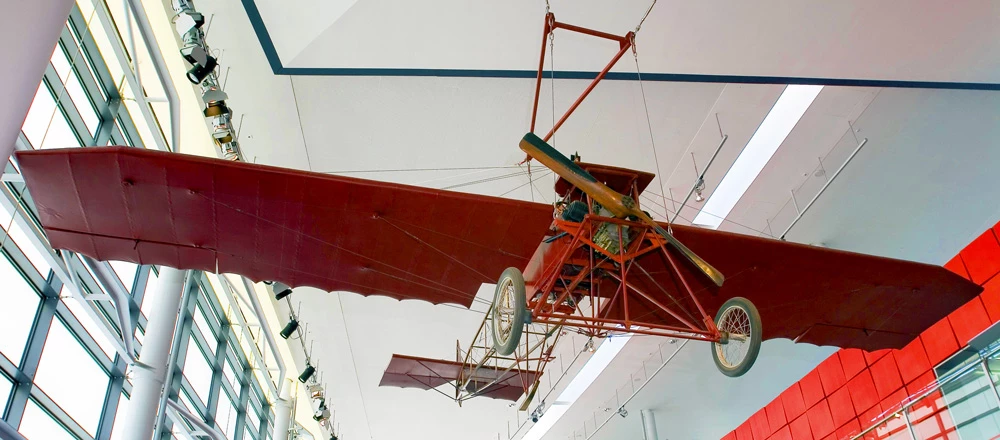
Made from a dining room chair, piano wire and a 40 horsepower engine, the Robin Goch (Red Robin) was built in 1909 - and also features a fuel gauge made from an egg timer.
The Robin Goch (Red Robin) on display at the National Waterfront Museum
Its builder, Horace Watkins, was the son of a Cardiff printer - here he is pictured with an earlier, even more rickety version of his famous monoplane.
Horace Watkins testing his monoplane in 1908
Our collections are full of stories which reflect Wales' unique character and history. The Robin Goch is one of the treasures of the collection, and is an example of Welsh ingenuity at its best.
Half a Million Searchable Items
The launch of Collections Online uncovers half a million records, which are now searchable online for the first time.
“Collections Online represents a huge milestone in our work, to bring more of our collections online and to reach the widest possible audience.
It’s also just the beginning. It’s exciting to think how people in Wales and beyond will explore these objects, form connections, build stories around them, and add to our store of knowledge." – Chris Owen, Web Manager
Our next project will be to work through these 500,000 records, adding information and images as we go.
We'll be measuring how people use the collections, to see which objects provoke debate or are popular with our visitors. That way, we can work out what items to photograph next, or which items to consider for display in our seven national museums.
Preparing and photographing the collections can take time, as some items are very fragile and sensitive to light. If you would like to support us as we bring the nation's collections online, please donate today - every donation counts.
At precisely 8:00pm, February 6th, 1918, The Representation of the People Act was passed by Royal Assent in Westminster. After decades of campaigning, some women were now allowed to vote. The Equal Franchise Act, passed in 1928, gave all women over 21 the right to vote.
We're used to seeing photos of 'Suffragettes' protesting in London, but what about the campaign in Wales?
Non-Violent Protest
Even though the press at the time concentrated on the trials and tribulations of the Suffragettes, there were far more Suffragists in Wales. Suffragists believed in peaceful action, and changing things through constitutional means. Among them were members of the Cardiff District Women's Suffrage Society - the largest branch of the National Union of Women's Suffrage Societies outside London.
At their helm was Rose Mabel Lewis (Greenmeadow, Tongwynlais) – or 'Mrs Henry Lewis' as she is described in our museum documentation. The most prominent members of the branch tended to be the city's well-connected, middle-class women. Their annual report for 1911 shows they held a whole host of activities to raise awareness of their campaign, including a fancy dress dance, whist drive and jumble sale. That year, their membership doubled to 920.
Banners: The Craft of Activism
Banner of the Cardiff Cardiff & District Women's Suffrage Society. Made by Rose Mabel Lewis, President of the Society
Rose Mabel Lewis made the silk banner now held in the Museum's collection - a powerful example of how the Suffragists and Suffragettes used craft to communicate and express themselves. The exact date of the banner is unknown, but evidence shows it was used in a protest in 1911. During that year, on the 17th of June, Rose Mabel led the women of south Wales in the Women's Coronation Procession in London. The banner's accession documents contain a note of explanation from one of the branch's former members:
The banner was worked by Mrs Henry Lewis… [she] was also President of the South Wales Federation of Women’s Suffrage Societies + she led the S. Wales section of the great Suffrage Procession in London on June 17th 1911, walking in front of her own beautiful banner… It was a great occasion, some 40,000 to 50,000 men + women taking part in the walk from Whitehall through Pall Mall, St James’s Street + Piccadilly to the Albert Hall. The dragon attracted much attention – “Here comes the Devil” was the greeting of one group of on lookers.
Banners like this were an incredibly important part of the visual culture of activists campaigning for women's right to vote. A number of these banners can be found today in museums and archives, including the Cardiff University Special Collections and Archives. Organisers of the 1911 march expected over 900 banners on the day!
Two years later, in July 1913, the banner appears again on the streets of Cardiff, as part of a march in the city to raise awareness of the Great Suffrage Pilgrimage. In the museum's collection, we find amazing pictures of Rose Mabel Lewis, and the branch's other members, gathering with the banner in front of City Hall in Cathays Park:
According to the annual report for 1913-14, some of the members were worried about the march, but were emboldened after receiving a positive response on the day:
It was with misgivings that some members agreed to take part in the procession, but afterwards their enthusiasm aroused and the desire to do something more in the future. The march was useful in drawing the attention of many people to the existance of our society.
Making History: St Fagans and the centenary
In 2018, the banner will be on display in Cardiff once more - not in a protest, but in a display of iconic objects from Wales at St Fagans National Museum of History. The display, which is part of the Making History project to redevelop St Fagans, will mark the first time the banner is displayed since it was donated in 1950 by the Cardiff Women Citizen's Association. At that time, their treasurer wrote a letter to Dr Iorwerth Peate, Keeper of St Fagans, to express their great pride in seeing the banner preserved for the future at St Fagans:
A cordial vote of thanks was accorded to you for realising how much the Suffrage Cause meant to women and for granting a memorial of it in the shape of the banner to remain in the Museum.
In addition to the banner, the museum also holds a number of objects relating to campaigns for women's right to vote, including letters and reports from the NUWSS, as well as an unusual hand-made anti-suffragette doll from west Wales.
Anti-suffrage voodoo doll sent anonymously to a woman in west Wales, early 1900s
Primary Sources:
National Union of Women's Suffrage Societies: Cardiff & District Annual Report, 1911-12 (St Fagans National Musuem of History).
National Union of Women's Suffrage Societies: Cardiff & District Annual Report, 1913-14 (St Fagans National Musuem of History).
Accession Documents 50.118 (St Fagans National Museum of History).
Secondary Sources:
Kay Cook a Neil Evans, 'The Petty Antics of the Bell-Ringing Boisterous Band'? The Women's Suffrage Movement in Wales, 1890 - 1918' yn Angela V. John (gol.), Our Mothers' Land Chapters in Welsh Women's History 1830 - 1939 (Cardiff: University of Wales Press, 1991).
Ryland Wallace, The Women's Suffrage Movement in Wales 1866 - 1928 (Cardiff: University of Wales Press, 2009).
St Dwynwen’s Day is celebrated in Wales on 25 January and commemorates St Dwynwen, the Welsh patron saint of love and friendship. Often described as the Welsh equivalent of Valentine’s Day, the celebration has its roots in medieval Welsh tradition.
When is St Dwynwen's Day Celebrated?
St Dwynwen's day is celebrated in Wales on 25 January and commemorates the patron saint of friendship and love.
Who was St Dwynwen?
Dwynwen lived during the 5th century and was, by all accounts, one of the prettiest of Brychan Brycheiniog's 24 daughters.
Who Was Maelon Dafodrill?
Central to the legend of St Dwynwen is her relationship with Maelon Dafodrill, a story that explains her association with love and loss.
The story goes that Dwynwen fell in love with Maelon Dafodrill, but unfortunately her father had already arranged that she should marry someone else. Maelon was so outraged that he raped Dwynwen and left her.
In her grief Dwynwen fled to the woods, where she begged God to make her forget Maelon. After falling asleep, Dwynwen was visited by an angel, who appeared carrying a sweet potion designed to erase all memory of Maelon and turn him into a block of ice.
God then gave three wishes to Dwynwen. First she wished that Maelon be thawed, second that God meet the hopes and dreams of true lovers and third that she should never marry. All three were fulfilled, and as a mark of her thanks, Dwynwen devoted herself to God's service for the rest of her life.
Ynys Llanddwyn and St Dwynwen’s Church
Remains of Dwynwen's church can be seen today on the island of Llanddwyn, off the coast of Anglesey.
During the 14th century, on visiting the island, the poet Dafydd ap Gwilym witnessed a golden image of Dwynwen inside the church, and was bold enough to request her help as a messenger between himself and Morfudd, the girl he hoped to win — despite the fact that Morfudd was already married.
Also situated on the island is Dwynwen's well, where, allegedly, a sacred fish swims, whose movements predict the future fortunes and relationships of various couples. Visitors to the well believe that if the water boils while they are present, then love and good luck will surely follow.
The popularity and celebration of St Dwynwen's day has increased considerably in recent years, with special events, such as concerts and parties, often held and greetings cards printed. Although still not as popular as St Valentine's Day in February, St Dwynwen is certainly becoming better-known among today's population of Wales.
Love Tokens in Wales: From Lovespoons to Staybusks
Throughout history and still today, love tokens are given as symbols of devotion and commitment to loved ones.
LOVESPOONS
Traditionally crafted by male suitors, lovespoons were presented to admired maidens. Using simple tools, they expressed their passions and emotions through the symbols they carved.
STAYBUSKS
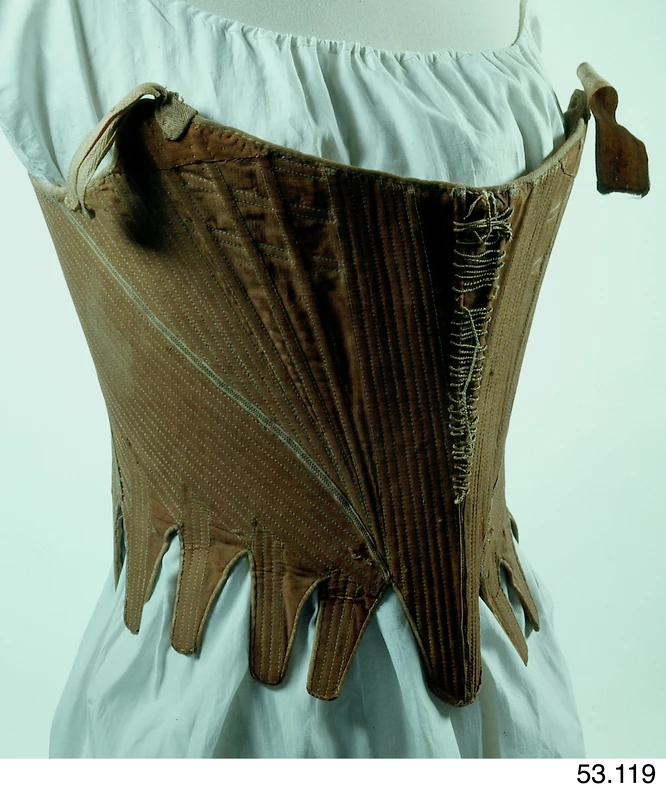
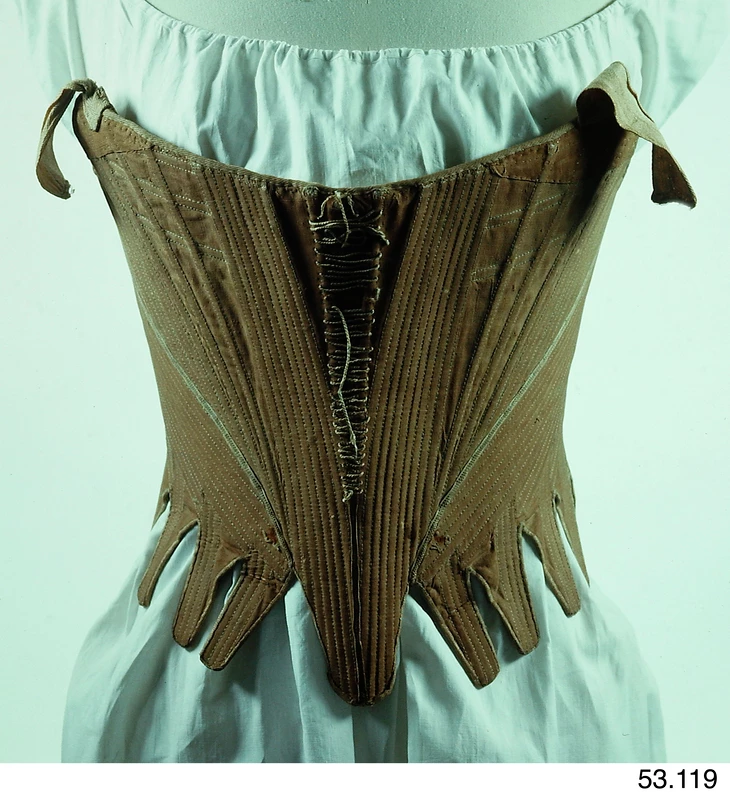
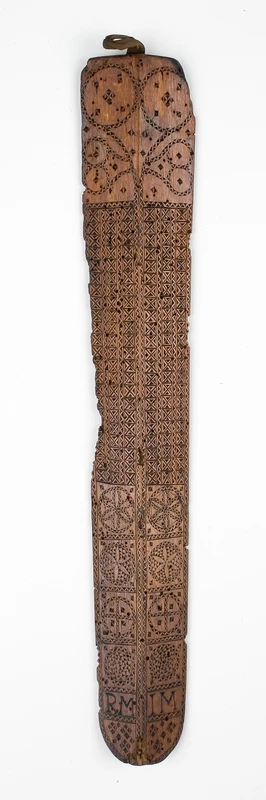
Decorated with motifs and initials, a busk was inserted into a woman’s stays, keeping her torso upright and sitting close to her heart. Pictured is a Staybusk from Llanwrtyd, inscribed with the initials RM and IM.
JESSIE KNIGHT TATTOOS
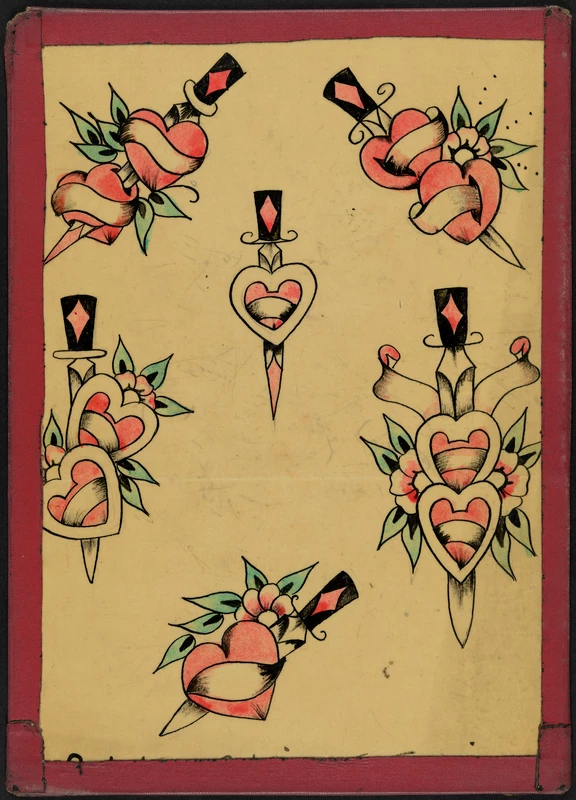
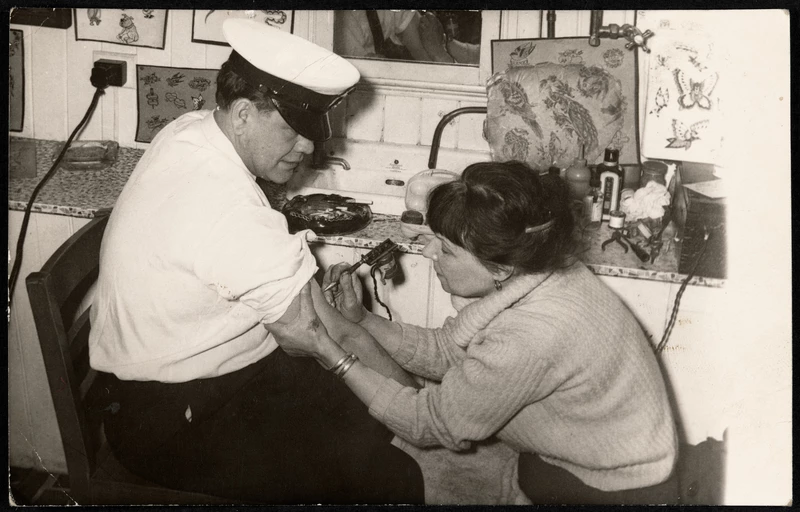
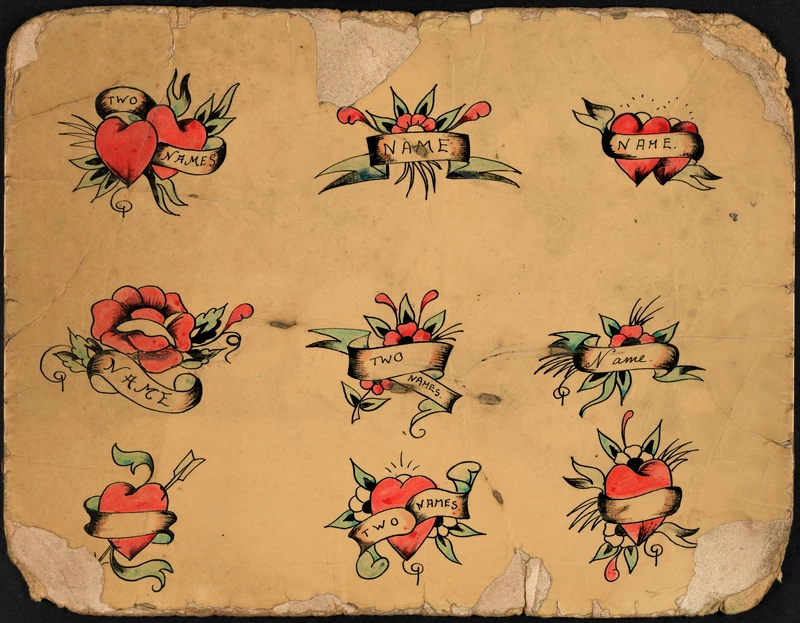
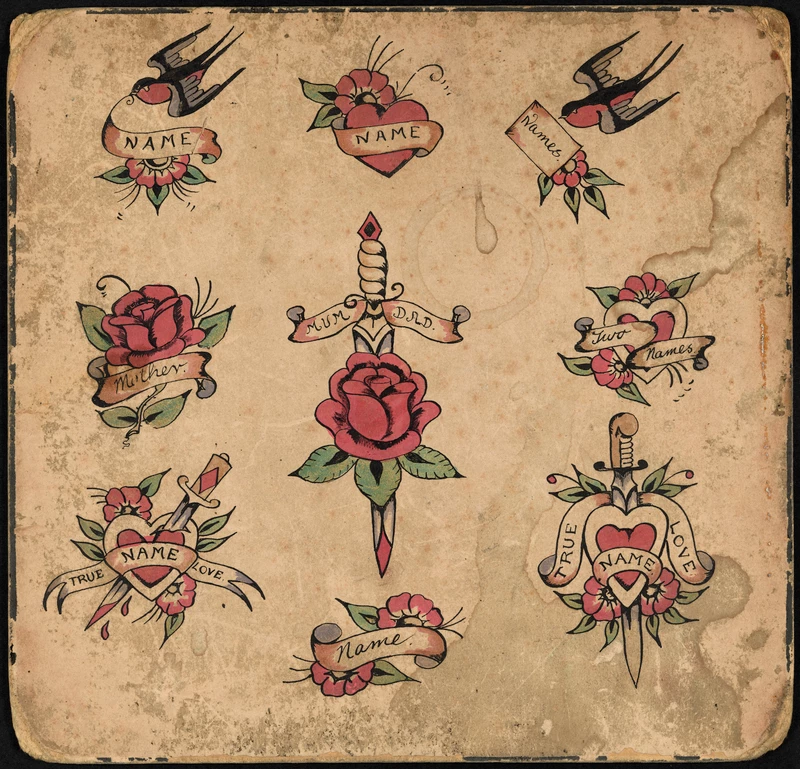
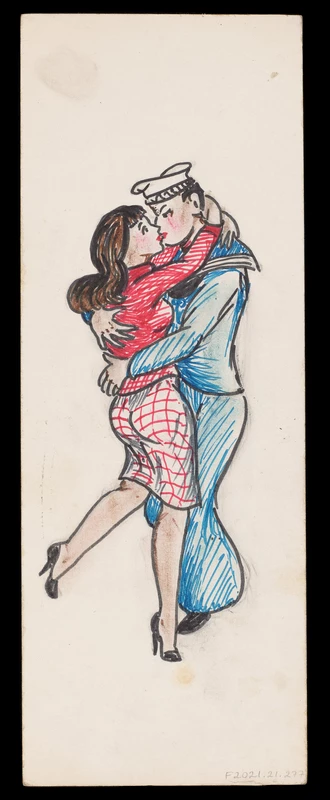
Between the 1920s and 1960s, Jessie Knight tattooed these designs onto sailors and servicemen. Symbolising their devotion, these permanent love tokens served as a way for sailors to keep their loved ones close at sea.
KNITTING SHEATH
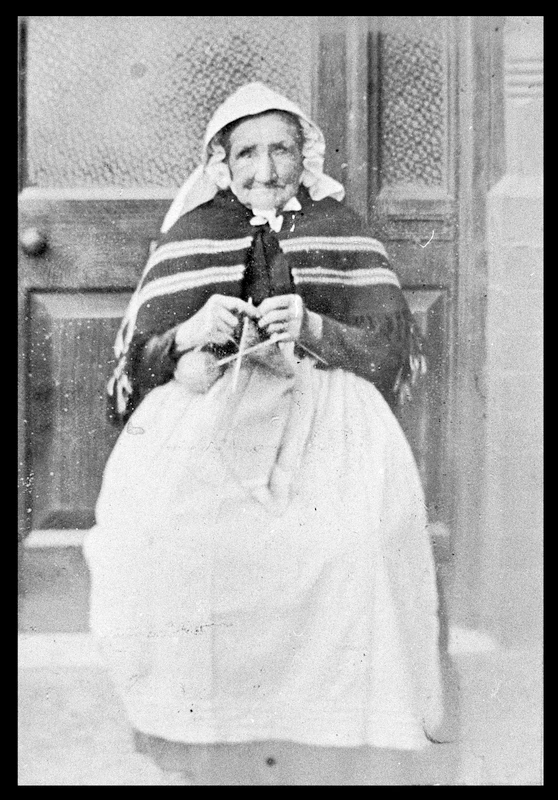
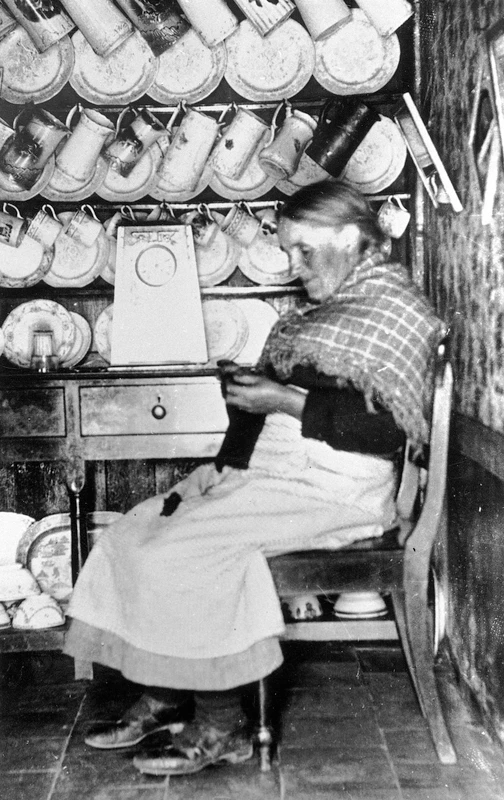
It was a Welsh custom to carve knitting sheaths with names and motifs and give them as love tokens. Worn on the right side of the body, they held the needle steady, freeing the left hand to work the yarn.
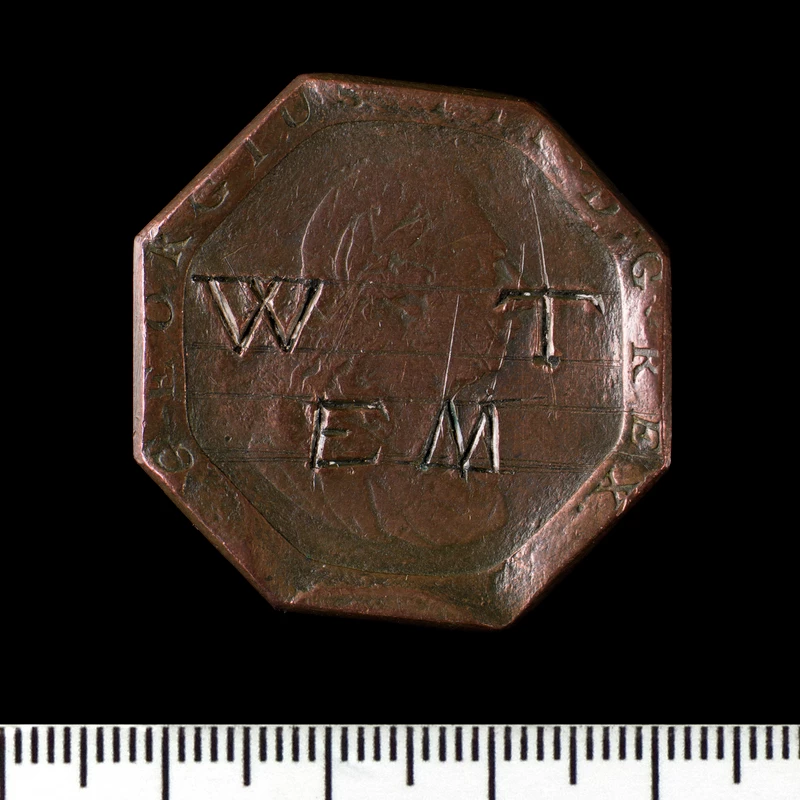
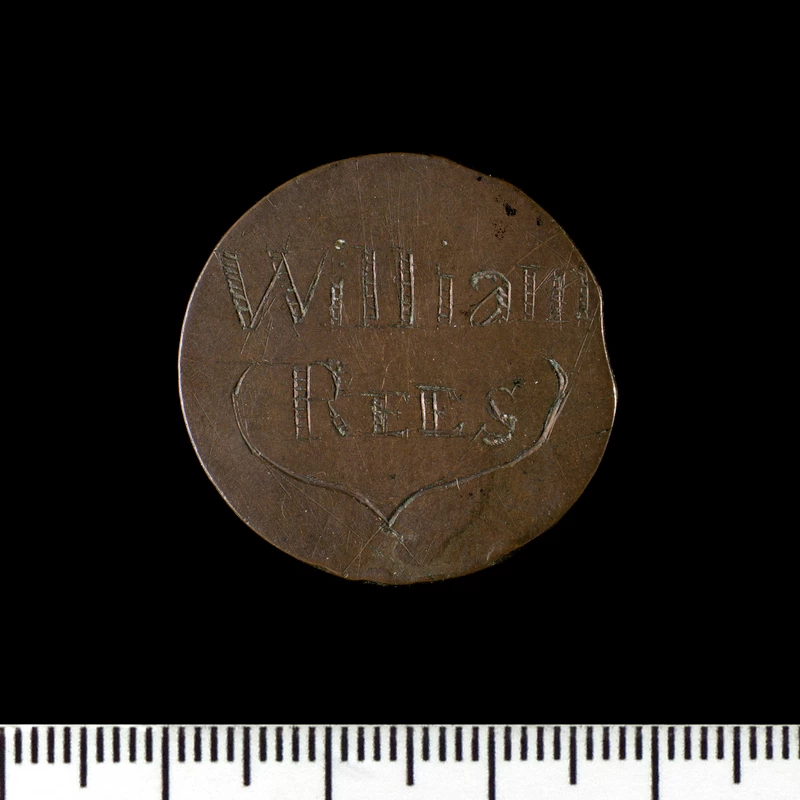
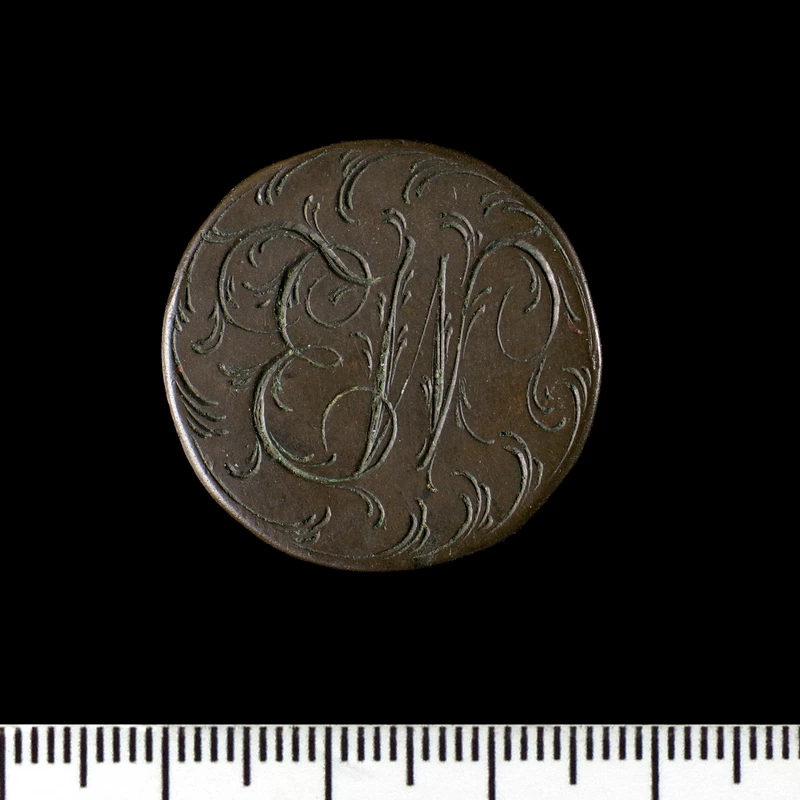
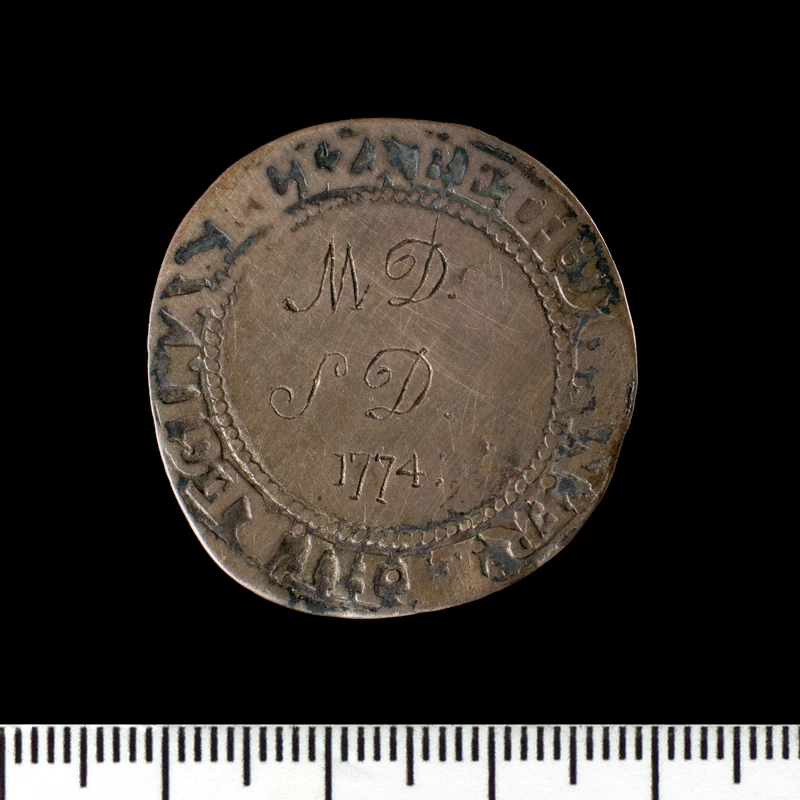
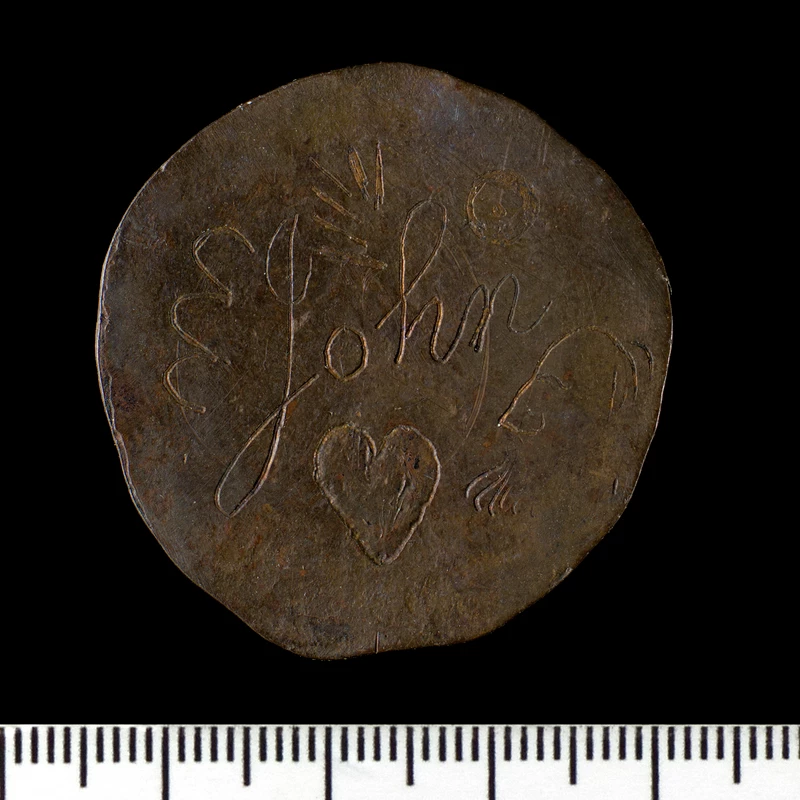
LOVE COINS
Made by sailors or convicts in the 18th-19th century, these coins were engraved with symbols of love, separation, and return. Offered as parting gifts for long or indefinite separations.
These enduring love tokens, each with their own unique story, continue to symbolise love and connection through Welsh history and tradition.