: Eisteddfod

Bardic high achievers

25 July 2010

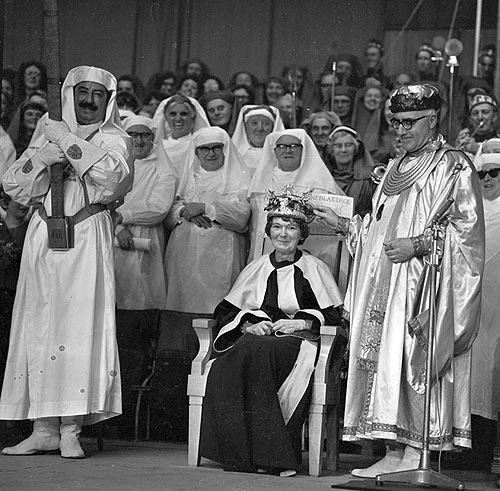
The Crowning of Dilys Cadwaladr at the Rhyl National Eisteddfod, 1953.

The Crowning of Dilys Cadwaladr for her pryddest 'Y Llen', at the Rhyl National Eisteddfod, 1953. She was the first woman to win the Crown.

The accomplishment of winning the double-double, namely the Crown and the Chair in the same year has been achieved by:

  • T.H.Parry-Williams — 1912 and 1915
  • Alan Llwyd — 1973 and 1976
  • Donald Evans — 1977 and 1980

Before the rule that bards could not win the Chair, the Crown or the Prose medal more than twice was passed, there were several successful multiple winners:

  • Crwys — the Crown three times (1910, 1911 and 1919);
  • Cynan — the Crown three times (1921, 1923, 1931) and the Chair once (1924);
  • Caradog Prichard — the Crown three times (1927, 1928, 1929) - each poem a variation on the same theme — the anguish of his mother's insanity; and the Chair once (1962);
  • Dewi Emrys — the Crown once (1926) and the Chair four times (1929, 1930, 1943, 1948). According to hearsay, he tried to sell his Crown to a pawnshop.

Dilys Cadwaladr was the first woman to win the Crown in the Rhyl Eisteddfod, 1953. Since then Eluned Phillips has won it twice (1967, 1983) and Einir Jones once (1991).

In Cardigan Eisteddfod, 1976, the adjudicators chose an ode by Dic Jones on the topic 'Gwanwyn' (Spring) as the winning entry but because a rule had been broken it was disqualified and Alan Llwyd was chaired instead.

Robat Powell from Ebbw Vale was the first learner to win the Eisteddfod Chair, in Rhyl in 1985 for a poem portraying the effects of the closure of heavy industries.

Caradog Pritchard, at 22, was also the youngest poet to have won one of the major Eisteddfod prizes when he won the Crown in 1927.

When the chaired poet, John Gwilym Jones was Archdruid (1993-96), he had the honour of crowning his brother, Aled Gwyn, and chairing his son, Tudur Dylan Jones, in the Bro Colwyn Eisteddfod, 1995. Furthermore, another brother, T. James Jones, had already won the Crown twice - in Fishguard 1986 and Newport 1988.

T. James Jones had competed for the Crown with the American poet, John Dressel in 1979 under the pseudonym 'Ianws' but when it was realised that it was a joint effort, they did not receive the prize.

Mererid Hopwood was the first woman to win the Chair of the Eisteddfod (in Denbigh 2001) and she went on to win the Crown two years later in Maldwyn 2003.

A Gorsedd Who's Who

25 July 2010

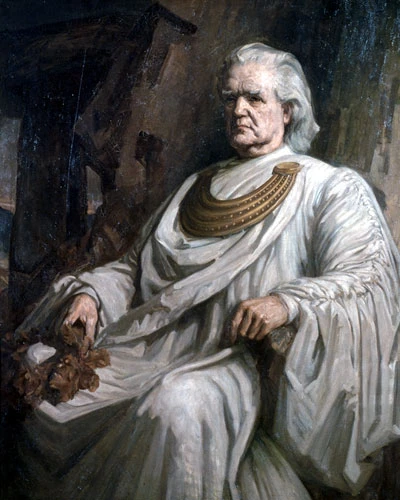
An oil painting of Archdruid Hwfa Môn by Christopher Williams.

An oil painting of Archdruid Hwfa Môn by Christopher Williams.

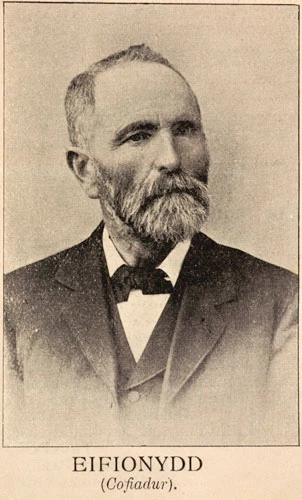
Eifionydd (John Thomas) - Gorsedd Recorder, 1881-1922.

Eifionydd (John Thomas) - Gorsedd Recorder, 1881-1922.

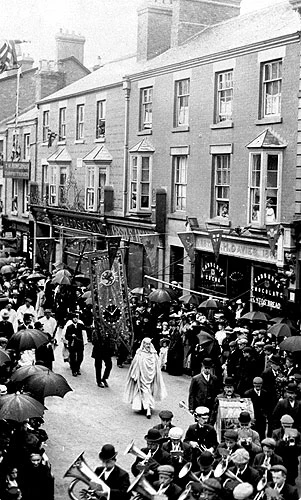
T.H.Thomas leading the Proclamation procession, Llangollen 1907.

T.H.Thomas, Arlunydd Pen-y-garn, Herald Bard (1895-1915) leading the Proclamation procession, Llangollen 1907.

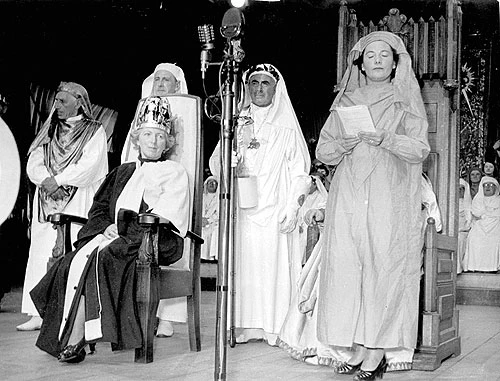
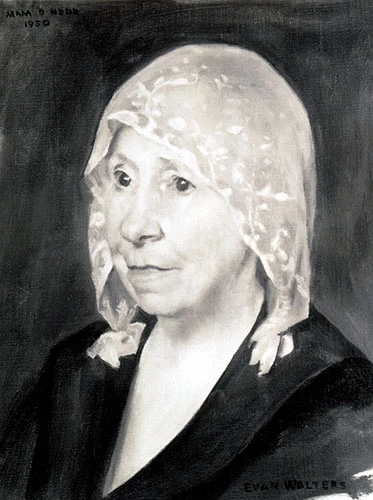
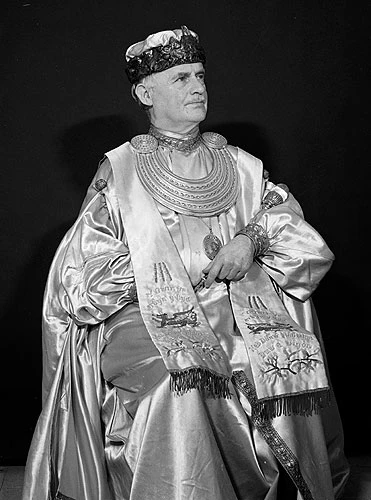
Winifred Coombe Tennant, Mistress of the Gorsedd Robes c.1923-34.

Winifred Coombe Tennant, 'Mam o Nedd' (Mother from Neath); Mistress of the Robes c.1923-34.

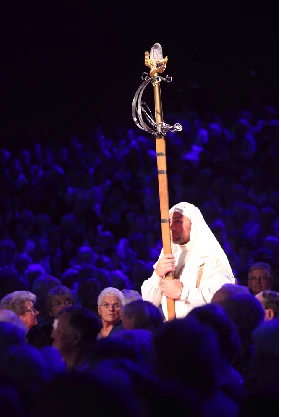
Bearing the Grand Sword

Bearing the Grand Sword during the Chairing Ceremony, 2009.

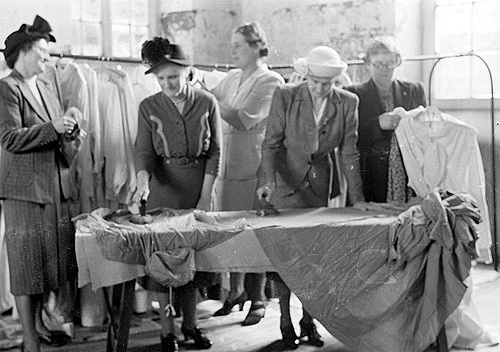
Women ironing gorseddogion robes, Dolgellau, 1949.

Women ironing gorseddogion robes, Dolgellau, 1949.

The Archdruid

The Archdruid in their splendid regalia is the focal point of all the Gorsedd rites and presides over all its ceremonies. They are the supreme authority of all the other Gorseddau and chairs the Gorsedd Board.

Iolo Morganwg, the father of the Gorsedd of the Bards, did not call himself an 'Archdruid'. In his first Gorsedd in 1792 he was the 'Chief Bard' and in the Carmarthen Gorsedd of 1819 he was the 'Official Bard'.

Before long, however, the presidents of the provincial eisteddfodau's gorseddau began to call themselves 'archdruids', but Clwydfardd is considered to be the first official Archdruid. He claimed:

'I was appointed Archdruid ... in the year 1860; but it was in the Wrexham Eisteddfod in the year 1876 that I was licensed as the Archdruid of the Gorsedd... of the Bards of the Isle of Britain.'

He held office for the rest of his life.

The number of visual images of his successor, Hwfa Môn, (Rowland Williams) (2002-2005), testify to his role as a national icon. Since 1936 an Archdruid serves for a term of three years only, except during the Second World War, when Crwys (W.Crwys Williams), was Archdruid for eight years. Only one Archdruid, Cynan (1950-54; 1963-6) has served for more than one term. As Tilsli has said of Cynan 'to many people he embodied the Gorsedd of the Bards' and it was Cynan who made the rites of the Gorsedd 'credible and colourful'. It was Cynan's influence, in Fishguard in 1936, which brought order to the ceremony of installing a new Archdruid, when they are invested with the crown, breastplate, sceptre and ring of office.

In 1932 it was stipulated that an Archdruid has to be a chaired or crowned bard. By the beginning of the twenty-first century Prose Medal winners were included in this élite band and the first to be elected under this ruling was Robyn Llŷn (Robyn Léwis) (2002-05). About this time too the voting procedure was changed with all members of the Gorsedd, not only the Gorsedd Board, now entitled to vote.

The Recorder

The Recorder of the Gorsedd of the Bards of the Isle of Britain is the Secretary of the Gorsedd Board and its supervisor. He/she is one of the main officers in the Gorsedd Circle and he/she is responsible for organising the ceremonies on the Eisteddfod stage. He/she proclaims the Eisteddfod and Gorsedd a year and a day in advance. It seems that Gwynfe (Recorder -1922-27)'s library, including the Gorsedd Minute Book for 1888-1921, was sold to the USA and this important historical document is now in the Library of Havard University, while the National Library of Wales has a copy of it. Without doubt Cynan (1935-50; 1954-63; 1966-70) was the most influential twentieth-century Recorder. Ernest Roberts maintained that he changed the Gorsedd 'from being some sort of ministers' pantomime into a dignified pageantry'; 'from being the butt of derision and mockery into an institution which attracted Welsh scholars and professional men from several fields to accept its honours and to support its aims.' Since Cynan's time succeeding Recorders have managed to maintain these high standards.

The Herald Bard

The Herald Bard looks after the Gorsedd furniture and regalia. They are responsible for the Gorsedd's Processions and helps the Recorder to direct its ceremonies. He/she, in turn, is supported by other officials: the Examinations' Organiser; the Mistress of the Robes and his/her own appointments - the Marshalls.

The Herald Bard was a post which evolved during the nineteenth century. Without doubt, T.H.Thomas, Arlunydd Pen-y-garn, during his term of office, 1895-1915, was the most influential Herald Bard. Through his innate artistic flair he reformed and transformed the Gorsedd robes and regalia and the Gorsedd Circle. Sieffre o Gyfarthfa, (Captain Geoffrey Crawshay), Herald Bard 1925-1947, led the Gorsedd processions, very dramatically, on horseback and in splendid riding gear. He published several pamphlets during his term of office dealing with Gorsedd 'membership', and 'the installation ceremony'. When he resigned in 1947 he presented a staff for the use of the Herald Bard.

Dilwyn Cemais (Dillwyn Miles), Herald Bard 1966-1996, published an invaluable volume on the history of the Gorsedd of the Bards, The Secret of the Bards of the Isle of Britain (Dinefwr Press, 1992) and also a book of his memoirs, Atgofion Hen Arwyddfardd in 1997.

The Mistress of the Robes

In her bright blue-green robe the Mistress of the Robes stands apart from the other members and officers of the Gorsedd. She supervises the condition of the robes at every Gorsedd ceremony throughout the year and she invests the poets and prose medal winners with their robes before escorting them from the body of the pavilion onto the stage for their respective ceremonies.

Such an officer was essential once the Gorsedd had introduced official robes c.1900 and Mair Taliesin (Gwenddydd Morgan) was the first to fulfil the role.

She was succeeded c.1923 by Mam o Nedd - Winifred Coombe-Tennant (1874-1956), a native of Cambridgeshire, who had married Charles Tennant of Cadoxton Lodge, Cadoxton, Glamorganshire in 1895. She had been Chair of the Neath National Eisteddfod's Arts and Crafts Committee in 1918 and had severely criticised the lack of dignity and untidiness of the Gorsedd Procession during the 1917 Proclamation ceremony. Mam o Nedd left £5,000 in her will towards the repair and refurbishment of Gorsedd robes and regalia.

Siân Aman (Jean Huw Jones), the Mistress of the Robes, (1983 onwards)'s annual reports to the Gorsedd Board illustrate the nature of this responsible post; not only the need to renew robes every year but also the constant demand upon her to talk to cultural societies around Wales about her role.

The Bearer of the Grand Sword

The Bearer of the Grand Sword's role is to look after the Gorsedd Sword during processions and during the Gorsedd ceremonies. He carries the Sword before the Archdruid in all Gorsedd processions, always by its blade, not by its hilt. This was the first officer to be named from among the Gorseddogion, because in 1819 it was noted that Gwilym Morganwg (Thomas Williams) was the 'Sword Bearer' in the important provincial eisteddfod in Carmarthen. Since then the office has been held by many prominent Welshmen, most notably the late Ray Gravell.

Women and the Gorsedd

From the very first, and especially bearing in mind Iolo Morganwg's belief in the principle of equality, women have been welcomed into the ranks of the Gorsedd of the Bards. When the first Gorsedd was held in London in June 1792, Sarah Elizabeth Owen was admitted into the Order of Ovates, unfortunately, it seems, not because she was an accomplished poet or prose writer, but because she was the wife of William Owen (Pughe) of the Gwyneddigion Society.

The first woman to be admitted to the Gorsedd in Wales, in Carmarthen in 1819, was Elizabeth Jones, Eos Bele, but once more not for her poetic talents but because the organiser wanted to marry her! In 1821 three other women, Angharad Llwyd, an able antiquarian from Caerwys; Hester Cotton, a Welsh learner and antiquarian and Mair Richards, a harpist from Darowen, were admitted in the Powys provincial eisteddfod. Reports from the provincial eisteddfodau and gorseddau during the next decades note women among the ranks of the Gorseddogion and the same pattern was followed after the establishment of the National Eisteddfodau. As a result women / girls have served as singers, harpists, presenters of the Hirlas Horn and the berthged / Blodeuged, as patrons, Mistresses of the Robes, and floral dancers in the ceremonies and rites of the Gorsedd of the Bards.
Scrolls, swords and mystic marks

25 July 2010

T.H.Thomas' plan of the Gorsedd of the Bards' Circle of Stones, 1901

T.H.Thomas, Arlunydd Pen-y-garn, the Herald Bard's Order of the Gorsedd of the Bards' Circle of Stones, 1901

The Corn Gwlad

Fanfare of the Corn Gwlad

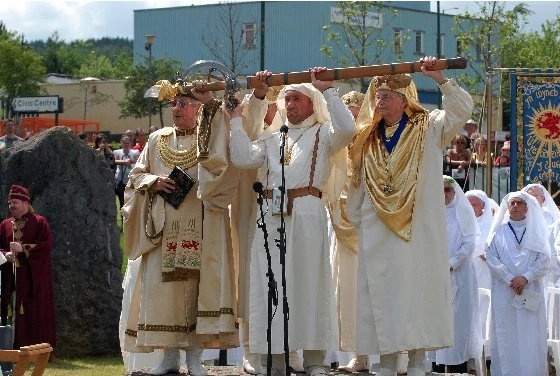
The Grand Sword in use at the Proclamation Ceremony

'A oes heddwch?'- 'Is there peace?'. The Grand Sword in use at the Proclamation Ceremony for the 2010 Eisteddfod at Ebbw Vale.

Archdruid Brinli (1972-75); Brinley Richards.

Archdruid Brinli (1972-75); Brinley Richards.

The Gorsedd Banner

The Gorsedd Banner at the Proclamation Ceremony of the 2011 Eisteddfod at Wrexham.

Gorsedd symbols and regalia

Over the two centuries or more since the first ever Gorsedd, its ceremonies have gathered a variety of iconic symbols and regalia, all of which add to the mystique and colour of eisteddfodic occasions.

In the ceremony to proclaim where the next year's Eisteddfod and Gorsedd are to be held, the Gorsedd Recorder reads from the Proclamation Scroll.

A Proclamation Scroll was used in 1791 before the first ever Gorsedd. Several of the features of later Scrolls can be seen in this first Scroll, namely:

  • noting the year and season;
  • where the Gorsedd is to be held;
  • that there will be no 'naked weapon' against the Bards;
  • some of the mottoes which have become essential elements of Gorsedd ceremonies since, e.g. 'Yn Llygad Haul, wyneb Goleuni' (in the Eye of the Sun and in the face of Light); 'Duw a phob Daioni' (God and all Goodness).

The Mystic Mark was added to the Proclamation Scroll by Taliesin ab Iolo in 1833. In 1946 the artist Meirion Roberts designed a new Scroll which was donated to the Gorsedd by Winifred Coombe-Tennant. In his design in black, red and gold, the artist incorporated the Grand Sword, the Corn Gwlad (trumpet) and the coat of arms of the Princes of Gwynedd in the decorated Celtic capital. Around the text he presented the coats of arms of the thirteen shires (before 1974) of Wales, oak leaves, acorns and a red dragon, but the Mystic Mark does not appear on the Scroll at all.

Y Corn Gwlad

The fanfare of the two Corn Gwlad is an essential element of Gorsedd ceremonies in the Stone Circle and especially as they call the winning poet or author onto the festival stage.

It isn't certain when the fanfare of the Corn Gwlad was first introduced to the ceremonies but by the1860s the 'call of the trumpeter' was a customary part of the Logan Stone rite.

At the Wrexham Eisteddfod in 1888, Edward Jones, Mayor of Pwllheli, presented a silver Corn Gwladfor the Gorsedd's use. Then, in 1900 Alicia Needham, an Irish composer, noted that she had ordered a new silver trumpet with a red dragon banner on it, because, she claimed:

'it will look much more dignified and appropriate than the Cornet which was used at Cardiff, and which seemed altogether too modern.'

The trumpeter's gown and cap were designed by Isaac Williams of the National Museum of Wales in 1923.

Members of the Welsh Guards were regular trumpeters after the Second World War and in 1947 Haydn Morris (Haydn Bencerdd) composed a fanfare for the different ceremonies. Since then several different trumpeters have served the Gorsedd. A pair of trumpets previously used at Queen Elizabeth's Coronation ceremony (1953) was donated through the former-Herald Bard (Sieffre o Gyfarthfa)'s Memorial Fund and the pendant banners on them were embroidered by Miss Iles, Brynsiencyn.

The Grand Sword

One of the Gorsedd's oldest rites is the ceremony of partly unsheathing the Grand Sword. The Archdruid asks the following questions and the audience replies 'Heddwch' (Peace) three times:

'Y Gwir yn erbyn y Byd, A oes Heddwch? (The Truth against the World, Is there Peace?) 
Calon wrth Galon, A oes Heddwch? (Heart to Heart, Is there Peace?) 
Gwaedd uwch Adwaedd, A oes Heddwch? (Shout above responding Shout, Is there Peace?)'

Carrying a sword was one of the rites in Iolo Morganwg's first Gorsedd in 1792. As a pacifist Iolo wanted to emphasise that the Bards met in peace and when a naked sword was placed on the Logan Stone they proceeded to sheath it as a symbol of peace in Gorsedd.

The rite of calling out for 'Peace' was originally a separate one and it was first heard in Carmarthen in 1867. Gradually it became linked to the rite of the Grand Sword when admitting new members and yet again the need for 'peace' between contestants in the Chair and Crown competitions.

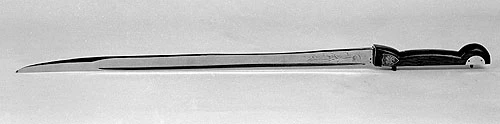
In 1888, Phillip Yorke of Erddig Hall presented a ceremonial sword to the Gorsedd which was used until the turn of the century. Then, in 1899, Professor Hubert Herkomer designed a Grand Sword for the Gorsedd. He explained its symbolism:

  • the natural crystal in the hilt represents mysticism;
  • the three sacred lines represent the first attempt to write 'Jehovah';
  • the dragon guards them both.
  • On the scabbard the following mottoes were inscribed: 
    'Y Gwir yn erbyn y Byd' (The Truth against the World) (motto of the Gorsedd of the Isle of Britain) 
    'Duw a phob Daioni' (God and all Goodness) (the Chair of Glamorgan and Gwent) 
    'Calon wrth Galon' (Heart to Heart) (the Chair of Dyfed) 
    'A Laddo a Leddir' ( He who Kills shall be Killed) (the Chair of Powys) 
    'Iesu na ad gamwaith' (Jesus, let there be no injustice) (the Chair of Gwynedd).

This is the Grand Sword still in use today.

The Mystic Mark

The Mystic Mark or the Mark of the Ray of Light, a symbol /|\ devised by Iolo Morganwg to represent the virtues Love, Justice and Truth.

However Iolo himself did not make much use of the symbol and it was after his death that it became increasingly popular. It was first seen on the Proclamation Scroll in Cardiff, 1833. By 1850 it could be seen on the banners in gorseddau and from around 1860 on new members' certificates.

By the end of the century it was considered the approved symbol of the Gorsedd of the Bards and appeared on its programmes, on the new banner and sometimes even on the Gorsedd Stones.

By the 1950s it was decided that the symbol had to be included on every national Chair and Crown.

The Gorsedd Banner

Some sort of banner seems to have been seen at many Gorsedd ceremonies during the nineteenth century. A simple banner with 'Gorsedd Beirdd Ynys Prydain' on it can be seen in a photograph of the Gorsedd at Brecon in 1889.

The first official banner, however, was the one designed by T.H.Thomas, Arlunydd Pen-y-garn, the Herald Bard, for the Llandudno Gorsedd in 1896. He explains:

'In the upper part is seen the sun symbolising celestial light, bearing upon it the golden dragon, at once a symbol of energy and the badge of Cambrian nationality; from the sun emerge golden rays, three of which are prolonged downwards forming the 'Nod Cyfrin' of the 'Awen'. ... The lower part of the design represents, in symbol, the Gorsedd of the Bards of the Isle of Britain ... Around the 'Maen Llog' are the twelve 'meini gwynion'; ... Upon the 'Maen Llog' may rest a sheathed sword... 
Around the Gorsedd Circle are deposited the plants representing the 'Alban' - trefoil, vervain, corn and mistletoe. The whole design is surrounded by a wide decorative border of oak leaves with acorns from which at parts mistletoe arises.'

These images are on a background of azure-blue silk and the mottoes 'Y Gwir yn erbyn y Byd' (the Truth against the World); 'Yn Wyneb Haul Llygad Goleuni' (In the Face of the Sun and in the Eye of Light) and 'Heddwch' (Peace) are embroidered on it in gold. It was embroidered by Miss Lena Evans (Brodes Dâr) and donated by Sir Arthur Stepney, Llanelli.

The Banner has been refurbished several times but remains faithful to this design.

Liverpool 1884: the influence of Friendly Societies' regalia on the Gorsedd

Liverpool 1884 - the gorseddogion in aprons and sashes similar to the Friendly Societies' regalia. In the centre are: Hwfa Môn a Clwydfardd.


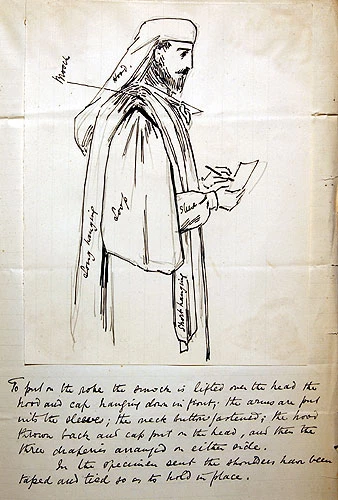
A sketch of the new Gorsedd robes and headgear by T.H.Thomas

A sketch of the new Gorsedd robes and headgear in T.H.Thomas, Arlunydd Pen-y-garn's manuscripts, c. 1895

Gorseddau outside Wales

25 July 2010

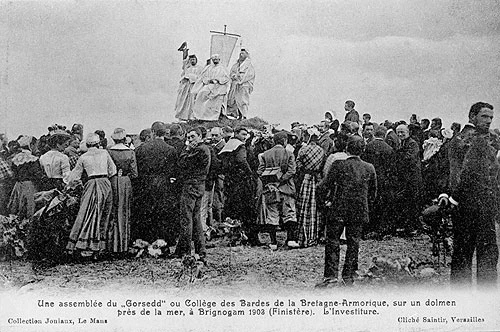
The first public meeting of the Breton Gorsedd, Brignonan, 1903.

The first public meeting of the Breton Gorsedd, Brignonan, 1903.

Gorseddau outside Wales

The ceremonies enacted in the Gorsedd Circle on Monday morning and again on the Eisteddfod stage in the afternoon, before the Crowning ceremony (since 1954), when the representatives of the Celtic nations and other friends are welcomed to the Gorsedd, are colourful and attractive ones. Usually there are representatives from Brittany, Cornwall, Ireland, Scotland, the Isle of Man, and also from Patagonia. Representatives of the Gorsedd of the Bards of the Isle of Britain attend their festivals in return. However, only two of the Celtic nations have a Gorsedd similar to that of Wales, namely Brittany and Cornwall. These are considered to be sub-Gorseddau and the Archdruid of the Welsh Gorsedd is the supreme head of them all.

The Breton Gorsedd

Interest in its Celtic heritage had re-kindled in Brittany after le Villemarqué's visit to Eisteddfod y Fenni (Abergavenny) in 1838 and the rite of marrying the two halves of the Split Sword was already popular before representatives from Brittany visited the Cardiff Eisteddfod in 1899. In 1900 a Breton Gorsedd - Gorsedd Barzed Gourenez Breiz-Izel - was established, with Ar Fusteg as Grand Druid and Taldir as Herald Bard. The Breton Gorsedd's first public ceremony was held at Brignonan in 1903.

However, for political and religious reasons, there has been considerable dissension within the Breton Gorsedd throughout its history. During the Second World War some Bretons, including Taldir, were accused of collaborating with the Vichy government and after the war had ended they were imprisoned. When Taldir was released he had to retire to north Africa and Eostig Sarzhaw was chosen as (vice) Grand Druid in his place. The dissension persisted and some members were drawn more towards Druidism and meetings at Stonehenge than towards the Welsh Gorsedd.

To quote Zonia Bowen on 'the tragic history' of the Breton Gorsedd, it has no '"raison d'être" such as the Welsh poetic tradition or an association with a body such as the National Eisteddfod.' Yet she emphasises that the Gorsedd as a society has survived longer than any other in the chequered history of the Breton nation.

The Grand Druid of Brittany wears a silver crown of mistletoe leaves.

The Gallic Gorsedd

Founded in 1923 on the basis that Gaul was a Celtic region before the Roman conquest, but by 1939 the Gorsedd had disappeared.

The Cornish Gorsedd:

Since the beginning of the twentieth century there had been somewhat of a revival in interest in the Cornish language, especially through the work of Henry Jenner, Keeper of Manuscripts at the British Museum. Several 'Old Cornwall' societies were formed and at the Treorchy Eisteddfod, in 1928, eight Cornishmen were accepted as members of the Gorsedd of the Bards. In September 1928 the first ceremony of the Cornish Gorsedd - Gorseth Kernow - was held at Boscawen Un, and Henry Jenner was invested as the first Grand Bard of Cornwall. The Cornish Gorsedd has only one order, the Order of Bards, wearing blue robes. The Grand Bard wears a crown of oak leaves and a breastplate.

The Gorsedd of North America

The sub-Gorsedd of North America was established by Archdruid Dyfed during the Pittsburgh Eisteddfod in 1913 and its Vice-Archdruid was Thomas Edwards - Cynonfardd, from Landore in Swansea. By 1946 the Gorsedd had been abolished.

The Gorsedd of Patagonia

Gutyn Ebrill (Griffith Griffiths, 1829-1909) established the Gorsedd of the Bards in Patagonia. Caeron (W.H.Hughes) and Prysor (William Williams) held office after Gutyn Ebrill but they considered themselves to be vice-Archdruids, under the authority of the Archdruid of Wales. After Prysor died in 1945 it seemed likely that the Patagonian Gorsedd would disappear for ever. Then, at the beginning of the twenty-first century during Meirion's period as Archdruid it was revived and representatives began to attend the National Eisteddfodau and Gorseddau of Wales once more.

A nation that spotlights poets

25 July 2010

The Chairing Ceremony, 2009

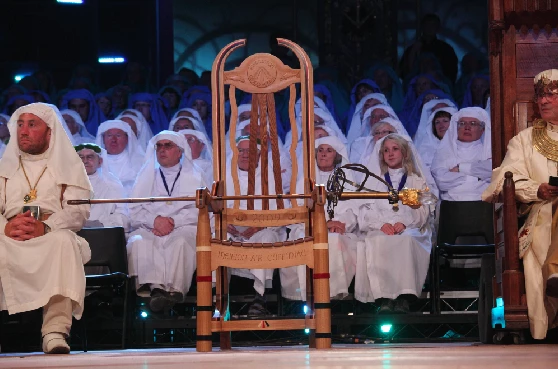
The Chairing Ceremony, 2009. No-one was deemed worthy of the main prize that year.

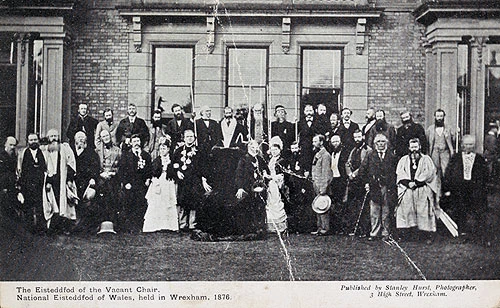
The Empty Chair at Wrexham, 1876

The Empty Chair at Wrexham, 1876. The winning bard, Thomas Jones (Taliesin o Eifion), had died a few weeks previously.

Eluned Phillips, winner of the Crown, Bala, 1967

Eluned Phillips, winner of the Crown, Bala, 1967. Gwyndaf was the Archdruid.

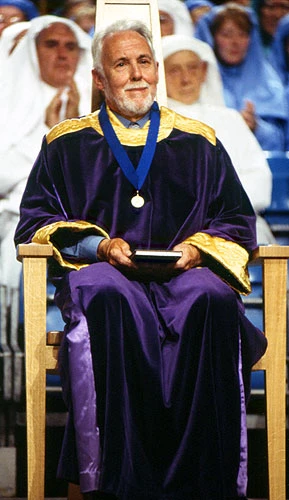
The Prose Medal winner, Elfyn Pritchard, Denbigh and District, 2001.

The Prose Medal winner, Elfyn Pritchard, Denbigh and District, 2001.

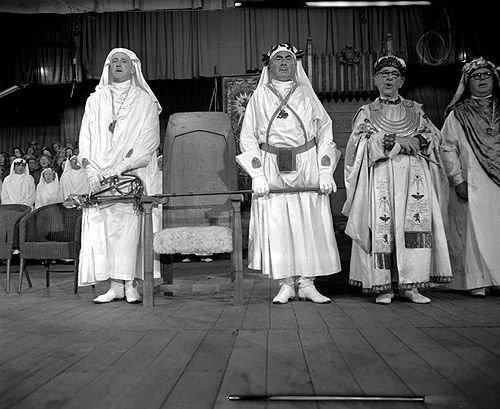
No-one worthy of the Crown: Aberdare, 1956.

The Grand Sword placed across the Chair to symbolize that no one was worthy of the Crown, Aberdare, 1956. In the picture we see: Erfyl Fychan, Herald Bard; Trefin, Grand Sword Bearer; Dyfnallt, Archdruid; Cynan, Recorder.

The Chairing Ceremony

The ceremony in which the winning poet is chaired for composing a collection of poems, an ode or other poem - all in strict meter on a specific subject is one of highlights of the Gorsedd of the Bards' pageantry in every National Eisteddfod. It is held on Friday afternoon.

It is a very old ceremony. The custom of competing for a chair in the King's court was already well-established in Hywel Dda's time in the tenth century and when the Lord Rhys 'held his court excellently' in Cardigan in 1176, the prize for the chief poet and chief musician was a chair each. Then, in c.1541, silver chairs were awarded at the Carmarthen eisteddfod and once more at the Caerwys eisteddfodau in 1523 and 1567. Having re-established the eisteddfodic movement in Bala in 1789 winning the Chair became the ambition of every poet, although there was no Gorsedd ceremony associated with it yet. It was at the first provincial eisteddfod in Dyfed / Dinefwr in Carmarthen in 1819 that Iolo succeeded in linking the rites of the Gorsedd of the Bards with the ceremony of Chairing the winning Bard.

In 1867 it was decided to assign the Chair for an ode in strict meter and to award a Crown for the best pryddest in free meter.

Notable Chairs

The Chairing ceremony at Wrexham 1876 was memorable and harrowing because the winning poet, 'Eurebius', Thomas Jones (Taliesin o Eifion) had died a few weeks previously. On the memorial poster for the sad event it was maintained that his dying words had been, 'Has the ode been sent safely?' On the festival stage the members of the Gorsedd wore mourning, and to the music of the Dead March, the chair was covered with a black cloth.

Among the most significant chairs awarded have been:

  •  
    • Chairs in the Celtic Revival style: 
      Eugene Vanfleteren - Birkenhead 1917 (winning poet - Hedd Wyn) 
      J.Kelt Edwards and Elias Davies - Corwen 1919 (Cledlyn Davies) 
      Llew Hughes - Barry 1920 (the prize was withheld)
    • The Wrexham Chair 1933 - a gift from J.R.Jones, Shanghai, a native of Llanuwchllyn (Trefin)
    • The Bro Dinefwr Chair 1996 by the Revd T. Alwyn Williams made from the oak left from Llandeilo Bridge, swept away in the great floods of 1845. The carpenter-minister died within hours of finishing it. (R.O.Williams)
    • The experimental Chair in Pembrokeshire and St David's 2002 made by Robert Jones, with its striking symbols, such as the thorn. (Myrddin ap Dafydd)

The Crowning Ceremony

One of the three ceremonies enacted by the Gorsedd of the Bards on the Eisteddfod stage, when the winning poet is crowned for composing a pryddest or a sequence of poems not in full strict meter. It takes place on Monday afternoon. In 1867 Archdruid Hwfa Môn announced from the Logan Stone that 'a new order is to be formed for the Pryddest (long poem in free meter), a crowned order'. By the turn of the century the pattern of awarding a chair and crown respectively had been established.

Eluned Phillips, crowned bard in 1967 and 1983, describes the experience of having to 'Keep the Secret' that she had won the main prize:

'I had to turn into an absolute recluse. I lost at least 12 pounds of flesh … I didn't want to lie so I had to hide from the light like a mole.' And on the stage itself 'I couldn't resist shedding a tear … You have to live through the experience to be able to appreciate the extreme ecstasy.'

Since the 1950s the Nod Cyfrin (Mystic Mark) has to be incorporated into every design for a National Crown.

The Prose Medal

The ceremony to honour the winner of the Prose Medal takes place on the Wednesday afternoon and it is one of the main ceremonies of the Gorsedd of the Bards on the festival stage.

The Prose Medal was awarded for the first time in Machynlleth in 1937 and it was won by J.O.Williams, Bethesda for a volume of essays, entitled Tua'r Gorllewin ac Ysgrifau Eraill. In 1966 the competition was given a full standard ceremony to celebrate the competition.

Then, in Aberystwyth in 1992, it became one of the official Gorsedd of the Bards' ceremonies. The Medal is presented for a volume of prose, sometimes on a specific theme or in a specific medium such as a novel, diary or series of short stories. Immediately after the ceremony the prize-winning volume is on sale on the Eisteddfod field.

Withholding the main prize

Occasionally, the adjudicators of the main competitions decide that there is no-one worthy of the national prize. In an article in the National Geographic in 1965 the Australian, Alan Villiers described the impact such a decision had upon the audience during the Chairing ceremony at Llandudno in 1963:

'No event symbolizes more vividly the poetic soul of the Welsh and the unyielding pride and integrity that accompany it than the ceremony of Chairing the Bard. This is the high point of the annual National Eisteddfod. … The large stage of an enormous prefabricated pavilion was banked with robed bardic dignitaries and the television lights stabbed at them like searchlights.' … 
But after Thomas Parry, T.H.Parry-Willams and William Morris's adjudication, 'No poem submitted was deemed worthy, … the ritual Chairing of the Bard would not take place. Merit before ritual - no ritual for its own sake! … The 8,000 still sat there in the huge pavilion, as if they had been stunned. Where else, I thought, would people feel so intensely about poetry?'

To demonstrate that the prize is withheld the Herald Bard and the Grand Sword Bearer place the Grand Sword across the arms of the empty chair where the winning poet or author would have sat.

The Floral Dance

Without doubt this is one of the most popular rites in the Gorsedd Circle and on the Eisteddfod stage. About 24 junior-school-aged girls take part; they wear green dresses adorned with meadow flowers and coronets of flowers in their hair and they carry sprays of flowers. The dance portrays the gathering of meadow flowers and it is linked to the Presentation of the Blodeuged (the gift of flowers) as two of the floral dancers add their bouquets to the Blodeuged itself.

However it is a comparatively recent rite. It was performed for the first time at the Machynlleth Proclamation ceremony in 1936 and it was devised by Cynan, the Gorsedd Recorder, and junior school teachers from the area. The dancers did not perform on the Eisteddfod stage until the Ystradgynlais Eisteddfod in 1954.