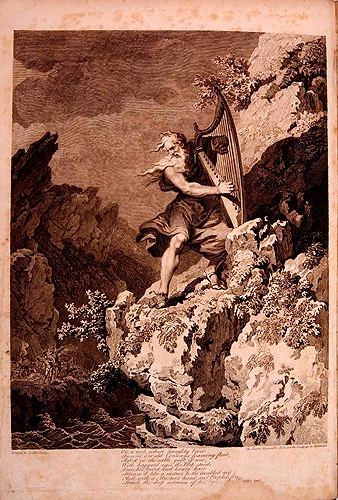
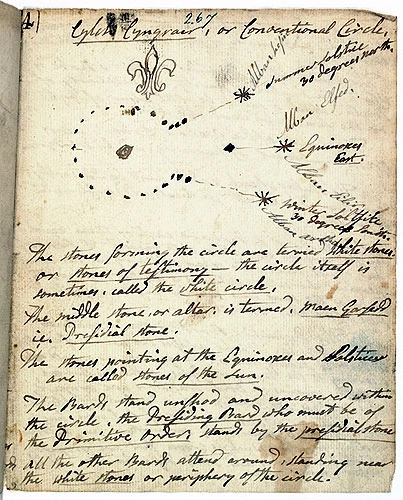
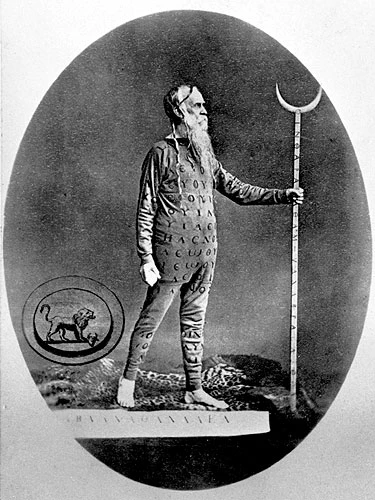
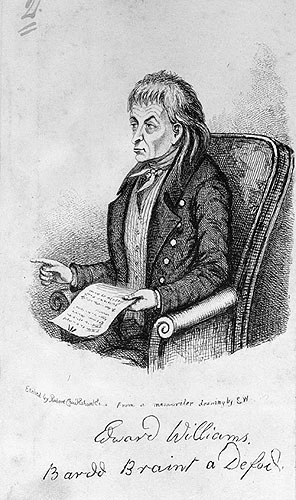
'Our own pageantry and peacockry': the Gorsedd of the Bards 25 July 2010 A portrait of Edward Williams, Ned of Glamorgan or Iolo Morganwg by George Cruickshank. What is the Gorsedd? The Gorsedd of the Bards of the Isle of Britain is a society of poets, writers, musicians, artists and individuals who have made a notable contribution to the nation, its language and culture. It operates through the medium of the Welsh language. The Gorsedd of the Bards is responsible for the pageantry of the National Eisteddfod of Wales and it organises and presents the colourful and dramatic Proclamation and Gorsedd Circle rites, and the Chairing, Crowning and Prose Medal ceremonies on the main festival stage. 'The gorsedd is a sort of guild of literati and it provides at 'the national' the ceremonial aspect, the incantations, the robes of white, blue and green, the dancing elves, the sword of peace, the horn of plenty, the sheaf of corn. All the tribes of the world like ritual, badges, medals, strange hats, parades and archaic nomenclature and language. … Wales likes its own pageantry and peacockry …' (Trevor Fishlock, Talking of Wales, London: Cassells, 1976, pp.75-6) The inventor of the tradition: Iolo Morganwg The Gorsedd is the product of the fertile imagination of Edward Williams, otherwise known as Ned of Glamorgan or Iolo Morganwg (1747-1826). He was born in the parish of Llancarfan, Glamorganshire, and although English was his home language he soon became interested in the Welsh language, its literature and history. He was a stonemason by craft and travelled throughout Wales and especially to London. Once there he came into contact with the Gwyneddigion Society and began to turn in cultural and radical circles. Iolo Morganwg was a genius - one of the founder members of the Unitarian movement in Wales, a political radical who supported the French Revolution, a pacifist, an antiquarian, a hymn-writer and an able lyrical poet who called himself 'The Bard of Liberty'. A Dreamer and a Forger But he was also a dreamer and a forger. He was addicted to the drug laudanum and this probably affected his perception of the world. The creation of the Gorsedd of the Bards of the Isle of Britain was part of his dream and vision for Wales and Glamorgan and he managed to convince the scholars of his own time that it was a totally authentic institution. Why did he go to such trouble? There are a number of possible reasons: He was entranced by the romanticism of eighteenth-century neo-Druidism and he believed that Welsh poets had inherited the mantle of the Celtic druids. When he was in London he realised that the English disparaged the language of culture of Wales. Therefore, he decided to create a brilliant ancient past for his nation through the Gorsedd of the Bards of the Isle of Britain. Iolo was jealous of the Gwyneddigion's confidence that Welsh poetry and culture were at their purest in Gwynedd. Thus, he tried to prove that druidic traditions had survived only in Glamorganshire. As the scholar G.J.Williams has shown, 'The Gorsedd was an attempt at taking the wind out of the people of Gwynedd's sails … an attempt to show that they in Glamorgan had safeguarded the old Welsh institution in its original purity.' And, of course, Iolo was central to his own vision. He wanted to define a central role for himself in Welsh history through the Gorsedd of the Bards of the Isle of Britain. Historian, Gwyn A. Williams crystallised Iolo's complex motives by claiming that he was driven by, 'a Welsh resentment against arrogant English, a south Wales resentment against arrogant northerners, a Glamorgan resentment against the rest and a Iolo resentment against any who snubbed him.' When Iolo died in 1826 Wales had scarcely begun to fathom the full nature and extent of his invention and deceit. An Archdruid in his Judicial Habit from Costume of the Original Inhabitants of the British Isles (1815) by Samuel Rush Meyrick and Charles Hamilton Smith. A plan of the Gorsedd Circle (the Conventional Circle) in Iolo Morganwg's handwriting. Note the comment 'the Bards stand unshod and uncovered within the circle'. Druidmania From the seventeenth to the nineteenth century British scholars were fascinated by everything Celtic. Druidmania flourished. One of the first to promote this interest was the antiquarian, John Aubrey, who suggested, in 1659, that the stone circles at Avebury and Stonehenge had been built by the Celts as druidic temples. Furthermore the Irish author, J.J.Toland, held a meeting for druids at Primrose Hill, London in 1717 and established The Ancient Druid Order. In Wales Henry Rowlands (1655-1723), the Anglesey antiquarian, tried to prove, in his Mona Antiqua Restaurata (1723), that the cromlechi on the island were druidic temples. But when Iolo Morganwg visited Anglesey at the end of the eighteenth century he was disappointed at 'the exceedingly pitiful monuments of the Island' and he realised that this gave him a chance to promote the antiquities of Glamorgan instead. The Archdruid and Druids of the Gorsedd of the Bards of the Isle of Britain today do not trace their origins back to the world of the Celtic druids, but the fact that the Gorsedd of the Bards meets within a Stone Circle demonstrates the influence of eighteenth neo-druidism upon its founder, Iolo Morganwg, and his lively imagination. The First Gorsedd of the Bards of the Isle of Britain, 1792 The first-ever Gorsedd was held on midsummer's day, June 21, 1792, on Primrose Hill, London. A second Gorsedd was held on September 22 and the Morning Chronicle presented an excellent report of the ceremony: 'Saturday, Sept 22, being the day on which the autumnal equinox occurred and consequently, in the phrase of Bardism, a Solemn Bardic Day, some Welch Bards, resident in London, assembled in Congress on Primrose Hill, according to ancient usage, which required that it should be in the eye of the public observation, in the open air, in a conspicuous place, and whilst the sun is above the horizon. The wonted ceremonies were observed. A circle of stone was formed, in the middle of which was the Maen Gorsedd, or altar, on which a naked sword being placed, all the bards assisted to sheathe it... On this occasion the Bards appeared in the insignia of their various Orders...' Several further ceremonies were held in London and in 1795 Iolo returned to Glamorgan to hold his first Gorsedd in his native county. But the authorities thought that he was fermenting revolutionary activity and therefore it was not until after the end of the Napoleonic Wars, in 1815, that Gorseddau were able to begin to flourish properly. Coelbren y Beirdd - The Bardic Alphabet Coelbren y Beirdd was a false alphabet invented by Iolo Morganwg c.1791. He claimed that it was the alphabet of the Celtic druids and that it had 20 'letters' and 20 others to represent elongated vowels and mutations. It would be hewn on a four-sided piece of wood and these pieces of wood would be placed in a frame, so that each piece could be turned to read all four sides. The name for this 'book' was 'peithynen'. Taliesin ab Iolo published a book, Coelbren y Beirdd, based upon his father's manuscripts, in 1840. The alphabet was popular with some poets and druids throughout the nineteenth century although others, such as Edward (Celtic) Davies (1756-1831), questioned its authenticity. By 1893 J. Romilly Allen, joint-editor of Archaeologia Cambrensis's comments in a letter to the Herald Bard reflected the general consensus of opinion regarding Coelbren y Beirdd: 'I think the so-called Bardic Alphabet a gigantic fraud … I don't believe you will find it repay you to look at these bogus alphabets and pseudo-Druidic antiquities as anything but but (sic) the most bare faced impostures.'
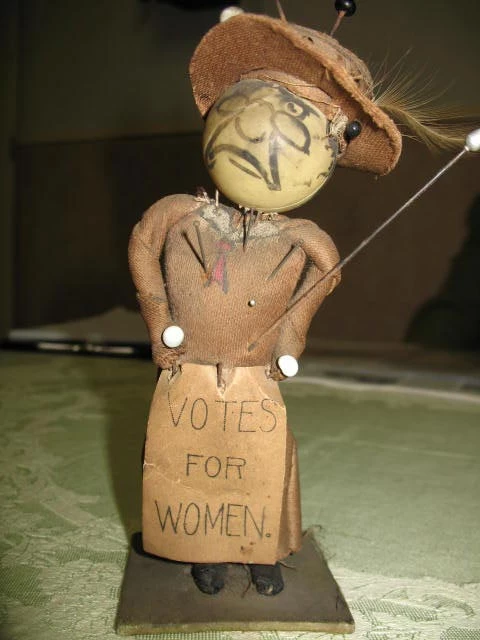
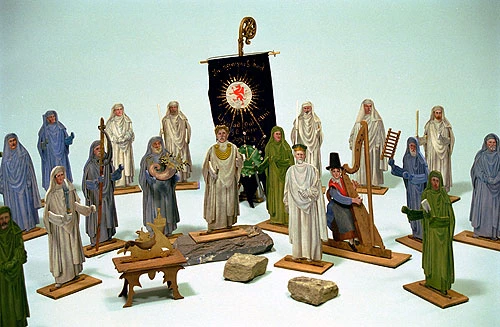
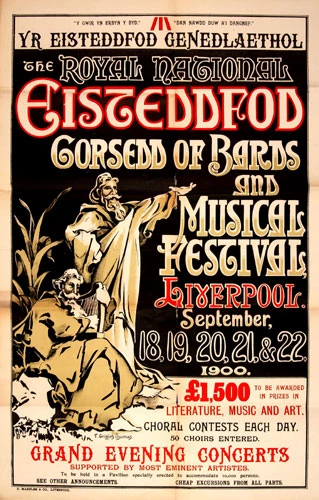
Historically interesting eisteddfodau 25 July 2010 This anti-suffragette 'voodoo' doll is an unflattering and grotesque caricature of a suffrage campaigner. The anti-suffrage movement used images such as this in cartoons and posters to ridicule and insult women who wanted the right to vote. Wooden models of the Bangor National Gorsedd, 1914 (postponed until 1915) by the Vale of Clwyd Toys Company, Trefnant, Denbighshire. A poster for the Liverpool National Eisteddfod and Gorsedd, 1900, showing how Anglicised the festival had become by the turn of the twentieth century. Targetted by SuffragettesOccasionally Eisteddfod and Gorsedd ceremonies reflect events of wider national importance.The first years of the twentieth century was a period of relentless campaigning for votes for women. When the Eisteddfod was held in the Albert Hall, London in 1909, with the prime minister, Asquith as guest speaker, suffragettes saw their chance to target the Prime Minister. Archdruid Dyfed's response to this 'audacity', in a poem composed extempore, in which he disparages the suffragettes for disrupting the bards' celebrations and revels in seeing the women imprisoned, was typical of the patriarchal attitude of the Gorsedd and Eisteddfod at this time.In Wrexham in 1912, Lloyd George was the target during his speech before the Chairing ceremony. The audience of 13,000 in the tent were enraged that the suffragettes dared to challenge the nation's darling son. They were physically attacked, their hair pulled and their clothes torn; ' the whole pavilion was in a turmoil'.Wars and DepressionWhen the First World War broke out in 1914 the National Eisteddfod in Bangor was postponed until 1915; in 1916 it was held in Aberystwyth, in Birkenhead in 1917 and in Neath in 1918. During the war gorseddau the Grand Sword was not unsheathed and there was no call for 'Peace'.The period between the wars was one of intense depression for many Welsh people. A symbol of this was that the National Eisteddfod Chair for 1938 was made in the Bryn-mawr factory, a settlement opened by the Quakers to try to alleviate the grievous unemployment in the town.During the Second World War the Government refused permission for the National Eisteddfod to hold the festival at Bridgend or Aberpennar in 1940 because they were both in danger zones. As a result a radio eisteddfod was organised.Concerns about the languageDuring the last decades of the twentieth century, many Gorsedd members were very concerned about the plight of the Welsh language and several Archdruids were heard voicing their opinions clearly from the Logan Stone. According to Tilsli, It was Archdruid Gwyndaf who initiated this new kind of speech, 'discussing controversial issues and offering positive leadership'.
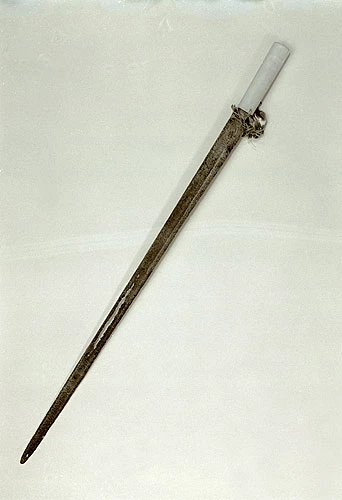
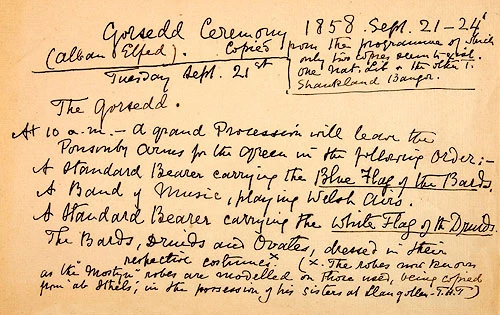
Eisteddfod and Gorsedd join forces 25 July 2010 Iolo Morganwg's sword, used in the 1819 ceremony. A copy of the order of the Gorsedd ceremony, September 21, 1858 in Llangollen. MWL MSS 2435 /280 Dr William Price, Llantrisant as a Druid T. H. Thomas, Arlunydd Pen-y-garn, the Herald Bard (1895-1915) in his Gorsedd robes. A portrait by C. F. Tunnicliffe of Archdruid Cynan, 1953. Carmarthen 1819In 1789 the Gwyneddigion Society had sponsored an eisteddfod in Bala in order to raise the standard and status of eisteddfodau in Wales. From this support the movement for provincial eisteddfodau developed and in 1819 the Bishop of St David's, Thomas Burgess, was very keen to establish such a provincial eisteddfod in Carmarthen. It was held at the Ivy Bush Hotel. Gwallter Mechain (Walter Davies) won the prize for the best ode and Iolo Morganwg tied a blue armband around his arm as a sign that he belonged now to the Order of Bards in Gorsedd.The next morning, in the hotel grounds, a Gorsedd ceremony was held in a small circle of stones, produced from Iolo's pocket. By associating the Gorsedd with the eisteddfodic movement in this way Iolo succeeded in transforming its future. The National Eisteddfodau and Gorseddau of the late nineteenth century evolved from this simple beginning. As G.J.Williams commented, 'Iolo gave the Welsh nation a national institution'.Early National EisteddfodauBetween 1819 and 1858 some Gorseddau were enacted in the provincial eisteddfodau but these did not have a standard form or order. Then, in 1858, Ab Ithel (John Williams 1811-1862) rector of Llanymawddwy, who was 'stark drunk' on Iolo's druidic ideas decided to try to establish a national eisteddfod and gorsedd, at Llangollen under the auspices of the Chair of Powys. Thousands flocked to it and the Gorsedd provided a remarkable spectacle with the eccentric Myfyr Morganwg wearing a druidical egg around his neck and Dr William Price in foxskin headgear!In spite of these strange sights the Llangollen eisteddfod and gorsedd were a turning-point for the eisteddfodic and gorsedd movements as this was the first step towards a National Eisteddfod with the Gorsedd as an integral part of its activities. Two years later at Aberdare (1861), Ab Ithel's dreams were fulfilled and the first National Eisteddfod and Gorsedd were held.During the following years Gorsedd ceremonies evolved but everyone was not supportive of them. The druids were like 'a pack of madmen' according to Cynddelw (Robert Ellis) and others feared that the 'ancient' rites did not suit the image of the Victorian Age as 'The Age of Progress'. A correspondent with the Times was in his element in 1867, as he mocked:'This remarkable piece of pantomime ... the puerile fopperies of making Druids in broadcloth and Ovates in crinoline.'Doubters and CriticsAlthough many Welsh people believed Iolo Morganwg's claims regarding the antiquity and authenticity of the Gorsedd, not everyone, even from among his contemporaries, was as gullible:John Walters (1721-97), who called it "a made Dish"Edward (Celtic) Davies (1756-1831), the author of a book on Druids.William Williams, Llandygái (1738-1817 who claimed that 'no vouches can be produced (for it) but the brains of Iolo Morganwg.'J.W.Prichard, Plas-y-brain, Llanbedr-goch (1749-1829) who detested Iolo because he was 'always a mischief-maker ... making up some lies to try to deceive the world.'Thomas Stephens (1821-75) who criticised the druidic and gorsedd institution in the periodical Yr Ymofynnydd, 1852-3.Then, towards the end of the nineteenth century, university scholars and academics began to express their doubts:John Rhŷs (1840-1915), a Celtic scholar who was appointed the first Celtic professor at Oxford University in 1877, described the Gorsedd as 'antiquarian humbug, positively injurious to the true interests of the Eisteddfod'.John Morris-Jones (1864-1929), Professor of Welsh at University College of North Wales, Bangor from 1895 onwards. In a series of five scathing articles in Cymru 1896, he cast doubts upon the alleged authenticity of the Gorsedd and came to the (erroneous) conclusion that the ceremonies had been introduced by Glamorganshire poets during the seventeenth century. He continued, 'it is all but child's play'.G.J.Williams (1892-1963) Professor of Welsh at University College, Cardiff from 1947 onwards. Through his meticulous research into Glamorganshire traditions and Iolo's own history he totally undermined the credibility and antiquity of the Gorsedd in an article in Y Llenor, 1922. It was, for him, 'a refuge for quackery', and its members 'merely useless members of an institution based upon falsehood and upheld through arrogance and ignorance.' Yet, he was willing to concede that 'a modern institution can be a blessing to a nation.'Dignifying the GorseddIn view of these attacks upon the Gorsedd's origins, authenticity and merit the supporters of the institution realised, by the 1890s, that efforts should be made to re-organise and dignify Gorsedd ceremonies and to enrich its rites and regalia. This would help to silence its critics and to promote its image.The Gorsedd found its champion in T.H.Thomas, Arlunydd Pen-y-garn (1839-1915) who was elected Herald Bard in 1895. His artistic training as a professional artist made him the ideal person to reform the Gorsedd. He supported Hubert Herkomer's plans to re-style the Gorsedd's robes and the Archdruid's regalia based upon Celtic patterns. Arlunydd Pen-y-garn designed the Gorsedd Banner, and the Stone Circle and transformed the standard of Gorsedd pageantry.Many of these changes have survived until today and the Gorsedd of the Bards' debt to Arlunydd Pen-y-garn's creativity and patriotic zeal is immense.Disciplined showmanshipIn 1935. Cynan (Albert Evans-Jones 1895-1970) was elected Gorsedd Recorder, an office which he held, between two periods as Archdruid (1950-54; 1963-66), until 1970. Cynan was very interested, as a playwright and actor, in the theatre and he used his talent in this respect to create more colourful, dramatic and disciplined ceremonies for the Gorsedd. He refined the rite of Presenting the Aberthged (the offering of the fruits of the earth); he composed new words for the Chairing Song and he, with the help of teachers from the Machynlleth area, created the Floral Dance in 1936.Cynan succeeded in getting the Gorsedd and the Council of the Eisteddfod to form one national body - the Court of the Eisteddfod, to manage its affairs, and thus ensured that both parties were considered as equal partners. Furthermore, the new Constitution agreed upon in 1937 and which came of age in Caerphilly in 1950 incorporated the all-Welsh Rule. As Ernest Roberts has shown:'Cynan, and no-one else, made the Gorsedd one of the main attractions of our National Festival'. This is, after all, 'the only national pageantry we possess.'
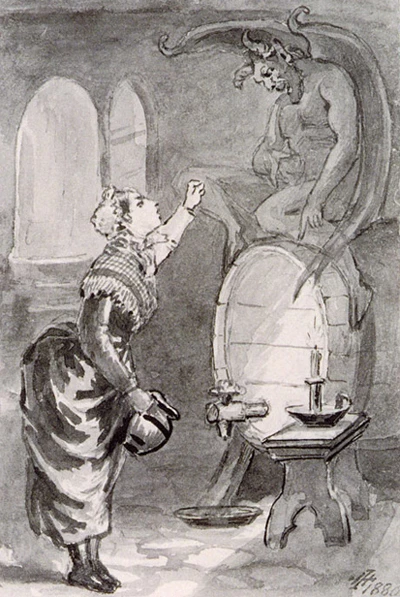
The unique prints and drawings of T. H. Thomas 20 September 2007 T.H.Thomas, 'Mrs Jones, the Devil and the supper beer' (1880), from 58, British Goblins; NMW A 11953, pen, ink and wash on paper. During his lifetime, Thomas Henry Thomas (1839—1915) created a unique catalogue of prints, drawings and watercolours detailing the major concerns of the 19th century. In 1915, the entire catalogue was bequeathed to Amgueddfa Cymru. Thomas Henry Thomas: the collector Thomas Henry Thomas, one of the founding fathers of Amgueddfa Cymru, was born in Pontypool in 1839. He studied at the Royal Academy and spent time in both France and Italy. On his return to London in 1864, he specialised in portraits, design and book illustration. He worked as an artist for The Daily Graphic, from which many illustrations still survive, ranging from work on the Severn tunnel at Portskewett to royal visits. Thomas in Wales Between 1866 and 1878, Thomas settled in Cardiff, where he was to remain for the rest of his life. He became involved with the Eisteddfod and the Gorsedd and joined the Royal Cambrian Academy. He was also a key member of the Cardiff Naturalist's Society, becoming president in 1888. His interest in geology led him to , new to science, in a large stone slab in the churchyard at Newton Nottage. The fossil was named Brontozoum thomasii in tribute. The collection Thomas's collection of over 1,000 prints, drawings and watercolours came to Amgueddfa Cymru following his death in 1915. The main collection comprises three boxes, each containing around seventy folders holding up to ten objects, grouped by subject types. Until recently, it had been assumed that this ordering system was the work of Thomas, but closer inspection of the handwriting revealed it to be that of Isaac Williams, the first Keeper of Art at the Museum. It is not known in what form these works first entered the Museum, although there is reference to a scrapbook which, has not as yet been discovered. As curating methods were rather different at that time, it seems likely that the scrapbook was broken up and its contents reassembled into the folders in which they appear today. Their contents are exceptionally wide-ranging, with topics including rural and industrial life, the natural world, archaeology, book illustration, folklore along with drawings of social and cultural life. Among the miscellaneous objects of the collection is a particularly intriguing object -a cigarette box filled with drawings by children from a school in Oxfordshire. These appear to be part of an experiment by Thomas to analyse the drawing techniques of children. Preserving the cultural life and heritage of Wales Thomas's all-embracing interests somewhat hampered his artistic development. Had he devoted himself solely to art, he could have achieved more widespread recognition. This is not, however, meant as a criticism — the strength of the Thomas material lies not in its artistic quality but in its quirkiness, its breadth, and that it represents an almost complete catalogue of the major concerns of the 19th century. Seen from this perspective, Thomas can be viewed in the tradition of J. W. Goethe and John Ruskin, men whose works spanned many diverse disciplines and wanted to bridge the gap between science and the arts. In addition to this, Thomas was also an avid champion of Welsh art and artists, and worked to support the cultural life and preserve the heritage of Wales wherever he was able. Amgueddfa Cymru is lucky to have received such a comprehensive bequest, especially one that encompasses each of its curatorial departments. T.H.Thomas, 'Effect of explosion at "Cwtch" Colliery', from 115, Mining, NMW A 12383, pen and wash with pencil on paper.
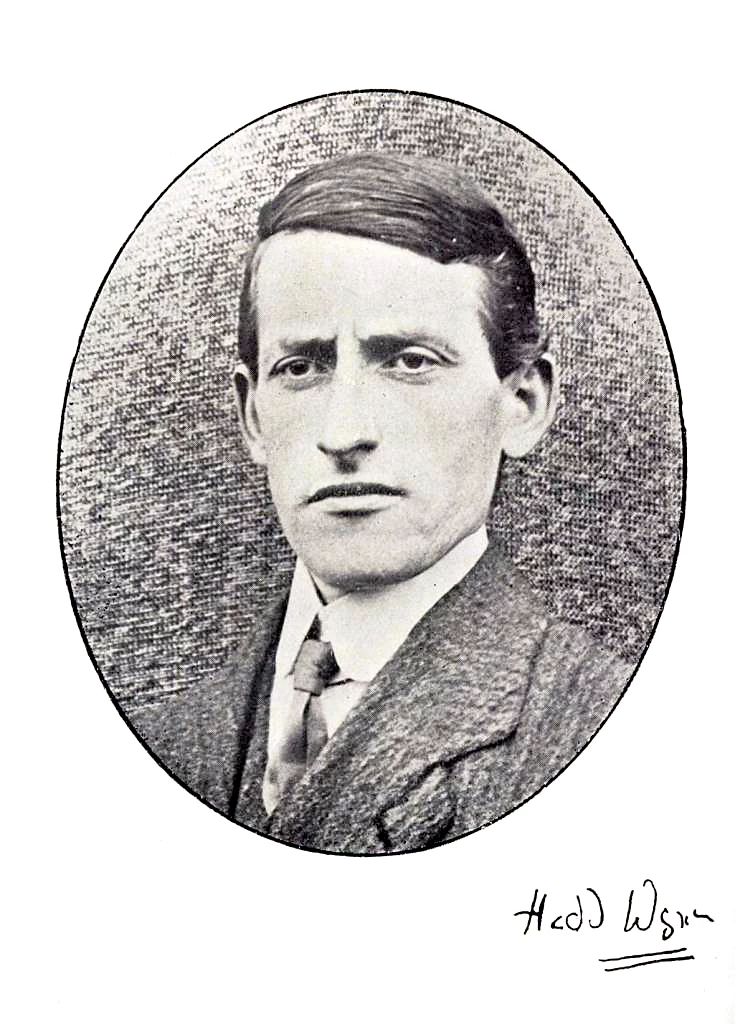
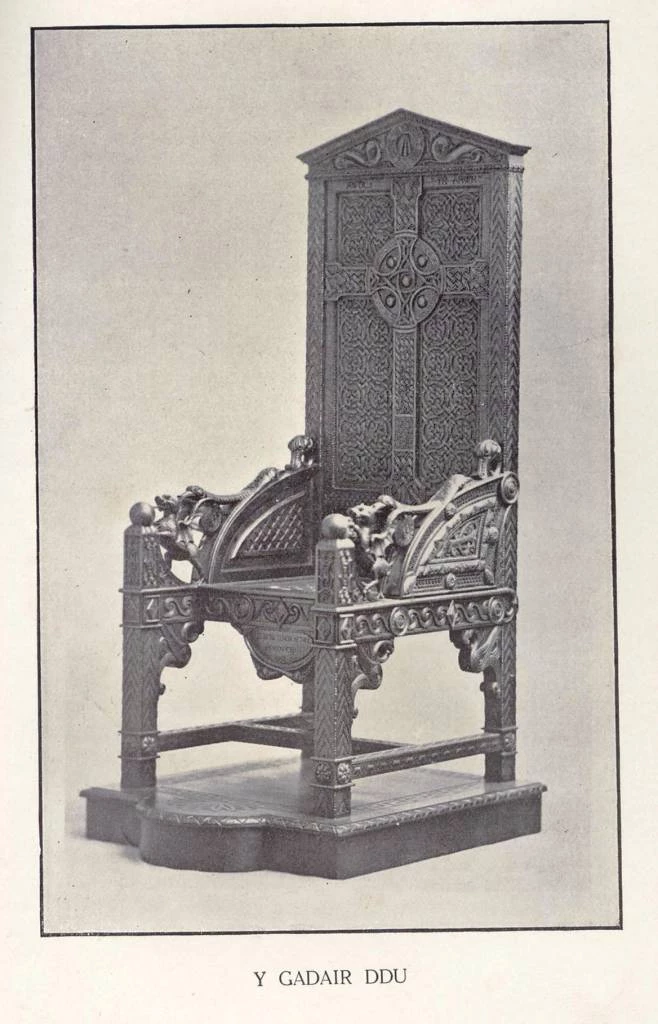
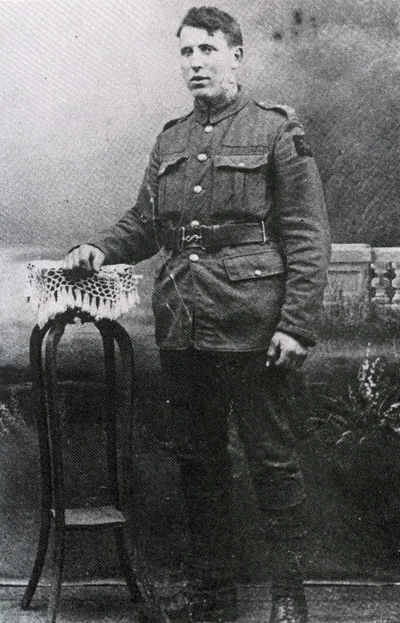
Welsh bard falls in the battle fields of Flanders 25 April 2007 "It was the last day of July, you see. The first day of probably the biggest battle that ever took place. The battle of Passchendaele". (Simon Jones, 1975). Over a quarter of a million Welshmen enlisted to fight in the First World War. Among them was the poet Ellis Humphrey Evans of Trawsfynydd, better known under his bardic name of Hedd Wyn. He was dispatched for active service in 1917. Just a few months later he was dead - killed in battle on the fields of Flanders. The Black Chair Six weeks later he was posthumously awarded the chair at the National Eisteddfod at Birkenhead for his poem Yr Arwr (The Hero) which he had completed shortly before his death. The chair itself was draped in black during the chairing ceremony, and has since been known as the Y Gadair Ddu (The Black Chair). By the age of 28 he had won four Eisteddfod chairs for his poetry. Ellis Humphrey Evans (Hedd Wyn; 1887 - 1917) The Black Chair Witness account Mr Simon Jones of Aberangell, Mid Wales, served in the same regiment as Hedd Wyn, and witnessed his falling on the field of battle. Hear or read his account, as recorded by St Fagans National Museum of History in 1975: AWC 4763. Recorded: 26.9.1975, by Robin Gwyndaf. AWC 4764. Recorded: 26.9.1975, by Robin Gwyndaf. "It was the last day of July, you see. The first day of probably the biggest battle that ever took place. The battle of Passchendaele. And we were going over the top at half past four. We started over Canal Bank at Ypres, and he was killed half way across Pilckem (Ridge). I've heard many say that they were with Hedd Wyn and this and that, well I was with him as a boy from Llanuwchllyn and him from Trawsfynydd. I saw him fall and I can say that it was a nosecap shell in his stomach that killed him. You could tell that. You couldn't stay with him - you had to keep going, you see. When did you see him last, to speak to him? Oh, it's difficult to say. Perhaps I spoke to him that morning, because if I saw him get killed, I must have been near to him. I remember well that we had an officer leading us called Newman, Lieutenant Newman. He was going in front of me, and I saw him fall on his knees and grab two fistfuls of dirt. Well there was nothing but dirt there, you see - the place was all churned up. He was dying, of course. What did you do? Could you do something when you saw Hedd Wyn... ? Nothing at all. No. There were stretcher bearers coming up behind us, you see. There was nothing - well, you'd be breaking the rules if you went to help someone who was injured when you were in an attack. Your business was to keep going. How did you feel when you saw your friend fall? Well I'll tell you straight. To be honest, you had no time to sympathise because you didn't know whether you'd be in the same situation as him in a couple of yards." Simon Jones in the First World War "I saw him fall and I can say that it was a nosecap shell in his stomach that killed him. You could tell that. You couldn't stay with him - you had to keep going, you see". (Simon Jones, 1975). Lost generation Hedd Wyn was one of 32,000 soldiers to be killed in the attack on Pilckem Ridge. The devastated village of Passchendaele itself was not captured until 6 November, 98 days after the start of the battle. This slow advance over little more than five miles of ground was achieved with the loss of 310,000 Allied and 260,000 German lives. The Black Chair remains a potent symbol of the devastating impact of the First World War on communities throughout Wales, and the unfulfilled potential of a whole generation of young Welsh men.