Lost Landscapes: Beneath the Eisteddfod of 2012 is a sacred landscape 3 August 2012 At the site of the National Eisteddfod of 2012, four thousand years ago, the people of the Vale buried selected members of their community. Impressive and complex mound constructions marked the resting places of their (and our?) ancestors. In the extreme winter of 1939-40 Sir Cyril Fox, Director of the National Museum, excavated these archaeological monuments. Around him bulldozers were already preparing the ground for the WWII airfield Llandow. Sir Cyril Fox, Lady Fox and "half-a-dozen pick-and-shove men" explored the remains of the past. That winter of 1939-40 was the coldest on record. The future looked very grim. The items in this gallery are a selection of pages from Cyril Fox's own handwritten notebooks from these excavations.
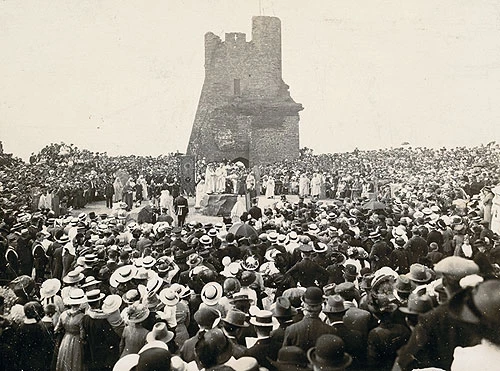
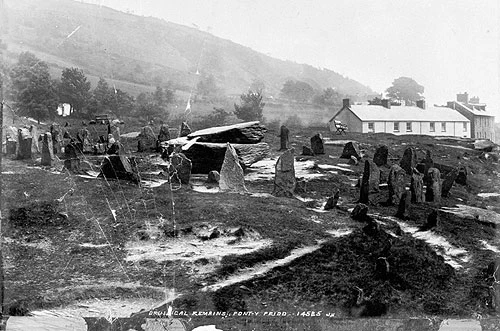
The Gorsedd Circle 25 July 2010 A huge crowd watching a ceremony in the Gorsedd Circle, in the Castle grounds, Aberystwyth, either during the Proclamation Ceremony, 1914 or during the Eisteddfod week itself, 1916. The Maen Chwŷf and Gorsedd Stones, Pontypridd The Proclamation Ceremony for the Newport and District National Eisteddfod, 1987 with Elerydd (W.J.Gruffydd) as Archdruid and Gwyn Tre-arth leading the singing on the Logan Stone. Successful young candidates (13-14 years old) in the Gorsedd examinations, invested as members in Swansea, 1962. The Proclamation CeremonyThe visit of the National Eisteddfod and the Gorsedd of the Bards to a specific area has to be proclaimed at least a year and a day in advance. During the ceremony the Recorder reads the Proclamation Scroll and the first copy of the list of competitions for the following year's National Eisteddfod is presented to the Archdruid.When Lord Rhys held a competition for poets and musicians at his court in Cardigan castle in 1176 it was noted that it had been proclaimed throughout Wales, Scotland, Ireland, England and the other islands a year in advance. This custom was revived when eisteddfodau were re-established in Wales at the end of the eighteenth century and likewise, in 1791, Iolo Morganwg chose to proclaim that the Gorsedd of the Bards of the Isle of Britain would hold its first ceremony on Primrose Hill, London, on June 21, 1792. This pattern has been adhered to ever since.From pebbles to fake stonesThe Proclamation Ceremony and other Gorsedd ceremonies held during the week of the National Eisteddfod are held within the Gorsedd Stone Circle.The remarkable stone remains at Avebury in Wiltshire and Dyffryn Golych, in his native county, probably influenced Iolo Morganwg's vision of a Celtic druidic stone circle. Thus, the first Gorsedd in 1792 was held within a circle of stones, with a Maen Gorsedd at its centre. However when Iolo came to link the Eisteddfod and the Gorsedd at Carmarthen in 1819 all he had to hand was a fistful of pebbles. Only Bards were allowed within this sacred circle of stones.In Glamorganshire the Maen Chwŷf, a huge slab of slate stone, near Eglwysilan, was seen as a natural gorsedd and several meetings of the Glamorgan Chair were held on it during the first half of the nineteenth century.Towards the end of the century, in order to inform future gorseddau, the Herald Bard - Arlunydd Pen-y-garn made a detailed plan of the Gorsedd Circle, and this was followed in the Cardiff Eisteddfod, 1899. According to this plan the stone to the east, the Maen Cyfamod, and the two Portal stones formed the shape of the mystic mark. For a time it was fashionable to dress the stones with oak and mistletoe leaves. To facilitate holding the Gorsedd Circle on the Eisteddfod field itself during the week of the Eisteddfod, it was decided in 2004 to use fake (but realistic-looking) stones.The Circle during Eisteddfod weekThe Monday morning ritesThe Hirlas Horn (the horn of plenty) is presented to the Archdruid and the Celts and other representatives from abroad are welcomed by the Gorsedd. The Recorder commemorates those Gorseddogion who have died during the past year and a hymn of remembrance is sung. Then the ceremony of admitting new members through examination or degree to the Order of Ovates or Order of Bards takes place.The Friday morning ritesThe Blodeuged (the gift of flowers) is presented to the Archdruid and the Floral Dance is performed. New honorary members are admitted to the Order of Druids in Gorsedd.Admitting new membersThe Gorsedd of the Bards has three orders/degrees:The Order of Ovates: in green robes. Candidates who pass Levels 1 and 2 in Gorsedd examinations in poetry, prose, music, or the tests for harpists and singers are admitted into this order. Members can be admitted to the order as honorary members for contributions of national significance. Several members of the royal family, including Queen Elizabeth, the Duke of Edinburgh and King George, have been admitted to this Order.The Order of Bards, in blue robes. Those who have passed the final Gorsedd examination are admitted to this order. Those who have gained a degree in Welsh or Music (and who can speak Welsh) can also be admitted. Members are admitted to these orders during the Monday morning ceremony in the Gorsedd Circle. The Herald Bard and the Bearer of the Grand Sword walk towards the entrance to the Circle and hold the Sword across it to bar the way. Every new member places his/her right hand on the Sword's blade. After a new member has been admitted he/she is led by the Marshalls to the Mistress of the Robes to be invested with his/her Order's head-dress.The Order of Druids: in white robes. The winners of the main competitions - the Chair, the Crown and the Literary Medal - are admitted automatically to this Order. Others are 'elevated' to be Druids from the green or blue Orders. Every year, too, those who have served the nation, the Welsh language and its culture are honoured by being admitted to the Order of Druids, among them world-famous singers and actors such as Bryn Terfel, Sian Phillips and Ioan Gruffudd; influential Welshmen such as the Archbishop of Canterbury, the Right Reverend Rowan Williams and star footballers and rugby players.Iolo differentiated between the bardic orders in the first Gorsedd ceremony in 1792 although he also emphasised that they should be considered equal in status. By the second half of the nineteenth century there was real concern regarding the merit of Gorsedd degrees. The scholar, John Morris-Jones, was the severest critic, because, he claimed, 'candidates are admitted as members through an examination which is five times easier than the most basic University of Wales examination ...'. As a result candidates came to be examined more stringently in order to raise standards.
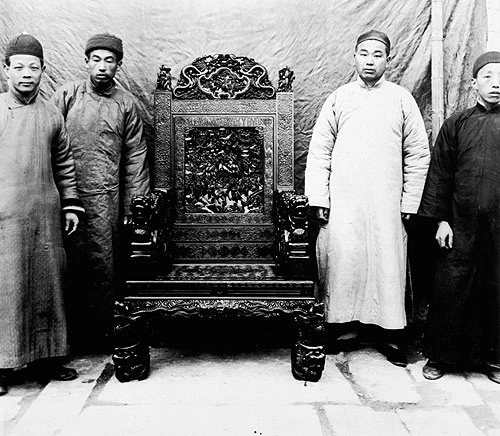
Made in China: the 1933 Eisteddfod chair 25 July 2010 Wrexham National Eisteddfod Chair, 1933; the gift of J.R.Jones, Shanghai. With the chair are the craftsmen who made the chair. It took the craftsmen in the photo over a year to carve this Eisteddfod chair. The chair was carved at the T’ou-se-we Catholic orphanage, on the outskirts of Shanghai. This orphanage, founded by Catholic missionaries in 1852, had many workshops teaching skilled crafts such as woodcarving, painting, printing, tinplate and stained glass workshops, and photography. The chair was given as a prize for the National Eisteddfod at Wrexham in 1933 by a successful Welshman living in Shanghai. Dr John Robert Jones(b. Llanuwchllyn 1887,d. Hong Kong 1976) was a barrister and an avid Eisteddfod-goer who also showed great interest in Chinese art and culture. He went to Shanghai in 1924, became General Secretary of International Council in 1928, and was a leading figure in the Shanghai branches of the Royal Asiatic Society and Cymdeithas Dewi Sant. It was his idea to commission the craftsmen of T'ou-se-we to make the chair. The winner of this chair in 1933 was Trefin (Edgar Phillips) for his poem entitled Harlech. An almost identical chair, also made at T’ou-se-we, was won by the poet Gwenallt in the 1926 Swansea Eisteddfod.
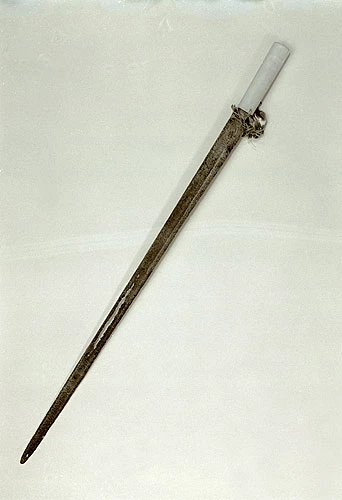
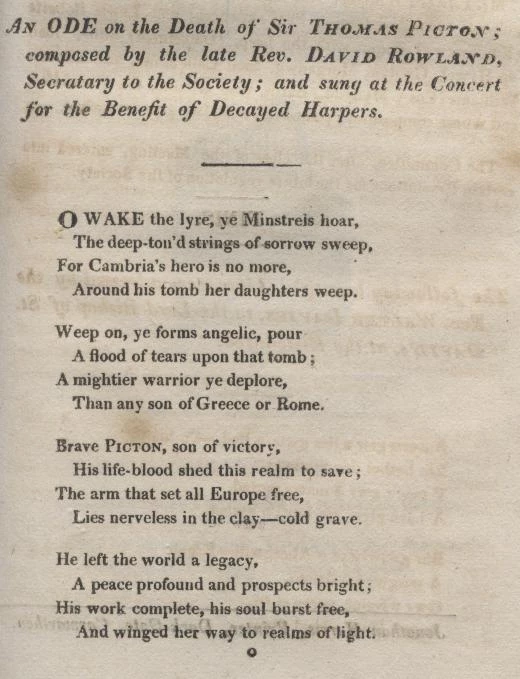
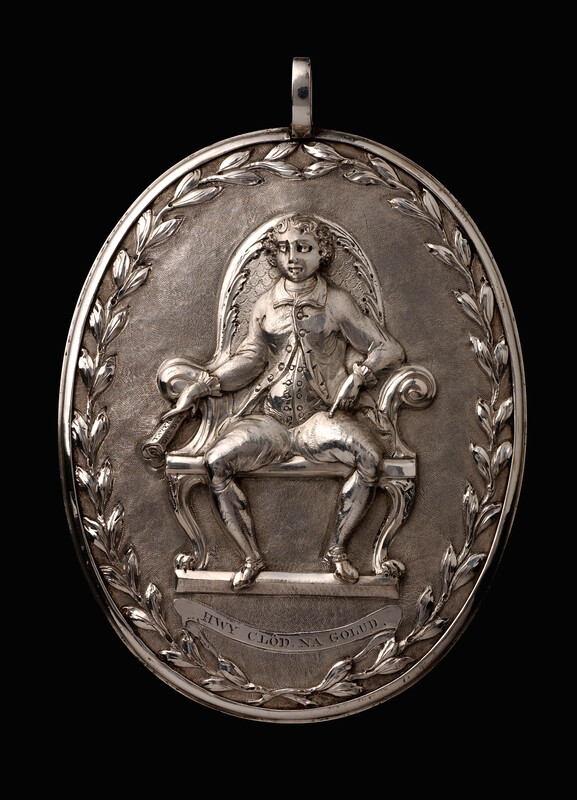
Pebbles and plots: eisteddfodau after the Napoleonic Wars 25 July 2010 From Revolution to Reverends The Napoleonic wars [1803-1815] led to a hiatus in the Gwyneddigion’s eisteddfodic activities. The radicalism of many London Welshmen had made the authorities profoundly uneasy, and a number of prominent Welshmen who had links to the Gwyneddigion – among them Dr Richard Price and John Jones (Jac Glan Gors) — had been deeply interested in the Revolution in France. Indeed, the authorities had instigated a raid on the Caradogion, the Gwyneddigion’s sister society. When Iolo Morganwg (Edward Williams, 1747-1826) created the Gorsedd of Bards (Gorsedd Beirdd Ynys Prydein) in 1792 its possibly seditious connections were viewed with suspicion. When the war came to an end these eisteddfodic interests resumed and many began to think seriously about creating proper Eisteddfodau. These ambitions were embraced most warmly by a group of clergymen under the leadership of Ifor Ceri (The Reverend John Jenkins, 1770-1829). He became known as one of the hen bersoniaid llengar (‘old literary clerics’), Anglican clergymen who delighted in the language and culture of Wales, and it was men such as he who took a deep interest in the first regional Eisteddfod, in Carmarthen in 1819. The Gwyneddigion Society medal awarded at the Bala Eisteddfod, 1789. The medal was designed by Augustus Duprê, General Engraver of French Money to the National Assembly of France. Considering 1789 was the year of the French Revolution, this was a very notable art commission. Iolo Morganwg's sword, used in the 1819 ceremony. Iolo brings his stones and sword The 1819 Carmarthen Eisteddfod was remarkable for being the first of ten regional Eisteddfodau which transformed the movement's history. One of the main reasons for this was the Gorsedd. Although held for the first time on 21 June 1792, on Primrose Hill in London, there was no link between the Gorsedd and the Eisteddfod until Iolo Morganwg saw his chance at Carmarthen in 1819. Aged seventy, he travelled all the way from Merthyr where he was staying at the time. On arriving at Carmarthen, he created a Gorsedd circle on the lawn of the Ivy Bush Hotel with a handful of pebbles from his pockets. He went on to admit poets and druids, giving them white, blue and green ribbons according to their rank. During the chairing ceremony a new rite took form as poets stood either side of the chair, sheathing and unsheathing a sword above the winning poet’s head. The sword used by Iolo Morganwg during the 1819 ceremonies is still to be seen at St Fagans National History Museum. An ode to a hero of Waterloo Gwallter Mechain (another of the hen bersoniaid llengar) was still competing and winning prizes. At the Carmarthen Eisteddfod he won the chair for his elegy to Carmarthen's idol, Sir Thomas Picton, hero of Waterloo. The prize was a silver medal with an engraving of the chair, made by the artist Hugh Hughes (newly returned to Wales from London, he had connections with a number of figures in the Eisteddfod movement). Medals such as these speak eloquently of the status and dignity the Welsh sought for their culture on the virtual stage offered by the Eisteddfod. The silver medal won by Gwallter Mechain at the Carmarthen Eisteddfod, 1819. Concert for the benefit of decayed harpists, Carmarthen 1819 Anglo-Italian farce With time the regional Eisteddfodau became extremely fashionable events — events where two cultures, the Welsh–language and the Anglicised, came face to face. The venerable traditional poets who had long thought themselves keepers of the Eisteddfod flame felt bitter at being left on the sidelines. Indeed, Ifor Ceri called these events an ‘Anglo-Italian farce’, because of the artistes brought down from London to perform at the Eisteddfod — in English. This Anglicised, concert-hall vision of culture went head to head with traditional Welsh language culture at Carmarthen in 1819 when the Reverend John Bowen brought a choir to the Eisteddfod. These members of the Bath Harmonic Society held two benefit concerts, one for the widows and orphans of deceased clergymen and the other in aid of so-called "decayed harpists" who had become too enfeebled to support themselves. The bourgeoisie of Carmarthen flocked to these fashionable concerts. From this moment onwards the battle between the two cultures for the soul of the Eisteddfod had begun.
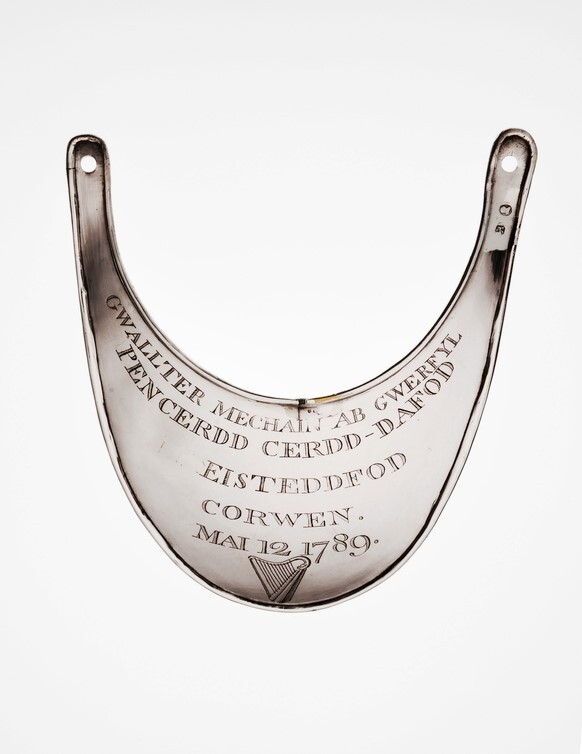
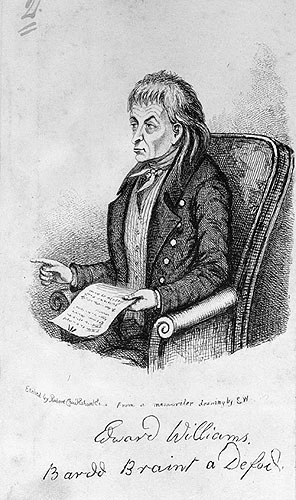
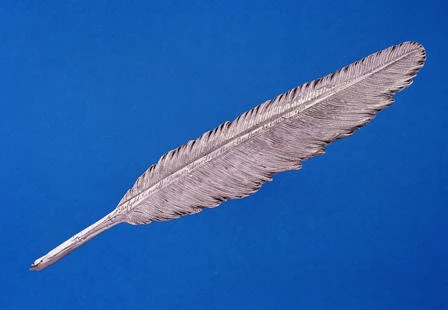
Words can be dangerous: the Gwyneddigion eisteddfodau 25 July 2010 This medal was made in Chester, having been commissioned by the Gwyneddigion Society as a prize at the Corwen Eisteddfod in 1789. It was awarded for extemporare verse, and won by Gwallter Mechain. Dr David Samwell was so incensed that his favourite, Twm o'r Nant, had not won that he threatened one of Gwallter Mechain's supporters to a duel. However, no blood was spilled and Samwell gave Twm a silver pen as a consolation prize. A portrait of Edward Williams, Ned of Glamorgan or Iolo Morganwg by George Cruickshank. Silver gorget awarded to Gwallter Mechain at an eisteddfod in Corwen in 1789, which marked the renaissance of the eisteddfodic movement in Wales. A silver pen given to Twm o'r Nant by Dr David Samwell, surgeon to Captain Cook, as a consolation prize for having been supposedly unfairly beaten by Gwallter Mechain at an eisteddfod in Corwen, 1789. Who were the Gwyneddigion?The Gwyneddigion Society (Cymdeithas y Gwyneddigion) began in London in 1770, established in response to what some members felt was the Cymmrodorion's lazily highbrow approach. The Gwyneddigion, on the other hand, were a lively lot who revelled in the cut and thrust of cultural debate through the medium of Welsh. Welsh literature, in particular, interested its members deeply and the society sponsored and promoted some of the most important publications in the history of the language, books such as a seminal edition of Dafydd ap Gwilym’s poetry (1789) and The Myvyrian Archaiology of Wales (1801-7).Many of the men associated with the Gwyneddigion were bold and brilliant characters. Among the boldest and most brilliant of them all were David Samwell and Twm o’r Nant.Colourful charactersToday any Welsh-language poet would be extremely pleased to see a volume of his or her poetry sell five hundred copies. Twm o’r Nant (Thomas Edwards, 1738-1810) boasted that his work, Gardd o gerddi (‘A Garden of verses’, 1790) had sold as many as 2000 copies. Twm was a character with a past. Son of a smallholder, he had had very little education – only a few weeks in Nantglyn Free School and a fortnight learning English at Denbigh. But he thought fast and wrote faster. Pursued by his creditors, he moved from town to town, trying to supplement a meagre income by writing interludes. These popular dramas offered a vividly satirical commentary on the social ills of his day, men whom Twm had had plenty of opportunity to study at first hand such as the greedy landlord, the hypocritical clergyman and the scruple-free lawyer.The career of David Samwell (Dafydd Ddu Feddyg, 1751-1798) was even more vivid and nomadic than that of his friend. A surgeon on Captain Cook’s last voyage, his journal is an outstanding record of the journey, including an account of Cook’s murder in Hawaii which is almost forensic in its approach. He had a lively interest in the Maori language too, transcribing six Maori chants in Queen Charlotte Sound among other examples, and his is the first written account of the language.Between voyages he was a central figure in the social and cultural life of the London Welsh. (It was Samwell who supplied the famous antiquarian Iolo Morganwg with laudanum, for example). Known for being extremely gregarious, fond of a drink and incendiary of spirit, he was tempestuously ready to pick a fight with any adjudicator unwise enough to disrespect his literary favourites. It was hardly a surprise, then, that he lost his temper completely when Twm o’r Nant was ‘robbed’ of the chair at the Gwyneddigion’s first Eisteddfod in 1789.1789: the rebirth of the EisteddfodIt could be said that the roots of the Eisteddfod tradition date from a meeting held at Cardigan Castle in 1176, under the patronage of Lord Rhys of Deheubarth. The competition was proclaimed ‘through Wales and England and Scotland and Ireland and all the other Islands’, with the chief poet’s chair going to north Wales and the chief harpist’s chair going to the south.It could equally be argued that it was the year 1789 which saw the beginnings of the modern Eisteddfod, when Thomas Jones, an exciseman from Corwen, asked the Gwyneddigion to sponsor the eisteddfod in Wales. The Gwyneddigion did not sponsor the Corwen Eisteddfod, but this was still the first step towards restoring some kind of standard and dignity – and maybe even a sense of national identity – to the culture of the Eisteddfod. Although the Owain Glyndŵr Hotel where the Corwen Eisteddfod was held in May 1789 had little in common with the present-day pink pavilion, it would be fair to say that this event was a kind of blueprint for the Eisteddfod in its modern-day form.There was no specific subject for the chair competition at the Corwen eisteddfod. The poets competed in the time-honoured way, extemporising on subjects given on the day. Jonathan Hughes and Twm o’r Nant competed, along with Gwallter Mechain. As Thomas Jones had told Mechain beforehand what the subjects would be, he had a significant advantage. So it was he who scooped the prize of a beautiful silver gorget. The other poets, unsurprisingly, were not best pleased with the situation.Twm was robbed!The first time the Gwyneddigion officially sponsored an Eisteddfod was in Bala in September 1789. In doing so, they insisted that they had the right to choose the adjudicators and the subjects for the major competitions. The subject for the chair was Ystyriaeth ar Oes Dyn (‘Reflections on the Life of Man’). Once again Gwallter Mechain had the advantage: Owain Myfyr, a prominent member of the Gwyneddigion, had told him what kind of poem they were hoping to see. When Gwallter Mechain’s ironical nom-de-plume, ‘Anonymous’, was announced at Bala the other poets walked out in protest, with Twm o’r Nant, who had again competed, among them.Matters almost got out of hand when David Samwell threatened to fight a duel with one of the adjudicators for failing to give the winner’s medal to his favourite, Twm. In the end he was persuaded to back down, and satisfied himself with giving Twm a magnificent silver pen as a consolation prize. It was Samwell, too, who coined the phrase ‘the Cambrian Shakespeare’ to describe him – a generous epithet, but utterly inappropriate to Twm’s particular genius.