Railway Posters
, 4 November 2013

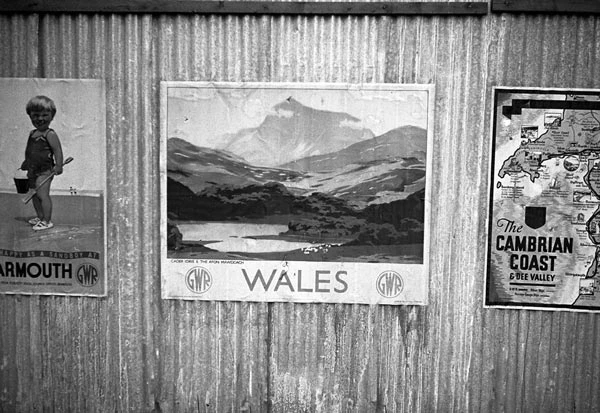
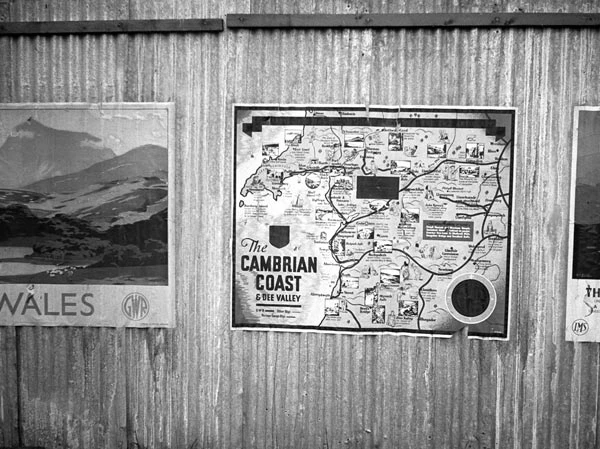
Railway posters displayed at Machynlleth Station, circa. 1930s
Railway Posters displayed at Machynlleth Station, circa. 1930s
Railway posters are colourful works of art that epitomise the era in which they were produced. Amgueddfa Cymru’s collection comprises about 60 examples, and these provide a good representation of the types of posters produced and displayed all over Wales.
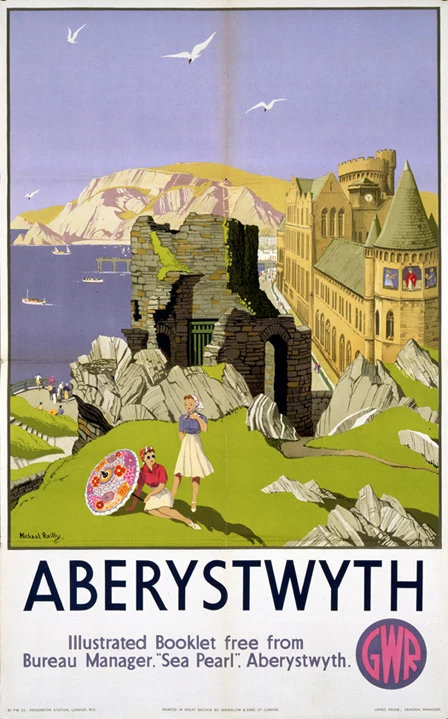
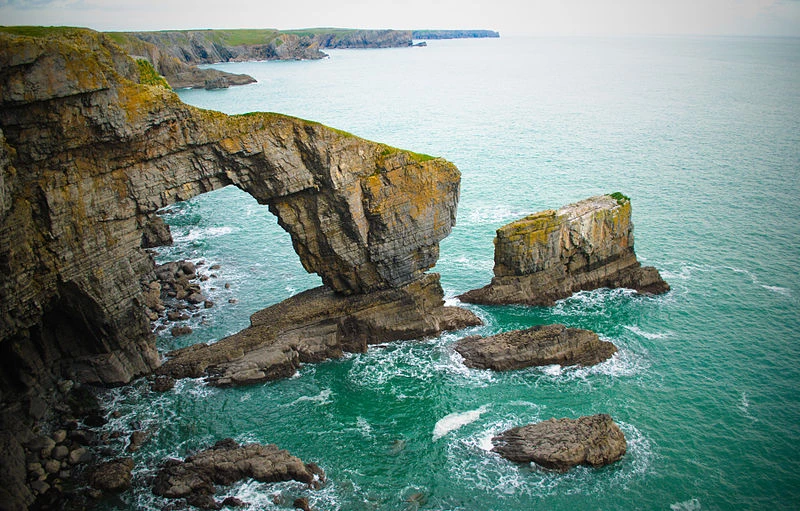
Railway posters were a familiar feature when travelling on the railway, being displayed in stations, ticket offices and on platforms hoardings. They were used to entice the public to board the railway and escape from their daily routine. Generally they presented idealised images of popular holiday resorts, such as Tenby and Aberystwyth; historic towns, such as Caernarfon; and the countryside and coastline of north Wales, Pembrokeshire and Gower. These had all been made accessible by the lines on which the railway companies operated. It is often claimed that the railway invented the ‘package holiday’.
During the early years of the railways most advertising was in the form of simple printed leaflets and handbills. However these gradually became more elaborate, and with improvements in colour lithography in the later part of the 19th century there was a revolution in poster printing, as the colour poster became cheaper to produce.
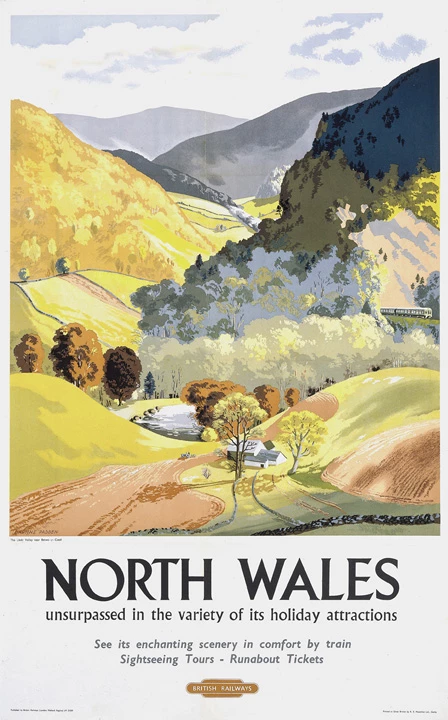
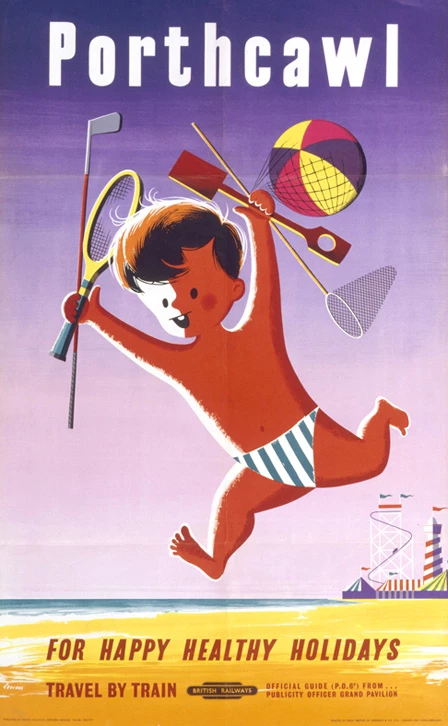
Although railway posters have been in popular use since the late nineteenth century, it is generally regarded that their heyday was between 1923 (when four large companies, the Great Western Railway, Southern Railway, London, Midland & Scottish, and London & North Eastern Railway were formed) and 1947, when the railways were nationalised. However, Amgueddfa Cymru has many examples of British Railway posters produced in the 1950s and 60s which are equally eye catching and interesting, and often much more bright and cheerful.
The jolly fisherman
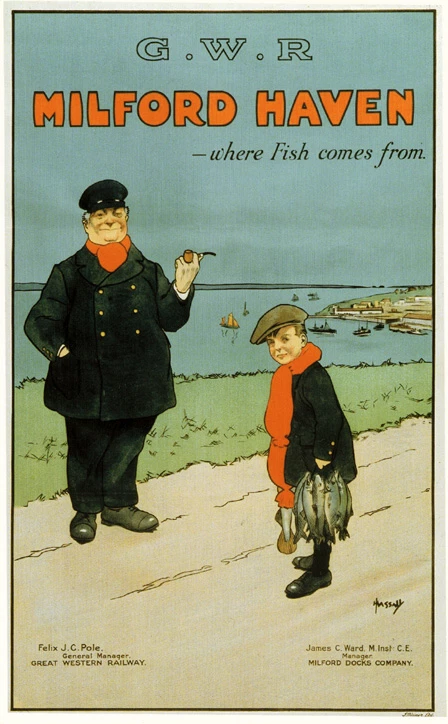
Some posters combined both images and slogans. One of the most famous is John Hassall’s image of a ‘jolly fisherman’ skipping along the beach, and the slogan “Skegness is SO Bracing”. The ‘jolly fisherman’ became the mascot of Skegness and is believed to have contributed to the success of this resort as a holiday destination. A G.W.R. poster by John Hassall in our collection, dating from c.1925, advertises Milford Haven, and depicts a fisherman and a boy holding fish with the slogan “Milford Haven – where fish comes from.”
The Museums collection comprises about 60 examples, and these provide a good representation of the types of posters produced and displayed all over Wales. Examples range in date from about 1914 into the 1960s, with the 1950s and 60s very well represented. Each railway company developed their own distinct style, and they all used some of the finest poster artists of the day. Our collection includes excellent examples by Norman Wilkinson, Charles Pears & John Hassall.
Museum collections
A selection of these posters can now be viewed on our Images of Industry collections database.
Further Reading
- Happy as a Sand-Boy Early Railway Posters by Beverly Cole & Richard Durack (1990)
- Railway Posters 1923-1947 by Beverly Cole & Richard Durack (1992).



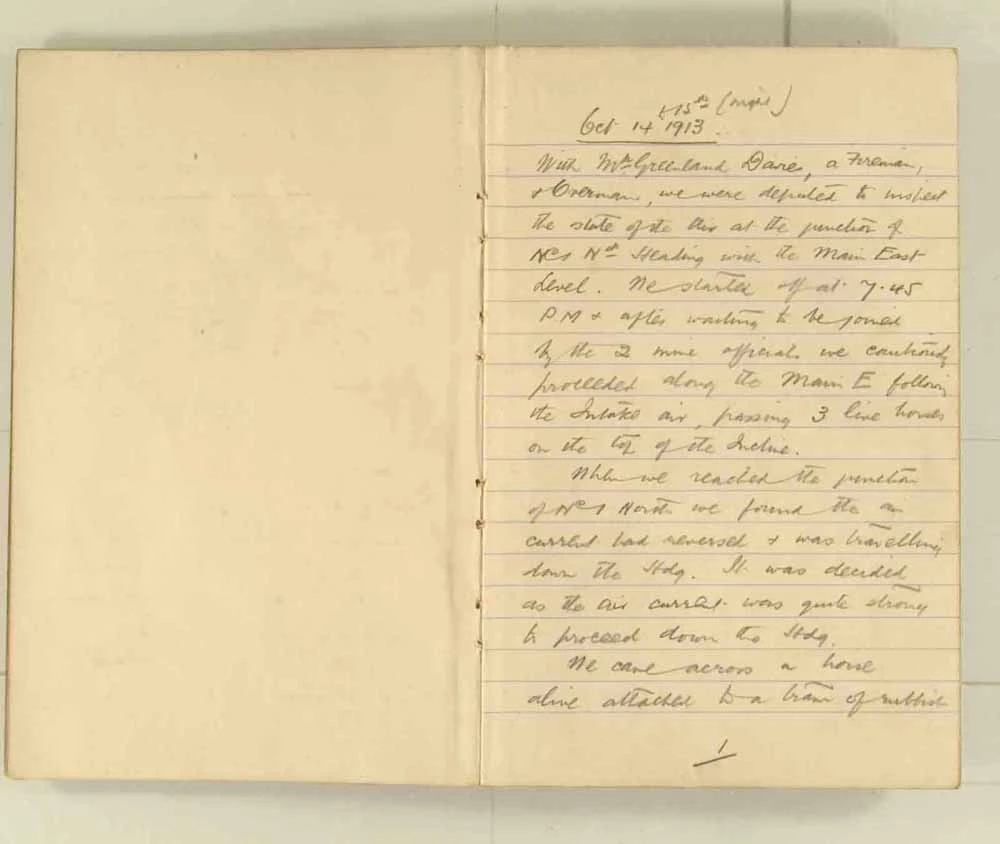
![Notes made by the Inspector of Mines as he travelled around the devastated underground workings following the Senghenydd mine explosion on 14th October 1913 that killed 439 men. Courtesy of the National Coal Mining Museum for England [Notebook 3/4]](/media/27264/version-full/note-books081.webp)
![Notes made by the Inspector of Mines as he travelled around the devastated underground workings following the Senghenydd mine explosion on 14th October 1913 that killed 439 men. Courtesy of the National Coal Mining Museum for England [Notebook 3/4]](/media/27263/version-full/note-books080.webp)
![Notes made by the Inspector of Mines as he travelled around the devastated underground workings following the Senghenydd mine explosion on 14th October 1913 that killed 439 men. Courtesy of the National Coal Mining Museum for England [Notebook 3/4]](/media/27262/version-full/note-books079.webp)
![Notes made by the Inspector of Mines as he travelled around the devastated underground workings following the Senghenydd mine explosion on 14th October 1913 that killed 439 men. Courtesy of the National Coal Mining Museum for England [Notebook 3/4]](/media/27261/version-full/note-books078.webp)
![Notes made by the Inspector of Mines as he travelled around the devastated underground workings following the Senghenydd mine explosion on 14th October 1913 that killed 439 men. Courtesy of the National Coal Mining Museum for England [Notebook 3/4]](/media/27260/version-full/note-books077.webp)
![Notes made by the Inspector of Mines as he travelled around the devastated underground workings following the Senghenydd mine explosion on 14th October 1913 that killed 439 men. Courtesy of the National Coal Mining Museum for England [Notebook 3/4]](/media/27259/version-full/note-books076.webp)
![Notes made by the Inspector of Mines as he travelled around the devastated underground workings following the Senghenydd mine explosion on 14th October 1913 that killed 439 men. Courtesy of the National Coal Mining Museum for England [Notebook 3/4]](/media/27258/version-full/note-books075.webp)
![Notes made by the Inspector of Mines as he travelled around the devastated underground workings following the Senghenydd mine explosion on 14th October 1913 that killed 439 men. Courtesy of the National Coal Mining Museum for England [Notebook 3/4]](/media/27256/version-full/note-books074.webp)
![Notes made by the Inspector of Mines as he travelled around the devastated underground workings following the Senghenydd mine explosion on 14th October 1913 that killed 439 men. Courtesy of the National Coal Mining Museum for England [Notebook 3/4]](/media/27255/version-full/note-books073.webp)
![Notes made by the Inspector of Mines as he travelled around the devastated underground workings following the Senghenydd mine explosion on 14th October 1913 that killed 439 men. Courtesy of the National Coal Mining Museum for England [Notebook 3/4]](/media/27253/version-full/note-books072.webp)
![Notes made by the Inspector of Mines as he travelled around the devastated underground workings following the Senghenydd mine explosion on 14th October 1913 that killed 439 men. Courtesy of the National Coal Mining Museum for England [Notebook 3/4]](/media/27251/version-full/note-books071.webp)
![Notes made by the Inspector of Mines as he travelled around the devastated underground workings following the Senghenydd mine explosion on 14th October 1913 that killed 439 men. Courtesy of the National Coal Mining Museum for England [Notebook 3/4]](/media/27249/version-full/note-books070.webp)
![Notes made by the Inspector of Mines as he travelled around the devastated underground workings following the Senghenydd mine explosion on 14th October 1913 that killed 439 men. Courtesy of the National Coal Mining Museum for England [Notebook 3/4]](/media/27248/version-full/note-books069.webp)
![Notes made by the Inspector of Mines as he travelled around the devastated underground workings following the Senghenydd mine explosion on 14th October 1913 that killed 439 men. Courtesy of the National Coal Mining Museum for England [Notebook 3/4]](/media/27247/version-full/note-books068.webp)
![Notes made by the Inspector of Mines as he travelled around the devastated underground workings following the Senghenydd mine explosion on 14th October 1913 that killed 439 men. Courtesy of the National Coal Mining Museum for England [Notebook 3/4]](/media/27246/version-full/note-books067.webp)
![Notes made by the Inspector of Mines as he travelled around the devastated underground workings following the Senghenydd mine explosion on 14th October 1913 that killed 439 men. Courtesy of the National Coal Mining Museum for England [Notebook 3/4]](/media/27245/version-full/note-books066.webp)
![Notes made by the Inspector of Mines as he travelled around the devastated underground workings following the Senghenydd mine explosion on 14th October 1913 that killed 439 men. Courtesy of the National Coal Mining Museum for England [Notebook 3/4]](/media/27244/version-full/note-books065.webp)
![Notes made by the Inspector of Mines as he travelled around the devastated underground workings following the Senghenydd mine explosion on 14th October 1913 that killed 439 men. Courtesy of the National Coal Mining Museum for England [Notebook 3/4]](/media/27243/version-full/note-books064.webp)
![Notes made by the Inspector of Mines as he travelled around the devastated underground workings following the Senghenydd mine explosion on 14th October 1913 that killed 439 men. Courtesy of the National Coal Mining Museum for England [Notebook 3/4]](/media/27241/version-full/note-books063.webp)
![Notes made by the Inspector of Mines as he travelled around the devastated underground workings following the Senghenydd mine explosion on 14th October 1913 that killed 439 men. Courtesy of the National Coal Mining Museum for England [Notebook 3/4]](/media/27240/version-full/note-books062.webp)
![Notes made by the Inspector of Mines as he travelled around the devastated underground workings following the Senghenydd mine explosion on 14th October 1913 that killed 439 men. Courtesy of the National Coal Mining Museum for England [Notebook 3/4]](/media/27239/version-full/note-books061.webp)
![Notes made by the Inspector of Mines as he travelled around the devastated underground workings following the Senghenydd mine explosion on 14th October 1913 that killed 439 men. Courtesy of the National Coal Mining Museum for England [Notebook 3/4]](/media/27238/version-full/note-books060.webp)
![Notes made by the Inspector of Mines as he travelled around the devastated underground workings following the Senghenydd mine explosion on 14th October 1913 that killed 439 men. Courtesy of the National Coal Mining Museum for England [Notebook 3/4]](/media/27237/version-full/note-books059.webp)
![Notes made by the Inspector of Mines as he travelled around the devastated underground workings following the Senghenydd mine explosion on 14th October 1913 that killed 439 men. Courtesy of the National Coal Mining Museum for England [Notebook 3/4]](/media/27236/version-full/note-books058.webp)
![Notes made by the Inspector of Mines as he travelled around the devastated underground workings following the Senghenydd mine explosion on 14th October 1913 that killed 439 men. Courtesy of the National Coal Mining Museum for England [Notebook 3/4]](/media/27235/version-full/note-books057.webp)
![Notes made by the Inspector of Mines as he travelled around the devastated underground workings following the Senghenydd mine explosion on 14th October 1913 that killed 439 men. Courtesy of the National Coal Mining Museum for England [Notebook 3/4]](/media/27234/version-full/note-books056.webp)
![Notes made by the Inspector of Mines as he travelled around the devastated underground workings following the Senghenydd mine explosion on 14th October 1913 that killed 439 men. Courtesy of the National Coal Mining Museum for England [Notebook 3/4]](/media/27233/version-full/note-books055.webp)
![Notes made by the Inspector of Mines as he travelled around the devastated underground workings following the Senghenydd mine explosion on 14th October 1913 that killed 439 men. Courtesy of the National Coal Mining Museum for England [Notebook 3/4]](/media/27232/version-full/note-books054.webp)
![Notes made by the Inspector of Mines as he travelled around the devastated underground workings following the Senghenydd mine explosion on 14th October 1913 that killed 439 men. Courtesy of the National Coal Mining Museum for England [Notebook 3/4]](/media/27231/version-full/note-books053.webp)
![Notes made by the Inspector of Mines as he travelled around the devastated underground workings following the Senghenydd mine explosion on 14th October 1913 that killed 439 men. Courtesy of the National Coal Mining Museum for England [Notebook 3/4]](/media/27229/version-full/note-books052.webp)
![Notes made by the Inspector of Mines as he travelled around the devastated underground workings following the Senghenydd mine explosion on 14th October 1913 that killed 439 men. Courtesy of the National Coal Mining Museum for England [Notebook 3/4]](/media/27228/version-full/note-books051.webp)
![Notes made by the Inspector of Mines as he travelled around the devastated underground workings following the Senghenydd mine explosion on 14th October 1913 that killed 439 men. Courtesy of the National Coal Mining Museum for England [Notebook 3/4]](/media/27219/version-full/note-books050.webp)
![Notes made by the Inspector of Mines as he travelled around the devastated underground workings following the Senghenydd mine explosion on 14th October 1913 that killed 439 men. Courtesy of the National Coal Mining Museum for England [Notebook 3/4]](/media/27218/version-full/note-books049.webp)
![Notes made by the Inspector of Mines as he travelled around the devastated underground workings following the Senghenydd mine explosion on 14th October 1913 that killed 439 men. Courtesy of the National Coal Mining Museum for England [Notebook 3/4]](/media/27217/version-full/note-books048.webp)
![Notes made by the Inspector of Mines as he travelled around the devastated underground workings following the Senghenydd mine explosion on 14th October 1913 that killed 439 men. Courtesy of the National Coal Mining Museum for England [Notebook 3/4]](/media/27216/version-full/note-books047.webp)
![Notes made by the Inspector of Mines as he travelled around the devastated underground workings following the Senghenydd mine explosion on 14th October 1913 that killed 439 men. Courtesy of the National Coal Mining Museum for England [Notebook 3/4]](/media/27215/version-full/note-books046.webp)
![Notes made by the Inspector of Mines as he travelled around the devastated underground workings following the Senghenydd mine explosion on 14th October 1913 that killed 439 men. Courtesy of the National Coal Mining Museum for England [Notebook 3/4]](/media/27214/version-full/note-books045.webp)
![Notes made by the Inspector of Mines as he travelled around the devastated underground workings following the Senghenydd mine explosion on 14th October 1913 that killed 439 men. Courtesy of the National Coal Mining Museum for England [Notebook 3/4]](/media/27213/version-full/note-books044.webp)
![Notes made by the Inspector of Mines as he travelled around the devastated underground workings following the Senghenydd mine explosion on 14th October 1913 that killed 439 men. Courtesy of the National Coal Mining Museum for England [Notebook 3/4]](/media/27212/version-full/note-books043.webp)
![Notes made by the Inspector of Mines as he travelled around the devastated underground workings following the Senghenydd mine explosion on 14th October 1913 that killed 439 men. Courtesy of the National Coal Mining Museum for England [Notebook 3/4]](/media/27211/version-full/note-books042.webp)
![Notes made by the Inspector of Mines as he travelled around the devastated underground workings following the Senghenydd mine explosion on 14th October 1913 that killed 439 men. Courtesy of the National Coal Mining Museum for England [Notebook 3/4]](/media/27210/version-full/note-books041.webp)
![Notes made by the Inspector of Mines as he travelled around the devastated underground workings following the Senghenydd mine explosion on 14th October 1913 that killed 439 men. Courtesy of the National Coal Mining Museum for England [Notebook 3/4]](/media/27209/version-full/note-books040.webp)
![Notes made by the Inspector of Mines as he travelled around the devastated underground workings following the Senghenydd mine explosion on 14th October 1913 that killed 439 men. Courtesy of the National Coal Mining Museum for England [Notebook 3/4]](/media/27208/version-full/note-books039.webp)
![Notes made by the Inspector of Mines as he travelled around the devastated underground workings following the Senghenydd mine explosion on 14th October 1913 that killed 439 men. Courtesy of the National Coal Mining Museum for England [Notebook 3/4]](/media/27207/version-full/note-books038.webp)
![Notes made by the Inspector of Mines as he travelled around the devastated underground workings following the Senghenydd mine explosion on 14th October 1913 that killed 439 men. Courtesy of the National Coal Mining Museum for England [Notebook 3/4]](/media/27206/version-full/note-books037.webp)
![Notes made by the Inspector of Mines as he travelled around the devastated underground workings following the Senghenydd mine explosion on 14th October 1913 that killed 439 men. Courtesy of the National Coal Mining Museum for England [Notebook 3/4]](/media/27205/version-full/note-books036.webp)
![Notes made by the Inspector of Mines as he travelled around the devastated underground workings following the Senghenydd mine explosion on 14th October 1913 that killed 439 men. Courtesy of the National Coal Mining Museum for England [Notebook 3/4]](/media/27204/version-full/note-books035.webp)
![Notes made by the Inspector of Mines as he travelled around the devastated underground workings following the Senghenydd mine explosion on 14th October 1913 that killed 439 men. Courtesy of the National Coal Mining Museum for England [Notebook 3/4]](/media/27203/version-full/note-books034.webp)
![Notes made by the Inspector of Mines as he travelled around the devastated underground workings following the Senghenydd mine explosion on 14th October 1913 that killed 439 men. Courtesy of the National Coal Mining Museum for England [Notebook 3/4]](/media/27202/version-full/note-books033.webp)
![Notes made by the Inspector of Mines as he travelled around the devastated underground workings following the Senghenydd mine explosion on 14th October 1913 that killed 439 men. Courtesy of the National Coal Mining Museum for England [Notebook 3/4]](/media/27201/version-full/note-books032.webp)
![Notes made by the Inspector of Mines as he travelled around the devastated underground workings following the Senghenydd mine explosion on 14th October 1913 that killed 439 men. Courtesy of the National Coal Mining Museum for England [Notebook 3/4]](/media/27200/version-full/note-books031.webp)
![Notes made by the Inspector of Mines as he travelled around the devastated underground workings following the Senghenydd mine explosion on 14th October 1913 that killed 439 men. Courtesy of the National Coal Mining Museum for England [Notebook 3/4]](/media/27199/version-full/note-books030.webp)
![Notes made by the Inspector of Mines as he travelled around the devastated underground workings following the Senghenydd mine explosion on 14th October 1913 that killed 439 men. Courtesy of the National Coal Mining Museum for England [Notebook 3/4]](/media/27198/version-full/note-books029.webp)
![Notes made by the Inspector of Mines as he travelled around the devastated underground workings following the Senghenydd mine explosion on 14th October 1913 that killed 439 men. Courtesy of the National Coal Mining Museum for England [Notebook 3/4]](/media/27197/version-full/note-books028.webp)
![Notes made by the Inspector of Mines as he travelled around the devastated underground workings following the Senghenydd mine explosion on 14th October 1913 that killed 439 men. Courtesy of the National Coal Mining Museum for England [Notebook 3/4]](/media/27196/version-full/note-books027.webp)
![Notes made by the Inspector of Mines as he travelled around the devastated underground workings following the Senghenydd mine explosion on 14th October 1913 that killed 439 men. Courtesy of the National Coal Mining Museum for England [Notebook 3/4]](/media/27195/version-full/note-books026.webp)
![Notes made by the Inspector of Mines as he travelled around the devastated underground workings following the Senghenydd mine explosion on 14th October 1913 that killed 439 men. Courtesy of the National Coal Mining Museum for England [Notebook 3/4]](/media/27194/version-full/note-books025.webp)
![Notes made by the Inspector of Mines as he travelled around the devastated underground workings following the Senghenydd mine explosion on 14th October 1913 that killed 439 men. Courtesy of the National Coal Mining Museum for England [Notebook 3/4]](/media/27193/version-full/note-books024.webp)
![Notes made by the Inspector of Mines as he travelled around the devastated underground workings following the Senghenydd mine explosion on 14th October 1913 that killed 439 men. Courtesy of the National Coal Mining Museum for England [Notebook 3/4]](/media/27192/version-full/note-books023.webp)
![Notes made by the Inspector of Mines as he travelled around the devastated underground workings following the Senghenydd mine explosion on 14th October 1913 that killed 439 men. Courtesy of the National Coal Mining Museum for England [Notebook 3/4]](/media/27191/version-full/note-books022.webp)
![Notes made by the Inspector of Mines as he travelled around the devastated underground workings following the Senghenydd mine explosion on 14th October 1913 that killed 439 men. Courtesy of the National Coal Mining Museum for England [Notebook 3/4]](/media/27190/version-full/note-books021.webp)
![Notes made by the Inspector of Mines as he travelled around the devastated underground workings following the Senghenydd mine explosion on 14th October 1913 that killed 439 men. Courtesy of the National Coal Mining Museum for England [Notebook 3/4]](/media/27189/version-full/note-books020.webp)
![Notes made by the Inspector of Mines as he travelled around the devastated underground workings following the Senghenydd mine explosion on 14th October 1913 that killed 439 men. Courtesy of the National Coal Mining Museum for England [Notebook 3/4]](/media/27188/version-full/note-books019.webp)
![Notes made by the Inspector of Mines as he travelled around the devastated underground workings following the Senghenydd mine explosion on 14th October 1913 that killed 439 men. Courtesy of the National Coal Mining Museum for England [Notebook 3/4]](/media/27187/version-full/note-books018.webp)
![Notes made by the Inspector of Mines as he travelled around the devastated underground workings following the Senghenydd mine explosion on 14th October 1913 that killed 439 men. Courtesy of the National Coal Mining Museum for England [Notebook 3/4]](/media/27186/version-full/note-books017.webp)
![Notes made by the Inspector of Mines as he travelled around the devastated underground workings following the Senghenydd mine explosion on 14th October 1913 that killed 439 men. Courtesy of the National Coal Mining Museum for England [Notebook 3/4]](/media/27185/version-full/note-books016.webp)
![Notes made by the Inspector of Mines as he travelled around the devastated underground workings following the Senghenydd mine explosion on 14th October 1913 that killed 439 men. Courtesy of the National Coal Mining Museum for England [Notebook 3/4]](/media/27184/version-full/note-books015.webp)
![Notes made by the Inspector of Mines as he travelled around the devastated underground workings following the Senghenydd mine explosion on 14th October 1913 that killed 439 men. Courtesy of the National Coal Mining Museum for England [Notebook 3/4]](/media/27183/version-full/note-books014.webp)
![Notes made by the Inspector of Mines as he travelled around the devastated underground workings following the Senghenydd mine explosion on 14th October 1913 that killed 439 men. Courtesy of the National Coal Mining Museum for England [Notebook 3/4]](/media/27182/version-full/note-books013.webp)
![Notes made by the Inspector of Mines as he travelled around the devastated underground workings following the Senghenydd mine explosion on 14th October 1913 that killed 439 men. Courtesy of the National Coal Mining Museum for England [Notebook 3/4]](/media/27181/version-full/note-books012.webp)
![Notes made by the Inspector of Mines as he travelled around the devastated underground workings following the Senghenydd mine explosion on 14th October 1913 that killed 439 men. Courtesy of the National Coal Mining Museum for England [Notebook 3/4]](/media/27180/version-full/note-books011.webp)
![Notes made by the Inspector of Mines as he travelled around the devastated underground workings following the Senghenydd mine explosion on 14th October 1913 that killed 439 men. Courtesy of the National Coal Mining Museum for England [Notebook 3/4]](/media/27179/version-full/note-books010.webp)
![Notes made by the Inspector of Mines as he travelled around the devastated underground workings following the Senghenydd mine explosion on 14th October 1913 that killed 439 men. Courtesy of the National Coal Mining Museum for England [Notebook 3/4]](/media/27178/version-full/note-books009.webp)
![Notes made by the Inspector of Mines as he travelled around the devastated underground workings following the Senghenydd mine explosion on 14th October 1913 that killed 439 men. Courtesy of the National Coal Mining Museum for England [Notebook 3/4]](/media/27177/version-full/note-books008.webp)
![Notes made by the Inspector of Mines as he travelled around the devastated underground workings following the Senghenydd mine explosion on 14th October 1913 that killed 439 men. Courtesy of the National Coal Mining Museum for England [Notebook 3/4]](/media/27176/version-full/note-books007.webp)
![Notes made by the Inspector of Mines as he travelled around the devastated underground workings following the Senghenydd mine explosion on 14th October 1913 that killed 439 men. Courtesy of the National Coal Mining Museum for England [Notebook 3/4]](/media/27175/version-full/note-books006.webp)
![Notes made by the Inspector of Mines as he travelled around the devastated underground workings following the Senghenydd mine explosion on 14th October 1913 that killed 439 men. Courtesy of the National Coal Mining Museum for England [Notebook 3/4]](/media/27174/version-full/note-books005.webp)
![Notes made by the Inspector of Mines as he travelled around the devastated underground workings following the Senghenydd mine explosion on 14th October 1913 that killed 439 men. Courtesy of the National Coal Mining Museum for England [Notebook 3/4]](/media/27173/version-full/note-books004.webp)
![Notes made by the Inspector of Mines as he travelled around the devastated underground workings following the Senghenydd mine explosion on 14th October 1913 that killed 439 men. Courtesy of the National Coal Mining Museum for England [Notebook 3/4]](/media/27172/version-full/note-books003.webp)
![Notes made by the Inspector of Mines as he travelled around the devastated underground workings following the Senghenydd mine explosion on 14th October 1913 that killed 439 men. Courtesy of the National Coal Mining Museum for England [Notebook 3/4]](/media/27171/version-full/note-books002.webp)
![Notes made by the Inspector of Mines as he travelled around the devastated underground workings following the Senghenydd mine explosion on 14th October 1913 that killed 439 men. Courtesy of the National Coal Mining Museum for England [Notebook 1/2]](/media/27170/version-full/DSCF0054.webp)
![Notes made by the Inspector of Mines as he travelled around the devastated underground workings following the Senghenydd mine explosion on 14th October 1913 that killed 439 men. Courtesy of the National Coal Mining Museum for England [Notebook 1/2]](/media/27169/version-full/DSCF0053.webp)
![Notes made by the Inspector of Mines as he travelled around the devastated underground workings following the Senghenydd mine explosion on 14th October 1913 that killed 439 men. Courtesy of the National Coal Mining Museum for England [Notebook 1/2]](/media/27168/version-full/DSCF0052.webp)
![Notes made by the Inspector of Mines as he travelled around the devastated underground workings following the Senghenydd mine explosion on 14th October 1913 that killed 439 men. Courtesy of the National Coal Mining Museum for England [Notebook 1/2]](/media/27167/version-full/DSCF0051.webp)
![Notes made by the Inspector of Mines as he travelled around the devastated underground workings following the Senghenydd mine explosion on 14th October 1913 that killed 439 men. Courtesy of the National Coal Mining Museum for England [Notebook 1/2]](/media/27166/version-full/DSCF0050.webp)
![Notes made by the Inspector of Mines as he travelled around the devastated underground workings following the Senghenydd mine explosion on 14th October 1913 that killed 439 men. Courtesy of the National Coal Mining Museum for England [Notebook 1/2]](/media/27165/version-full/DSCF0049.webp)
![Notes made by the Inspector of Mines as he travelled around the devastated underground workings following the Senghenydd mine explosion on 14th October 1913 that killed 439 men. Courtesy of the National Coal Mining Museum for England [Notebook 1/2]](/media/27164/version-full/DSCF0048.webp)
![Notes made by the Inspector of Mines as he travelled around the devastated underground workings following the Senghenydd mine explosion on 14th October 1913 that killed 439 men. Courtesy of the National Coal Mining Museum for England [Notebook 1/2]](/media/27163/version-full/DSCF0047.webp)
![Notes made by the Inspector of Mines as he travelled around the devastated underground workings following the Senghenydd mine explosion on 14th October 1913 that killed 439 men. Courtesy of the National Coal Mining Museum for England [Notebook 1/2]](/media/27162/version-full/DSCF0046.webp)
![Notes made by the Inspector of Mines as he travelled around the devastated underground workings following the Senghenydd mine explosion on 14th October 1913 that killed 439 men. Courtesy of the National Coal Mining Museum for England [Notebook 1/2]](/media/27161/version-full/DSCF0045.webp)
![Notes made by the Inspector of Mines as he travelled around the devastated underground workings following the Senghenydd mine explosion on 14th October 1913 that killed 439 men. Courtesy of the National Coal Mining Museum for England [Notebook 1/2]](/media/27160/version-full/DSCF0044.webp)
![Notes made by the Inspector of Mines as he travelled around the devastated underground workings following the Senghenydd mine explosion on 14th October 1913 that killed 439 men. Courtesy of the National Coal Mining Museum for England [Notebook 1/2]](/media/27159/version-full/DSCF0043.webp)
![Notes made by the Inspector of Mines as he travelled around the devastated underground workings following the Senghenydd mine explosion on 14th October 1913 that killed 439 men. Courtesy of the National Coal Mining Museum for England [Notebook 1/2]](/media/27158/version-full/DSCF0042.webp)
![Notes made by the Inspector of Mines as he travelled around the devastated underground workings following the Senghenydd mine explosion on 14th October 1913 that killed 439 men. Courtesy of the National Coal Mining Museum for England [Notebook 1/2]](/media/27157/version-full/DSCF0041.webp)
![Notes made by the Inspector of Mines as he travelled around the devastated underground workings following the Senghenydd mine explosion on 14th October 1913 that killed 439 men. Courtesy of the National Coal Mining Museum for England [Notebook 1/2]](/media/27156/version-full/DSCF0040.webp)
![Notes made by the Inspector of Mines as he travelled around the devastated underground workings following the Senghenydd mine explosion on 14th October 1913 that killed 439 men. Courtesy of the National Coal Mining Museum for England [Notebook 1/2]](/media/27155/version-full/DSCF0039.webp)
![Notes made by the Inspector of Mines as he travelled around the devastated underground workings following the Senghenydd mine explosion on 14th October 1913 that killed 439 men. Courtesy of the National Coal Mining Museum for England [Notebook 1/2]](/media/27154/version-full/DSCF0038.webp)
![Notes made by the Inspector of Mines as he travelled around the devastated underground workings following the Senghenydd mine explosion on 14th October 1913 that killed 439 men. Courtesy of the National Coal Mining Museum for England [Notebook 1/2]](/media/27153/version-full/DSCF0037.webp)
![Notes made by the Inspector of Mines as he travelled around the devastated underground workings following the Senghenydd mine explosion on 14th October 1913 that killed 439 men. Courtesy of the National Coal Mining Museum for England [Notebook 1/2]](/media/27152/version-full/DSCF0036.webp)
![Notes made by the Inspector of Mines as he travelled around the devastated underground workings following the Senghenydd mine explosion on 14th October 1913 that killed 439 men. Courtesy of the National Coal Mining Museum for England [Notebook 1/2]](/media/27151/version-full/DSCF0035.webp)
![Notes made by the Inspector of Mines as he travelled around the devastated underground workings following the Senghenydd mine explosion on 14th October 1913 that killed 439 men. Courtesy of the National Coal Mining Museum for England [Notebook 1/2]](/media/27150/version-full/DSCF0034.webp)
![vNotes made by the Inspector of Mines as he travelled around the devastated underground workings following the Senghenydd mine explosion on 14th October 1913 that killed 439 men. Courtesy of the National Coal Mining Museum for England [Notebook 1/2]](/media/27149/version-full/DSCF0034.webp)
![Notes made by the Inspector of Mines as he travelled around the devastated underground workings following the Senghenydd mine explosion on 14th October 1913 that killed 439 men. Courtesy of the National Coal Mining Museum for England [Notebook 1/2]](/media/27148/version-full/DSCF0033.webp)
![Notes made by the Inspector of Mines as he travelled around the devastated underground workings following the Senghenydd mine explosion on 14th October 1913 that killed 439 men. Courtesy of the National Coal Mining Museum for England [Notebook 1/2]](/media/27147/version-full/DSCF0032.webp)
![Notes made by the Inspector of Mines as he travelled around the devastated underground workings following the Senghenydd mine explosion on 14th October 1913 that killed 439 men. Courtesy of the National Coal Mining Museum for England [Notebook 1/2]](/media/27146/version-full/DSCF0031.webp)
![Notes made by the Inspector of Mines as he travelled around the devastated underground workings following the Senghenydd mine explosion on 14th October 1913 that killed 439 men. Courtesy of the National Coal Mining Museum for England [Notebook 1/2]](/media/27145/version-full/DSCF0030.webp)
![Notes made by the Inspector of Mines as he travelled around the devastated underground workings following the Senghenydd mine explosion on 14th October 1913 that killed 439 men. Courtesy of the National Coal Mining Museum for England [Notebook 1/2]](/media/27144/version-full/DSCF0029.webp)
![Notes made by the Inspector of Mines as he travelled around the devastated underground workings following the Senghenydd mine explosion on 14th October 1913 that killed 439 men. Courtesy of the National Coal Mining Museum for England [Notebook 1/2]](/media/27143/version-full/DSCF0028.webp)
![Notes made by the Inspector of Mines as he travelled around the devastated underground workings following the Senghenydd mine explosion on 14th October 1913 that killed 439 men. Courtesy of the National Coal Mining Museum for England [Notebook 1/2]](/media/27142/version-full/DSCF0027.webp)
![Notes made by the Inspector of Mines as he travelled around the devastated underground workings following the Senghenydd mine explosion on 14th October 1913 that killed 439 men. Courtesy of the National Coal Mining Museum for England [Notebook 1/2]](/media/27141/version-full/DSCF0026.webp)
![Notes made by the Inspector of Mines as he travelled around the devastated underground workings following the Senghenydd mine explosion on 14th October 1913 that killed 439 men. Courtesy of the National Coal Mining Museum for England [Notebook 1/2]](/media/27140/version-full/DSCF0025.webp)
![Notes made by the Inspector of Mines as he travelled around the devastated underground workings following the Senghenydd mine explosion on 14th October 1913 that killed 439 men. Courtesy of the National Coal Mining Museum for England [Notebook 1/2]](/media/27139/version-full/DSCF0024.webp)
![Notes made by the Inspector of Mines as he travelled around the devastated underground workings following the Senghenydd mine explosion on 14th October 1913 that killed 439 men. Courtesy of the National Coal Mining Museum for England [Notebook 1/2]](/media/27138/version-full/DSCF0023.webp)
![Notes made by the Inspector of Mines as he travelled around the devastated underground workings following the Senghenydd mine explosion on 14th October 1913 that killed 439 men. Courtesy of the National Coal Mining Museum for England [Notebook 1/2]](/media/27137/version-full/DSCF0022.webp)
![Notes made by the Inspector of Mines as he travelled around the devastated underground workings following the Senghenydd mine explosion on 14th October 1913 that killed 439 men. Courtesy of the National Coal Mining Museum for England [Notebook 1/2]](/media/27136/version-full/DSCF0021.webp)
![Notes made by the Inspector of Mines as he travelled around the devastated underground workings following the Senghenydd mine explosion on 14th October 1913 that killed 439 men. Courtesy of the National Coal Mining Museum for England [Notebook 1/2]](/media/27135/version-full/DSCF0020.webp)
![Notes made by the Inspector of Mines as he travelled around the devastated underground workings following the Senghenydd mine explosion on 14th October 1913 that killed 439 men. Courtesy of the National Coal Mining Museum for England [Notebook 1/2]](/media/27134/version-full/DSCF0019.webp)
![Notes made by the Inspector of Mines as he travelled around the devastated underground workings following the Senghenydd mine explosion on 14th October 1913 that killed 439 men. Courtesy of the National Coal Mining Museum for England [Notebook 1/2]](/media/27133/version-full/DSCF0018.webp)
![Notes made by the Inspector of Mines as he travelled around the devastated underground workings following the Senghenydd mine explosion on 14th October 1913 that killed 439 men. Courtesy of the National Coal Mining Museum for England [Notebook 1/2]](/media/27132/version-full/DSCF0017.webp)
![Notes made by the Inspector of Mines as he travelled around the devastated underground workings following the Senghenydd mine explosion on 14th October 1913 that killed 439 men. Courtesy of the National Coal Mining Museum for England [Notebook 1/2]](/media/27131/version-full/DSCF0016.webp)
![Notes made by the Inspector of Mines as he travelled around the devastated underground workings following the Senghenydd mine explosion on 14th October 1913 that killed 439 men. Courtesy of the National Coal Mining Museum for England [Notebook 1/2]](/media/27130/version-full/DSCF0015.webp)
![Notes made by the Inspector of Mines as he travelled around the devastated underground workings following the Senghenydd mine explosion on 14th October 1913 that killed 439 men. Courtesy of the National Coal Mining Museum for England [Notebook 1/2]](/media/27129/version-full/DSCF0014.webp)
![Notes made by the Inspector of Mines as he travelled around the devastated underground workings following the Senghenydd mine explosion on 14th October 1913 that killed 439 men. Courtesy of the National Coal Mining Museum for England [Notebook 1/2]](/media/27128/version-full/DSCF0013.webp)
![Notes made by the Inspector of Mines as he travelled around the devastated underground workings following the Senghenydd mine explosion on 14th October 1913 that killed 439 men. Courtesy of the National Coal Mining Museum for England [Notebook 1/2]](/media/27127/version-full/DSCF0012.webp)
![Notes made by the Inspector of Mines as he travelled around the devastated underground workings following the Senghenydd mine explosion on 14th October 1913 that killed 439 men. Courtesy of the National Coal Mining Museum for England [Notebook 1/2]](/media/27126/version-full/DSCF0011.webp)
![Notes made by the Inspector of Mines as he travelled around the devastated underground workings following the Senghenydd mine explosion on 14th October 1913 that killed 439 men. Courtesy of the National Coal Mining Museum for England [Notebook 1/2]](/media/27125/version-full/DSCF0010.webp)
![Notes made by the Inspector of Mines as he travelled around the devastated underground workings following the Senghenydd mine explosion on 14th October 1913 that killed 439 men. Courtesy of the National Coal Mining Museum for England [Notebook 1/2]](/media/27124/version-full/DSCF0009.webp)
![Notes made by the Inspector of Mines as he travelled around the devastated underground workings following the Senghenydd mine explosion on 14th October 1913 that killed 439 men. Courtesy of the National Coal Mining Museum for England [Notebook 1/2]](/media/27123/version-full/DSCF0008.webp)
![Notes made by the Inspector of Mines as he travelled around the devastated underground workings following the Senghenydd mine explosion on 14th October 1913 that killed 439 men. Courtesy of the National Coal Mining Museum for England [Notebook 1/2]](/media/27122/version-full/DSCF0007.webp)
![Notes made by the Inspector of Mines as he travelled around the devastated underground workings following the Senghenydd mine explosion on 14th October 1913 that killed 439 men. Courtesy of the National Coal Mining Museum for England [Notebook 1/2]](/media/27121/version-full/DSCF0006.webp)
![Notes made by the Inspector of Mines as he travelled around the devastated underground workings following the Senghenydd mine explosion on 14th October 1913 that killed 439 men. Courtesy of the National Coal Mining Museum for England [Notebook 1/2]](/media/27120/version-full/DSCF0005.webp)
![Notes made by the Inspector of Mines as he travelled around the devastated underground workings following the Senghenydd mine explosion on 14th October 1913 that killed 439 men. Courtesy of the National Coal Mining Museum for England [Notebook 1/2]](/media/27119/version-full/DSCF0004.webp)
![Notes made by the Inspector of Mines as he travelled around the devastated underground workings following the Senghenydd mine explosion on 14th October 1913 that killed 439 men. Courtesy of the National Coal Mining Museum for England [Notebook 1/2]](/media/27118/version-full/DSCF0003.webp)