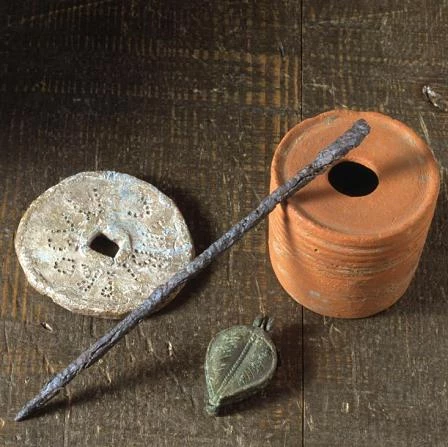
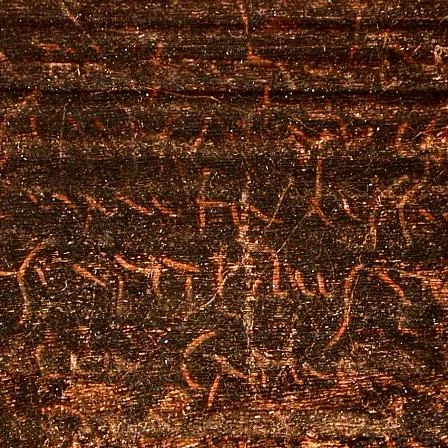
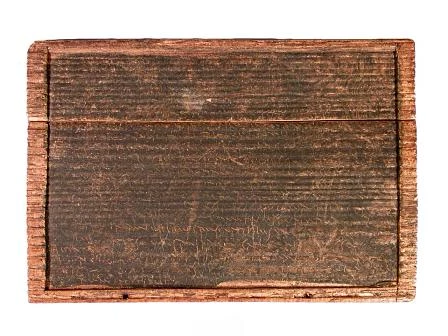
Britain's only surviving Roman will 10 May 2007 Roman Trawsfynydd The first 'page' of a Roman will found near Trawsfynydd in the 19th century. The tablet was already broken in two. Britain's only surviving Roman will was found in the 19th century near Trawsfynydd, Merionethshire. Two letters written at the time shed light on its history. The first letter describes a 'wooden book', consisting of 10 or 12 leaves, as being found by farm servants cutting peat 5km to the south-east of the Roman fort at Tomen-y-Mur. The letter reads: "I saw the book a few days after it was first found – only 2 or 3 of the leaves then contained the inscription perfect – On the rest it had been partly obliterated by the carelessness of the farm servants. The work is, probably, a relic of the Ancient Druids, who may have employed a modification of the Roman alphabet to write their own language." The author of the letter was mistaken in linking the text to the Druids, but did well to identify it as Roman, since at this time Roman 'cursive' (joined characters) writing was unknown. TV show prompts artefact to be identified Pottery inkwell, an iron stylus for writing on waxed tablets, a seal box and a lead property marker. The second letter records the delivery, probably in the mid 19th century, of one leaf to George Carr Pearson in London. Pearson studied the tablet, but never returned it. Eventually, the tablet was found again when clearing a house in West Kensington. In 1991 it came into the possession of Mr Stafford Ellerman, who in 2003 saw a television programme about the writing tablets discovered at the Roman fort of Vindolanda on Hadrian's Wall. He realised he too owned a Roman writing tablet and took it to the British Museum for identification. He generously donated it to Amgueddfa Cymru. The will Detail of the tablet revealing the Roman writing preserved on its surface. The tablet is a thin rectangular slab of wood from a silver fir tree, which was not native to Britain. The wax coating on one side is now degraded. Originally this would have been a smooth dark coating made of beeswax and a colouring agent, probably soot, in which the scribe wrote with his 'stylus' (a pointed metal writing tool) to expose the pale wood underneath. Some 300 stylus tablets have now been found on sites in Britain. With careful photography and meticulous study of the original, it is possible to discern a ghost of writing in many places. The writing is in 'lower-case' Roman cursive script. The tablet forms the first page of a Roman will, written in Latin. Its author names an heir to his estate, possibly his wife or daughter, and charges them with responsibility for accepting it within 100 days of becoming aware of their inheritance. The identity of the author and the extent of his estate were presumably detailed on the other tablets, now lost. Considering that Roman wills were regularly written on waxed tablets, with good reason to preserve them and millions of Roman citizens to write them, it is surprising that the actual tablets should be so rare; four are known from Egypt and now this example from Wales. The text translates as: "[The name and status of the testator] ... before I die, I order that [name] be my sole heir... Let all others for me be disinherited [...] on no other terms than that as much as I shall give, have given, shall have ordered to be given [...] and you [enter upon, accept my estate [... within] the next hundred [days] after my death in which you know or can know that you are my legitimate heir, in the presence of witnesses [...] let the heirs be those who know that they are [...] of this property. But if you do not thus accept my estate, if you refuse to enter upon it, be thou disinherited [...], whom I have instituted as my sole heir." Background reading ‘A Roman Will from North Wales’ by R. S. O. Tomlin. In Archaeologia Cambrensis, 150 (2004) pp. 143–56 Life and Letters on the Roman Frontier by A. K. Bowman. Published by British Museum Press (1994).
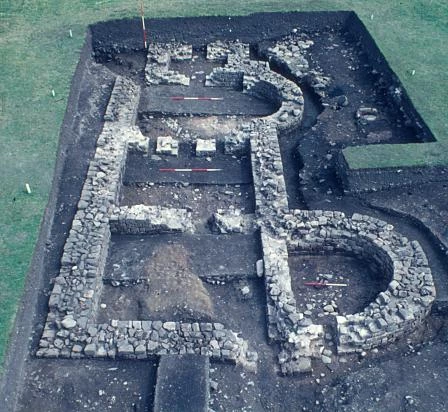
Segontium - The Romans in North Wales 10 May 2007 Aerial view of Segontium showing the playing-card shape that is typical of Roman forts. Many of its stone buildings have been exposed for public display. Image: Cadw (Crown Copyright). R. E. M. Wheeler with Lady Lloyd George (far right) at Segontium in 1922. Image © Private collection. In the early 4th century construction of a bathhouse began in the south-east corner of the fort. The building was never completed. Roman soldiers worshiped many gods. This relief from Segontium depicts Mars, the god of war and, on some occasions, healing. The Roman fort of Segontium was founded in AD77 and was garrisoned until about AD394. No other Roman fort in Wales was held so long. Segontium's name comes from that of the river: 'sego-' , meaning 'vigorous', which is hidden in its modern form, Seiont. The fort, one of the most famous in Britain, occupies a key position in the Roman military network. It is built on the summit of a broad rounded hill overlooking the Menai Strait and the Isle of Anglesey. The first excavations were undertaken by R. E. M. Wheeler, then Keeper of Archaeology at the National Museum of Wales. Wheeler undertook excavations within the fort between 1921 and 1923. Many of the stone buildings now on view were uncovered at this time. Further excavations undertaken between 1975-79 revealed a number of timber barrack blocks dating to the later 1st century and earlier part of the 2nd centuries AD. This indicates that the fort was designed initially to accommodate a 'cohors milliaria' (a regiment of auxiliary infantry, up to 1,000 strong). There is clear evidence that the garrison had been reduced in size by about AD120. A large courtyard house, with its own small bathhouse, was constructed in the mid 2nd century. This impressive building may have been the residence of an important official who was possibly in charge of regional mineral extraction. In the earlier part of the 3rd century the garrison was the First Cohort of Sunici, a 500-strong infantry regiment originally recruited from Germany. The name of the unit appears on an inscription, which records the repair of the fort's aqueduct around AD200. The garrisons of the later 3rd and 4th centuries were much smaller. At this time Segontium's main role was the defence of the north Wales coast against Irish raiders and pirates. Coins found at Segontium point to a continued presence of troops at this key fort until AD394. This extraordinarily long occupation can be explained by the need to protect the fertile and mineral-rich lands of Anglesey. Throughout the Roman period Segontium was the military and administrative centre for north-west Wales. The military significance of Caernarfon did not end when the Romans left. In the medieval period a Norman 'motte' (a mound upon which a castle was sited) was established at the mouth of the Seiont, followed in the late 13th century by the famous Edwardian castle with its walled town joining it and, finally, by a small fort planted at the mouth of the strait in 1775. Background Reading 'Excavations at Segontium (Caernarfon) Roman Fort, 1975-1979', by P. J. Casey and J. L. Davies. Published by the Council for British Archaeology (1993). 'Roman & Early Medieval Wales' by C. J. Arnold & J. L. Davies. Sutton Publishing (2000). 'Segontium and the Roman Occupation of Wales' by R. E. M. Wheeler. In Y Cymmrodor, vol. 33 (1923).
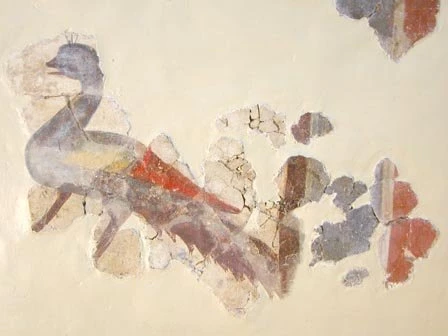
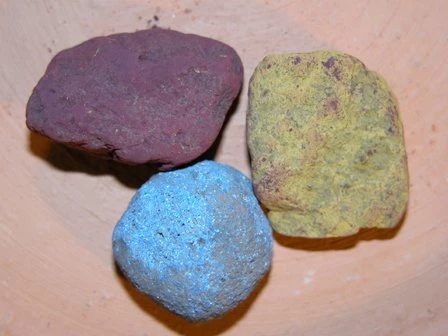
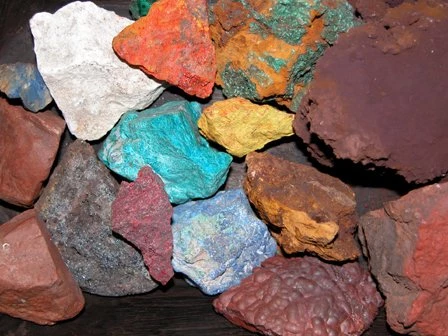
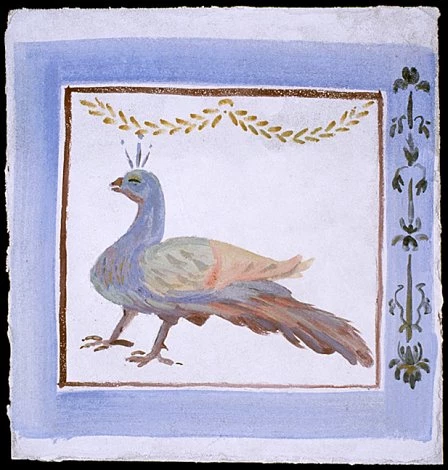
Roman Caerwent's painted peacock 10 May 2007 The Caerwent peacock. Many colours have been used to create the peacock - blues, yellows, greens and reds of varying shades. Excavation at the Roman fortress of Caerleon, 10km (6 miles) from Caerwent, has revealed a range of original pigments. These include red and yellow ochre, as well as a pellet of the rare Egyptian blue. A selection of natural minerals used by the Romans to make pigments. These illustrate the vibrancy of colours available to the Roman wall painters. This reconstruction of the peacock shows how it might have looked when first painted. The pigment is applied to the plaster when it is still wet, becoming fixed to the wall as it dried. This technique is known as fresco painting. Study of a fragile wall painting from Caerwent has revealed some of the influences Romans brought to the lives of native Britons. The Roman conquest brought parts of Wales into contact with the style and sophistication of Imperial Rome. For wealthy Britons this contact offered a chance to share in the lifestyle of the invaders. For craftsmen it offered the prospect of new patrons and greater profits. In the Roman world it was common for the wealthy to have the walls and sometimes the ceilings of their rooms painted with brightly coloured panels, floral motifs, or scenes from mythology. But, before the Roman conquest, wall painting in this style was unknown in Britain - here was a new craft, and one that appears to have been quickly seized upon. It is in the Roman town of Caerwent that we have some of our best evidence for the work of the wall painters. One piece that has attracted particular interest is a painting of a peacock from a late 3rd century AD house at Caerwent excavated in the 1980s. Enough fragments of the peacock have survived to allow its original appearance to be recreated. It would have been painted as a fresco, that is while the plaster was still wet, the colours becoming bonded into the surface as it dried. Many colours have been used to create the peacock - blues, yellows, greens and reds of varying shades. The picture itself is on a white background within a blue frame. While the peacock is itself a work of art, it is the pigments from which it was produced that tell us most about the wide cultural and trade contacts of Roman Britain. For example, the blue pigment is an artificial colour first developed in Egypt but then manufactured in Italy, where a wealthy businessman set up production in the 1st century BC. It was made from heating together a mixture of sand, natron and copper, and was sold around the empire in the form of small balls to be ground up by the painter as required. The bright red in the picture is cinnabar or vermillion (mercuric sulphide) mined in Sisapo, Spain and distributed from Rome. Trade in the pigment was so lucrative that the government had to fix its price to stop it rising. It has only been identified on 20-30 sites in Britain - an indication of its rarity. Not all the pigments were imported from overseas - some of the red ochre in the peacock was probably mined locally, possibly in the Forest of Dean. However, the presence of the exotic pigments demonstrates a lot more than just artistic taste. They would have been a statement to anyone who visited the house with the painted peacock, that its owners were both aware of and able to afford the luxuries that came with a place in the Roman Empire. Background Reading Caerwent Roman Town by R. J. Brewer, Published by Cadw (2006) Wall-painting in Roman Britain by N. Davey and R. Ling. Published by the Society for the Promotion of Roman Studies (1981).
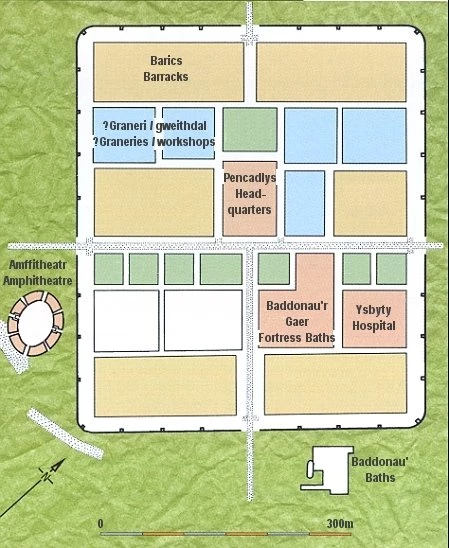
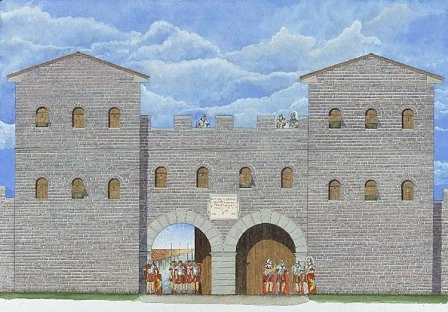
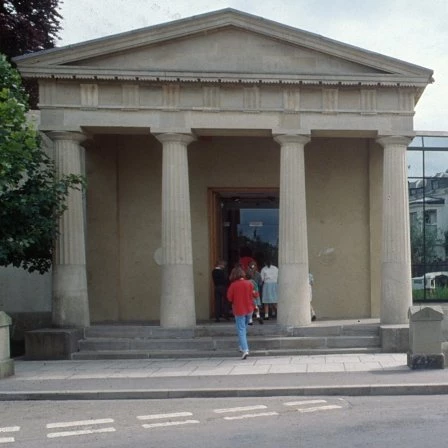
Caerleon - City of the Legion 9 May 2007 Plan of Caerleon Roman fortress. Marble inscription, probably from the south-west gate at Caerleon. Reconstruction of the south-west gate, Caerleon. Reconstruction of the Roman fortress baths (Caerleon) in about AD80. Finds from the excavations at Caerleon are on display at the Roman Legionary Museum, Caerleon. Home to Rome's 2nd Augustan Legion for over two centuries, Caerleon is the best preserved Roman fortress in Wales. Caerleon (Newport) is the only permanent Roman base within the borders of modern Wales. It was founded in AD 74 or 75, and used by the Second Augustan Legion, which had been stationed in various parts of southern Britain since the Roman invasion of AD43. Caerleon remained the headquarters of the Second Augustan Legion for more than 200 years. The fortress was known to the Romans as Isca, taking its name from the nearby River Usk. Excavations at Caerleon since the 1920s have allowed us to build up a good understanding of the fortress. The site The fortress is a rectangular enclosure 490m by 418m (535 × 457 yards) giving an area of 20.5ha (50 acres). To the south-west lie a parade-ground and an amphitheatre and, beyond, various buildings of a civilian settlement have been found. The defences were first built in earth and timber but were replaced in stone about AD 100. At the centre of the fortress, beneath the present parish church, was the headquarters building (principia) and next to it the commanding officer’s house. Remains of the fortress baths (the baths are now in the care of Cadw, who have restored them as a visitor attraction), a hospital, officers’ houses and various workshops have also been found. But over half the area would have contained barrack blocks to house the ordinary soldiers – over 5,000 of them. Most of these buildings were first constructed in wood; they were gradually rebuilt in stone from the 2nd century onwards. Activity at the fortress appears to have been at its peak at the close of the first and beginning of the 2nd century. After this the legion was involved in the building of Hadrian’s Wall across northern England. During the reign of Antoninus Pius (AD 138–161) the occupation of Caerleon decreased dramatically, probably indicating a more major commitment to the north. Around AD 300 the legion left Caerleon for good, with many of the main fortress buildings being demolished. This is probably related to the seizure of power in Britain by Carausius and Allectus (AD 287–96) and their need to defend the south of England from expected invasion by the official emperors Diocletian and Constantius. Some buildings at Caerleon were certainly in use up to the mid 4th century and some streets were resurfaced after AD 346–8, but post-350 coins are sparse, suggesting little activity on the site after this date. By AD 1188, when Gerald of Wales visited the fortress, it had been reduced to a stately ruin.
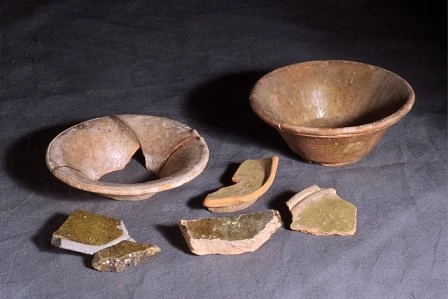
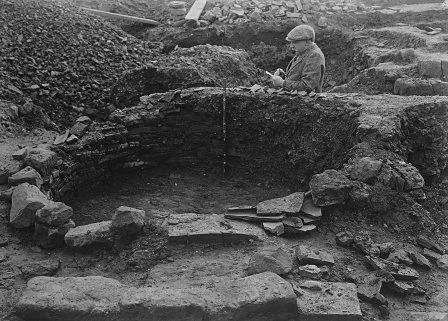
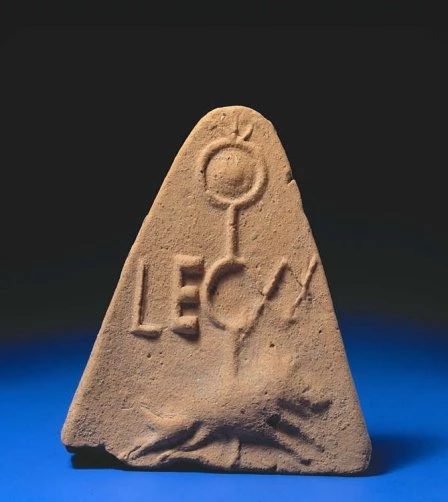
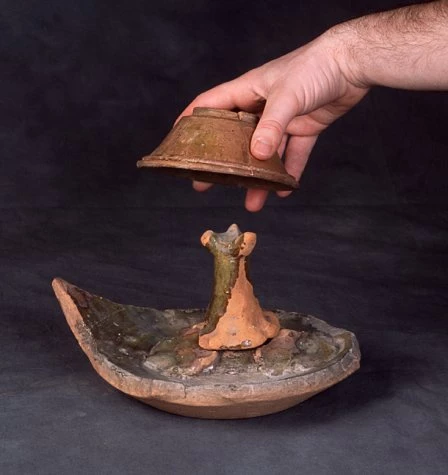
Roman glazed pottery from North Wales 9 May 2007 Green glazed pottery from Holt (Wrexham). Excavations at Holt before the First World War. In this photograph Mr Acton stands beside the remains of one of the pottery kilns he discovered. This ceramic plaque (known as an antefix) was used to cover the end of a line of roof tiles. It was produced at Holt and bears the stamp of the 20th Legion (LEG XX), as well as their emblem (a wild boar), and a standard. Illustration of how green glazed vessels were fired. Shortly after the Roman conquest, potters in North Wales were using a technology first developed in Egypt in the 1st millennium BC. Holt, near Wrexham, North Wales produced pottery and building materials for the legionary fortress at Chester. The main period of production at Holt appears to have been between AD87 and AD135 - when the fort at Chester was rebuilt. However, production probably continued into the 3rd century AD. Holt specialized in a number of different shapes and styles of pottery, some of which show a remarkable degree of technological sophistication on the part of the potters - none more so than the Green Glazed ware. Glazed wares of any type are difficult to produce and are rare in Britain prior to the medieval period, however, limited numbers of vessels were produced at Holt and at Caerleon in the Roman period. They were made by dipping a vessel into a 'frit' (a raw glaze suspended in water). In the Roman world this frit was normally based on a lead oxide. When the vessel was fired this reacted with silica in the pot, to form a hard impermeable glazed surface that can range in colour from light yellow to olive green to dark brown. During the firing the Holt potters would have faced two major problems. First, during the firing, the glaze liquifies and, if over-heated, could run excessively; if this happened the pots could become fused together. Second, hot, dirty gases in the kiln could affect the chemical reaction and cause blisters to the glaze or change its colour. The Holt potters overcame these problems by firing their pots on a prop set within a 'saggar' (a fired clay box). A lid sealed the top of the saggar, keeping the vessel inside protected from the kiln gases and running glaze from other pots. The technology to produce glazed pots in this way was developed in the Near East and Egypt during the early first millennium BC and was not known in Britain prior to the arrival of the Romans. Presumably it was introduced at Holt to enable the soldiers to continue to enjoy luxuries they had grown familiar with elsewhere in the empire. Background Reading 'A collection of samian from the legionary works-depot at Holt' by M. Ward. In Form and Fabric: Studies in Rome's material past in honour of B. R. Hartley by J. Bird, p133-43. Published by Oxbow Books (1998). 'Holt, Denbighshire: the works depot of the twentieth Legion at Castle Lyons' by W. F. Grimes. In Y Cymmrodor, vol. 41. Published by The Society of Cymmrodorion (1930). 'The Lead Glazed Wares of Roman Britain' by P. Arthur. In Early Fine Wares in Roman Britain by P. Arthur and G. Marsh, p293-356. Published by British Archaeological Reports (1978).