: Wealth & Income

Grand portrait for a wedding in 1777

25 July 2007

Amgueddfa Cymru has an outstanding group of whole-length portraits from the 1770s. These include a work that was critical in establishing the reputation of the artist George Romney after his return from a career-making visit to Italy, and helped to make him the chief competitor of Reynolds and Gainsborough.

Elizabeth Harriet Warren

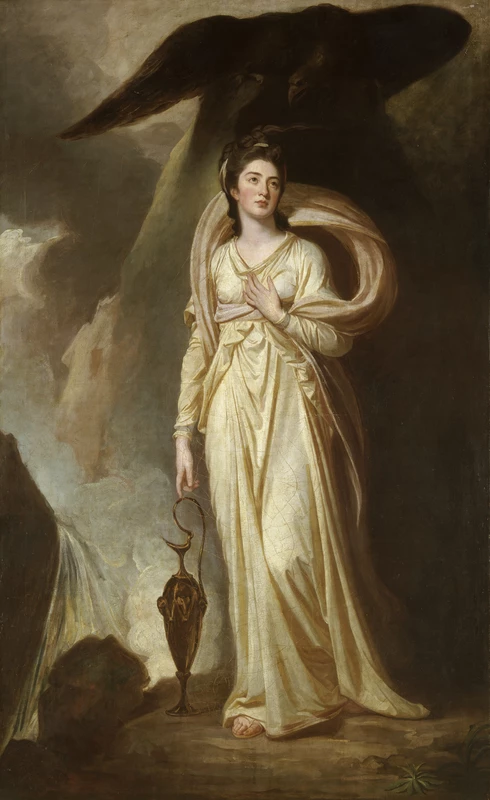
George Romney (1734-1802), Elizabeth Harriet Warren (Viscountess Bulkeley) as Hebe, c. 1776 Oil on canvas, 238.5 cm x 148 cm.

Romney had moved to London from Kendal in 1762 to seek success and fame. One of the pictures that began to make his reputation was a grand group portrait of the Warren family of Poyton, Cheshire, completed in 1769.  

Between 1773 and 1775 Romney travelled in Italy, to study classical and renaissance art first-hand and to increase his credibility with patrons. On his return to London he found himself largely forgotten. However, he leased a large house in Cavendish Square, and some of his former supporters came forward with new commissions.

Sir George Warren was one of the first, ordering a portrait of his daughter Elizabeth, to mark her wedding in April 1777 to Thomas, 7th Viscount Bulkeley of Beaumaris (1752-1822). The principal landowner in Anglesey, and an associate of Sir Watkin Williams-Wynn, he was MP for his county from 1774 to 1784, when he was made a British peer.

She sat for Romney on five occasions during May 1776. The artist then fell ill, and the final sitting took place in December. He put much thought into the composition, and there are sketches for it in several collections.

Ronmey had long wanted to establish himself as a painter of "histories" (works with a literary and moral message), and Elizabeth is depicted as Hebe, cupbearer of the gods and goddess of youthful beauty. Hebe's traditional attributes are a cup or ewer and the eagle, symbolic of her father Zeus. She was a popular allegorical persona for 18th-century portraits of young women.

This work exemplifies the "sublime and terrible" aspect of Romney's style. The mountain cascade is in austere, almost monochrome colour. The picture was intended to remind the viewer of classical sculpture. It was one of a number of neo-classical works that transformed his standing in 1776 and led to twenty years as London's busiest and most fashionable portrait-painter.

Elizabeth and Thomas Bulkeley had no children and her portrait, which hung in the drawing room of their Anglesey house, Baron Hill, was eventually inherited by his half-brother. It passed to the Williams-Bulkeley family until bought by the Museum (where it had been on loan since 1948) with the assistance of the Art Fund in 2000.

Further reading:

Fritz Saxl & Rudolph Wittkower, British Art and the Mediterranean , Oxford 1948, repr.63(4);

John Steegman, A Survey of Portraits in Welsh Houses, vol. 1, Houses in North Wales, National Museum of Wales, Cardiff 1957, p.25;

David Irwin, English Neoclassical Art, London 1966, p.152.
A splendid silver cup for a copper magnate

25 July 2007

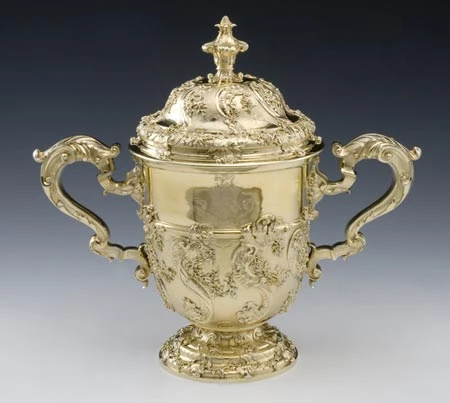
Ornamental silver cup and cover

Silver Cup and Cover, Paul Crespin, 1733

Silver Cup and Cover, Paul Crespin, 1733

Owning and displaying a large silver cup and cover was a mark of wealth and status for centuries in Britain. By 1700 such cups were no longer drinking vessels. They became entirely ornamental and a focus for the skills of their designers and makers.

William Lewis Hughes

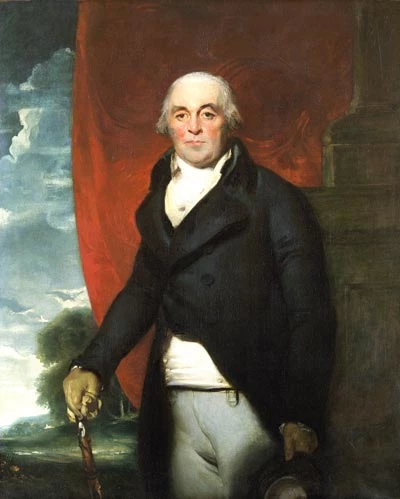
Sir Thomas Lawrence's (1769 - 1830) portrait of Thomas Williams (1737-1802) oil on canvas; 127.5 x 102.1 cm.

Sir Thomas Lawrence's (1769 - 1830) portrait of Thomas Williams (1737-1802) oil on canvas; 127.5 x 102.1 cm.

A hundred years later, a particularly splendid cup made in 1733, and now in Amgueddfa Cymru, was the prized possession of one of the wealthiest men in Wales, William Lewis Hughes (1767—1835), of Kinmel Park, Denbighshire. This tells us something about a growing taste at the time for antiques, rather than the new.

The cup bears the mark of Paul Crespin, together with London marks for 1733-4. Crespin was born in 1694 into a French Protestant family. He set up business in London in 1720, and although he was recorded as bankrupt in 1747, he seems to have continued working there until 1759.

Crespin was one of the most cosmopolitan and sophisticated makers of his day. As early as 1724 he made a "curious silver vessel for bathing, which weighed about 6030 ounces" (now lost) for the King of Portugal.

He had many important clients, and his masterpiece is perhaps the celebrated "Neptune" centrepiece of 1741 in the Royal Collection, an elaborate rococo object made for Frederick, Prince of Wales.

A large silver cup

Detail of the cup cover

Partly because of the wealth derived from the Parys copper mine and partly because of the energetic personality of Edward Hughes, the family was to become spectacularly rich.

The cup is exceptionally large, standing 14 inches high and weighing over 150 troy ounces — a cup and cover of 1731 by Crespin's associate Abraham Buteaux and described as "large" in 1749 weighed only 94 ounces.

It is ornamented entirely in the newly fashionable rococo manner, and would have seemed quite novel. The foliage and vine decoration also appear on a pair of wine coolers made by Crespin for the Duke of Marlborough in the same year, and the double scroll handles appear a little later on cups by George Wickes, Paul de Lamerie, John Le Sage and John White.

Coat of arms

The arms of William Lewis Hughes of Kinmel.

The arms of William Lewis Hughes of Kinmel. Note the arms of its original owner have been erased.

The engraving is of very high quality, remaining crisp, with little sign of surface wear. The arms of its original owner have been erased, presumably because the cup came on the market in the early 19th century. Its surface may originally have been white silver, rather than gilt. The present, rather brassy gilding is contemporary with the later armorials that can be dated to around 1830. It is interesting that the cup was 'improved' and resold in this way.

The cup's new owner was William Lewis Hughes of Kinmel. It probably came into his possession before he was raised to the peerage as Lord Dinorben in 1831, as his arms, which are engraved on both sides of the cup, have what appears to be an added Baron's coronet and lack the heraldic supporters that he was to adopt as a peer.

Parys copper mine

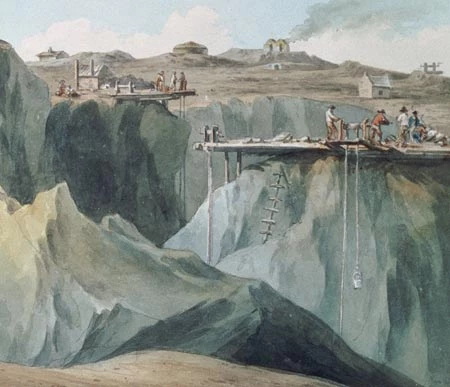
Junction of Mona and Parys Copper Mine as depicted in 1790.

Junction of Mona and Parys Copper Mine as depicted in 1790.

Hughes's mother was the niece of William Lewis of Llysdulas, Anglesey. With her husband the Rev. Edward Hughes she became heir of the Llysdulas estate, which included one side of Mynydd Parys. Partly because of the wealth derived from the Parys copper mine and partly because of the energetic personality of Edward Hughes, the family was to become spectacularly rich.

The Copper King

Foliage and vine decoration

The cup engraved ornament is of very high quality, remaining crisp, with little sign of surface wear.

William Lewis Hughes, the first Lord Dinorben, was colonel of the Anglesey Militia and MP for Wallingford from 1802 to 1831. From 1819 his London home was Bute House, South Audley Street. Edward and William Hughes were business partners of Thomas Williams, the 'copper king', whose portrait by Lawrence is also in the collections of Amgueddfa Cymru.

The cup was later owned by the Edwardian financier and philanthropist Sir Ernest Cassel (1852-1921), and was acquired by the Museum in 2005 with the support of the National Heritage Memorial Fund and the Art Fund.

The Stone Age tombs of south-east Wales

14 May 2007

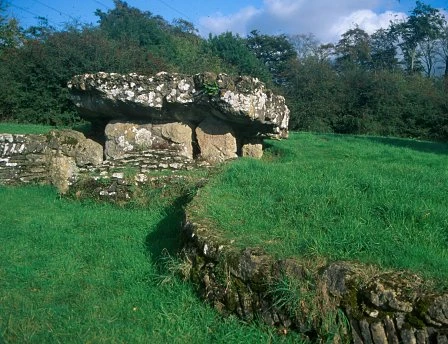
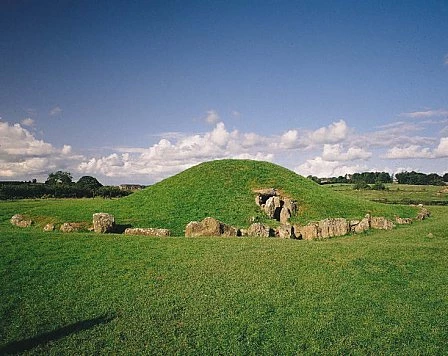
The forecourt and chamber of Tinkinswood (Vale of Glamorgan).

The forecourt and chamber of Tinkinswood (Vale of Glamorgan). Built in the Cotswold-Severn style, the chamber of this impressive monument can still be visited today. Image: Cadw (Crown Copyright).

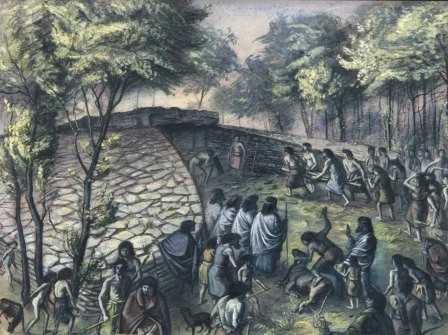
Imaginative reconstruction of a burial ceremony at Tinkinswood, by Alan Sorrell.

Imaginative reconstruction of a burial ceremony at Tinkinswood, by Alan Sorrell.

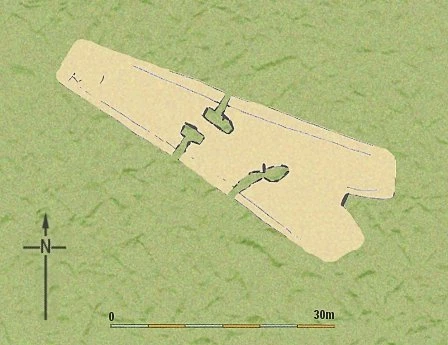
Ground plan of tomb at Gwernvale (Powys).

Ground plan of tomb at Gwernvale (Powys). This plan of the tomb is typical of the Cotswold-Severn type, although in this case the chambers are not accessed from the forecourt, but from the sides of the tomb.

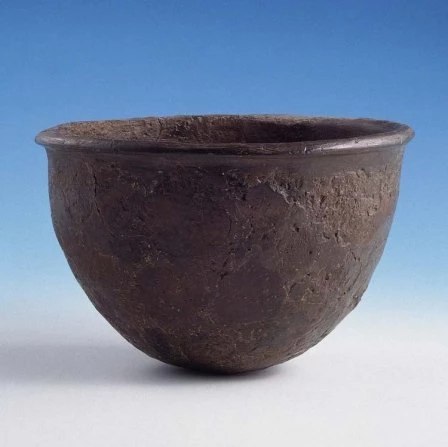
Bowl from Ty-Isaf (Powys). 24.6cm (9.8 inches) in diameter. Found in fragments, this simple bowl is more typical of the grave goods offered at this time.

Bowl from Ty-Isaf (Powys). 24.6cm (9.8 inches) in diameter. Found in fragments, this simple bowl is more typical of the grave goods offered at this time.

6,000 years ago small farming communities began to build tombs that continued to be used for hundreds of years - many survive to this day.

Stone Age tombs are relatively common in Wales. These 6,000 year old monuments consist of one or more chambers constructed from massive stones (megaliths). These were originally covered by a mound of earth or stones, although this rarely survives.

Many of these tombs were made to a common design, and in south-east Wales this often takes the form of mounds where the wider end points eastwards and opening to a forecourt. The internal chambers are accessed by short passages leading from the forecourt or the sides of the mound.

This design also appears throughout the Cotswolds (England), and beside the River Severn giving rise to the archaeological name Cotswold-Severn tombs.

Excavation at Cotswold-Severn tombs such as Gwernvale (Powys) have shown that they were sometimes built over earlier settlements, suggesting it was important that the dead be buried on land once occupied by the living.

At Pipton and Ty-Isaf (both in Powys) archaeologists have also discovered that some tombs were built in stages, often with a smaller monument being incorporated into a larger design.

The end product can be massive, for example Penywyrlod, Talgarth (Powys). It is likely that these grand houses for the dead were intended to stake a claim to a territory, emphasising to passers-by that the land was taken.

Once built Cotswold-Severn tombs were used for generations. For example, bodies were interred at Parc le Breos Cwm (Gower) for over five hundred years. This site gives us a glimpse of the burial rituals at these tombs, with some bodies apparently having been kept outside the tomb until they had partially decomposed - a practice which sounds gruesome today, but appears to have been a common part of the burial rite at this time.

When abandoned Cotswold-Severn tombs often held the remains of a large number of people. At Parc le Breos Cwm archaeologists found more than 40 bodies, while at Ty-Isaf and Tinkinswood (Vale of Glamorgan) over 30 and 50 were found respectively.

The fragmentary nature of these bodies suggests that it was not the individual burial that was important to the tomb builders, but the creation of an ancestral bone pile.

Few grave goods are found in these tombs, at most a few broken pots and a handful of flint tools. It is likely that what ceremony occurred to honour the dead took place outside of the chambers.

Together, the bones, grave goods and the tombs themselves provide one of the main sources of information about life and death in south-east Wales during this remote period.

Background Reading

The Tomb Builders: In Wales 4000-3000BC by Steve Burrow. National Museum Wales Books (2006)

The megalithic chambered tombs of the Cotswold-Severn region by T. C. Darvill. Vorda Publications (1982).

The burial tombs of Stone Age Wales

14 May 2007

Common Culture

Bryn Celli Ddu

Bryn Celli Ddu (Anglesey) is one of the best preserved passage tombs in Wales. Image: Cadw (Crown copyright).

5,500 years ago a common culture spread around the Atlantic coast of Europe linking Brittany, Cornwall, Wales, southern Scotland and Ireland.

Today, evidence of this culture survives in the form of passage tombs - circular burial mounds pierced by stone-lined passages that open into central chambers.

Stone Age Crematoriums

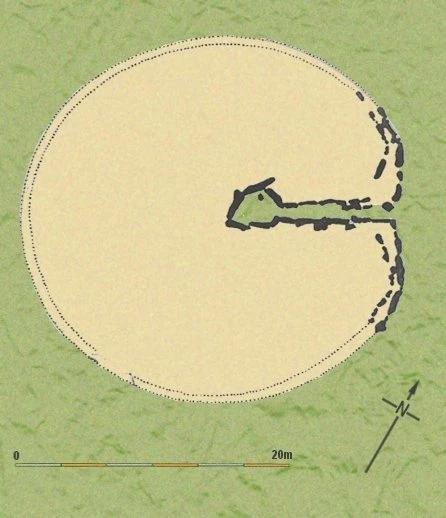
Plan of Bryn Celli Ddu showing the passage way leading into the centre of the circular mound.

Plan of Bryn Celli Ddu showing the passage way leading into the centre of the circular mound.

These tombs were built by early farming communities to house the cremated remains of their dead and were used for generations. They must have been important landmarks that linked the living with their ancestors.

Within Wales, passage tombs are best seen on Anglesey where two important examples are sufficiently well-preserved to allow public access - Barclodiad y Gawres and Bryn Celli Ddu.

Barclodiad y Gawres ('the apronful of the giantess') was built with a main chamber flanked by three side-chambers in which the dead would have been placed. In the centre of the main chamber was a hearth from which a fire would have illuminated the tomb during rituals.

Witches brew and spiral artwork

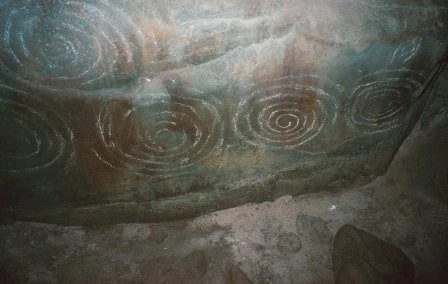
Carved stone inside the chamber of Barclodiad y Gawres (Anglesey). The style of carving in this passage tomb is common to many tombs in Ireland.

Carved stone inside the chamber of Barclodiad y Gawres (Anglesey). The style of carving in this passage tomb is common to many tombs in Ireland.

To the surprise of the archaeologists excavating the site, the hearth contained a strange mix of reptile, fish and amphibian bones. While the reason for this 'witches brew' will never be known, one important insight into the culture of these tomb builders is the strange artwork that is pecked into the rocks that line the passage and chamber. These designs include spirals and strange meandering zig-zag patterns.

On their own they might be dismissed as a whim of the builders, but this type of design is also found within other passage tombs as far afield as Ireland and Brittany.

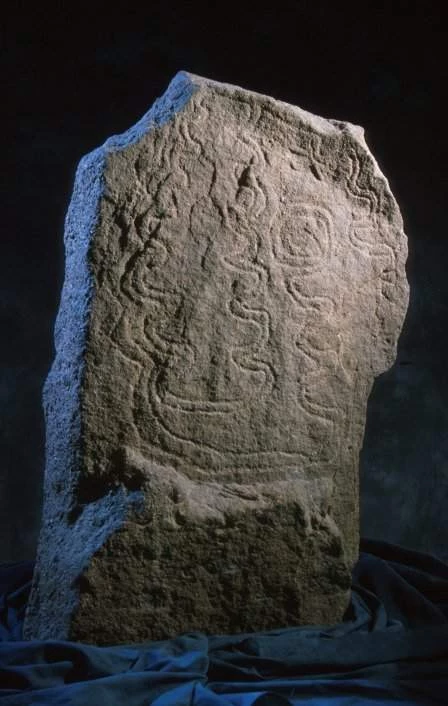
A similarly patterned stone was found at Bryn Celli Ddu (Anglesey). However, here the stone was discovered lying face down in a pit beneath the tomb's chamber where it must have been buried before tomb building began. Was it buried in order to sanctify the site, or was it buried to hide it away? - another unanswered mystery.

The passage tombs on Anglesey are not the only ones in Wales. Other examples are known from Gwynedd and Pembrokeshire, although these are less well-preserved.

Grand ambitions

Decorated stone

Decorated stone found beneath Bryn Celli Ddu (Anglesey). 1.5m (4.9 feet) high. The swirling patterns on this stone are typical of passage tomb art.

The largest and most complex passage tombs occur in Ireland. The tombs at Newgrange and Knowth show how grand the ambitions of the tomb builders could be.

At Knowth the central tomb is accompanied by a cemetery of at least 18 smaller examples, while at Newgrange skilled engineers precisely aligned the passage way with the mid-winter sunrise.

In all of the areas where passage tombs appear they are built to slightly different designs, but there is sufficient similarity between them all to indicate that the Irish Sea was a thriving highway at the end of the Stone Age, with communities from Brittany to Scotland sharing both ideas and ways of respecting the dead.

Background Reading

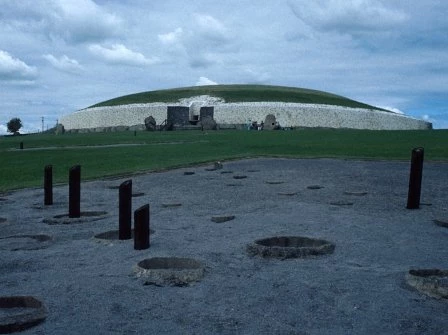
Newgrange, Co. Meath (Ireland), with pit circle in foreground.

Newgrange, Co. Meath (Ireland), with pit circle in foreground. The reconstructed passage tomb at Newgrange is one of several massive tombs in the Boyne Valley. Image © Steve Burrow.

The Tomb Builders: In Wales 4000-3000BC by Steve Burrow. National Museum Wales Books (2006)

Barclodiad y Gawres: the excavation of a megalithic chamber tomb in Anglesey, 1952-1953 by T. G. E. Powell and G. E. Daniel. Liverpool University Press (1956).

Irish Passage Graves: Neolithic tomb builders in Ireland and Britain 2500BC by M. Herity. Dublin University Press (1974).

'The chambered cairn of Bryn Celli Ddu' by W. J. Hemp. In Archaeologia Cambrensis vol. 86, p216-58 (1931).

The megalithic tombs of Stone Age Wales

14 May 2007

Megalithic Tombs

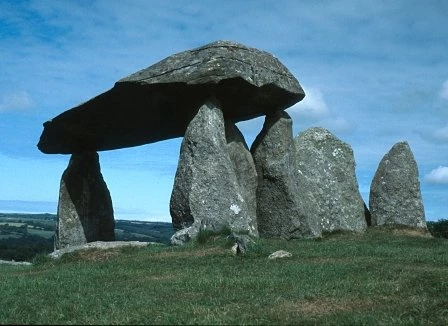
Pentre Ifan

Pentre Ifan (Pembrokeshire), one of the most dramatic megalithic tombs in Wales. It would originally have been covered by a stone mound.

Wales is home to one of the best collections of megalithic tombs in the UK. As well as being visually dramatic, they provide an important source of information about life, and death, from over five thousand years ago.

The landscape of Wales is filled with ancient monuments. A thousand years ago castles were the most impressive features, a thousand years before that it was Roman forts and before that Iron Age hillforts. But the earliest monuments to survive to the present day are megalithic tombs - stone burial chambers, built almost six thousand years ago.

Megalithic tombs were built at a time when the population of Wales lived in small communities, using stone tools, and experimenting with the newly introduced ways of farming and herding. Today such a life sounds simple and unsophisticated compared to our own. However, the evidence of the megalithic tombs tells us that life was not completely uncomplicated at this time.

Wales's megalithic tombs consist, for the most part, of stone chambers composed of a large capstone perched on top of a number of uprights. These would once have been covered with a mound of earth or stone. Often they have a forecourt area in which ceremonies would have been performed.

The scale of the megaliths is their most striking feature. At Arthur's Stone on the Gower peninsula a rock over 4m (14ft) long and 2m (7ft) thick was lifted to create the chamber. At Tinkinswood (Vale of Glamorgan) a slab weighing over 36 tonnes (39 tons) was used.

Community crypts

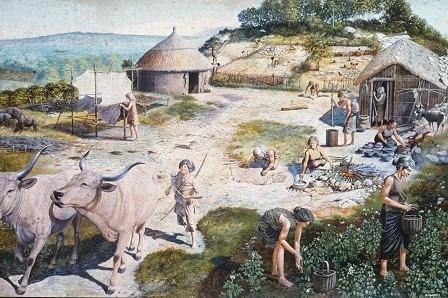
Reconstruction of daily life in Wales 6,000 years ago

Reconstruction of daily life in Wales 6,000 years ago, based on excavations at Clegyr Boia (Pembrokeshire). For most people the daily routine focused on farming crops, gathering wild plants, and herding sheep and cattle.

That Stone Age people went to such lengths to build their tombs indicates their importance for communities at this time.

When completed the tomb functioned like a modern crypt, being slowly filled over the generations with the dead. The result was, in effect, a home for the ancestors.

South East Wales

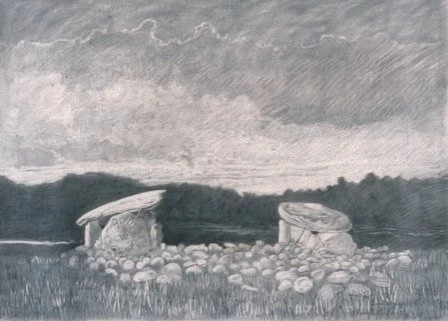
Dyffryn Ardudwy

Drawing of Dyffryn Ardudwy (Gwynedd), by David Gunning. This monument was constructed in stages with the chamber on the right being the first to be built.

Tombs like these can be found in many parts of Wales. In south-east Wales there is an important group of tombs centred on the Black Mountains as well as in the Vale of Glamorgan. In south-west Wales, there are clusters in Pembrokeshire and Carmarthenshire. Most impressive of all are the tombs of Anglesey, which are notable for their number and variety.

These tombs are the few that have survived agricultural clearance and robbing for building works - doubtless there were once many more in Wales, and perhaps there are a few more still waiting to be discovered.

Background Reading

Arthur's Stone, on the Gower peninsula.

Arthur's Stone, on the Gower peninsula. The massive stone that caps this chamber was set atop several smaller uprights in an impressive feat of Stone Age engineering.

The Tomb Builders: In Wales 4000-3000BC by Steve Burrow. National Museum Wales Books (2006)

Megalithic tombs and long barrows in Britain by F. Lynch. Shire Publications (1997).