: Mining & Extraction

A Rhondda rebel song - lyrics discovered from first hunger march in Wales

27 August 2008

'A Rhondda Rebel Song' (to the tune of Cwm Rhondda)

These lyrics were discovered in the documents of the late grandparents of Ms Powell, Isle of Man, in 2008. See below for transcript. Reproduced with kind permission of Ms Powell.

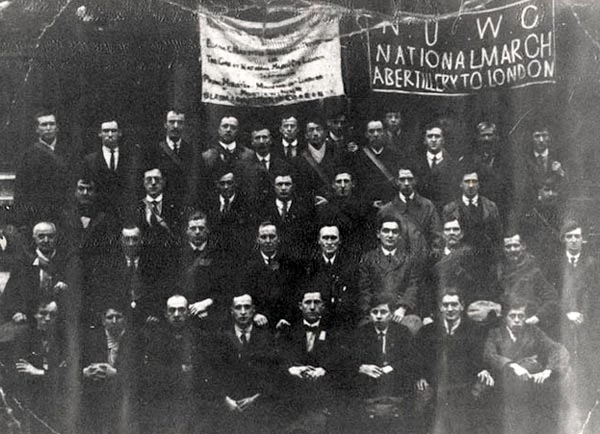
Abertillery Members of the Hunger March, 1927

Abertillery Members of the Hunger March, 1927. [Image: South Wales Coalfield Collection, Swansea University.]

Poster advertising 'Red Sunday in Rhondda Valley' demontration

Poster advertising 'Red Sunday in Rhondda Valley' demonstration

These lyrics were discovered in the documents of the late grandparents of Ms Powell from the Isle of Man in 2008. They are written in memory of two men who died during the miners march on London in 1927.

The first hunger march from Wales to London took place in 1927 as a protest against the Ministry of Health who were refusing or limiting relief notes to unemployed miners and their families. It was also a demonstration against the Government's new Unemployment Bill.

Red Sunday in Rhondda Valley

During a demonstration on 18 September 1927 — 'Red Sunday in Rhondda Valley' — A. J. Cook, the miners' leader at the time, called for a march to London on 8 November (when Parliament re-opened). Every South Wales Miners' Federation (SWMF) lodge (colliery union branch) chose members to march, and each marcher would carry a miner's safety lamp.

By November the march had lost the support of the SWMF. However, it was still supported by A. J. Cook, S. O. Davies (later MP for Merthyr), the SWMF Rhondda section and the Communist Party.

On 8 November 1927, 270 men eventually marched in spite of hostility from the trades unions, press and government. They did, however, gain support from Trades Councils in every town and village they passed through (which included Pontypridd, Newport, Bristol, Bath, Chippenham and Swindon).

Soldiers in a Workers Army

The 270 marchers came from the Rhondda Valleys, Caerau, Aberdare, Merthyr, Pontypridd, Tonyrefail, Ogmore Valley, Gilfach Goch, Nantyglo and Blaina. Two miners died on the march - Arthur Howe from Trealaw in a traffic accident and John Supple of Tonyrefail who died after catching pneumonia during the rally in Trafalgar Square.

In his last letter to his wife Mr Supple had written — 'Don't worry about me. Think of me as a soldier in the Workers' Army. Remember that I have marched for you and others in want.'

'Fascists' harassment and Armed Escorts

From the beginning, the march was frequently referred to as a 'workers' army'. The marchers had been organized on military lines, divided into detachments and companies. During the march there was alleged harassment by 'Fascists', causing the organizers to be met by an armed escort of 100 members of the Labour League of Ex-Servicemen at Chiswick.

The 'Workers' Army' senior 'officer', Wal Hannington, later wote in a pamphlet entitled 'The March of the Miners: How we Smashed the Opposition': '... these men are lighting a lamp stronger and more powerful than that which they are carrying. They are lighting a lamp that reveals the tortuous path the toilers have had to follow, and which lights up the road of struggle for the battle with the forces of reaction and the conquest of power by the workers'.

The pamphlet includes 'A Rhondda Rebel Song' echoing James Connolly's 'A Rebel Song' which, along with 'March Song of the Red Army' and 'The Red Army March', was sung by the marchers.

Transcript:

Transcript of 'A Rhondda Rebel Song'

Foreign workers in the Welsh coalfields

6 March 2008

Post War miner shortage

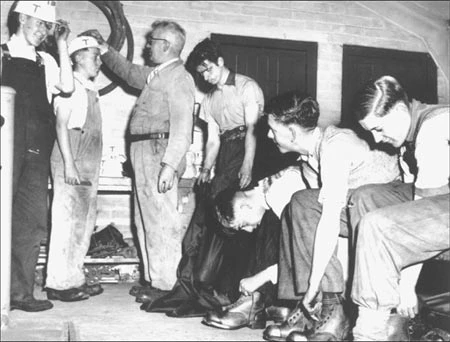
Group of Slovenians at Oakdale Training Centre 1948

Group of Slovenians at Oakdale Training Centre 1948.

Following the Second World War, the demand for coal was high and generally rising. Post-war recovery and growth demanded cheap and abundant energy that could only come from coal. There was an urgent need to recruit more miners. One source for these was among the thousands of Europeans who had to flee their home countries during the War.

Although Britain desperately needed these men they were not always welcomed with open arms and there was much resistance from local National Union of Mineworkers' lodges. There was more disquiet when the recruitment of Italians began in 1951, and things were no better when the National Coal Board tried to recruit among Hungarian refugees after the 1956 revolution. By this time another group had already entered the coal field. In 1954 the German mining engineering group, Thyssen UK, came to work in south Wales, bringing some of their own countrymen with them.

As with today's immigrants, these 'foreign workers' faced much initial suspicion, which arose partly from ignorance and partly from the fear of unemployment among the local population. These young men came to Britain after years of hardship, danger and tragedy.

"All Poles"

Nyk Woszczycki (2nd from left) in a group celebrating his friend Joe Hughes's retirement from Britannia Colliery

Nyk Woszczycki (2nd from left) in a group celebrating his friend Joe Hughes's retirement from Britannia Colliery

Many left the coal industry as soon as they could, many even left Britain, but the ones who stayed earned a lasting reputation for toughness and hard work. Even though they came from many countries they tend to be regarded as 'all Poles' by the Welsh miner. They married local girls and settled down; on their living room walls can often be found photographs of their children and grandchildren, who have been brought up as Welsh. Many of these have gained university degrees; some have won sporting honours for Wales.

In spite of their pride in their original homelands, most now regard themselves as Welsh. In turn, Wales should be proud of them and the part they have played in her history.

This article forms part of a magazine in the series 'Glo' produced by Big Pit National Coal Museum. Download the complete magazine here:

The National Coal Board in South Wales

25 February 2008

Post War Britain

The dismal history of the coal industry between the world wars, government control during the Second World War and the need for coal in post-war Britain made nationalisation of the British coal industry almost inevitable after the election of a Labour government in 1945.

'Vesting Day', 1 January 1947, was largely welcomed in Welsh collieries when the south Wales coalfield became part of the South-Western Division of the National Coal Board (NCB). Assets taken over by the NCB in the UK included over 1,400 coal mines, 225,000 acres of farm land, 140,000 miners' houses, shops, offices, hotels, swimming baths, a holiday camp and a cycle track!

Investment and Disappointment

Nationalisation brought in considerable new investment for south Wales. Between 1948 and 1953, nearly £32 million was invested in the Cardiff region alone, with the reconstruction of Nantgarw Colliery cost £4.5 million. There was increased mechanisation at the coal face and drives to improve health and safety. However, by the mid-1950s, the NCB began to be seen as remote as any of the previous private coal owners. Investment had also often failed to bring results, with the expensive Nantgarw Colliery producing a disappointing 100,000 tons of coal a year.

Closures and disasters

Even from the early days of the NCB there was a tendency to close smaller, uneconomic pits and reorganise the larger ones. However, during the 1960s a deliberate rundown of the south Wales coalfield had begun. No other British coalfield suffered such closures - in 1960 there were 106,000 south Wales miners, by 1970 there were 60,000. The pace of closures only slackened off during the Middle East oil crisis of the mid-1970s.

1960, an explosion at Six Bells Colliery killed 45 miners, and on the morning of Friday, 21 October 1966, a large section of the spoil heap of Merthyr Vale Colliery slid down the hillside onto the village of Aberfan, killing 144 people including 116 children.

The 1960's

The 1960s saw the development of new 'super pits' at Abernant, Brynlliw and Cynheidre Collieries as well as the reorganisation of existing collieries such as Coegnant, Deep Navigation and Merthyr Vale.

The decade also saw all British mineworkers brought onto the same pay rate. Both management and trade unions broadly welcomed this agreement, although many men saw a substantial fall in their incomes.

The Agreement forged a greater sense of unity between UK coalfields, which paved the way for the national strikes of 1972 and 1974, which were fought over wages, the latter dispute bringing about the fall of the Conservative government.

The final years

By the early 1980s the British mining industry had become one of the safest and most efficient in Europe. However, a new Conservative government was in place and a new round of pit closures announced. The Welsh coalfields were especially vulnerable due to the age of the collieries and the difficult geology.

Although closures had been reluctantly accepted in the past, the lack of alternative employment led to calls for industrial action. The last great miners' strike began in March 1984 and lasted a year. The defeat of the miners paved the way for the final destruction of the Welsh coal industry.

The next ten years saw the end of coal as a nationalised industry. In 1994, Tower Colliery, the last remaining deep coal mine in Wales was closed by the NBC, (renamed British Coal). However, convinced that the mine was still economical, 239 miners bought the colliery with their own redundancy money and the mine remained operational until it's final closure on 25th January 2008, bringing to an end 200 years of deep coal mining in south Wales.

This article forms part of a booklet in the series 'Glo'produced by Big Pit: National Mining Museum. Download here

Dreaming sometimes is not enough

31 January 2008

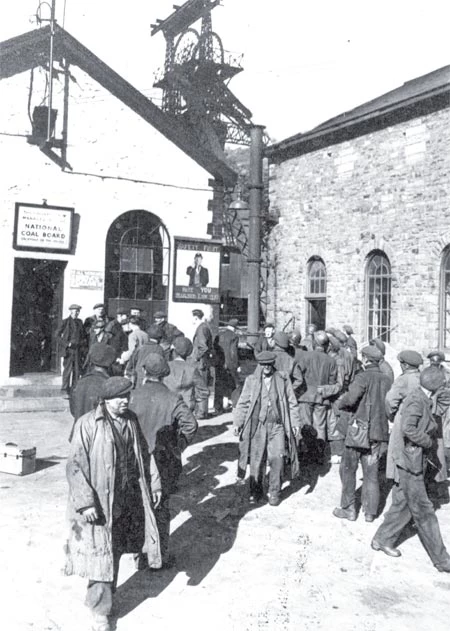
George Evans waiting to go on shift at Banwen colliery

George Evans waiting to go on shift at Banwen colliery

Glo - National Coal Board pdf dowload

Glo: 'N C bloody B' [PDF 7 MB]

First of January, 1947: The coalmines of Great Britain were taken into public ownership. It was something that every miner in Britain had wanted, had dreamt about indeed had been praying for.

The often callous and brutal treatment of coalminers over the years by both mine owners and management had nurtured a contempt that bordered on hatred. There were three British miners killed every single working day at the time.

So there was genuine rejoicing.

The National Coal Board standard flew proudly at every pithead, the NCB gold logo on a blue field. Only thirteen years earlier 266 miners, had been burnt to death in a north Wales pit. Only 16 bodies were ever recovered and no one properly brought to book. So the rejoicing was truly heartfelt in every coalfield on this island.

No one expected miracles from nationalisation but people became slowly aware of a giant incompetence, a kind of disjointed progress to somewhere, but no one knew exactly where.

One instance that I witnessed was when I was standing in for the underground engine driver in the Eighteen Feet seam. The rope on the main winding engine was about an inch and half in diameter and perhaps about a mile long. The manager, John Williams, was having a heated argument with some blokes from HQ. They wanted to replace the existing rope with a much thicker longer rope.

The new rope was fitted and proved to be too heavy for the weight of the journey (train of trams) to pull the length of the drift. What it cost to put that stupid blunder right goodness only knows. And that sort of crack-brained, hugely expensive blunder was happening a dozen times a day, in every coalfield in the country.

One or two of the colliers were over seventy years of age but filling as much coal as most and earning a tidy wage. We came out one Thursday off afternoon shift and picked up our pay dockets. The old timers had an envelope attached to theirs with a crude little note inside telling them they were on 14 days notice. No pension, no redundancy, nothing - and one or two of the old chaps had started work at 13 years of age!

John Williams had the old men brought back for a day, signed them on and kept them in the canteen until the end of the shift. That meant that the old fellers qualified for one pound a week colliery pension.

I became disgusted with the behaviour of the National Coal Board. Men had struggled over the years to bring about nationalisation - they had even gone to prison!

With each day that passed it became more and more apparent that trying to run the coal industry of Britain from a posh address in Belgravia wasn't working. Everywhere you looked there was disorderliness in planning and organisation. Still, work went on at the coal face in spite of it all.

With the advantage of hindsight we are now able to see an industry, colossal in size, massively underfunded for many, many years and generally very badly managed.

Maybe if someone had thought of asking, or if someone had had the courage to ask, say the head of Boots the Chemist or the head of Austin Cars to take charge, or demand co-operatives to be set up then perhaps the dream would have become reality.

The one positive thing that the miners got from nationalisation was that health and safety improved out of all recognition.

This article forms part of a booklet in the series 'Glo'produced by Big Pit: National Mining Museum. You can download the booklet here:

Glo - National Coal Board pdf dowload

Glo: 'N C bloody B' [PDF 7 MB]

Tales from down under - memories from Ray Isted, Bevin Boy collier

4 January 2008

Recollections by Raymond George Isted, Bevin Boy in Roseheyworth Colliery 1943—9

Raymond George Isted, Bevin Boy, Roseheyworth Collier 1943 — 1949

Raymond George Isted, Bevin Boy, Roseheyworth Collier 1943 — 1949

I was born in Herstmonceux in East Sussex; I left school at 14 and worked in a factory making automotive parts. When I reached 18, I was called up and sent to Brighton for a medical, I wanted to join the army although to be honest I would have been quite happy stopping at home!

"I was actually balloted to go into the mines and sent to Oakdale Training Centre. I lodged with a Mrs Jones in Risca along with Wyndham Jones, a cockney who had relations in Abertillery. We trained for six weeks at Oakdale (Wyndham proved to be 'like a woman' on the shovel) and then sent to Roseheyworth Colliery. We had to wear our own clothes at work, mine were supplied by my parents, and I used to send them back to Sussex every week by my mother for washing. She used to say 'I would rather my Raymond go to the army than the pit' — she thought it was all terrible, thought that Welsh people lived in caves.

"After a while I worked with Sid Fox on a heading where we were filling 13 or 14 drams a shift — Sid used to give me around £3 'knocking money'. When Sid went on the sick I worked the road with Gerald Williams.

"Gerald introduced me to Phyllis on a night out — I was shy and couldn't dance so that was the only way to do it in those days. But it ended up that she was the only girl I ever went out with and we've been married for 58 years this August (2005). We had a quiet wedding, both my parents were ill and couldn't come and there was no one else from my side of the family there. We went to Weston Super Mare for the honeymoon. My new wife didn't want to settle in Eastbourne so we stopped in Wales. It was always 'Hello Ray' every ten minutes in Wales - in Eastbourne you could walk around for six months and no one would talk to you!

"I worked for 6 years in the pits. I remember an overman pointing me out to someone and saying 'You see this boy here? A Bevin Boy and still working here — we can't get him from here!' I even picked up the accent a bit although that was to stop me getting ribbed about my Sussex accent. I feel more Welsh than my wife does now!"

This article forms part of the magazine 'Glo', produced by Big Pit National Coal Museum.