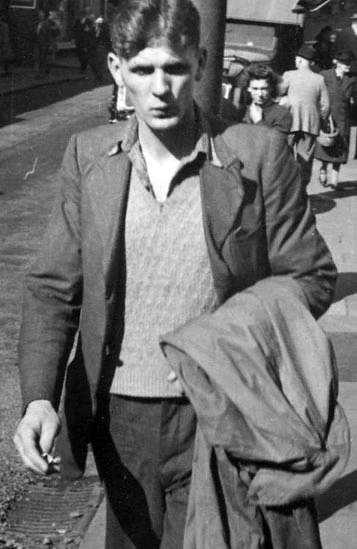
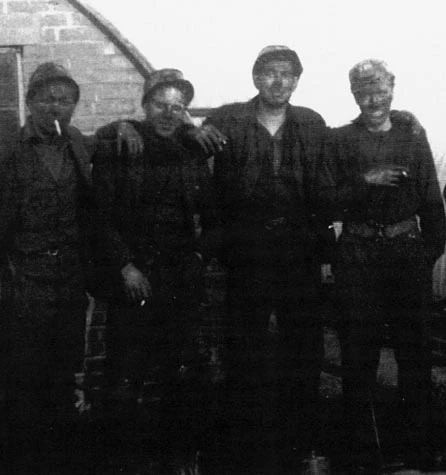
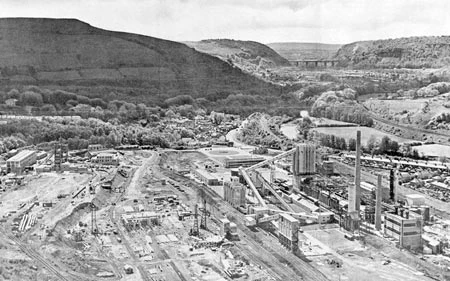
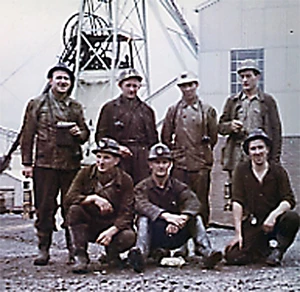
Tales from down under - memories from Bevin Boy colliers 4 January 2008 Being a Bevin Boy in Cwm Colliery by Mel Harris. Mel Harris, Bevin Boy, Cwm Colliery 1944-1947. I had done many jobs since Ernest Bevin forced me into the coalmine rather than the RAF. I had worked with a repairer and a haulier, with a shot firer, as a rider with journeys of drams — always reluctant, uninterested and rebellious. "Now I was on the coal face with a senior collier who was also chairman of the miners' lodge — the union leader at the colliery... As the days passed, I watched him at work, noticing how neat and careful he was in everything he did. To the uninitiated the work of the collier appears rough and ready but it is really skilled and, at times, almost aesthetic. The care taken to keep floor, face and top of the stent well trimmed, the posts and cross pieces in line and the pride taken in leaving the stent neat and tidy at the end of the shift... "Although working hard with Mr David — never called him anything else — my feeling about coal mining did not change. All my friends wore the uniform of one of the Forces and serving overseas, whilst I was in civilian clothes with no uniform provided except boots and helmet. I was on meagre rations, a very small wage and open to accusations of cowardice. Various attempts to get re-assigned to military posts were thwarted so that future prospects seemed bleak. "In this feeling of despair I continued to work alongside Mr David and gradually he brought me some peace and resolution of my attitudes. I began to see him as a role model for a balanced and more optimistic view of life. He was a poorly educated, very intelligent man with clear views on rights and responsibilities. Once I asked him how, in his role as lodge chairman, he dealt with the payment agreements with the manager. He told me 'I will see that he keeps to his side of the agreement — and if any of my men break it they will answer to me.' "I still hated being a Bevin Boy but he helped me to look at it as an experience which would benefit me in later life." This article forms part of the Glo publication by Big Pit: National Mining Museum. Download here Recollections by Raymond George Isted, Bevin Boy in Roseheyworth Colliery 1943—9 Raymond George Isted, Bevin Boy, Roseheyworth Collier 1943 — 1949 I was born in Herstmonceux in East Sussex; I left school at 14 and worked in a factory making automotive parts. When I reached 18, I was called up and sent to Brighton for a medical, I wanted to join the army although to be honest I would have been quite happy stopping at home! "I was actually balloted to go into the mines and sent to Oakdale Training Centre. I lodged with a Mrs Jones in Risca along with Wyndham Jones, a cockney who had relations in Abertillery. We trained for six weeks at Oakdale (Wyndham proved to be 'like a woman' on the shovel) and then sent to Roseheyworth Colliery. We had to wear our own clothes at work, mine were supplied by my parents, and I used to send them back to Sussex every week by my mother for washing. She used to say 'I would rather my Raymond go to the army than the pit' — she thought it was all terrible, thought that Welsh people lived in caves. "After a while I worked with Sid Fox on a heading where we were filling 13 or 14 drams a shift — Sid used to give me around £3 'knocking money'. When Sid went on the sick I worked the road with Gerald Williams. "Gerald introduced me to Phyllis on a night out — I was shy and couldn't dance so that was the only way to do it in those days. But it ended up that she was the only girl I ever went out with and we've been married for 58 years this August (2005). We had a quiet wedding, both my parents were ill and couldn't come and there was no one else from my side of the family there. We went to Weston Super Mare for the honeymoon. My new wife didn't want to settle in Eastbourne so we stopped in Wales. It was always 'Hello Ray' every ten minutes in Wales - in Eastbourne you could walk around for six months and no one would talk to you! "I worked for 6 years in the pits. I remember an overman pointing me out to someone and saying 'You see this boy here? A Bevin Boy and still working here — we can't get him from here!' I even picked up the accent a bit although that was to stop me getting ribbed about my Sussex accent. I feel more Welsh than my wife does now!" This article forms part of the Glo publication by Big Pit: National Mining Museum. Download here
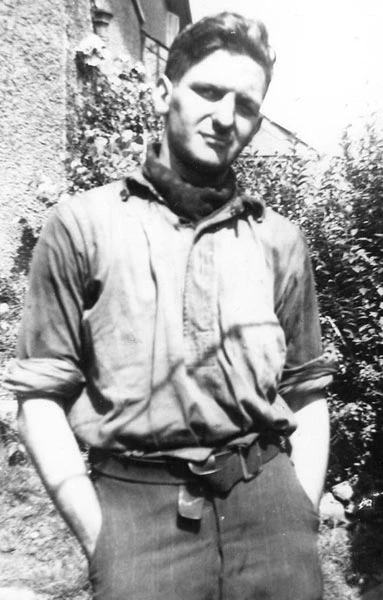
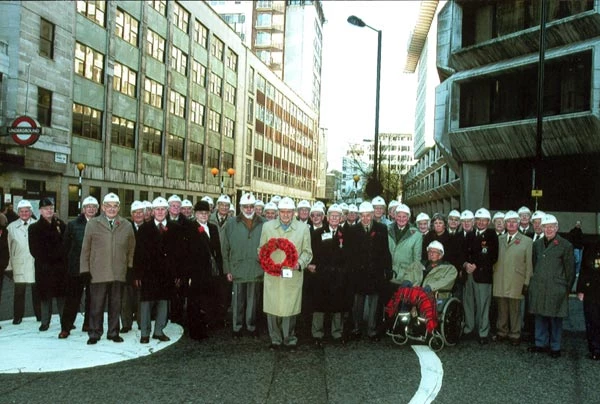
Remembering the Bevin Boys in the Second World War 3 January 2008 Bevin Boys commemorative banner Bevin Boys from South Wales Bevin Boys Association blazer badge. A retired pit pony poses with two former Bevin Boys at the annual reunion at Trentham Gardens, Stoke-on-Trent. Former Bevin Boys attending the Remembrance Parade in London on the 14th November 2004 The underground front The story of the Bevin Boys miners has been largely untold; those many men who spent their war on the so-called 'underground front' went unrecognized for almost half a century. When Britain declared war in 1939, thousands of experienced miners left the mines to join the armed services or transfer to higher-paid 'war industries'. By the summer of 1943 over 36,000 men had left the coal industry . The British government decided that it needed around 40,000 men to take their places. Ernest Bevin In December 1943, Ernest Bevin, the wartime Minister of Labour and National Service, devised a scheme whereby a ballot took place to put a proportion of conscripted men into the collieries rather than the armed services. Every month, ten numbers were placed in a hat; two numbers were drawn out, and those whose National Service registration number ended with those numbers were directed to the mining industry. These "ballotees" became known as "Bevin Boys". Alongside the ballotees were the "optants", men who had volunteered for service in the coal mines rather than the armed services. Between 1943 and 1948, 48,000 young men were conscripted for National Service Employment in British coal mines. Contrary to a common belief at the time, only 41 of them were conscientious objectors. Bevin Boys, therefore, came from all social classes and regions in Britain, not just the mining areas. Many had only been vaguely aware of the mining industry before being drafted. Most had set their sights on a career in the armed services and were horrified to be sent to the collieries instead. Punishment In April 1944 the Colliery Guardian reported that 135 ballotees had been prosecuted for failing to comply with the direct labour order. Thirty two went to prison, although 19 of them were released when they eventually agreed to go into the mining industry. Picks and shovels Unlike the ordinary miners, who wore their own clothes, Bevin Boys were issued with overalls, safety helmet and working boots. However, they still had to pay for their own tools and equipment, which led to complaints that the infantry were not expected to supply their own rifles so why were they expected to buy picks and shovels! Only a small proportion of Bevin Boys were actually employed cutting coal on the coal face, although some worked as colliers' assistants filling tubs or drams. The majority worked on the maintenance of haulage roads, or generally controlled the movement of underground transport. A small number who had previous electrical or engineering experience were given similar work in the collieries. Bevin Boys suffered from resentment from local mining families who had seen their own children drafted into the armed services only to be replaced by "outsiders". In addition, just being young men out of uniform could lead to abuse from the public or attention from the police as possible deserters, "army dodgers" or even enemy spies. It is not surprising that they suffered from high absentee rates. A very small number stayed in mining after the war, but most couldn't wait to leave. Official records destroyed The ballots were suspended in May 1945, with the last Bevin Boys being demobbed in 1948. Unlike other conscripts, they had no right to go back to their previous occupations, they received no service medals, "demob" suit or even a letter of thanks. Because the official records were destroyed in the 1950s, former Bevin Boy ballotees cannot even prove their service unless they have kept their personal documents. The first official Bevin Boys reunion was held at the former Chatterley Whitfield Mining Museum in 1989. More have been held at various venues since then. However, it was not until 1995, 50 years after Victory in Europe Day, that the British government finally recognized their service to the war effort and former Bevin Boys are now officially allowed to take part in the Remembrance Day service at Whitehall. For any information on the Bevin Boys Association please contact: Warwick H Taylor, Vice President, Bevin Boys Association, 1 Rundlestone Court, Dorchester Dorset, DT1 3TN This article forms part of a booklet in the series ' Glo ' produced by Big Pit: National Mining Museum.
Spirit of the miners 1 October 2007 The modern county of Ceredigion is not immediately associated with mining. As you travel towards Aberystwyth on the coast, following the inland valleys of the Ystwyth, Rheidol and the Mynach rivers in the northern part of the county, you could be mistaken in thinking that the economy of Ceredigion - formerly known as Cardiganshire - had always been dependent on agriculture. As you journey through the hills, take a closer look at the changing landscape and a different story unfolds. Driving from one rural settlement to another, the ancient landscape hides many stories, traditions and intrigues of the years gone by. Mining for metals such as copper, lead, zinc and silver has been an important part of the economy of the county for nearly 4,000 years. The scattering of small communities such as Ponterwyd, Pontrhydfendigaid, Ffair Rhos, Cwmystwyth, Ysbyty Ystwyth, Goginan, Ystumtuen, Pontrhydygroes, Cwmsymlog, Taliesin and Talybont often have nothing seemingly in common. However they do have one theme linking them all - the history and legacy of metal mining. This information forms part of the website 'Spirit of the Miners' - a community regeneration project that sets out to create an identity for northern Ceredigion using the legacy of metal mining as a theme for regeneration.
Nantgarw Colliery - once the deepest coal mine in South Wales 2 September 2007 Parc Nantgarw Nantgarw Colliery under construction May/June 1951 Anyone visiting Amgueddfa Cymru's Collections Centre at Parc Nantgarw, north of Cardiff, might not realise that this was once the site of one of the most famous collieries in south Wales. All that now remains are two small concrete pyramids marking the sites of the shafts and a commemorative winding wheel.The deepest mine in south WalesNantgarw Colliery was one of the flagships of the National Coal Board. It was the nearest deep mine to Cardiff, and a reminder to travellers that they had entered the south Wales coalfield.Opened in 1911, it boasted two large shafts and, at a depth of 782.73m (856 yards), was the deepest mine in south Wales. However, despite appearing as a fine example of a clean and efficient modern coal industry, the colliery was abandoned in 1927 due to lack of manpower, poor industrial relations and, above all, being located above very complex underground geology.The war yearsThe mine re-opened in 1937 after a major reorganization, but work was suspended when war broke out in 1939. A later project to re-open the colliery was approved by the Ministry of Fuel and Power in 1946. It was the first major scheme to be operated by the new NCB in the south-west district.A new state-of-the-art colliery Nantgarw in 1974 In order to construct a model colliery at Nantgarw, all traces of the original were demolished and new surface buildings were designed with state-of-the-art facilities. Appliances were installed to reduce smoke and fumes, and all waste was placed underground keeping the surface clear of unsightly spoil heaps. The entire underground network was designed to minimise the risk of accidents. Great care was taken to minimise any dust produced both underground and on the surface, in order to protect the workforce from contracting illnesses such as pneumoconiosis.Not enough miners to mineDuring the 1940s there was a marked decline in the number of men willing to consider a coal mining career, even in the traditional mining strongholds such as the Rhondda.The Nantgarw Colliery posed a specific manpower problem, with the working population choosing employment elsewhere. The workforce had to be recruited from new entrants or from closed collieries outside the area. By 12 March 1954 the total cost of the project had increased to £5.25 million. Labour relations were also a cause for concern. During 1958 alone there were 65 stoppages, go-slows and walk-outs in the collieryDeclining fortunesNantgarw survived the mass pit closures of the 1960s and, in 1975, merged with Windsor Colliery (near Abertridwr). By 1979, the combined Nantgarw / Windsor Colliery employed around 650 men, producing over 4,000 tons of coal per week. During 1979–80 they made a profit of just over £0.5 million. Despite development difficulties, the pit's future looked reasonably secure.However, by the early 1980s the colliery's fortunes were again hit by low manpower and poor geological conditions. The colliery lost £7 million in 1981, and in 1982 output declined steeply as a major coal seam became unworkable. A year later, an overtime ban led directly to the twelve-month strike of 1984-5. Within eighteen months of the strike ending, the mass pit closures took place in south Wales. This time, Nantgarw Colliery was included. Nearly 80 years of coal mining history at Nantgarw ended.
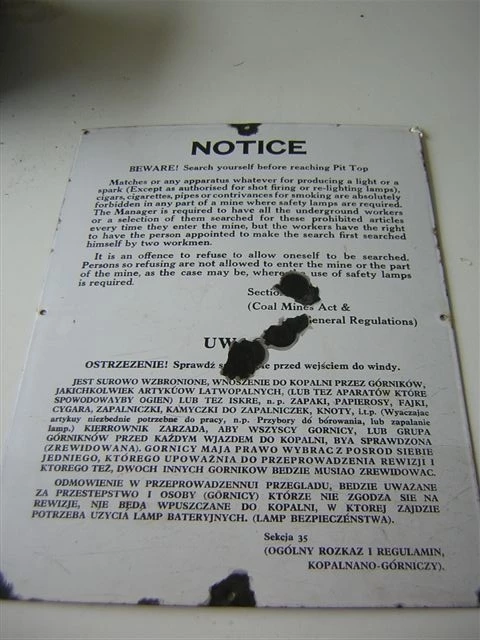
Scattered by war and revolution 12 June 2007 Colliery sign in English and Polish German mine workers at a south Wales coal pit After the Second World War the demand for coal was high and there was a need to recruit new miners. One source for these was amongst the thousands of Europeans who had to flee their home countries during the Second World War. In January 1947, a national agreement was made between the National Union of Mineworkers (NUM) and the National Coal Board (NCB) to recruit from the large number of Polish soldiers who had fought with the Allies during the war. However, there was much resistance amongst local unions. By the end of May 1947 there were Poles whose training was complete but no collieries willing to take them. The NCB appealed for help from the NUM who put a strong resolution to a delegate conference in favour of the acceptance of the Poles and most found places eventually. A scheme to recruit other eastern European displaced persons began in September 1947. There was again fierce opposition from local unions and by the winter only a minority found collieries willing to take them. By 1951 only 10,000 of the 18,000 foreign workers still remained in the mines and a new scheme to recruit Italians was launched. Again there was local opposition, only 400 found placements and the recruitment stopped in April 1952. It was no better when the National Coal Board tried to recruit amongst refugees who had fled from Hungary during the 1956 revolution. There were over 4,000 volunteers but under a third of them found places, the rest went to other industries. The 'foreign workers' came to Wales after years of hardship and danger. The ones that found employment in the coal industry eventually gained a reputation for hard work and respectability. Wales should be proud of them and the part they played in its industrial history.