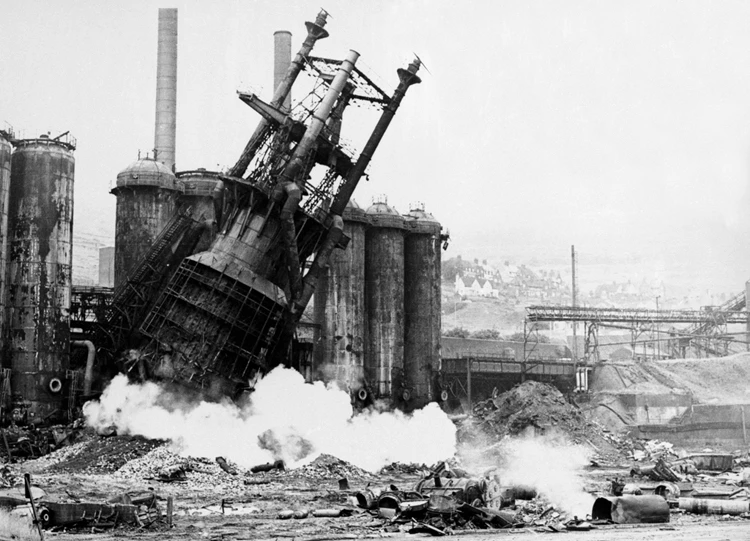
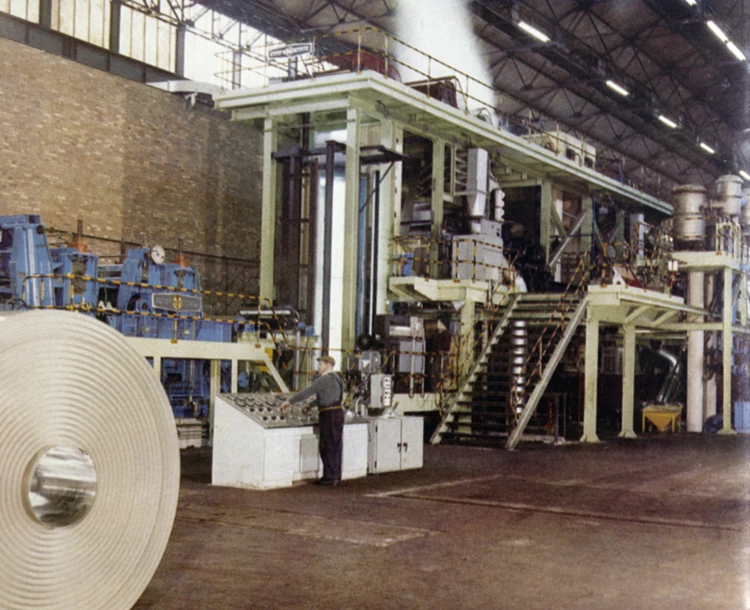
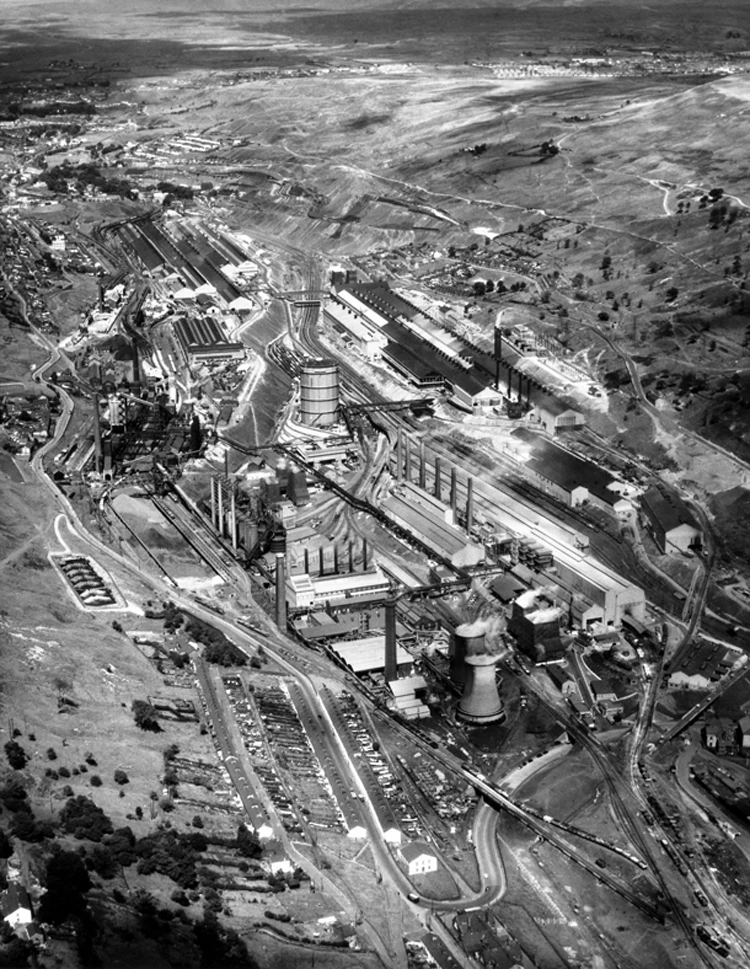
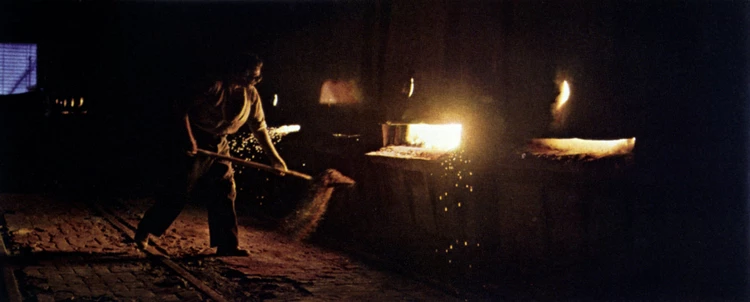
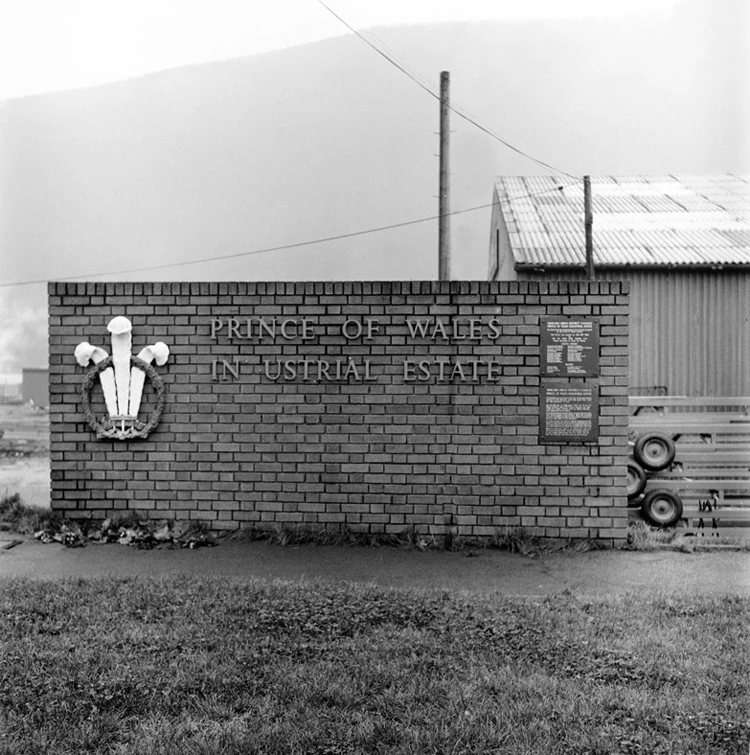
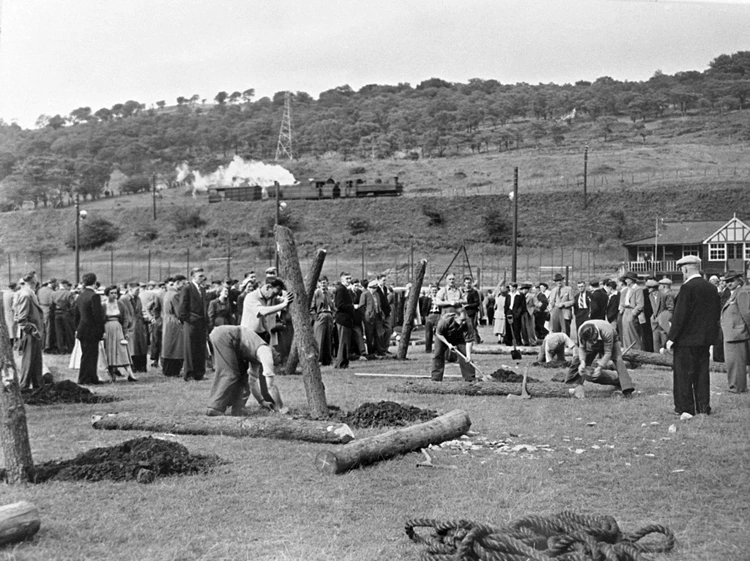
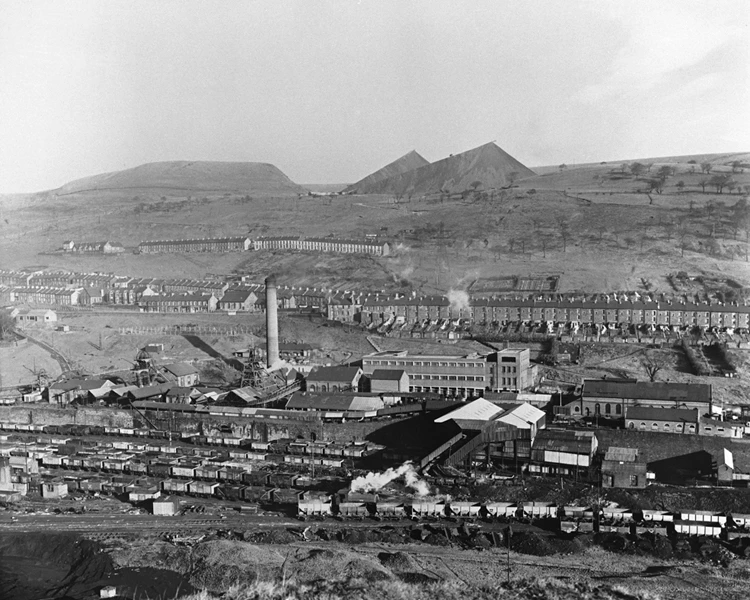
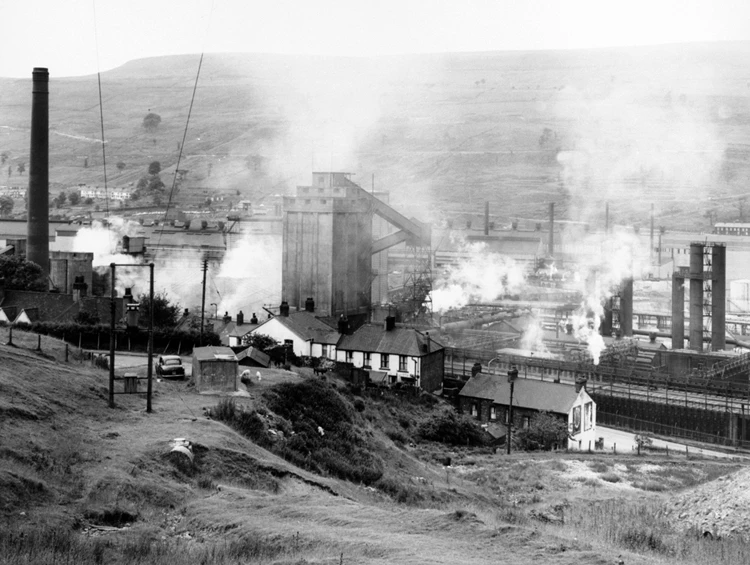
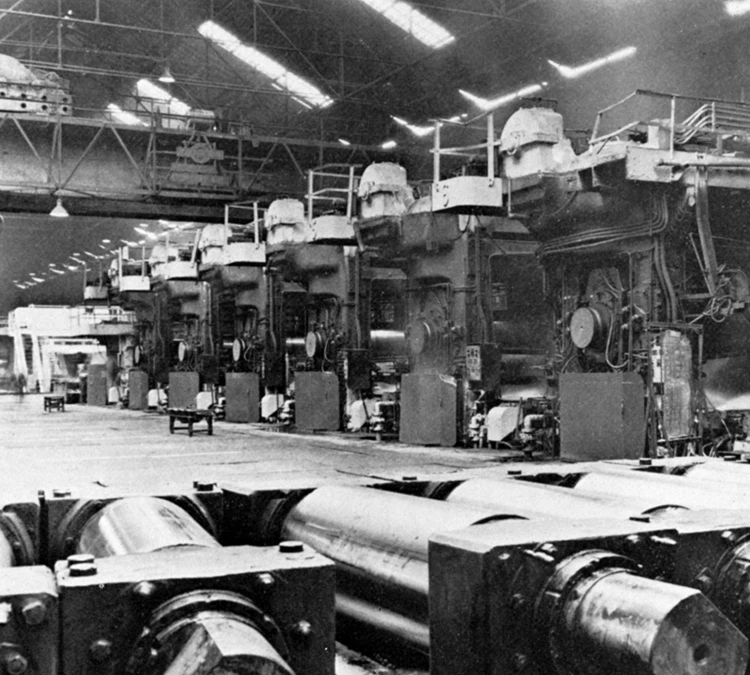
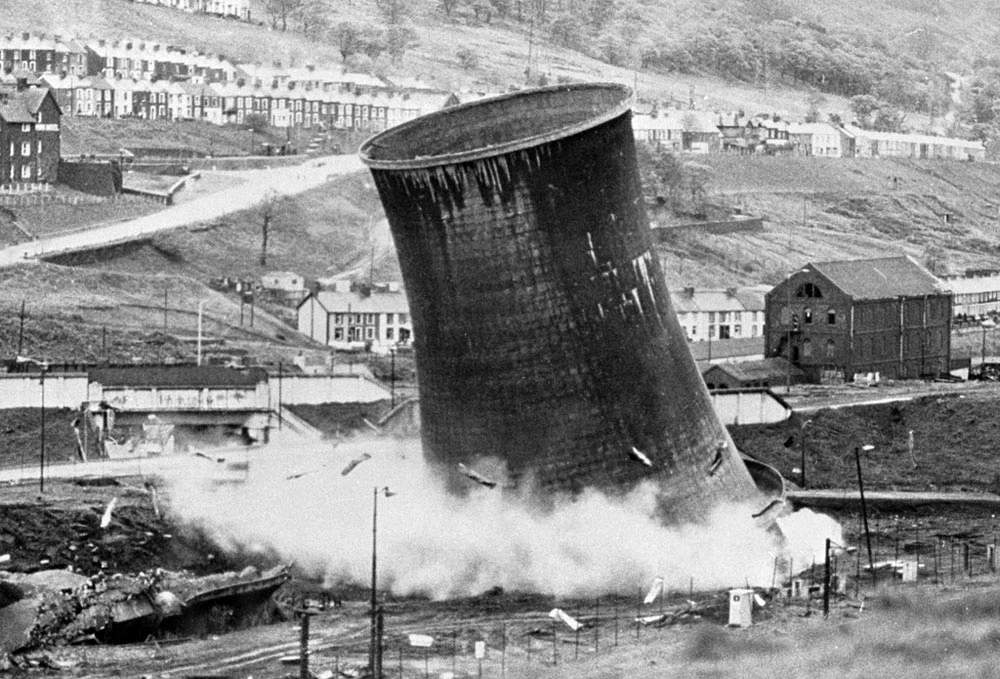
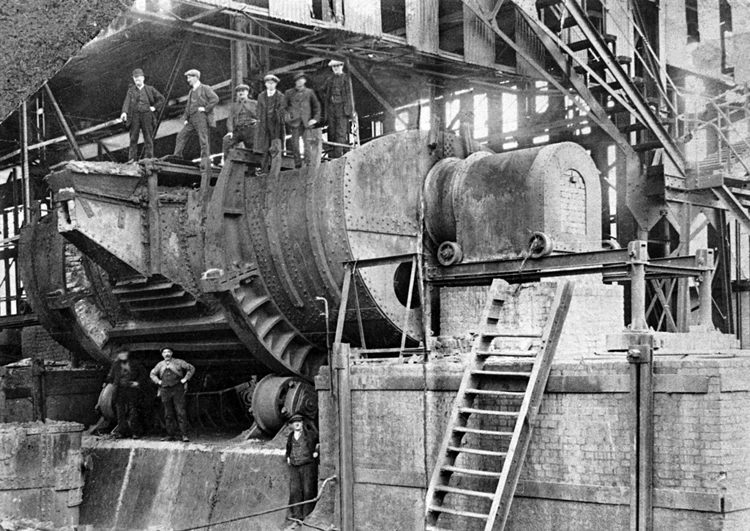
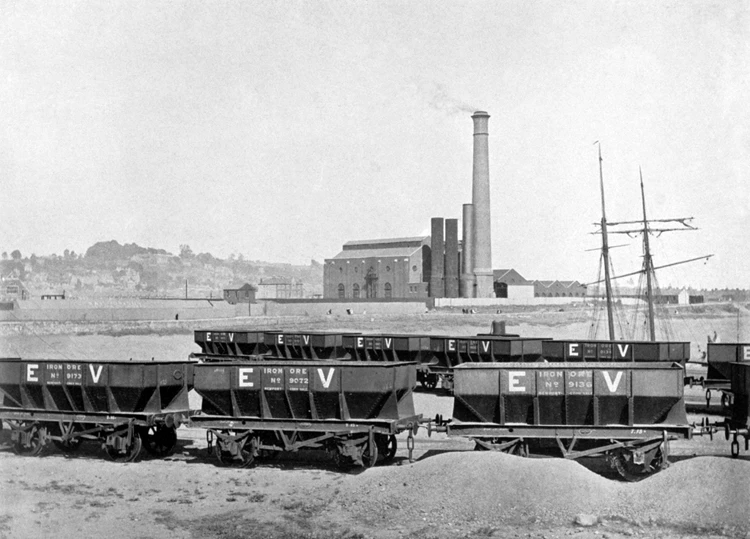
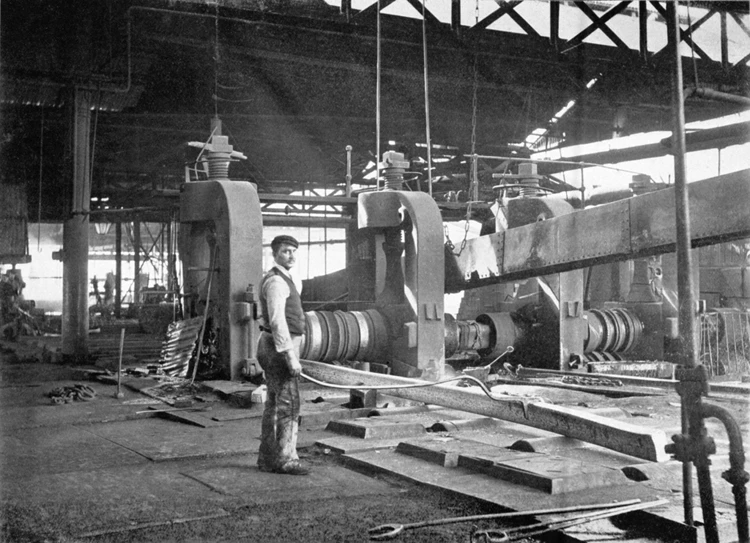
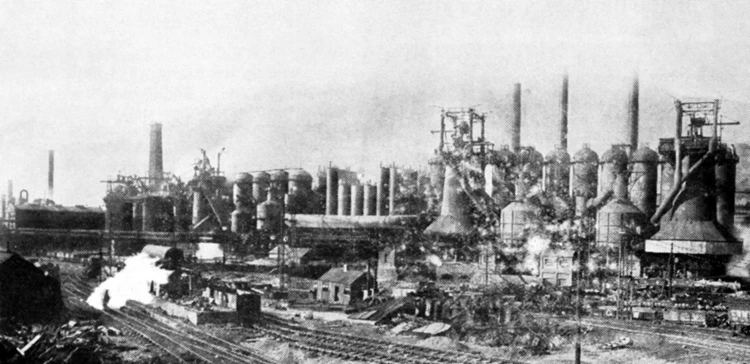
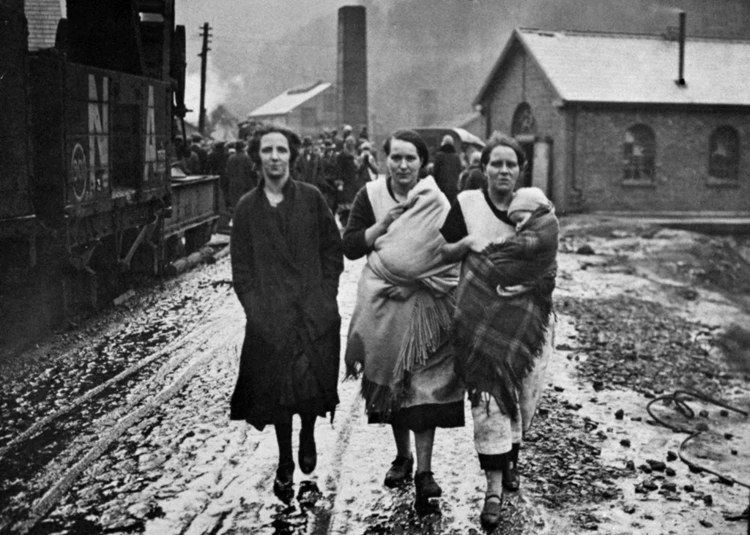
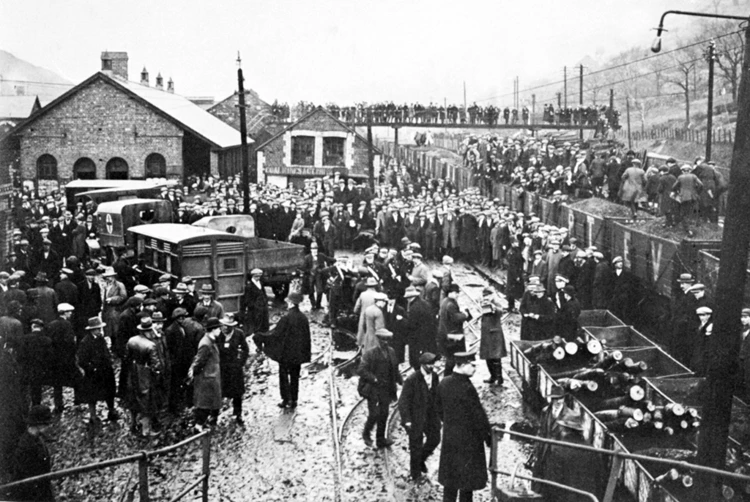
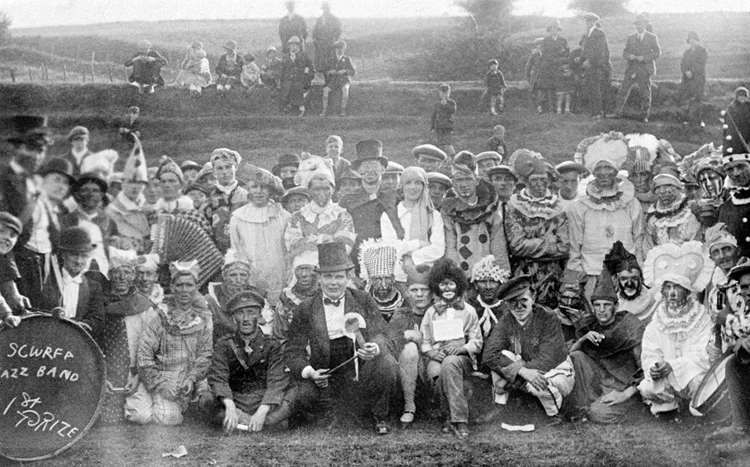
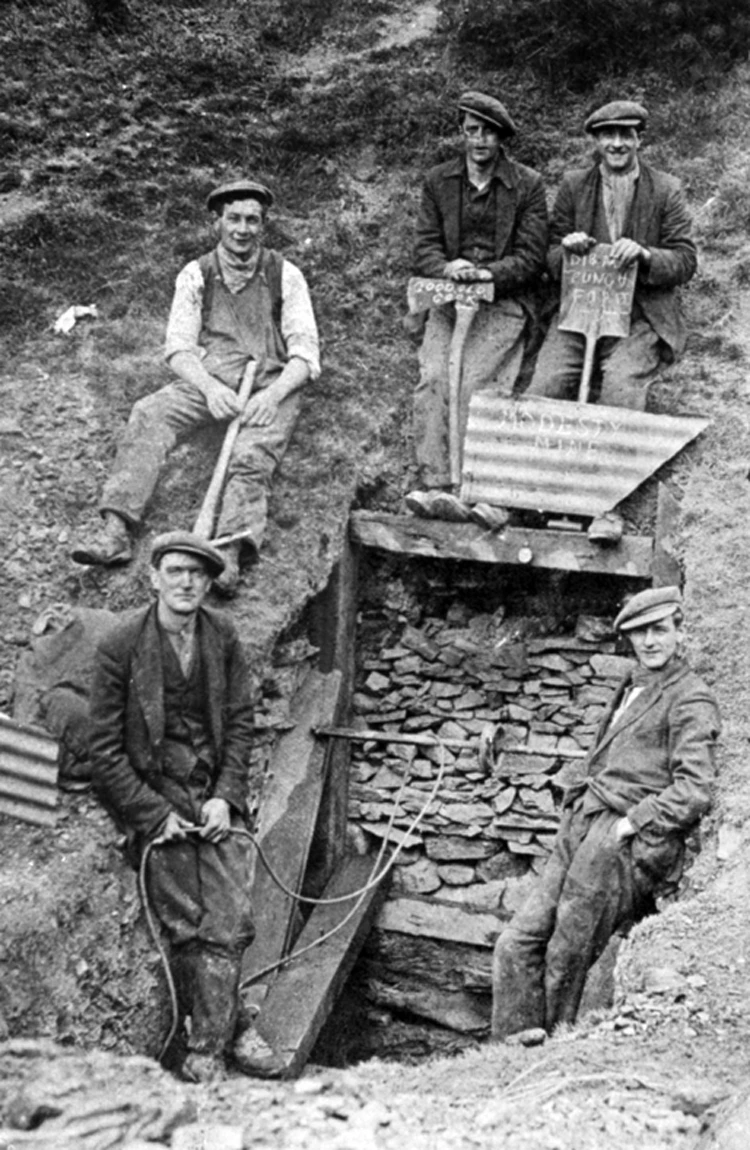
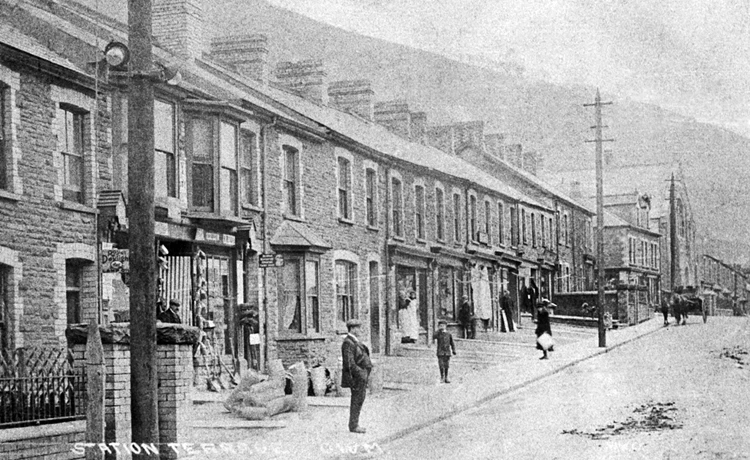
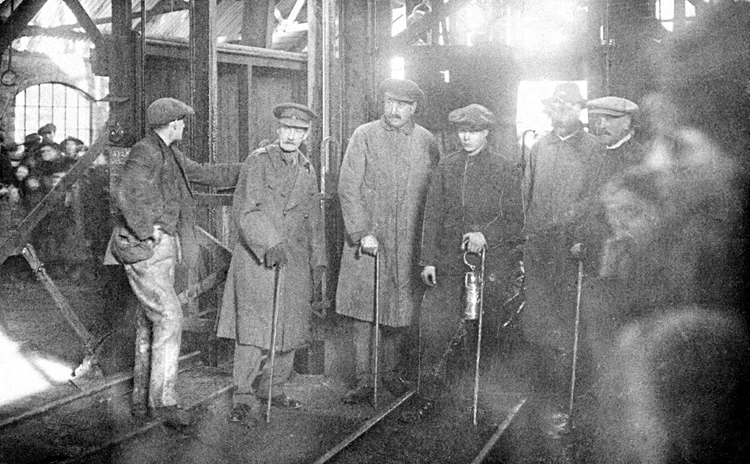
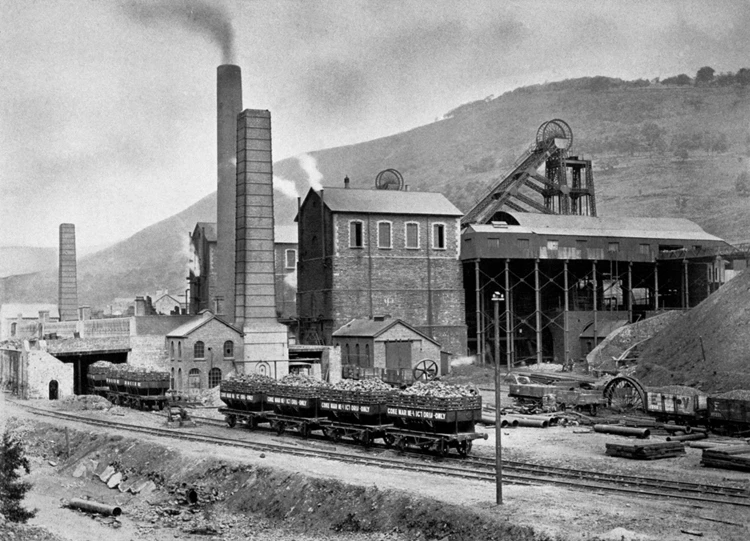
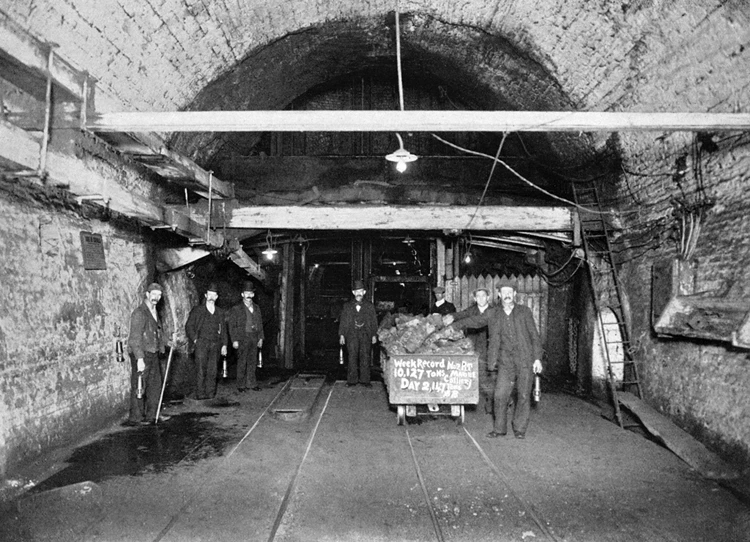
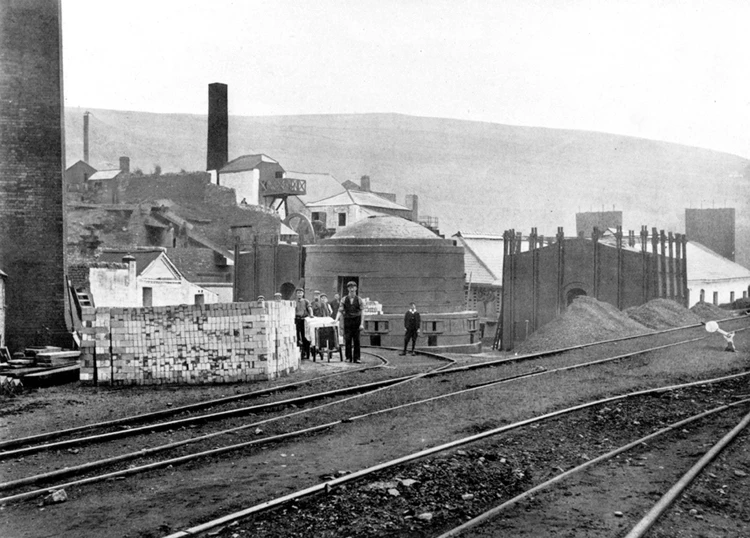
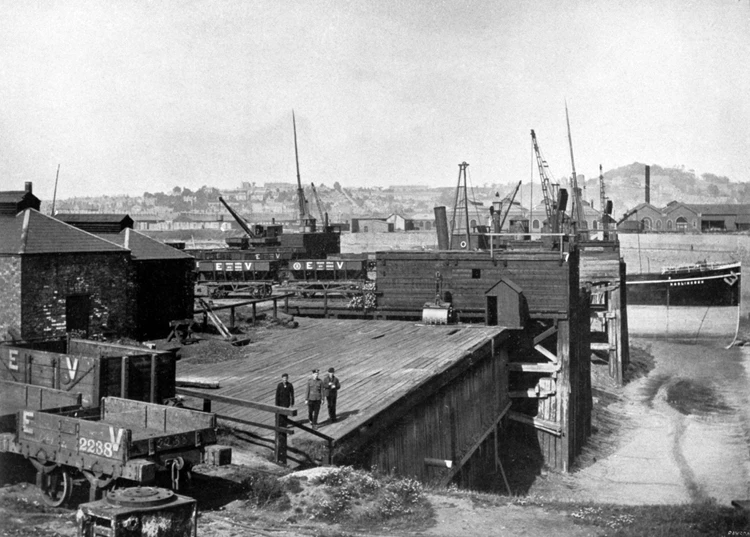
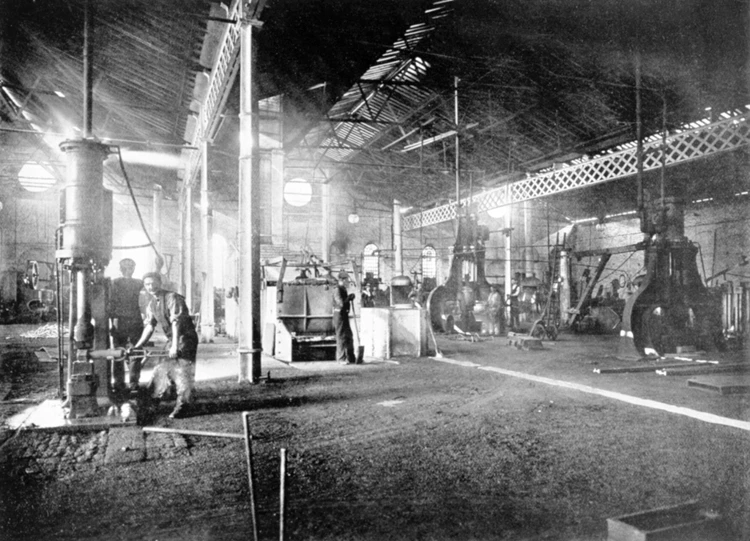
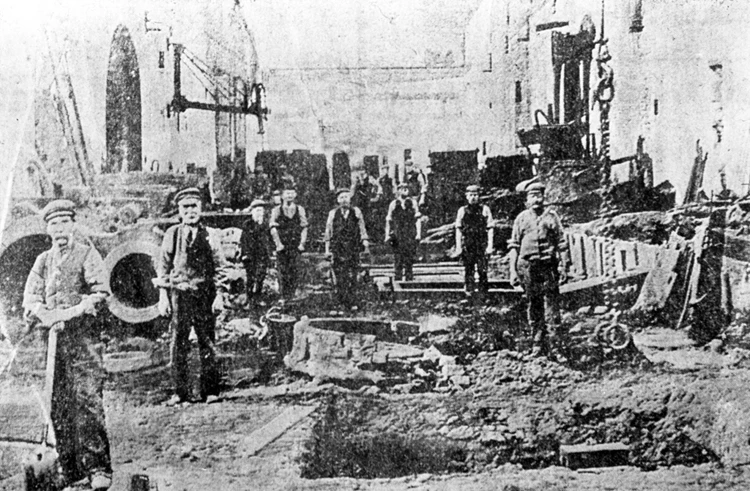
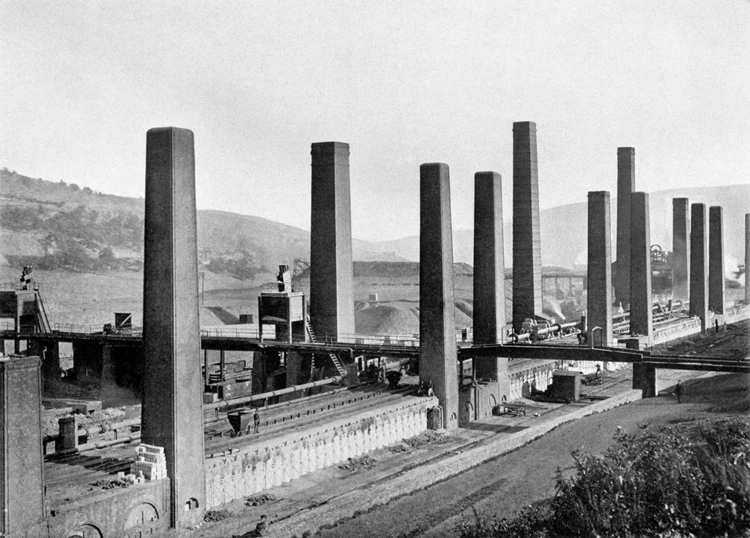
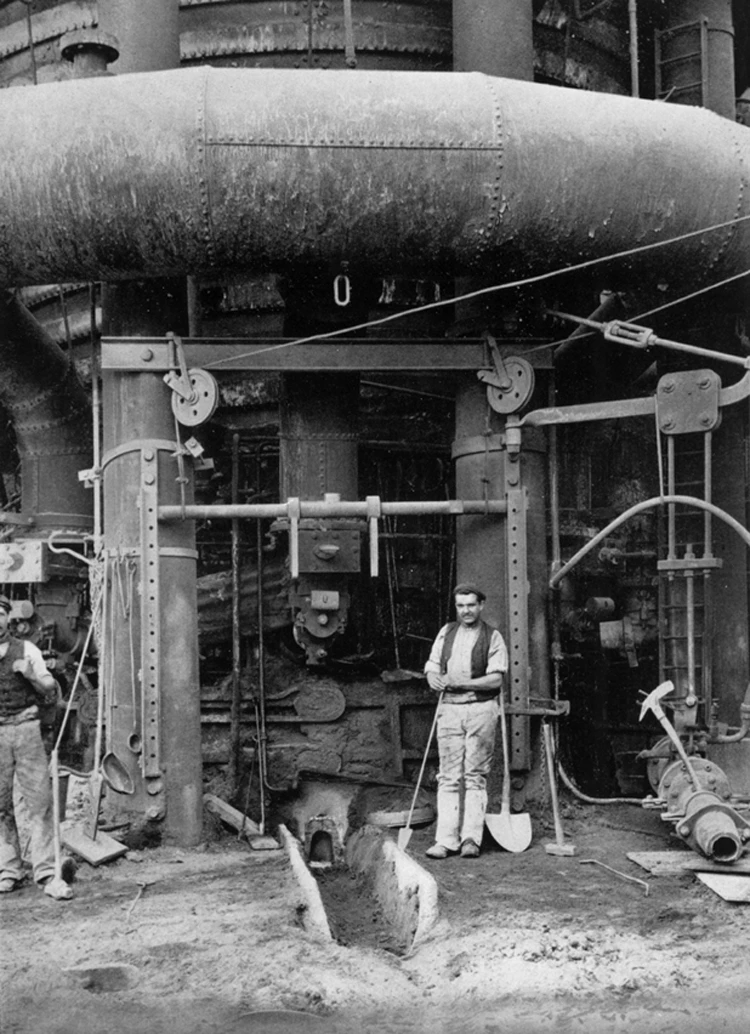
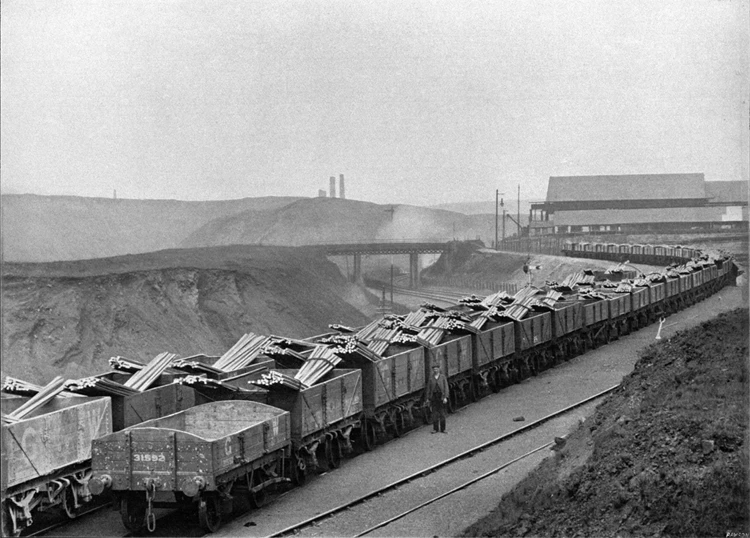
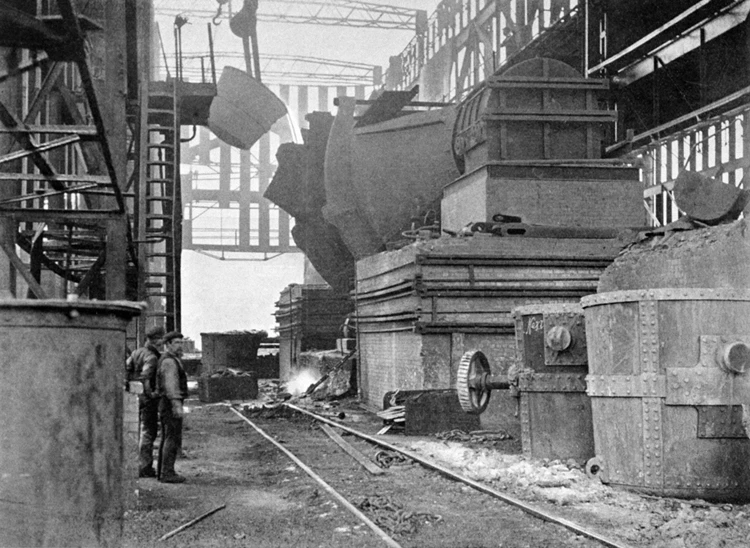
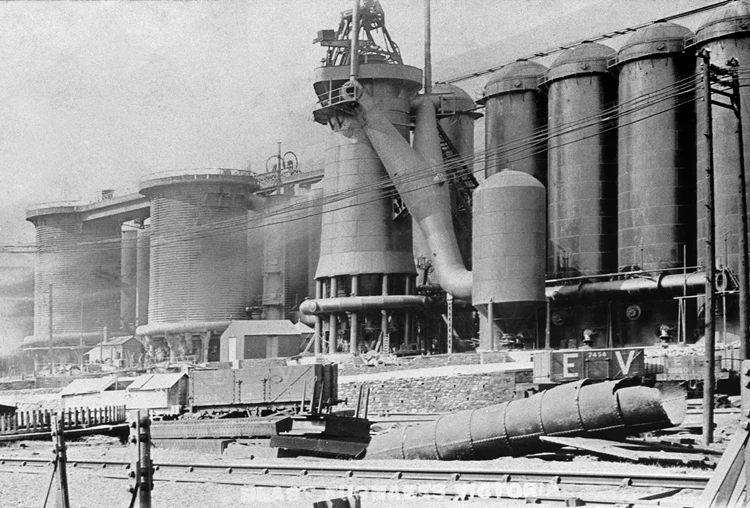
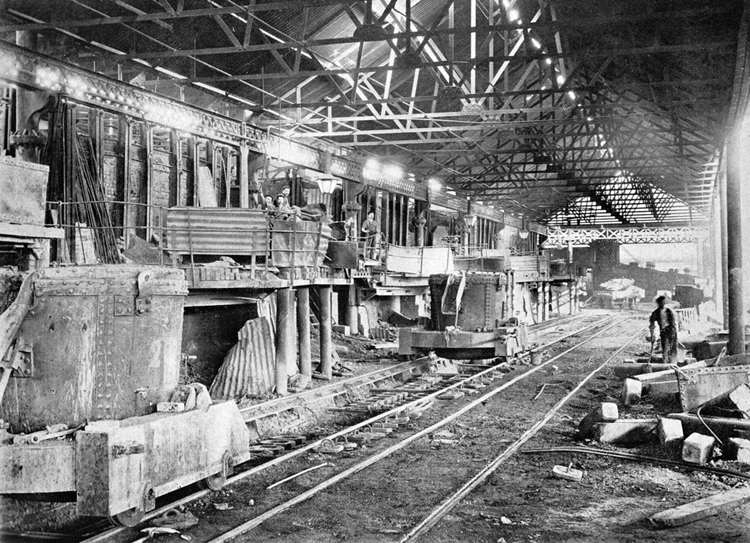
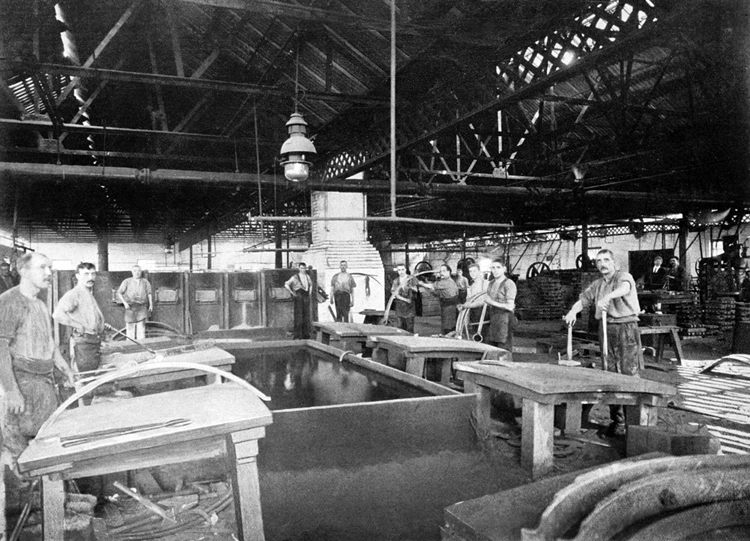
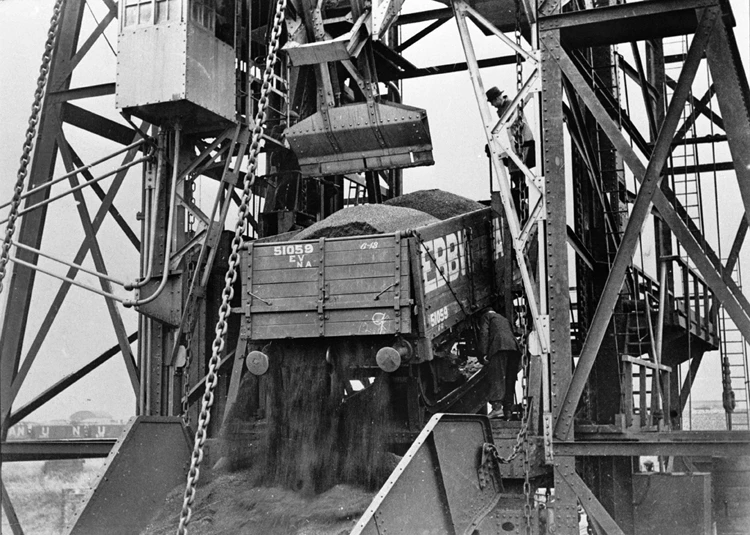
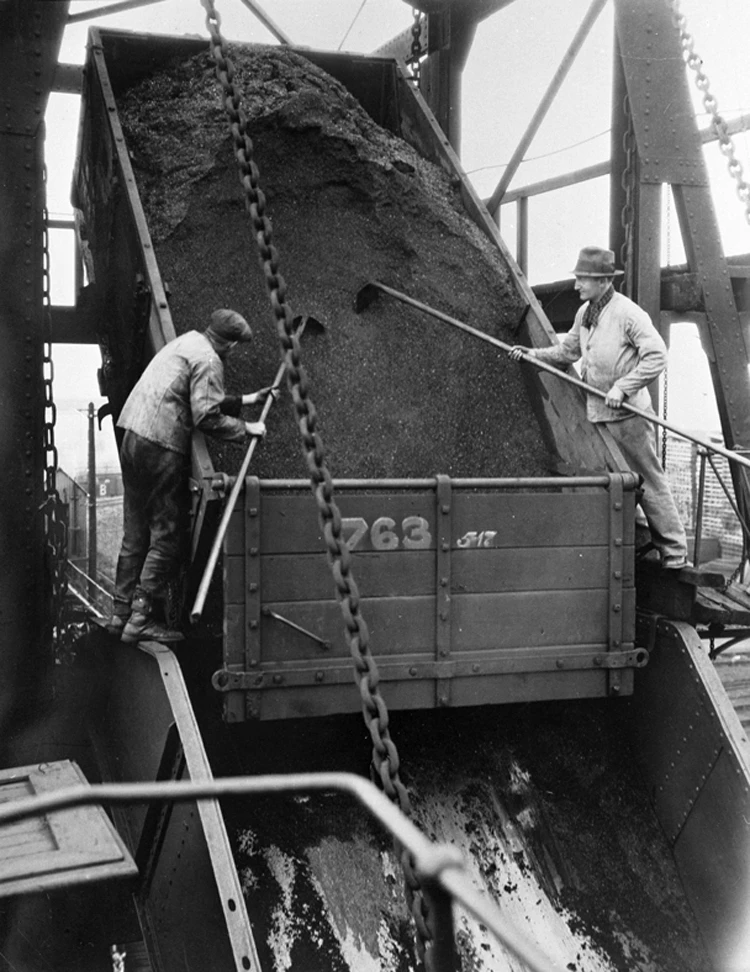
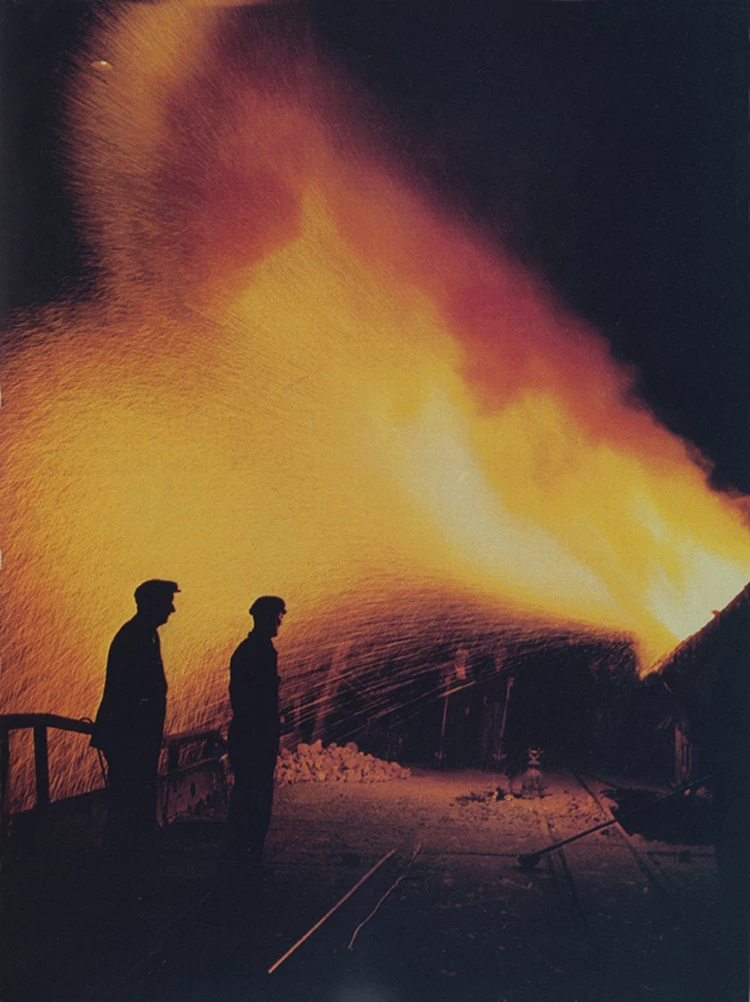
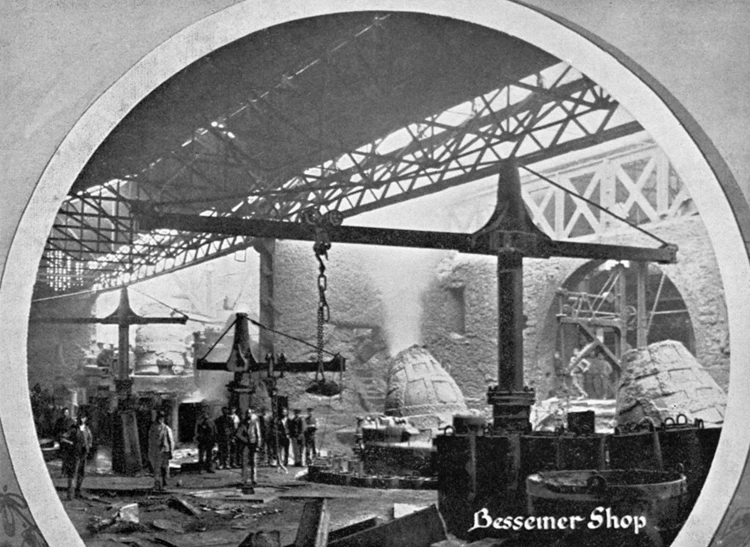
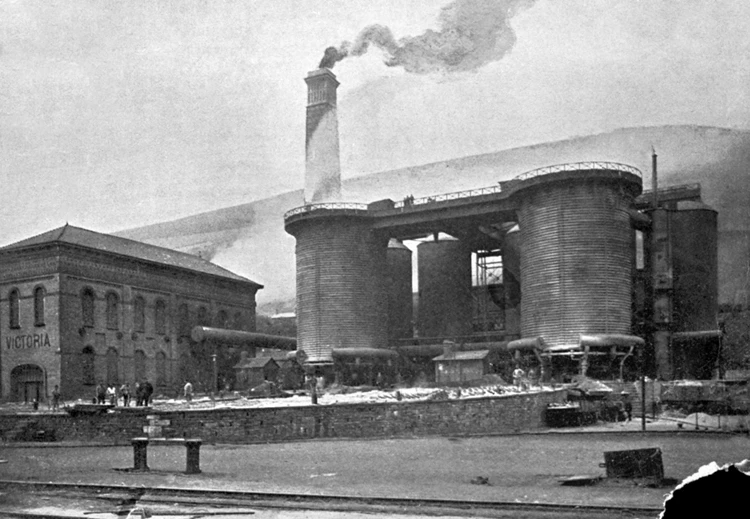
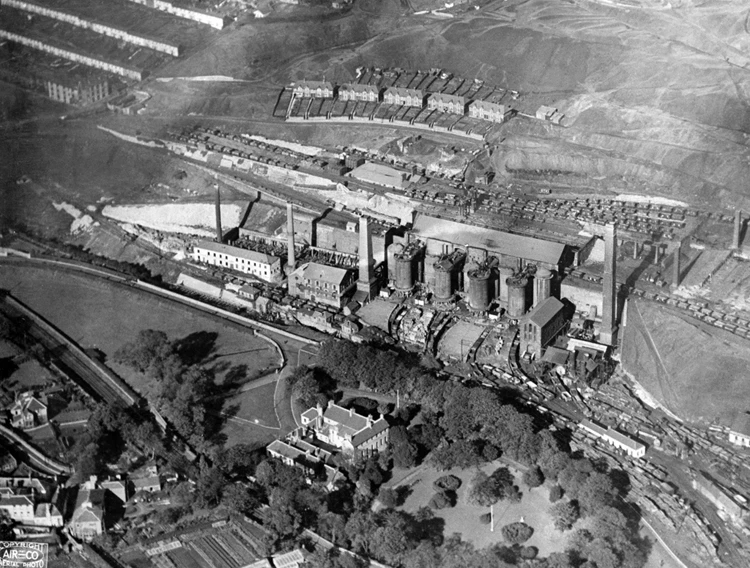
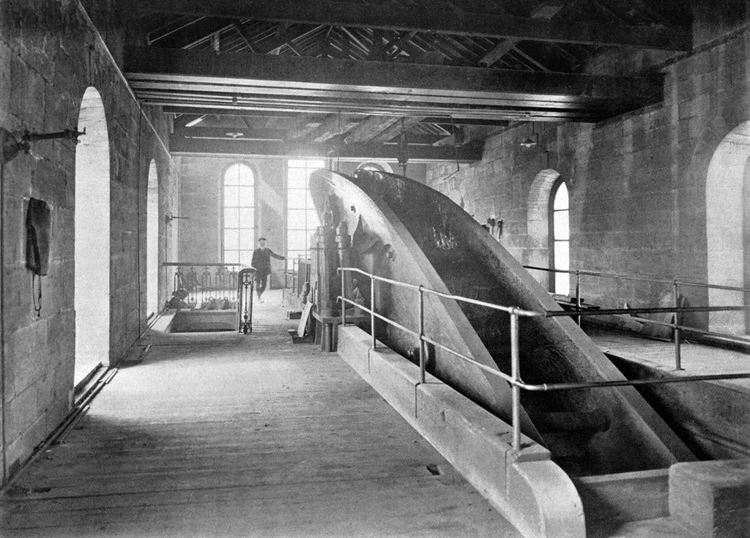
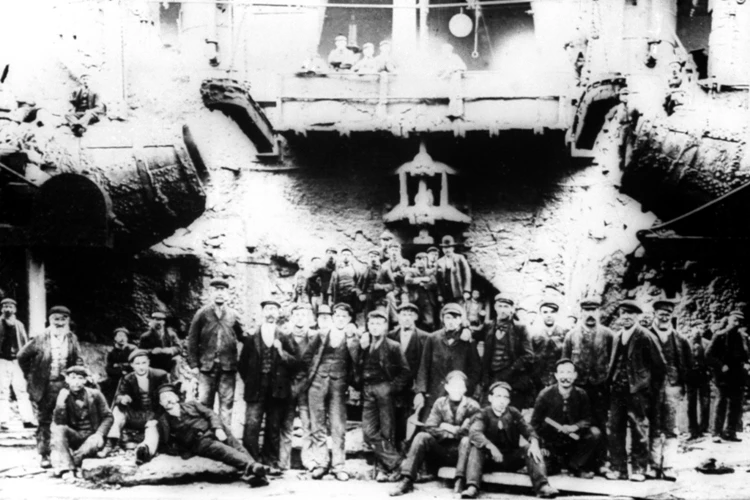
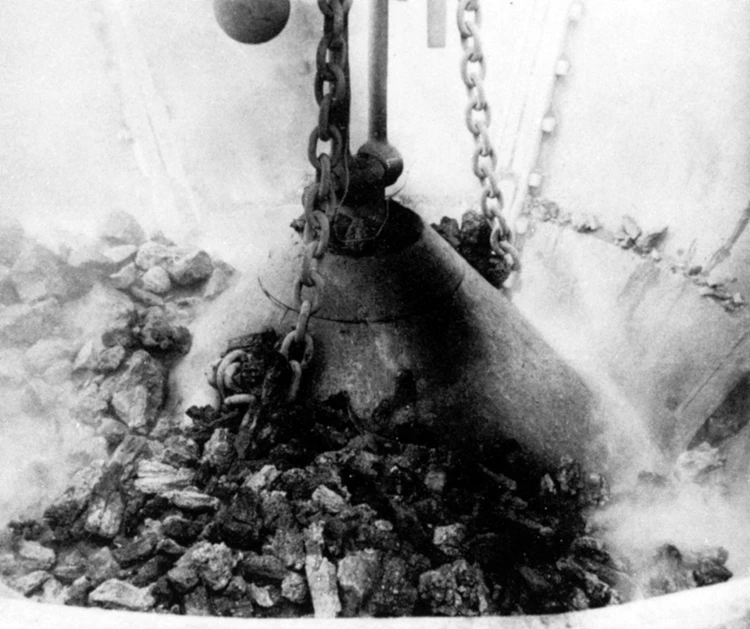
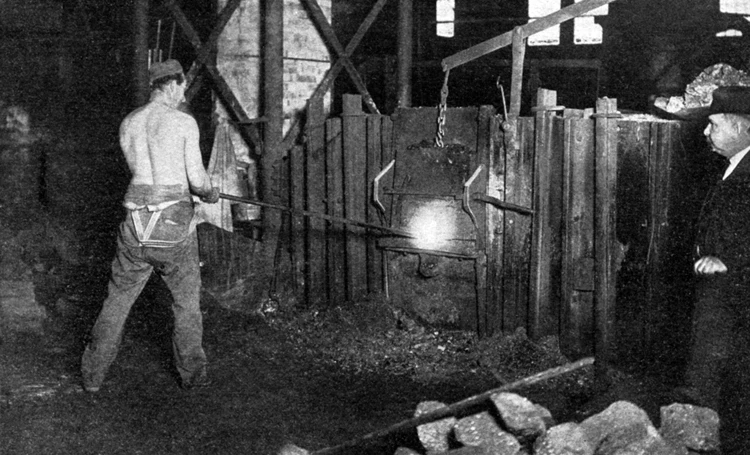
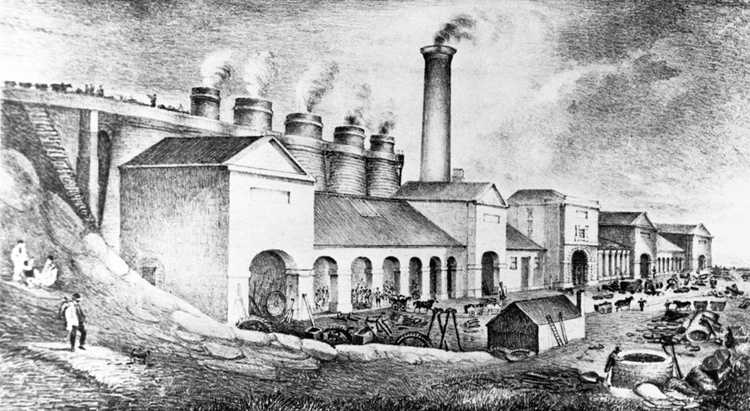
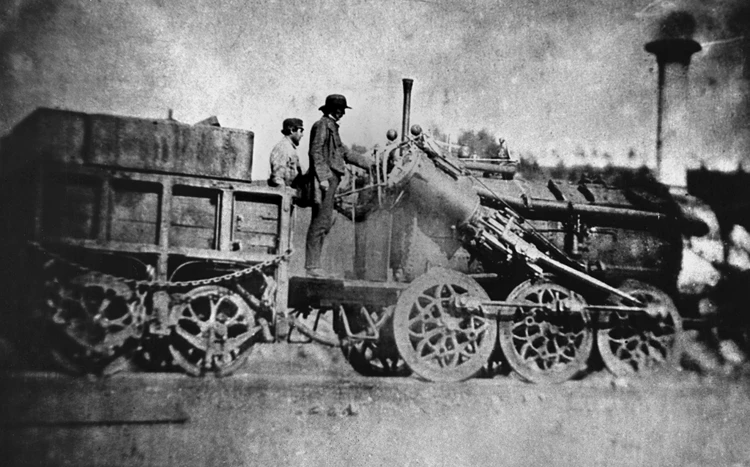
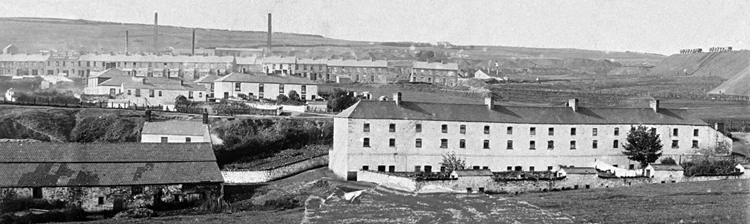
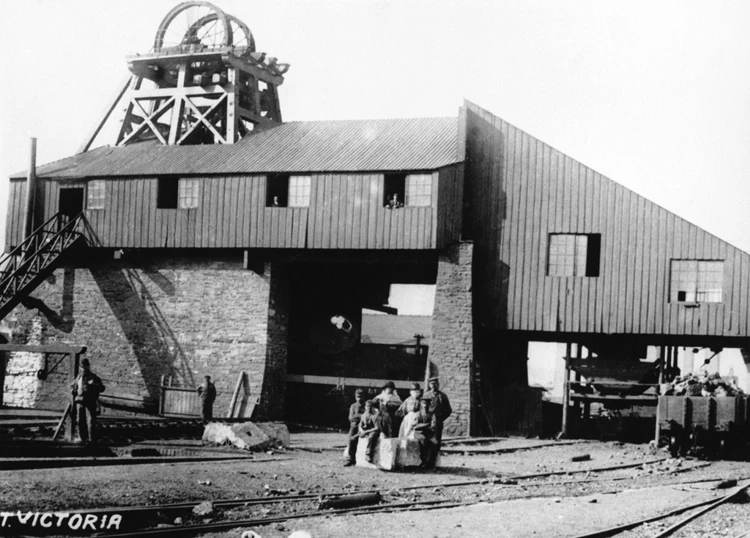
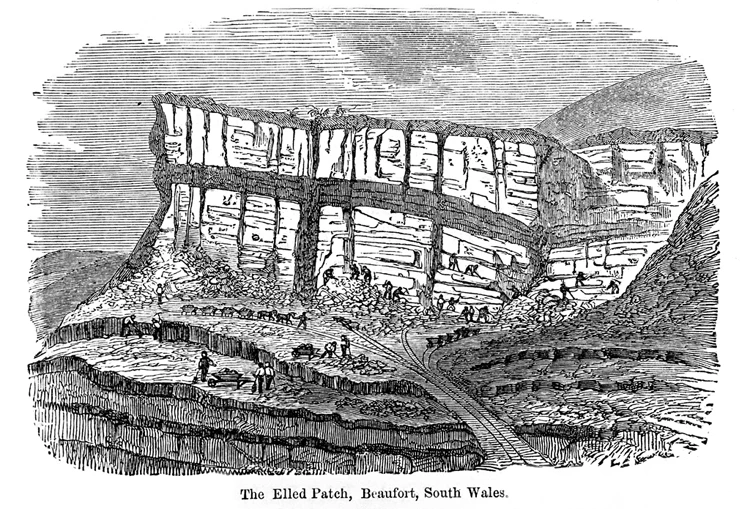
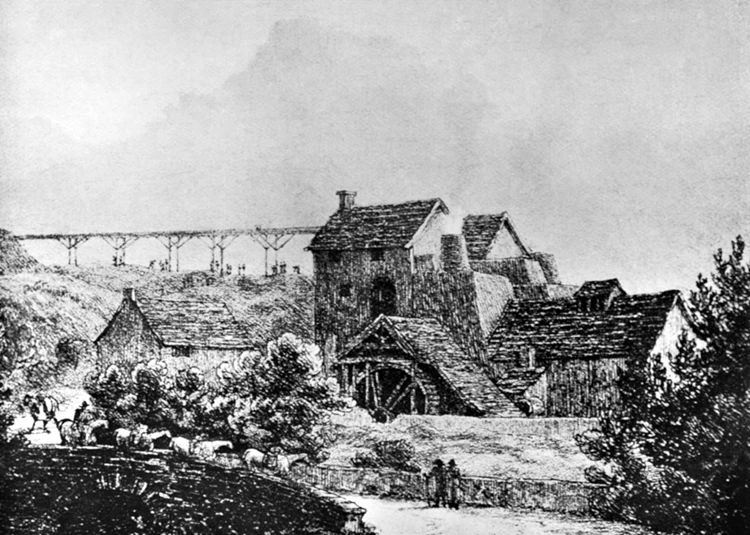
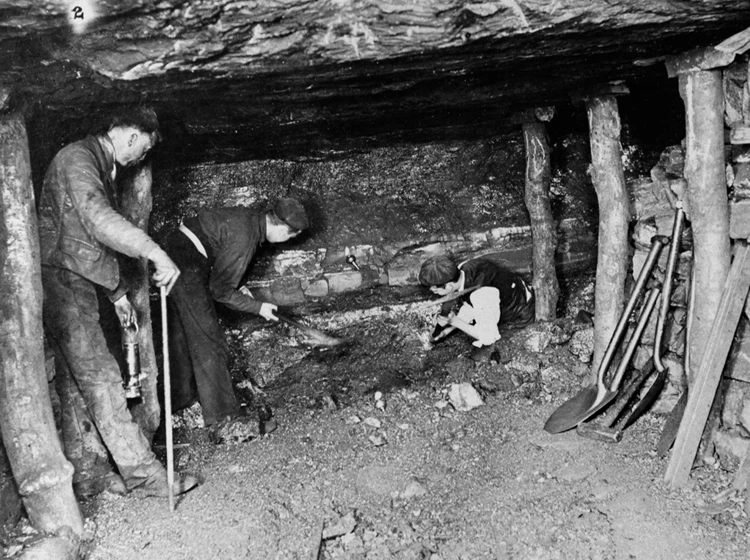
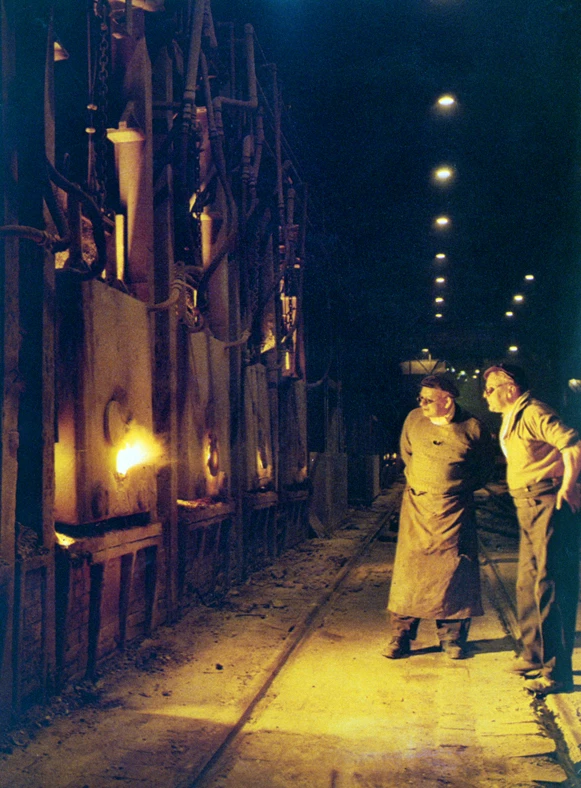
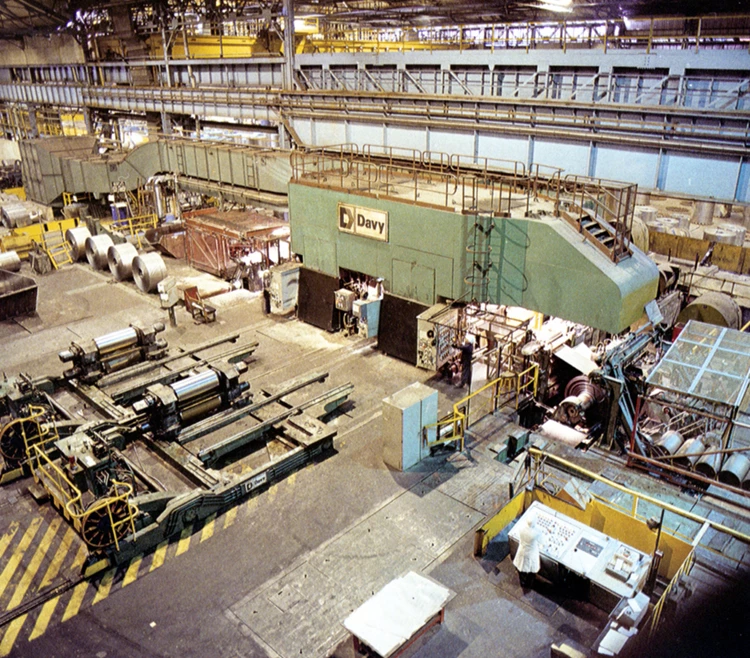
The Ebbw Vale Steel, Iron & Coal Company 20 July 2010 The Ebbw Vale Steel, Iron & Coal Company was based in south Wales. Founded in 1790, it was the largest tinplate producer in the country, until its closure in 2002. Ebbw Vale Steel, Iron & Coal Co. The Double Reduction Mill installed in 1978 produced very thin strip steel for making drinks cans Demolition of the blast furnaces, August 1978. The no 2 electrolytic tinplating line was the fastest in the world when installed in 1961. An air view of the works in August 1957 Fettling an open hearth steel furnace at Ebbw Vale in about 1962. Abercarn Colliery site in the 1970's Underground timbering competition at Cwm Betterment Society Carnival 1956 Coal mining and its landscape, Waunlwyd, 1950s The new works started production in 1938 and prosperity returned to the town of Ebbw Vale. The new stripmill produced high quality strip steel at 20 miles per hour & far faster than the hand rolling mills it replaced. On 30 October 1929 the works were closed. In 1936 they were demolished. In 1929 a new 1,500 ton hot metal receiver, then the largest in the world, was installed. The works were due to close before it could be used. Ebbw Vale's inland location necessitated a huge fleet of railway trucks to haul iron ore from the Newport wharves to the furnaces The Roughing Mill at the Steel Works. The depressed state of the steel trade between the wars has been described as "like entering a tunnel and not emerging until 1938". The new Nos. 4 and 5 blast furnaces at Victoria produced 2,750 tons a week each. On St David's day 1927, 52 miners at Marine Colliery were killed in an explosion. The cause of the disaster was never ascertained. On St David's day 1927, 52 miners at Marine Colliery were killed in an explosion. The cause of the disaster was never ascertained. During the industrial disputes of the 1920s and the depression of the 1930s jazz bands provided fun and just as important, kept up spirits. Digging for coal at Llangynidr Road during the 1926 miner's lockout. As Marine Colliery expanded so did the village of Cwm where the bulk of the miners and families lived. Station Terrace, Cwm's first major shopping centre, in 1913. The Prince of Wales during his visit to Victoria No 5 pit in 1918. The colliery had recently been deepened and modernised. After he had been underground he agreed to the colliery being renamed 'Prince of Wales'. Marine Colliery, 1907: Coke for the furnaces, but the bulk of its coal was exported overseas. Pride and achievement: Pit Bottom. Marine Colliery, Cwm, c.1907. In 1907 the company built a third brickworks and production reached 14 million a year. The company owned four wharves at Newport to import iron ore and pit props and to export iron and steel By 1907 the company employed 350 maintenance and engineering staff: The Smith Shop in the Engineering Department. Victoria Foundry, rebuilt in 1902, produced 18,000 tons of castings a year, used both within the works and sold to other firms. In 1907 the company owned 524 coke ovens and was producing 200,000 tons of coke a year. The tapping hole of the "Yankee" furnace at Victoria, it could produce 2,300 tons of iron a week. Ten hours output of steel billets from the Bessemer Steel Works. The 750-ton hot metal receiver in the Bessemer Steel Works was the largest in the World when installed in 1905-06. A new American design blast furnace was built at Victoria in 1903. Two open-hearth steel furnaces were built in 1898, followed by a further three in 1905-06. In 1897 a spring making shop was built to make railway carriage springs. The export market was the mainstay of the company. Cardiff Docks, early twentieth century The export market was the mainstay of the company. Cardiff Docks, early twentieth century The new pits sunk from the 1870s onwards were much deeper than the older collieries so that they could reach new reserves and the steam coal seams. The shaft of Victoria No. 5 (Prince of Wales) Colliery. Waunlwyd Colliery. At the turn of the century two trainloads of coal from this colliery went to Crewe everyday to power the locomotives of the L.M.S. The rolling mills about 1900. A Bessemer converter "on the blow" is a dramatic sight. The process had not changed at Ebbw Vale in the 1950s when this photograph was taken. One of the works' main products was rails; steel replaced wrought iron in the 1870s and in 1881 wrought iron puddling ceased at Ebbw Vale. The Bessemer steel converters kept the works going through the 1880s. The last act of expansion was the rebuilding of the two Victoria Furnaces in 1882. The four furnaces of Ebbw Vale were rebuilt in 1871-72, increasing production to 800 tons per week per furnace In 1866 the "Darby" blast furnace blowing engine was installed, the largest in the world. Sir Henry Bessemer paid the Ebbw Vale Company £30,000 for their patents on steel making (George Parry received £10,000) and in 1866-68 the company erected six Bessemer Converters to make steel, one of the first two installations in Britain. One of George Parry, the works chemist, inventions was the "cap and cone" to close the top of the blast furnace to retain heat. It was briefly lowered during charging. Much of the company's pig iron production was converted to wrought iron in 100 puddling furnaces. Abersychan Ironworks shown here in 1866 was bought by the Ebbw Vale Company in 1852. The company's other works probably resembled it, although their buildings were not as ornate. Ebbw Vale experimented with locomotives from 1829 and was one of the first South Wales ironworks to do so. This is the Tredegar Iron Company's locomotive 'St David' in 1854. The Ebbw Vale Company built many rows of homes for its workers, Gantra Row, intended for colliers, accommodated one family in the upper two floors of each house and another in the basement. No. 6 pit, Victoria, sank in 1838 provided coke for the Victoria Ironworks. Women were prohibited from working underground in 1842 but a small number continued to work on the surface until the early twentieth century. The earliest coal and ironstone mines were "patches" or small opencast pits. The early iron industry of South Wales was small scale and rural; blast furnaces at Clydach Ironworks, 1813. Holing in the Gwern Y Cae Seam, Sirhowy No. 7 Pit, 1898. Ebbw Vale Open Hearth Furnaces, 1960s.
The Miners' Strike - 1984-85 23 September 2009 The coal industry underwent great changes following nationalisation in 1947. Considerable investment was ploughed into the industry by the government allowing new equipment and mining techniques to be introduced. Until the mid 1950s, levels of employment and production remained steady but, with the decline in the demand for coal and the challenge from Middle East oil, 50 collieries were closed in south Wales between 1957 and 1964.During the 1970s, the industry was hit by two major strikes. In 1972 Conservative Prime Minister Edward Heath caved in when the miners went on strike for more pay. When another miners' strike began in 1974, Mr Heath called a snap general election hoping to rally public support against the miners. But the public vote went against him resulting in victory for the Labour Party.By the 1980s the British coal industry was one of the safest and most efficient in the world. However, the new Conservative government under Margaret Thatcher wanted to make industry more efficient by slimming down what they regarded as unprofitable industries. Under her leadership, many former state run industries like gas, water and the railways were transferred to private sector ownership i.e. they were privatised. British Telecom was the first service provider to be 'de-nationalised' in 1984, followed by many others in subsequent years. At the same time she wanted to weaken the power of the trade union movement which she believed had become too powerful. This agenda put the Conservative government on a collision course with the National Union of Mineworkers (NUM). Incidentally, the NCB became British Coal in 1987, in readiness for privatisation which occurred in 1994. The Miners' Strike - 1984-1985 Glamorgan Colliery, Llwynypia Bargoed Colliery and surrounding area Strike poster Western Mail article, 14 February 1985 The march back to work, Maerdy, Rhondda South Wales NUM strike poster Rhymney Valley Miners' Support Group newsletter Police and Pickets, Bedwas Colliery Police and Pickets, Bedwas Colliery Strike poster Strike badge Poster produced during the strike Front Page, Labour Weekly 1984 Penallta's oldest picket Arthur Scargill visits Banwen Picket line, Trawsfynydd power station Demonstration in support of the miners, Blaenau Ffestiniog Collecting for the miners, Tonypandy Police and pickets at Nantgarw Colliery Police and pickets at Nantgarw Colliery Christmas party for Miners' children, Banwen, Neath Valley Welsh police on picket duty, English coalfield Strike graffiti, Abercarn Graffiti on an explosives magazine Picket duty at Aberthaw power station Rhymney Valley Women's Support Group Picket line, Penallta Colliery Advertisement produced by the south Wales NUM Wales Congress poster supporting miners Arthur Scargill, Maesteg Lady Windsor Colliery North Celynen Colliery Six Bells Colliery Cwm Colliery, Rhondda Rose Heyworth Colliery, Abertillery Download the PDF here [3.3MB]
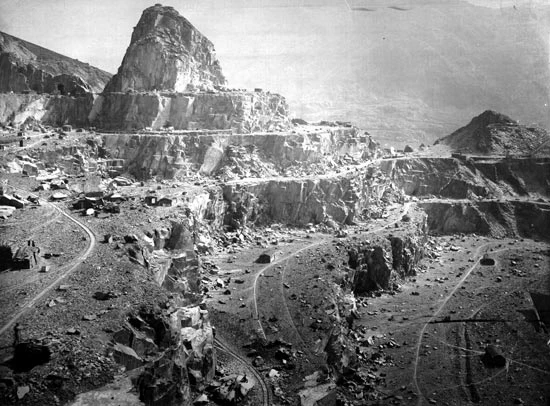
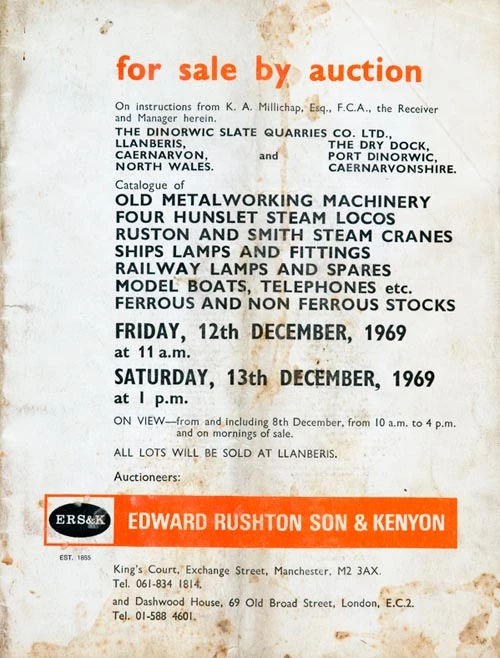
Dinorwig '69: End of the line for one of the largest slate quarries in the world 22 August 2009 End of the line Dinorwig Quarry. With the dawn of the Industrial Revolution slate was used to cover the roofs of factories and houses throughout Britain, mainland Europe as well as towns in North America and other parts of the world. On 22nd August 1969 silence came to Dinorwig Quarry. After almost 200 years of hard toil, the quarry was closed and the men were sent home for the last time. Not only did 350 men lose their jobs but a quarrying community and a way of life that had existed since the 1780's changed forever. Everyone in the area had lived in the shadow of Dinorwig Quarry all their lives. Everyone had a father, grandfather, husband, uncle or brother who had worked there. A century earlier, closure would have been unimaginable. Dinorwig was one of the two largest slate quarries in the world ‐ and, along with its neighbour at Penrhyn, Bethesda, could produce more roofing slates in a year than all other combined slate mines and quarries world-wide. Old quarrying methods This is a clip from the first audio film in Welsh, Y Chwarelwr (The Quarryman), made in 1935. There is no sound in this piece as only some of the film survived, and the sound was recorded on disks separate from the film itself. © Urdd Gobaith Cymru. Why did the quarry close? Quarrymen at Dinorwig Quarry. Dinorwig Quarry's demise didn't happen overnight. Things hadn't been going well for a number of years for various reasons: there was less demand for slate in the UK during the 20th century; Welsh slate was expensive compared to roofing tiles and slate from overseas; the quarry owners were competing against one another for a share of a fairly small market; Dinorwig Quarry hadn't been developed effectively. The slate that was easy to get at had been quarried by the 60s and investment was needed to develop further. The quarry owners didn't have the money for this investment. One of their mistakes was to invest heavily in Marchlyn Quarry, but this part of the mountain didn't make them any money. There was no slate worth working there at all; by the late 1960s, the quarry depended on orders from France to survive. In July 1969, these orders stopped. The final nail in the coffin. By the 1960s, the slate industry in general was facing an uncertain future. What next? Dinorwig Quarry auction catalogue. December 1969 Many of the 350 who lost their work found other jobs, some locally, at Ferodo and Peblig Mills, others further afield at Dolgarrog, Trawsfynydd and Holyhead. Others went even further to find work — to Corby, the relatively new steel town in Northamptonshire. October and December, 1969 saw the auctions — selling off anything and everything that was worth carrying from the workshops. Fortunately for us, here at the Museum, Hugh Richard Jones, Dinorwig Quarry's Chief Engineer, ensured that not everything was sold. With the help of like-minded visionaries, he was instrumental in ensuring that the water wheel wasn't broken up and taken away and in preserving the machinery in the workshops. Three years following the closure of Dinorwig Quarry, in 1972, the National Slate Museum was opened at Gilfach Ddu, and Hugh Richard Jones became its first manager.
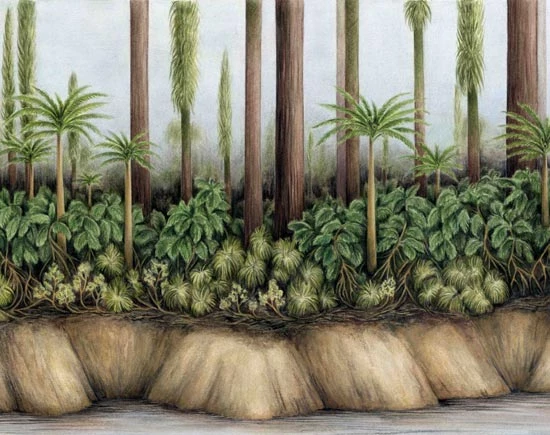
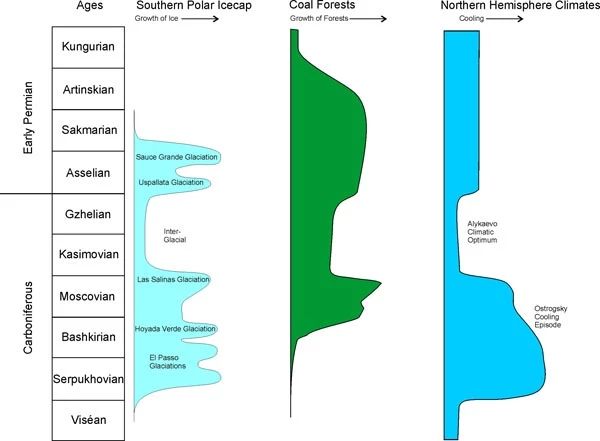
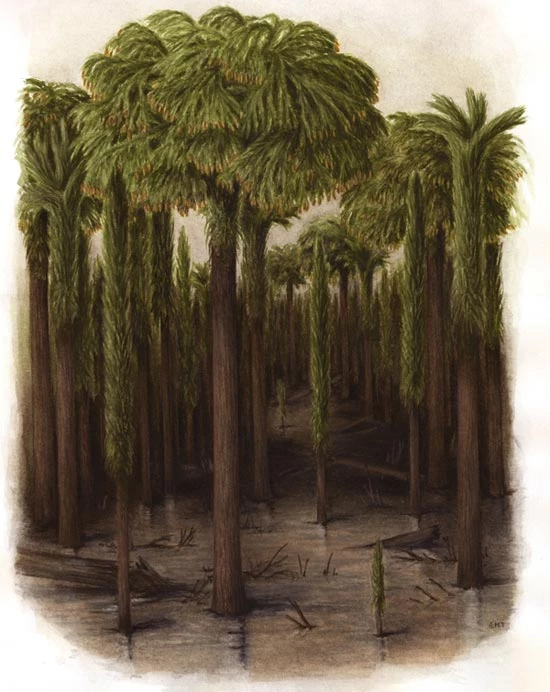
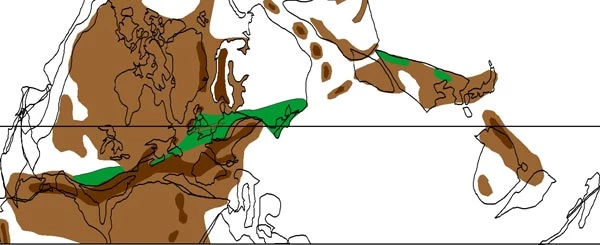
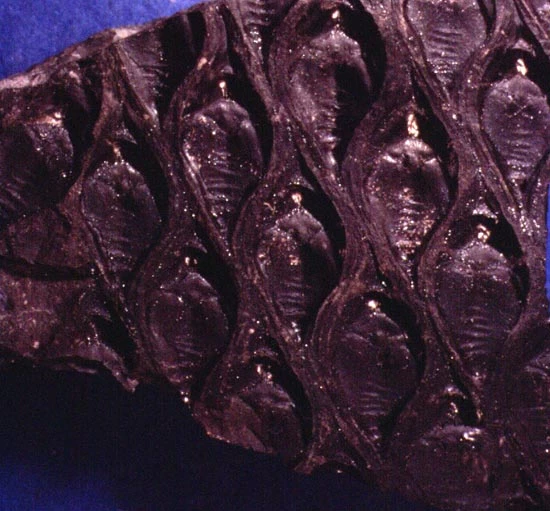
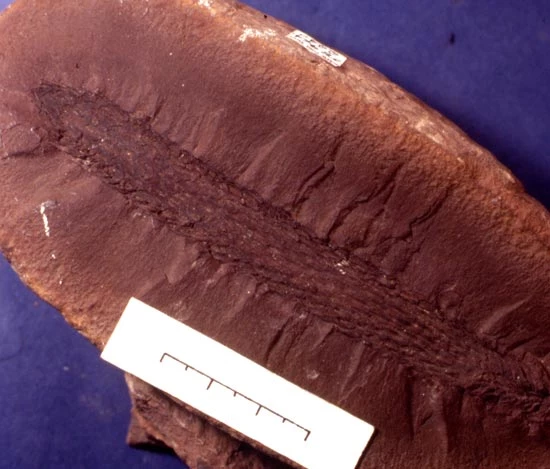
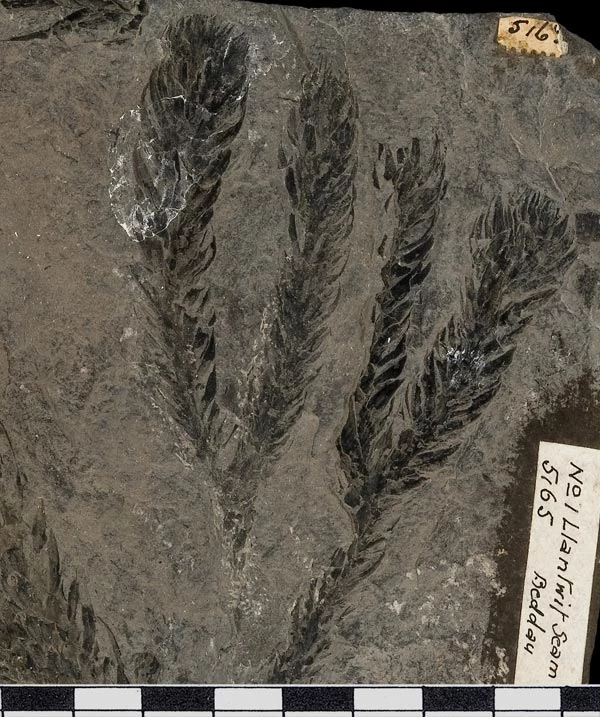
How coal cooled the climate 300 million years ago Christopher Cleal, 1 June 2009 Reconstruction of the levee of a river that flowed through the tropical wetlands 300 million years ago. The plants growing on these levees are often found as fossils in the rocks associated with coals in Wales. Painting: Annette Townsend. A comparison of how the area of coverage of the Coal Forests varied with time with evidence of changing climate in late Carboniferous and early Permian times. Reconstruction of giant lycophytes growing in tropical wetlands of Wales, about 300 million years ago. Note that there are plants in different stages of their life-cycle. Painting by Annette Townsend. A map of the tropical lands about 300 million years ago, showing mountains (dark brown), lowlands (light brown) and wetlands where peat was being deposited (green). Bark from the trunk of a Late Carboniferous giant lycophyte, found at the Risca Colliery in south Wales. The diamond-shaped structures on the surface, which are about 1cm long and 0.5cm wide, are where the leaves were originally attached. A cone from a Late Carboniferous giant lycophyte, found in an ironstone nodule in south Wales. These cones produced spores. The scale is marked in centimetres. The leafy shoot of a giant lycophyte from the Upper Carboniferous Llantwit Beds of Beddau, south Wales. South Wales has the best-exposed coal-bearing rocks in Europe. Scientists at Amgueddfa Cymru are leading an international team of specialists investigating how the formation of this coal affected the composition of the ancient atmosphere. What is coal? Coal is what is left of peat when it has been compressed and heated, so that virtually all that remains is carbon. The coalfields in Wales are the remains of part of a wetland forest that extended over large areas of the tropics, about 300 million years ago (the Late Carboniferous Period). These are known as the Coal Forests. There is also evidence of extensive ice cover over much of the land around the southern pole at this time. This is in fact the only other time in the geological past, other than the last 2 million years or so, when there has been this combination of extensive tropical forests and polar ice. Looking at the Late Carboniferous world therefore provides valuable insights into how plants, climate and atmosphere might be interacting in our present-day world. Plants of the Coal Forests The Coal Forests were quite different from anything growing today. The main plants were tree-like lycophytes ('club mosses') that could grow up to 50m tall. Unlike a modern tree, most of the trunk of these giant lycophytes did not consist of wood, but of soft cork-like tissue (periderm). This allowed the plants to grow to their full size in as little 10 years. Also unlike modern trees, when these lycophytes had reached their full size, they reproduced by producing cones, and then died. Life, death and carbon Because these plants grew so quickly and then died, vast quantities of peat accumulated on the forest floor. This eventually formed the coal found in the coalfields of Wales and other parts of Europe, as well as North America and China. All plants obtain carbon for growth from the atmosphere. These forests are thought to have been responsible for extracting nearly a hundred thousand-million tonnes (100 gigatonnes) of carbon from the atmosphere every year, and would have had a profound influence on the composition of the atmosphere during Carboniferous times. The contraction of coal forests and global warming The Coal Forests habitats remained essentially stable for about 10 million years. Then they contracted in size, probably due to changes in drainage patterns in the wetlands where they grew. This coincided with a marked increase in global temperatures. Most notable was a significant contraction of the ice sheet in the southern polar regions, which has been recognized in the rocks of both Australia and Argentina. It seems that the contraction of the Coal Forests caused the amount of carbon (as CO2) to build up in the atmosphere, and that this caused temperatures to increase through a greenhouse effect. South Wales Coalfield There are Late Carboniferous coalfields across Europe, North America and China. However, the South Wales Coalfield is particularly important as it shows one of the most complete successions of rocks in which the remains of the Coal Forests are preserved. It has also yielded an excellent fossil record of plants, as well as of animals including insects, spiders and freshwater molluscs. It is also one of the few places in Europe where these rocks are exposed at the surface. In most other places, the geology of these coal deposits has to be investigated in underground mines — an increasingly difficult thing to do as mines are progressively closing. The geological record of the South Wales Coalfield has therefore played an important role in developing our understanding of the evolution of the Coal Forests, especially through the work of Welsh geologists such as Emily Dix and David Davies in the 1920s and 1930s. More recently, scientists at Amgueddfa Cymru have been investigating how the south Wales forests changed in composition with time. This has been done by looking at changes in species diversity in the plant fossil record, and at the evidence from pollen and spores extracted from the rocks. This suggests that the Coal Forests were remarkably stable habitats for most of the time they existed in south Wales, at least until they contracted and caused the increase in global temperatures. Further reading Cleal, C. J. & Thomas, B. A. 1994. Plant fossils of the British Coal Measures. Palaeontological Association, London. Cleal, C. J. & Thomas, B. A. 2005. Palaeozoic tropical rainforests and their effect on global climates: is the past the key to the present? Geobiology, 3, 13-31. Thomas, B. A. & Cleal, C. J. 1993. The Coal Measures forests. National Museum of Wales, Cardiff.
Strike! Interviews 22 May 2009 Here you can listen to interviews with individuals from the Museum, looking back at a period of unrest that changed the industrial and social landscape of Wales forever. Jeff White - Mechanical Engineer Paul Meredith - Conservation Engineer Ceri Thompson - Curator Peter Walker - Keeper, Big Pit Gavin Rogers - Shaftsman/Guide