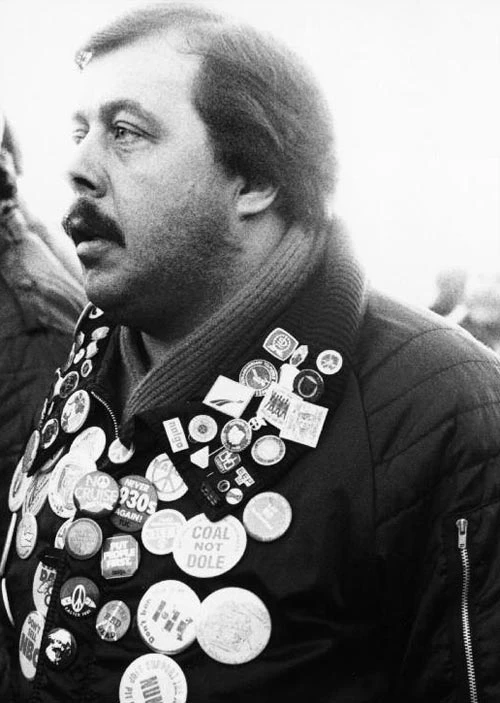
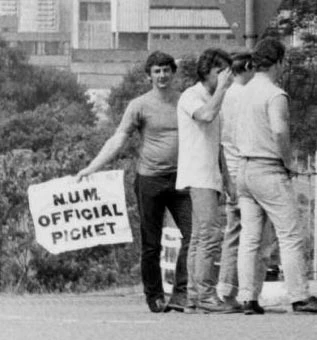
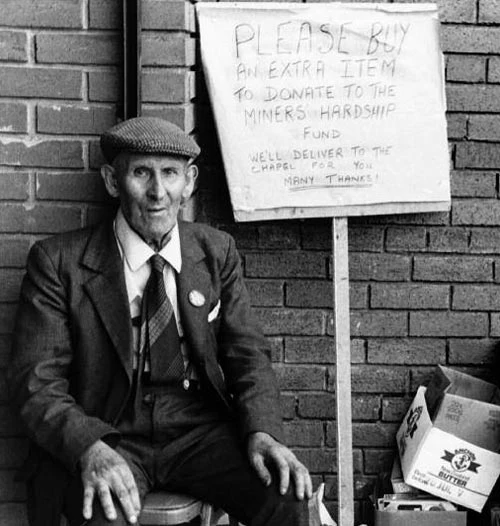
The Miners Strike of 1984 12 March 2009 National Coal BoardOn 1 March 1984 the National Coal Board announced that it planned to close 20 coal mines with the loss of 20,000 jobs. The year-long strike that followed changed the political, economic and social history of Wales forever."The miners in south Wales are saying — we are not accepting the dereliction of our mining valleys, we are not allowing our children to go immediately from school into the dole queue — it is time we fought!"Emlyn Williams, President, NUM, South Wales AreaPicketing and demonstrationsThe majority of Welsh miners initially voted against a strike but later played a major part in picketing and demonstrations. Miners' wives rose to the challenge of supporting their men by raising funds and organizing food distribution, but were also active on picket lines and marches.Although Wales did not suffer the picket line violence seen in some other British coalfields, Welsh miners were killed on picket duty and carrying out colliery safety work and a taxi driver was killed as he took a strike-breaker to work."We had to fight the enemy without in the Falklands, but we always have to be aware of the enemy within, which is much more difficult to fight and more dangerous to liberty."Margaret Thatcher, Prime MinisterCollecting storiesThere were rights and wrongs on both sides of the dispute and great pains have been taken to try to collect stories from each side. The passions aroused by the strike have made this a difficult task, for even now some participants are reluctant to allow their stories to be told.This, and the fact that the majority of the stories were collected from Wales, where only a small percentage of the workforce returned to work during the strike, makes it inevitable that one view should seem to predominate. If stories had been collected elsewhere it is quite possible that the opposite view would dominate.An objective and balanced history of the miners strike will one day be written but the pages that follow present the stories of some of the men and women whose lives were touched by what today has simply become known as... The Strike.This article forms part of a booklet in the series 'Glo' produced by Big Pit: National Mining Museum. You can download the booklet here
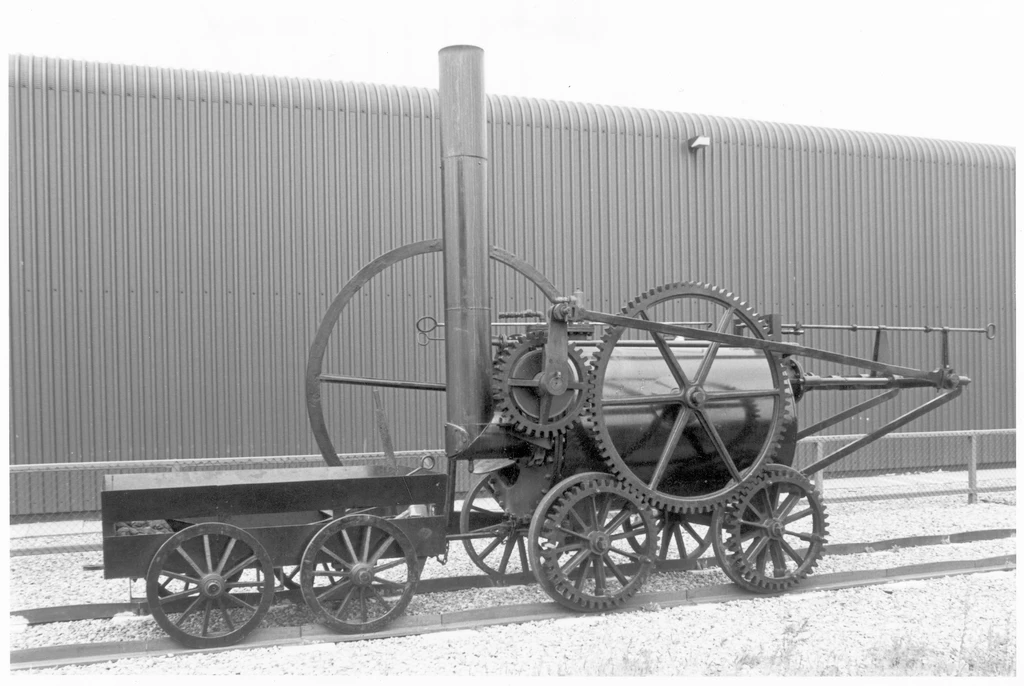
Richard Trevithick’s steam locomotive 15 December 2008 The replica locomotive in its present home, the National Waterfront Museum. The Penydarren locoOn 21 February 1804, the world’s first ever railway journey ran 9 miles from the ironworks at Penydarren to the Merthyr–Cardiff Canal, south Wales. It was to be several years before steam locomotion became commercially viable, meaning that Richard Trevithick and not George Stephenson was the real father of the railways.In 1803, Samuel Homfray brought Richard Trevithick to his Penydarren ironworks at Merthyr Tydfil in South Wales. Homfray was interested in the high pressure engines that the Cornishman had developed and installed in his road engines.He encouraged Trevithick to look into the possibility of converting such an engine into a rail-mounted locomotive to travel over the newly laid tramroad from Penydarren to the canal wharf at Abercynon.Crawshay’s wagerIt would appear that Trevithick started work on the locomotive in the autumn of 1803 and, by February 1804, it was completed. Tradition has it that Richard Crawshay, owner of the nearby Cyfarthfa ironworks, was highly sceptical about the new engine, and he and Homfray placed a wager of 500 guineas each with Richard Hill (of the Plymouth ironworks) as to whether or not the engine could haul ten tons of iron to Abercynon, and haul the empty wagons back.The first run was on 21 February, and was described in some detail by Trevithick:‘...yesterday we proceeded on our journey with the engine, and we carried ten tons of iron in five wagons, and seventy men riding on them the whole of the journey... the engine, while working, went nearly five miles an hour; there was no water put into the boiler from the time we started until our journey’s end... the coal consumed was two hundredweight’.Unfortunately, on the return journey a bolt sheared, causing the boiler to leak. The fire then had to be dropped and the engine did not get back to Penydarren until the following day.This gave Crawshay reason to claim that the run had not been completed as stipulated in the wager, but it is not known if this was ever settled!The engine was, in fact, too heavy for the rails. Later, it would serve as a stationary engine driving a forge hammer at the Penydarren works.Replica locomotiveThe replica locomotive on display in the Museum today was built working from Trevithick’s original documents and plans (now in the National Museum of Science and Industry). It was inaugurated in 1981 and, ironically, presented the exact same problem as the original engine – it too broke the rails on which it ran!We cannot overestimate the importance of Trevithick’s locomotive. In 1800, the fastest a man could travel over land was at a gallop on horseback; a century later, much of the world had an extensive railway system on which trains regularly travelled at speeds of up to sixty miles per hour. This remarkable transformation, a momentous occasion in world history, was initiated in south Wales in that February of 1804. The Penydarren locomotive – Steaming DaysA short film documenting the yearly steaming of Richard Trevithick’s replica locomotive at the National Waterfront Museum, Swansea.
Working Abroad - Welsh Emigration: Slate 19 September 2008 Griffith Owen-Jones and his wife Kate, who moved from Bethesda, Wales to Granville, New York State
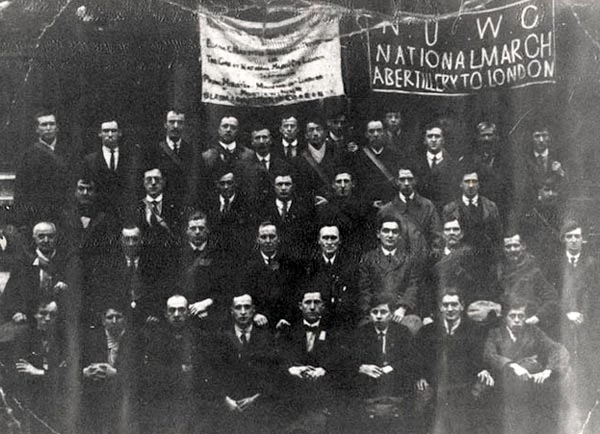
A Rhondda rebel song - lyrics discovered from first hunger march in Wales 27 August 2008 These lyrics were discovered in the documents of the late grandparents of Ms Powell, Isle of Man, in 2008. See below for transcript. Reproduced with kind permission of Ms Powell. Abertillery Members of the Hunger March, 1927. [Image: South Wales Coalfield Collection, Swansea University.] Poster advertising 'Red Sunday in Rhondda Valley' demonstration These lyrics were discovered in the documents of the late grandparents of Ms Powell from the Isle of Man in 2008. They are written in memory of two men who died during the miners march on London in 1927. The first hunger march from Wales to London took place in 1927 as a protest against the Ministry of Health who were refusing or limiting relief notes to unemployed miners and their families. It was also a demonstration against the Government's new Unemployment Bill. Red Sunday in Rhondda Valley During a demonstration on 18 September 1927 — 'Red Sunday in Rhondda Valley' — A. J. Cook, the miners' leader at the time, called for a march to London on 8 November (when Parliament re-opened). Every South Wales Miners' Federation (SWMF) lodge (colliery union branch) chose members to march, and each marcher would carry a miner's safety lamp. By November the march had lost the support of the SWMF. However, it was still supported by A. J. Cook, S. O. Davies (later MP for Merthyr), the SWMF Rhondda section and the Communist Party. On 8 November 1927, 270 men eventually marched in spite of hostility from the trades unions, press and government. They did, however, gain support from Trades Councils in every town and village they passed through (which included Pontypridd, Newport, Bristol, Bath, Chippenham and Swindon). Soldiers in a Workers Army The 270 marchers came from the Rhondda Valleys, Caerau, Aberdare, Merthyr, Pontypridd, Tonyrefail, Ogmore Valley, Gilfach Goch, Nantyglo and Blaina. Two miners died on the march - Arthur Howe from Trealaw in a traffic accident and John Supple of Tonyrefail who died after catching pneumonia during the rally in Trafalgar Square. In his last letter to his wife Mr Supple had written — 'Don't worry about me. Think of me as a soldier in the Workers' Army. Remember that I have marched for you and others in want.' 'Fascists' harassment and Armed Escorts From the beginning, the march was frequently referred to as a 'workers' army'. The marchers had been organized on military lines, divided into detachments and companies. During the march there was alleged harassment by 'Fascists', causing the organizers to be met by an armed escort of 100 members of the Labour League of Ex-Servicemen at Chiswick. The 'Workers' Army' senior 'officer', Wal Hannington, later wote in a pamphlet entitled 'The March of the Miners: How we Smashed the Opposition': '... these men are lighting a lamp stronger and more powerful than that which they are carrying. They are lighting a lamp that reveals the tortuous path the toilers have had to follow, and which lights up the road of struggle for the battle with the forces of reaction and the conquest of power by the workers'. The pamphlet includes 'A Rhondda Rebel Song' echoing James Connolly's 'A Rebel Song' which, along with 'March Song of the Red Army' and 'The Red Army March', was sung by the marchers. Transcript:
Foreign workers in the Welsh coalfields 6 March 2008 Post War miner shortage Group of Slovenians at Oakdale Training Centre 1948. Following the Second World War, the demand for coal was high and generally rising. Post-war recovery and growth demanded cheap and abundant energy that could only come from coal. There was an urgent need to recruit more miners. One source for these was among the thousands of Europeans who had to flee their home countries during the War. Although Britain desperately needed these men they were not always welcomed with open arms and there was much resistance from local National Union of Mineworkers' lodges. There was more disquiet when the recruitment of Italians began in 1951, and things were no better when the National Coal Board tried to recruit among Hungarian refugees after the 1956 revolution. By this time another group had already entered the coal field. In 1954 the German mining engineering group, Thyssen UK, came to work in south Wales, bringing some of their own countrymen with them. As with today's immigrants, these 'foreign workers' faced much initial suspicion, which arose partly from ignorance and partly from the fear of unemployment among the local population. These young men came to Britain after years of hardship, danger and tragedy. "All Poles" Nyk Woszczycki (2nd from left) in a group celebrating his friend Joe Hughes's retirement from Britannia Colliery Many left the coal industry as soon as they could, many even left Britain, but the ones who stayed earned a lasting reputation for toughness and hard work. Even though they came from many countries they tend to be regarded as 'all Poles' by the Welsh miner. They married local girls and settled down; on their living room walls can often be found photographs of their children and grandchildren, who have been brought up as Welsh. Many of these have gained university degrees; some have won sporting honours for Wales. In spite of their pride in their original homelands, most now regard themselves as Welsh. In turn, Wales should be proud of them and the part they have played in her history. This article forms part of a magazine in the series 'Glo' produced by Big Pit National Coal Museum. Download the complete magazine here: