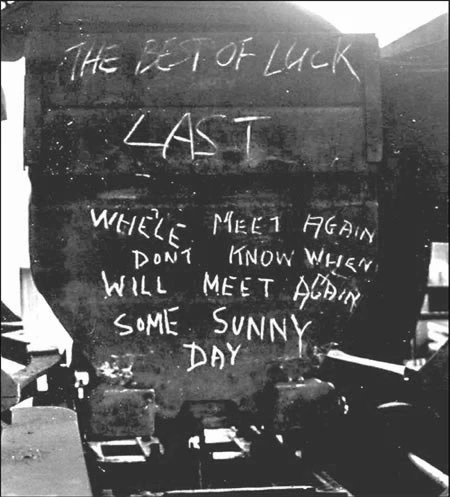
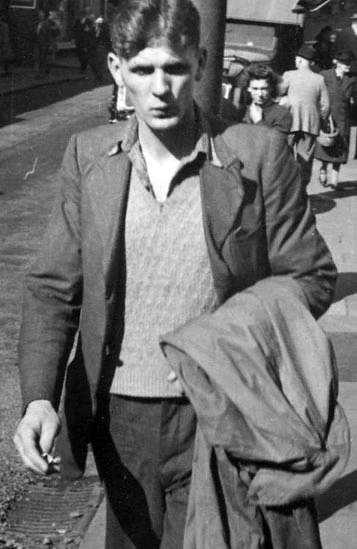
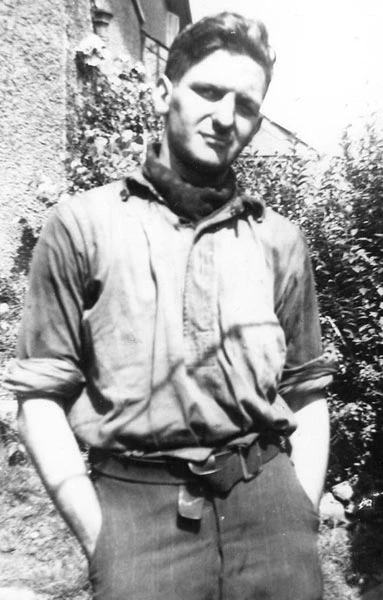
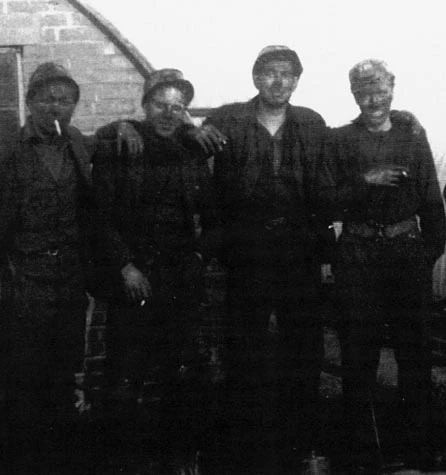
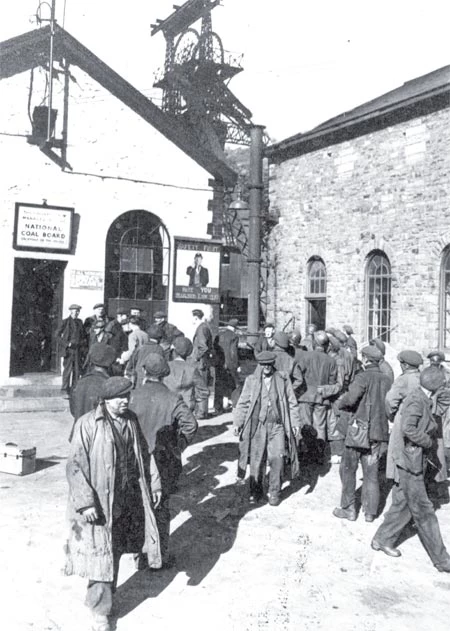
The National Coal Board in South Wales 25 February 2008 Post War BritainThe dismal history of the coal industry between the world wars, government control during the Second World War and the need for coal in post-war Britain made nationalisation of the British coal industry almost inevitable after the election of a Labour government in 1945.'Vesting Day', 1 January 1947, was largely welcomed in Welsh collieries when the south Wales coalfield became part of the South-Western Division of the National Coal Board (NCB). Assets taken over by the NCB in the UK included over 1,400 coal mines, 225,000 acres of farm land, 140,000 miners' houses, shops, offices, hotels, swimming baths, a holiday camp and a cycle track!Investment and DisappointmentNationalisation brought in considerable new investment for south Wales. Between 1948 and 1953, nearly £32 million was invested in the Cardiff region alone, with the reconstruction of Nantgarw Colliery cost £4.5 million. There was increased mechanisation at the coal face and drives to improve health and safety. However, by the mid-1950s, the NCB began to be seen as remote as any of the previous private coal owners. Investment had also often failed to bring results, with the expensive Nantgarw Colliery producing a disappointing 100,000 tons of coal a year.Closures and disastersEven from the early days of the NCB there was a tendency to close smaller, uneconomic pits and reorganise the larger ones. However, during the 1960s a deliberate rundown of the south Wales coalfield had begun. No other British coalfield suffered such closures - in 1960 there were 106,000 south Wales miners, by 1970 there were 60,000. The pace of closures only slackened off during the Middle East oil crisis of the mid-1970s.1960, an explosion at Six Bells Colliery killed 45 miners, and on the morning of Friday, 21 October 1966, a large section of the spoil heap of Merthyr Vale Colliery slid down the hillside onto the village of Aberfan, killing 144 people including 116 children.The 1960'sThe 1960s saw the development of new 'super pits' at Abernant, Brynlliw and Cynheidre Collieries as well as the reorganisation of existing collieries such as Coegnant, Deep Navigation and Merthyr Vale.The decade also saw all British mineworkers brought onto the same pay rate. Both management and trade unions broadly welcomed this agreement, although many men saw a substantial fall in their incomes.The Agreement forged a greater sense of unity between UK coalfields, which paved the way for the national strikes of 1972 and 1974, which were fought over wages, the latter dispute bringing about the fall of the Conservative government.The final yearsBy the early 1980s the British mining industry had become one of the safest and most efficient in Europe. However, a new Conservative government was in place and a new round of pit closures announced. The Welsh coalfields were especially vulnerable due to the age of the collieries and the difficult geology.Although closures had been reluctantly accepted in the past, the lack of alternative employment led to calls for industrial action. The last great miners' strike began in March 1984 and lasted a year. The defeat of the miners paved the way for the final destruction of the Welsh coal industry.The next ten years saw the end of coal as a nationalised industry. In 1994, Tower Colliery, the last remaining deep coal mine in Wales was closed by the NBC, (renamed British Coal). However, convinced that the mine was still economical, 239 miners bought the colliery with their own redundancy money and the mine remained operational until it's final closure on 25th January 2008, bringing to an end 200 years of deep coal mining in south Wales.This article forms part of a booklet in the series 'Glo'produced by Big Pit: National Mining Museum. Download here
Dreaming sometimes is not enough 31 January 2008 George Evans waiting to go on shift at Banwen colliery Glo: 'N C bloody B' [PDF 7 MB] First of January, 1947: The coalmines of Great Britain were taken into public ownership. It was something that every miner in Britain had wanted, had dreamt about indeed had been praying for. The often callous and brutal treatment of coalminers over the years by both mine owners and management had nurtured a contempt that bordered on hatred. There were three British miners killed every single working day at the time. So there was genuine rejoicing. The National Coal Board standard flew proudly at every pithead, the NCB gold logo on a blue field. Only thirteen years earlier 266 miners, had been burnt to death in a north Wales pit. Only 16 bodies were ever recovered and no one properly brought to book. So the rejoicing was truly heartfelt in every coalfield on this island. No one expected miracles from nationalisation but people became slowly aware of a giant incompetence, a kind of disjointed progress to somewhere, but no one knew exactly where. One instance that I witnessed was when I was standing in for the underground engine driver in the Eighteen Feet seam. The rope on the main winding engine was about an inch and half in diameter and perhaps about a mile long. The manager, John Williams, was having a heated argument with some blokes from HQ. They wanted to replace the existing rope with a much thicker longer rope. The new rope was fitted and proved to be too heavy for the weight of the journey (train of trams) to pull the length of the drift. What it cost to put that stupid blunder right goodness only knows. And that sort of crack-brained, hugely expensive blunder was happening a dozen times a day, in every coalfield in the country. One or two of the colliers were over seventy years of age but filling as much coal as most and earning a tidy wage. We came out one Thursday off afternoon shift and picked up our pay dockets. The old timers had an envelope attached to theirs with a crude little note inside telling them they were on 14 days notice. No pension, no redundancy, nothing - and one or two of the old chaps had started work at 13 years of age! John Williams had the old men brought back for a day, signed them on and kept them in the canteen until the end of the shift. That meant that the old fellers qualified for one pound a week colliery pension. I became disgusted with the behaviour of the National Coal Board. Men had struggled over the years to bring about nationalisation - they had even gone to prison! With each day that passed it became more and more apparent that trying to run the coal industry of Britain from a posh address in Belgravia wasn't working. Everywhere you looked there was disorderliness in planning and organisation. Still, work went on at the coal face in spite of it all. With the advantage of hindsight we are now able to see an industry, colossal in size, massively underfunded for many, many years and generally very badly managed. Maybe if someone had thought of asking, or if someone had had the courage to ask, say the head of Boots the Chemist or the head of Austin Cars to take charge, or demand co-operatives to be set up then perhaps the dream would have become reality. The one positive thing that the miners got from nationalisation was that health and safety improved out of all recognition. This article forms part of a booklet in the series 'Glo'produced by Big Pit: National Mining Museum. You can download the booklet here: Glo: 'N C bloody B' [PDF 7 MB]
Tales from down under - memories from Ray Isted, Bevin Boy collier 4 January 2008 Recollections by Raymond George Isted, Bevin Boy in Roseheyworth Colliery 1943—9 Raymond George Isted, Bevin Boy, Roseheyworth Collier 1943 — 1949 I was born in Herstmonceux in East Sussex; I left school at 14 and worked in a factory making automotive parts. When I reached 18, I was called up and sent to Brighton for a medical, I wanted to join the army although to be honest I would have been quite happy stopping at home! "I was actually balloted to go into the mines and sent to Oakdale Training Centre. I lodged with a Mrs Jones in Risca along with Wyndham Jones, a cockney who had relations in Abertillery. We trained for six weeks at Oakdale (Wyndham proved to be 'like a woman' on the shovel) and then sent to Roseheyworth Colliery. We had to wear our own clothes at work, mine were supplied by my parents, and I used to send them back to Sussex every week by my mother for washing. She used to say 'I would rather my Raymond go to the army than the pit' — she thought it was all terrible, thought that Welsh people lived in caves. "After a while I worked with Sid Fox on a heading where we were filling 13 or 14 drams a shift — Sid used to give me around £3 'knocking money'. When Sid went on the sick I worked the road with Gerald Williams. "Gerald introduced me to Phyllis on a night out — I was shy and couldn't dance so that was the only way to do it in those days. But it ended up that she was the only girl I ever went out with and we've been married for 58 years this August (2005). We had a quiet wedding, both my parents were ill and couldn't come and there was no one else from my side of the family there. We went to Weston Super Mare for the honeymoon. My new wife didn't want to settle in Eastbourne so we stopped in Wales. It was always 'Hello Ray' every ten minutes in Wales - in Eastbourne you could walk around for six months and no one would talk to you! "I worked for 6 years in the pits. I remember an overman pointing me out to someone and saying 'You see this boy here? A Bevin Boy and still working here — we can't get him from here!' I even picked up the accent a bit although that was to stop me getting ribbed about my Sussex accent. I feel more Welsh than my wife does now!" This article forms part of the magazine 'Glo', produced by Big Pit National Coal Museum.
Tales from down under - memories from Bevin Boy colliers 4 January 2008 Being a Bevin Boy in Cwm Colliery by Mel Harris. Mel Harris, Bevin Boy, Cwm Colliery 1944-1947. I had done many jobs since Ernest Bevin forced me into the coalmine rather than the RAF. I had worked with a repairer and a haulier, with a shot firer, as a rider with journeys of drams — always reluctant, uninterested and rebellious. "Now I was on the coal face with a senior collier who was also chairman of the miners' lodge — the union leader at the colliery... As the days passed, I watched him at work, noticing how neat and careful he was in everything he did. To the uninitiated the work of the collier appears rough and ready but it is really skilled and, at times, almost aesthetic. The care taken to keep floor, face and top of the stent well trimmed, the posts and cross pieces in line and the pride taken in leaving the stent neat and tidy at the end of the shift... "Although working hard with Mr David — never called him anything else — my feeling about coal mining did not change. All my friends wore the uniform of one of the Forces and serving overseas, whilst I was in civilian clothes with no uniform provided except boots and helmet. I was on meagre rations, a very small wage and open to accusations of cowardice. Various attempts to get re-assigned to military posts were thwarted so that future prospects seemed bleak. "In this feeling of despair I continued to work alongside Mr David and gradually he brought me some peace and resolution of my attitudes. I began to see him as a role model for a balanced and more optimistic view of life. He was a poorly educated, very intelligent man with clear views on rights and responsibilities. Once I asked him how, in his role as lodge chairman, he dealt with the payment agreements with the manager. He told me 'I will see that he keeps to his side of the agreement — and if any of my men break it they will answer to me.' "I still hated being a Bevin Boy but he helped me to look at it as an experience which would benefit me in later life." This article forms part of the Glo publication by Big Pit: National Mining Museum. Download here Recollections by Raymond George Isted, Bevin Boy in Roseheyworth Colliery 1943—9 Raymond George Isted, Bevin Boy, Roseheyworth Collier 1943 — 1949 I was born in Herstmonceux in East Sussex; I left school at 14 and worked in a factory making automotive parts. When I reached 18, I was called up and sent to Brighton for a medical, I wanted to join the army although to be honest I would have been quite happy stopping at home! "I was actually balloted to go into the mines and sent to Oakdale Training Centre. I lodged with a Mrs Jones in Risca along with Wyndham Jones, a cockney who had relations in Abertillery. We trained for six weeks at Oakdale (Wyndham proved to be 'like a woman' on the shovel) and then sent to Roseheyworth Colliery. We had to wear our own clothes at work, mine were supplied by my parents, and I used to send them back to Sussex every week by my mother for washing. She used to say 'I would rather my Raymond go to the army than the pit' — she thought it was all terrible, thought that Welsh people lived in caves. "After a while I worked with Sid Fox on a heading where we were filling 13 or 14 drams a shift — Sid used to give me around £3 'knocking money'. When Sid went on the sick I worked the road with Gerald Williams. "Gerald introduced me to Phyllis on a night out — I was shy and couldn't dance so that was the only way to do it in those days. But it ended up that she was the only girl I ever went out with and we've been married for 58 years this August (2005). We had a quiet wedding, both my parents were ill and couldn't come and there was no one else from my side of the family there. We went to Weston Super Mare for the honeymoon. My new wife didn't want to settle in Eastbourne so we stopped in Wales. It was always 'Hello Ray' every ten minutes in Wales - in Eastbourne you could walk around for six months and no one would talk to you! "I worked for 6 years in the pits. I remember an overman pointing me out to someone and saying 'You see this boy here? A Bevin Boy and still working here — we can't get him from here!' I even picked up the accent a bit although that was to stop me getting ribbed about my Sussex accent. I feel more Welsh than my wife does now!" This article forms part of the Glo publication by Big Pit: National Mining Museum. Download here
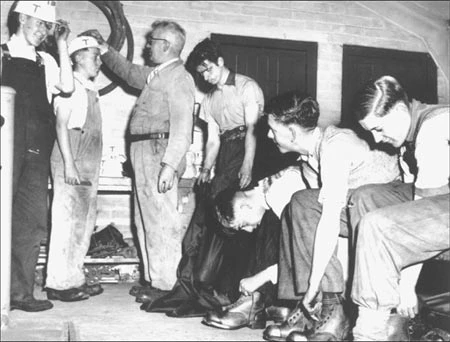
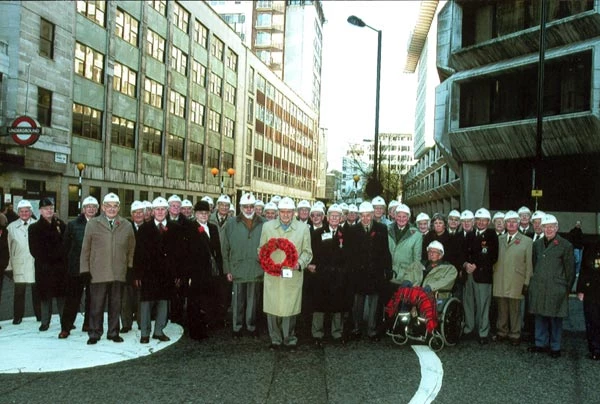
Remembering the Bevin Boys in the Second World War 3 January 2008 Bevin Boys commemorative banner Bevin Boys from South Wales Bevin Boys Association blazer badge. A retired pit pony poses with two former Bevin Boys at the annual reunion at Trentham Gardens, Stoke-on-Trent. Former Bevin Boys attending the Remembrance Parade in London on the 14th November 2004 The underground front The story of the Bevin Boys miners has been largely untold; those many men who spent their war on the so-called 'underground front' went unrecognized for almost half a century. When Britain declared war in 1939, thousands of experienced miners left the mines to join the armed services or transfer to higher-paid 'war industries'. By the summer of 1943 over 36,000 men had left the coal industry . The British government decided that it needed around 40,000 men to take their places. Ernest Bevin In December 1943, Ernest Bevin, the wartime Minister of Labour and National Service, devised a scheme whereby a ballot took place to put a proportion of conscripted men into the collieries rather than the armed services. Every month, ten numbers were placed in a hat; two numbers were drawn out, and those whose National Service registration number ended with those numbers were directed to the mining industry. These "ballotees" became known as "Bevin Boys". Alongside the ballotees were the "optants", men who had volunteered for service in the coal mines rather than the armed services. Between 1943 and 1948, 48,000 young men were conscripted for National Service Employment in British coal mines. Contrary to a common belief at the time, only 41 of them were conscientious objectors. Bevin Boys, therefore, came from all social classes and regions in Britain, not just the mining areas. Many had only been vaguely aware of the mining industry before being drafted. Most had set their sights on a career in the armed services and were horrified to be sent to the collieries instead. Punishment In April 1944 the Colliery Guardian reported that 135 ballotees had been prosecuted for failing to comply with the direct labour order. Thirty two went to prison, although 19 of them were released when they eventually agreed to go into the mining industry. Picks and shovels Unlike the ordinary miners, who wore their own clothes, Bevin Boys were issued with overalls, safety helmet and working boots. However, they still had to pay for their own tools and equipment, which led to complaints that the infantry were not expected to supply their own rifles so why were they expected to buy picks and shovels! Only a small proportion of Bevin Boys were actually employed cutting coal on the coal face, although some worked as colliers' assistants filling tubs or drams. The majority worked on the maintenance of haulage roads, or generally controlled the movement of underground transport. A small number who had previous electrical or engineering experience were given similar work in the collieries. Bevin Boys suffered from resentment from local mining families who had seen their own children drafted into the armed services only to be replaced by "outsiders". In addition, just being young men out of uniform could lead to abuse from the public or attention from the police as possible deserters, "army dodgers" or even enemy spies. It is not surprising that they suffered from high absentee rates. A very small number stayed in mining after the war, but most couldn't wait to leave. Official records destroyed The ballots were suspended in May 1945, with the last Bevin Boys being demobbed in 1948. Unlike other conscripts, they had no right to go back to their previous occupations, they received no service medals, "demob" suit or even a letter of thanks. Because the official records were destroyed in the 1950s, former Bevin Boy ballotees cannot even prove their service unless they have kept their personal documents. The first official Bevin Boys reunion was held at the former Chatterley Whitfield Mining Museum in 1989. More have been held at various venues since then. However, it was not until 1995, 50 years after Victory in Europe Day, that the British government finally recognized their service to the war effort and former Bevin Boys are now officially allowed to take part in the Remembrance Day service at Whitehall. For any information on the Bevin Boys Association please contact: Warwick H Taylor, Vice President, Bevin Boys Association, 1 Rundlestone Court, Dorchester Dorset, DT1 3TN This article forms part of a booklet in the series ' Glo ' produced by Big Pit: National Mining Museum.