The modern county of Ceredigion is not immediately associated with mining. As you travel towards Aberystwyth on the coast, following the inland valleys of the Ystwyth, Rheidol and the Mynach rivers in the northern part of the county, you could be mistaken in thinking that the economy of Ceredigion - formerly known as Cardiganshire - had always been dependent on agriculture.
As you journey through the hills, take a closer look at the changing landscape and a different story unfolds. Driving from one rural settlement to another, the ancient landscape hides many stories, traditions and intrigues of the years gone by.
Mining for metals such as copper, lead, zinc and silver has been an important part of the economy of the county for nearly 4,000 years.
The scattering of small communities such as Ponterwyd, Pontrhydfendigaid, Ffair Rhos, Cwmystwyth, Ysbyty Ystwyth, Goginan, Ystumtuen, Pontrhydygroes, Cwmsymlog, Taliesin and Talybont often have nothing seemingly in common.
However they do have one theme linking them all - the history and legacy of metal mining.
This information forms part of the website 'Spirit of the Miners' - a community regeneration project that sets out to create an identity for northern Ceredigion using the legacy of metal mining as a theme for regeneration.
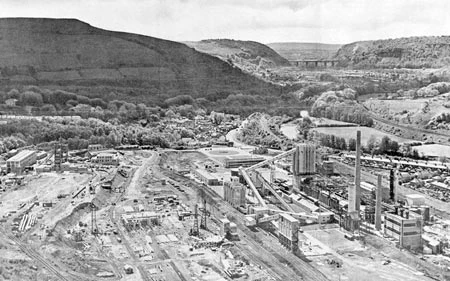
Nantgarw Colliery under construction May/June 1951
Anyone visiting Amgueddfa Cymru's Collections Centre at Parc Nantgarw, north of Cardiff, might not realise that this was once the site of one of the most famous collieries in south Wales. All that now remains are two small concrete pyramids marking the sites of the shafts and a commemorative winding wheel.
The deepest mine in south Wales
Nantgarw Colliery was one of the flagships of the National Coal Board. It was the nearest deep mine to Cardiff, and a reminder to travellers that they had entered the south Wales coalfield.
Opened in 1911, it boasted two large shafts and, at a depth of 782.73m (856 yards), was the deepest mine in south Wales. However, despite appearing as a fine example of a clean and efficient modern coal industry, the colliery was abandoned in 1927 due to lack of manpower, poor industrial relations and, above all, being located above very complex underground geology.
The war years
The mine re-opened in 1937 after a major reorganization, but work was suspended when war broke out in 1939. A later project to re-open the colliery was approved by the Ministry of Fuel and Power in 1946. It was the first major scheme to be operated by the new NCB in the south-west district.
A new state-of-the-art colliery
Nantgarw in 1974
In order to construct a model colliery at Nantgarw, all traces of the original were demolished and new surface buildings were designed with state-of-the-art facilities. Appliances were installed to reduce smoke and fumes, and all waste was placed underground keeping the surface clear of unsightly spoil heaps. The entire underground network was designed to minimise the risk of accidents. Great care was taken to minimise any dust produced both underground and on the surface, in order to protect the workforce from contracting illnesses such as pneumoconiosis.
Not enough miners to mine
During the 1940s there was a marked decline in the number of men willing to consider a coal mining career, even in the traditional mining strongholds such as the Rhondda.
The Nantgarw Colliery posed a specific manpower problem, with the working population choosing employment elsewhere. The workforce had to be recruited from new entrants or from closed collieries outside the area. By 12 March 1954 the total cost of the project had increased to £5.25 million. Labour relations were also a cause for concern. During 1958 alone there were 65 stoppages, go-slows and walk-outs in the colliery
Declining fortunes
Nantgarw survived the mass pit closures of the 1960s and, in 1975, merged with Windsor Colliery (near Abertridwr). By 1979, the combined Nantgarw / Windsor Colliery employed around 650 men, producing over 4,000 tons of coal per week. During 1979–80 they made a profit of just over £0.5 million. Despite development difficulties, the pit's future looked reasonably secure.
However, by the early 1980s the colliery's fortunes were again hit by low manpower and poor geological conditions. The colliery lost £7 million in 1981, and in 1982 output declined steeply as a major coal seam became unworkable. A year later, an overtime ban led directly to the twelve-month strike of 1984-5. Within eighteen months of the strike ending, the mass pit closures took place in south Wales. This time, Nantgarw Colliery was included. Nearly 80 years of coal mining history at Nantgarw ended.
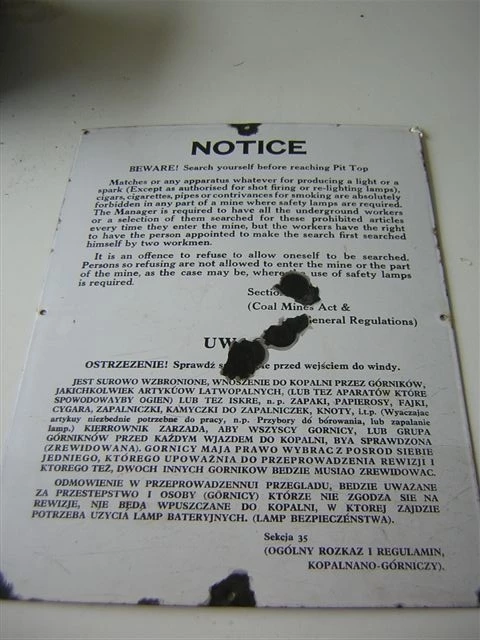
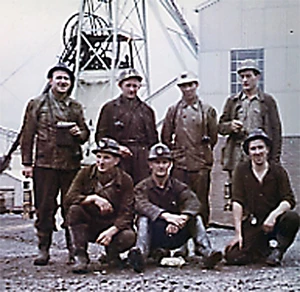
After the Second World War the demand for coal was high and there was a need to recruit new miners. One source for these was amongst the thousands of Europeans who had to flee their home countries during the Second World War.
In January 1947, a national agreement was made between the National Union of Mineworkers (NUM) and the National Coal Board (NCB) to recruit from the large number of Polish soldiers who had fought with the Allies during the war.
However, there was much resistance amongst local unions. By the end of May 1947 there were Poles whose training was complete but no collieries willing to take them.
The NCB appealed for help from the NUM who put a strong resolution to a delegate conference in favour of the acceptance of the Poles and most found places eventually.
A scheme to recruit other eastern European displaced persons began in September 1947. There was again fierce opposition from local unions and by the winter only a minority found collieries willing to take them.
By 1951 only 10,000 of the 18,000 foreign workers still remained in the mines and a new scheme to recruit Italians was launched. Again there was local opposition, only 400 found placements and the recruitment stopped in April 1952.
It was no better when the National Coal Board tried to recruit amongst refugees who had fled from Hungary during the 1956 revolution. There were over 4,000 volunteers but under a third of them found places, the rest went to other industries.
The 'foreign workers' came to Wales after years of hardship and danger. The ones that found employment in the coal industry eventually gained a reputation for hard work and respectability. Wales should be proud of them and the part they played in its industrial history.
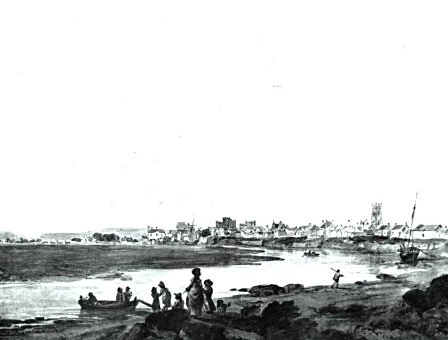
Cardiff: the pre-industrial port. Two sloops lying in the River Taff, as portrayed by Paul Sandby in 1776.
Cardiff: the industrial port. An aerial view showing the completed dock system about 1948.
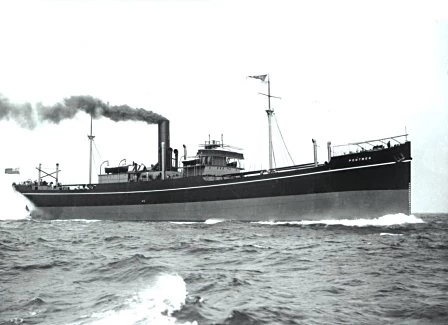
A typical Cardiff tramp steamer - the SS Pontwen, built in 1914.
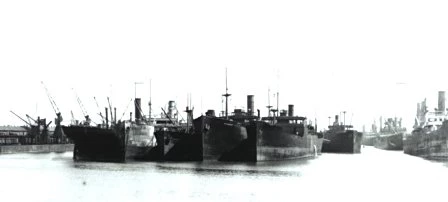
The age of depression. Laid-up ships in Cardiff docks about 1930.
Cardiff: the port transformed. Modern retail developments now stand where Cardiff once exported coal to the world.
Second Marquess of Bute
In 1862, 2 million tonnes of coal were exported from Cardiff Docks
; by 1913, this had risen to nearly 11 million. This was the heyday of the coal industry before the depression of the 1930s.
Cardiff was the boom town of late Victorian Britain. For a few years before the First World War, the tonnage of cargo handled at the port outstripped that of either London or Liverpool. Yet in the late 18th century, Cardiff's trade was all transported by two small sloops sailing to Bristol on alternative days. So what had led to this transformation?
It was the growth of the iron industry in the South Wales Valleys that caused Cardiff to develop a port. In 1794, the
Glamorganshire Canal
was completed, linking Cardiff with Merthyr, and in 1798 a basin was built, connecting this canal to the sea. Cardiff's foremost landowner, the 2nd Marquess of Bute, built West Bute Dock in 1839. Two years later, the Taff Vale Railway
was opened.
Coal overtakes Iron
From the 1850s, coal began to replace iron as the industrial foundation of south Wales. South Wales steam coal was what oil is today, with yearly exports reaching 2 million tonnes as early as 1862. A further dock, the East Bute, was opened in 1859, but following the death of the 2nd Marquess in 1848, the Bute Estate trustees were over-cautious and reluctant to invest in new dock facilities.
Coal exports reach 9 million tonnes
Frustration at the lack of development at Cardiff led to rival docks being opened at Penarth in 1865 and
Barry
in 1889. These developments eventually spurred Cardiff into action, with the opening of the Roath Dock in 1887, and the Queen Alexandra Dock in 1907. By then, coal exports from Cardiff totalled nearly 9 million tonnes per annum, much of it exported by locally-owned tramp steamers.
Tramp steamers and steamships
Cardiff's first steamship was the little Llandaff of 1865, and she was the first of a fleet of steamships that grew rapidly in the late 19th century. By 1910, there were some 250 tramp steamers owned at Cardiff. Each day, the owners would meet to arrange cargoes of coal for their ships in the opulent
The coal export industry reached its peak in 1913, when 10.7 million tonnes of coal were exported from the port.
First World War
After the First World War, there was a significant increase in shipping in Cardiff, with 122 shipping companies in business in 1920. The boom proved short-lived, however; oil was growing in importance as a maritime fuel, and the terms of the Treaty of Versailles soon flooded Europe with cheap German coal. By 1932, in the depths of the depression, coal exports had fallen to below 5 million tonnes and dozens of locally owned ships were laid-up. It was an era of depression from which Cardiff never really recovered, and despite intense activity at the port during the Second World War, coal exports continued to decline, finally ceasing altogether in 1964.
Modern day Cardiff
Today, the port of Cardiff presents a very different picture from that existing a century ago. The waterfront has been totally transformed. Exclusive flats now stand where coal hoists once stood, and the rough and ready sailortown pubs have been replaced by sedate bistros. Only two docks, the Roath and the Queen Alexandra, remain in use, and just two shipping companies remain.
There is still some trade in timber, oil, and containers, but the days when the port was packed with tramp steamers, shrouded in coal dust as they loaded the 'black diamonds' of the valleys of south Wales, will never be seen again.
Background Reading
Cardiff and the Marquesses of Bute, by John Davies. Published by University of Wales Press (1981).
Cardiff Shipowners, by J. Geraint Jenkins and David Jenkins. Published by the National Museums & Galleries of Wales (1986).
Coal Metropolis: Cardiff, 1970-1914, by Martin Daunton. Published by Leicester University Press (1977).
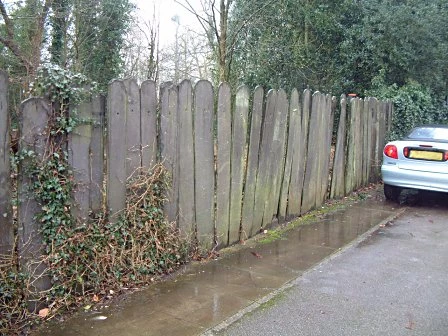
The slate pillar fence at Bisham (Windsor and Maidenhead). Approximately 150m (164 yards) of this fence survives, although local residents remember it as once being significantly longer. The pillars of Bisham's fence typically extend about 180cm (5.9 feet) above ground level and must have a further 40cm (1.3 feet) or so below the ground. Each pillar is some 20cm (7.9 inches) in width and 3.5cm (1.4 inches) thick.
How did a slate pillar fence come to be built in the Thames Valley, 300km away from the slate quarries of north-west Wales?
Slate pillar fences became common in north-west Wales from the middle of the 19th century. In 1861, the Penryhn Quarry at Bethesda, Gwynedd - one of the largest slate quarries in the world at that time - produced around 9,000 individual pillars. These pillars consisted of poor quality blue slate, typically about 150cm (4.9 feet) tall.
They were used to mark fields, gardens, railways lines and roads, with their simple construction being particularly well-suited to the harsh weather experienced by upland areas.
Despite their use around Wales's slate quarries, slate pillar fences are rarely found further a field. The discovery of a slate pillar fence at Temple House (now demolished) at Bisham, Maidenhead, is therefore extremely unusual. The bluish-purple colouring of the slate makes it certain that it was quarried in north-west Wales, probably at Penrhyn Quarry.
This raises the question of how a slate pillar fence came to be built almost 300km (186 miles) away from the source of the stone?
Temple House was built around 1790 for Thomas Williams, who owned the nearby Temple Mill copper works. Thomas Williams (1737-1802) was from north Wales originally and became the leading figure of the British copper industry. Williams employed the architect, Samuel Wyatt, to develop the Temple Mill copper works, and it is likely that Samuel also built Temple House.
Samuel Wyatt had very close links with the owners of the Penrhyn slate quarry. In 1782 he refurbished a building for Richard Pennant (later Lord Penrhyn), and in 1786 his brother became the general manager of the Penrhyn estate. This relationship ensured Samuel a regular supply of slates for his own business activities. In return, Samuel promoted the use of slate in the London area, using it for shelves, cisterns, lavatory-seats, window-sills and as a wall covering, as well as for roofing.
If the Temple House slate pillars had been supplied by Samuel Wyatt, their transport to Bisham could have been relatively simple. Even before the construction of a tramway from Penrhyn Quarry to the coast in 1801, there existed an efficient network of roads linking the quarry to the sea at Port Penrhyn.
From Port Penrhyn a fleet of vessels carried slate around the coast of the British Isles. The Wyatt family had an owning interest in many of these vessels. From London the cargo could be navigated up the Thames by barge.
There is therefore a great deal of circumstantial evidence linking the Bisham slate pillar fence with Samuel Wyatt and Penrhyn Quarry, and dating its construction to around 1790. But one aspect of the pillars' manufacture raises doubts about this. Some of the larger support pillars were clearly cut with circular saws - a technique which was not certainly used before 1805 and only became common from 1840.
One suggestion which unites these two strands of evidence is the possibility that the original fence was erected about 1790, but it had suffered from subsidence in the soft soil around Bisham. The result might have been a second order for Welsh slate around 1840 to rectify the problem.
The fence at Temple House may show evidence of the links between two of Wales's great industrialists, the copper magnate Thomas Williams and Richard Pennant of Penrhyn slate quarry, through the architect Samuel Wyatt. Both shared a common heritage, so what would have been more natural than for Thomas Williams and his architect to display the potential of Welsh slate beside his copper works at Temple Mill?
Background Reading
The Wyatts: an architectural dynasty by John Martin Robinson. Published by Oxford University Press (1979).
'Copper and Slate: Thomas Williams' Slate Pillar Fence at Bisham', by Dafydd Roberts. In The Marlow Historian, vol. 3, p16-21 (2003).
Nantgarw Colliery under construction May/June 1951
Nantgarw in 1974
Colliery sign in English and Polish
German mine workers at a south Wales coal pit
Cardiff: the pre-industrial port. Two sloops lying in the River Taff, as portrayed by Paul Sandby in 1776.
Cardiff: the industrial port. An aerial view showing the completed dock system about 1948.
A typical Cardiff tramp steamer - the SS Pontwen, built in 1914.
The age of depression. Laid-up ships in Cardiff docks about 1930.
Cardiff: the port transformed. Modern retail developments now stand where Cardiff once exported coal to the world.
The slate pillar fence at Bisham (Windsor and Maidenhead). Approximately 150m (164 yards) of this fence survives, although local residents remember it as once being significantly longer. The pillars of Bisham's fence typically extend about 180cm (5.9 feet) above ground level and must have a further 40cm (1.3 feet) or so below the ground. Each pillar is some 20cm (7.9 inches) in width and 3.5cm (1.4 inches) thick.