A Sisley painting of the south Wales coast

La falaise a Penarth, le soir, marée basseby Alfred Sisley
La falaise a Penarth, le soir, marée basse

by Alfred Sisley

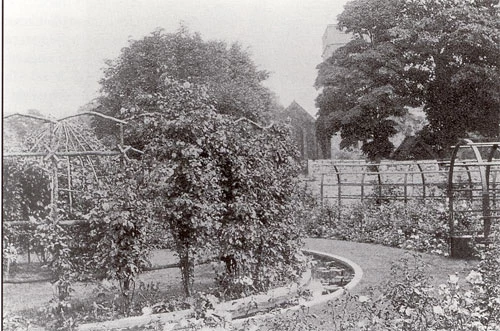
The view at the same location today

The view at the same location today

Sisley and south Wales

Within the Museum's art collections is a view of the south Wales coast painted by Alfred Sisley - La falaise a Penarth, le soir, marée basse ('The cliff at Penarth, the evening, low tide'). Sisley's coastal views of 1897 are the only pictures of Wales ever painted by a leading Impressionist.

The first Impressionist exhibition

Born in Paris in 1839 to British parents, Alfred Sisley became a leading member of the circle of young painters who stood in opposition to the traditional art taught at the French Académie. In 1874, this group mounted the show that has gone down in history as the 'First Impressionist Exhibition'. Sisley participated in three of the next seven shows organized by the Impressionists between 1876 and 1886.

He never enjoyed the success of his friends Monet, Renoir and Pissarro and in 1882 he withdrew to the small town of Moret-sur-Loing near Fontainebleau, where he worked for the rest of his career, dying there in 1899.

a

Sisley paints south Wales

In the summer of 1897, Sisley visited south Wales, staying at 4 Clive Place, Penarth and on 5 August he married Eugenié Lescouezec at Cardiff Town Hall.

Sisley found Penarth stimulating. On 16 July he wrote "I have been here for a week ... The countryside is very pretty and the Roads with the big ships sailing into and out of Cardiff, is superb ... I don't know how long I shall stay at Penarth. I am very comfortable here, 'in lodgings' with some very decent folk. The climate is very mild, and has indeed been too hot these last few days, especially now as I write. I hope to make good use of what I see around me and to return to Moret in October, or thereabouts".

Sisley's 19 or so oil paintings of Penarth and Langland Bay near Swansea (where he stayed from 15 August until his return to Moret on 1 October) are his only sea pieces and show the energy and excitement of a new discovery. The Penarth seascapes are more atmospheric than the Langland views, which capture the intense heat and light of the Gower Peninsula.

Six Penarth views have so far been identified. One shows a tree at the cliff's edge with shipping and Penarth Pier in the background. Two show the view northwards up the Bristol Channel and three show the view southwards looking along the cliff's edge towards Lavernock. La falaise a Penarth is one of these southward looking views.

The evening light rakes sharply from the west, casting a mauvish shadow from the steep cliff over the beach below. It depicts low tide, with the rocks of Ranny Point and Lavernock Point clearly visible.

On 4 October 1897 an article in the French paper Le Journal observed: "The Impressionist master has brought back from Penarth and Langland Bay a series of admirable sea pieces, in which the strange flavour of that landscape, little frequented by painters, is rendered with an art that is as captivating as it is personal."

Sisley's vision marks a fundamental change in the interpretation of the Welsh landscape, replacing the Romantic outlook of Turner and his successors. He and his fellow Impressionists blazed a trail for the next generation, led by the native Welsh artists Augustus John and James Dickson Innes.
A magnificent Romantic Landscape

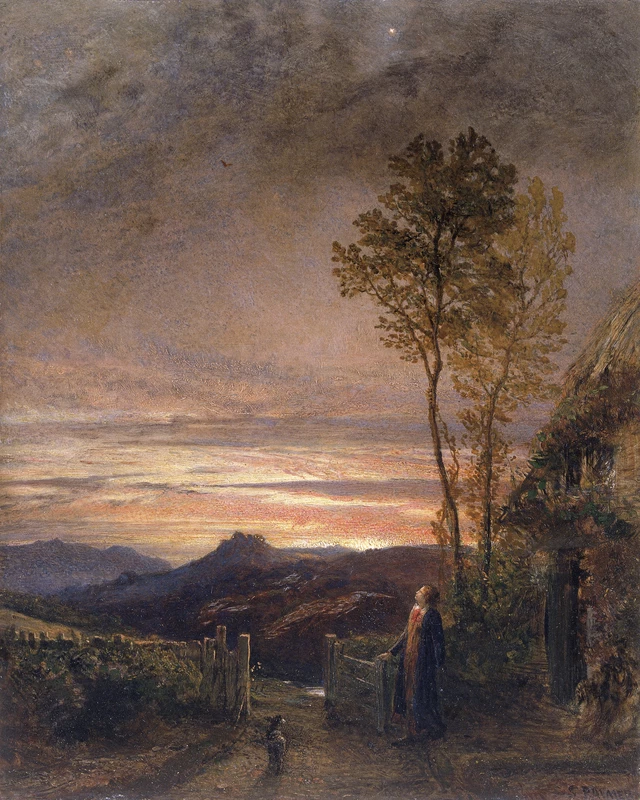
Samuel Palmer ranks among the most important British landscape painters of the Romantic Period. The first of his paintings to enter the collections of Amgueddfa Cymru is a landscape titled The Rising of the Lark.

'The Rising of the Lark' by Samuel Palmer
The Rising of the Lark

by Samuel Palmer.
Acquired 1990; Gift; Sidney Leigh through the National Art Collections Fund

Samuel Palmer (1805–51)

Samuel Palmer was the son of a London bookseller. His early work was profoundly influenced by the visionary poet and painter William Blake (1757–1827), whom Palmer met in 1824.

Palmer settled in the village of Shoreham in Kent. He created a symbolic language, using his pictures to celebrate the rural fruitfulness and pastoral simplicity of the world before the industrial revolution.

Palmer’s later work is more conventional and naturalistic. He travelled to Wales and other parts of Britain in the early 1830s, but no place inspired him as much as Shoreham.

Following his marriage to Hannah, the daughter of the artist John Linnell (1792—1882), his painting became increasingly geared to the requirements of the art market.

Inspired by a poem

The Rising of the Lark is inspired by lines from L’Allegro by the poet John Milton (1608–74), a favourite of the artist:

‘To hear the lark begin his flight,
And, singing, startle the dull night,
From his watch-tower in the skies,
Till the dappled dawn doth rise’

Through the rising sun and the joyful song of the lark, Palmer suggests a new beginning. The shepherd opening the gate through which the lamb will pass into the broad landscape may symbolise the stirrings of new life.

Palmer based this oil painting on a detailed drawing dating from his later time in Shoreham. His son Alfred Herbert Palmer wrote about the picture in his biography, The Life of Samuel Palmer. He suggests that it was painted soon after his father’s return from Italy in 1839.

The Romantic Period

This painting belongs to the Romantic period. At this time many artists, musicians and writers aimed to recapture a rural lifestyle which they felt was being lost to industrialisation.

The Library at Amgueddfa Cymru

The library at Amgueddfa Cymru was established many years before the main museum building in Cardiff was formally opened in 1927.

The library at Amgueddfa Cymru

The library at Amgueddfa Cymru

Miss E. M. Breese, a cataloguer from the adjacent University of Wales, was the first Librarian. Although Miss Breese did not arrive until 1913, the accession books run from 1909.

The beginnings of a collection

The first item to be accessioned was a copy of John Ward's Handbook of objects from the Roman fort of Gelligaer (John Ward, Curator of Cardiff's museum, later became Keeper of Archaeology at Amgueddfa Cymru).

Among the first books purchased in 1909/10 were the Yearbook to learned and scientific societies, Esther Crawford's Cataloguing: suggestions for the small public library and a guide to the House of Commons.

The main Library of the Museum, located in National Museum Cardiff, consists of a central, shelved room with accommodation for staff and readers, along with two wings of heavy 1920s mobile racking that are still in use today.

The only other known example of such racking, suspended from iron girders, is from old library stacks in the British Museum.

The Museum expands

As the Library outgrew its original premises, departmental libraries were created. As well as the libraries at National Museum Cardiff, there is a substantial collection at St Fagans National History Museum.

The library covering industrial history and archaeology is now in the National Waterfront Museum in Swansea, and there are small collections at the National Slate Museum in Llanberis and the National Roman Legion Museum in Caerleon. All three libraries are administered from National Museum Cardiff.

Important and significant collections

The Library has attracted some major donations. The most important is the Tomlin library of 17th-century and later books on Mollusca, with several volumes of the finest hand-coloured natural history engravings ever produced.

In 1953 the Willoughby Gardner collection arrived, with a number of early printed books on the natural sciences, including herbals and the Museum's only two incunables (books published before 1501) - two editions of Pliny's writings on natural history from 1481 and 1487.

As well as Museum staff, the Main Library is often used by external students and the Library can be used by the public by appointment.

Special collections

As well as general museological and conservation books, special collections are housed in the Main library at National Museum Cardiff. For example, there is a fine collection of Welsh topographical books - mainly published tours of Wales from the 18th and early 19th century, together with some manuscripts.

On loan to the library is a set of Gwendoline Davies's own copies of the Gregynog Press books in special bindings. The Library has been acquiring examples of other private press books contemporary with the Gregynog Press, as well as modern private presses in Wales, including Gwasg Gregynog, Old Stile Press and Red Hen Press.

The Library continues to actively collect.

Friday 6th July

Contributed by CAROLINE and pupils of LLANTWIT MAJOR COMPREHENSIVE SCHOOL

The students visited the site as a geography field trip. However, it also it also covered subjects such as art, science, biology and history. Today the students were making clay huts replicating Iron Age Roundhouses. The students were shown around the site and shown post holes and a hearth forming a roundhouse as inspiration for their Iron Age roundhouses of clay.

Last year (then in year 6 of primary school) the same students visted the site, looking at the spoil heap and sieving for finds. Today they were learning more in depth about the structural elements of Iron Age roundhouses, particularly their entrances and the positioning of the hearth in the centre of the roundhouse.

The weather was particularly bad and a temporary hut was constructed using posts and tarpaulin. Unfortunately the archaeologists weren’t so lucky and had to continue digging in the rain while the comprehensive students made clay huts under shelter…

Site visit was 2 hours long, involved a site tour and creative tasks. The students from this year’s year 7 are hoping to come again when in year 8.