‘People are drowning come on!’

Ian Smith, 14 October 2019

Saturday 6th October 2019 8.30am

I took my breakfast cereal into the living room and looked out at the sky for any hint of what the weather might do. It had been raining and very windy for days, the remnants of hurricane ‘Lorenzo’ had been battering Wales all week. The sky was cloudy, a hint of drizzle against the glass and the weeping willow in our front garden was doing a samba.

Today I had more than a passing interest in the forecast as I had a boat trip planned for later that morning, in a very special boat.

The Ferryside Lifeboat to be precise, a 6.4 metre long RIB, the ‘Freemason’ which cost about £90,000, £50,000 of which was donated by the Freemasons, hence the name.

The crew had bought all new safety suits and gear and had offered the museum one of their old suits for our maritime collection. We jumped at the chance to acquire this very important piece of our seagoing history. One of the crew members is Mark Lucas who happens to be Curator of Wool at the National Woollen Museum in Drefach Velindre, Carmarthenshire and it was at his suggestion that the suit be donated to us. The lifeboat crew were running sea trials that morning and had asked me to go along to experience the conditions for myself and collect the gear.

We have three lifeboats in the National Collection, two of these have wooden hulls and in 2011 we collected a RIB (rigid hull inflatable boat) from Atlantic College in St Donats, where the original RIB design was created and patented by the college. So the fact that the suit was from a RIB crew made it even more special.

Eleven o’clock found us at the Lifeboat Station on the Towy Estuary in Ferryside. The Ferryside Lifeboat is an independent station, as are many around our coastline, and not funded by the RNLI. Just like the RNLI they are run by volunteers and rely on donations and grants.

The crew were gathering and getting changed into their ‘new’ suits and they had one for me to wear too. Now, getting into a ‘dry suit’ is no easy task, especially for a novice like me. To say it was a struggle is an understatement, and after ten minutes of performing like a contortionist and the ensemble heckling me that

‘people are drowning come on!’

It was then they decided that I needed a bigger suit. Hmm…

The weather by this time wasn’t too bad, a slight wind and light rain and the estuary looked fairly calm, this was indicated by the fact that the new ferry was sailing between Llansteffan and Ferryside.

‘That looks OK, not too rough’ I thought to myself, and it was OK in the estuary…

The giant Talus tractor pushed the lifeboat the ‘Freemason’ down the slipway and into the water. I was already installed by this point having been pushed unceremoniously over the rubber tube by the crew as I struggled to climb aboard in an extra 20 kilos of suit and gear. The rest of the crew climbed aboard (easily) and we set off.

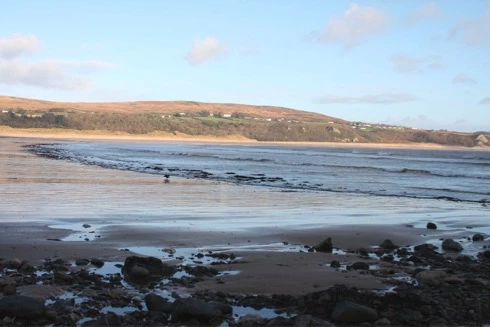
As I thought the estuary was fairly quiet, but the coxswain pointed out to sea where I could see large white breakers rolling in over a sandbar which runs roughly from Laugharne to St Ishmaels.

‘That’s where we are going, it’s a bit lively out there, all good fun though’.

It was very lively. The crew put the boat through its paces doing figure eights and three-sixty manoeuvres, all at high speed whilst I hung on tightly and braced myself against the G-force of the turns. The boat will do 30 knots flat out, about 26 miles an hour, which doesn’t seem fast in a car on the road but in a boat is a different matter.

I kept thinking how brave these guys are to come out in all weathers and try and rescue people. The sea we were in wasn’t that rough and it was broad daylight. I couldn’t imagine what it would be like in a gale and in the dark.

Eventually we headed in and back to the comparatively flat calm of the river Towy. My trip was over and what an experience!

We headed for the Lifeboat Station and the crew presented me with a dry suit, life jacket, radio and GPS locator which are now part of the National Collection and on display at the National Waterfront Museum in Swansea.

Living and Working with Bipolar

Joe Lewis, 9 October 2019

Thursday 10th October is Mental Health Awareness Day. I want to use this day to share my experience of living with bipolar. Bipolar is a life-long mental health condition where the person can experience very high manic moods and very low depressive moods. Recent research suggests that up to 5% of people have bipolar. For more information visit Bipolar UK.

TRIGGER WARNING - I discuss my experiences of depression and psychosis.

A Difficult Few Years
At the end of 2015 I was suffering quite severely with depression. It was probably the worst bout of depression I’d ever had. I was completely incapable of making decisions, I did not find joy in anything, I was worried about everything and worst of all was the constant thoughts of suicide. It finally came to a head when my manager asked if I was OK and I burst out crying. She had done mental health first aid training and said the right things to get me to talk. After finding out how bad I felt she recommended I went to the doctors.

I was able to get an emergency appointment and the doctor was very nice. I was put on anti-depressants and was suggested other therapies such as Cognitive Behavioural Therapy (CBT) and a mindfulness course. After a few months I was feeling better. Unfortunately a combination of a stressful few weeks in work and the antidepressants caused me to go into a manic episode and then psychosis which meant I was signed off work for 3 months.

Frustration
After returning to work in the summer of 2016 I slowly got back into the rhythm of work. Over the next year I was doing OK but became increasingly frustrated at not getting an answer as to why I had gone through psychosis. One psychiatrist had suggested I had bipolar whilst another didn’t think I did.

Over the summer of 2017 a series of stressful events led me to go into another manic episode. In the September I went into my second episode of psychosis and was diagnosed with bipolar. I was once again signed off work.

Psychosis
I want to emphasise that when someone is in psychosis they are very rarely a danger to the public that the media portray them to be. I was not a danger to others, in fact if you met me during that time you might have even had a hug from me. This is not to say that it is easy to see someone going through psychosis. I had rapid racing thoughts, paranoia, delusions, hallucinations, severe lows, and delusional euphoric highs. It was a terrifying experience for me and very difficult for my family as they felt helpless in trying to help me through it. Psychosis felt like being trapped in a waking nightmare and I would never wish that experience on anyone. Despite how difficult it was, my local mental health crisis team, my family and friends really helped me and I was incredibly grateful for their support.

Recovery
Since returning to work in January 2018 it has been a slow but steady recovery. I felt like my mind had taken a severe beating. I have had incredible help from my Community Psychiatric Nurse (CPN), psychologist and psychiatrist. This year I have attended a course on living with bipolar run by the National Centre for Mental Health based at Cardiff University and a group therapy course on Compassion Focused Therapy (CFT). I have also started volunteering for Time to Change Wales as one of their champions. All of this together with the right medication and support from my family, friends, managers and colleagues has helped me to recover and stay well.

It’s Good to Talk
I have been very open with colleagues about why I was off work and my experiences. In return I have found they often open up and share their own experiences. 1 in 4 people will suffer from mental ill health at some point in their lives. By sharing with others we can help reduce the suffering and feelings of being alone.

If you are suffering at the moment find someone you can talk to whether that is family, friends, colleagues, doctor, or your local mental health crisis team. There are lots of people out there that want to help you. Thanks for reading this and take care.

Historic Buildings go into Hibernation for the Winter

Penny Hill, 7 October 2019

Although many of our historic buildings remain open throughout the year, those without an open fire or any form of heating have to be closed for the winter months and the collections packed away to protect them from the cold and damp. It's also a good time to clean the displays and check for pests such as clothes moth, carpet beetle and mice that may have made a home in the buildings over the summer months. If left undetected these pests can go on to cause considerable damage to the collections.

The two buildings going into hibernation this week are the Tailor's Workshop and the Saddler's Workshop. There is a grand total of 1379 objects on display in both these buildings, so our conservation volunteers provide us with a welcome helping hand to clean and condition check all this material.

United Nations international year of the periodic table of chemical elements: September - carbon

Ceri Thompson, 30 September 2019

Continuing the international year of the periodic table of chemical elements, for September we have chosen carbon, the element which – in coal - has arguably had the most influence on the shaping of the built landscape and culture in Wales.

The Welsh Coalfields

For around 150 years the coal industry has dominated the industrial, political and social history of Wales. Between 1801 and 1911 the population of Wales quadrupled from 587,000 to 2,400,000. This was almost entirely due to the effects of coal mining: either directly through the creation of colliery jobs or through industries reliant on coal as a fuel (eg. steel-making).

There are two major coalfields in Wales, one in the north-east of the country and one in the south.  North Wales produced mostly high volatile, medium to strong caking coal, and the coalfield has a long history of production. By 1913, it was producing around 3,000,000 tons per annum but went into a slow decline afterwards. The last colliery in the area, Point of Ayr, closed in 1996.

The south Wales coalfield is more extensive than that of north Wales.  It forms an elongated syncline basin extending from Pontypool in the east to Ammanford in the west, with a detached portion in Pembrokeshire. The total area covers some 1,000 square miles.

The south Wales coalfield is famous for its variety of coal types, ranging from gas and coking bituminous coals, steam coals, dry steam coals and anthracite. They had a wide range of uses: domestic, steam raising, gas and coke production and the smelting of copper, iron and steel.

Loose jointed and friable roof conditions were more commonplace in south Wales than other UK coalfields which resulted in numerous accidents from falls of roof and sides. The deeper seams are also very ‘fiery’ leading to numerous disasters. Between 1850 and 1920, one third of all mining deaths in the UK occurred in Wales. Between 1890 and 1913 alone there were 27 major UK mining disasters, thirteen of which occurred in south Wales including the 1913 explosion at the Universal Colliery, Senghenydd where 439 men died – the largest loss of life in a UK mining disaster.  North Wales was largely free of major disasters but, in 1934, an explosion at Gresford Colliery killed two hundred and sixty-six men, the third worst disaster in Welsh mining history.

South Wales steam and anthracite coal differ from other coal seams due to the presence of numerous partings (‘slips’) which lie at an angle of about 45 degrees between floor and roof.  This made the coal relatively easy to work as the coal fell in large blocks.  However this large coal was coated with fine dust which was the prime cause of pneumoconiosis, a disease which was more prevalent in south Wales than all other UK coalfields. In 1962, 40.7% of all south Wales miners were suffering from the disease.

A close relationship grew up between coal mining and the local community.  Villages were virtually single occupation communities. In Glamorgan and Monmouthshire half of all adult male workers were directly involved in the coal industry, while in places such as the Rhondda and Maesteg, the proportion could be as high as 75%.

Because of the peculiar geology and geography, south Wales was slow to unionise. However, following the humiliating defeat after the 1898 coal strike, there arose a need for unity and in 1914 the South Wales Federation became the largest single trade union with almost 200,000 members.

From the early 1920s until WW2, the Welsh coalfields suffered a prolonged industrial recession due to the changeover to oil by shipping and the development of foreign coalfields. The numbers of miners fell from 270,000 to 130,000. The industry was nationalised following the war and experienced tremendous changes with the introduction of new techniques and equipment. There was now a greater emphasis on safety, but the coalfields were still dangerous places. In 1960, 45 men died in Six Bells Colliery, 31 died in Cambrian Colliery in 1965 and, perhaps most tragically of all, 144 people died when a tip collapsed on Aberfan, including 116 children.

By the 1980s the threat of mass pit closures arose. In March 1984 the last major strike began and continued for twelve months. Following the defeat of the National Union of Mineworkers, mines began to close on a regular basis. By the mid-1990s, there were more Welsh mining museums than working deep mines.  The last deep mine, Tower Colliery, closed in January 2008. One of the most important influences on Welsh social, industrial and political life has now vanished.

Volunteer Blog: Lavandula Heaven

Luciana Skidmore, Volunteer , 26 September 2019

August is the most fragrant month here in St. Fagans gardens as we just finished trimming back and harvesting our lavender shrubs. We prune them at this time of the year to remove old flowers and give them a chance to grow new foliage before the Autumn/Winter months.

A well known favourite the lavender has a unique and distinguishable fragrance that is grown for ornamental, aromatic, medicinal and culinary purposes. They are sun loving plants and require a well drained soil.

Lavender is such a versatile plant suiting different garden styles and pleasing the most varied tastes. In St. Fagans you can find hundreds of plants of different species. You will see them in our herb garden, surrounding the fountain in the Dutch Garden, dotted amongst perennials in flower borders, as lavender hedges by the greenhouse and  complimenting the romantic style of the Rosery. A true aromatic heaven!

Lavandula is a genus of 47 known species, here you can find the well known Lavandula angustifolia ‘Hidcote’, the beautiful white flowers of the Lavandula x intermedia ‘Edelweiss’ and one of my favourites the Lavandula x intermedia ‘Grosso’. This particular species is a hybrid cross between the Lavandula angustifolia (English lavender) and the Lavandula latifolia (Portuguese lavender). They are larger, more robust and have longer stalks with bluish purple flower heads making them perfect for cut flowers.

Lavender is also a wonderful culinary ingredient. Most varieties can be used in cooking, however the Lavandula angustifolia ‘Munstead’ is more widely used. They taste great in cakes, scones, jams and as a tea. Add 1 tsp. of dried lavender flowers to a cup of water, let it steep for 10 minutes and enjoy! It’s perfect for calming the mind and helping you drift into dreamland.

When harvested most of our flowers are dried in our potting shed and used to create lavender bags, beautiful dried flower arrangements and other products that can be seasonally found in the Museum store. We also use them in our historic buildings as decoration and inside mattresses to repel insects as they would have done years ago.