Art

Katheryn of Berain

10 October 2011

Katheryn of Berain, 'The Mother of Wales' (1534/5-1591)

The life of Katheryn of Berain is laden with intrigue. This wealthy heiress from Denbighshire had Tudor blood in her veins, and was a distant relative to Queen Elizabeth I.

The story of her and her many husbands has become one of the chief romances of north Wales. She had six children and over thirty grandchildren who all went on to form some of the country's richest families, earning her the title 'the Mother of Wales'.

In Katheryn's age people married for money, land and power, not love. As a wealthy heiress of royal descent, Katheryn was considered a bit of a catch! She married four times to high-profile Welshmen, and became related to the richest, most important families of north Wales.

Wealthy sitters would often have their portraits painted to flaunt their richness and social status. But in this religious time it was just as important to appear humble in front of God.

The portrait is attributed to the Dutch artist Adriaen van Cronenburgh, who often painted portraits of the Friesian nobility. His work demonstrates the sophisticated Netherlandish oil painting technique of the time.
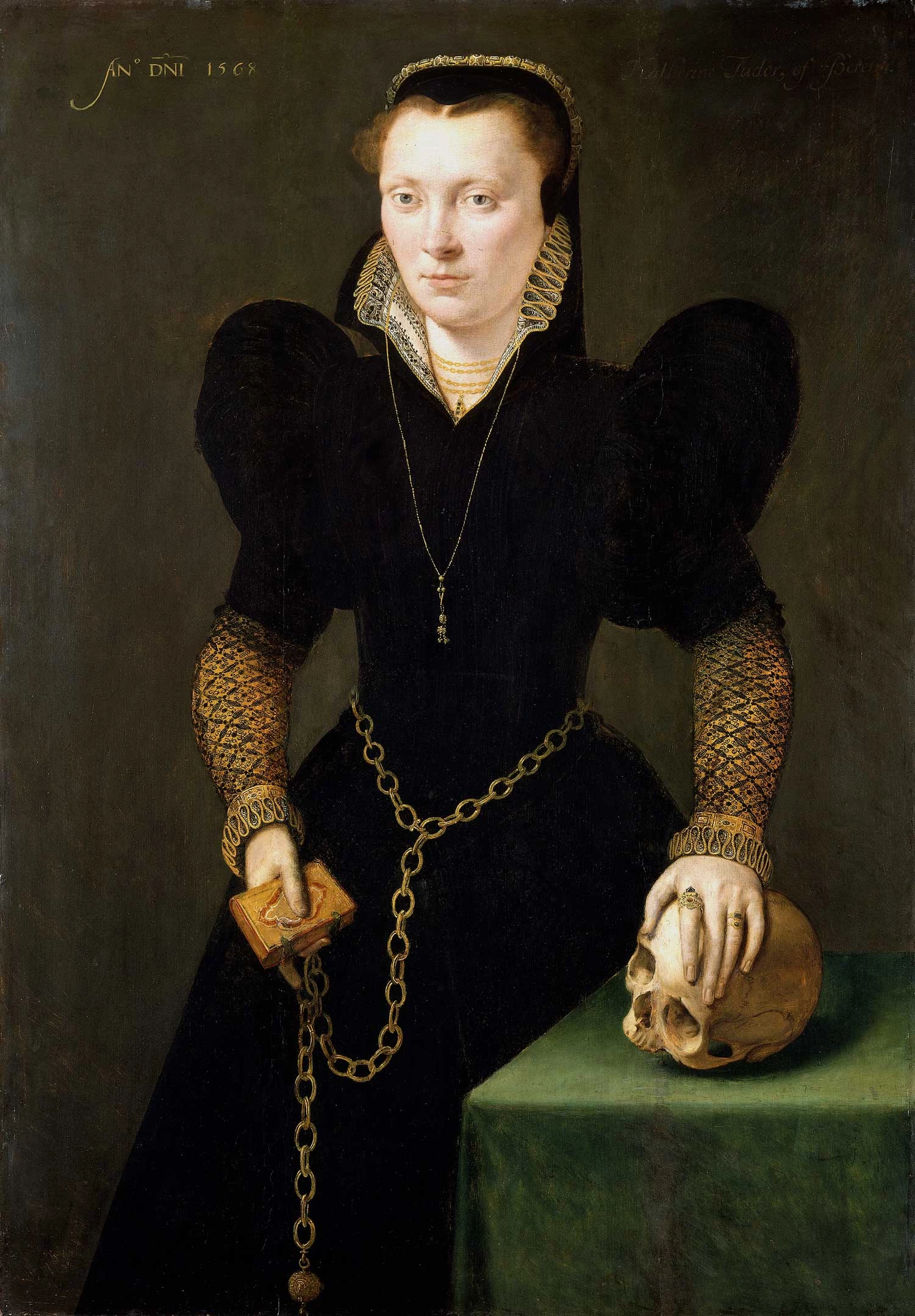
When Katheryn's second husband died abroad, she returned to Denbighshire with this portrait, where it remained for almost four hundred years. Just before the Second World War it was sold and taken to the Netherlands. From there it was sold to a collector who brought the work back to Britain. Finally, it was purchased by the Friends of National Museum Wales who presented it to the Museum in 1957.

Kathryn of Berain can be seen in the

Historic Art galleries at National Museum Cardiff
Francsesco Guardi's View of the Palazzo Loredan

Anne Pritchard, 6 September 2011

Partially restored image of <em>View of the Palazzo Loredan dell'Ambasciatore on the Grand Canal, Venice</em>

Partially restored View of the Palazzo Loredan dell'Ambasciatore on the Grand Canal, Venice

Ultra-violet light shows areas of previous retouching

Ultra-violet light shows areas of previous retouching

This small painting by Francesco Guardi depicts in exquisite detail the embassy of the Holy Roman Empire in Venice.

It is set amid the bustle of daily life on the Grand Canal. Washing hangs from balconies, Gondoliers take their boats to and fro, and finely dressed diplomats peer from windows and promenade on the quayside.

Among the many figures a gentleman in a blue coat — probably the ambassador himself — stands at the entrance to the palazzo grandly holding a gold sceptre. Above him hangs the imperial crest of the powerful regime which for centuries dominated most of central Europe.

Guardi is renowned as one of the great eighteenth century Venetian landscapists known as veduta painters. His works were highly popular and influential among the British artists and collectors who visited Venice on their Grand Tour.

This work is a fine example of his mature technique. It combines the detailed precision mastered under the influence of the artist Canaletto with an increasingly expressive use of brushwork, atmosphere and light.

Cleaning of the painting by the museum's conservators has revealed the stunning luminosity of these original effects.

When this painting initially entered the museum's collection, the brilliance of Guardi's technique was not fully visible. The top layer of varnish which covered the painting had severely discoloured, turning brown with age. Excessive retouching of the sky area had also been carried out, made visible under ultra-violet light.

The museum's conservator cleaned the paint surface, removing the old varnish and previous restorations. Tiny black spots in the paint, initially thought to be dirt, were found to be granules of pigment. Similar spots can be seen in other works by the artist, who would have ground and mixed his own paints.

With the full clarity and radiance of Guardi's original work revealed, the painting was re-varnished and placed on display.

Before and after cleaning

Museum conservators have been busy cleaning the image, here is a before and after view of the image:

View of the Palazzo Loredan dell'Ambasciatore on the Grand Canal, Venice [before cleaning]

View of the Palazzo Loredan dell'Ambasciatore on the Grand Canal, Venice [before cleaning]

View of the Palazzo Loredan dell'Ambasciatore on the Grand Canal, Venice [after cleaning]

View of the Palazzo Loredan dell'Ambasciatore on the Grand Canal, Venice [after cleaning]

The Derek Williams Trust Collection

6 May 2011

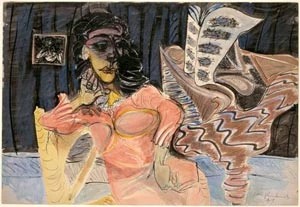
Ceri Richards - The Pianist

NMW A(L) 606
Ceri Richards
The Pianist
1949
Pencil, indian ink and watercolour
38.2 x 56.2 cms
On loan from the Derek Williams Trust since 1984
© Estate of Ceri Richards. All rights reserved, DACS
2010

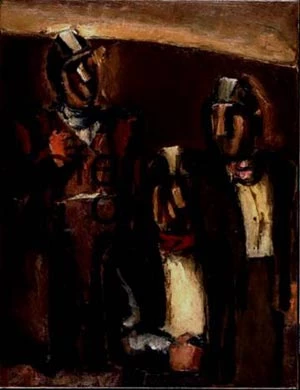
Josef Herman - Three Welsh Miners

NMW A(L) 561
Josef Herman
Three Welsh Miners
About 1966
Oil on canvas
66 x 51 cms
On loan from the Derek Williams Trust since 1984
Copyright of Artist's Estate

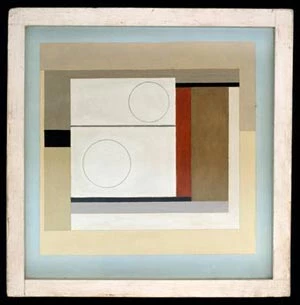
Ben Nicholson - (painting)

NMW A(L) 577
Ben Nicholson
1944-45 (Painting)
1944-45
pencil and watercolour on board
17.2 x 16.8 cms
On loan from the Derek Williams Trust since 1984 © Angela Verren Taunt 2010. All rights reserved, DACS.

Derek Mathias Tudor Williams F.R.I.C.S. (1929-1984) has been the greatest benefactor to Amgueddfa Cymru – National Museum Wales since Gwendoline and Margaret Davies.

Derek Williams was a modest and private man, based in Cardiff and Pontypridd as a chartered surveyor, who enjoyed many pursuits, including golf, opera, photography, but most of all collecting contemporary art. He gained immense satisfaction from building his collection and displaying it within his numerous residences.

The collection contains a large number of works by the British neo-romantics, including Ceri Richards, John Piper, David Jones and Keith Vaughan. This element is supported by the work of other artists of this period such as Lucian Freud, Josef Herman, Ivon Hitchens, Graham Sutherland, Ben Nicholson and Henry Moore.

In 1984 Derek Williams died, requesting in his Will that his collection and the residue of his estate be held in trust, allowing his trustees to undertake the care and public display of the works of art, in addition to contributing to the enhancement of the collection. The Derek Williams Trust was formed by his executors in 1992, which in the following year made a formal agreement with the Museum to work together in order to fulfil the wishes of Derek Williams.

The Trust’s collection has since been on long-term loan to the Museum and there have been over fifty works added and more continue to be acquired every year. A number of pictures by leading painters of the 1970s, ‘80s and ‘90s, including Michael Craig-Martin, Craigie Aitchison, Sean Scully and Howard Hodgkin form a strong component of the new additions.

The original Derek Williams collection continues to be strengthened and consolidated by the purchase of major works by artists of the mid-twentieth century, among them Ceri Richards, Henry Moore, John Minton and Edward Burra. Interest in contemporary international art has been expressed through the regular purchase of works by artists featured in Artes Mundi.

Applied arts are not overlooked by the Derek Williams Trust as they possess an active interest in this area and have acquired eleven works of applied art over the last sixteen years, in addition to assisting the Museum with a number of acquisitions, particularly in the field of ceramics.

The Trust also has an interest in work by contemporary Welsh and Wales-based artists, which includes the purchase of work by Eisteddfod Gold Medal-winners.

The great generosity and support of The Derek Williams Trust made possible many acquisitions of post-1900 art for the Museum’s own modern art collection, such as David Hockney, Stanley Spencer and Pablo Picasso.

Wales 1678: Reconstructing the earliest on-the-spot sketches of Wales

Emily O'Reilly, 11 February 2011

Pembroke Castle

Pembroke Castle

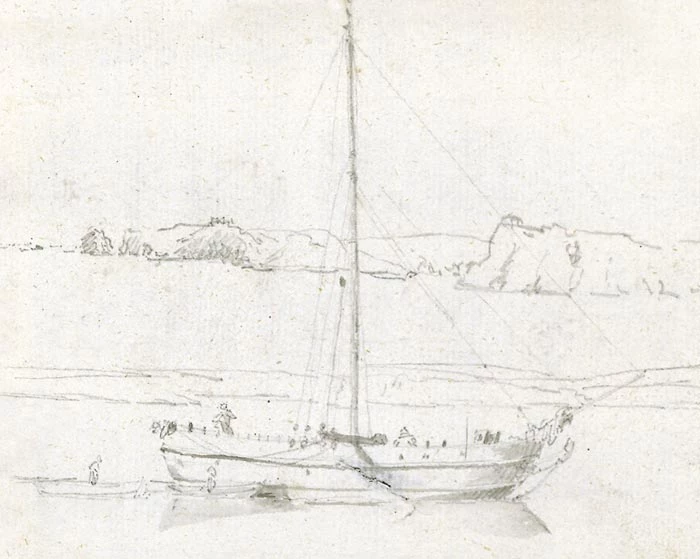
Boat at Tenby

Boat at Tenby

Amgueddfa Cymru has in its collection fifteen views of Wales drawn by Francis Place (1647-1728). Of these, ten are from a single sketchbook. These ten sketches, dated 1678, are the earliest images that the Museum holds of Wales that were drawn on-the-spot. In addition to revealing sketches hidden for 200 years, recent conservation work by the Museum has enabled sketches to be digitally stitched together - creating complete panoramic views that have never been viewed before.

The Museum purchased the sketches from a dealer in 1931. The dealer had bought them at Sotheby's in a sale of the collection of Patrick Allan-Fraser Art College in Arbroath, Scotland. The collection included drawings, prints, pottery and the only known oil painting, a self portrait, descended directly through the family from Place.

The drawings are all made from at least two separate sheets joined together and then stuck to a secondary support, which appears to be early wove paper, suggesting the late eighteenth or early nineteenth century.

Some drawings that obviously extended over the page had been left 'loose', allowing the viewer to lift the page and view the other side, but others had been stuck down to the secondary support — with the 'inconsequential' sketch on the verso hidden from view.

Hidden sketches

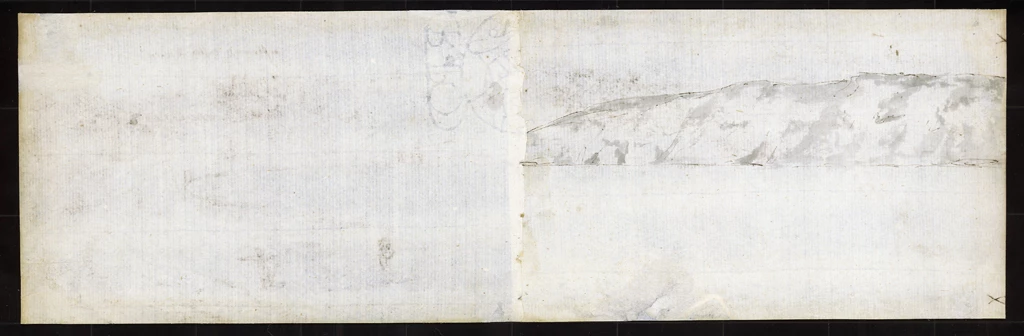
During conservation work, Museum staff decided to remove all the sketches from their secondary supports, and with all the sketches detached from the album pages it was revealed that a drawing on the back of one page joined up with the drawing on the back of another page, creating a new double-page spread.

The images could then be matched up, revealing sketches unseen since the original sketchbook had been taken apart at least 200 years ago. The original order of the sketches could also be determined.

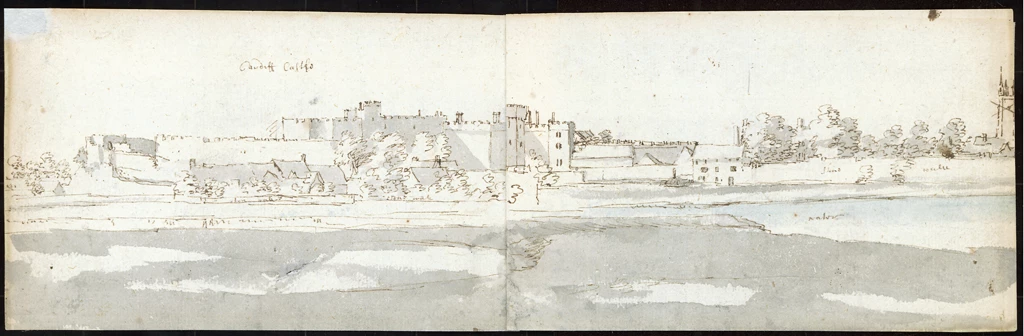
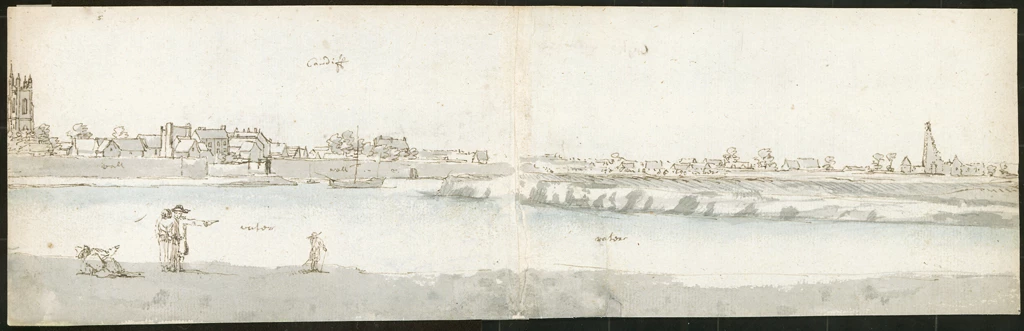
Cardiff

Many of the sketches have crosses or arrows showing where the panorama is extended over the page. Cardiff is two double-page sketches that join in the middle. There is a cross on the church tower in both sketches, which is where the two overlap.

<em>Cardiff</em> (1678) Francis Place. Double-page sketch 1
Cardiff

(1678) Francis Place. Double-page sketch 1

<em>Cardiff</em> (1678) Francis Place. Double-page sketch 2
Cardiff

(1678) Francis Place. Double-page sketch 2

<em>Cardiff</em> (1678) Francis Place, digitally stitched together.
Cardiff

(1678) Francis Place, digitally stitched together. This complete panorama has never been viewed before.

Never seen before panoramic views

As there was limited potential in showing these historical views of Wales in a traditional gallery setting, the images were scanned and digitally 'stitched together', and the panoramas could be viewed as complete images for the very first time.

During this process some insights into Place's working methods were discovered. When putting the separate pages together, no manipulation was required to match up the horizons as they already did perfectly — testimony to Place's ability as a draughtsman.

Although technology has not changed the way these objects are treated, it has greatly enhanced our knowledge of the works by giving deeper insight into the artist's working methods.

Oystermouth

Oystermouth has two crosses on the very left edge, indicating that the drawing extends over the page. On the reverse side of the sheet there are two corresponding crosses on the right edge.

<em>Oystermouth</em> (1678) Francis Place.
Oystermouth

(1678) Francis Place. Sketchbook sheet 1

<em>Oystermouth</em> (1678) Francis Place.
Oystermouth

(1678) Francis Place. Sketchbook sheet 2

<em>Oystermouth</em> (1678) Francis Place.
Oystermouth

(1678) Francis Place, digitally stitched together

Research

The bulk of Place's original work comes from the Sotheby's sale in 1931. Various lots from this sale are now in the Victoria and Albert Museum in London, including a number of mounted drawings and two sketchbooks. These items suggest that the drawings in Amgueddfa Cymru and the Victoria and Albert Museum originally came from one sketchbook.

The first Victoria and Albert Museum sketchbook consists of eighteen sheets, exactly the same size as the one at Amgueddfa Cymru and also bearing the same watermarks; there is a list at the front of the sketchbook corresponding to the views in the sketchbook, and the list continues with places in Wales that correspond with the order established from the Amgueddfa Cymru sketches.

The list is not in Places's handwriting, but is still of some age. Maybe it was a descendant of Place's, who made the list before they removed the best sketches to mount in a separate album?

More evidence is found in the second sketchbook from the Victoria and Albert Museum, where there is a sheet pasted inside the back cover. This sheet matches up with the last sketch in the first sketchbook. Unfortunately, this last page is pasted down but on the one small part that can be lifted there is a definite pencil line, which could match up with that on one of sketches at Amgueddfa Cymru...

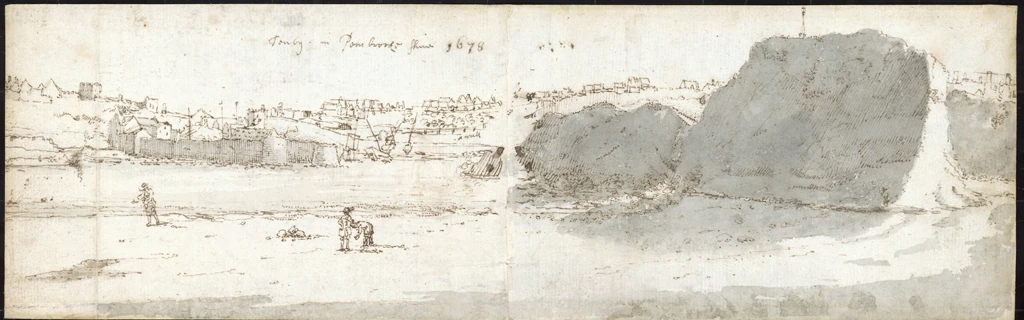
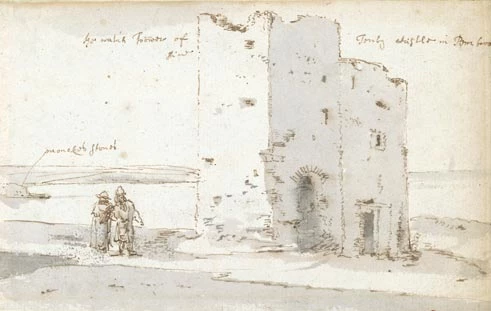
Tenby

Another example of folding over can be seen Tenby. The crease over on the left of the drawing shows the reverse.

<em>Tenby</em> (1678) Francis Place
Tenby

(1678) Francis Place - Sketchbook sheet 1

<em>Tenby</em> (1678) Francis Place.
Tenby

(1678) Francis Place. Sketchbook sheet 2

<em>Tenby</em> (1678) Francis Place. Digitally stitched together
Tenby

(1678) Francis Place. Digitally stitched together

Francis Place (1647-1728)

Emily O'Reilly, 10 February 2011

Francis Place 1678
Francis Place 1678

Amgueddfa Cymru has in its collection fifteen views of Wales drawn by Francis Place (1647-1728). Of these, ten are from a single sketchbook. These ten sketches, dated 1678, are the earliest images that the Museum holds of Wales that were drawn on-the-spot. But who was Francis Place?

Francis Place was a Yorkshire man, born into a wealthy family in 1647 and the youngest of ten children. His lawyer father decided that he should follow in his footsteps and at the age of seventeen or eighteen Francis entered Gray's Inn in London to study Law.

However he disliked law and the Great Plague in 1665 gave him his excuse to finish with his studies and return home. A short time later he returned to London and worked with Wenceslaus Hollar, who introduced him to printmaking and print selling in London.

There is some suggestion that Place received some or all of his inheritance before his father died in 1681, and it would have been this that enabled him to follow his passion for art and angling.

Royalty and the age of the Virtuosi

The seventeenth century was the age of the Virtuosi — likeminded men with money and leisure interested in art, science and philosophy, many of whom went on to form the Royal Society in 1660. In the first half of the century only royalty and those closely associated with royalty learned and practised the art of drawing and painting.

Towards the end of the century it began to be taken up by the landed gentry and their sons and daughters. They studied to acquire knowledge, which was very different from those who had to make a living from it. There is evidence that, although ostensibly an amateur, Place was paid for work, particularly early on.

So Place fits in very well with the gentlemen of the time; he had the time and the money and, from what survives of his work, he dabbled in many media including early experiments in porcelain.

He was a member of the York Virtuosi who included Martin Lister, Henry Gyles, Thomas Kirke FRS and William Lodge. It may have been through this group that he earned commissions.

With his fathers money Place travelled far and wide in the UK to sketch and practise the art of angling. We know from correspondence of the period that the sketches at Amgueddfa Cymru were carried out on a tour of Wales and the West Country in 1678. He was travelling with his friend and fellow York Virtuosi William Lodge.

Travelling at this time was not without its dangers as this was the time of the Popish plots, and it is known that while in Wales they both spent one night in jail under suspicion of being Jesuit spies.

Tenby Cliffs

Tenby cliffs original stetchbook

<em>Tenby Cliffs</em> (1678), Francis Place.

and after digital restoration:

<em>Tenby Cliffs</em> (1678), Francis Place.