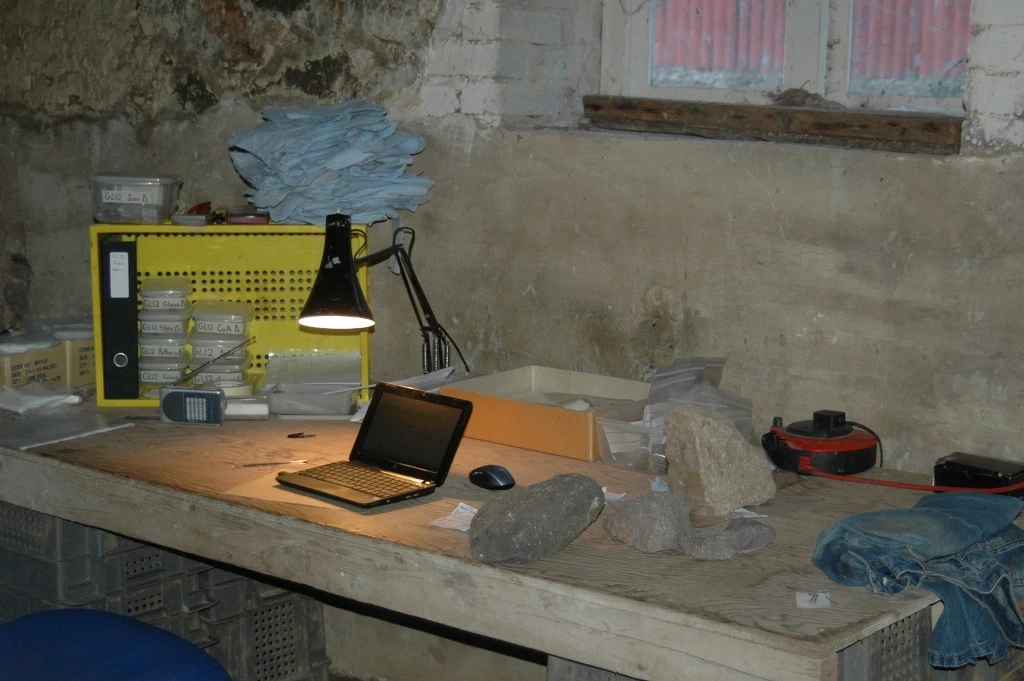
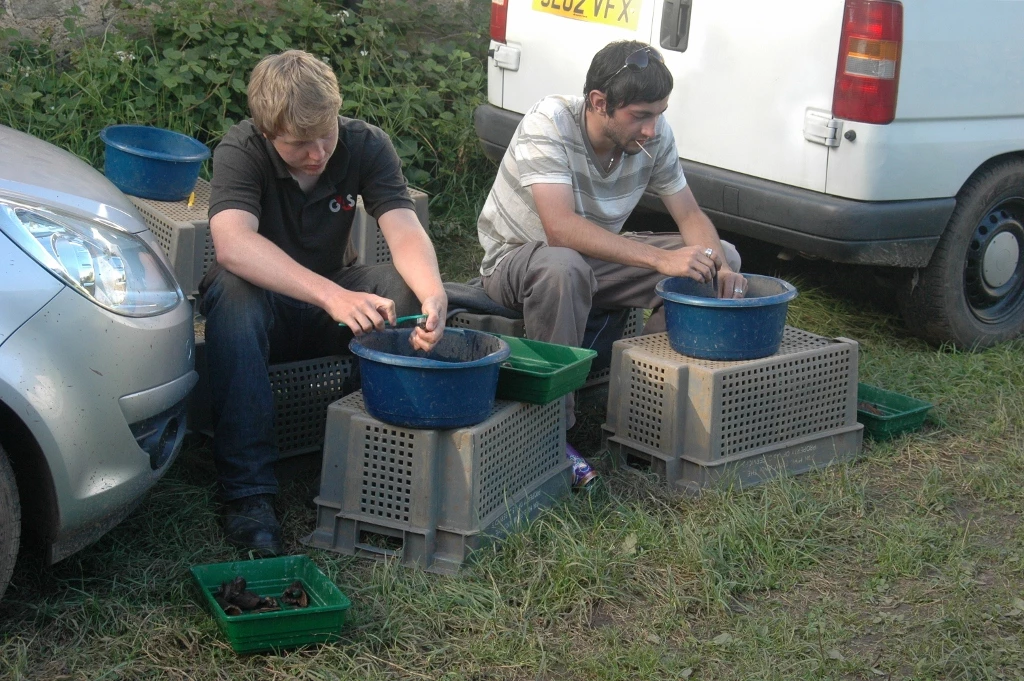
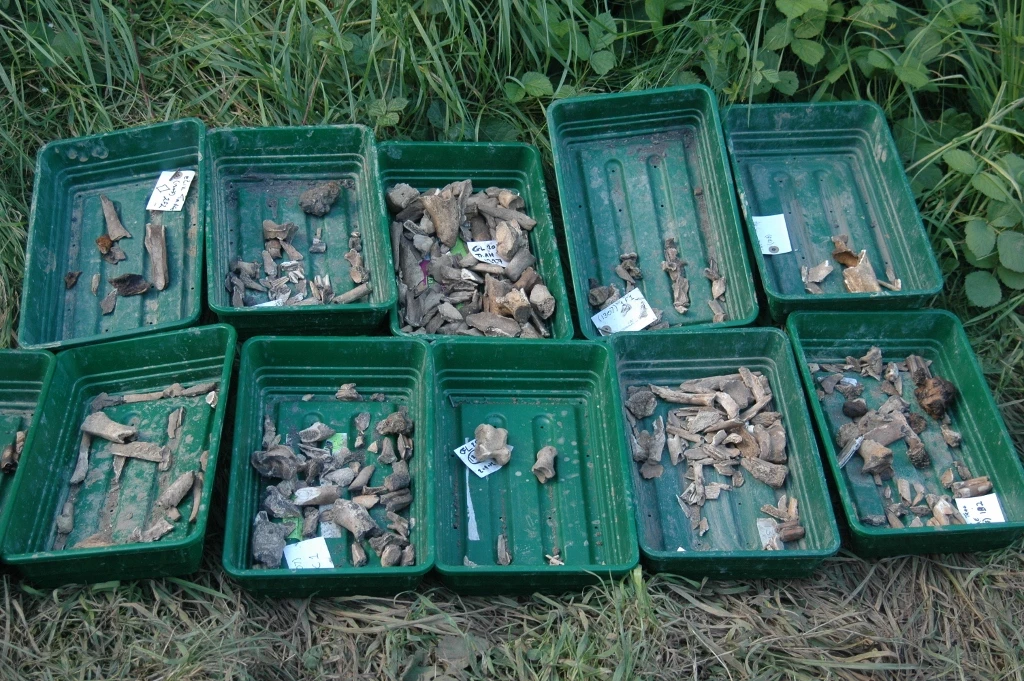
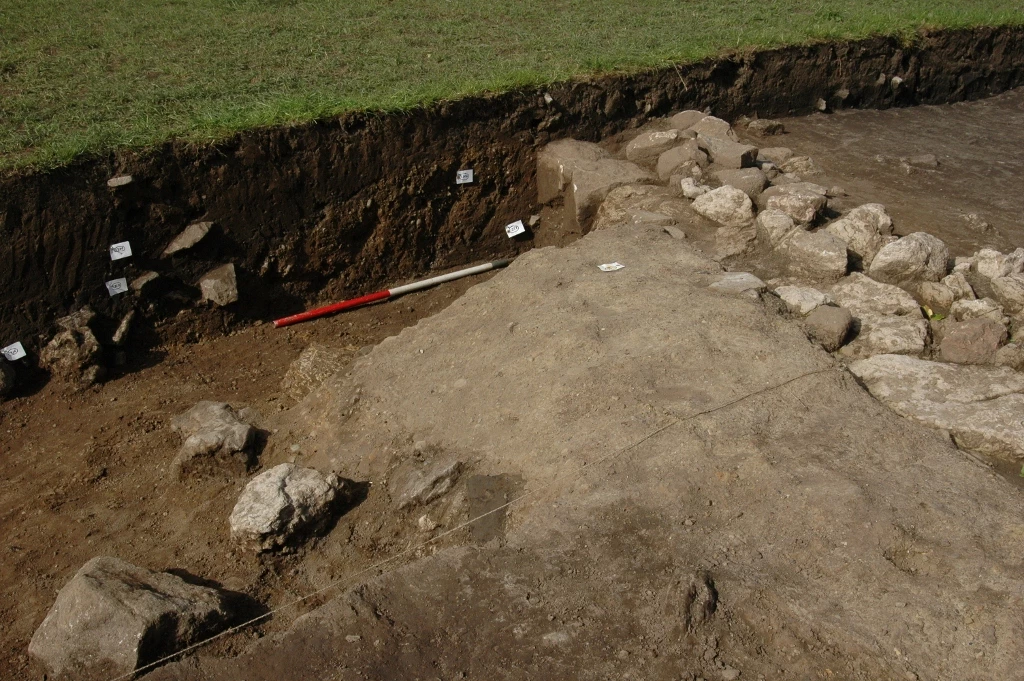
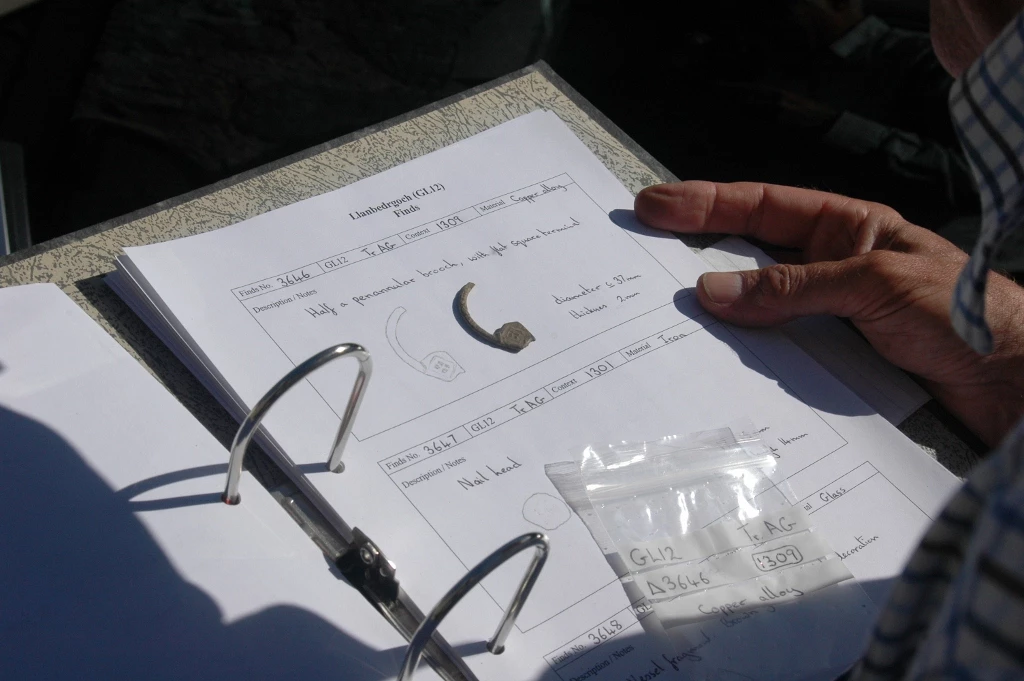
Return of the Vikings? 3rd September Julie Taylor, 4 September 2012 After two weeks of hard work by all the team to remove ploughsoil, and backfill from previous years’ excavation, the archaeological remains are finally being examined in detail. Today, one discovery brought the entire site to a halt, bringing everyone to gather around one of the smaller exploratory trenches opened last week. Following clearing rubble from the upper fill of the enclosure ditch, the longbone of a burial was found on the western side of the enclosure ditch. It is hoped that this exciting discovery will provide more information relating to a group of five skeletons previously found immediately to the south during the excavation seasons of 1998 and 1999. Weather conditions on site are currently excellent for the detection of archaeological features. This is exemplified by the discovery of a several archaeological features within an area previously excavated in 1998 at the east end of the main trench. Some of these features were previously known from the earlier season, but remained unexcavated because of a lack of time. Elsewhere in the main trench, the team has uncovered more of the enclosure wall defining the western boundary of the site, and have also begun the excavation of a slot through the enclosure ditch adjacent to that wall. Exploratory slots placed through midden deposits at the east end of the trench are finding animal bones in large quantities, which will provide valuable dietary information about the inhabitants of the site. These tantalising glimpses into the archaeology of the site are getting everyone very excited, and we look forwards to seeing what new discoveries await us during the next two weeks.Tudur Burke Davies
Return of the Vikings? Week One Julie Taylor, 29 August 2012 RETURN TO LLANBEDRGOCH (WEEK ONE)The unexpected discovery in 2001 of an intramural burial within the early medieval enclosed settlement at Llanbedrgoch raised a new series of questions about the site, its occupants, their activities and their relationships with other regions. We returned to the site a week ago, and the last eight days have focused on setting out the new areas of excavation, removing ploughsoil, monitoring weather forecasts and adjusting the daily tasks to make the best of at times trying conditions. The team of students includes volunteers from Bangor and Cardiff, and one from Toronto (Canada). Yesterday we were joined by some local, experienced, volunteers from Gwynedd and Anglesey. They have all been outstanding, and the early medieval archaeology of the site is already being transformed. Excavation is an ongoing process, and if you follow us over the next three weeks, the team will provide you with personal insights into the excavation.Even though the research design has clearly stated objectives, the work often reveals evidence of a completely different nature. Our return this year was in fact the result of such an unexpected discovery and its implications. The burial from inside the enclosure (Burial 6) was not revealed in plan through specific searching for inhumations, or the recognition of subtle changes in soil colour or character, but by the decision to cut a narrow trench through the early medieval ‘black earth’ midden material in the south-western area of the site in order to reveal the midden sequence and facilitate section drawing and sampling. In spite of the profound silence of the individual in this grave and those discovered in 1998-99, they continue since their discovery to help us answer in increasing detail a range of fundamental historical questions: How did the people of Llanbedrgoch and north-west Wales, who had contact with Anglo-Saxons, Irish and Scandinavians, respond to such peoples? How does the archaeological evidence for the politics and economy of early medieval Wales compare to that provided by other sources? Were the daily lives of people at Llanbedrgoch during the sixth and seventh centuries different from those in the ninth and tenth centuries? What types of diet and health did they enjoy? How did Christianity affect their lives and burial practices? We have already begun to answer some of these questions – one of the first artefacts to be found last week in the ploughsoil was a lead necklace pendant in the form of a cross – slightly larger than one found in an earlier season of excavation at the site. This site continues to amaze, surprise and inspire – follow us if you can. Mark Redknap
Return of the Vikings? Julie Taylor, 23 August 2012 After a gap of more than a decade, a team of archaeologists has returned to excavate at Llanbedrgoch, Anglesey. You can read more about previous seasons at this Viking-Age settlement here http://www.museumwales.ac.uk/en/archaeology/vikings/Mark Redknap and his team made an exciting discovery towards the end of the 2001 season - evidence that there might be an early medieval cemetery on the site. Are they right? Finds are appearing already, but what can they tell us? Watch this space to find out more!Mark is joined this season byEvan Chapman (Amgueddfa Cymru - National Museum Wales)David Griffiths (University of Oxford)Tudur Davies (University of Sheffield)Brian Milton, an experienced archaeologist from Cornwall who has spent many seasons at LlanbedrgochArchie Gillespie, one of the two metal detectors who originally found the site and who is a dab hand with the archaeological trowel too.Students from Cardiff, Bangor and Toronto Universities, and other volunteers.Hopefully you'll get to hear more about them as the dig progresses over the next 3 weeks.
Radio 2 Arts Show - tonight Sara Huws, 27 July 2012 Twice in one week? Just a quick post before I succumb to blog fever:On tuesday, I visited the BBC in Llandaf to talk a bit about my work, and St Fagans in general, for the Radio 2 Arts Show. This week, Penny Smith is standing in for Claudia Winkleman, so it's a good job I decided to forego the nude-coloured-lipstick tribute I had planned. The interview was conducted across the BBC aether - me in front of a box of very compelling lights and buttons, them in a padded room in London - and so I did end up feeling overdressed all the same.Anyway, we had great fun, even though the question of the Welsh language's perceived lack of vowels did come up, which can sometimes lead to a leap in my blood pressure. I consider it a public service to have tackled that myth with grace and aplomb. Tune in to see if you agree! Radio 2 Arts Show - 22:00 Friday 27 July
Making blogs while the sun shines Sara Huws, 26 July 2012 Reading back over my entries, it seems I only really like posting here when the sun is shining! It's another beautiful day at St Fagans and it seemed only right to fire up the blogging engine and start writing.You'll find us in a very cheerful mood at the moment: after many months of working collaboratively, we handed in a dossier as thick as a loaf of bara brith to the Heritage Lottery Foundation. They, in turn, pored over it and decided to award St Fagans with a whopping grant of £11.5 million, to fund its redevelopment. We still have a few quid to raise in order to reach our goal, and so the '£1 appeal' was launched last week. Its message? If you've got a pound to spare, then we promise to do something amazing with it!Our plans for the future, while unbelievably detailed, still seem a bit distant and unreal - but soon enough, you'll start to see the site start to change. The museum, as an entity, will change, too - and we hope you'll come along with us for the ride. We want to open up how we work, and give people from all walks of life a chance to take part in the day-to-day life of the museum.At the moment, though, it's business as usual.My Tudor Plant walks went off without a hitch (and by hitch I mean rain and slugs). I was joined by students from England, France, Germany and Japan, as well as a couple of English/Welsh/Spanish families. I was a linguist in a former life and so dredged as much vocabulary as I could from the back of my mind, so that everyone could follow the tour. We tasted and smelled our way around the gardens, where 16th century varieties still grow. We usually discourage people from picking plants while they're here, to leave enough for our furry/feathered residents - but on this occasion, we were allowed to have a nibble here and there. Thankfully, Bernice and Paul from the gardens department have been kind enough to teach me which ones to eat, and which to avoid!Yesterday, I met with students from Cardiff University yesterday, to talk about how we can use information and objects from excavations to engage the public. We looked at all sorts of things: from the pigments on the church walls to cauldrons and Tudor toilet-seats. This morning, I helped Sian and Ian take eighty-four (we counted) cardboard shields up to the Celtic Village for a painting workshop.The reason I find myself in the office is because I am preparing a lecture for the Eisteddfod. I'm honoured to be speaking, and want to make sure I show off St Fagans in its best light! The topic of the talk will be murals from the Vale of Glamorgan - reading about all these little fragments has me keen to traipse around a graveyard with my camera pretty soon.I hope you're enjoying this sunny spell - if you're thinking of coming to see us, then have a look here for our upcoming events. If you're coming by bus, remember that, as well as the number 32, you can now catch a band new shuttle bus, the number 5, which takes you from the steps of the National Museum in Cardiff, right to our front door.PS: next time there'll be pictures, I promise!