: Cultural Life

Captain Scott’s Welsh Flag

Elen Phillips, 1 March 2012

 The <em>Terra Nova</em>  leaving Cardiff on 15 June 1910. The Welsh flag flies from the mizzen mast, while the White Ensign flies from the mizzen gaff. On the foremast is the flag of the City of Cardiff.

The Terra Nova leaving Cardiff on 15 June 1910. The Welsh flag flies from the mizzen mast, while the White Ensign flies from the mizzen gaff. On the foremast is the flag of the City of Cardiff.

 The Welsh flag made by Howell & Co and presented to Scott's Expedition.

The Welsh flag made by Howell & Co and presented to Captain Scott's Antarctic Expedition.

Full-page advertisement for James Howell & Co - featured in a guide to the National Pageant of Wales, 1909. Published by the Great Western Railway Co.

Full-page advertisement for James Howell & Co - featured in a guide to the National Pageant of Wales, 1909. Published by the Great Western Railway Co.

The textile collection of Amgueddfa Cymru includes several Welsh flags. Most were originally hoisted above civic buildings; one has even flown in outer space! The oldest and largest example in the collection is associated with another daring mission — Captain Robert Falcon Scott’s 1910–13 British Antarctic Expedition.

The flag in question was displayed at a departure dinner held for Captain Scott and his officers in Cardiff on 13 June 1910 and was flown on the Terra Nova as the ship sailed from Cardiff and when she returned in 1913.

On St David’s Day 1911 and 1912, the flag was hoisted in Antarctica at Scott’s expedition base hut.

Made from a coarse woollen fabric, with selvages at the top and bottom edges, the flag measures an impressive 3.45m x 1.83m. The dragon motif is a cut-out which has been machine stitched to the green and white ground fabric. Details — such as its claws, tongue and eyes — have been achieved using black and white paint.

James Howell & Co. of Cardiff

We do not know who stitched and painted the flag, but we do know that it was made by James Howell & Co in Cardiff, probably by its dressmaking department.

During a lunch held for Lieutenant E. R. G. R. Evans of Scott’s expedition on 1 November 1909, Howell’s offered to make a large Welsh flag for him ‘to take to the South Pole’. Evans had given up plans for his own Welsh Antarctic Expedition and had joined Scott as second-in-command.

Evans was particularly influential in drumming up publicity and donations to the expedition, largely through the editor of the Western Mail, Willie Davies — it was Davies’s wife who came up with the idea of presenting a Welsh flag to the expedition.

Cardiff ‘one of the most enterprising cities in the Empire’

The inhabitants of Cardiff, in particular, had embraced the British Antarctic Expedition like no other region. Having achieved city status in 1905, Cardiff’s civic leaders were on a re-branding mission. They wanted, in the words of the Town Clark, J. L. Wheatley, to promote Cardiff ‘as one of the most enterprising cities in the Empire’.

Closely associating the city with Scott’s voyage to Antarctica — one of the last great frontiers — was indicative of this newfound civic confidence.

James Howell was a prominent figure within Cardiff’s business community. His department store, James Howell & Co., established in 1865, was the largest of its kind in Wales. It is of no surprise that James Howell felt compelled to contribute in some way to Scott’s venture. He had a track-record of ‘sponsoring’ civic events in Cardiff. In early 1909, he supplied one of his buildings on Wharton Street free-of-charge to the National Pageant of Wales.

Postcard issued to commemorate the National Pageant of Wales, 1909

Postcard issued to commemorate the National Pageant of Wales, 1909

The Marchioness of Bute as 'Dame Wales' at the National Pageant of Wales, July 1909.

The Marchioness of Bute as 'Dame Wales' at the National Pageant of Wales, July 1909.

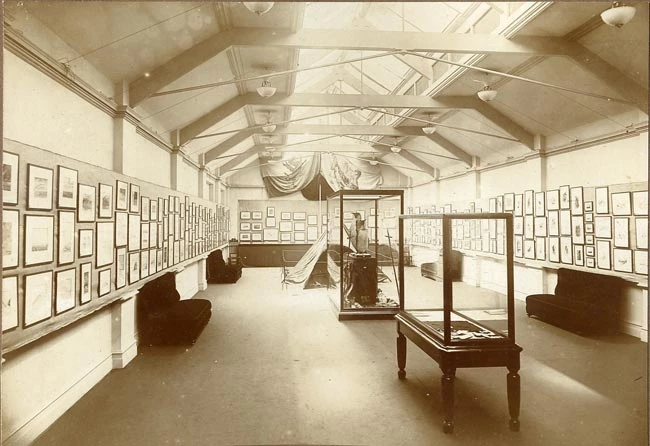
1914 temporary exhibition of Edward Wilson's Antarctic watercolours and sketches

In the summer of 1914, the Museum held a temporary exhibition of Edward Wilson's Antarctic watercolours and sketches. Wilson was Chief Scientist on Scott's expedition and died with him on the return journey from the South Pole in 1912. The exhibition was held in the City Hall as the Museum building was still under construction at that time.

 The Welsh flag and the flag of the City of Cardiff, both flown on the <em>Terra Nova</em>  were displayed on the wall at the back of the exhibition. The two penguins in the display case are still in the Museum's collections.

The Welsh flag and the flag of the City of Cardiff, both flown on the Terra Nova were displayed on the wall at the back of the exhibition. The two penguins in the display case are still in the Museum's collections.

National Pageant of Wales

The National Pageant was essentially the great and the good of high society re-enacted scenes from Wales’s heroic past. The Pageant organisers required 40,000 items of costume and a team of 800 ‘lady workers’ were drafted in to help. For six months, the ladies set up camp in Wharton Street. As a Pageant sponsor, Howell would have also supplied professional dressmakers from his own workforce. Indeed, the iconic ‘Dame Wales’ dress worn in the Pageant’s opening scene on 26 July 1909 is remarkably similar in execution to the Terra Nova flag.

Both the dress and the flag have similar, naïvely designed, appliquéd Welsh dragon motifs. Made probably only months apart in workrooms associated with James Howell & Co., could they have been stitched by the same hands?

The Welsh Dragon of the 1890s

The dragon on the Terra Nova flag is noticeably different from that on today’s flag. It is more upright, a dragon segreant, rather than a dragon passant. This style of dragon was common during the 1890s and early 1900s. It can be seen, in various guises, on eisteddfod bardic chairs from this period, as well as on a host of other national insignia. The dressmakers of Howell’s probably adapted the Terra Nova dragon from such sources.

Standardising the Welsh Flag

In 1910, the National Eisteddfod of Wales wrote to the Museum asking for advice on the design of the dragon: ‘We are anxious to have as near as possible the true form of the device’. A curator replied: ‘I regret to say that we have no authentic specimen of the animal in the National Museum’. The letter was handed to Mr Thomas Henry Thomas, a recognized authority on these matters, who had for many years attempted to standardise the Welsh dragon. His sketches and papers are now deposited at the Museum.

The flag gets cut up for souvenirs

When the Terra Nova returned to Cardiff in June 1913, with this Welsh flag flying from the mainmast, the Western Mail noted that it was ‘considerably smaller than when first hoisted three years ago. While the Terra Nova was berthed at Lyttleton, in New Zealand, the representatives of the Welsh societies at that port were allowed to cut away portions of the flag and to keep them as mementoes of the expedition’.

At a dinner held in the Royal Hotel on 16 June 1913 to mark the expedition’s return to Cardiff, Teddy Evans announced that the flag was to be given to the National Museum of Wales. However, following the festivities there seems to have been some confusion as to what Evans had done with the flag. He thought he had given it to the Lord Mayor, but in fact it was found in the Royal Hotel some four months later!

Hooks, wheels and rag dolls

16 December 2011

Home-made toys

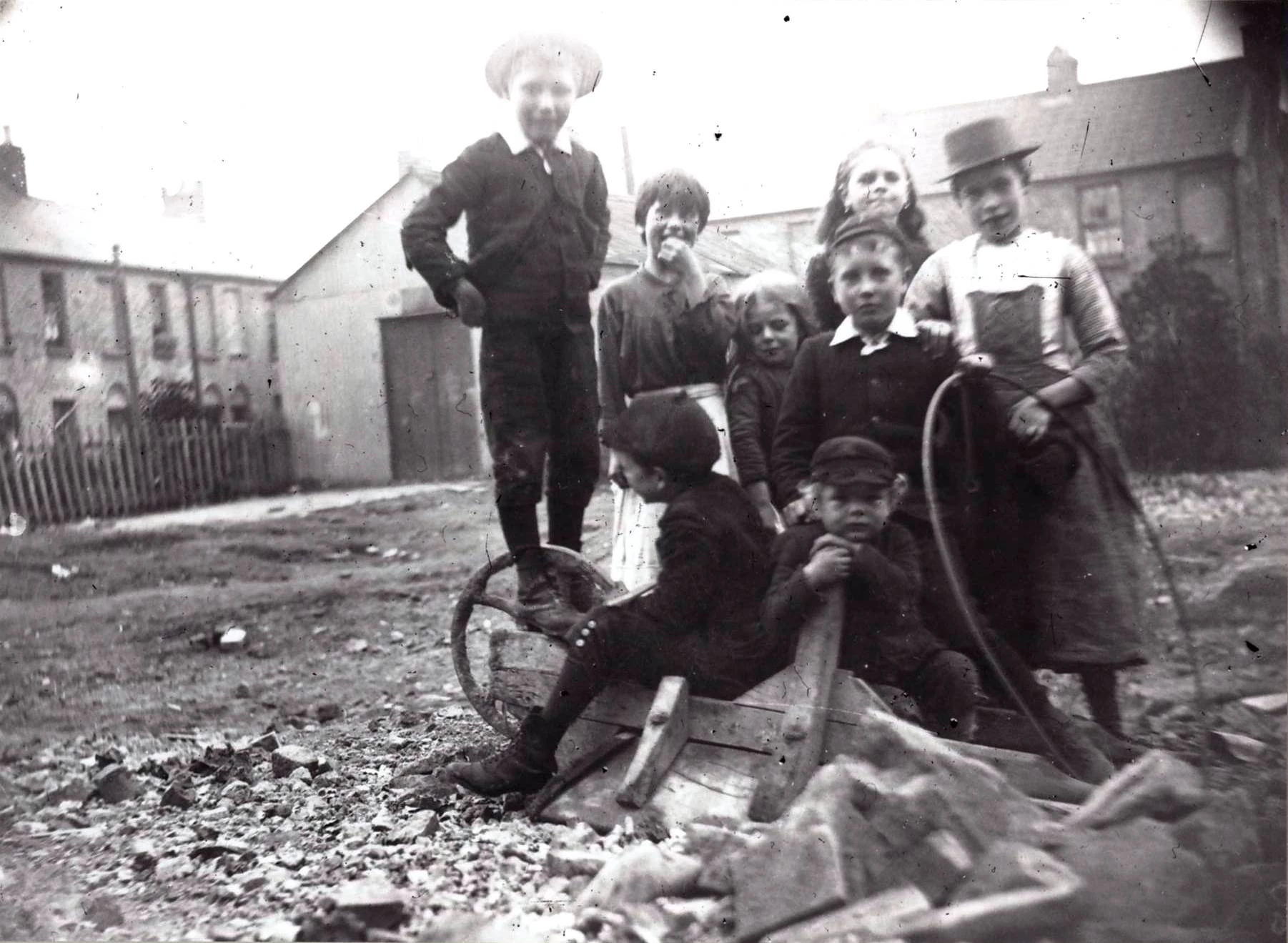
Children playing in Cardiff, c1892

A group of children, photographed around 1892 in Rowe Square, Cardiff, with one holding an iron hoop and two others sitting on what appears to be an upturned wheelbarrow.

In Wales, as in many parts of the world before the rise of factory-produced items, the toys of yesteryear consisted of unsophisticated, home-made objects, constructed from whichever raw materials were locally available. Wood was the main material used to make children's toys, as it could easily be shaped into a wide variety of objects such as dolls, spinning tops and rattles. Also popular were iron hooks and wheels and footballs made from pigs' bladders. These were commonplace at home and in schoolyards and would entertain children for hours. Being in possession of a ball opened the door to a host of exciting team games such as rounders, hand ball and football, especially for boys, while both boys and girls would roll wooden or iron hoops to their hearts' content, either on their own, or in competitions to see who could roll the fastest, the slowest or the furthest.

Treasured possessions

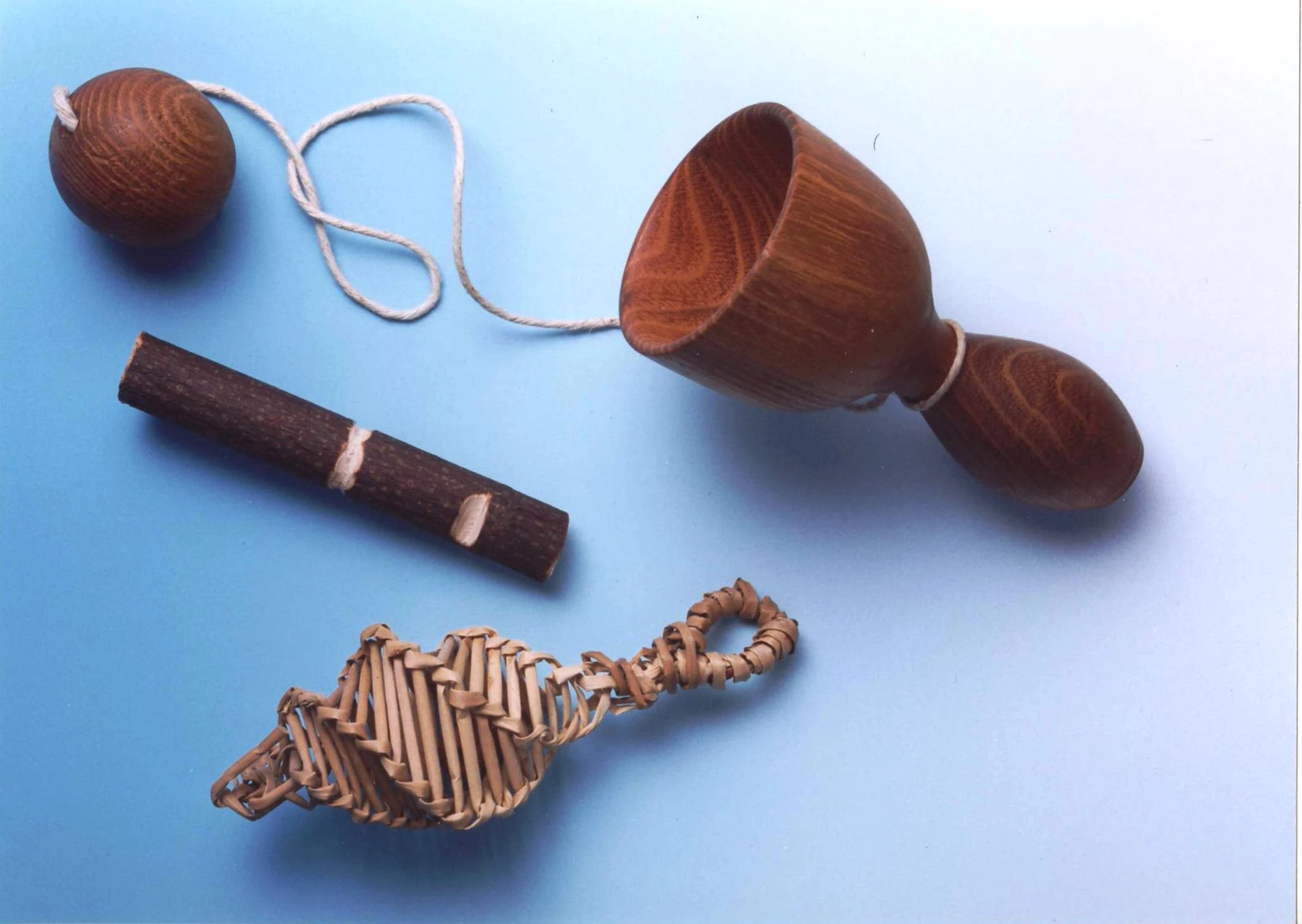
Cup and ball, whistle and rattle

Homemade toys such as these were played with in Wales before the rise of factory-made products. The cup and ball, whistle and rattle shown are modern replicas.

Folk toys describe playthings made either by the child, or by parents or craftspeople according to the child's wishes. In nineteenth-century Wales children from poor families where little money was available for life's essentials, let alone playthings, owned only the simplest of toys. These, however, would have been treasured possessions and a means of escaping the harshness of daily life. With poverty the reality for many families at this time, making one's own forms of entertainment and amusement was a necessity, and children were justifiably proud of fashioning their own toys out of nothing.

All that was needed for a paper kite, for example, was a light wooden frame and some paper, while even the youngest children could create a hobby horse from a stick and a considerable amount of imagination. For a see-saw, two wooden planks were often placed one over the other on a barrel. Two children would then sit either end, happily rocking up and down until they tired. Ropes could be used for skipping, or climbed by securing one end to a strong branch, leaving the other end free to be scaled by the brave and fearless. For boys, creating such objects as paper kites, toy boats or catapults was extremely satisfying, while girls could use their needlework skills to make rag dolls and dolls' house pieces, or play drapers' shops using little scraps of material.

Mass-produced toys

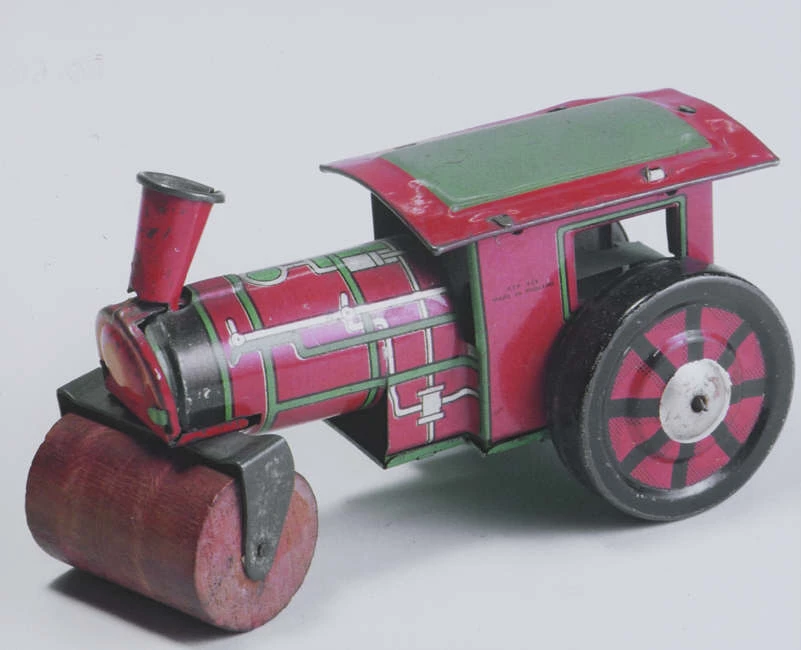
Toy steamroller made by Glamtoys Ltd

Toy steamroller, produced by Glamtoys Ltd at Treforest Industrial Estate, late 1950s

Until the early twentieth century, bought toys belonged almost exclusively to the wealthy. As methods of mass-production improved, however, more affordable toys were made available. These transformed the toy market in Wales and elsewhere. Toy factories were opened in great numbers, and as their marketing and advertising campaigns became increasingly high profile, they reached children of all social backgrounds. As a result the simple folk toy became surplus to the requirements of most youngsters, who stopped making their own toys and saved their pennies for the brightly-coloured, decorative and more fashionable shop-bought versions.Although home-made folk toys are often regarded today as somewhat quaint and quirky, in recent years a growing number of craftsmen have begun to turn their hand to toy-making, perhaps in reaction to the large number of factory-made items shipped into Britain from elsewhere. Despite the continuing dominance of commercially-made toys, most people would agree that home-made objects possess a more enduring appeal, for who could deny the innocent and timeless charms of such items as a knitted finger-puppet or a painted peg-doll? The unique individuality of hand-crafted pieces and the care and patience that have gone into their creation undoubtedly tell us more about the maker than a mass-produced Barbie or computer game ever could.

Witch-bottles and healing charms

16 June 2011

Bitten by a mad dog or cursed by a witch?

Ever wondered what you should do if you were bitten by a mad dog or cursed by a witch? In Wales it was a common practice, as late as the nineteenth and twentieth centuries in some parts, for people to use various kinds of charms for healing or protection against witchcraft. These could be in the form of prayer-like words, which were recited or written on a piece of paper to be safely hidden, while objects such as shoes or stones were also believed to cure illnesses and bring good luck.

Snakestones

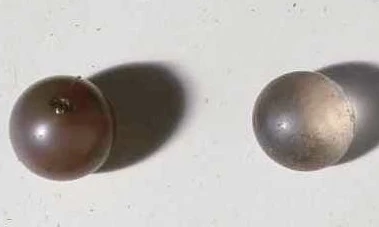
Adder stones from Pen-tyrch, Glamorgan

Adder stones from Pen-tyrch, Glamorgan

The most renowned stone charms in Wales are the Maen Magl or Glain Nadredd — snakestones. In 1695 Edward Lhuyd described these as Cerrig y Drudion — Druid stones. The belief was that they were created when snakes joined their heads together, forming a kind of bubble about the head of one snake. This 'bubble' is similar to a glass ring like the one found at Twyn-y-tila, Caerleon, and was thought to bring good luck to whoever found it. It was also believed to be a remedy for eye diseases and was often in great demand. The term Maen signifies a stone and Magl is an ancient word for an eye ailment such as a stye. The water in which the stone had been soaked could be dabbed on the affected area, but the most common form of treatment involved rolling or rubbing the stone over the eyelid. People used to use the expression 'fel y glaim', literally 'like the stone', to mean very healthy.

A cure for rabies

Hydrophobia stone from Henllan, Ceredigion

Hydrophobia stone from Henllan, Ceredigion

The Llaethfaen or hydrophobia stone, thought to cure rabies, is a variant of the Maen Magl. In his Folk-Lore of West and Mid Wales, Jonathan Ceredig Davies wrote about a llaethfaen that was 'very much in request' because it was widely believed to cure those bitten by a mad dog, a common problem in the nineteenth century. Whether it had curative or preventative powers, those who used the stone were said to be safe from hydrophobia. Iolo Morgannwg described seeing a stone like this in Pembrokeshire in 1802, when he met a man who carried one around the country. He would scrape it into a powder which could be dissolved into a drink, and sell it for five shillings an ounce as a remedy for rabies.

Witch-bottles and pots

Now a witch bottle is a totally different kind of charm. Take this eighteenth- century Buckley pot, or witch-bottle, found buried at the foot of an old yew tree at Allt-y-Rhiw farmhouse near Llansilin, Powys. What is interesting about the jug is that a quarter if it was filled with lead. This suggests that it was used as some form of protection or, indeed, as a means of sealing or capturing a troublesome spirit, similar to the concealed shoes in our collection. Often with witchcraft beliefs the act of sealing an object within a bottle or pot symbolised the entrapment of the evil spirit, and so was used as a protective charm. There are many tales of troublesome ghosts being 'put down' in this way, like the ghost of 'Lady Jeffreys' who was persuaded to enter a bottle which was corked and sealed and thrown into the pool underneath the Short Bridge in Llanidloes.

Conjurers or dynion hysbys

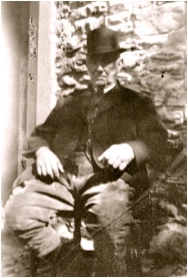
Mr Evan Griffiths, a conjurer from Llangurig, mid Wales,  1928

When any bad luck occurred a conjurer was consulted to discover who had done the "witching", one such conjurer was Evan Griffiths from Pantybenni.

People who had been bewitched could also carry out their own counter-magic rituals by placing sharp objects like thorns and pins inside a bottle, which was usually filled with the victim's urine. It was then sealed and boiled over the fire or buried under the hearthstone. This was believed to torment the witch into revealing her identity, thereby breaking the spell. The bottle symbolised the witch's bladder, and so the sharp objects were believed to cause her much pain. Alternatively, you could buy a charm from a dyn hysbys — wise man. These figures were very common in Wales at one time, and their services ranged from countering witchcraft, healing, and astrology, to fortune telling and uncovering lost property.

In the nineteenth and early twentieth centuries Llangurig was especially famous for its dynion hysbys. Charms against witchcraft were written on a piece of paper which was carefully rolled up and sealed inside a bottle. This was then placed under the hearth or hidden in one of the main beams in the house, thus ensuring protection from witchcraft and any other evildoer. Should you find one of these charms, as with the concealed garments, remember to take photographs and record the details of exactly where you found it, and contact your local museum. Whatever you do, mind, always remember to keep the bottle sealed!

The Gorsedd Circle

25 July 2010

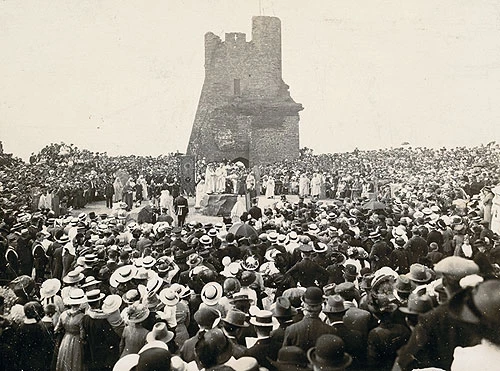
A ceremony in the Gorsedd Circle at Aberystwyth, c. 1916

A huge crowd watching a ceremony in the Gorsedd Circle, in the Castle grounds, Aberystwyth, either during the Proclamation Ceremony, 1914 or during the Eisteddfod week itself, 1916.

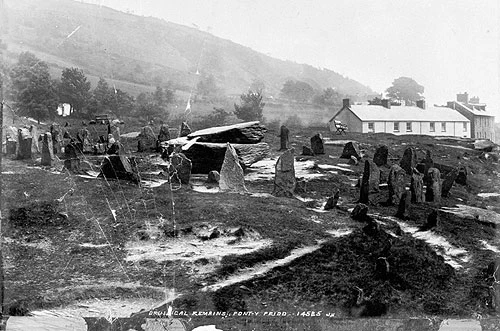
The Maen Chwŷf and Gorsedd Stones, Pontypridd

The Maen Chwŷf and Gorsedd Stones, Pontypridd

The Proclamation Ceremony,Newpor t and District National Eisteddfod, 1987

The Proclamation Ceremony for the Newport and District National Eisteddfod, 1987 with Elerydd (W.J.Gruffydd) as Archdruid and Gwyn Tre-arth leading the singing on the Logan Stone.

New Gorsedd members invested at Swansea, 1962

Successful young candidates (13-14 years old) in the Gorsedd examinations, invested as members in Swansea, 1962.

The Proclamation Ceremony

The visit of the National Eisteddfod and the Gorsedd of the Bards to a specific area has to be proclaimed at least a year and a day in advance. During the ceremony the Recorder reads the Proclamation Scroll and the first copy of the list of competitions for the following year's National Eisteddfod is presented to the Archdruid.

When Lord Rhys held a competition for poets and musicians at his court in Cardigan castle in 1176 it was noted that it had been proclaimed throughout Wales, Scotland, Ireland, England and the other islands a year in advance. This custom was revived when eisteddfodau were re-established in Wales at the end of the eighteenth century and likewise, in 1791, Iolo Morganwg chose to proclaim that the Gorsedd of the Bards of the Isle of Britain would hold its first ceremony on Primrose Hill, London, on June 21, 1792. This pattern has been adhered to ever since.

From pebbles to fake stones

The Proclamation Ceremony and other Gorsedd ceremonies held during the week of the National Eisteddfod are held within the Gorsedd Stone Circle.

The remarkable stone remains at Avebury in Wiltshire and Dyffryn Golych, in his native county, probably influenced Iolo Morganwg's vision of a Celtic druidic stone circle. Thus, the first Gorsedd in 1792 was held within a circle of stones, with a Maen Gorsedd at its centre. However when Iolo came to link the Eisteddfod and the Gorsedd at Carmarthen in 1819 all he had to hand was a fistful of pebbles. Only Bards were allowed within this sacred circle of stones.

In Glamorganshire the Maen Chwŷf, a huge slab of slate stone, near Eglwysilan, was seen as a natural gorsedd and several meetings of the Glamorgan Chair were held on it during the first half of the nineteenth century.

Towards the end of the century, in order to inform future gorseddau, the Herald Bard - Arlunydd Pen-y-garn made a detailed plan of the Gorsedd Circle, and this was followed in the Cardiff Eisteddfod, 1899. According to this plan the stone to the east, the Maen Cyfamod, and the two Portal stones formed the shape of the mystic mark. For a time it was fashionable to dress the stones with oak and mistletoe leaves. To facilitate holding the Gorsedd Circle on the Eisteddfod field itself during the week of the Eisteddfod, it was decided in 2004 to use fake (but realistic-looking) stones.

The Circle during Eisteddfod week

The Monday morning rites

The Hirlas Horn (the horn of plenty) is presented to the Archdruid and the Celts and other representatives from abroad are welcomed by the Gorsedd. The Recorder commemorates those Gorseddogion who have died during the past year and a hymn of remembrance is sung. Then the ceremony of admitting new members through examination or degree to the Order of Ovates or Order of Bards takes place.

The Friday morning rites

The Blodeuged (the gift of flowers) is presented to the Archdruid and the Floral Dance is performed. New honorary members are admitted to the Order of Druids in Gorsedd.

Admitting new members

The Gorsedd of the Bards has three orders/degrees:

  • The Order of Ovates: in green robes. Candidates who pass Levels 1 and 2 in Gorsedd examinations in poetry, prose, music, or the tests for harpists and singers are admitted into this order. Members can be admitted to the order as honorary members for contributions of national significance. Several members of the royal family, including Queen Elizabeth, the Duke of Edinburgh and King George, have been admitted to this Order.
  • The Order of Bards, in blue robes. Those who have passed the final Gorsedd examination are admitted to this order. Those who have gained a degree in Welsh or Music (and who can speak Welsh) can also be admitted.   
    Members are admitted to these orders during the Monday morning ceremony in the Gorsedd Circle. The Herald Bard and the Bearer of the Grand Sword walk towards the entrance to the Circle and hold the Sword across it to bar the way. Every new member places his/her right hand on the Sword's blade. After a new member has been admitted he/she is led by the Marshalls to the Mistress of the Robes to be invested with his/her Order's head-dress.
  • The Order of Druids: in white robes. The winners of the main competitions - the Chair, the Crown and the Literary Medal - are admitted automatically to this Order. Others are 'elevated' to be Druids from the green or blue Orders. Every year, too, those who have served the nation, the Welsh language and its culture are honoured by being admitted to the Order of Druids, among them world-famous singers and actors such as Bryn Terfel, Sian Phillips and Ioan Gruffudd; influential Welshmen such as the Archbishop of Canterbury, the Right Reverend Rowan Williams and star footballers and rugby players.

Iolo differentiated between the bardic orders in the first Gorsedd ceremony in 1792 although he also emphasised that they should be considered equal in status. By the second half of the nineteenth century there was real concern regarding the merit of Gorsedd degrees. The scholar, John Morris-Jones, was the severest critic, because, he claimed, 'candidates are admitted as members through an examination which is five times easier than the most basic University of Wales examination ...'. As a result candidates came to be examined more stringently in order to raise standards.

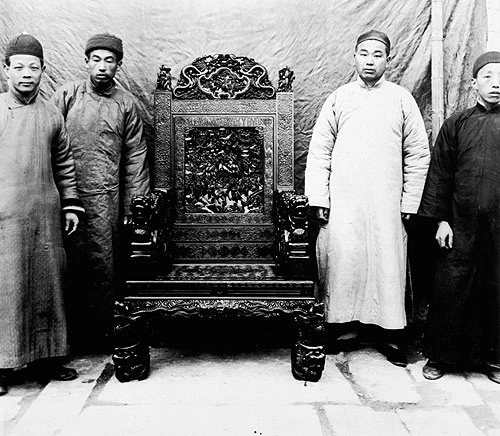
Made in China: the 1933 Eisteddfod chair

25 July 2010

Made in China: Wrexham National Eisteddfod Chair, 1933

Wrexham National Eisteddfod Chair, 1933; the gift of J.R.Jones, Shanghai. With the chair are the craftsmen who made the chair.

It took the craftsmen in the photo over a year to carve this Eisteddfod chair. The chair was carved at the T’ou-se-we Catholic orphanage, on the outskirts of Shanghai. This orphanage, founded by Catholic missionaries in 1852, had many workshops teaching skilled crafts such as woodcarving, painting, printing, tinplate and stained glass workshops, and photography.

The chair was given as a prize for the National Eisteddfod at Wrexham in 1933 by a successful Welshman living in Shanghai. Dr John Robert Jones(b. Llanuwchllyn 1887,d. Hong Kong 1976) was a barrister and an avid Eisteddfod-goer who also showed great interest in Chinese art and culture. He went to Shanghai in 1924, became General Secretary of International Council in 1928, and was a leading figure in the Shanghai branches of the Royal Asiatic Society and Cymdeithas Dewi Sant. It was his idea to commission the craftsmen of T'ou-se-we to make the chair.

The winner of this chair in 1933 was Trefin (Edgar Phillips) for his poem entitled Harlech. An almost identical chair, also made at T’ou-se-we, was won by the poet Gwenallt in the 1926 Swansea Eisteddfod.