: Myths & Legends and Folklore

Uncovering our Collections: Half a Million Records now Online

26 March 2018

As we reveal half a million collection records for the first time, we look at some of the strangest and most fascinating objects from National Museum Wales Collections Online.

This article contains photos of human skeletal fragments.

The Biggest

We have some real whoppers in our collections - including a full-size Cardiff Tram and a sea rescue helicopter - but the biggest item in our collection is actually Oakdale Workmen's Institute.

Built in 1917, the Institute features a billiard room, dance hall and library - and is nowadays found in St Fagans National Museum of History.

Photograph from 1908 showing Horace Watkins in a very early, precarious-looking monoplane

Horace Watkins testing his monoplane in 1908

Many of the buildings in St Fagans are part of the national collection - meaning they have the same legal status as one of our masterpiece Monets or this coin hoard. The buildings are dismantled, moved, rebuilt - and cared for using traditional techniques, by the museum's legendary Historic Buildings Unit.
 

The Oldest


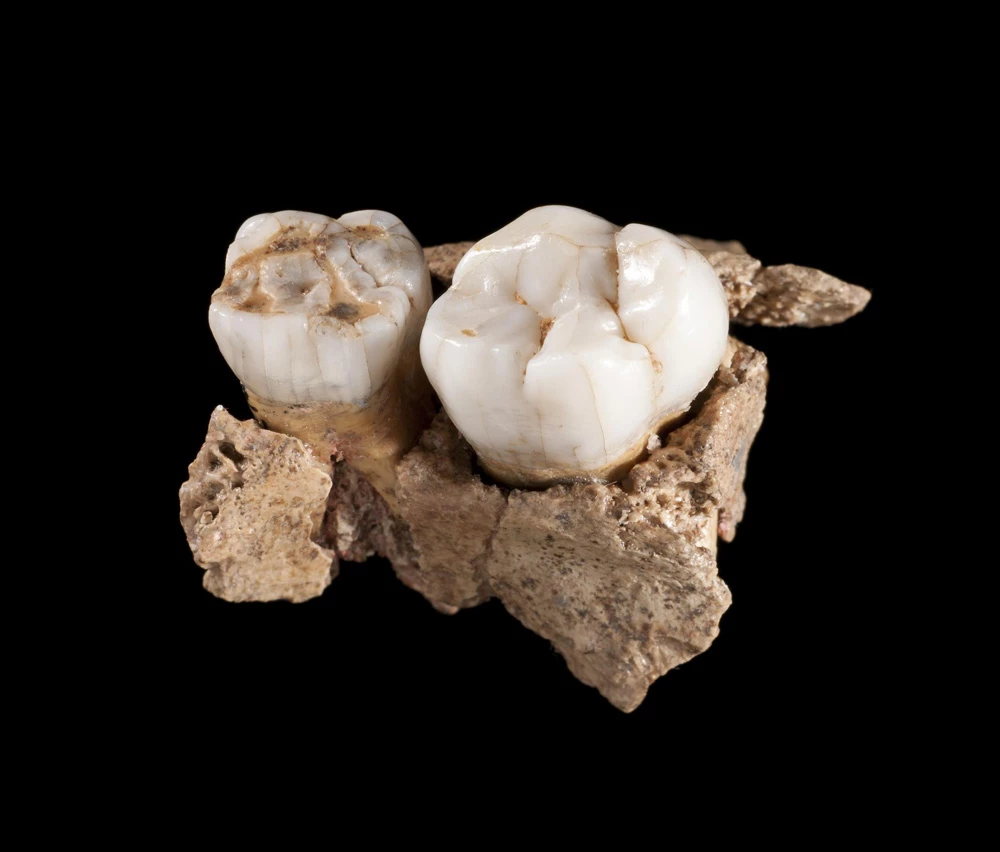
photograph of two teeth, belonging to a Neanderthal boy aged 8

The oldest human remains ever discovered in Wales

These teeth belonged to an eight year-old Neanderthal boy - and at 230,000 years old, they are the oldest human remains in Wales.

They were discovered in a cave near Cefn Meiriadog in Denbighshire, along with a trove of other prehistoric finds, including stone tools and the remains of a bear, a lion, a leopard and a rhinocerous tooth.

These teeth are among some of the incredible objects on display at St Fagans National Museum of History
 

The Shiniest

People in Wales have been making, trading and wearing beautiful treasures from gold for thousands of years - like this Bronze Age hair ornament and this extremely blingy Medieval signet.


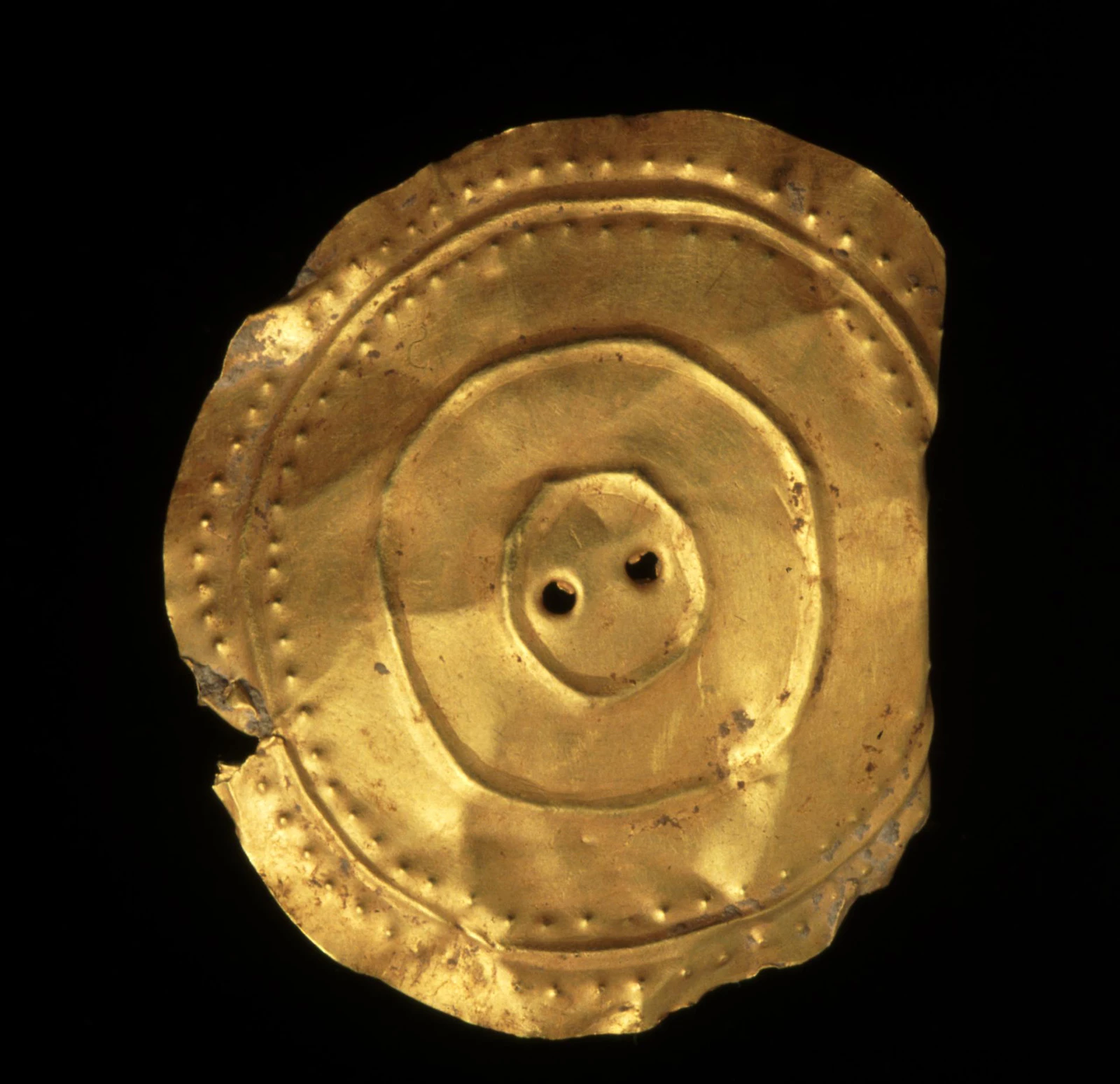
photograph of gold disc with repousse design

At around 4000 years old, this sun disc is one of the earliest and rarest examples of Welsh bling

One of the earliest examples of Welsh bling is this so-called 'sun disc', found near Cwmystwyth in Ceredigion.

Current research suggests that these 'sun discs' were part of ancient funeral practice, most likely sewn onto the clothes of the dead before their funerals. Only six have ever been found in the UK.
 

Most Controversial

At first glance, an ordinary Chapel tea service - used by congregations as they enjoyed a 'paned o de' after a service. A closer look reveals the words - 'Capel Celyn'. The chapel, its graveyard and surrounding village are now under water.


Photograph showing a cup and saucer with 'Capel Celyn' and a ribbon scroll design

Capel Celyn, in the Tryweryn Valley, is now underwater

Flooded in 1965 by the Liverpool Corporation, the Tryweryn valley became a flashpoint for Welsh political activism - creating a new generation of campaigners who pushed for change in how Welsh communities were treated by government and corporations.

Curators from St Fagans collected these as an example of life in Capel Celyn - to serve as a poignant reminder of a displaced community, and to commemorate one of the most politically charged moments of the 20th century in Wales.
 

Honourable Mention: an Airplane made from a Dining Room Chair

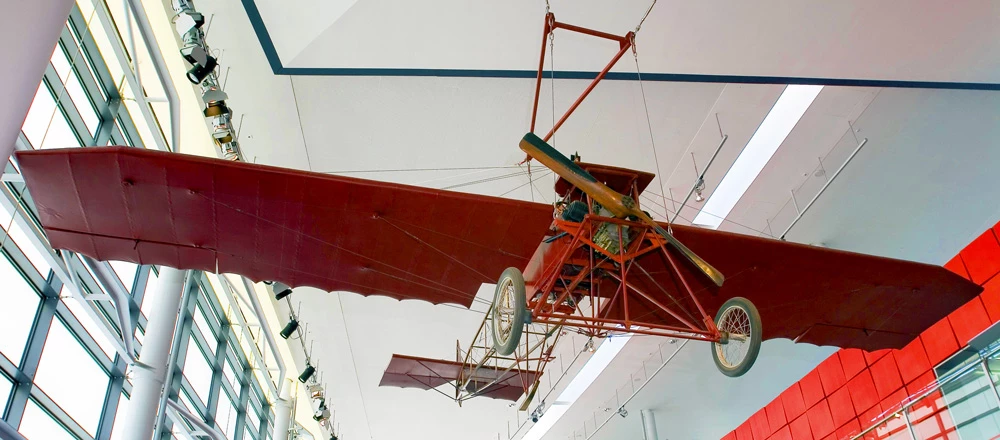
Made from a dining room chair, piano wire and a 40 horsepower engine, the Robin Goch (Red Robin) was built in 1909 - and also features a fuel gauge made from an egg timer.


photograph of a small, early twentieth century airplane with red wings

The Robin Goch (Red Robin) on display at the National Waterfront Museum

Its builder, Horace Watkins, was the son of a Cardiff printer - here he is pictured with an earlier, even more rickety version of his famous monoplane.
 

Photograph from 1908 showing Horace Watkins in a very early, precarious-looking monoplane

Horace Watkins testing his monoplane in 1908

Our collections are full of stories which reflect Wales' unique character and history. The Robin Goch is one of the treasures of the collection, and is an example of Welsh ingenuity at its best.

Half a Million Searchable Items

The launch of Collections Online uncovers half a million records, which are now searchable online for the first time.

“Collections Online represents a huge milestone in our work, to bring more of our collections online and to reach the widest possible audience.

It’s also just the beginning. It’s exciting to think how people in Wales and beyond will explore these objects, form connections, build stories around them, and add to our store of knowledge." – Chris Owen, Web Manager
 

Search Collections Online

Plans for the future

Our next project will be to work through these 500,000 records, adding information and images as we go.

We'll be measuring how people use the collections, to see which objects provoke debate or are popular with our visitors. That way, we can work out what items to photograph next, or which items to consider for display in our seven national museums.

Preparing and photographing the collections can take time, as some items are very fragile and sensitive to light. If you would like to support us as we bring the nation's collections online, please donate today - every donation counts.


Donate Today


We are incredibly grateful to the People's Postcode Lottery for their support in making this collection available online.
 

The Healing Power of Dogs

Penny Hill, 5 March 2014

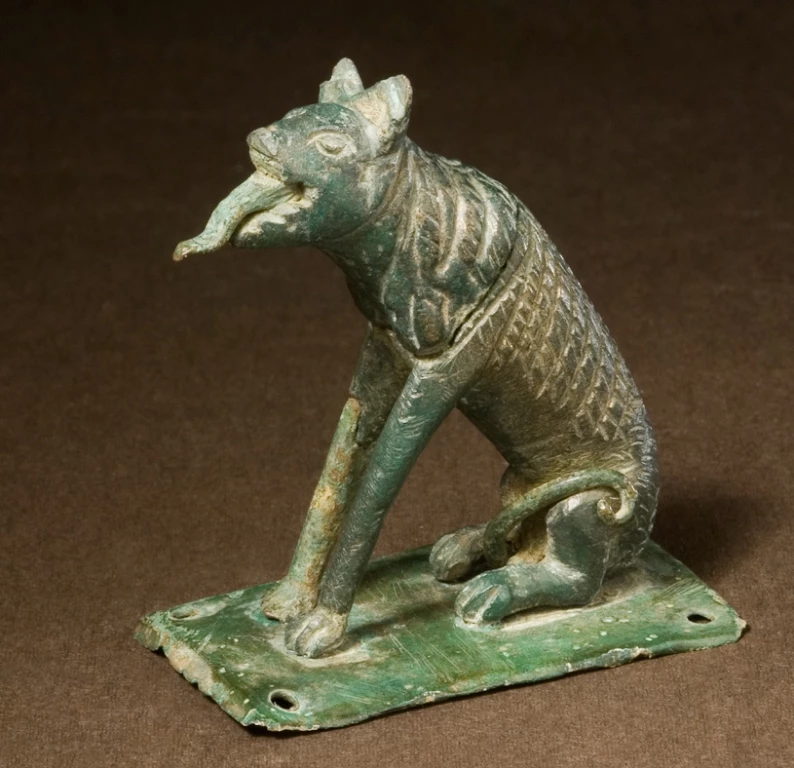
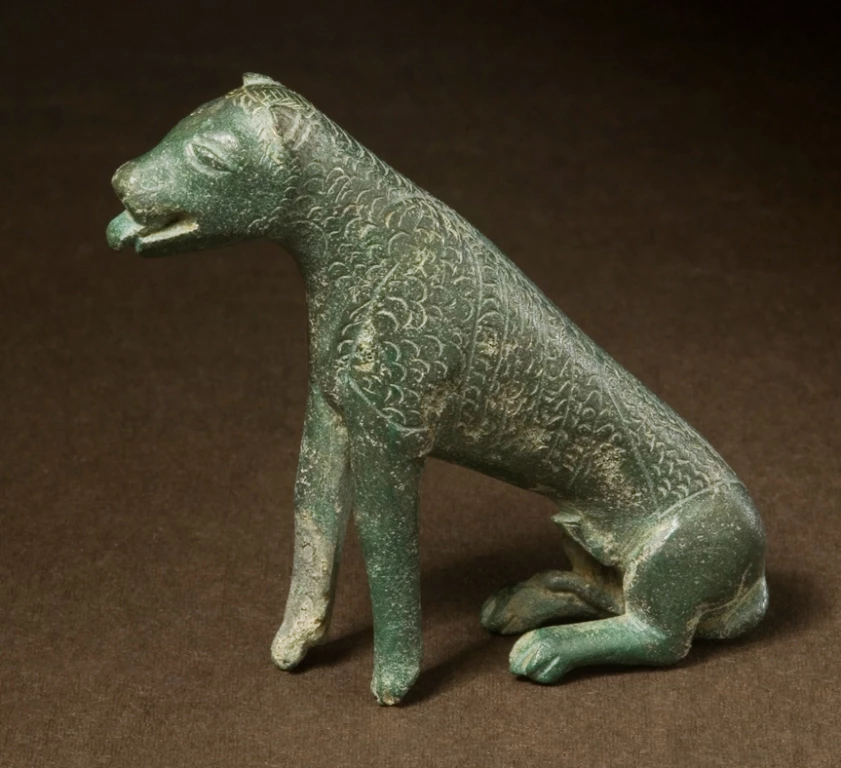
Detailed miniature statue of a dog

This detailed miniature statue of a dog is no more than 4 to 5cms in height, and was probably once coated in tin or silver. Holes in the metal base plate suggest he was attached to a small plinth.

One of two miniature statues of dogs found at Llys Awel

One of two miniature statues of dogs found at Llys Awel. His tongue is sticking out in the action of licking.

Man’s best friend, the dog has recently been making headlines again through his ability to save life by either sniffing out cancer or licking to help restore circulation to injured limbs. This association between people, dogs and good health is nothing new and was recognised back in antiquity.

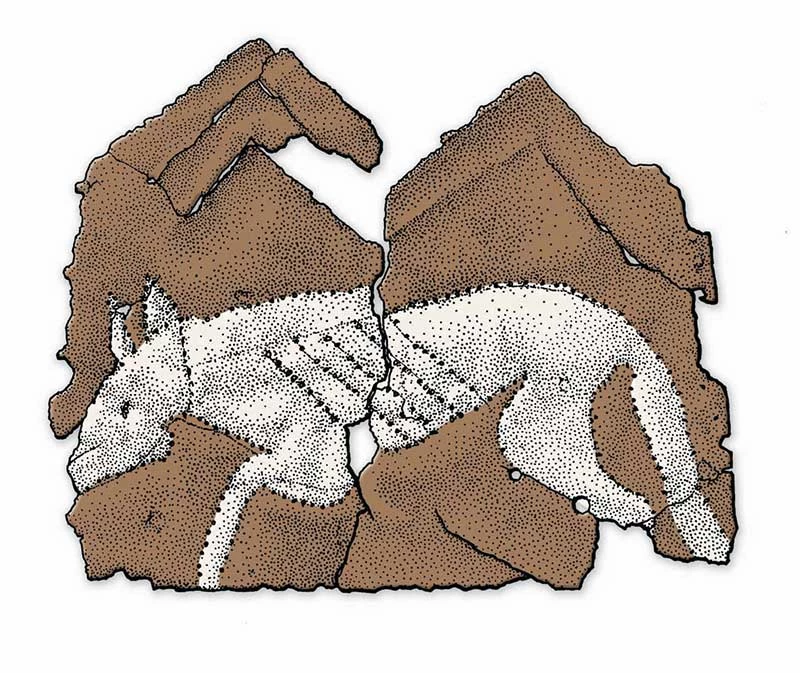
Housed in the Archaeology collections are 2 small dog figurines, part of a group of objects found at Llys Awel, Conwy. There are also two copper alloy plaques. One is decorated with a dot-punched outline of a dog; the second is not so well preserved, the dotted outline is less clear and it could either be another dog or a name, possibly of a god. The site is believed to be a shrine dedicated to a healing god and the objects themselves date to the Roman period in Britain, sometime between the late first century AD and the end of the fourth century AD. The objects were probably left by people as gifts to the god hoping they would be granted good health and help to recover from an illness.

Why dogs?

Well, the Greek god of medicine, Asklepios (adopted by the Romans who knew him as Aesculapius), was frequently depicted with a dog as his animal companion. This association probably came about after people observed dogs healing themselves by licking. A major sanctuary to his cult was built in the fourth century BC at Epidaurus, in Greece. This place became one of the major centres for healing in the ancient world. One part of the healing treatment or ritual was to receive licks from a sacred dog kept at the sanctuary. The only known British equivalent of Epidaurus is the cult centre of the Romano-British god Nodens at Lydney in Gloucestershire. Here, 9 representations of dogs were found: like the dogs at Llys Awel these were probably left by visitors seeking cures for their ailments.

The dogs are made from copper alloy and are about 5cm tall. They are seated with tails between their legs and tongues sticking out, as if in the action of licking. The figures are incredibly detailed with eyes, ears, nose, paws and fur texture well defined. They were probably made by the lost wax process, so there was only one chance to get the metal casting right. One dog was cast as a single piece, but the other revealed a slightly more complicated construction.

During conservation we can find out how the statue was made

During conservation we can find out how the statue was made. Different pieces appear to have been cast separately and soldered together.

Illustration of a votive plaque with added shading to highlight the outline of a dog.

Illustration of a votive plaque with added shading to highlight the outline of a dog.

Illustration of votive leaf plaque

Illustration of votive leaf plaque. Do the dotted lines in the lower half spell out the name of a long lost god or is it another dog?

Conservation

During conservation it became apparent the dog was cast in several sections, the head, body, tail and tongue. The individual pieces were then soldered together to create the whole figure. Grooves in the metal at the junction between the head and body support this idea and would have helped the solder grip and hold the two sections together. There is evidence to suggest the craftsman had problems casting the figure, the molten copper alloy failing to flow to all parts of the tiny mould. Repairs had to be made to the nose and the right front leg, the miscast material removed and then new sections recast and soldered in place. The replacement nose has gone, but we still have the replacement leg, which is not as well modelled as the original left leg.

The statue was probably given a coat of either tin or silver to hide the construction detail and enhance its appearance, which would have helped elevate our dog to a slightly higher pedigree. Unfortunately analysis of the surface was inconclusive; the coating, if one had existed, did not survive. Therefore we can only imagine its original appearance and wonder if the people who gave this little treasure to the god were ever granted their wish.

Witch-bottles and healing charms

16 June 2011

Bitten by a mad dog or cursed by a witch?

Ever wondered what you should do if you were bitten by a mad dog or cursed by a witch? In Wales it was a common practice, as late as the nineteenth and twentieth centuries in some parts, for people to use various kinds of charms for healing or protection against witchcraft. These could be in the form of prayer-like words, which were recited or written on a piece of paper to be safely hidden, while objects such as shoes or stones were also believed to cure illnesses and bring good luck.

Snakestones

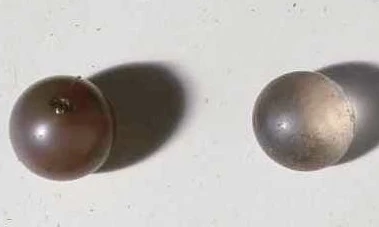
Adder stones from Pen-tyrch, Glamorgan

Adder stones from Pen-tyrch, Glamorgan

The most renowned stone charms in Wales are the Maen Magl or Glain Nadredd — snakestones. In 1695 Edward Lhuyd described these as Cerrig y Drudion — Druid stones. The belief was that they were created when snakes joined their heads together, forming a kind of bubble about the head of one snake. This 'bubble' is similar to a glass ring like the one found at Twyn-y-tila, Caerleon, and was thought to bring good luck to whoever found it. It was also believed to be a remedy for eye diseases and was often in great demand. The term Maen signifies a stone and Magl is an ancient word for an eye ailment such as a stye. The water in which the stone had been soaked could be dabbed on the affected area, but the most common form of treatment involved rolling or rubbing the stone over the eyelid. People used to use the expression 'fel y glaim', literally 'like the stone', to mean very healthy.

A cure for rabies

Hydrophobia stone from Henllan, Ceredigion

Hydrophobia stone from Henllan, Ceredigion

The Llaethfaen or hydrophobia stone, thought to cure rabies, is a variant of the Maen Magl. In his Folk-Lore of West and Mid Wales, Jonathan Ceredig Davies wrote about a llaethfaen that was 'very much in request' because it was widely believed to cure those bitten by a mad dog, a common problem in the nineteenth century. Whether it had curative or preventative powers, those who used the stone were said to be safe from hydrophobia. Iolo Morgannwg described seeing a stone like this in Pembrokeshire in 1802, when he met a man who carried one around the country. He would scrape it into a powder which could be dissolved into a drink, and sell it for five shillings an ounce as a remedy for rabies.

Witch-bottles and pots

Now a witch bottle is a totally different kind of charm. Take this eighteenth- century Buckley pot, or witch-bottle, found buried at the foot of an old yew tree at Allt-y-Rhiw farmhouse near Llansilin, Powys. What is interesting about the jug is that a quarter if it was filled with lead. This suggests that it was used as some form of protection or, indeed, as a means of sealing or capturing a troublesome spirit, similar to the concealed shoes in our collection. Often with witchcraft beliefs the act of sealing an object within a bottle or pot symbolised the entrapment of the evil spirit, and so was used as a protective charm. There are many tales of troublesome ghosts being 'put down' in this way, like the ghost of 'Lady Jeffreys' who was persuaded to enter a bottle which was corked and sealed and thrown into the pool underneath the Short Bridge in Llanidloes.

Conjurers or dynion hysbys

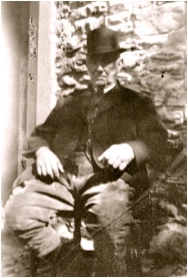
Mr Evan Griffiths, a conjurer from Llangurig, mid Wales,  1928

When any bad luck occurred a conjurer was consulted to discover who had done the "witching", one such conjurer was Evan Griffiths from Pantybenni.

People who had been bewitched could also carry out their own counter-magic rituals by placing sharp objects like thorns and pins inside a bottle, which was usually filled with the victim's urine. It was then sealed and boiled over the fire or buried under the hearthstone. This was believed to torment the witch into revealing her identity, thereby breaking the spell. The bottle symbolised the witch's bladder, and so the sharp objects were believed to cause her much pain. Alternatively, you could buy a charm from a dyn hysbys — wise man. These figures were very common in Wales at one time, and their services ranged from countering witchcraft, healing, and astrology, to fortune telling and uncovering lost property.

In the nineteenth and early twentieth centuries Llangurig was especially famous for its dynion hysbys. Charms against witchcraft were written on a piece of paper which was carefully rolled up and sealed inside a bottle. This was then placed under the hearth or hidden in one of the main beams in the house, thus ensuring protection from witchcraft and any other evildoer. Should you find one of these charms, as with the concealed garments, remember to take photographs and record the details of exactly where you found it, and contact your local museum. Whatever you do, mind, always remember to keep the bottle sealed!

Catherine of the Wheel

1 November 2007

What do a firework and a painting from a medieval church have in common?

St Catherine

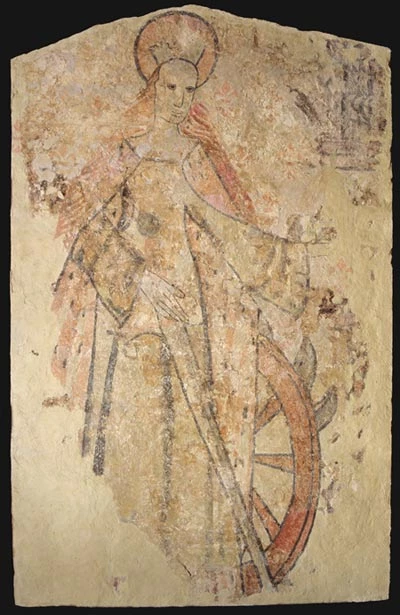
Medieval wall painting of St Catherine, from St Teilos church, dating to around 1400.

In 1998 St Fagans National History Museum began the challenging work of rebuilding and refurbishing a stone-built medieval church that had been moved from its original site in west Wales in 1984 — one of the first projects of its kind to be attempted in Europe. During the dismantling process, a number of extremely rare wall paintings were uncovered from beneath the limewashed walls.

St Catherine

One of the oldest paintings uncovered at the church dates from around 1400-1430 and represents St Catherine of Alexandria. It had remained hidden for centuries under layers of limewash, which had to be removed using doctors' scalpels.

Once the complete image had been painstakingly uncovered and the many thin layers of limewash delicately removed, St Catherine was revealed dressed in late fourteenth/early fifteenth-century costume, standing next to a spiked wheel and holding a sword.

Torture wheel and sword

St Catherine medieval wall painting

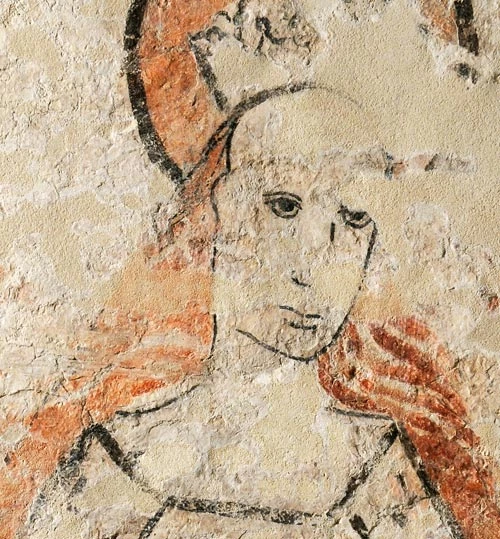
Close up showing detail of St Catherine's face after conservation and cleaning by Jane Rutherfoord & Associates Ltd of Milton Lilbourne, Wilts. The work involved removing the backing that had been applied during initial conservation work in 1986, and replacing it with a modern high-tec solution based on hexlite - a lightweight aluminium hollow board used in aircraft manufacture. The surface was then cleaned to reveal the original paintwork.

The spiked wheel she is pictured next to is the instrument of torture that Catherine was condemned to death on by the Roman Emperor Maxentius [306-312] for her strong Christian beliefs. According to legend, the wheel itself broke when she touched it, so she was beheaded with the sword she is seen holding.

The torturous wheel that St Catherine is associated with gave rise to the name 'Catherine wheel' for the popular firework.

The re-erected church can be seen at St Fagans National History Museum. The wall paintings have been faithfully and expertly reproduced to show how the church would have appeared in about 1530. The St Catherine painting is not represented in the re-erected building, as it would have been covered over by this time.

The original wall painting of St Catherine is currently stored at the museum and can be viewed upon request in advance.

Ancient druids of Wales

3 May 2007

Ancient Druid: 'An Archdruid in his Judicial Habit' from Costume of the Original Inhabitants of the British Isles (1815) by Samuel Rush Meyrick and Charles Hamilton Smith.
An Archdruid in his Judicial Habit

from Costume of the Original Inhabitants of the British Isles (1815) by Samuel Rush Meyrick and Charles Hamilton Smith.

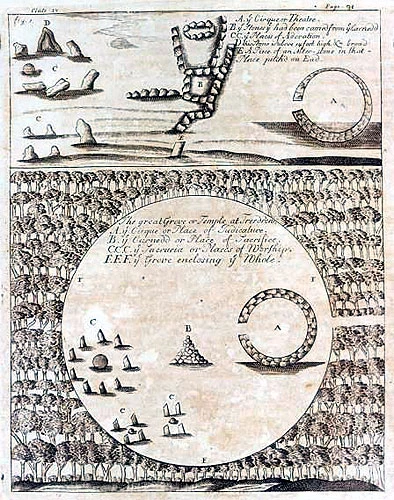
The alleged Druidical Temple of Tre'r Dryw (Anglesey) - prepared by the Revd Henry Rowlands (1723)

The alleged Druidical Temple of Tre'r Dryw (Anglesey) - prepared by the Revd Henry Rowlands (1723)

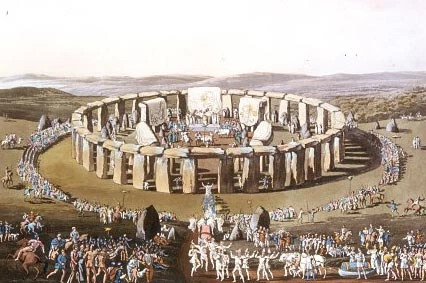
Druidic ceremony

Early 19th-century speculation on how a Druidic ceremony might have appeared at Stonehenge. We now know that Stonehenge was built some 1,500 years before the first historical reference to the Druids.

Llyn Cerrig Bach

Llyn Cerrig Bach (Anglesey). A large quantity of Iron Age metalwork was found in this lake during 1943. [Image © Philip Macdonald.]

Selection of metalwork

Selection of metalwork found in Llyn Cerrig Bach, including slave chains, bent swords, tools and chariot equipment.

Druids, the ancient priests of Britain and Ireland, have long intrigued and kindled the imagination of large popular audiences. The stereotypical image of the white robed wise man, carrying perhaps a golden sickle and mistletoe, or clasping a white staff, remains strong with us today, the outcome of many centuries of thinking and invention. Yet what evidence do we have for these powerful but elusive figures?

Earliest mention of Druids comes during the 1st century BC, referring to druidae in Gaul (France) and Britain, who were wise men, observers of natural phenomena and moral philosophers. Similar to the druids were the

bards (bardoi) - singers and poets, and diviners (vates), who interpreted sacrifices in order to foretell the future.

Druids and bards were common in medieval Welsh and Irish texts, probably giving account of much earlier oral tradition, passed on by word of mouth.

The visual appearance of druids - what they wore and what possessions they owned - is difficult to clarify. There are few illustrations or inscriptions of the time, whilst archaeology rarely provides certain answers. A druidic ceremony described by Pliny, in his Natural History, describes, a white robed druid climbing an oak tree to cut down mistletoe with a golden sickle.

Hywel Dda

In Wales, the roles and privileges of bards related to laws set down by Hywel Dda in the 10th century AD. During the 18th century, druids came to be seen as the ancestors of the bards, the praise poets, musicians and genealogists, who flourished in Welsh medieval society.

Human Sacrifice

A revival of interest in druids began during the Renaissance (14th to 16th-centuries), when translations of Classical Greek and Roman texts became widely available. A number of sources describe the druids as performing human sacrifice. Places of worship were described as isolated wooded groves and near sacred pools and lakes. According to one source, the druidic groves on Mona (Anglesey) had the blood of prisoners drenched upon their altars.

Stonehenge

Some accounts suggested that the stone circles at Avebury and Stonehenge had been druidic temples. Similarly, a number of megalithic monuments on Anglesey were thought as the temples and sacrificial altars of druids. However, with advances in archaeological understanding during the 19th century, it became clear that these monuments were built over 4,000 years ago, long before the appearance of druids. Nevertheless, modern druids and bards continue to meet within stone circles today.

Celtic rituals of the Iron Age

Archaeology does however provide evidence for the religious expression of Celtic Iron Age people. The tradition of offering gifts to the gods is well illustrated at the site of

Llyn Cerrig Bach on Anglesey. Here, between 300BC and AD100, chariots, weapons, tools and decorated metalwork items were cast from a causeway or island into a small lake. Coincidentally, an account by the Roman author Tacitus vividly recounts the crushing of a druidic stronghold on Anglesey by the Roman army, leading some to infer that Llyn Cerrig Bach was a druidic site.

Other instances of Celtic Iron Age ritual have also been identified. For example, a probable sacrificial victim preserved in peat has been found at Lindow Moss in Cheshire (England). Recently, the famous

Cerrig-y-Drudion bowl , elaborately decorated in the Celtic or La Tène art style, has also been convincingly interpreted as a ceremonial crown. This and a number of other crowns and regalia, found with burials or in temples in Britain, may have denoted priestly office.

In this prehistoric world, the power of the pagan Celtic gods was keenly felt, ever present and intermingled within everyday life.

Anglesey

The druids have long been associated with Anglesey in popular imagination. The historical evidence upon which this association is based is an account by the Roman author Tacitus, who wrote of the Roman conquest of Anglesey:

"On the beach stood the adverse array [of Britons], a serried mass of arms and men, with women flitting between the ranks. In the style of Furies, in robes of deathly black and with disheveled hair, they brandished their torches; while a circle of Druids, lifting their hands to heaven and showering imprecations, struck the troops with such an awe at the extraordinary spectacle that, as though their limbs were paralysed, they exposed their bodies to wounds without an attempt at movement. Then, reassured by their general, and inciting each other never to flinch before a band of females and fanatics, they charged behind the standards, cut down all who met them, and enveloped the enemy in his own flames. The next step was to install a garrison among the conquered population, and to demolish the groves consecrated to their savage cults; for they considered it a pious duty to slake the altars with captive blood and to consult their deities by means of human entrails." (Translated by John Jackson, published by William Heinemann, 1951).

Background Reading

Druids by A. Ross. Tempus Publishing (1999).

Exploring the World of the Druids by M. J. Green. Published by Thames & Hudson (1997).

Shrines & Sacrifice by A. Woodward. Published by Batsford (1992).

Tacitus: the annals By J. Jackson. Published by William Heinemann (1951).

The Bog Man and the Archaeology of People by D. Brothwell. British Museum Publications (1986).

The Druids by S. Piggott. Published by Thames & Hudson (1968).