The Red Dragon is the heraldic symbol of Wales, and is incorporated into the Welsh national flag.
According to tradition, the red dragon appeared on a crest born by
Arthur
, whose father, Uthr Bendragon, had seen a dragon in the sky predicting that he would be king.
Where did the dragon symbol originate?
The dragon as a symbol was probably introduced into Britain by the Roman legions. Medieval Welsh poets often compared their leaders to dragons in poems praising their bravery, for example, Gruffydd ab yr Ynad Coch said of
Between 1485 and 1603, the dragon formed part of the arms of the Tudor dynasty, but it was replaced on the royal coat of arms with a unicorn by order of James I.
How did the Welsh dragon end up on the national flag of Wales?
The Red Dragon reappeared as the royal badge for Wales in 1807, and from then on it was often seen in the regalia of Welsh patriotic societies. At the suggestion of the Gorsedd of the Bards, it was officially recognised by the Queen in 1959, and is now widely used as the national flag.
The Leek and the Daffodil
Why is the leek a Welsh symbol?
Legend has it that St David ordered his soldiers to wear leeks on their helmets during a battle against the Saxons during the sixth century, while the Battle of Crecy, in 1346, featured loyal and brave Welsh archers who fought in a field of leeks. By 1536, when Henry VIII gave a leek to his daughter on 1 March, was already associated with St David's Day. It is possible that the green and white family colours adopted by the Tudors were taken from their liking for the leek.
When did people start wearing a daffodil on St David's day?
In comparison with the ancient Welsh associations of the leek, the daffodil has only recently assumed a position of national importance. An increasingly popular flower during the 19th century, especially among women, its status was elevated by the Welsh-born prime minister David Lloyd George, who wore it on St David's Day and used it in ceremonies in 1911 to mark the investiture of the Prince of Wales at Caernarfon.
In many parts of Wales, Christmas meant rising early (or staying up overnight) to attend the plygain service at the parish church. The hour for the plygain appears to have varied between 3 a.m. and 6 a.m., the latter becoming more common as time went on. To await the service, young people, in particular, would pass away the time in one way or another.
In some country districts they would gather at certain farmhouses to make cyflaith (treacle toffee) and spend the night merrily, decorating the houses with holly and mistletoe, as at Marford, Flintshire, in the 1830's. According to Mrs. Thrale's journal of a tour in 1774 the inhabitants of Dyffryn Clwyd kindled their lights at two in the morning and sang and danced to the harp until the plygain.
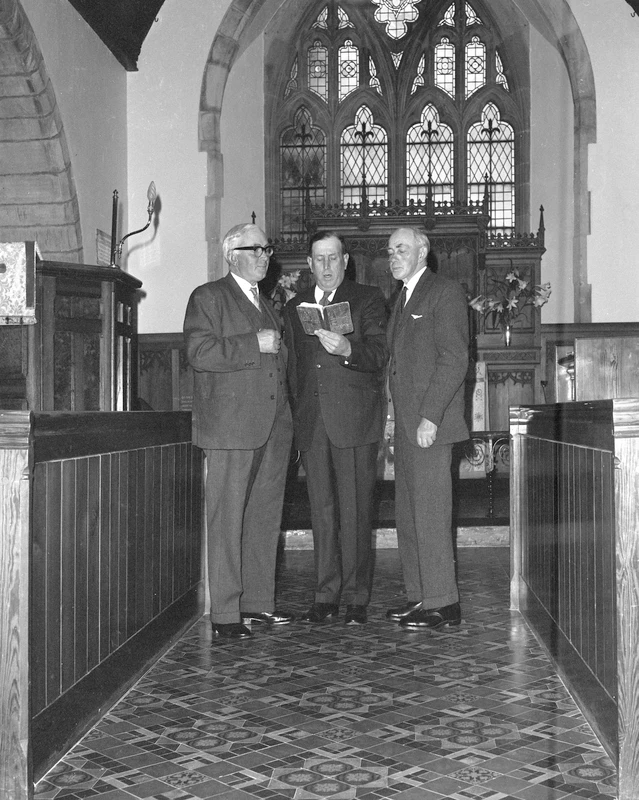
Llanrhaeadr Party singing Plygain carols
In other districts, especially country towns, the time was spent playing in the streets. In Tenby, Pembrokeshire, for example, crowds carried torches, shouted verses and blew cow-horns, before finally forming a torch procession in which the young men of the town escorted the rector from his house to the church. A similar procession is recorded in Laugharne, Carmarthenshire, and also in Llanfyllin, Montgomeryshire, where candles were used instead of torches.
Plygain candles
In the countryside the plygain at the parish church was attended by people from even the remotest farmsteads. Often each person brought his or her candle to help to light the church since, until the nineteenth century, regular services were rarely held at night-time and no provision for lighting was usually made. The brilliant illumination from the candles of the attenders was an important feature of the festival. In Llanfyllin, special candles known as canhwyllau plygain were made by local chandlers in the middle of the 19th century.
During the service the church was decorated inside with chandeliers holding coloured candles and, in Dolgellau, for example, decked with holly. In Maentwrog, Merioneth, candles were also fixed in sockets on the tops of standards or posts fastened to pews here and there in the building. In Lanfyllin the edifice was lighted with some hundreds of candles, placed a few inches; apart from each other, around the walls inside which made the building look very brilliant. In Maentwrog it was the carollers singing in the little gallery at the bell tower end of the church who brought their own candles for it was too dark in that part of the building to follow the service in the Common Prayer Book.
While no doubt the custom varied in detail from parish to parish, the brilliant illumination of the church appears to have made a lasting impression on the memories of those who have left us descriptions, and to have been a striking characteristic of the traditional plygain. As Gwynfryn Richards has suggested, the spiritual significance of candle-lighting at Christmas as a symbol of the coming of the Light of the World, may be discerned in these practices.
The Plygain Service
The plygain itself was an abbreviated form of morning service interspersed with and followed by carols sung by soloists and parties. William Payne described the plygain in Dolgellau as he knew it in the middle of the last century in the following words:
'Now the church is in a blaze, now crammed, body, aisles, gallery, now Shon Robert, the club-footed shoemaker, and his wife, descending from the singing seat to the lower and front part of the gallery, strike up alternately, and without artificial aid of pitch pipe, the long, long carol and old favourite describing the Worship of Kings and of the Wise Men, and the Flight into Egypt, and the terrible wickedness of Herod. The crowds are wholly silent and rapt in admiration. Then the good Rector, and his curate, David Pugh, stand up, and read the Morning Service abbreviated, finishing with the prayer for All Conditions of Men, and the benediction restless and somewhat surging is the congregation during prayers the Rector obliged sometimes to stop short in his office and look direct at some part or persons, but no verbal admonishment. Prayers over, the singers begin again more carols, new singers, old carols in solos, duets, trios, choruses, then silence in the audience, broken at appropriate pauses by the suppressed hum, of delight and approval, till between eight and nine, hunger telling on the singers, the Plygain is over and the Bells strike out a round peal.'
In Maentwrog a sermon was included in the plygain service, but the rector was careful to keep both sermon and service short, as he evidently felt that the chief attraction was not the service but the carolling that followed it. In other places, such as Llanfair Dyffryn Clwyd, holy communion was administered during the plygain.
A Pre-Reformation Survival
Seen against its historical background the plygain is a survival of a pre-Reformation Christmas service modified to suit the new Protestant conditions. Richards points out that plygain in the sixteenth century denoted an ordinary morning service and only at a later date came to be restricted to the service held on Christmas morning. The plygain, he suggests, took the place of the midnight Christmas mass of the Catholic period and was originally associated with a communion service held later on Christmas morning.
The practice of holding the communion service at eight o'clock ended the earlier association between the plygain (morning service) at six, seven or eight o'clock, and the High Mass at nine or ten o'clock. After the Reformation, carol-singing in the vernacular, which had hitherto been excluded from the Latin service of the church at Christmas, was incorporated in the early morning Christmas service, and, as nineteenth-century descriptions plainly show, had become the main attraction of the plygain. John Fisher has drawn attention to the similarity between the Manx festival of Oiel Verrey, held at midnight on Christmas Eve, and the Welsh plygain. He points out that both became popular carol-singing festivals soon after the translation of the Bible into the respective vernacular tongues.
Far from disappearing under the impact of Nonconformity in the nineteenth century, the plygain was one of the few traditional church festivals not discarded by Welsh Nonconformist chapels, although the character of the service was sometimes changed by making it a variation of the ordinary week-night prayer-meeting. As a general custom, the early-morning Christmas plygain ceased towards the end of the last century, although in some cases it survived to a later date.
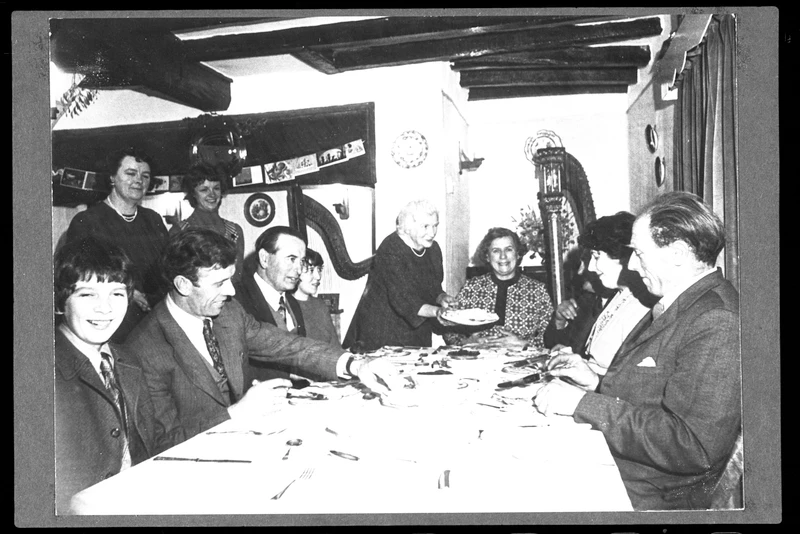
Plygain Supper at Cefn Llwyn Farmhouse, Llangynyw
The Carol-Singing Tradition in North Wales
In the past, all parts of North Wales shared a strong carol-singing tradition. Nowadays, however, this tradition survives at its most intense in the east midlands, in the predominantly Welsh-speaking areas bounded by Mallwyd, Llanerfyl, Cefnyblodwel (within England) and Llangynog.
For the stranger, attending a plygain service is an unusual experience. For almost two hours, the service is completely in the hands of the carol singers. No programme has been prepared beforehand and no-one acts as announcer, but, each in turn, the carol parties walk forward quietly and leisurely forward to sing. On average there will be eight to fourteen parties present and one is likely to hear between twenty and thirty Christmas carols during the service - all in Welsh and all different, since it is a point of honour not to offer a carol already heard that evening
Adapted from Trefor M. Owen, Welsh Folk Customs (Cardiff, 1959), pp. 28-33
One of the most well-known Welsh customs is the Mari Lwyd, meaning 'Grey Mare', a horse-figure carried from door to door by wassail-singing groups during the Christmas season.
Popular in South Wales during the 19th century, the tradition features a real horse's skull, usually decorated with coloured ribbons and rosettes and with glass bottle eyes. The lower jaw is fixed on a spring which shuts the mouth with a loud snap and brings the creation to life. A long white cloth is draped down the carrier which hides him from view.
Occasionally the head was of wood, one account says paper, and in around 1935 a group of boys in Swansea used a pillow, but a horse's head was characteristic. The same horse's head tended to be used annually, for it was buried in lime to preserve it for most the year, and dug up each December.
How is Mari Lwyd celebrated?
In terms of the celebration itself, the custom used to begin at dusk and often lasted late into the night. During the ceremony, a party of usually all men, would carry the Mari through the streets of the village singing and dancing. The Mari does not hunt alone, for depending on the area and the amount of people in the wassailing party, she can be joined by an array of other characters named Punch and Judy, the Sergeant and the Merryman.
Even very small groups usually have a leader, who holds the reigns to control the horse and take charge of the singing.
They would visit every house or pub in the village and stand in front of the door to sing traditional songs.
Next followed the pwnco, an improvised rhyme and verse contest between the Mari party and the inhabitants of the house.
There was a lot of leg pulling, and the verses were usually quite mischievous.
Traditionally these exchanges would be done with the door closed, and the contest could last for some time, sometimes even an hour or so, until one side gave up.
If the Mari side lost the contest, they would have to leave without being admitted to the house. However this would have been quite a rare occurrence, as the Mari entering the building was thought to bring good luck, so they would usually win (or be allowed to win).
Alternatively, the Mari party might sing one last verse begging for entrance.
Once inside, the entertainment continued with the Mari running around neighing and snapping its jaws, creating havoc, and frightening the children, while the Leader pretended to try to restrain it.
The Merryman played music and entertained the householders. Punch and Judy would also be part of the festivities. The participants would be rewarded with food and drink, and sometimes received a gift of money as well. The visit concluded with a traditional farewell song.
Popularity of the Mari Lwyd
With the earliest account of the Mari dating from 1798, the boom years, as regards to the amount of horse's heads in existence, were between 1850 and 1920.
Apart from one or two sightings in the north, the ritual remained exclusive to south Wales, being especially popular in Glamorgan, Monmouthshire and Carmarthenshire.
A general decline occurred in the number of Mari Lwyd groups during the twentieth century. One of the reasons normally given for its demise is the decrease of Welsh speakers, preventing inhabitants from replying to the Mari group, as the Mari Lwyd contest was almost always sung and performed in Welsh.
Another reason for the custom's decline was the increasing rowdiness and drunkenness which became associated with it. This was seen as unacceptable behavior especially with the rise of the Chapel and Methodism in Wales.
However there has been a growing interest in the Mari Lwyd in recent years, and this has resulted in a resurgence in groups performing this tradition across all of Wales.
Join us at St Fagans this Christmas to witness the Mari Lwyd tradition brought to life, explore our full Christmas programme here
At one time in Wales – New Year’s festivities were even more important than Christmas. In fact, one resident of Cynwyl Elfed, Carmarthenshire, in the 1860s, said that the chief importance of Christmas was , ‘that it was within a week of New Year’s Day, the biggest day of the year’.
New Year has always been important in that it symbolized hope and starting afresh, every January 1st we make resolutions and try to turn over a new leaf. It’s not surprising therefore, that this period was associated with future fortunes.
It was said that one’s behavior at the beginning of the year was held to influence his fate for the proceeding twelve months. The custom of ‘letting in’ in the New Year is familiar throughout most of Britain and in Wales, the first visitor to enter somebody’s house was of great significance, depending on their sex and personal characteristics.
For instance, on New Year’s Day in Carmarthenshire and Pembrokeshire it was unlucky for a woman to see a woman first, and for a man to see a man first. People from Pencoed, near Bridgend, believed it bad luck to see a red-haired man first; in Pembrokeshire it was lucky to bring a fresh loaf into the house on January the first.
What is calennig?
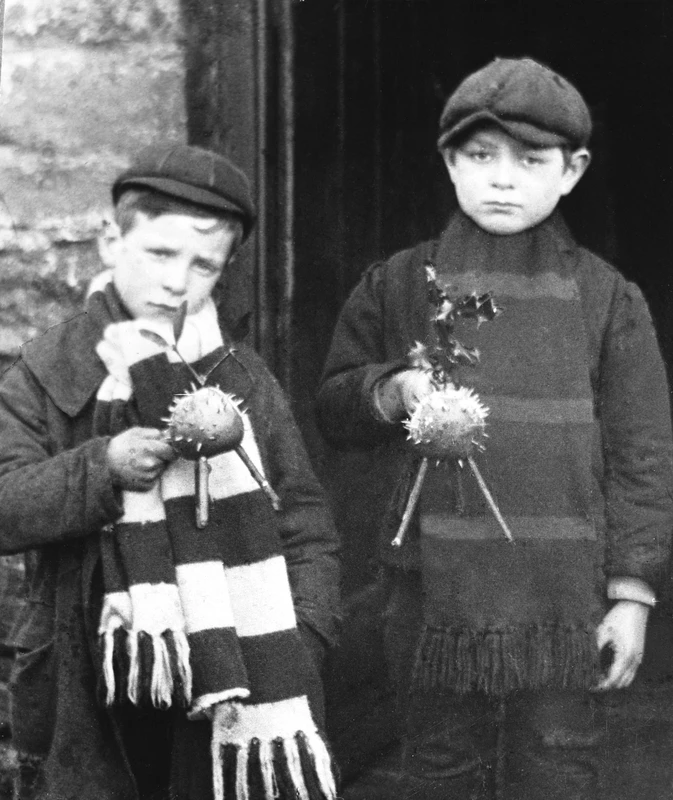
A well-known Welsh tradition, still seen in some areas, is the collection of calennig (New Year’s gift) where children rise early and carry from door to door, as bearers of good luck, a decorated apple, pierced with three sticks and adorned with a sprig of box and hazelnuts.
The children usually sing a simple verse and in return usually received a gift or food or money for their troubles. Rhymes and songs were concisely worded and their message was to announce the New Year's arrival, to wish the family a prosperous twelvemonth, and to ask from it ‘calennig’ or (New Year's Gift).
Two boys collecting Calennig in Llangynwyd c. 1904-1910
Here is a verse sung in Cardiganshire and Pembrokeshire:
(I left my house today
With my bag and my stick,
And here is my message to you,
Fill my bag with bread and cheese.)
What is the New Year’s water ritual?
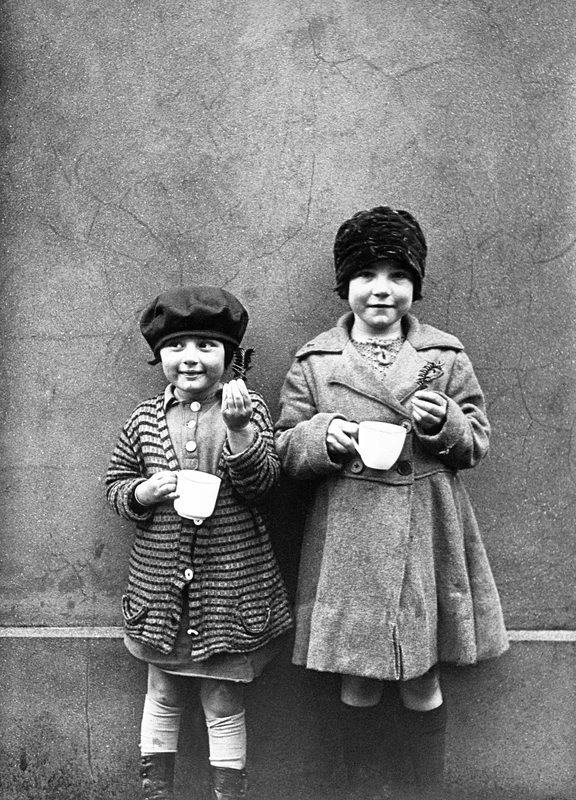
The New Year’s water ritual also took place in some parts of Wales, where children, after filling cups or small bowls with spring water, which they’d drawn from the well that morning, dipped into it a sprig of box, myrtle or mistletoe. This was then sprinkled either on grown ups hands and faces or around the house, in order to do away with the old year and usher in the new. The adults gave them a small gift in return of the sprinkling, which was commonly regarded as a sign of cleansing or or purifying.
Two girls at Tenby partaking in New Year's water ritual, 1928.
Amgueddfa Cymru houses a fine collection of dolls dating from around 1800 to 2000. Made from a range of different materials, they all possess some link to Wales. From early wooden examples to contemporary plastic figures, the development of doll-making can be traced from simple, home-made items to mass-produced factory goods.
Playtime in the Ancient World
Past and present, children have always played - escaping to their own imaginary world is an integral part of a healthy and stimulating childhood.
Primitive dolls from materials such as wood and clay have been found in Egyptian tombs dating from 1600 BC, and such figures were enjoyed as playthings in ancient Greece and Rome. The Middle Ages saw dolls being produced in Europe, and as the centuries progressed, so did the variety of materials employed to create dolls and toys in general.
Doll classification
Dolls are classified according to their head type. Most early dolls in the woodcarving areas of Germany and Austria were, unsurprisingly, made from wood. Wax dolls appeared during the 17th century, and by around 1800 composition dolls, namely mixtures of pulped wood or paper, were introduced in Germany.
Papier-mâché, a type of composition and a cheaper alternative to wood, was a popular mix and its mass-production during the early-nineteenth century marked the beginnings of the German doll-making industry. The production of glazed porcelain, or china dolls during the mid-19th century meant that wax doll-making had halted by around 1890. Porcelain dolls boasted a shiny appearance, creating a very pleasing finish. Most were produced in Germany and France.
Also common in both countries from around the 1860s were dolls of bisque (unglazed porcelain), which featured delicately painted faces and a most attractive skin colour. While the heads were of china, the dolls' bodies tended to be of leather or wood. Historically most dolls were representations of adult women, the French 'bebe', popular in the 1880s, depicted a younger girl for the first time. The 19th century was truly a golden era for the production of dolls, whether in wood, wax, or china, when most were made in Germany, France, England (and later in the United States).
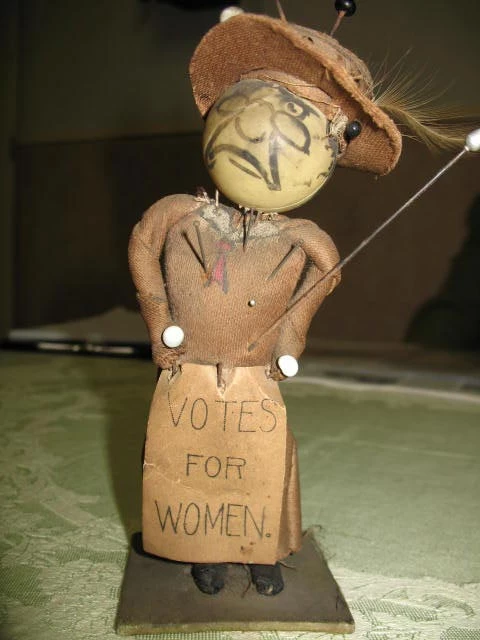
This anti-suffragette 'voodoo' doll is an unflattering and grotesque caricature of a suffrage campaigner. The anti-suffrage movement used images such as this in cartoons and posters to ridicule and insult women who wanted the right to vote.
An Edwardian suffragette rag doll, c.1890-1900
Set of three miniature bisque dolls, c.1920-25
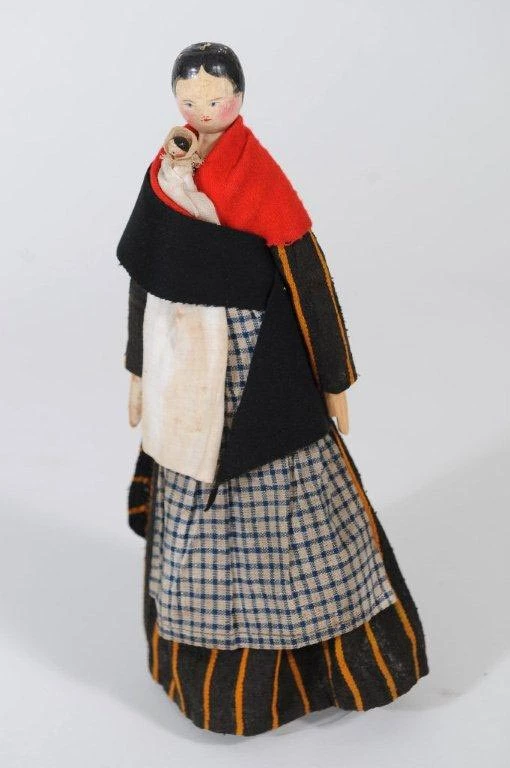
Whereas travelling fairs and markets commonly sold toys and dolls during the pre-industrial era, by the 19th century more permanent toyshops had been opened to sell goods on a regular basis. Undressed dolls were often purchased, after which mothers or their daughters sewed their own outfits, either following their own designs or shop-bought patterns. The sewing of the body is a good indication of a doll's date, for sewing machines were not generally used until about 1870. By this time, dolls were generally becoming less of a luxury item and more affordable for a larger audience. In Wales, however, until the mid-20th century few Welsh families had money to spend on anything save life's essentials, which usually meant creating one's own forms of entertainment and amusement. Dolls were made by local craftsmen or a child's parents from wood or cloth, thus being rather unsophisticated, yet, at the same time, often charming and full of character.
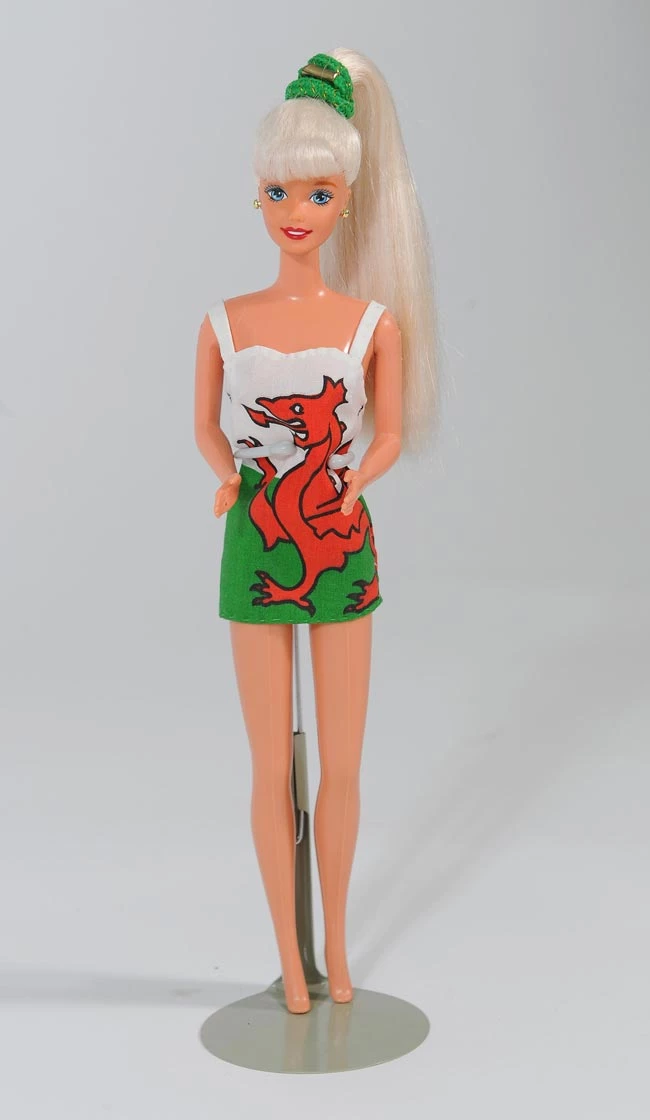
Owing to new production methods, the toy industry in Britain was transformed following the Second World War by the emergence of new, cheaper materials, such as plastic. Prices dropped as toys and dolls became available for all children. Hard plastic dolls were first manufactured in the 1940s, and from then on, such brightly coloured and fashionable new creations led to the demise of home-made items, which appeared rather dowdy in comparison. The internationally successful Barbie doll first hit the shelves from America in 1959 and nowadays, large toy shops stock a staggeringly large array of dolls, many of which are based on female characters from popular films and television programmes.
The Museum's doll collection continues to grow and it is important that contemporary examples are collected to reflect the changing nature of doll-making as new materials and techniques are introduced into the market. Welsh connections remain essential, with the doll needing either to have been made or played with in Wales before it can be accessioned. The Museum is particularly proud of its Welsh costume dolls, ranging from rare mid-19th century pieces to a 1999 'Cool Cymru' Barbie smartly donned in Welsh dragon dress.
Two boys collecting Calennig in Llangynwyd c. 1904-1910
Two girls at Tenby partaking in New Year's water ritual, 1928.
A male doll from the late 19th century
Wooden doll with baby carried 'Welsh fashion', c.1850
This anti-suffragette 'voodoo' doll is an unflattering and grotesque caricature of a suffrage campaigner. The anti-suffrage movement used images such as this in cartoons and posters to ridicule and insult women who wanted the right to vote.